Disclosure: Some links in this post are affiliate links. As an Amazon Associate I earn from qualifying purchases, at no extra cost to you. Learn more
Specs are compiled from manufacturer listings and verified buyer reviews and can change over time — please confirm the key details on the product page before buying.
Wisteria does not die because you cut it. It dies because something reaches the root crown under the soil and keeps working after the leaves are gone. That is the whole game. Most people hack the vine back, see green shoots in three weeks, and assume the plant is unkillable. It is not. You need a concentrated brush herbicide you mix yourself, applied at the right time, aimed at the right place — and that is what this shortlist covers.
This guide is built by comparing the manufacturers’ published specifications and the patterns across verified customer reviews, so you get each pick’s real strengths and trade-offs instead of marketing spin.
Below you’ll find seven concentrates and ready-to-use killers, sorted by how they actually get used: gallons for fence rows and big property jobs, quarts for stump treating, and ready-to-use bottles for spots that don’t justify mixing a tank. The one that fits your wisteria is the one whose label matches your situation — so read the containment notes as closely as the kill claims when you’re shopping for an herbicide to kill wisteria.
Top Picks

How To Choose The Best Herbicide to Kill Wisteria
Wisteria is a woody vine, not a broadleaf weed, and that single fact eliminates half the bottles on the shelf. A product built for dandelions and crabgrass will scorch the top growth and leave the root crown completely unharmed. What you want is something labeled for vines, brush, and stump sprouts — ideally a triclopyr or imazapyr concentrate you dilute yourself.
Concentrate Or Ready-To-Use
A concentrate means you buy the active ingredient and mix it with water in a tank or hose-end sprayer. You get far more treated area for what you spend, and you can dial the strength up for wisteria specifically — most wisteria jobs want a stronger mix than a general weed pass. A ready-to-use bottle skips the mixing and the measuring, which is genuinely useful for a few cut stumps or a single fence-post vine. The trade-off is strength per dollar and the fact that you cannot adjust the ratio.
Read The Selectivity Label First
Some of these products are selective — they target broadleaf plants and brush while leaving grass alone. Others are non-selective and kill anything green they touch, including your lawn. Wisteria usually grows where you also have grass, so the selective-versus-non-selective line is the single most important decision on this page. If you plan to spray a fence row and want the grass to survive, buy selective. If you are clearing bare ground and want nothing to come back, the non-selective options with extended residual control are the ones built for that job.
Cut-Stump Beats Foliar Spray On Thick Trunks
On an established wisteria with a trunk thicker than your wrist, spraying leaves is slow and often incomplete. The stronger play is to cut the vine and apply concentrate directly to the freshly cut stump, within minutes if you can. The plant is still pulling sap down at that moment, and it carries the chemical into the root system with it. Foliar spraying still works on smaller runners and regrowth — most people end up doing both.
Side-by-Side Comparison
| Model | Best For | Form | Volume | Coverage | Amazon |
|---|---|---|---|---|---|
| Remedy Specialty Herbicide Weed Killer & Brush Control★ Best Overall | Pasture and fence-line wisteria | Liquid concentrate | 128 fl. oz. | Selective brush and mid-size trees | Amazon |
| Roundup Poison Ivy Plus Tough Brush Killer₂ ConcentrateHardest-Working Formula | Vines climbing poles and mature trees | Liquid concentrate | 32 fl. oz. | 1,500 square feet | Amazon |
| Brush Killer, Ready to Use | Spot-treating cut stumps | Ready to use | 32 fl. oz. | Non-selective broad spectrum | Amazon |
| Hi-Yield (32170) Killzall 365 | Bare-ground and driveway edges | Liquid concentrate | 32 fl. oz. | Up to 4,300 square feet | Amazon |
| Alligare Imazapyr Herbicide 4 SL | Rangeland and pond edges | Liquid concentrate | 32 fl. oz. | 1 acre | Amazon |
| Southern Ag Brush Killer 8.8% Triclopyr | Large overgrown bushes and vines | Liquid spray | 128 fl. oz. | 4,096 square feet | Amazon |
| Crossbow Herbicide Brush Killer | Broadleaf brush on driveways | Liquid concentrate | 128 fl. oz. | Approximately 1 acre or less | Amazon |
Detailed Reviews
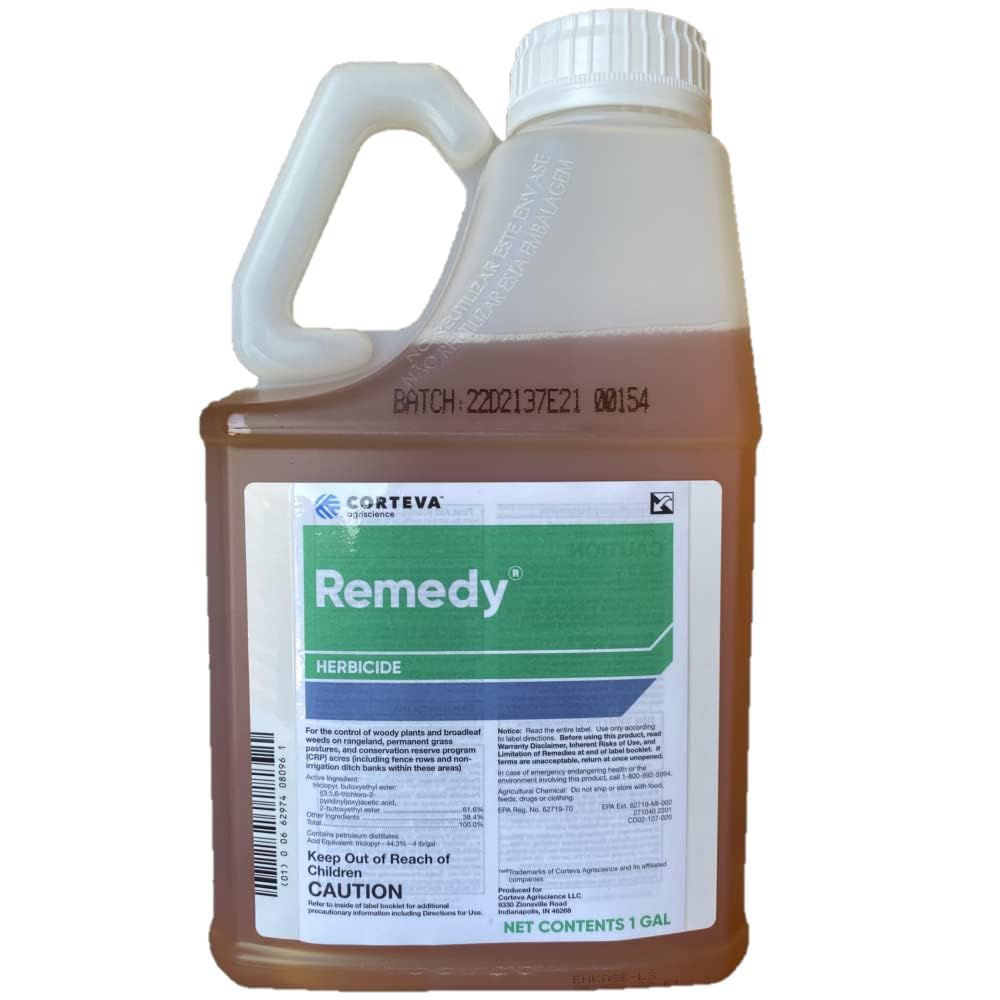
1. Remedy Specialty Herbicide 1 Gallon
Our pick — 4.5+★ from 850+ verified ratings; the strongest balance of quality and price.
A full gallon of triclopyr that owners run along fence rows year after year.
If your wisteria is swallowing a fence line and you want the grass underneath to survive, start here. This is a triclopyr concentrate — that’s the active class specifically labeled for woody brush and vines rather than broadleaf lawn weeds — and it comes in the biggest container on this list at 128 fluid ounces. That is four times the volume of the Roundup concentrate, which sits at 32 fluid ounces. One gallon at a dilution mixed to the label goes a long way on a fence row.
What wins people over is straightforward: it works on the whole plant, top growth and root system together, not just the leaves you can see. Buyers report mixing 4.5 cups per 26 gallons of water and taking down pasture trees and brush up to 5 feet tall and 2 inches in diameter, with wilting starting around a week out. The low-odor formulation matters for anyone spraying near a house or livestock, and the label covers application around children and pets when you follow the directions and let it dry.
The catch is cost concentration. A gallon of concentrate is a real outlay up front, and the value question splits opinion — some buyers call it worth every application, others find it pricey. If you have one wisteria on a trellis, an entry-tier quart makes more sense. This is the pick for someone with a fence row, a pasture edge, or several vines across a property.
What carries the weight
- Kills top growth and the root system together, so regrowth is far less likely than with a leaf-only spray
- 128 fluid ounces — four times the volume of the 32-ounce Roundup concentrate, so fewer repeat purchases
- Low-odor and labeled for use around children and pets once applied per the label
- Selective enough for brush and mid-size trees, which is exactly the wisteria profile
Where it asks more of you
- You mix it yourself, so a sprayer and careful measuring are part of the job
- The highest single outlay of the concentrates here — value is a genuine split in the reviews
- Foliar results are not instant; expect roughly a week to see the wilt set in
Settle on this one if: you’re treating a fence row, pasture edge, or several vines and you want a selective triclopyr that spares the grass.
Move past it if: you have a single wisteria on a trellis and don’t want to commit to a full gallon and a mixing routine.
2. Roundup Poison Ivy Plus Tough Brush Killer₂ 32 fl. oz.
The named-vine specialist that also lists kudzu on the label.
Wisteria and kudzu cause the same problem — a fast-growing woody vine that climbs any pole or trunk it can reach. So a formula explicitly labeled for kudzu, wild blackberry, poison ivy, poison oak, and poison sumac is aimed right at the job. That label coverage is the reason people reach for this one on vines wrapping a mature tree or a utility pole, where you need something that goes after the climbing part, not just ground-level brush.
The practical edge is speed on both ends. It’s rainproof in as fast as 30 minutes, which matters on a job you’re squeezing between weather, and it shows visible results in hours rather than the week a triclopyr alone typically takes. One label dilution sprays evenly across 300 square feet per gallon of solution, with a stated coverage of 1,500 square feet. You can also plant in the treated area 1 to 30 days afterward, which is a real difference if you plan to reseed or restore that patch.
Where this pick asks for patience is in expectation-setting. Owner feedback on effectiveness is genuinely split — some report most plants dying on a single application, others call it a waste of money. That is not the pattern you want for a stubborn trunk, but it is often a dose and timing story rather than a formula failure. At 32 fluid ounces, it is also a quarter the volume of the Remedy gallon, so heavier users will restock sooner. The easy-application consensus, though, is unanimous — this is the simplest bottle on the list to mix and use.
Speed on the label: rainproof in as fast as 30 minutes and visible results in hours makes this the fastest responder here — genuinely useful when you’re working around rain and want to see that the spray took.
The honest caveat: effectiveness feedback is split, and the 32-ounce bottle equals a quarter of the Remedy gallon’s volume — so use it for targeted climbing vines, not whole-property clearing.
Reach for it when: wisteria is climbing a pole or tree and you want a formula that names kudzu, poison ivy, and brush on the label, with rainproofing measured in minutes.
Look elsewhere when: you’re clearing acreage — the volume per bottle won’t stretch that far.
3. Brush Killer, Ready to Use

Squeeze it on a fresh cut and the root system follows.
Cut-stump treatment is the technique that actually finishes off a mature wisteria, and this bottle is built for exactly that job. It is labeled for invasive species use with non-selective broad-spectrum coverage, meaning it kills whatever green tissue it contacts — so you are not spraying this one around your lawn. What you are doing is applying it directly to a cut surface and letting the plant move it down into the roots.
The owners who get results treat it as a precision tool, not a spray-and-pray bottle. Their advice holds up: for stems around an inch thick, drip 2 drops on the freshly cut surface and spread it with a paper towel, keeping your focus on the bark ring where the growth layer sits. A second application 5 to 10 minutes later completes the job. Timing is the whole trick — you are working within seconds to minutes of the cut, while the plant is still pulling downward. One homeowner reports a stump that bled sap heavily for days and still died.
Two things to plan around. First, this is a 32-fluid-ounce ready-to-use bottle, so it’s a spot-treatment purchase, not a perimeter-clearing one — if you have a long fence line, the Remedy gallon is the better economic call. Second, the recurring feedback mentions cost relative to how far it goes. Keep nitrile gloves on and keep it off other vegetation; overspray on this bottle is not forgiving. If you have a couple of thick wisteria trunks to finish, though, this is the lowest-fuss way to do it.
This earns its place when: you’ve just cut a wisteria trunk and want a no-mix product you can squeeze directly onto the fresh stump surface.
Steer clear if: you’re covering a fence row — ready-to-use volume won’t stretch past a handful of stumps.
4. Hi-Yield (32170) Killzall 365, 32 oz

Kill it this season and keep it from coming back for up to a year.
Most brush killers kill what’s there. This one is built to stop the regrowth too. The label pairs glyphosate with imazapic for extended control, and the stated result is weeds killed and regrowth prevented for up to a year — a different job than the knockdown-only bottles. That makes it the pick when wisteria has taken over a driveway edge, a gravel pad, or an area you want bare.
You get a lot of killing power from a small bottle. One 32-ounce container treats up to 4,300 square feet, so a single bottle can clear a large patch of wisteria. The label gives two mix ratios: 6 ounces of concentrate per gallon of water for spot control of brush and vines, or 7.4 ounces with 1 to 10 gallons of water where you want bare ground. A homeowner who used it to clear grass from an empty lot reports the ground was still bare four months later. It does not discriminate, either — the recurring caution is distance from anything you want to keep, because it kills grass along with the target.
The extended-control claim comes with a real-world asterisk that owners have noticed. It performs best in heavier soils; in sandy ground the residual window shortens considerably, and the label itself acknowledges that. Expect two to three days before you can see it working, so don’t judge it on the first evening. If you’re spraying a fence line and want your lawn intact, this is the wrong bottle — the Remedy is the selective one. For bare-ground clearing, this is the value play.
Why it lands
- Kills vegetation and prevents regrowth for up to a year in the right soil — knockdown plus prevention in one bottle
- Up to 4,300 square feet per 32-ounce container, the widest stated coverage of the quart-size concentrates
- Two published mix ratios, so you can go light for spot work or stronger for full bare-ground treatment
What to watch
- Non-selective — it will kill your lawn and any wanted planting it reaches
- The residual window shortens in sandy soil, which the label notes and owners confirm
- Results take two to three days to become visible, so don’t expect same-day browning
The right bottle for: driveways, gravel, and bare-ground areas where you want the vegetation gone and kept gone for up to a year.
Skip it for: fence rows where the grass beside the wisteria should survive — this one is non-selective.
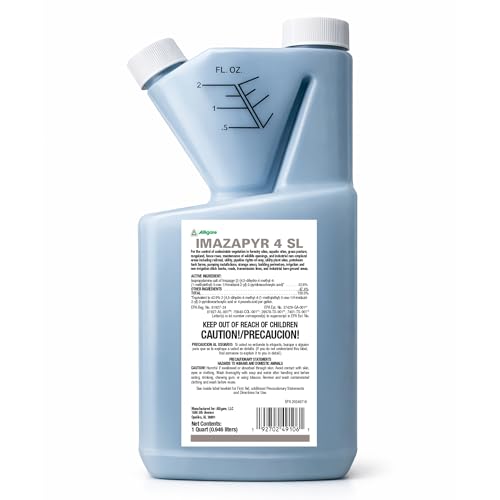
5. Alligare Imazapyr Herbicide 4 SL 1 Quart
One quart that states a full acre of coverage — and lingers in the soil.
Imazapyr is the active ingredient landowners reach for when other chemistry has already failed on a vine. This concentrate is labeled for control of 185 annual, biennial, and perennial weeds and brush, including vines and hardwood brush, with a stated coverage of 1 acre from a single 32-ounce quart. It also handles emerged and floating vegetation in ditches, ponds, and lakes, which is a use case the other concentrates here do not cover.
Owners mention it kills to the root, with results in one to two weeks that hold for months, and it’s the bottle that gets named for genuinely stubborn targets like blackberry and bamboo. Mix guidance from the field is 1 to 2 ounces per gallon with a surfactant, plus a marker dye so you can see where you’ve been. The application flexibility is real too — broadcast, targeted handgun, low volume, cut stump, or basal application, depending on whether you’re treating a whole paddock or one trunk.
Here’s the honest warning, and it’s a big one: imazapyr lingers in soil. It is non-selective, kills your grass dead, and can hold in the ground long enough to affect what you plant there next. Spray on a still day, wear goggles and gloves, and keep it well away from desirable plants and trees. The duration question is a genuine split in the feedback, so treat the longer window as soil-dependent rather than guaranteed. This is a site-preparation tool — powerful, but not the bottle for a suburban fence line beside a lawn.
What it’s built for: one quart stating 1 acre of coverage, five listed application methods, and aquatic use for ponds and ditches — it does jobs the specialty bottles can’t touch.
The trade-off you accept: soil residual. It is non-selective and lingers, so anything you want to grow nearby needs distance and a plan.
Go with this if: you’re doing rangeland, forestry site prep, or pond-edge clearing and you need root-deep control plus residual hold.
Choose another if: you’re treating wisteria in a garden bed surrounded by plants you want to keep.
6. Southern Ag Brush Killer 1 Gallon

A named-strength triclopyr gallon aimed square at vines and stump sprouts.
The label here tells you almost everything: 8.8% triclopyr, and it’s named for vines, hard-to-control plants, and stump sprouts — the exact wisteria problem profile, spelled out. You get 128 fluid ounces in the jug, the same gallon size as the Remedy, with a stated coverage of 4,096 square feet. It comes as a spray-form product you dilute to your target strength rather than a fixed ready-to-use mix, so you can push the concentration up on tough wisteria.
On the right plant, it’s decisive. Owners describe killing invasive yellow archangel a month after spraying three test areas, after horticultural vinegar, boiling water, and even goats had all failed on the same patch. Another reports taking down overgrown bushes by applying around the trunk, waiting a day or two, then cutting — with the roots killed. It gets used at 4 ounces per gallon for ivy, sumac, and sassafras, and bumped to the 8-ounce-per-gallon maximum for tougher targets like yaupon.
Set expectations before you buy: the feedback on effectiveness is genuinely mixed, and one reviewer’s experience was a bottle that barely yellowed the weeds, with suspicion that the product had been diluted. That’s not the common result, but it’s a reminder to buy sealed and mix fresh. It’s also slow by design — woody material dies back over weeks, not days, so plan on a reapplication pass. Even fans of the product note it works better on some plants than others.
This is your jug if: you have a gallon-worth of vines and stump sprouts to work through and want a triclopyr you can mix stronger for the tough ones.
Look at the Remedy gallon instead if: you also want a low-odor, pasture-labeled selective option with the same capacity.
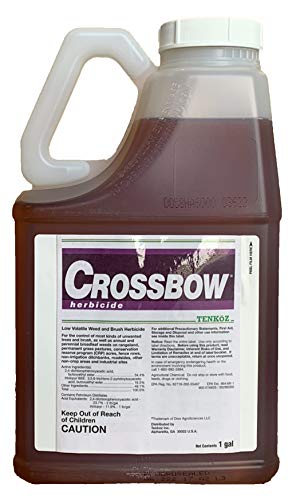
7. Crossbow Herbicide Brush Killer 1 Gallon
The gallon the neighbors ask about when the brush dies fastest.
Land-clearing pros reach for Crossbow when they want wisteria gone fast. Customers note it kills faster than the name-brand standby, and it gets broadleaf brush, vines, and small trees in one pass. The gallon container carries a stated coverage of approximately 1 acre or less, which puts it in the same working range as the Alligare quart and the two other full gallons here — plenty for a driveway, a fencerow, or a property edge.
What people describe is speed and reach together. One owner says poison ivy dies the same day, weeds are gone for months, and it handles the driveway and the ground under bushes in one treatment. Small unwanted trees and vegetation come down with it, and it gets named specifically for creeping Charlie, which other products on this list don’t claim. It’s a working bottle for someone who wants broad results without much fuss — mix it, spray it, watch it work.
Two honest notes. The odor is strong — several users comment on the chemical smell during and after application, so plan for ventilation and keep it away from windows on a still day. And on value, opinion splits: some find it cheaper than the name brands for the same coverage, others disagree. It’s a 128-fluid-ounce gallon with 11 pounds of liquid weight, so it’s a two-handed pour. For broadleaf brush where speed is the priority, this is a serious contender.
Where it delivers: same-day poison ivy knockdown and months of clearance, plus creeping Charlie control no other bottle on this list claims.
Plan for this: it carries a strong chemical smell, so spray early in the day and keep treated areas away from open windows.
Pick this for: broadleaf brush, vines, and small trees where you want the fastest visible knockdown and a full acre’s worth in the jug.
Pass on it if: strong odor is a dealbreaker, or you want wisteria-specific selectivity over broad power.
Know the Specs
Concentrate Versus Ready-To-Use
You mix a concentrate with water yourself, so you supply the sprayer and do the measuring. That gives you far more coverage per bottle and total control over strength, which matters on wisteria because the label ratio for vines usually runs stronger than a general weed mix. Ready-to-use skips the math and the equipment, which is the right call for a few cuts or a single vine and the wrong call for a fence row. Concentrate strengths here range from a 32-ounce quart on up to full gallons at 128 fluid ounces, so the same plant family can be treated with a spot bottle or a property-size jug depending on how much you have to cover.
Selective Versus Non-Selective, And Why It Decides Your Pick
A selective herbicide targets broadleaf brush while leaving grass alone — the property you want if your wisteria is growing up a fence line with lawn on either side. Non-selective products kill any green tissue they touch and often leave residual activity in the soil. When in doubt about which you have, check the coverage description: “selective coverage for brush and mid-size trees” is the safe-with-grass signal, while “non-selective” or “full” coverage means nothing green survives. For a wisteria growing through a lawn or garden, buy selective and spot-treat. For bare ground, right-of-way, or a clear-and-keep-clear job, non-selective with residual is what you want.
Dilution Ratios And Stated Coverage
Coverage numbers on these labels are what you actually get after mixing to the published ratio, not the concentrate volume alone. A 32-ounce quart that states up to 4,300 square feet is a different proposition than a 32-ounce bottle stating 1,500 square feet — same bottle size, very different working area. The mix ratios in the data range from 1 to 2 ounces per gallon (Alligare) and 3 ounces per gallon (Killzall’s spot rate), up to 4.5 cups per 26 gallons (Remedy) and 4 to 8 ounces per gallon (Southern Ag). Read the ratio, calculate your tank, and don’t overshoot — stronger is not always better, and some label guidance warns against overapplication.
Residual Control And Reapplication
Residual is the ingredient that keeps working after the visible plant is gone, preventing seed germination and regrowth. Killzall 365 states regrowth prevention for up to a year; Alligare notes lasting residual for bare-ground use; imazapyr lingers in the soil by its nature. The trade-off is that residual is not fussy about targets — it holds off your grass and your desirable plantings too. On the other side, triclopyr-only concentrates tend to be faster on existing top growth with less soil carryover, which is why they’re the standard choice for selective fence-line work. Match the residual behavior to if you want that spot to stay bare or regrow with grass.
Common Questions
What actually kills wisteria roots and not just the leaves?
Is triclopyr or imazapyr better for wisteria?
Can I spray wisteria without killing the grass around it?
How soon will I see results after spraying?
Can I plant in the area after treating wisteria?
How much area does a quart or gallon actually cover?
Do I need to worry about pets or kids after spraying?
Will wisteria grow back after one spraying?
Is a ready-to-use bottle strong enough for wisteria?
Can I use a hose-end sprayer or do I need a tank sprayer?
The Bottom Line
For most wisteria jobs, the herbicide to kill wisteria that does the heavy lifting is the Remedy Specialty Herbicide Weed Killer & Brush Control. It pairs triclopyr selectivity with a full gallon of concentrate, which is the combination you want for a fence row or pasture edge where you’re trying to save the grass and finish off a vine. Add the Brush Killer, Ready to Use for the trunks you cut back — applying within seconds to the fresh stump surface is the technique that actually finishes the job. If your wisteria is on bare ground with nothing to protect, the Hi-Yield Killzall 365 delivers up to 4,300 square feet with residual control that keeps the ground bare for up to a year. And for rangeland or pond-edge clearing where nothing nearby matters, the Alligare Imazapyr 4 SL is the root-deep, lingering option worth having on the shelf. One tip: buy sealed and mix fresh, because a diluted or old bottle is one issue that shows up in the brand feedback across several of these.
How we choose
We do not accept paid placement. Every pick is matched to a real buyer and a real use-case; we do not hands-on test units.
Sources
Specifications: manufacturer listings and product documentation. Review insights: verified customer reviews, as of October 2026. Pricing: not shown on this page (it changes often); check the current price via the retailer link.
As an Amazon Associate, Aappliancez earns from qualifying purchases. This does not affect which products we feature.