Disclosure: Some links in this post are affiliate links. As an Amazon Associate I earn from qualifying purchases, at no extra cost to you. Learn more
Specs are compiled from manufacturer listings and verified buyer reviews and can change over time — please confirm the key details on the product page before buying.
If you want bare ground and you want it fast, the Roundup Poison Ivy Plus Tough Brush Killer₂ Concentrate is the bottle to grab. It kills poison ivy, poison oak, poison sumac, wild blackberry and kudzu, goes rainproof in as little as 30 minutes, and shows visible results in hours. The five concentrates below split into two jobs: knock down whatever is green right now, or keep it gone for a year. Pick by that, not by how scary the label looks.
This guide is built by comparing the manufacturers’ published specifications and the patterns across verified customer reviews, so you get each pick’s real strengths and trade-offs instead of marketing spin.
Concentrates cost less per spray than ready-mixed jugs, but they demand respect: you mix them yourself, you get the ratio right, and you keep them off anything you want alive. This breakdown of the herbicide to kill everything covers coverage, active ingredients and the mistakes that leave you respraying.
Top Picks

How To Choose The Best Herbicide To Kill Everything
Two numbers decide almost everything: what the active ingredient is, and how far a bottle stretches. Get those right and the rest is application detail. Get them wrong and you will be back at the store in two weeks.
Read the active ingredient before anything else
Glyphosate is the general-purpose killer — it takes down grass and broadleaf weeds by stopping an enzyme only plants use. Triclopyr goes after woody brush, vines and poison ivy. Imazapyr is the slow, stubborn one that keeps working in the soil for up to a year. A mix gives you both speed and staying power. Roundup Poison Ivy Plus Tough Brush Killer₂ carries Triclopyr, Triethylamine Salt at 2.50%, Fluazifop-P-Butyl at 2.00% and Diquat Dibromide at 1.50% — a brush-first blend that browns vegetation within hours.
Match coverage to the size of the job
Coverage is the single most under-read spec on the bottle. A quart of Eraser Max lists 4,324 square feet of control. Roundup Pro Herbicide lists 435,600 square feet. That is the difference between a driveway and a right-of-way, and it is why two concentrates at similar shelf positions can serve completely different owners. Measure your area first, then buy.
Decide if you need residual control
Some products kill what is growing and stop there. Roundup Pro Herbicide does not provide residual weed control — weed seeds in the soil will keep germinating after your spray dries. Eraser Max works the other way, killing for up to one year from a single application. If you want bare gravel or a fence line to stay bare, you want residual. If you are clearing ground to plant, you usually do not.
Plan for mixing and drift
Every bottle here is a concentrate, so you will dilute it yourself and you will need gloves, long sleeves and eye protection. Wind is the other variable: drift carries these products onto shrubs and garden plants, and once a leaf is hit there is no undoing it. Spray on a still morning and keep a dedicated sprayer that never touches anything else.
Side-by-Side Comparison
| Model | Best For | Coverage | Active Ingredient | Volume | Amazon |
|---|---|---|---|---|---|
| Roundup Poison Ivy Plus Tough Brush Killer₂★ Best Overall | Brush, vines and poison ivy | 1,500 square feet | Triclopyr, Fluazifop-P-Butyl, Diquat Dibromide | 32 fluid ounces | Amazon |
| Control Solutions 82002488 Eraser MaxYear-Round Control | Year-long bare ground | 4,324 Square feet | Glyphosate and Imazapyr | 32 fluid ounces | Amazon |
| Quali-Pro Negate 37WG | Warm-season turf cleanup | 8 to 12 weeks per application | Rimsulfuron and Metsulfuron methyl | 1.5 Ounce | Amazon |
| Plus Herbicide 41% Glyphosate with Surfactant | Large properties and repeated spraying | 50-1,000 square feet | Glyphosate 41% with surfactant | 2.5 gallons | Amazon |
| Roundup Pro Herbicide | Industrial and acreage-scale jobs | 435,600 square feet | Glyphosate-isopropylammonium | 2.5 gallons | Amazon |
Detailed Reviews
1. Roundup Poison Ivy Plus Tough Brush Killer₂ Concentrate
Our pick — 4.5+★ from 950+ verified ratings; the strongest balance of quality and price.
Triclopyr at 2.50% makes this the brush, vine and poison ivy pick in a 32-fluid-ounce bottle.
Anyone fighting poison ivy, wild blackberry or kudzu up a fence line picks this first — and it earns the spot. The formula leans on Triclopyr at 2.50%, a woody-brush specialist, backed by Fluazifop-P-Butyl at 2.00% and Diquat Dibromide at 1.50% for fast burn-down. Roundup states visible results in hours, and rainproof protection in as fast as 30 minutes, which matters when afternoon storms roll in over an afternoon’s work.
The mix covers 1,500 square feet from a 32-fluid-ounce bottle, applied at one gallon of spray solution per 300 square feet. That is a spot-treatment footprint, not an acreage one — think stumps, mature tree bases, fencelines and foundations. You can also plant back between 1 and 30 days after application, which is unusually quick for this class of product and makes it the pick for anyone clearing ground for something new.
You get easy mixing and a spot-spray routine that is hard to mess up, so owners talk about ease of use more than anything else. The catch is consistency: some owners see plants die after one pass, while others get a slower response and have to spray again. Also, the price per ounce of this 32-fluid-ounce concentrate is higher than the larger jugs later in this list. For brush work around your home, that trade-off is worth it.
What This Bottle Does Best
- Rainproof in as fast as 30 minutes, so a sudden shower will not wash your work away
- Visible results in hours rather than weeks
- Planting allowed 1 to 30 days after application, per the booklet
- Targets poison ivy, poison oak, poison sumac, wild blackberry and kudzu by name
Where It Asks More Of You
- 1,500 square feet of coverage means big properties need several bottles
- Effectiveness draws a divided response, so slow-killing patches may need a second pass
- Cost per fluid ounce sits above the bulk jugs
Reach for this if: your enemy is brush, vines or poison ivy around a home, cabin, fence or stumps, and you want visible die-off the same day.
Step past it if: you are treating open ground by the acre — the bulk jugs handle that footprint better.
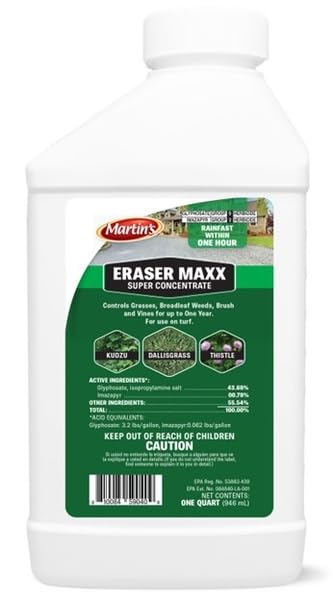
2. Control Solutions Eraser Max Herbicide
This quart lists 4,324 square feet of control — nearly three times the 1,500 square feet of the 32-ounce Roundup above.
Bare gravel, driveway seams, crack lines and a fence line you never want to see green again — Imazapyr at 0.78% keeps them that way for up to a year. A single application kills weeds for up to one year, because Imazapyr at.78% stays active in the soil long after the Glyphosate at 4.68% has done its fast work. The formula is low-odor, which matters when the sprayer sits in a garage or shed.
This quart covers a lot of ground: it is rated for 4,324 square feet of control, while the Plus Herbicide later in this list covers only 50-1,000 square feet. So the Eraser Max reaches much farther on paper. The label says to mix six ounces per gallon, so a two-gallon sprayer uses half a quart each time you fill it. Buyers report the kill is slow but complete: “This stuff really works it takes a little bit to kill the weeds but it works great,” and one says it “completely obliterates weeds and grass for up to a year with a single use.”
The one discipline this product demands is patience. Most reviews describe visible death across a few hours to a week, not minutes, and the six-ounces-per-gallon mix means a refill comes around fast in a larger tank. If you spray and check the next morning expecting brown, you will think it failed. Three days later you will not.
The coverage math: 4,324 Square feet from one quart is the largest per-ounce reach of any single-quart option here, which is exactly what makes it the right pick for keeping gravel and driveways permanently clear.
Give it time: the kill is thorough rather than instant, and the six-ounce-per-gallon rate drains a two-gallon sprayer quickly — plan for a couple of fills on a big job.
The right bottle for: driveways, non-crop ground and gravel where you want the green gone and staying gone for a year.
Wrong tool for: a vegetable bed or anywhere you plan to plant soon — the residual action is the whole point here.
3. Quali-Pro Negate 37WG Herbicide
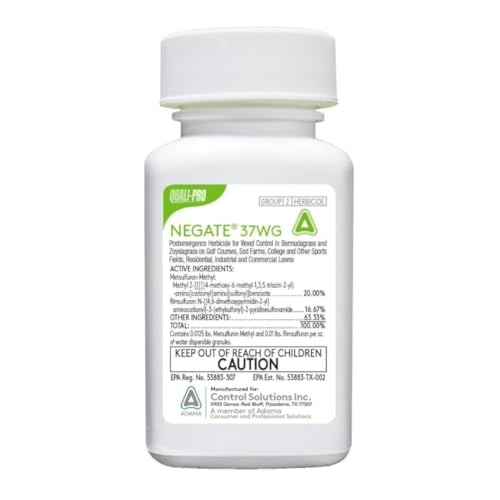
Rimsulfuron and Metsulfuron methyl kill Poa annua and clover in established warm-season turf without scorching the grass.
Negate 37WG is a post-emergent granule-and-powder blend for established warm-season turfgrass, built on two actives: Rimsulfuron at 16.67% and Metsulfuron methyl at 20%. That combination is aimed at grassy and tough broadleaf weeds — Poa annua, Poa trivalis, ryegrass, bentgrass, clovers, dandelion, henbit, chickweed, wild onion, wild garlic and spurge. Use sites cover golf courses, sod farms, sports fields, industrial and commercial grounds, and residential lawns.
The label promises control lasting 8 to 12 weeks per application. Buyers describe a two-step process: they apply in March, the first pass kills most weeds, and a second pass spot-sprays the rest. In one detailed account, Poa annua in TifGrand Bermuda showed no change at one week, then died within five days of the second application, mixed at about 3-4 ounces per gallon over 1,000 square feet, with no Bermuda damage. In another, yellowing appeared in days and most weeds were dead within a week. Effectiveness is what this product is known for, and owners talk about it freely.
The catch is packaging. The container must be mixed entirely at once, and reviewers point out that leaves leftover solution within about four weeks. The other note is a slight lag: Negate can stunt Bermuda grass before it recovers with fertilizer and iron in two to three weeks after scalping. The 1.5-ounce unit count also means small treatments waste product. Buy this when you have a full spray plan, not a single weed.
Precision over brute force: the Rimsulfuron and Metsulfuron methyl pairing lets you knock back Poa annua and clover in healthy turf without a scorched-earth spray.
Plan the whole batch: the entire container has to be mixed at once, so figure out how far 1.5 ounces will go before you open the lid.
Ideal owner: someone with established warm-season turf — especially Bermuda — fighting Poa annua or clover and willing to run two applications.
Less suited to: small-spot users and cold-season lawns, which is not listed in the use sites.
4. Plus Herbicide 41% Glyphosate

A 2.5-gallon jug of 41% glyphosate with the surfactant already blended in, so you skip buying and measuring a separate bottle.
It ships as 320 fluid ounces against the 32 fluid ounces of the Roundup Poison Ivy Plus Tough Brush Killer₂ above — ten times the volume in one purchase. That is a ten-to-one difference in volume in one purchase, which is why the Plus Herbicide suits anyone spraying the same ground several times a season. The built-in surfactant is the other differentiator — a surfactant is a wetting agent that helps the spray cling to waxy leaves instead of beading off, and it saves you buying and measuring a separate bottle.
For general use, mix 2 ounces per gallon of water. Owner feedback is both enthusiastic and cautious. Owners mention “this stuff works and everything I sprayed is dead including the branches of shrubs from the over spray,” and another warns that at a 3-ounce-per-gallon mix you should be careful what you spray, because everything green in range is affected. Several say grass goes down within hours rather than days. Ingredients are what owners value most here, with the surfactant (a soap-like ingredient that helps the spray stick and spread) getting credit for the consistency.
In return, you accept variability: concentration and effectiveness both split the feedback, with some finding it runs a bit weaker than expected and others finding it works for about two weeks. The label lists 50-1,000 square feet of coverage, but a 320-fluid-ounce bottle mixed at 2 ounces per gallon makes far more spray than that number suggests. Treat the coverage figure as the area you would realistically treat in one session, not a hard limit. Mix carefully, keep a separate sprayer, and this is the workhorse for repeated clearing.
The surfactant is the point: a wetting agent blended in from the factory means fewer bottles on the shelf and one less measurement to get wrong per tank.
Be careful with the mix ratio: at 3 ounces per gallon this spray is unforgiving, and overspray has taken out shrub branches — keep it away from anything you want to keep.
Buy this when: you treat large areas repeatedly and want a big jug of surfactant-boosted glyphosate you mix yourself.
Think again if: you only spray a crack or two a season — far more herbicide than that job calls for.
5. Roundup Pro Herbicide

435,600 square feet of rated coverage from one 2.5-gallon jug — acreage, rights-of-way and fencelines, not a driveway.
At 50.2% glyphosate-isopropylammonium, one jug mixes enough spray for acreage-scale jobs that would empty smaller bottles. One 2.5-gallon concentrate is rated to cover 435,600 square feet, a scale that leaves every other product here far behind. Use sites run to industrial, turf, ornamental, forestry, roadside, utility rights-of-way and railroad management. The active ingredient works by blocking an enzyme found only in plants and microorganisms, and Roundup states it is visible on most annual weeds within 2 to 4 days and most perennial weeds in 7 or more days.
Value is why owners keep coming back: one notes the concentrate makes two and a half gallons for the price of a single gallon of ready-mixed, and another says a concentrate jug covers 140,000+ square feet, while a store-bought gallon handles 400 square feet. The concentration earns its own praise. In one account, the glyphosate-isopropylammonium content at 50.2% (a strong weed-killing ingredient) is described as the most potent Roundup the buyer has found, browning cottonwood root volunteers under a driveway within a day with no re-treatment. Elsewhere it took down grass and kudzu outright.
The honest limitation is labor: the 20-pound jug requires mixing, protective gear, and knowing how to dilute it, and drift in a breeze will kill anything it touches. Two owner cautions worth repeating: check expiration dates, since one batch arrived with only 60 days left on it, and remember that Roundup Pro Herbicide does not provide residual weed control (it won’t stop new weeds from sprouting later), so weed seeds in the soil will keep germinating and you will spray again. The label says as much.
Why Acreage Owners Commit
- 435,600 square feet of rated coverage from one 2.5-gallon concentrate
- Visible on most annual weeds within 2-4 days, per the label
- Handles woody brush, trees and vines alongside standard weeds
- Built for roadside, utility, forestry and railroad use sites
The Care This Takes
- No residual control — germinating weed seeds will sprout again
- 20 pounds of liquid to handle, mix and store safely
- Drift travels in a breeze and affects anything green in range
- Expiration dates are worth checking when the jug arrives
Made for: large properties, farms, fencelines and rights-of-way where you spray in volume and re-spray by plan.
Overkill for: a driveway crack or two — matching this coverage to a small job wastes the bottle.
Know the Specs
Active Ingredient
The active ingredient is the chemical doing the killing, and it sets the product’s personality. Glyphosate is the generalist — it blocks an enzyme only plants and microorganisms use to build specific amino acids, which stops growth from the inside. Triclopyr is the brush and vine specialist. Imazapyr is the long-memory one, staying active in soil for up to a year. Diquat Dibromide and Fluazifop-P-Butyl supply faster top-growth burn-down, so a blend gives you both a quick visible hit and a thorough root kill.
Coverage Rating
Coverage is how much ground the label expects one package to treat, and it varies wildly across this category. A single quart can hold 4,324 square feet of rated control, while a 2.5-gallon jug can list 435,600 square feet. Neither is better in isolation — the quart suits spot work on driveways and stumps, the jug suits acreage. Read the figure before you buy so you are not making six trips to the shed or left holding gallons you will never use.
Concentrate vs Ready-Mixed
Everything on this list is a concentrate, meaning you dilute it with water before spraying. The advantage is cost per spray and how far one container stretches. The cost is that you own the mixing, the ratio and the safety gear. Mixing rates differ sharply between products — some call for 2 ounces per gallon, others 3 to 6 ounces per gallon — and getting the ratio wrong is the most common way to waste a tank.
Surfactant and Rainfastness
A surfactant is a wetting agent that helps spray spread across and cling to waxy leaf surfaces rather than beading off. Some products include one; others expect you to add it. Rainfastness is how long the spray needs on the leaf before rain will not wash it away, and it varies by product — one option here is rainproof in as fast as 30 minutes, per its maker. Both traits matter for how reliable your results feel.
Common Questions
How long before I can plant in an area I sprayed?
Will glyphosate kill my lawn grass as well as the weeds?
What is the difference between glyphosate and imazapyr?
Do I need a surfactant with 41% glyphosate?
How long does a concentrate stay good once mixed?
Is it safe to spray near shrubs and garden plants?
Why is my spray not killing anything after a day?
Do these products stop weeds coming back?
What gear should I wear when mixing a concentrate?
Which is better for a driveway Eraser Max or Roundup Pro?
The Bottom Line
For most homes, the winner among these herbicide to kill everything options is the Roundup Poison Ivy Plus Tough Brush Killer₂ — it handles the brush, vines, and poison ivy that actually annoy homeowners, becomes rainproof in as fast as 30 minutes, and lets you replant in 1 to 30 days. Its 1,500-square-foot coverage suits spot work. If you need the green gone for a year across gravel or a driveway, the Control Solutions Eraser Max holds that residual ground for up to a year. And when the job runs to acres or a right-of-way, the Roundup Pro Herbicide is built for that scale. Decide your area first, then buy the bottle that matches it — and if you only ever spray a crack or two a season, be honest about that, because a concentrate punishes over-buying with storage and handling you did not need.
How we choose
We do not accept paid placement. Every pick is matched to a real buyer and a real use-case; we do not hands-on test units.
Sources
Specifications: manufacturer listings and product documentation. Review insights: verified customer reviews, as of October 2026. Pricing: not shown on this page (it changes often); check the current price via the retailer link.
As an Amazon Associate, Aappliancez earns from qualifying purchases. This does not affect which products we feature.