Disclosure: Some links in this post are affiliate links. As an Amazon Associate I earn from qualifying purchases, at no extra cost to you. Learn more
Specs are compiled from manufacturer listings and verified buyer reviews and can change over time — please confirm the key details on the product page before buying.
Blackberry bushes do not lose to pruning shears. Cut a cane to the ground and it comes back thicker from the same root crown, because the plant stores its energy underground. The fix is a concentrated brush herbicide that moves down into those roots and stops the regrowth — and the right pick depends on whether you are clearing a pasture, a fence line, or a tangle beside the garage.
This guide is built by comparing the manufacturers’ published specifications and the patterns across verified customer reviews, so you get each pick’s real strengths and trade-offs instead of marketing spin.
Below you will find the concentrates that actually carry triclopyr or glyphosate into blackberry roots, sorted by what they are best at. Whether you are spraying a fence row or a quarter acre, this breakdown of the best herbicide to kill blackberry bushes spells out what each jug mixes to.
Top Picks
How To Choose The Best Herbicide to Kill Blackberry Bushes
Blackberry is a woody perennial, not a broadleaf weed. It stores reserves in a crown and a lateral root system that can send up new canes for years after the top growth dies. Herbicide choice therefore matters less than getting the active ingredient down to that crown — and getting it there before the plant goes dormant for winter.
Look for triclopyr on the label, not just “brush killer”
Triclopyr is the active ingredient that woody plants absorb through leaf and bark tissue and carry down into the root system. That is exactly what blackberry needs. A product can say “tough brush killer” on the front panel and still be built around a different chemistry, so read the small text for triclopyr, triclopyr triethylamine salt, or the trade names Garlon and Crossbow.
Match the formulation to the job
A ready-to-use spray is fine for a handful of canes along a driveway. A concentrate is what you want for a fence row, a pasture corner, or anything measured in thousands of square feet, because you dilute only what you need and the jug keeps. High-volume jobs — pasture regeneration, acre-scale clearing — justify the gallon jugs.
Decide before you spray whether the surrounding plants matter
Some formulations are built to leave established grass standing, which is what you want if blackberry is creeping into pasture or a lawn edge. Others deliberately kill everything they contact, which is what you want on a gravel driveway, a building foundation, or bare ground you plan to keep bare. Getting this wrong is the single most common regret among brush herbicide buyers — the blackberry dies, and so does the grass you wanted.
Side-by-Side Comparison
| Model | Best For | Form | Volume | Coverage | Amazon |
|---|---|---|---|---|---|
| Remedy Specialty Herbicide★ Best Overall | Pasture and fence lines | Liquid concentrate | 1 gallon | Selective brush and mid-size trees | Amazon |
| ALLIGARE Agri Star Triclopyr 4EBest For Stumps | Cut-stump and stump treatment | Liquid concentrate | 1 gallon | Non-selective broad spectrum | Amazon |
| Crossbow Herbicide Brush Killer | Acre-scale clearing | Liquid concentrate | 1 gallon | Approximately 1 acre or less | Amazon |
| Southern Ag Crossbow Specialty Herbicide | Broadleaf and vine control | Liquid concentrate | 128 ounces | 2.23 acres | Amazon |
| Hi-Yield Killzall 365 | Stopping regrowth on bare ground | Liquid concentrate | 1 gallon | Up to 17,200 square feet | Amazon |
| Ortho GroundClear Poison Ivy & Tough Brush Killer3 | Spot treatment around the yard | Ready-to-use spray | 1 gallon | Over 60 listed tough weeds and brush | Amazon |
| Roundup Poison Ivy Plus Tough Brush Killer2 | Driveways, trails and stumps | Liquid concentrate | 32 fluid ounces | 1500 square feet | Amazon |
Detailed Reviews
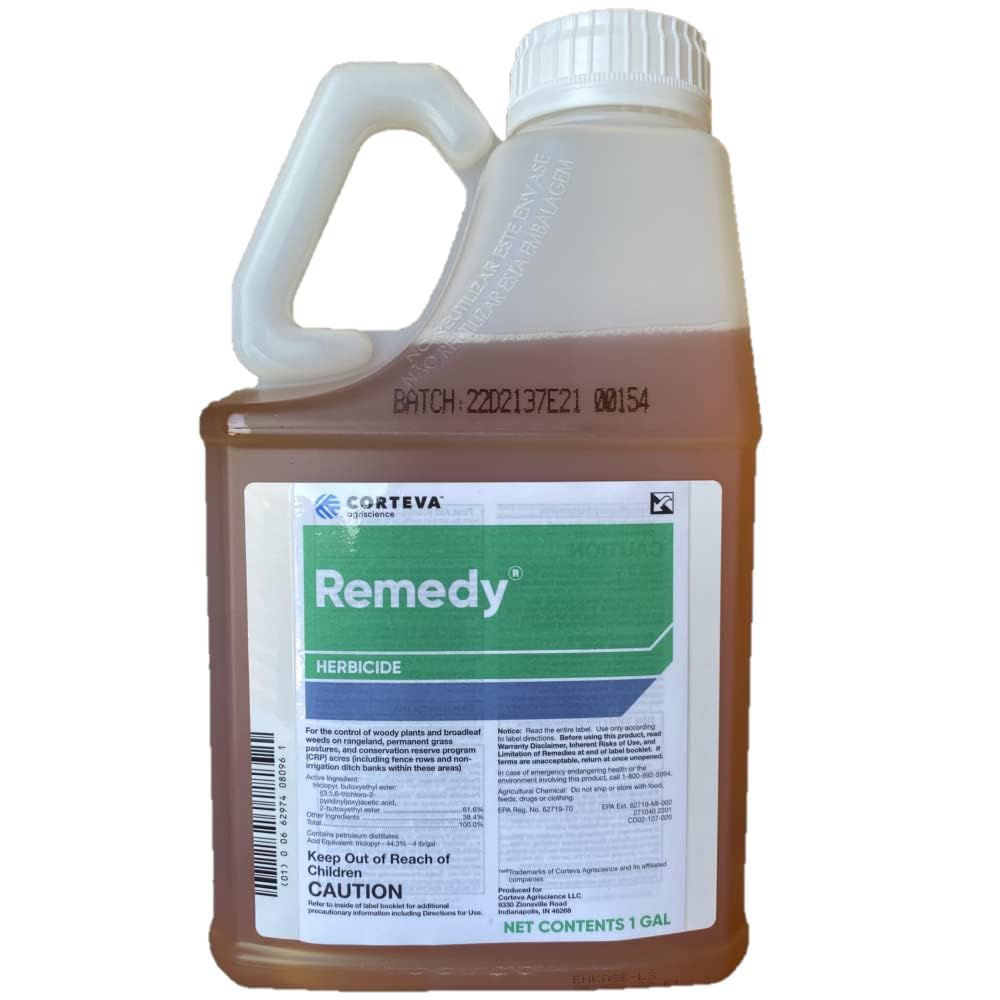
1. Remedy Specialty Herbicide 1 Gallon
Our pick — 4.5+★ from 850+ verified ratings; the strongest balance of quality and price.
The pasture specialist that browns canes in days and leaves the grass standing.
If blackberry has pushed into a pasture, a fence row, or ground you want to keep in grass, this is the jug to start with. It is a triclopyr concentrate that works on the whole plant — the top growth you can see and the roots underneath — and it is designed to leave the grass around it alone. That combination is rare, and it is why this one holds the top spot.
The crowd favorite here is the effectiveness — 4.5+ stars from 800+ buyers — and the experience matches the label. Mixing runs about 4.5 cups of concentrate per 26 gallons of water, and buyers report it taking down pastured trees and brush reaching 5 feet tall and 2 inches in diameter. Wilting shows up in roughly a week, and the root system goes with it without harming the grass. One buyer cut woody Montana brush, sprayed the regrowth, and saw the green leaves brown within a few days.
For blackberry specifically, that root kill is the whole point. This one also tank-mixes with GrazonNext and ForeFront HL if you are already running a pasture program, and the low-odor formula is easier to live with when you are treating a large area. It ships as a 1-gallon jug.
What wins people over
- Kills top growth and root system together — regrowth stops instead of returning
- Selective enough to leave pasture grass intact, so you are not reseeding afterward
- Tank-mix compatible with GrazonNext and ForeFront HL for an existing spray program
- Low odor for a concentrate, which matters on a long spray day
- 16-ounce shipping weight makes the jug manageable to pour and carry
The honest catch
- The cost is the most-discussed trade-off — some buyers find it worth it, others feel it is steep
- You are mixing your own solution, so you need a sprayer and a measuring cup
- Not an organic route, and treated ground must dry fully before children or animals return
How it lands against the rest: The Ortho GroundClear is the grab-and-go option at 1 gallon of ready-to-use spray, but it arrives pre-mixed and goes down at whatever strength the bottle holds. This Remedy jug lets you dial the mix for a light fence-line pass or a heavier pasture job, and the 1-gallon concentrate is the difference between treating one hedge and treating an acre.
Reach for this if: you are clearing blackberry out of pasture, along fence lines, or anywhere the surrounding grass needs to survive.
Think twice if: you want something you can pull off the shelf and spray without measuring, or if a mixed value verdict on cost gives you pause.
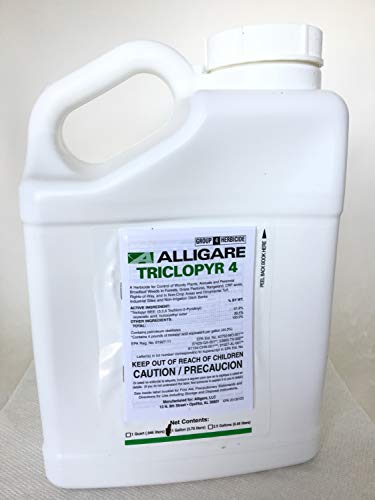
2. ALLIGARE Agri Star Triclopyr 4E Herbicide 1 Gallon
The concentrate that mixes to 64 gallons and takes blackberry by the stump.
Blackberry has a crown, and the smartest way to end it permanently is to cut the canes back and treat what is left. That is what this jug is built for. It is a 60% triclopyr concentrate — buyers describe it as a generic equivalent of Garlon 4 — and at 1 gallon it holds 128 fluid ounces, which is 4.0x the volume of the 32-fluid-ounce Roundup Poison Ivy Plus Tough Brush Killer2 on this list.
Mixing is where it earns its place. For foliar work you dilute to roughly 2% with a surfactant; for stump and hack-and-squirt treatment you go much heavier. Owners mention it killing black locust, multiflora rose, blackberry, ailanthus, and sumac, and one gallon makes between 64 and 128 gallons of mixed spray. Its strength is the most-cited quality after raw effectiveness, and it is easy to apply once you have the ratio right.
This is also the pick for anyone whose real target is trees rather than blackberries. Buyers who tried it against glyphosate for woody plants report it doing the job where glyphosate struggled, and one noted it is safe for wildlife and fish.
Read the label twice: the instruction sheet is the one weak spot — buyers call the directions hard to follow, and this ester formulation has specific dilution ratios for foliar versus stump work. Get those two recipes straight and the jug handles everything else.
Non-selective by design: this kills what you spray, so it is not a product to broadcast near lawn or garden beds. It also carries an oily smell that lingers for weeks, and vine maple nearby has shown vapor damage in owner reports.
A great match for: cut-stump and hack-and-squirt work on established blackberry crowns and the trees tangled up with them.
Pass on it if: you want a spray you can point at a bed of ornamentals, or you need clearer step-by-step direction on the bottle.
3. Crossbow Herbicide Brush Killer 1 Gallon
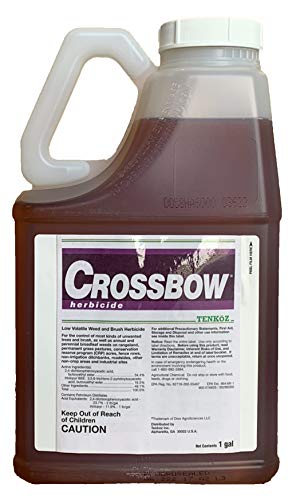
The farmers’ answer — brush and small trees gone, sometimes the same day.
When the blackberry patch is measured in fractions of an acre rather than square feet, this is the jug that fits. A single gallon covers approximately 1 acre or less, and the formulation is aimed at broadleaf weeds, brush, and small trees — the exact mix you find when blackberry has gone feral over an old pasture corner.
What buyers talk about is speed. One describes it as what local farmers use and rates it better than Roundup on this job — faster kill, poison ivy down the same day, weeds gone for months. It goes on driveways and under bushes, and the blunt summary repeated across the feedback is that whatever you spray it on dies. Creeping Charlie, a notoriously stubborn ground ivy, comes up repeatedly as something this handles when other products did not.
The 11-pound shipping weight and 1-gallon volume tell you this is a serious jug for serious ground. It also carries a strong chemical smell, which is standard for this class of chemistry and worth planning your spray day around.
Fit note on cost: some buyers find it cheaper than the name-brand equivalents, while others are not convinced. That split shows up in the feedback and is worth weighing against how much ground you actually need to clear.
Built for: property owners clearing blackberry, creeping Charlie, and small volunteer trees across a driveway or up to an acre of rough ground.
Look elsewhere if: you only need to spot-treat a few canes, or you need a low-odor formulation.
4. Southern Ag Crossbow Specialty Herbicide 128oz

One gallon that stretches to 96 gallons of spray across 2.23 acres.
Read the coverage number and the case for this one writes itself: a single 128-ounce gallon makes up to 96 gallons of spray solution and covers 2.23 acres. That is the broadest reach on this list, and the active ingredients are Garlon and 2,4-D, a combination built for unwanted trees and brush plus annual and perennial broadleaf weeds. Compare it to the Remedy at 1 gallon of concentrate — both are single-gallon jugs, but this one covers the larger area.
Effectiveness is what buyers single out. English ivy and broadleaf plants come up repeatedly as wins, and the value side is strong enough that buyers call it worth the price. One sums it up simply: it works just like they say it does, and they are buying more next spring.
There is a real soil story worth knowing before you buy. One buyer tracked creeping Charlie kill at 95% in Ohio brownish soil, 70% in Indiana, and 60% in Northern Illinois black soil, with rain within a day or two cutting the results. On vines, the technique that works is painting the cut stem — systemic action then carries it down and takes the vine, shrub, or ivy within about a week.
Two things to plan around: it has a strong odor, so gloves and old clothes are part of the job. And it is not glyphosate — a 1% solution does the work but takes roughly a week rather than a couple of days.
Suits you well if: you are treating broadleaf weeds and vines across a large property and want the shortest path from one jug to full coverage.
skip it if: you are dealing with a single blackberry patch, or you want the fastest visible knockdown rather than a systemic week-long kill.
5. Hi-Yield (32171) Killzall 365, 1 gal
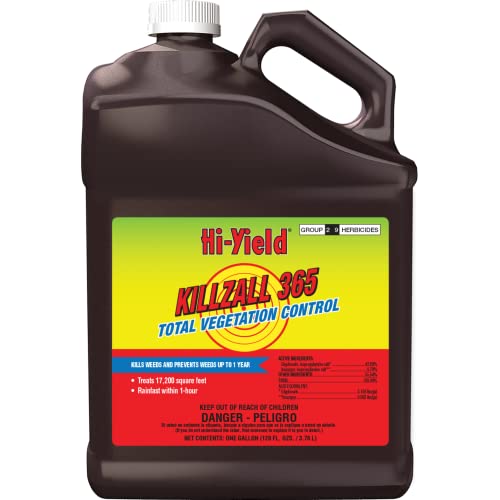
Kills the canes and then keeps the ground bare for up to a year.
For blackberry on a gravel drive, a building pad, or ground you intend to keep bare, the killing is only half the job — the waiting for regrowth is the other half. This jug pairs glyphosate with imazapic, and the imazapic is what holds the ground clean. Per the label it kills weeds and prevents regrowth for up to 1 year, and a single gallon treats up to 17,200 square feet.
Mixing is straightforward. For spot control of brush, vines, and weeds, blend 6 ounces of concentrate per gallon of water; for full vegetation control and bare ground, mix 7.4 ounces with 1 to 10 gallons of water. Buyers who ran it on an empty lot report no grass four months later, and the recurring phrase in the feedback is that nothing survives the spray.
Soil type changes how long the barrier lasts. In sandy soil one buyer saw the barrier last about three or four months rather than the full year, which the label states. In heavy clay the same buyer expects it to last much longer. Expect two or three days before you see the kill land — buyers describe it as slower to show than some competitors but thorough once it does.
Precision matters more here: this is not a product to wave near a lawn. One buyer’s warning is blunt — don’t get too close to grass. Because it also stops seeds from germinating, anything you plan to plant in that ground later should go somewhere else.
The right tool for: keeping blackberry from returning on driveways, lots, and bare ground where nothing is meant to grow for the season.
Look elsewhere if: you need to protect grass nearby, or you want to replant the treated area soon.
6. Ortho GroundClear Poison Ivy & Tough Brush Killer3, 1 gal.

The ready-to-use jug with a wand on it, for when you want to start spraying now.
Nobody mixes anything with this one. It is a 1-gallon ready-to-use spray that arrives with a battery-powered Comfort Wand applicator, so you pull it from the start, point it, and go. The formula covers over 60 types of listed tough weeds and brush, and wild blackberry is named right on the label alongside poison ivy, poison oak, and kudzu.
The speed claims are the loudest part of the spec sheet, and they are specific: visible results in just 1 hour, rainproof in 2 hours. Buyers confirm the fast end of that — leaves wilting within hours, and one reported a gigantic poison ivy bush dying completely over a week and still dead three months later. The wand is the other thing people like; it aims precisely at a cane without soaking everything around it.
Where this one pays for itself is spot work — around homes, cabins, buildings, fences, and trails. It is not recommended for lawns or gardens with desirable plants, so keep it away from anything you want to keep. The recurring gripe is the sprayer itself: the wand’s battery life does not last long, so heavy jobs may leave you mid-row with a dead handle.
Plan for the smell: this carries a strong odor, and buyers recommend keeping children and pets off the treated area for a day. That is a small scheduling note rather than a problem — spray in the morning, keep everyone clear, and the blackberry is browning by afternoon.
Best for you if: you have a handful of blackberry canes near a fence, foundation, or trail and want results the same afternoon.
Choose differently if: you are treating a large patch, want to protect adjacent grass, or need the wand to hold out through a long session.
7. Roundup Poison Ivy Plus Tough Brush Killer2 Concentrate

A small-batch concentrate built for driveways, trails, and freshly cut stumps.
When the job is a strip of blackberry along a property line rather than a pasture, this is the right size. The 32-fluid-ounce concentrate covers 1500 square feet, and wild blackberry is named on the label among poison ivy, poison oak, poison sumac, and kudzu. At 8 ounces shipping weight it is 2.0x lighter than the 16-ounce Remedy, which makes it easy to handle — but it also holds 4.0x less volume than the Remedy’s 128 fluid ounces, so it is a spot-treatment jug rather than an acre tool.
Three actives do the work here — triclopyr triethylamine salt, fluazifop-P-butyl, and diquat dibromide — and the label’s headline promises are genuinely fast: rainproof in as fast as 30 minutes and visible results in hours. Buyers back up the speed, describing leaves dropping off a treated plant in a day or two. Where the feedback splits is on staying power. One buyer cut a giant sticker bush near the ground, sprayed the exposed top, and reported it brown the next day and dead in two weeks — but also that tough Virginia Creeper takes two applications.
That is the honest read on this one: for most plants a single pass does it, and tougher customers need a second round. It is also a non-selective formula that will take out regular grass along with the blackberry, so mind your edges. The label allows planting 1 to 30 days after application — check the booklet for the details on that.
A smart fit if: you want a compact concentrate for a driveway, trail, or cut-stump job and you are willing to re-treat stubborn canes.
Not the one for: a sprawling blackberry thicket, or any spot where the grass beside the canes needs to survive.
Know the Specs
Active ingredient and concentration
The active ingredient is the actual chemistry that kills the plant, and the concentration tells you how much of it is in the jug. Triclopyr is the workhorse for woody blackberry — it moves through leaf and bark tissue and gets down into the crown and roots. Read the fine print rather than the front panel, because “tough brush killer” can describe more than one chemistry. A higher-concentration jug mixes to far more finished spray, which is what makes a gallon of concentrate reach across a large area.
Coverage and mix ratio
Coverage is the area one jug treats, and the mix ratio is the recipe that gets you there. Both matter. A concentrate might call for a few ounces per gallon for spot work and a heavier blend for bare-ground control, so the same jug can produce very different total spray volumes depending on the job. Ready-to-use sprays skip this step entirely but arrive at one fixed strength. If your patch is small, a compact concentrate is easier to manage; if you are clearing acres, a gallon jug with a wide coverage figure is the better buy.
Selective versus non-selective
Selective means the product is built to knock down brush while leaving the grass around it standing — handy when blackberry is creeping into pasture or a lawn edge. Non-selective means it kills whatever it touches, which is what you want on gravel, foundations, and bare ground. Neither is better; they solve different problems. The mistake to avoid is using a non-selective formula next to grass you care about, or using a selective one on pavement where you want everything gone.
Rainfast time and visible results
Rainfast time is how long the spray needs to dry before rain will not wash it off — some formulations claim rainproof in as fast as 30 minutes, others in 2 hours. Visible results tells you when you will see leaves begin to wilt, which ranges from hours to days. Neither of those numbers means the plant is dead. Blackberry dies when the chemistry reaches the roots, and that typically takes longer than the visible browning, so judge success by whether new canes return the following season.
Common Questions
Will a brush herbicide actually kill blackberry roots or just the canes?
Can I spray blackberry in pasture without killing the grass?
How long after spraying before I can let pets or children back on the treated area?
Is it better to spray blackberry leaves or cut the canes and treat the stumps?
How much concentrate do I mix per gallon of water for blackberry?
How fast will I see the blackberry start to die back?
Will these brush killers stop blackberry from coming back next season?
Does rain after spraying wash the herbicide off and ruin the job?
What is the difference between a concentrate and a ready-to-use brush killer?
Can I plant grass or garden plants after using a brush herbicide?
The Bottom Line
Blackberry loses when the chemistry reaches the crown, and the pick that does that best while leaving grass standing is the Remedy Specialty Herbicide — 4.5+ stars, a triclopyr concentrate that takes out top growth and roots together, and a 1-gallon jug that tank-mixes with the pasture program you may already run. If you are cutting canes and treating the stumps, the ALLIGARE Agri Star Triclopyr 4E is the tool that mixes to 64 gallons and is the most-discussed pick for blackberry, multiflora rose, and sumac. And if the blackberry is creeping along a driveway or a foundation where you never want it back, the Hi-Yield Killzall 365 pairs glyphosate with imazapic to keep the ground bare for up to a year. Buy the one that matches your ground, spray on a dry morning, and let the roots do the rest.
How we choose
We do not accept paid placement. Every pick is matched to a real buyer and a real use-case; we do not hands-on test units.
Sources
Specifications: manufacturer listings and product documentation. Review insights: verified customer reviews, as of October 2026. Pricing: not shown on this page (it changes often); check the current price via the retailer link.
As an Amazon Associate, Aappliancez earns from qualifying purchases. This does not affect which products we feature.