Disclosure: Some links in this post are affiliate links. As an Amazon Associate I earn from qualifying purchases, at no extra cost to you. Learn more
Specs are compiled from manufacturer listings and verified buyer reviews and can change over time — please confirm the key details on the product page before buying.
Nutsedge is the weed that laughs at your mower. You cut it, it comes back thicker. You pull it, and the little underground tubers (small bulb-like roots that store energy) it leaves behind sprout three new plants. For a lawn owner in the middle of a yellow-sedge invasion, the honest answer is simple: the fastest, easiest win for most people is the Ortho Max Nutsedge Killer Ready-to-Use 2-Pack, a hose-attach spray that needs no mixing and starts showing results within days. Everything else on this list is about matching the product to your grass type and your patience level.
This guide is built by comparing the manufacturers’ published specifications and the patterns across verified customer reviews, so you get each pick’s real strengths and trade-offs instead of marketing spin.
Nutsedge control is a two-front war: you want something that kills what you see and something that stops the tubers under the soil from firing back. The picks below split neatly between ready-to-spray speed, halosulfuron root-kill, and mesotrione seed suppression, so read the grass-type warnings before you buy the herbicide for nutsedge.
Top Picks

How To Choose The Best Herbicide for Nutsedge
The first thing to know is that nutsedge is a sedge, not a broadleaf weed — and not a grass either. That matters because ordinary broadleaf weed killers barely touch it, and if you attack it the wrong way you feed it.
Match the active ingredient to the problem
Halosulfuron-methyl (the active in several of the picks below) travels down into the roots and tubers, which is why it is the one the label writers point at for tough nutsedge. Mesotrione works differently — it stops photosynthesis and turns the weed white before it dies, and it also blocks new seed from sprouting. If your sedge is already up and green, you want a post-emergent that kills what you see; if you are spraying ahead of the season, a pre-emergent stops the next wave.
Check your grass type before you spray
Every product on this list is labeled for established turf, but “established” and “safe for my lawn” are two different questions. Fine fescue, Kentucky bluegrass, Bermuda, and St. Augustine all react differently to the same bottle. Read the “do not use on” line first — spraying the wrong product on a cool-season lawn can scorch it for weeks.
Decide how much work you want
A ready-to-spray bottle attaches to your garden hose and you are done. A concentrate or a pre-measured packet means measuring, mixing in a pump sprayer, and cleaning up afterward. Neither is better in the abstract — one costs you time, the other costs you precision.
Side-by-Side Comparison
| Model | Best For | Active Ingredient | Form | Coverage / Volume | Amazon |
|---|---|---|---|---|---|
| Ortho Max Nutsedge Killer RTU (2 Pack)★ Best Overall | Fast, low-maintenance spot treatment | Not listed | Liquid RTU spray | 24 fl oz (2 packs, 48 fl oz total) | Amazon |
| Atticus Empero Q-Pak Nutsedge Killer (2 Pack)Pre-Measured Pro Pick | Blueprint for a tackle-and-repeat job | Halosulfuron-methyl | Water-dispersible granules | 2,000 sq ft coverage | Amazon |
| Fertilome (11254) Weed-Out Nutsedge Control | Big lawns on a mix-and-spray budget | Halosulfuron-methyl | Liquid concentrate | Up to 5,800 sq ft from 1 pint | Amazon |
| Bonide Sedge Ender (16 oz) | Broadest coverage per bottle | Sulfentrazone | Ready-to-spray | 2,000–8,700 sq ft | Amazon |
| Liquid Harvest Mesotrione (8 oz) | Pre-emergent plus broadleaf cleanup | Mesotrione | Liquid concentrate | 8 fl oz concentrate | Amazon |
Detailed Reviews
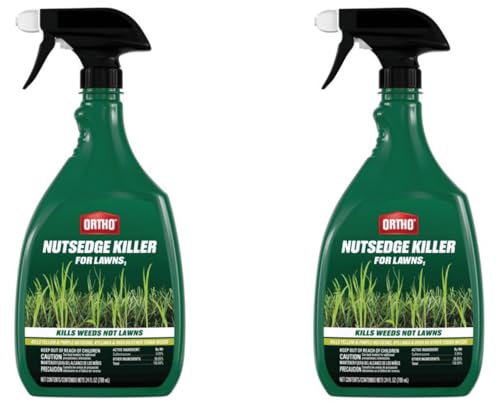
1. Ortho Max Nutsedge Killer Rtu, 24 fl.oz. (2 Pack)
Our pick — 4.0+★ from 8,500+ verified ratings; the strongest balance of quality and price.
The bottle that clips straight onto your hose and settles the argument with nutsedge in days.
If the sight of yellow nutsedge threading through your lawn sends you hunting for the fastest possible fix, this is the one to reach for. You screw the bottle onto a garden hose, flip the switch, and spray — no measuring cup, no tank, no mixing. That ready-to-use design is the single biggest reason this pick holds the top spot: the overwhelming majority of owners describe it working, and the results show up fast, with the listing’s own two-hour rainproof window meaning a surprise shower will not undo your afternoon.
What it kills is broad: yellow and purple nutsedge, kyllinga, wild onion, garlic, broadleaf plantain, purslane, redroot, pigweed, dandelion, and spurge — over 50 tough weeds on the label — and it is labeled for both Northern and Southern turf grasses. Nutsedge removal is where the real-world reports cluster, and the recurring theme in owner feedback is how quickly the weed goes from healthy green to dying brown. What buyers report most is speed: the “Results visible in ~4 days; grass hasn’t returned” line captures the gist of it. For a lot of people that is two mowings before they stop noticing the sedge.
The honest catch is overspraying. When the urge to douse a stubborn patch hits, this is not the product to soak twice — an over-saturated patch can burn the surrounding grass brown, and one owner’s grass took several soaking rains and sunshine to recover. The recovery is temporary and the label is clear about dosage, so read the rate first. Follow the label rate and you get the green, weed-free result.
The Case for It
- Hose-attach, no-mix ready-to-use bottle makes spot treatment a two-minute job
- Two 24 fl oz packs give you a full spray plus a backup for the next flush of weeds
- Rainproof in 2 hours means you are not chained to the forecast
- Labeled for both Northern and Southern turf grasses, so most lawns qualify
The Fine Print
- Over-saturation can burn surrounding turf — measure, don’t guess
- Two packs are ready-to-spray only; there is no concentrate here for large full-lawn jobs
Reach for this if: you want a lawn-safe nutsedge killer that works without mixing anything, and you would rather treat the visible patches than broadcast a whole-lawn spray.
Spray carefully if: you tend to dump extra product on a stubborn spot — over-saturating is the one thing owners flag as the way to scorch your grass.
2. Atticus Empero Q-Pak Nutsedge Killer (2 Pack) Turf Herbicide
The pre-measured halosulfuron packet that goes after the tubers, not just the leaves.
Atticus Empero is the pick for the lawn owner who has tried the fast sprays, watched the sedge come back, and has now accepted that it takes a real root-kill to end this. Its active is halosulfuron-methyl — the ingredient the label copy calls the one pros trust most for tough nutsedge — and the way it works is to travel down to the root system tubers for a top-to-bottom kill. That is a fundamentally different job than knocking down leaves.
The format is a pre-measured, water-dispersible granular packet pre-mixed with a surfactant. You empty one packet into a sprayer, add one gallon of water, swirl, and spray. The design keeps your dose correct every time and removes the guesswork that leads to burn. It is labeled for nearly any established warm- or cool-season turf — bluegrass, fescue, Bermudagrass, zoysia, and more — covering about 2,000 square feet per the listing. Pets and people can re-enter the area once the spray has dried.
Set your expectations on timing. The highest-count feedback theme here is that effectiveness is genuinely mixed — some owners see a full takedown, others are still staring at green sedge and frustrated. The ones who win with it spray, wait several weeks, and spray again. As owners mention: “After 3 weeks, nutsedge turning yellow/dying. Re-spray recommended at 6-8 weeks.” That is the pattern to plan around, and the packet convenience is what makes the repeat application easy to stick with.
One packet, one gallon: the pre-mixed dosage is the cleanest part of this product — mix a gallon, spray about 2,000 square feet, done. No measuring spoons, no clumps.
Honest limitation: this is a patience product. If you want the yellow-brown change inside 48 hours, the Ortho Max above gets you there faster. Empero is the one you plan a season around, with a second spray already penciled in.
Best for: committed lawn owners fighting a nutsedge problem that has survived simpler sprays, and who will actually come back for the second application.
Think twice if: you want same-week visual proof — this one rewards patience over speed, and the label warns it is tough on skin, so glove up during mixing.
3. Fertilome Weed-Out Nutsedge Control Concentrate
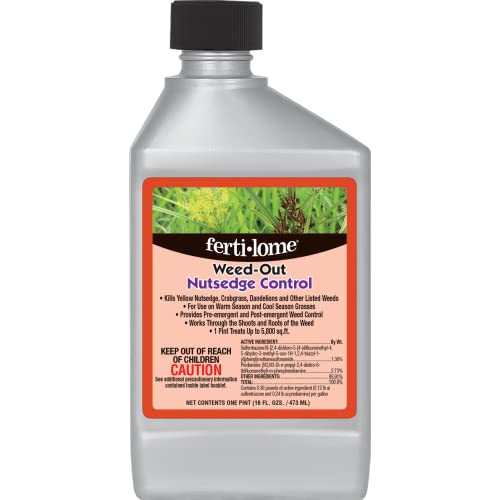
A pint of concentrate that stretches to nearly 6,000 square feet of lawn.
Fertilome Weed-Out is built for the homeowner with more lawn than patches. One pint of this liquid concentrate dilutes down to treat up to 5,800 square feet of turfgrass, which is a whole lot of coverage per bottle compared to ready-to-spray formats. It is a selective pre- and post-emergent — so it hits weeds already up and helps block the next flush — and it knocks out clover, dandelion, crabgrass, ground ivy, nutsedge, spurge, and more. It fits both warm- and cool-season grasses including bluegrass, Bahia, Bermuda, and fescue.
Compared with the ready-to-spray Ortho at the top of the list, this is the working owner’s route: you buy a concentrate, mix it in a pump sprayer at the label rate, and spray the lawn thoroughly. That extra step is why it is not the fastest option, but it is the one that makes sense when you are treating a real yard rather than a handful of trouble spots. It is also built to handle the pulling problem: pulling nutsedge by hand breaks the tubers apart and spreads the weed, so a proper root-killing spray is the smarter move.
What customers note about it splits mainly on the checkbook. Effectiveness is the strong side — the summary of owner feedback lands on it working, with several notes about how much of the lawn’s nutsedge it knocked back. The lasting impression from long-time users is durability: as reviewers point out, “It took care of my Nutsedge … most of it did not come back the next year … best I have ever used.” Cost-effectiveness is the more debated point — a great value for the 5,800 sq-ft coverage camp, less so for others — and one owner found it failed to move a poa annua problem planted in fescue, so this is a nutsedge and listed-weed tool, not a universal one.
Coverage math that matters: 1 pint stretches up to 5,800 sq ft, dwarfing the small ready-to-spray volumes and giving you room for a full-season campaign with one purchase.
Weigh the debate: value for the coverage is the honest split here — buy it to treat a large area, not to test a single patch.
Pick this for: a large lawn, a pump sprayer already in your garage, and a nutsedge problem big enough to justify mixing your own.
Look elsewhere if: you want a grab-and-go hose bottle or you’d rather not fuss with dilution rates — the ready-to-spray Ortho does that job without the mixing.
4. Bonide Sedge Ender, 16 oz Ready-to-Spray Weed Killer
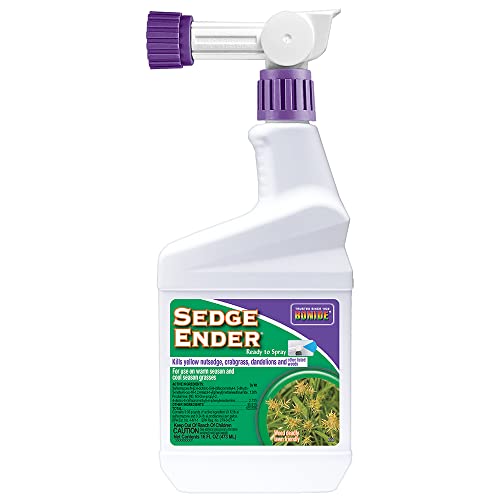
One ready-to-spray bottle with the boldest square-footage claim on the shelf.
If coverage per bottle is your buyer’s math, Bonide Sedge Ender is the one that changes the equation. The listing says one pint treats 2,000 to 8,700 square feet — the widest spread in this lineup — and it arrives as a ready-to-spray bottle you can use the moment it lands. Its active is sulfentrazone (a chemical that kills weeds by disrupting their cell membranes), and it kills yellow nutsedge, crabgrass, goosegrass, and other grassy weeds down to their roots. It is labeled safe on both warm- and cool-season grasses including bluegrass, ryegrass, fescue, Bermuda grass, and carpetgrass, and it is a pre- and post-emergent (works before and after weeds sprout), so it kills both roots and shoots of what is up while preventing newly sprouted seedlings.
The rainproof story here is specific: it starts working on contact and is rainproof within hours, though the label advises leaving enough time for it to fully dry before rain for the best result. It will not wash off once dried. That matters in a real yard, where a midafternoon storm can wipe out a spray you just applied. Compared with the concentrate route, this bottle is the fastest way to cover a moderate lawn without any mixing — the tradeoff is the coverage number rather than the convenience.
Owner feedback is genuinely split on how hard it hits. Effectiveness is the most-discussed theme, and Amazon’s own read of it is mixed — some owners see clean nutsedge kills, others are left unimpressed. The value-for-money question is similarly contested. One caution worth understanding: sulfentrazone can temporarily bleach or discolor the weeds it’s killing, so a patch going pale is progress, not damage — unless the grass itself is the thing going brown. Read the label rate and give it the dry window it needs.
Suits you if: one big ready-to-spray bottle covering up to 8,700 square feet is the coverage math you want, and you plan to apply it ahead of the next rain.
Not for you if: you need near-certain knockout results — this one’s owner feedback is honestly mixed, so a backup or second application is a smart hedge.
5. Liquid Harvest Mesotrione – 8oz Concentrate

The photosynthesis-stopper that whitens weeds and blocks the next generation from sprouting.
Liquid Harvest Mesotrione is a different animal from the halosulfuron and sulfentrazone picks above. Its active, mesotrione — the same chemistry as Tenacity — works by inhibiting photosynthesis (the process plants use to make food) in susceptible plants and then distributing throughout the plant via roots and leaves. Applied to weeds already up, it takes time and turns the leaf tissue white as it works; the fast post-emergent response some people expect does not come instantly, and the label says full weed death can take 2-3 weeks. Where it earns its keep is the pre-emergent side: it stops crabgrass seed from germinating and knocks out broadleaf weeds on contact.
Its target list is broad — the listing says it targets 46 broadleaf species and grasses including barnyard grass, carpetweed, chickweed, clover, crabgrass, and dandelion — and it fits Kentucky bluegrass, centipede grass, buffalo grass, tall fescue, perennial ryegrass, fine fescue, and St. Augustine (sod only). That is where it gets picky: the label warns against bentgrass, Poa annua, kikuyugrass, zoysiagrass, seashore paspalum, and bermudagrass, with the exception that you can apply it on dormant bermudagrass. If your lawn is one of the “avoid” list, this is not your product.
Activation is non-negotiable — mesotrione needs water to switch on, and if no rainfall comes within 10 days you have to apply 0.15 inches of water yourself. Shoppers say the whitening effect clearly: crabgrass going white within a week, clover taking on a purple pallor, all while the surrounding fescue stays untouched. The measuring bottle gets a specific thumbs-up from owners who hate eyeballing concentrate. The trade-offs are the mixed notes on concentration, duration, and instructions you will see in the feedback — this is a read-the-label-twice product, and a surfactant is worth adding per owner reports.
Where It Shines
- Mesotrione doubles as a pre-emergent, blocking crabgrass seed germination while killing what is up
- Targets 46 broadleaf species and grasses, with a built-in measuring bottle
- Broad coverage of cool-season favorites — Kentucky bluegrass, tall fescue, perennial ryegrass, fine fescue
- Whitened leaf tissue signals it is working — the color shift is expected, not damage
What to Watch
- Not for bentgrass, Poa annua, kikuyugrass, zoysiagrass, seashore paspalum, or active bermudagrass lawns
- Needs water within 10 days or you must apply 0.15 inches yourself to activate it
- Slow by design — full death can take 2-3 weeks, so patience is required
Ideal for: cool-season lawns that want one bottle doing double duty as a pre-emergent and a broadleaf killer, provided your grass is on the approved list.
Steer clear if: your lawn is zoysia, active Bermuda, or bentgrass, or you want immediate visual results — this one works on a multi-week clock.
Know the Specs
Active Ingredient
The active ingredient is the chemical that actually does the killing, and it decides what your spray will hit and what it will leave alone. Halosulfuron-methyl is a root-and-tuber killer built for tough sedges; sulfentrazone goes after grassy weeds down to the roots; mesotrione blocks photosynthesis and doubles as a seed-germination stopper. Match the active ingredient to your weeds and your grass type before you buy.
Coverage & Volume
Coverage is how many square feet the bottle actually treats, and it varies wildly — one pint can carry anywhere from around two thousand to close to nine thousand square feet depending on the product. A ready-to-spray bottle and a concentrate at the same volume can cover very different areas because you dilute the concentrate. If you have a big lawn, concentrate wins on coverage per dollar; if you are spot-treating, ready-to-spray saves time.
Pre-Emergent vs Post-Emergent
A post-emergent kills weeds that are already up and growing. A pre-emergent stops new weeds from sprouting in the first place. Nutsedge comes back from underground tubers year after year, so the smartest program usually uses both — knock down what you see now, then treat ahead of the next flush so the problem shrinks season over season.
Rainproof Timing
How long a spray takes to dry and become rainproof matters more than most buyers realize. Some products are rainproof in as little as two hours; others need a full dry window before rain. A spray that washes off before it dries does nothing to the weeds. Read the rainfast window on the label and spray when no rain is forecast for that window.
Common Questions
Will a nutsedge herbicide kill my regular grass too?
Why does nutsedge keep coming back after I pull it?
How long before I see nutsedge starting to die?
Do I need to spray nutsedge more than once?
What is the difference between halosulfuron, sulfentrazone, and mesotrione?
Can I use these on St. Augustine grass?
What happens if it rains right after I spray?
How long do I need to keep kids and pets off the treated lawn?
Which gives me more coverage — a concentrate or a ready-to-spray bottle?
Is it safe to use a nutsedge killer on a newly seeded lawn?
The Bottom Line
For most people facing yellow nutsedge in an established lawn, the winner is the Ortho Max Nutsedge Killer Ready-to-Use 2-Pack — it clips onto your hose with zero mixing, is rainproof in two hours, and covers over 50 tough weeds across both Northern and Southern turf grasses. If you are chasing a harder, tuber-level kill and can commit to a second spray, the Atticus Empero Q-Pak is the one to mix and reapply. And for a large lawn on a mix-it-yourself budget, the Fertilome Weed-Out Concentrate stretches up to 5,800 square feet from a single pint. Whichever you choose, spray to the label rate — over-saturating is how a good product torches the grass around your weeds.
How we choose
We do not accept paid placement. Every pick is matched to a real buyer and a real use-case; we do not hands-on test units.
Sources
Specifications: manufacturer listings and product documentation. Review insights: verified customer reviews, as of October 2026. Pricing: not shown on this page (it changes often); check the current price via the retailer link.
As an Amazon Associate, Aappliancez earns from qualifying purchases. This does not affect which products we feature.