Disclosure: Some links in this post are affiliate links. As an Amazon Associate I earn from qualifying purchases, at no extra cost to you. Learn more
Specs are compiled from manufacturer listings and verified buyer reviews and can change over time — please confirm the key details on the product page before buying.
Morning glory does not die politely. It wraps around everything you planted on purpose, then comes back from the root. The short answer: you want a concentrate that kills down to the root and can survive rain, and the Spectracide Weed and Grass Killer Concentrate 32 Oz is the pick most people should start with. Below are five concentrates that actually list vines and tough brush on the label, plus which one fits your situation and which one will waste your weekend.
This guide is built by comparing the manufacturers’ published specifications and the patterns across verified customer reviews, so you get each pick’s real strengths and trade-offs instead of marketing spin.
You will see the exact coverage each bottle gives, how long it takes before the leaves start browning, and where the label says it is safe to spray. By the end you will know which concentrate matches your fence line, your lawn, or that wall of blackberry you keep ignoring. That is the whole point of a good herbicide for morning glory.
Top Picks

How To Choose The Best Herbicide for Morning Glory
The mistake almost everyone makes is buying a lawn weed killer to fight a vine. Those two jobs want different chemicals. A lawn formula is built to spare your turf while knocking out broadleaf weeds, and it is often gentle on a woody vine. A brush and vine formula is built for the opposite: it goes after stems, stumps, and deep roots and does not care what else is nearby.
Read the label for the word “vine” before anything else
If the label mentions brush, vines, stumps, or poison ivy, it is aimed at the plant class morning glory belongs to. If it only lists dandelion, clover, and crabgrass, it is a lawn product. Nothing on that label is a mistake — it is just doing a different job, and it will disappoint you on a fence full of vines.
Do the coverage math before you commit
Coverage numbers vary enormously, and this is the real cost story. A bottle listed for 5,000 sq. ft goes much further than one listed at 1,350 sq ft. On a long fence line or a bank of blackberry, that difference decides how many bottles you buy.
Know whether rain will wash it off
Some concentrates are listed as rainfast within a short window after spraying. That matters because a single shower on an unprotected leaf can mean you spray the whole fence again next weekend. Check the rain window on the label and plan your application around the forecast.
Decide how much patience you have
How fast you see dead vines depends on the formula you pick. Some labels promise visible results in a few hours, while brush formulas can take a week or more before you see yellowing. Speed is not quality — a vine that dies slowly often dies deeper. Pick based on if you need the area clear this weekend or cleared for the season.
Side-by-Side Comparison
| Model | Best For | Stated Coverage | Active Ingredient | Bottle Size | Amazon |
|---|---|---|---|---|---|
| Spectracide Weed and Grass Killer Concentrate★ Best Overall | Fastest visible knockdown on hard surfaces | 1,350 sq ft | Diquat Dibromide | 32 fl oz | Amazon |
| Southern Ag Lawn Weed Killer with TrimecBest Coverage | Lawn weeds across a big yard | 5,000 sq ft | Trimec blend | 32 fl oz | Amazon |
| Roundup for Lawns2 Concentrate | Northern grass without killing turf | 5,000 sq ft | Not listed | 32 fl oz | Amazon |
| Image Brush & Vine Killer Concentrate | Poison ivy, blackberry and stubborn vines | 4,000 sq ft | Ammonium Salt of Imazaquin | 32 fl oz | Amazon |
| Southern AG 01113 Brush Weed Killer | Stumps and woody brush on rough ground | 512–1024 sq ft per gallon | Triclopyr | 1 quart | Amazon |
Detailed Reviews
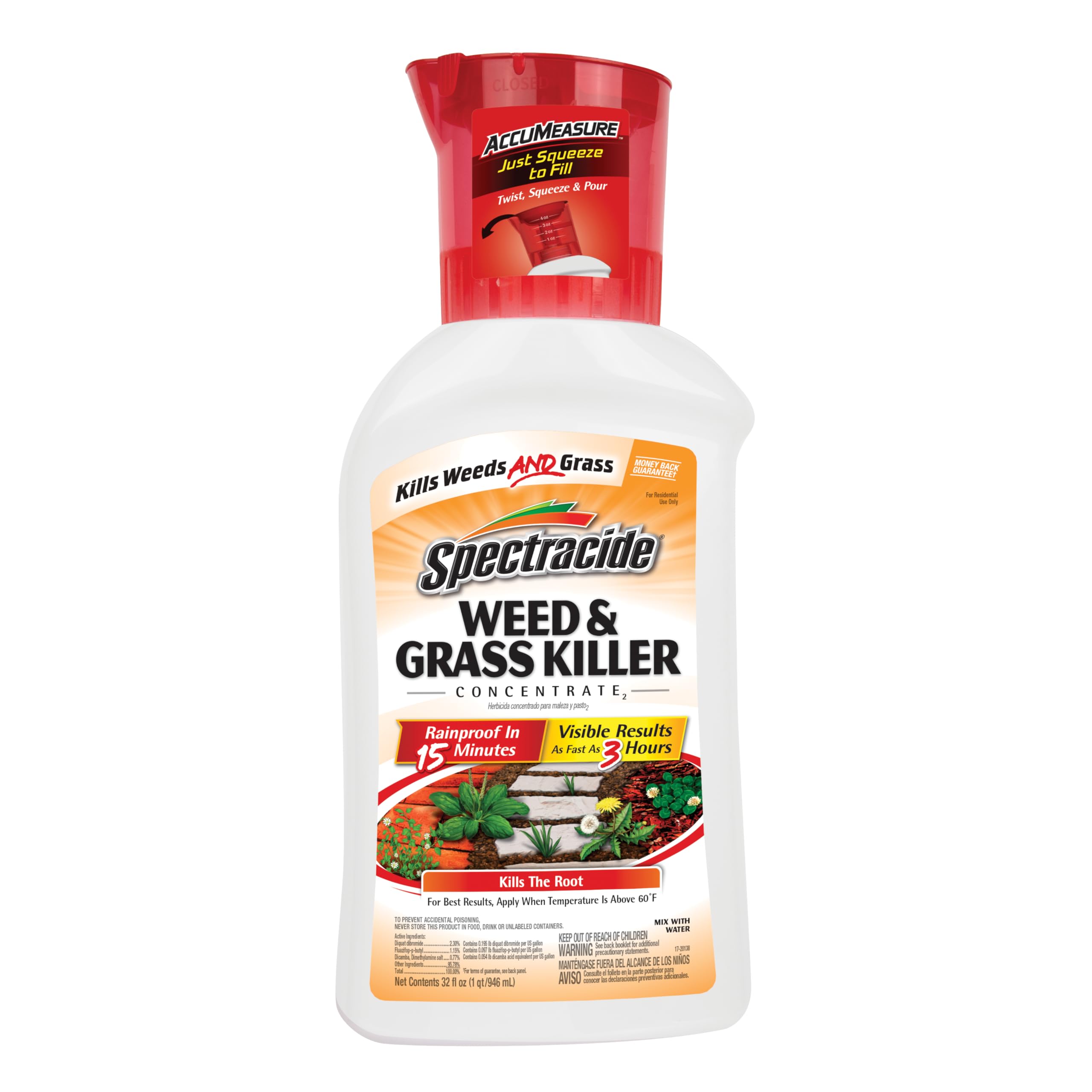
1. Spectracide Weed and Grass Killer Concentrate 32 Oz
Our pick — 4.5+★ from 700+ verified ratings; the strongest balance of quality and price.
Diquat dibromide concentrate that browns leaves in as little as 3 hours.
If your morning glory is climbing a chain-link fence, pushing through a driveway crack, or creeping along a walkway edge, this is where most people should start. The number that does the work is three hours — the label states visible results as fast as 3 hours, which is the kind of feedback loop that stops you from over-spraying out of doubt. The active ingredient is diquat dibromide, a contact herbicide, meaning it goes after the green tissue it touches rather than being absorbed slowly through the root system.
The other figure worth knowing is 15 minutes. That is the rainfast window — rainfall or watering 15 minutes after application will not wash away effectiveness. For anyone who sprays on a Saturday and then watches a grey sky roll in, that single window is the difference between being done and starting over. It comes as a 32 fluid ounce concentrate that you mix into a tank sprayer, with a stated coverage of 1,350 sq ft.
That coverage is where you need to be honest with yourself. Compared with the Southern Ag Trimec bottle and the Roundup for Lawns2 bottle — both listed at 5,000 sq ft off the same 32 fl oz — this one is the small-area tool of the group. One bottle will not clear a long rural fence line. What wins people over is plainly the kill itself, and it is the spray that does not care what it hits, so keep it off anything you want alive. The Accumeasure cap that twists, squeezes, and pours draws divided reactions; it saves you hunting for a measuring cup, and plenty of people would rather just use their own.
What earns its keep
- Visible results as fast as 3 hours, so you see progress the same day
- Rainfast 15 minutes after spraying — a passing shower does not undo your work
- Kills the green tissue it touches down to the root, so you can replant the same weekend
- Mixes clean into a tank sprayer and coats leaves evenly
Where it runs short
- 1,350 sq ft of coverage is modest next to the 5,000 sq ft bottles in this lineup
- The self-measuring cap splits opinion — some find it handy, others find it fussy
- It is non-selective, so overspray on a windy day reaches plants you want to keep
Reach for this if: you are clearing a driveway, patio edge, or fenceline and want to see brown leaves the same afternoon.
Think twice if: your morning glory problem covers a large open bank — the coverage figure will have you buying again quickly.
2. Southern Ag Lawn Weed Killer with Trimec 32oz
A three-weed blend that treats your whole yard without tearing up the turf.
Here is the case where 32 fluid ounces stretches a long way: this bottle is listed for 5,000 sq ft, which is a genuine whole-yard figure rather than a spot-treatment one. The formula is a patented combination of three proven weed killers, sold as Trimec, and the label names 9 turf types it is cleared for. If your morning glory has crept into the lawn itself rather than up a fence, this is the class of product you want — it targets the weed, not the grass around it.
The label suggests pairing it with a surfactant for increased performance, which is a small extra step that helps the spray cling to waxy leaves instead of beading off. Directions cover both conventional and hose-end sprayers, so a basic end-of-hose bottle works. Buyers report good results mixing at 2 oz per gallon, avoiding rain for 24 hours, and spraying young weeds rather than mature ones — and that last point is the honest limit here. Trimec-type formulas do their best work on weeds that are still growing.
What you have to plan around is return visits. Several users describe strong knockdown followed by weeds coming back within a few weeks, which points to the lack of long-season residual control rather than a weak mix. Treat this as one tool in a rotation, not a one-and-done season killer. Grass damage is possible if you spray the entire yard rather than spot-treating, so be deliberate about where the nozzle points.
The practical read: if weeds keep coming back in the same lawn spots, this bottle treats a lot of ground and works with sprayers you already own — just budget for a second application weeks later.
The honest limit: it knocks weeds down fast but does not keep them down, and treating a full yard rather than individual patches can set back the grass you were protecting.
Best matched to: a homeowner with a broad lawn full of clover, spurge, and dandelions who is willing to re-spray in a few weeks.
Not the right tool for: a wall of woody vine — you want the brush formulas further down for that job.
3. Roundup for Lawns2 Concentrate, 32 fl. oz.

Built for cool-season grass, with a two-week clock you have to accept.
Cool-season lawns need a different formula, and this bottle says so on the label. It is listed for Northern grasses including Kentucky Bluegrass, Perennial Ryegrass, Fescue spp. including Tall, Red, and Fine Leaf Fescues, and Zoysiagrass. If you live in a cool-season climate and your morning glory has moved into the turf, check that grass list first — spraying a formula meant for the wrong turf type is how people damage a lawn they were trying to save.
The scope here is broad: the label states it kills 253 types of weeds as listed, covering crabgrass, dandelion, clover, yellow nutsedge, poison ivy, chickweed, oxalis, and purslane, with up to 3 month weed control as listed. It is rainproof in 3 hours, and the 32 fluid ounce concentrate covers 5,000 sq ft, matching the Southern Ag Trimec bottle on ground treated per bottle. Mix it in a tank sprayer or a Dial ‘N Spray and apply evenly.
Expect a slow burn on speed, though. It starts working immediately per the label, but visible change often takes about two weeks on the tougher targets, and crabgrass is the recurring weak spot — owners mention it shrugging off a first pass and needing a heavier, well-saturated second application with a pump sprayer before it finally gave. Overspray is the other risk: keep it off windy days because desirable plants in flower beds are vulnerable. Judge this one on the grass list and the coverage, not on instant gratification.
Why it earns a spot: a named Northern-grass list plus 5,000 sq ft of coverage makes it a straightforward fit for a cool-season lawn, and the 3-hour rainproof window buys you slack on timing.
The catch: crabgrass can take repeat, heavy applications, and it is not a fast visual win — plan on roughly two weeks before you can judge it.
Pick this when: your turf is fescue, bluegrass, ryegrass, or zoysia and you need a broad weed list handled without losing the lawn.
Look elsewhere if: you are facing woody vines on a fence — this is a turf product, not a brush killer.
4. Image Brush & Vine Killer Concentrate, 32 oz
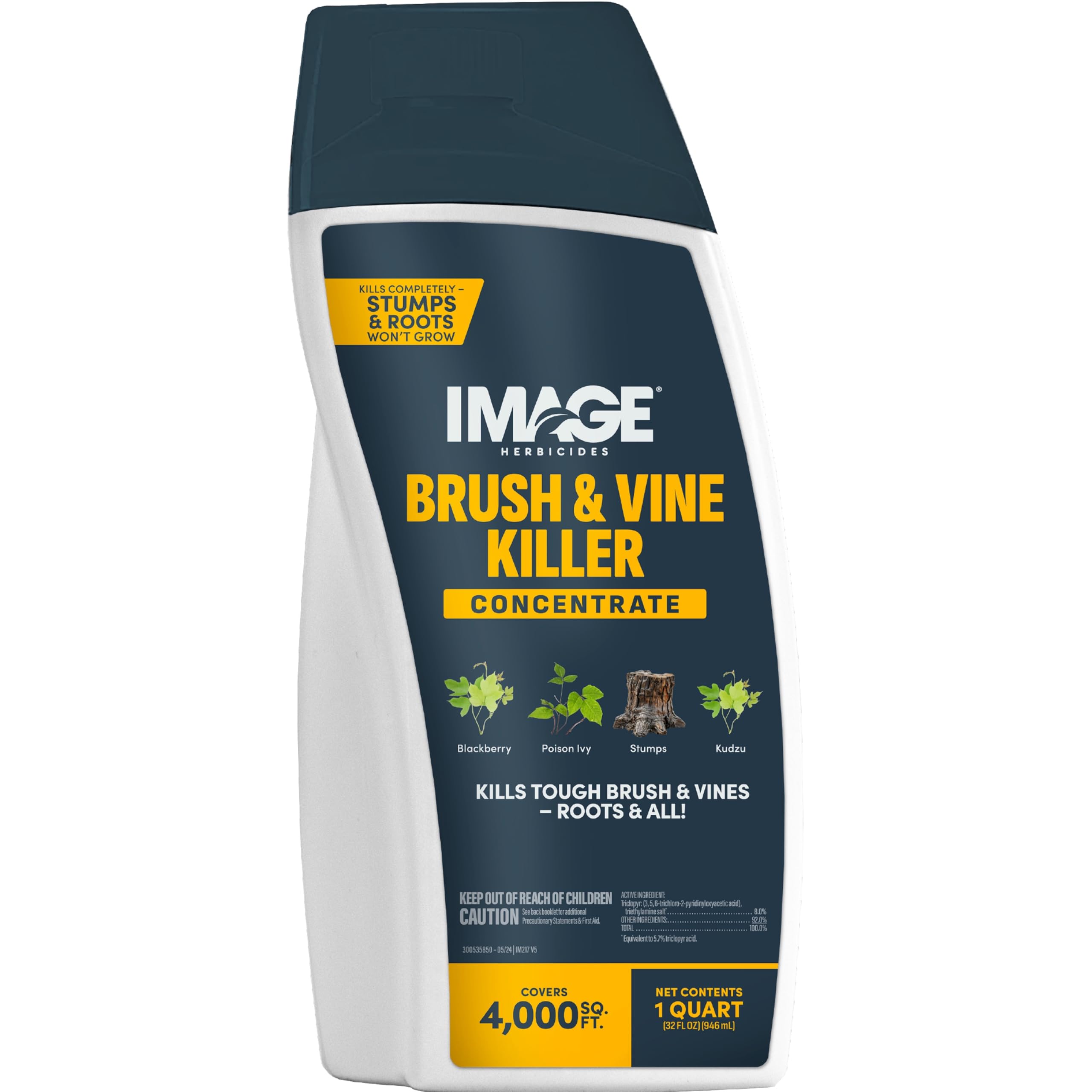
Imazaquin concentrate labeled for vines, brush, and stumps — not turf.
This is the closest match on the list to what a morning glory problem actually is. The label names tough weeds, grasses, vines, brush and stumps including poison ivy, poison oak, poison sumac, wild blackberry and other listed plants, and states it kills roots and all with no regrowth from the roots. The active ingredient is ammonium salt of imazaquin, and one 32 fluid ounce bottle is listed for 4,000 square feet.
Weight tells you something practical too — at 2 pounds it is lighter than the Spectracide bottle at 2.5 pounds, so it is easier to haul along a fence line or up a slope in a backpack sprayer. Speed is where you must be patient. Users describe yellowing starting around 10+ days at a 4 oz per gallon mix, with most leaves yellow by three weeks, and a faster response at 5 oz per gallon going brown and dry by week four. Fall spraying is often recommended for woody vines, with results judged on spring regrowth.
Reviewers keep reporting the same thing: this kills plants that shrug off ordinary lawn weed killer — blackberry stands and poison ivy are the repeated examples. The reason is that the vine’s crown, not just its leaves, has to die. That also means it is not a lawn product and should not be broadcast over grass you want. Save it for blackberry and poison ivy that lawn formulas have already failed on.
Where it delivers
- Label targets vines, brush and stumps, with a stated complete kill and no root regrowth
- 4,000 sq ft of coverage from a single 32 fl oz bottle
- Lighter to carry than the Spectracide bottle — 2 pounds versus 2.5 pounds
- Handles blackberry and poison ivy that lighter formulas leave standing
Where it asks for patience
- Yellowing can take 10+ days; full browning runs into weeks
- Results can hinge on mixing strength and on fall versus summer timing
- Not a turf product — keep it off grass and desirable plants
If vines are the enemy: this is the formula class built for the job, and the root-kill claim is the reason to choose it over a lawn weed killer.
The trade-off to accept: you will wait well past a week to know if it worked, so spray and then leave it alone.
5. Southern AG 01113 Brush Weed Killer, 1 Quart (32 oz)

Triclopyr in a quart bottle, aimed at vines, brush, and cut stumps.
The active ingredient here is triclopyr (a vine-killing herbicide), and the label lays out its lane clearly: it kills vines and many hard to control plants, and prevents sprouting on clean-cut stumps. It is meant for non-crop areas like road sides, rangeland, pastures and fences. That fence and roadside framing is exactly where morning glory tends to win, and the stump clause is a useful extra — if you cut a woody vine back and then treat the fresh cut, you are attacking the part that keeps regenerating.
Coverage is quoted differently from the rest of this list: 512–1024 square feet per gallon, so you are measuring in mixed gallons rather than a single bottle figure. That makes the quart a concentrate you dilute and stretch, and the small bottle size is not the whole story. Customers note it working on pokeweed in about a week and taking blackberry bushes and cherry trees down within a week of a morning application before several full-sun days.
Where you need to slow down is the word “most.” Triclopyr is strong on the plants it is listed for, and a strangler fig is the named example where it did nothing. Woody plants with different physiology can simply ignore it. Overspray near desirable plants is the other caution — this is not a spot-and-forget spray. And as with any brush killer, the clock is slower than a contact herbicide, so judge it after a week, not an hour.
The standout spec: triclopyr with a stump-sprout claim is the combination you want when the vine keeps coming back from a cut stem, and it is a genuinely different tool from the lawn bottles above.
One real miss to know about: results vary by species, and some tough woody plants come through it untouched — so plan a test patch first.
Suits you if: you are working a fence line, roadside, or pasture edge and need vines and cut stumps handled on rough ground.
Worth skipping if: your target is broadleaf weeds in a manicured lawn — this is not that formula.
Know the Specs
Coverage in Square Feet
This is the number that tells you how far a bottle actually goes. A 32 fluid ounce bottle listed at 5,000 sq ft treats far more ground than one listed at 1,350 sq ft — same bottle size, very different value for a long fence line. Work out your area before you buy, and remember that heavy vine growth often needs a stronger mix than a light weed patch.
Active Ingredient
The active ingredient is the chemical doing the killing, and it decides the job. Diquat dibromide is a contact herbicide that works on the green tissue it touches. Imazaquin and triclopyr are absorbed and move toward the root or crown, which is why they suit vines and stumps. A three-way blend is aimed at turf weeds. Pick the ingredient class for your plant: contact for green tissue, systemic for roots and crowns.
Rainfast Window
Rainfast means the spray has bonded to the leaf well enough that rain will not wash it off. One product states rainfall or watering 15 minutes after application will not wash away effectiveness; another is rainproof in 3 hours. Check that figure against your local forecast before you mix, because a wash-off means a full repeat application.
Concentrate Versus Ready-to-Use
A concentrate is a bottle you dilute into water in a tank, hose-end, or pump sprayer. It costs less per treated area and lets you adjust strength — users of several of these products describe mixing at 2 oz per gallon or 4 to 5 oz per gallon depending on how tough the plant is. The trade-off is that you must measure carefully and store the mixed product safely.
Common Questions
Will a lawn weed killer get rid of morning glory vines?
How long does it take to see morning glory die after spraying?
Will these herbicides kill my grass too?
What happens if it rains right after I spray?
Can I spray morning glory that is growing in my flower bed?
Does brush and vine killer really kill the roots?
How much area does one bottle of concentrate cover?
Is triclopyr better than the other active ingredients for vines?
Can I use a hose-end sprayer with these concentrates?
How do I stop morning glory from coming back next season?
The Bottom Line
For most people fighting morning glory on a driveway, fenceline, or patio edge, the Spectracide Weed and Grass Killer Concentrate is the place to start. It is rainfast in 15 minutes (rain won’t wash it off after that), shows results as fast as 3 hours, and kills down to the root so you can replant the same weekend. Its only real ask is ground area, at 1,350 sq ft per bottle.
If your vines are the woody, stubborn kind — blackberry, poison ivy, stumps that keep sprouting — go straight to the Image Brush & Vine Killer for its stated root-and-all kill. Choose the Southern AG 01113 Brush Weed Killer if you also want to stop sprouting on cut stumps. And if the morning glory has crossed into the lawn, the Southern Ag Trimec covers 5,000 sq ft and is built for turf. Match the bottle to where the vine grows: turf formulas for lawn, brush formulas for fence lines.
How we choose
We do not accept paid placement. Every pick is matched to a real buyer and a real use-case; we do not hands-on test units.
Sources
Specifications: manufacturer listings and product documentation. Review insights: verified customer reviews, as of October 2026. Pricing: not shown on this page (it changes often); check the current price via the retailer link.
As an Amazon Associate, Aappliancez earns from qualifying purchases. This does not affect which products we feature.