Disclosure: Some links in this post are affiliate links. As an Amazon Associate I earn from qualifying purchases, at no extra cost to you. Learn more
Specs are compiled from manufacturer listings and verified buyer reviews and can change over time — please confirm the key details on the product page before buying.
You spray horsenettle, the leaves brown, and weeks later it is back — because it spreads by a deep creeping root system, so a spray that only browns the leaves can leave the plant alive underground. The fix is a product whose active chemistry actually travels down into that root. The picks below are built to do it, from triclopyr brush killers to a surfactant (a spray additive that helps liquid stick) that makes any spray cling to horsenettle’s fuzzy leaves. Each pick is sorted by what it actually controls, so you can match the bottle to your pasture, fence line or lawn instead of guessing on the shelf.
This guide is built by comparing the manufacturers’ published specifications and the patterns across verified customer reviews, so you get each pick’s real strengths and trade-offs instead of marketing spin.
Each entry below lists what the product physically is, which weeds it targets, and the mixing or coverage details that decide whether it works on horsenettle in your particular patch. You’ll see exactly which one travels to the root and which one only burns the top. That match is the whole game with the herbicide for horsenettle you finally carry home.
Top Picks

How To Choose The Best Herbicide for Horsenettle
Horsenettle is a perennial with prickly stems and a root network that keeps sending up new shoots long after the top dies. That single fact drives every buying decision. You are not shopping for something that yellows leaves fast. You are shopping for something that moves down into the root and stays lethal long enough to finish the job.
Match the active ingredient to where you’re spraying
A triclopyr-based brush killer (triclopyr is a selective herbicide that targets broadleaf plants and woody growth) travels into the root system, which is what horsenettle demands. A 2,4-D blend is a broadleaf weed killer that can knock back tops but often needs repeat passes on tough perennials. If your horsenettle is mixed into grass you want to keep, you need a product the label says will not harm the surrounding grass — read that line before you buy, not after.
Check the coverage number before you commit
Concentrates quote coverage in acres or square feet, and that tells you how far one bottle stretches. A gallon that covers about an acre suits a fence line and a few pasture patches. A quart covering 5,000 square feet fits a yard-scale job. Buy bigger than your immediate patch if the root is widespread — you will likely need a follow-up pass.
Plan for a second application
Horsenettle regrows, so treat the first spray as round one. Labels that call for two or three applications are being honest about perennial roots, not underselling. A surfactant (a liquid additive that helps the spray spread and stick to the leaf instead of beading off) earns its place on horsenettle’s fuzzy, slightly waxy foliage because it helps the active ingredient get into the plant.
Side-by-Side Comparison
| Model | Best For | Active Type | Volume / Size | Stated Coverage | Amazon |
|---|---|---|---|---|---|
| Remedy Specialty Herbicide★ Best Overall | Pasture and fence-line brush | Triclopyr concentrate | 1 gallon | Brush and mid-size trees | Amazon |
| Southern Ag CrossbowTop Coverage | Woody brush and broadleaf weeds | Garlon and 2,4-D | 128 fluid ounces | 2.23 acres | Amazon |
| GORDON’S Trimec Plus | Lawn weeds including crabgrass | 3-way herbicide blend | 32 fluid ounces | 5,000 square feet | Amazon |
| Liquid Harvest Surfactant | Adding to your own mix | Non-ionic surfactant | 32 fluid ounces | — | Amazon |
| Whitetail Institute Arrest Max | Food plots with clover | Selective grass herbicide | 8 fluid ounces | 1–4 acre treatments | Amazon |
| Sulfentrazone 4SC (Dismiss) | Established turf and sedge | Sulfentrazone | 6 fluid ounces | Established turfgrass | Amazon |
| Crossbow Herbicide Brush Killer | Driveway and fence-line brush | Herbicide concentrate | 1 gallon | About 1 acre or less | Amazon |
Detailed Reviews
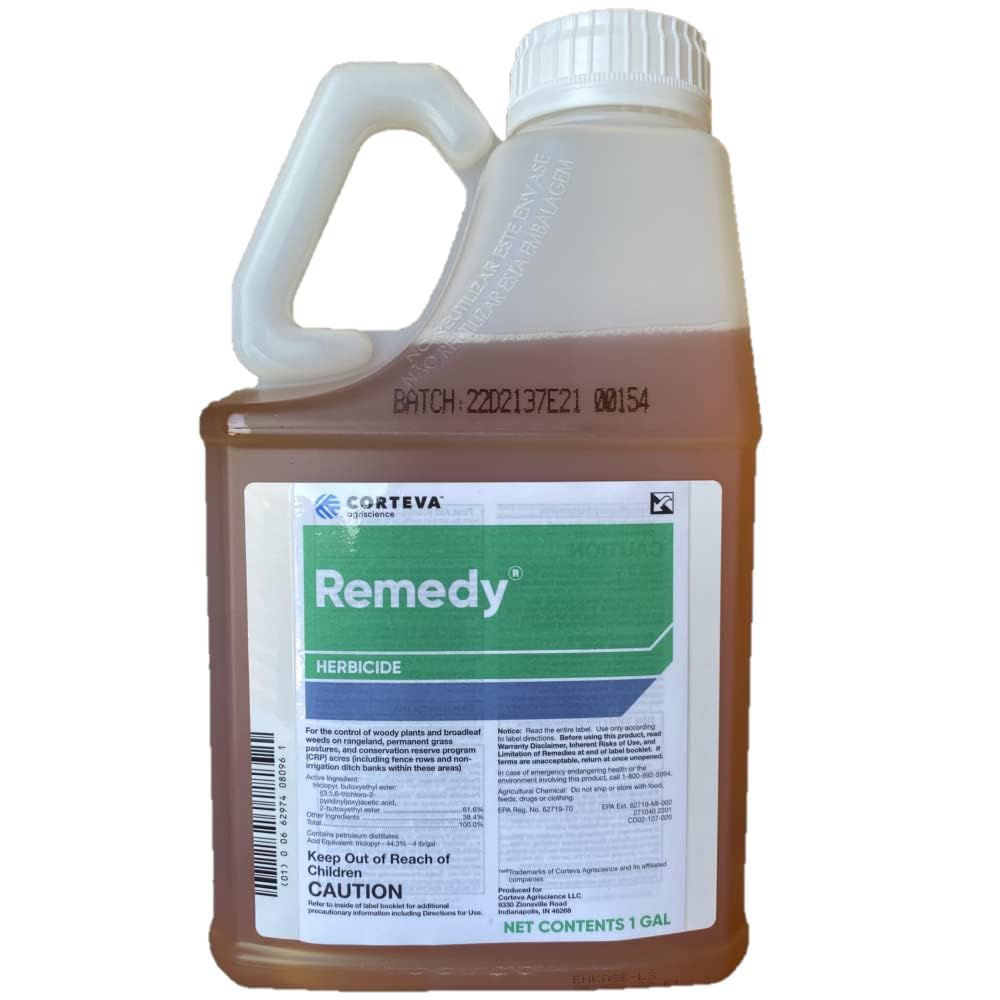
1. Remedy Specialty Herbicide Weed Killer & Brush Control
Our pick — 4.5+★ from 850+ verified ratings; the strongest balance of quality and price.
The triclopyr concentrate that hits roots and tops, made for pasture and fence lines.
Remedy earns its spot because triclopyr — a selective herbicide that targets broadleaf and woody plants — does the one thing horsenettle punishes you for skipping: it works down into the root system as well as the top growth. That dual action is what separates it from a straight 2,4-D lawn spray, which only eats away at the leaves. One gallon is a full 128 fluid ounces, and the label sets it up for pasture restoration, encroaching brush and routine fence-row maintenance. If you are treating a pasture, fence line or rough ground, this is the one to carry home; if you only need to spot-treat a small lawn patch, a quart-sized lawn product covers you for less.
The mixing math is generous. Buyers report that 4.5 cups per 26 gal water takes down pasture trees and brush up to 5 ft tall and 2 in diameter, with wilting in about a week and the root system killed. That is the kind of slow, thorough die-back you want on a perennial — fast yellowing means very little if the root survives. It is low-odor for a triclopyr concentrate, and the maker states it is safe around children and pets when applied according to the label — which matters on a working pasture.
The catch is honest: the value question splits people. Some find it worth what it costs and others find it pricey, so plan to buy enough for a second pass rather than treating one spray as a guarantee. It is also not a grass-safe lawn product — this is a brush and broadleaf tool aimed at pasture, fence line and rough ground, not a fine turf. The crowd has noticed the results, too: this is the highest-rated pick here at 4.5+ stars across 800+ owners.
Where Remedy Pulls Ahead
- Triclopyr chemistry that works root and top, not just the leaves
- One gallon of concentrate with a label built for pasture and fence rows
- Low-odor triclopyr formula with a maker statement on safe use around children and pets per the label
- Wilting reported in about a week on brush up to 5 ft tall
What To Weigh First
- Buyers split on value — some consider it pricey for the volume
- Not a turf-safe lawn product; brush and broadleaf ground only
- Perennial roots usually mean a follow-up application
Go with it for: pasture renovation, fence lines and encroaching brush where the root has to die, not just the top.
Think twice if: you’re treating a manicured lawn and need something the label says won’t touch the grass.
2. Southern Ag Crossbow Specialty Herbicide
A gallon that stretches to 2.23 acres and makes up to 96 gallons of spray.
The Southern Ag Crossbow gallon covers ground in a way lawn-sized bottles cannot: 128 fluid ounces that reach 2.23 acres, with the label stating it makes up to 96 gallons of spray solution. For a large pasture or a long perimeter of brush and broadleaf weeds, that spread means fewer bottles to buy and fewer trips to refill. The 4.0x gap in liquid volume against GORDON’S Trimec quart — 128 fluid ounces versus 32 — tells you how differently these two are built. Buy this one when acreage is the job; a homeowner with a single fence line will never finish the bottle.
It blends Garlon (a brand of triclopyr) with 2,4-D, so you get the woody-plant action of triclopyr alongside a broadleaf weed killer. Owners mention 85-95% kill on creeping charlie in Ohio and 70-100% in Indiana, but just 30-60% in rich Northern Illinois soil — soil and timing change the result. It kills jewelweed and pokeweed overnight, but the same report calls it ineffective on wild violets and poison hemlock, and notes rain within days cuts its efficacy.
The honest friction is odor and handling. This is a strong-smelling concentrate that calls for gloves, and you want to spray early on a warm, dry day so it has time to work before rain — the same buyer noted avoiding rain within 3 days. The other plus is value: unlike Remedy, where the cost question divides people, this one lands on the positive side of that ledger for most.
Why it earns a slot: 2.23 acres of coverage and up to 96 gallons of mixed spray from one 128-fluid-ounce gallon, which is what large ground actually needs.
The working constraint: results swing with soil and weather, and it takes a strong odor and gloves to use comfortably.
Reach for this if: you’re covering a big pasture or long brush line and want one bottle to go the distance.
Look elsewhere if: your target is wild violets or poison hemlock, which this blend is reported not to touch.
3. GORDON’S Trimec Plus Crabgrass Killer Concentrate

The three-way quart for lawns where the grass needs to survive the spray.
If your horsenettle is sitting in a lawn you want to keep, this is the one to consider before the brush killers. Trimec is a 3-way herbicide blend that controls emerged grassy weeds such as crabgrass, foxtail and signalgrass, plus 200+ common broadleaf weeds as listed — dandelions and plantain among them. A single quart covers 5,000 square feet, which makes it the yard-scale option next to gallon-size brush products.
For a perennial like horsenettle, the label behavior is the part that matters. Henbit, a tough winter broadleaf, gets knocked back by Trimec as well as or better than other 2,4-D products, but it takes two or three applications — saturate in late winter or early spring when first seen, wait 7–10 days, then soak again. A single pass lets it recover, and the same pattern is your warning on horsenettle: treat the first spray as round one. The formula kills the growing weeds but not the seeds, so a fresh flush can still come up later.
Its weak spot is stubborn grasses. Bermuda grass reportedly shrugged it off, and one North Georgia yard saw weeds only turn purple — the process started, but the kill did not finish. At 4.0+ stars across 400+ ratings it is the most modestly rated pick here, which fits a product that does its best work on broadleaf lawns rather than woody brush.
Best suited to: broadleaf weed cleanup on a lawn you intend to keep green, with a two-to-three-pass plan.
Not built for: Bermuda grass or deep-rooted woody brush, which this blend struggles to finish off.
4. Concentrated Surfactant for Herbicides Non-Ionic 32oz

The additive that makes your horsenettle spray stick instead of bead off the leaf.
This is not an herbicide on its own — it is the helper you pour into your tank. A non-ionic surfactant is a liquid that lowers the surface tension of the spray so it spreads evenly across the leaf instead of beading up and rolling off. On horsenettle, with its slightly fuzzy, waxy foliage, that difference can be the gap between a droplet that soaks in and one that slides to the dirt. The bottle is 32 fluid ounces, sold as its own separate product from your weed killer.
The real-world payoff is speed and staying power. One buyer reports weed death visible in 36 hours with the surfactant versus a week without it, plus longer-lasting control — a real edge on a plant that regrows. It helps on fuzzy-leafed targets in particular, and it works across a wide range of herbicides, both liquid and granular formulations, so it isn’t locked to one bottle. It’s also compatible with DI- and DIY-scale sprayer tank mixes. Do note it is not for sale in CA and WA.
What wins people over is straightforward effectiveness, and it lasts a long time for the volume — customers note that a little goes a long way. The trade-off is that you have to measure and mix correctly. A surfactant is a booster, not a substitute for the herbicide itself, and the plants can yellow as part of the process, which is expected rather than a fault.
The lift it gives: faster visible die-back and better leaf coverage, especially on fuzzy foliage that would otherwise shed the spray.
What it isn’t: a stand-alone weed killer — you still need an active herbicide plus a careful mixing ratio.
Pair it with: any triclopyr or 2,4-D spray when horsenettle’s leaf surface is shedding your mix.
skip it if: you’re in CA or WA, where this bottle isn’t sold.
5. Whitetail Institute Arrest Max Selective Grass Control

A small bottle built to kill grass in clover plots without killing the clover.
This is a niche tool, and its niche is narrow: it controls a broad range of annual and perennial grasses while the label says it is safe for Whitetail Institute perennial forages and any other clover or alfalfa plantings. That selectivity is the point. If your horsenettle is competing inside a clover or chicory food plot, a general brush killer would take the clover with it, and this is made to separate the two. The bottle is 8 fluid ounces, sized for treatments quoted at 1, 2 and 4 acre rates. If your weeds sit in open pasture rather than a food plot, a broad brush killer like Remedy fits better.
Patience is required. One plot report had grass yellow-streaked and purple-spotted at 7 days and roughly 100% dead by 13, with the clover surviving — so give it two to three weeks, not three days. Mow to about 4 inches and spray about a week later for the best result. It is rainfast (safe from rain wash-off) in 1–3 hours once it’s on and dry. Note that while it spares clover, the same report says it kills chicory, so check your plot mix first.
The mixed signals are real. Some plots get clean grass kill and lush clover; others report it didn’t work at all, and the value question draws the loudest complaints. The pattern in the negatives points to misapplication — following the label fully, including the 2-3 week window, is what separates the two outcomes. If you want grass-only control in a food plot and can follow directions exactly, this earns its place; if you want a fast all-purpose brush killer, it’s the wrong bottle.
The selective edge: the label gives it to you as safe for Whitetail Institute forages and any clover or alfalfa planting — that is a rare and specific property.
The patience tax: results run to 2-3 weeks, the value question divides buyers, and it kills chicory.
Built for: grass cleanup inside a clover or alfalfa food plot where you must not lose the plot.
Wrong tool if: you expect fast broad-spectrum brush kill or you’re protecting chicory alongside the clover.
6. Sulfentrazone 4SC Herbicide (Dismiss) 6 Ounces

Six ounces that start browning weeds in 24-48 hours — about the fastest here.
Sulfentrazone 4SC gets visible results in 24-48 hours, which is the quickest knock-down of anything on this list. That speed is chemistry: the active ingredient, sulfentrazone, works by interrupting an enzyme the weed needs for chlorophyll and heme biosynthesis, so the plant shuts down fast. The small 6-fluid-ounce bottle handles sedge, broadleaf and grassy weeds in established turfgrasses, and it’s cleared for use sites from residential and institutional lawns to athletic fields, golf course fairways and roughs and commercial sod farms.
It’s also a pre- and post-emergent product, so it can work both before weeds come up and on ones already growing. The proof of toughness is in the sedge: one report had yellow sedge turning in 2-3 days and staying away over a week, where a prior product needed respraying every two weeks. It controls broadleaf and grassy weeds in established turf without wrecking the lawn, and it plays well near ornamentals and vegetables when sprayed at the base — zinnias, marigolds, hollies and tomatoes among them, per one report.
The honest trade-off is a small bottle that asks for precision and a clear mixing ratio, and one note points out the label’s mixing direction could be clearer. Some sedge can return at six weeks and need a respray, and it earns a mixed word on value. It isn’t a horsenettle-specific root killer like the triclopyr products, but for fast top-kill in an established lawn, it’s the speed leader.
Where It Races Ahead
- Visible results in 24-48 hours, the fastest on the list
- Pre- and post-emergent action in one bottle
- Cleared for established turf, athletic fields and sod farms
- 6-ounce bottle a little goes a long way with, per buyer reports
What To Plan Around
- Mixing ratio isn’t clearly spelled out on the label
- Some sedge returns around six weeks and needs respray
- Mixed opinion on value per bottle
Best when: speed matters and you’re working established turf where a fast brown-down is the goal.
Less ideal if: you need a deep-root horsenettle treatment rather than fast top-kill.
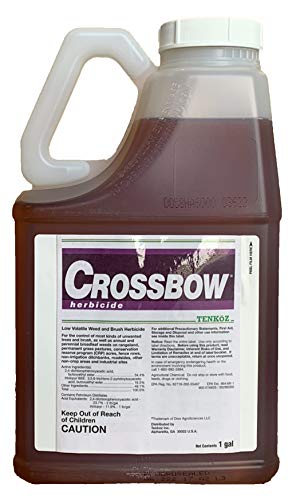
7. Crossbow Herbicide Brush Killer 1 Gallon
A gallon of brush and tree killer that browns growth within a day and holds regrowth back for months.
Crossbow is the blunt, fast option for fence lines, driveways and rough edges. This gallon is built as a brush and tree killer, covering about an acre or less, and it goes to work on broadleaf weeds, brush and small trees. It’s a name farmers reach for, and the pace is the draw: one report had it killing brush the same day, where a prior product needed reapplication after days. That speed is why it handles poison ivy and tough weeds in a single pass rather than a slow, repeated campaign.
The strength shows up on stubborn plants. Creeping Charlie, which shrugs off many sprays, gets killed here, and it works on tough weeds and brushy bushes. A key advantage is that it knocks plant life down fast and keeps it down — regrowth held back for months, per buyer reports. For a fence line or driveway edge you want cleared and kept clear, that one-and-done rhythm saves a lot of repeat spraying.
The honest catch is odor and the mixed word on value. This has a strong chemical smell, and opinions split between calling it cheaper than the name brands and finding it not worth the cost. It isn’t a delicate lawn product — this is a brush-and-tree tool for rough ground, so keep it away from turf you care about. At 4.5+ stars across 300+ owners, the results on stubborn brush are what people remember.
Pick it for: driveway edges, fence rows and brushy corners that need a fast, strong knockdown.
Don’t reach for it if: your target is inside a managed lawn or a planting you want to keep.
Know the Specs
Active Ingredient and Mode of Action
The active ingredient is what actually kills the plant, and it decides whether the chemical reaches the root or only burns the top. Triclopyr-based products like Remedy travel into woody and broadleaf root systems, which is what a creeping perennial demands. A 2,4-D blend works on broadleaf tops and often needs repeat passes. Sulfentrazone, by contrast, interrupts an enzyme the weed needs for chlorophyll (the green pigment plants use to make food), so it browns fast but acts more on the above-ground plant. Match the chemistry to if you need root death or quick top-kill.
Volume, Coverage and Application Rate
Volume tells you how far a bottle stretches and how many passes you can afford. A gallon typically covers a large acreage or a long brush line, while a quart covers a yard-scale area like 5,000 square feet. Because perennial weeds like horsenettle regrow, plan for more than one application and buy enough volume to do it. A surfactant added to the tank helps the spray spread and stick to the leaf, improving coverage so fewer spots get missed.
Common Questions
Which herbicide actually kills horsenettle to the root?
Can I use a brush killer on horsenettle in my lawn without killing the grass?
How long does it take to see horsenettle die after spraying?
Will rain right after spraying wash the herbicide off?
Do I need a surfactant to make horsenettle spray work?
How much concentrated herbicide do I need for my patch?
Is a sulfate or pre-emergent product better than a brush killer for horsenettle?
How safe is herbicide around pets and children after spraying?
Why does my horsenettle come back after one spray?
The Bottom Line
For most people dealing with horsenettle on pasture, fence line or rough ground, the Remedy Specialty Herbicide is the one to carry home because its triclopyr formula works the root and the top instead of just browning the leaves. If you have a large pasture and want the bottle to go the distance, the Southern Ag Crossbow stretches over 2.23 acres and up to 96 gallons of spray. And if the horsenettle is inside a lawn you want to keep, reach for the GORDON’S Trimec Plus — then add a surfactant so the spray sticks to that fuzzy leaf and does its work.
Whichever bottle you pick, treat horsenettle as a root problem, not a leaf problem: one good pass down into the root beats three fast ones that only burn the top.
How we choose
We do not accept paid placement. Every pick is matched to a real buyer and a real use-case; we do not hands-on test units.
Sources
Specifications: manufacturer listings and product documentation. Review insights: verified customer reviews, as of October 2026. Pricing: not shown on this page (it changes often); check the current price via the retailer link.
As an Amazon Associate, Aappliancez earns from qualifying purchases. This does not affect which products we feature.