Disclosure: Some links in this post are affiliate links. As an Amazon Associate I earn from qualifying purchases, at no extra cost to you. Learn more
Specs are compiled from manufacturer listings and verified buyer reviews and can change over time — please confirm the key details on the product page before buying.
Your hay crop is only worth what the weeds leave behind. Thistles, buttercup, poison ivy, cattails and brush steal moisture, crowd out tender grass, and cut the feed value of every bale you pull off the field. A selective broadleaf herbicide kills thistle and buttercup while leaving your hay grass standing. This guide covers seven weed and brush killers sold on Amazon, each matched to a hay-field job — pasture broadleaf, bare ground, brush, big acreage, cool weather, pond edge or granular.
This guide is built by comparing the manufacturers’ published specifications and the patterns across verified customer reviews, so you get each pick’s real strengths and trade-offs instead of marketing spin.
Some sprays knock weeds back in days, others hold the ground bare for months, and a few are built only for water edges. Below you’ll find which bucket each one belongs to before you spend a cent on the best herbicide for hay fields.
Top Picks

How To Choose The Best Herbicide for Hay Fields
Buying the wrong jug wastes money and, worse, can set your field back a whole season. The trick is to match three things: what you want dead, what you want to keep, and how much ground you need to cover. Nail those three and the mixing, timing and equipment decisions follow.
Know what you want gone
A broadleaf-only broadleaf killer like 2,4-D handles thistle, buttercup and plantain without touching the grass around it. A non-selective product takes down everything it touches, including the fescue you were counting on, so it belongs on fence lines and bare spots, not across a hay meadow. Read the label to see whether the jug is selective or not — that one word decides your whole plan.
Match the coverage to your acreage
Coverage tells you how far one bottle stretches, so you don’t run out halfway across the field. A gallon jug that makes up to 96 gallons of mixed spray covers far more ground than a 32-ounce concentrate, even though both look small on a shelf. Multiply your field width by its length before you buy, so you are not left with a half-sprayed meadow.
Think about what happens after the spray
Some products burn the weed down and let it sprout again in weeks. Others carry soil activity that keeps new seedlings from germinating, which is why bare ground stays bare for up to a year. Decide if you want a fast knockdown or lasting bare ground — the shelf full of options splits cleanly between those two jobs.
Side-by-Side Comparison
| Model | Best For | Active Ingredient | Coverage | Form | Amazon |
|---|---|---|---|---|---|
| Southern Ag Crossbow Specialty Herbicide★ Best Overall | Broadleaf weeds in pasture | Garlon, 2,4-D | 2.23 acres | Liquid | Amazon |
| Hi-Yield (32171) Killzall 365Best For Bare Ground | Bare-ground and fence-line control | Glyphosate + imazapic | Up to 17,200 sq ft | Liquid | Amazon |
Detailed Reviews
1. Southern Ag Crossbow Herbicide 128oz
Our pick — 4.5+★ from 800+ verified ratings; the strongest balance of quality and price.
The pasture workhorse that mixes one gallon into 96 gallons of spray.
One gallon of this concentrate mixes into up to 96 gallons of spray solution, and that is why it earns the top spot. That coverage figure is the whole story — you get roughly 2.23 acres of field treated from a single jug. So a small hay operation can spray a barn-size pasture multiple times before it runs dry.
What wins people over is straightforward effectiveness: broadleaf weeds and brush go down hard on a warm, dry day. Buyers report poison ivy knocked back the same day and weeds staying gone for months. Owners mention this one beats Roundup, which they say needed reapplication to hold the line. The 2,4-D plus Garlon (the trade name for the triclopyr in the mix — triclopyr is what targets woody plants) combination is what does it: broadleaf weeds take the hit without your grass losing its place in the field.
One honest catch: kill rates swing with your soil. Customers note 85–95% control on brownish Ohio ground, 70% in Indiana, but only 30–60% in rich black Northern Illinois soil — and rain within a day or two cuts the result. It also runs a tad shy of premium products for texture and total kills, which is the trade-off buyers weigh. The faint chemical smell and the glove-and-tank discipline it demands are the normal cost of doing business with any 2,4-D concentrate.
The 96-Gallon Advantage
- Makes up to 96 gallons of mixed spray, covering roughly 2.23 acres per jug.
- All-season broadleaf control including poison ivy and creeping weeds.
- Kills broadleaf weeds without broad-spectrum damage to pasture grass.
- Works on annual and perennial weeds plus small trees and brush.
Where It Calls a Draw
- Efficacy drops sharply on rich black soils and in high rainfall years.
- Sold while the shelf life is shorter than some competitors marketed for multi-year storage.
- Requires careful mixing, gloves and dry weather — don’t spray before rain.
The best overall for most fields: If you cut hay off a few acres of mixed pasture and need broadleaf and brush control that earns its jug across multiple spray seasons, this is the one — 2.23 acres of coverage and a 2,4-D plus Garlon formula that handles thistle, ivy and unwanted woody growth.
What to weigh first: Kill rates fall off a cliff in rich black soil and high rain, so if your ground runs heavy and wet, plan on reapplying.
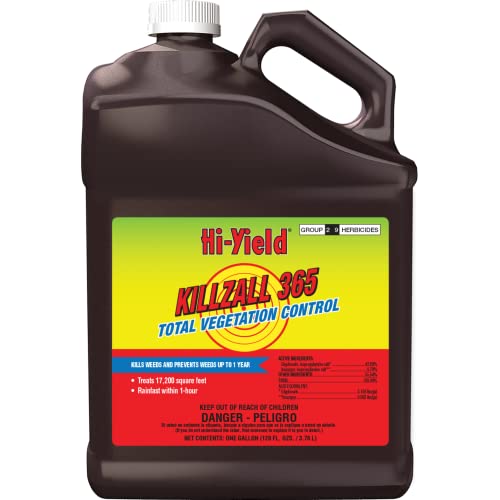
2. Hi-Yield (32171) Killzall 365, 1 gal
A gallon that treats up to 17,200 square feet and keeps bare ground bare for months.
Fence lines, barn approaches and non-crop ground you want stripped clean are what this jug is made for. A single gallon mixes to treat up to 17,200 square feet, and each jug carries enough concentrate to do that job repeatedly rather than once. That is 17,200 square feet of fence line or driveway cleared per gallon.
Here’s what actually happens when you spray it. Bare ground stays bare — reviewers point out one lot sprayed four months earlier still had no grass back on it. That staying power comes from the imazapic added to the glyphosate, which extends the knockdown well past what a plain glyphosate jug delivers. Glyphosate is a non-selective killer (it takes down any plant it touches), and the label says up to a year of residual control.
The one caveat that keeps this off your hay rows: with a glyphosate base it is non-selective, so spray drift onto pasture can take out grass you meant to keep. Site it on driveways, fence posts, edges, and ground you want kept clear, and mix 6 oz of concentrate per 1 gallon of water for spot work. Treat it as a whole-section reset, not a spot spray.
Where it wins: The gallon covers up to 17,200 square feet at straight mix rates. It holds bare ground for months in sandy soil, and it comes in cheaper per mixed gallon than the Southern Ag Crossbow.
The trade-off to plan around: Because the formula is non-selective, drift onto pasture grass burns it. And one buyer using it in sandy soil found it only held three to four months there — the label even notes the shorter hold in sandy ground, so sandy acreage needs a reapplication plan.
The bare-ground specialist: Fence lines, driveways and non-crop areas stripped and stayed clear are its job. A hay meadow you plan to cut is not — drift here burns grass you wanted.
3. Crossbow Herbicide Brush Killer 1 Gallon
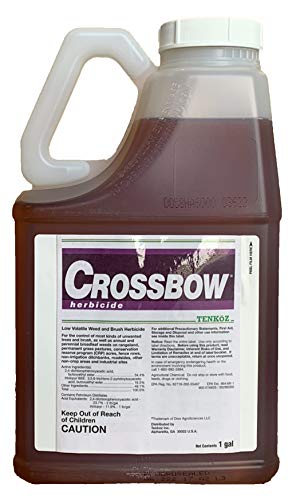
Built to take down the woody stuff — brush, shoots and small trees.
When the problem across your hay ground has bark on it, this is the jug. The blend of 2,4-D and triclopyr hits broadleaf weeds, brush, and small trees alike, and a gallon treats approximately 1 acre or less of that mix. Shoppers say the shoots of trees and brush start dying off within days of the first pass.
It also holds up against creeping Charlie where most standard sprays fall short. On the everyday job — a fencerow grown over with vines, saplings and broadleaf weeds — it delivers. Warm, dry weather improves the kill, and this particular gallon carries a heavier, more concentrated feel in the jug than the Southern Ag does, which matters when you are reaching for it off a high shelf.
Coverage is the honest catch: approximately 1 acre or less per gallon is the tightest reach on this list, so a large hay meadow will need multiple jugs. The label does not go out of its way to spell out whether the ground will support a planted crop afterward, so treat the sprayed acres as a reset and plan your seeding around it. The 2,4-D-and-triclopyr combination is broadleaf and woody-specific, not a grass-safe choice for spraying across established pasture you plan to harvest.
Read this before you buy: Crossbow works best as a fence-line and brush-control tool. Coverage is approximately 1 acre or less per gallon, so it is a precision weapon, not a field-wide application. If your hay acreage needs broad-spectrum coverage, a bigger jug with more reach makes more sense.
For the fencerow and the thicket: Saplings, vines, and woody brush along the edges of your hay ground are what this gallon is best at. It is not built for a field-wide pass — plan on a different jug for that.
4. Dow Milestone Specialty Herbicide with Aminopyralid 32 oz

A 32-oz bottle that stretches across 4 to 7 acres of pasture.
A 32-ounce bottle treating between 4 and 7 acres is the widest coverage on this list. That reach comes in a compact, lighter jug than any gallon-size herbicide on the shelf, so carrying it to the far end of a field is easier. The aminopyralid in it is a pasture-specific active ingredient (a chemical that only targets certain plants) labeled for rangeland, permanent grass pastures and CRP acres — the exact settings hay producers work in.
The effectiveness story here matches the acreage. Buyers report Milestone ran two years on a 4-acre horse pasture, aimed at buttercup and plantain in early spring. Bull thistle and teasel also came down. Used once a year or split into two or three more dilute applications, it does the job on rangeland. Mix small: a 32-ounce bottle covers 4 to 7 acres, and stored cool and dry it keeps three to five years.
Here is the honest part. Some broadleaf weeds survive the spray — the plants look sick but regrow, which is why some users mix Milestone with 2,4-D to push the kill rate higher. And because it is a soil-active chemical, ground sprayed with it can stay dead to new growth for at least two years. That makes it great for permanent pasture and dangerous for any spot you plan to reseed.
The acreage math: At 4 to 7 acres of coverage from a 32-ounce bottle, the value per treated acre beats the gallon jugs when you count the whole field in one job.
Weeds it can leave standing: Milestone makes many weeds look sick without killing them off completely — the plants can come back, so plan on a follow-up or mixing partner for the stubborn species.
Widest acreage coverage here: Field 4 to 7 acres of permanent pasture on buttercup, plantain, thistle or teasel and want one bottle to do the whole run, this is the best fit. skip it if you plan to reseed that ground within the next couple of years, since aminopyralid leaves the soil dead to new growth for a long stretch.
5. PBI Gordon SpeedZone EW Herbicide

The cool-weather broadleaf killer that shows clover damage within a week.
Broadleaf weeds gone before the first cutting, while the weather is still cool — that is the job this jug takes. The label reports visible activity in hours and clover control in as little as one week, so it suits early-season work before the grass takes off. The EW (emulsion in water, a formula that mixes into a milky spray) blends clean and stays stable in the tank.
What owners mention is straightforward. Tough broadleaf weeds get knocked out without killing the surrounding grass when mixed a little weak for the lawn. Customers note one 2,4-D tank user alternates it with a second product and gets neighbors asking what the spray is, because their weeds look perfect when SpeedZone is in the rotation.
A hard limitation you must read before buying: this product is not for sale in a long list of states including California, Texas, New York, Colorado, Illinois, Michigan and Washington, plus most of New England. If your hay operation sits in one of those states, this is shelf you cannot pull from. The formulation is also labeled for turf and lawns rather than pasture grass, so read the label before you carry a gallon out to the meadow.
Fastest cool-season knockout: The label reports the broadleaf kill showing in hours and clover gone in a week, making this the most responsive option for cool weather work. The coverage is broad-spectrum across the whole label, not a single species.
Where you can’t spray it: Twenty-plus states ban sales of SpeedZone, including most of the Northeast and West Coast. The formulation is turf-targeted rather than pasture-targeted, so verify your state and your crop before you buy.
Fast-action broadleaf: Cool-weather spraying, clover and broadleaf weeds gone inside a week, and a state that allows the sale — check all three and this is your jug. Brush and woody growth are a different job entirely.
6. Airmax Shoreline Defense Herbicide 1 Gallon
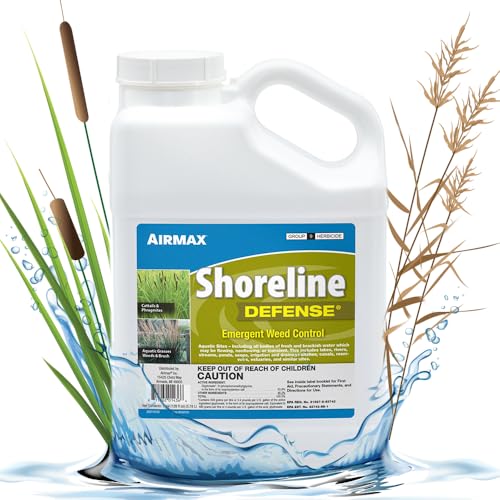
The one made for water edges — cattails, phragmites and shoreline brush.
Shoreline weeds climb into a hay field from the pond, ditch or irrigation canal beside it, and this gallon is built for exactly that territory. It treats 10,000 square feet of cattails, phragmites (a tall reed grass that spreads fast along water), emergent grasses and brush on fresh and brackish water. The formula is designed to kill down to the root, so the growth does not just come back next season.
The real-world confidence builder here is what happens to the water around it. Used according to the label, the maker says it will not harm fish, birds, pets, livestock, wildlife or other aquatic animals, with no water use restrictions to schedule around. A buyer with a 1.5-acre pond killed everything sprayed along the shoreline, then reordered a second bottle to finish the job.
Be patient with the timing. It can take at least a month for visible progress on tougher targets like water lilies. One owner watched a 250-square-foot patch go from full growth to only 30 square feet remaining — but the change happened over weeks, not days. Mix it with a surfactant (a wetting agent that helps the spray cling and soak in) or the leaves will not absorb the spray, and note that a few stubborn areas will need a second pass. Coverage is 10,000 square feet, so a mile of shoreline may need more than one jug.
Why Shoreline Owners Reorder
- Won’t harm fish, pets, livestock or wildlife when used per label — no water use restrictions.
- Kills cattails and phragmites down to the root for long-term control.
- Works on fresh and brackish water, and on lakes, ponds, ditches, canals and reservoirs.
- Concentrated gallon — one purchase reached 10,000 square feet of shoreline.
What Takes Patience
- Visible progress on water lilies can take at least a month — this isn’t an overnight kill.
- Must be mixed with a surfactant, or the leaves won’t absorb the spray.
- Really tough perennial targets may need a second pass to finish the job.
For the ditch and the pond edge: A hay operation that borders water and needs cattails, phragmites and emergent weeds controlled without hurting livestock, pets or fish is what this gallon is built for. Dry upland broadleaf weeds are a job for a standard pasture herbicide instead.
7. Blindside Herbicide WDG 8 oz.
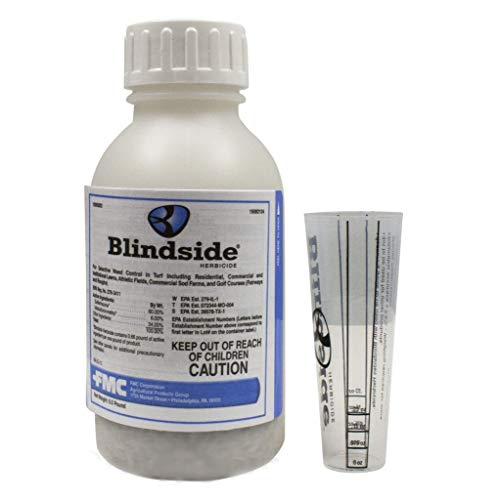
A no-mixing granular that stores easy and quietly stops next season’s weeds.
Warm-season grass — Bermuda, St. Augustine, Kentucky Blue or Tall Fescue — is where this pick plays, in the transition zone where liquid broadleaf sprays get touchy. Blindside is a dispersible granule (WDG means water-dispersible granule: it dissolves in your tank but starts as a powder), and it treats over 50,000 square feet from each ½-package. The sulfentrazone in it works through both leaf and root to control over 70 broadleaf weeds and sedges.
What owners like most is the fit for warm-season turf. Reviewers report Bermuda grass in particular gets the best postemergent control here — crabgrass, poa annua, goose grass and sedge all take the hit with minimal impact on the Bermuda. Doveweed needs a second application about 10 days out to finish it. A tip-and-measure dosing chamber dispenses enough product to treat 1,000 square feet at either a low or high rate, and the label claims visible signs of control within a week.
Being honest about the timing: this is not an overnight product. Expect about a week before results show, and be patient — it won’t knock down Dallis grass at all, though it handles everything else it targets. The dry granule stores in a cabinet and mixes only when you need it, so one package covers many spray sessions. Dallisgrass or fields treated within the last season with atrazine are the main spots where this granular is not the right tool.
Why granular wins here: Blindside treats over 50,000 square feet from each ½-lb package and stores in a cabinet without a liquid spill risk. It is the only granule in the group and the easiest to store between seasons.
The one weed it won’t touch: Dallis grass shrugs the granule off entirely. Plan on a separate product for that species and give the application a week before judging results.
For warm-season turf: Bermuda, St. Augustine or another warm-season grass is the ground this granule was designed for, with broadleaf and sedge control that leaves the field intact. A cool-season meadow, or a field where Dallis grass is the main problem, needs a different product.
Know the Specs
Active Ingredient
The active ingredient is the chemical that actually kills the weed — the rest of the jug is water, solvent and carriers. Read the label under Active Ingredients and get to know the name. Glyphosate is a broad-spectrum, non-selective kill (it takes down any plant it touches) that handles grass and broadleaf alike, which suits bare-ground work like driveways and fence lines. 2,4-D plus triclopyr (often called Garlon) is selective for broadleaf and woody growth and leaves grass mostly alone. Aminopyralid is pasture-specific and works on buttercup, thistle and plantain without harming the pasture grass around it. Sulfentrazone works through both leaf and root for a longer hold in the soil. Match the active ingredient to your target weed and you avoid a wasted jug.
Coverage
Coverage is how much ground one bottle actually reaches when mixed per the label — the single number that decides whether a jug is a bargain or a bad buy. Reading coverage sideways: 128 ounces of concentrate came in as much as 96 gallons of mixed spray on one product, and covered 4–7 acres from a 32-ounce bottle on another. That said, a gallon that only treats up to 17,200 square feet of non-crop ground is smaller than it looks. Before you buy, multiply your own acreage or square footage by how many passes you expect per season. If your field is bigger than the label says one jug covers, plan on a second purchase.
Common Questions
Which herbicide is safe to spray on my hay pasture without killing the grass?
Will Crossbow kill clover in my hay meadow?
How long does it take to see results after spraying?
Can I use these herbicides near a pond or ditch?
What is the difference between a selective and non-selective herbicide?
Do I need a surfactant when mixing these products?
How long does the ground stay clear after spraying Milestone?
Is Blindside safe on St. Augustine grass?
Can I spray an herbicide when rain is forecast?
Are these products safe around livestock, dogs or fish?
The Bottom Line
For most hay producers working a few acres, the herbicide for hay fields that does the most work across the most jobs is the Southern Ag Crossbow Specialty Herbicide Low Volatile Weed & Brush. One gallon mixes up to 96 gallons of spray and covers roughly 2.23 acres, and it kills broadleaf weeds plus the poison ivy and brush that routinely creep into hay ground — with 4.5+ stars across 800+ ratings to back that up. If your hay operation spans 4 to 7 acres of permanent pasture and you want one bottle per field, reach for the Dow Milestone Specialty Herbicide. And if your field borders a pond, ditch or canal, the Airmax Shoreline Defense is the one that clears cattails and phragmites at the water edge without worrying the livestock or the fish.
How we choose
We do not accept paid placement. Every pick is matched to a real buyer and a real use-case; we do not hands-on test units.
Sources
Specifications: manufacturer listings and product documentation. Review insights: verified customer reviews, as of October 2026. Pricing: not shown on this page (it changes often); check the current price via the retailer link.
As an Amazon Associate, Aappliancez earns from qualifying purchases. This does not affect which products we feature.