Disclosure: Some links in this post are affiliate links. As an Amazon Associate I earn from qualifying purchases, at no extra cost to you. Learn more
Specs are compiled from manufacturer listings and verified buyer reviews and can change over time — please confirm the key details on the product page before buying.
Foxtail is a grassy weed your mower cannot kill. It sprouts in bare or thin spots, sends up those fuzzy seed heads you keep bagging, and then drops new seed before you have even finished the row. Mowing more often will not kill it. You need a post-emergent herbicide (a spray or granule that kills weeds that have already come up, not just one that stops new seed) that reaches the foxtail’s roots, and you need it before the seed heads turn brown.
This guide is built by comparing the manufacturers’ published specifications and the patterns across verified customer reviews, so you get each pick’s real strengths and trade-offs instead of marketing spin.
Below you will find five real foxtail killers, ranked so the strongest all-round pick sits first and the value options sit toward the bottom. herbicide for foxtail always depends on matching the formula to your grass type and timing.
Top Picks


How To Choose The Best Herbicide for Foxtail
Foxtail sits in a strange spot. It is a grassy weed, so a broadleaf-only spray that saves your lawn will often walk right past it. It also spreads by seed, so a spray that only burns the top of the plant lets it come back two weeks later. The products that actually work here are the ones that either reach the roots of emerged grass or stop the seed from sprouting in the first place.
Three things decide whether your bottle or bag actually does the job: the active ingredient, the grass type you are spraying onto, and the size of the patch.
Match the active ingredient to the weed you actually see
If the foxtail is already up and green, you want a post-emergent formula. Look at the label and find the active ingredient rather than the brand name. A three-way blend built for grassy and broadleaf weeds will hit foxtail, crabgrass, and signalgrass in one pass. A single-ingredient selective grass killer is designed for the opposite job — killing grass weeds without touching the flowers and shrubs growing near them, which matters if the foxtail has crept into a bed rather than open lawn.
Know your grass before you spray
This is the mistake that costs people a lawn. Some formulas are labeled for established warm-season grasses and simply are not meant for fescue or fine turf. Read the back of the label for the list of species the maker allows, and check whether your lawn appears on it. If you are unsure what you are growing, a selective grass killer labeled for use around ornamentals gives you a safer path than a broadcast lawn spray.
Work out your square footage first
Coverage is the number that tells you whether one bottle is enough. Measure the patch, or your whole lawn, and compare it with the coverage figure on the container. A concentrate that states 5,000 square feet will handle a decent suburban front lawn; a smaller bottle rated around 2,500 square feet suits spot work. Granular bags list coverage in pounds and square feet. Buying the wrong size either leaves the job half done or leaves you storing a bucket for years.
Side-by-Side Comparison
| Model | Best For | Item Form | Coverage | Active Ingredient | Amazon |
|---|---|---|---|---|---|
| GORDON’S Trimec Plus Crabgrass Killer Concentrate, 1 Quart★ Best Overall | All-round foxtail and crabgrass control | Liquid concentrate | 5,000 square feet | Herbicide | Amazon |
| Preen Lawn Crabgrass Control 15 lb. BagSeason-Long Stopper | Stopping foxtail before it sprouts | Granule | Covers 5,000 sq. ft. | Dithiopyr | Amazon |
| Fertilome 8 Oz Over The Top Grass Killer | Grass weeds in flower beds and around shrubs | Liquid concentrate | 2,000 square feet per 8 oz | Herbicide | Amazon |
| Ortho Weed B Gon Plus Crabgrass Control Ready-To-Use Comfort Wand | Fast spot spraying with no mixing | Ready-to-use liquid | 1.1 gallons of mixed spray | — | Amazon |
| Fertilome (11031) Weed-Out with Crabgrass Killer RTS, 32 oz | Entry-level ready-to-spray foxtail and broadleaf control | Liquid, ready-to-spray | 2,500 sq feet | Dicamba, Quinclorac | Amazon |
Detailed Reviews
1. GORDON’S Trimec Plus Crabgrass Killer Concentrate
Our pick — 4.0+★ from 400+ verified ratings; the strongest balance of quality and price.
One quart of concentrate that covers a whole suburban front lawn and hits foxtail from the root.
If you want the pick that handles foxtail, crabgrass, and signalgrass without a second trip to the store, this is it. The blend is a three-way herbicide — three different active weed-killing compounds working together instead of one — and it carries a 5,000 square foot coverage figure that turns one 32 fluid ounce bottle into a full front-lawn treatment. It also lists control of 200+ common broadleaf weeds such as dandelions and plantain, so the same pass cleans up the rest of the lawn. Hundreds of owners have rated it 4.0+ out of 5.
Timing is what makes this one work. The manufacturer calls it a post-emergent control, which means it works on weeds that have already sprouted. Owners who spray early report the fastest turnaround, and the review pages sum it up: “Sprayed 7 days ago, saw results in 2 days.” Owners repeatedly report spraying before the foxtail flowers. Once those seed heads set, you are fighting the next generation instead of this one.
The honest limit: concentrated formula means you have to do the mixing math. Dilute it weaker than the label allows and the foxtail shrugs it off. It also is not a seed preventer — it kills what is growing, not what is waiting to sprout, so a second application 7 to 10 days later is the pattern that finishes the job. For a lawn where the foxtail has already broken through, that two-pass routine is the reliable path.
What earns it the top spot
- One 32 fluid ounce container covers 5,000 square feet, so an average front lawn takes a single bottle
- Three-way formula takes foxtail, crabgrass, and signalgrass in the same pass
- Also listed for 200+ broadleaf weeds, so you clear dandelions and plantain without a second product
- Owners commonly report visible results within about 2 days of spraying
What to know before you buy
- It kills emerged weeds only — it will not stop new foxtail seed from sprouting
- You have to measure and mix the concentrate yourself, and going light on the dose lets the weed survive
- Best on grass types the label lists; check your turf species first
Grab it when: your foxtail is already up and green and you want a single bottle to cover a normal front lawn with a couple of sprays.
Step past it when: you need seed prevention as well, or you would rather not mix anything at all.
2. Preen Lawn Crabgrass Control 15 lb. Bag
Fifteen pounds of granules that stop foxtail seed from ever becoming a plant.
Here is the strategic difference from the concentrate above. That one kills growing weeds. This one is built on the other half of the foxtail problem — the seed sitting in your soil, waiting for bare ground and warmth. Its active ingredient is dithiopyr, a pre-emergent (a weed-killer that works on seed before it sprouts, rather than on a plant you can see), and the 15 pound bag covers 5,000 square feet. Applied before foxtail emerges, it shuts down germination instead of chasing the weed after the fact.
The coverage math is the selling point — the same 5,000 square feet as the GORDON’S quart, but in a spreadable granule form. It is also listed for cool and warm-season grasses including Kentucky bluegrass, fine fescue, tall fescue, perennial ryegrass, bahiagrass, bermudagrass, buffalograss, carpetgrass, centipedegrass, St. Augustinegrass, and zoysiagrass, which is a wider species list than most granular preventers bother to print. It also rates for 40+ common lawn weeds and can go down up to 4 weeks after foxtail emerges.
Be straight with yourself about timing, because that is the whole game with a preventer. Owners who put it down early in spring report the cleanest lawns, and the recurring note in the reviews is that skipping the pre-emergent window means the weed beats you. Where you see real spread-out results is the coverage itself — heavy infestations do not vanish completely, though one reviewer’s honest summary was that it “probably reduced it by 85%.” If your foxtail is already tall and seeding, this bag is a season ahead of the problem.
The timing trade-off: you have to apply before foxtail breaks through, or apply within about 4 weeks of emergence, so it rewards planning rather than reacting.
Worth it if: you spread a granular in early spring and want a season-long barrier across a large lawn without ever mixing a concentrate.
The cleanest fit: a homeowner with a known foxtail problem who spreads in early spring, before the first green shows.
Get the liquid instead if: the weed is already up and seeding in your yard right now.
3. Fertilome 8 Oz Over The Top Grass Killer – 10434

The one you reach for when foxtail has crawled into the flower bed, not the lawn.
This is a different animal from the lawn sprays above, and the label says so. It is a selective grass killer built on a fluazifop-p-butyl formula — a compound that targets grass weeds specifically while leaving most broadleaf plants alone — and the maker lists annual and perennial grass weeds as its target. Where it separates from the GORDON’S quart is placement: you can spray this around vegetables, gardens, trees, shrubs, and ornamentals, which is exactly the scenario where a broadcast lawn herbicide is the wrong tool.
On coverage, this is the small-and-precise pick. The 8 fluid ounce concentrate makes 8 gallons of spray solution and covers 2,000 square feet per 8 oz — so versus the GORDON’S 5,000 square foot figure you are buying targeted treatment, not a lawn-wide pass. That small coverage is the point when foxtail is tangled in your roses. What wins people over here is that it does the job without wrecking the bed: the plant-health side of the reviews is the positive note, with owners reporting their flowerbeds, shrubs, and monkey grass came through fine while the grass weeds died.
Patience is non-negotiable, and the reviews are blunt about it. The label states it stops weed grass growth 2 days after application, but the field reports run longer — owners describe a week of slight yellowing before the grass browns and dies, with the strongest results around the 3-week mark. Some units do not deliver at all, and a few owners found mature grass fought it off. Mixing a surfactant (a helper that makes the spray cling to the leaf) into the tank is the trick that shows up most often in the write-ups. Note too that one owner’s warning is worth heeding: it is not for fescue.
Where it shines
- Labeled for use around vegetables, gardens, trees, shrubs, and ornamentals, so beds are fair game
- 8 fluid ounces of concentrate makes 8 gallons of spray solution
- Targets both annual and perennial grass weeds
- Owners consistently report bedding plants and monkey grass surviving the spray
The fine print
- Slow — visible browning often takes a week, with full kill nearer 3 weeks
- Coverage tops out at 2,000 square feet per 8 oz, so it is not a whole-lawn product
- Do not use it on fescue
- Mature, established grass can shrug it off
Buy this if: grass weeds have invaded your planting beds and you need something that will not torch the flowers and shrubs sitting next to them.
Not your bottle if: you are treating an open lawn — the coverage is too small and the wait too long.
4. Ortho Weed B Gon Plus Crabgrass Control Ready-To-Use

A wand you point and squeeze — no measuring jug, no mixing, no gloves-and-bucket routine.
Nothing to dilute. This arrives as a ready-to-use liquid at 140.8 fluid ounces — roughly a gallon — with a comfort wand attached, and the label says the formula kills crabgrass, dandelions, and other common lawn weeds, kills 200+ weeds, kills weeds to the roots, and will not harm the lawn when used as directed. It also starts working immediately per the maker. For a small yard or a handful of foxtail patches, that removes the entire mixing-and-measuring step that the concentrates demand.
The attached comfort wand is why it makes this list. Owners who like it consistently single out the dispenser — one wrote that “the comfort wand makes weed control a breez….” — because an adjustable spray tip means no pumping and no hand-squeezing a trigger for twenty minutes. The other note that keeps coming up is using it on a calm, windless day and avoiding over-spray, since a broadcast mist on a breezy afternoon drifts onto plants you meant to leave alone.
Set your expectations on speed and on what it will and will not take down. It works on foxtail, but slowly by owner accounts — several describe the weed browning at the edges while neighboring missed weeds survive, and a few report stubborn weeds like Creeping Charlie barely reacting. The recurring, fair gripe is the wand length: it is short enough that taller users end up stooping through a long spraying session. Treat it as a spot-and-touch-up tool for a modest yard rather than a whole-property solution.
Where the value sits: it is the only pick here that needs no measuring or mixing, and the battery-free wand sprayer earns the most consistent praise of anything on the label.
Set your expectation: results show up over days, not hours, and tough weeds like Creeping Charlie may need a second round.
The right pick for: a small yard or a couple of foxtail patches where you want to spray today without buying a separate sprayer or mixing jug.
Look elsewhere if: you are treating a large lawn or you expect quick, dramatic die-back.
5. Fertilome (11031) Weed-Out with Crabgrass Killer RTS, 32 oz
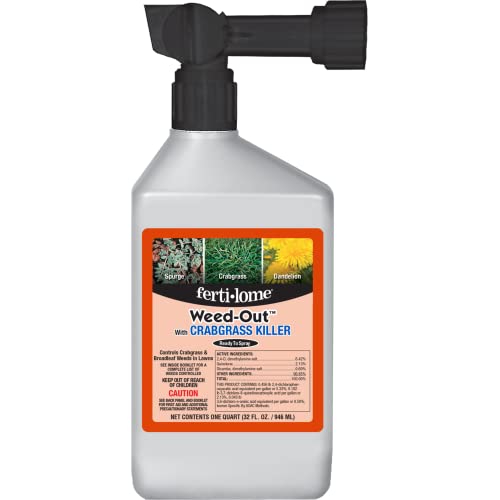
An entry-level spray bottle that will take foxtail and broadleaf weeds in one pass, if your expectations are set right.
Fertilome’s ready-to-spray bottle is the lowest outlay here and the simplest to start. It carries two active ingredients — dicamba and Quinclorac — and the label lists control of over 200 grassy and broadleaf weeds including crabgrass and foxtail. It is formulated for established lawns including Bermuda, Buffalo, and Kentucky bluegrass, comes ready to spray straight from the bottle, and covers up to 2,500 square feet. For a first-time buyer with a foxtail patch and a thin lawn, that is a low-risk way to start.
The RTS design is the draw — a ready-to-spray bottle means you attach it to a hose and go, with no jug or pump. The maker’s own guidance is to apply in spring or early summer, when weeds are small and actively growing, because this is a post-emergent formula. Those two active ingredients do real work on young foxtail, but they are also broad-spectrum, and that matters in one specific review that is worth reading before you spray: “I spot treated weeds using manufacture recommedation Spot Treatments: Mix 2.5 fl. oz. (5 Tbs) in 1 gallon. It killed the weed and the bermuda grass around it.”
On established warm-season turf that the label covers, some owners call it “a very effective product at a good price” and report it clears ground ivy and crabgrass well. On other lawns, owners say it needs two applications to kill mature weeds and, in some yards, it does not deliver on crabgrass at all. The bottle itself is a good value — the liquid volume is the widest here at 32 fluid ounces, the same container format as the GORDON’S quart. Read your grass species off the label before you commit.
Best for: a small patch of young foxtail on a labeled lawn where you want to spend as little as possible to test the approach.
Think twice if: you have Bermudagrass next to the weeds, or you expect one application to finish mature foxtail.
Know the Specs
Post-emergent vs. pre-emergent
These two words describe what stage of the weed’s life the product attacks. A post-emergent herbicide is designed to kill a plant that has already sprouted; you spray the green foxtail you can see. A pre-emergent is applied before the weed breaks through and works on seed in the soil, so it stops germination. Many foxtail programs use both — a preventer in early spring and a post-emergent for any that get through — because the two formulas do not substitute for each other.
Active ingredient
The active ingredient is the compound in the bottle that actually kills the weed, and it is the fastest way to compare two products. Rather than reading the brand name, find the ingredient line and check what class of weed it targets. A three-way blend going after grassy and broadleaf weeds will take foxtail, crabgrass, and dandelions together; a single-ingredient selective grass killer is built to kill grass weeds specifically without damaging the surrounding planting. Match the ingredient to the weed and to what is growing next to it.
Common Questions
Will a broadleaf weed killer get rid of foxtail?
Can I spray foxtail once and be done with it?
Is it safe to use one of these around flower beds and shrubs?
How long does it take for a foxtail herbicide to show results?
Will these foxtail herbicides also kill my lawn grass?
Is a concentrate better than a ready-to-use bottle?
Do I need to add a surfactant to a foxtail herbicide?
Will a granular preventer stop foxtail if I already have it in my lawn?
What grass types are safe for the products in this guide?
How much coverage do I need for my lawn?
The Bottom Line
The best pick for most foxtail problems is the GORDON’S Trimec Plus Crabgrass Killer Concentrate, because one 32 fluid ounce bottle covers a full 5,000 square feet and the three-way formula takes foxtail, crabgrass, and signalgrass together. If your foxtail problem is a seed problem — you keep killing it and it keeps coming back — grab the Preen Lawn Crabgrass Control 15 lb. Bag and put it down in early spring to stop the next batch before it sprouts. And if the foxtail has crept into your flower beds rather than open lawn, the Fertilome 8 Oz Over The Top Grass Killer is the one to reach for, since it is the only pick here labeled for use around vegetables, gardens, and ornamentals.
How we choose
We do not accept paid placement. Every pick is matched to a real buyer and a real use-case; we do not hands-on test units.
Sources
Specifications: manufacturer listings and product documentation. Review insights: verified customer reviews, as of October 2026. Pricing: not shown on this page (it changes often); check the current price via the retailer link.
As an Amazon Associate, Aappliancez earns from qualifying purchases. This does not affect which products we feature.