Disclosure: Some links in this post are affiliate links. As an Amazon Associate I earn from qualifying purchases, at no extra cost to you. Learn more
Specs are compiled from manufacturer listings and verified buyer reviews and can change over time — please confirm the key details on the product page before buying.
If cattails have marched past your dock line, the fix is simpler than you think: use a liquid aquatic herbicide built for emergent weeds, mix it in a tank sprayer, and spray the foliage so the chemical travels down and kills the roots. The catch is that the wrong bottle — or the wrong mix rate — just browns the tips and lets the rhizomes (the thick underground stems that spread cattails sideways) push up new shoots next season. Below you will find five aquatic herbicides worth putting in your sprayer, sorted by how fast they work, what they kill, and who each one actually suits.
This guide is built by comparing the manufacturers’ published specifications and the patterns across verified customer reviews, so you get each pick’s real strengths and trade-offs instead of marketing spin.
Some kill by contact and knock foliage down in a day, while others reach the root system for lasting control. One pick here is the crowd favorite at 4.0+ stars across 800+ owners, and it earns that spot on root-kill performance, not on price. Read on for the only comparison of herbicide for cattails you need before you fill a sprayer.
Top Picks

How To Choose The Best Herbicide for Cattails
Cattails are not like a dandelion in your lawn. They grow out of a dense mat of rhizomes under the mud, and a spray that only burns the leaves leaves that mat completely untouched. Three things decide whether your bottle works: the active ingredient, whether it is labeled for aquatic use, and how much water you are treating.
Match the active ingredient to the job
Glyphosate-based aquatic herbicides are the slow, systemic option — they get absorbed through the leaf and move down, which is what you want when the goal is killing cattails down to the root. Diquat dibromide is the opposite: a contact herbicide that disrupts the plant tissue it touches, so foliage collapses fast but underground rhizomes may survive and re-shoot. Imazamox is the specialist route, formulated for aquatic environments and aimed at cattails, water milfoil, pondweed, and duckweed without leaning on glyphosate at all.
Check the coverage rating against your actual shoreline
A concentrate that covers 1,000 square feet and one that covers 10,000 square feet are doing very different amounts of work, even when the bottle size looks similar. Measure your cattail patch roughly — length of shoreline times how far the stand reaches out into the water — and compare that against the coverage figure on the label. Buying short means a second order mid-season.
Never skip the surfactant
Cattail leaves are waxy and shed water, so a plain water mix can bead up and roll off before the plant absorbs anything. A surfactant (a spreader-sticker that breaks the surface tension of the droplet) is what makes the spray cling. Airmax states outright that results improve when you apply with a surfactant, and the CattPlex Pro mixing notes call for roughly eight ounces of surfactant alongside the herbicide for leaf adherence.
Plan around the water, not just the weed
Everything on this list is meant for fresh and brackish water margins — lakes, rivers, streams, ponds, seeps, irrigation and drainage ditches, canals, reservoirs, and estuaries all appear across these labels. What changes is the caution level. Diquat products demand surgical accuracy because they kill any plant they touch, ornamentals included. Read the label on the bottle you buy and follow its mix rate exactly; that is the difference between a clean shoreline and a dead flowerbed.
Side-by-Side Comparison
| Model | Best For | Active Ingredient | Liquid Volume | Coverage | Amazon |
|---|---|---|---|---|---|
| Airmax Shoreline Defense★ Best Overall | Cattails and phragmites along a shoreline or dock | Glyphosate-based | 32 fluid ounces | 10,000 square feet | Amazon |
| Hi-Yield (33700) Killzall AquaticBest Value | Budget coverage of a large pond or beach edge | Glyphosate | 32 fluid ounces | Up to 1 acre | Amazon |
| Agrisel Diquat Weed Killer | Fast knockdown of pond weeds and algae | Diquat dibromide | 32 fluid ounces | Varies by mix rate | Amazon |
| Weedtrine D Aquatic Herbicide | Large ponds with duckweed plus emergent edge growth | Diquat dibromide | 128 fluid ounces | Broad aquatic weed range | Amazon |
| CattPlex Pro Aquatic Herbicide | Targeted cattail control without glyphosate | Imazamox | 32 fluid ounces | 1,000 square feet | Amazon |
Detailed Reviews
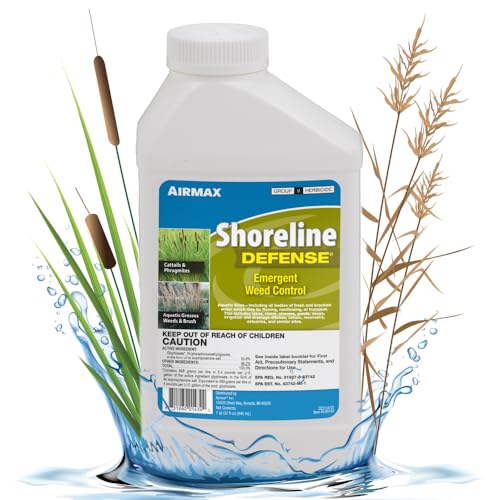
1. Airmax Shoreline Defense Herbicide 1 Quart
Our pick — 4.0+★ from 800+ verified ratings; the strongest balance of quality and price.
The shoreline specialist that goes after cattail roots instead of just browning the tips.
If your problem is a wall of cattails and phragmites pushing out from the bank, start here. Shoreline Defense is a concentrated glyphosate treatment built for emergent aquatic weeds — the ones standing above the waterline — and it is rated to cover 10,000 square feet from one quart bottle. That is the biggest stated coverage figure on this list, and it is why this bottle carries the top spot rather than the cheapest one.
You mix it in a tank sprayer, apply it directly to the foliage, and let the plant pull it down into the root mass for long-term control rather than a one-season shave. Airmax notes that results improve when you apply it with a surfactant, which is the sticker that helps the spray hold onto waxy cattail leaves instead of beading off. The label clears it for lakes, rivers, streams, ponds, seeps, irrigation and drainage ditches, canals, reservoirs, and estuaries, and it is cleared for use in both fresh and brackish water.
What wins people over is straightforward: it does the job on the bank. A 1½-acre pond owner bought a second bottle after the first killed everything along the sprayed shoreline, and a mixed-with-water application browned and killed the sprayed stretch inside a week. One buyer put it plainly enough that it covers the whole category — as buyers report, the pond grass stays dead. The safety side is well covered too: no harm to fish, birds, pets, livestock, wildlife, or other aquatic animals when used according to label directions, and no water use restrictions attached.
Here is the honest catch. The value question splits people — a bottle that earns a reorder from one pond owner reads as pricey to another, and nothing about a concentrate feels cheap when you are buying a quart. That is the trade-off you accept for root-level control at this coverage. If you want a bigger jug without a bigger coverage claim, the Weedtrine D gallon below is worth a look, but it runs a different active ingredient and a different job.
What it does well
- Covers 10,000 square feet from a single quart of concentrate
- Labeled for cattails, phragmites, grasses, weeds, and brush
- No harm to fish, birds, pets, livestock, or wildlife per label directions
- Works in fresh and brackish water with no water use restrictions
Where it asks patience
- Value splits opinion — a reorder for one pond owner is a splurge for another
- Best results require adding a surfactant, sold separately
- Slow systemic kill rather than same-day browning
Reach for this if: you are treating a cattail or phragmite stand along a defined shoreline and want the longest-lasting result per bottle.
Look elsewhere if: you need visible knockdown by tomorrow — a contact diquat product browns faster even though it may leave roots behind.
2. Hi-Yield (33700) Killzall Aquatic Herbicide (32 oz)
A small bottle that claims a whole acre — but it kills on plant time, not yours.
The pitch on Killzall is coverage versus bottle size, and it is a striking ratio: 32 ounces of liquid concentrate labeled to treat up to 1 acre. For a pond owner with a long weedy bank and a tight budget, that is the most ground per bottle on this page. It is a glyphosate concentrate, so it belongs in the same slow-systemic family as the Airmax pick above rather than the fast-contact group.
Weeds it is labeled for include Canadian thistle, chickweed, pigweed, and ragweed — see the label for the full list — and it is cleared for non-crop sites such as wildlife habitat restoration and management areas and aquatic areas. Practical use means mixing the concentrate with water at the rate printed on the label and spraying the foliage thoroughly. One owner applied it at two ounces per gallon to lake shore weeds sitting in two to six inches of fresh water and watched vegetation yellow and brown over the next five days, with shore weeds reacting faster than the submerged growth.
The honest expectation to set is speed. It works, but not quickly, and the bigger the plant the longer it takes — that is the recurring note from the pond and beach owners who use it. Spray a tall, established cattail clump and you should plan on waiting rather than checking the bank each morning. Complicating that is a label warning worth reading twice: mixing this product with materials not recommended on the label may reduce performance, so keep your tank to what the directions allow.
Against the Airmax bottle it is the budget route: two and a half pounds of product against the Airmax quart at two pounds, with the acre coverage claim doing the heavy lifting. If your cattail patch is modest and you want maximum area per dollar, this is the sensible entry point.
Where the money goes: 32 ounces of concentrate covering up to 1 acre is the largest stated coverage on this list, and it holds a 4.0+ rating from 100+ buyers.
Pick this one when: you are covering a big, weedy pond edge on a tight budget and can give the treatment a week or more to show.
Keep shopping if: you are impatient — the kill is tied to plant size, and a tall stand will test your patience.
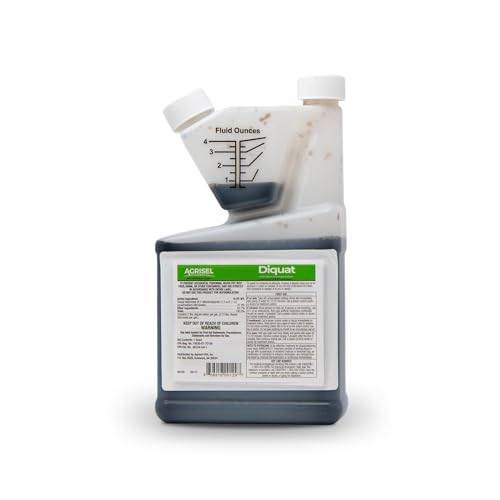
3. Agrisel Diquat Weed Killer, Pet Safe, 32 Ounces
Twelve hours to visible collapse — and zero forgiveness if your aim slips.
Diquat dibromide is a contact herbicide, which means it damages the plant tissue it lands on rather than traveling down to the root. The payoff is speed: Agrisel advertises visible results in just one to two days on stubborn weeds like chickweed and poison ivy, and the people spraying ponds describe browning inside twelve hours. That is a different experience entirely from the two glyphosate picks above, which work slowly and systemically by comparison.
The application range is the widest here in terms of setting. It is built for both water and land, so the same bottle covers ponds, lakes, greenhouses, nurseries, and landscapes, and the manufacturer notes the low usage rates keep it economical across small and large areas. It carries an EPA registration and comes in 32-ounce and 128-ounce sizes. The weed sprayer is sold separately, so budget for a tank and plan on reading the label carefully before you mix.
The one rule you cannot bend is precision. This kills any plant it touches, ornamentals included — pond owners put it bluntly with a warning to keep it well away from the plants you want to keep, since a hit means a dead plant and visible results follow fast. Bring the same discipline to the water itself: it worked well on dry land weeds while one pond application came back weaker on water weeds, and this ingredient does not chase roots, so a tough cattail stand may need a follow-up pass after the tops die back. Against the budget Hi-Yield bottle it is a different tool rather than a better one — fast visual results instead of cheap acreage.
It holds a 4.0+ rating from 200+ buyers, and the recurring theme in the feedback is that it simply kills a wide spread of weeds, briars, and algae.
The precision trade-off: fast-acting and versatile across water and land, but the same power that browns a pond weed in hours will take out a garden bed it drifts onto.
Good match for: pond and landscape owners who want weeds visibly collapsing within days and can spray a controlled, aimed pattern.
Think twice if: your cattails grow shoulder-to-shoulder with ornamentals you care about — this is the least forgiving bottle here.
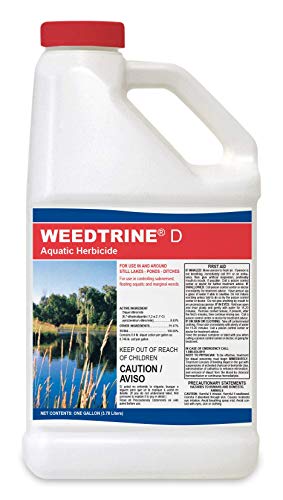
4. Weedtrine D Aquatic Herbicide 1 Gallon
The gallon jug that treats duckweed, floating weeds, and the emergent edge in one pass.
This is the volume pick. Weedtrine D is a professional-grade diquat formulation (diquat dibromide is the active) that arrives as a 128-fluid-ounce gallon — four times the liquid of the 32-ounce Hi-Yield and Airmax bottles on this page. If you own a real pond rather than a decorative one, that difference ends the mid-season reorder.
The acreage of weeds it targets is broader than a pure cattail treatment too. It is built for a range of aquatic weeds in a pond area and lists control of duckweed, floating weeds, submersed weeds, and emergent weeds — which means one product can handle the surface carpet and the cattails standing at the bank. The people using it on duckweed say it works as advertised, with weed along the sprayed edge beginning to die within hours, and it is described as fish and wildlife safe.
The honest caveat is that not every plant gets fully removed. One four-star review notes that with some plants and weeds it will not kill the root, which is exactly the limitation you would expect from a diquat contact herbicide — the same root-survival issue that applies to the Agrisel bottle above. It holds a 4.0+ rating from 200+ buyers, and the recurring split in the feedback is value: a gallon is real money, and some pond owners find it a great value while others find it too expensive for what they treat.
Compared with the Airmax quart, you are trading a four-fold jump in volume against roughly a third of the coverage claim — 10,000 square feet stated for Airmax versus a broad pond area range for Weedtrine D. Pick on which problem dominates your water: surface carpet, or the bank.
Why pond owners keep buying it
- 128 fluid ounces — four times the liquid volume of the quart bottles here
- Labels duckweed, floating, submersed, and emergent weeds in one bottle
- Edge weeds begin dying within hours of a sprayed pass
- Described by users as fish and wildlife safe
What to know before you buy
- Diquat contact action means some plants keep their roots and can return
- Value divides buyers — a great deal to some, steep to others
Suits you if: you are managing a genuine pond with duckweed or mixed floating growth alongside your cattail edge and want one large bottle to cover the season.
Overkill if: your whole job is a thirty-foot cattail strip — a quart-sized treatment will do it for less.
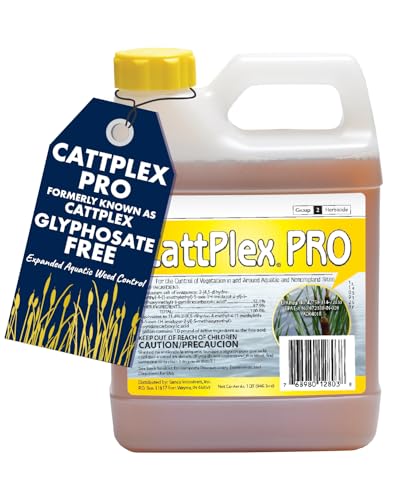
5. CattPlex Pro Aquatic Herbicide Quart
The cattail-named product that skips glyphosate entirely for an aquatic-specific active.
If you would rather not spray glyphosate near your water, this is the bottle on the list built around a different chemistry. CattPlex Pro uses imazamox instead of glyphosate — an herbicide designed specifically for aquatic environments that targets cattails, water milfoil, pondweed, and duckweed. The manufacturer positions the residual activity as a way to cut how often you have to re-treat, and states that imazamox has minimal impact on beneficial flora and fauna while selectively targeting weeds.
What it does not have is big coverage. The stated coverage is 1,000 square feet, versus the 10,000 square feet on the Airmax bottle and the up-to-1-acre claim on the Hi-Yield — a wide gap that matters the moment your cattail stand is bigger than a small dock-side patch. The 32-ounce quart is also the most expensive way to buy liquid on this page, and buyers notice; value is the recurring complaint in the feedback, and one three-star review reports it did not do much for that pond.
Where it earns its place is on speed and results at the right scale. Owners describe cattails yellowing in days and fully dead in about two weeks, with visible browning within 24 hours of application. The mixing notes are unusually specific and worth following: roughly eight ounces per two gallons of water with about eight ounces of surfactant for leaf adherence, applied where turtles are present without apparent harm. Lily pads told a slower story — one pond cleared all of them inside two weeks, while another saw lily pads take five to six weeks to disappear with roots surfacing slowly.
It carries a 4.0+ rating from 100+ buyers. Treat this as the specialist for a defined cattail patch where you want an imazamox-based, aquatic-specific option and are willing to apply it precisely.
The case for imazamox: a glyphosate-free active aimed squarely at aquatic weeds, with owners reporting browning within 24 hours on cattails.
Worth it for: a small, defined cattail or water lily patch where you specifically want a non-glyphosate aquatic herbicide and will mix to the label.
Not your bottle if: you are covering a large shoreline — the 1,000 square foot rating will not stretch far, and it carries the highest cost per ounce here.
Know the Specs
Active ingredient: glyphosate, diquat, or imazamox
Glyphosate is systemic — the plant absorbs it through the leaf and moves it down, which is what makes root kill possible on a tough cattail stand. Diquat dibromide is a contact herbicide, so it disrupts the tissue it touches and knocks foliage down quickly, but roots can survive and re-shoot. Imazamox is the aquatic-specific option used in CattPlex Pro, targeting cattails, water milfoil, pondweed, and duckweed without glyphosate.
Coverage: square feet or acres
Coverage tells you how much shoreline one bottle treats, and it is the number that decides whether you reorder mid-season. A 10,000 square foot rating and a 1,000 square foot rating look like similar bottles on a shelf but do very different amounts of work. Measure your patch roughly before you buy, and treat the label figure as a ceiling reached under ideal conditions.
Common Questions
Will an aquatic herbicide kill the cattail roots or just the tops?
Can I spray cattails in a pond with fish in it?
How fast will I see cattails turn brown after spraying?
Do I need to add a surfactant to the tank?
How much area does one bottle of cattail herbicide actually cover?
Is diquat or glyphosate better for cattails?
Can I use these products in brackish water or an irrigation ditch?
What mix rate should I use for a cattail stand?
Will the spray drift onto my garden plants?
Does killing cattails all at once hurt the pond?
The Bottom Line
For most pond and shoreline owners, the herbicide for cattails winner is the Airmax Shoreline Defense because it is the only pick here that pairs root-level glyphosate control with the largest stated coverage on the list at 10,000 square feet — and it holds the crowd’s confidence across 800+ owners. If you want fast visible knockdown and mixed pond weeds rather than a pure cattail job, grab the Weedtrine D gallon. And for a small, defined cattail patch where you want a glyphosate-free aquatic option, the CattPlex Pro is the one to reach for. Whichever you pick, mix to the label, add a surfactant, and give the roots time — that is what turns a browning shoreline into a cleared one.
How we choose
We do not accept paid placement. Every pick is matched to a real buyer and a real use-case; we do not hands-on test units.
Sources
Specifications: manufacturer listings and product documentation. Review insights: verified customer reviews, as of October 2026. Pricing: not shown on this page (it changes often); check the current price via the retailer link.
As an Amazon Associate, Aappliancez earns from qualifying purchases. This does not affect which products we feature.