Disclosure: Some links in this post are affiliate links. As an Amazon Associate I earn from qualifying purchases, at no extra cost to you. Learn more
Specs are compiled from manufacturer listings and verified buyer reviews and can change over time — please confirm the key details on the product page before buying.
Rain on the roof, a helicopter crossing the frame, thunder rolling past your left ear — that overhead sound is the piece most home theaters are missing. You do not need to cut holes in your ceiling to get it. Every pick below either bounces sound off your ceiling or fires straight at your seat from a wall. The crowd favorite is the Klipsch RP-500SA pair, at 4.5+ stars across 700+ owners.
This guide is built by comparing the manufacturers’ published specifications and the patterns across verified customer reviews, so you get each pick’s real strengths and trade-offs instead of marketing spin.
A height speaker that disappears into your setup and one you notice every movie come down to three things: driver size (the cone that moves the air), cabinet depth (how far it sticks out from the wall) and how you mount it. Here is how each of these height speakers behaves in a real room.
Top Picks


How To Choose The Best Height Speakers
Height speakers do one job: they put sound above your head. Whether they succeed depends far less on brand badges than on three things — how your ceiling is built, how the speaker gets its signal, and how big the driver is that has to push that sound upward.
Up-firing versus wall-mounted
An up-firing speaker points at your ceiling and relies on the reflection bouncing back down to your seat. That works well in a flat room with a normal ceiling. A sloped or vaulted ceiling scatters that reflection, so a wall-mounted height channel aimed down at you usually delivers the more convincing overhead effect. If your ceiling is unusual, plan for a mount.
Driver size and cabinet depth
The woofer is the round cone that moves air. A larger driver moves more air, which gives you a fuller, more physical overhead effect. Depth matters just as much when you are hanging a box near the ceiling — a slim cabinet tucks against the wall where a deep one crowds the room.
Matching your receiver
Height channels need an AV receiver that supports Dolby Atmos or DTS:X, and most modules are built for 4- and 8-ohm amplifiers. Check the crossover setting your receiver offers, because a sealed height cabinet usually wants to hand low bass off to your subwoofer rather than produce it itself.
Side-by-Side Comparison
| Model | Best For | Woofer Size | Mounting | Channel Design | Amazon |
|---|---|---|---|---|---|
| Klipsch RP-500SA★ Best Overall | All-around Atmos pair | 5.25 inches | Keyhole on-wall | Up-firing or surround, switchable | Amazon |
| Polk Audio OWM3Most Versatile | Flexible multi-angle mounting | 11.4 centimeters | Keyhole and ¼-20 | Surround / height | Amazon |
| Monoprice rich SatelliteBudget Up-Firing Pick | Budget upward-firing add-on | 7.6 centimeters | Binding post, shelf | Up-firing height | Amazon |
| Polk Monitor XT90 | Tight-budget Atmos build | 10 centimeters | Keyhole wall slots | Up-firing or wall height | Amazon |
| ULTIMEA Skywave F30 Boom | No-rear-speaker Atmos bar | 6.5 inches (subwoofer) | Wall bracket kit included | 3.1.2 with up-firing drivers | Amazon |
| Klipsch RP-140SA | Adding height to existing towers | — | Keyhole on-wall | Dolby Atmos elevation | Amazon |
| Hisense AX5140Q | Full 5.1.4 in one box | 6.5 inches (subwoofer) | Rear satellites, floor placement | 5.1.4 Dolby Atmos / DTS:X | Amazon |
| SVS Prime Elevation | Direct-firing accuracy | 4.5 inches | Multi-angle wall bracket | Height, surround or LCR | Amazon |
| Polk Signature Elite ES90 | Sitting on existing towers | 5.25 inches | Rubber base, sits on speaker | Dolby Atmos module | Amazon |
Detailed Reviews
1. Klipsch RP-500SA Speakers Pair
Our pick — 4.5+★ from 750+ verified ratings; the strongest balance of quality and price.
The Atmos pair that does double duty — bounce off the ceiling today, hang it as a surround tomorrow.
Klipsch calls this an Atmos speaker, but the switch on the back is what actually sells it. Flip it one way and the RP-500SA acts as an up-firing elevation module that points sound at your ceiling. Flip it the other way and it works as a full-range surround speaker. That flexibility means you can buy it now for a 5.1.2 setup and later repurpose the same pair as rears if you rebuild your room.
Overhead effects get real body from the 5.25″ Spun copper cerametallic woofer (the cone that moves the air). A 1″ titanium LTS vented tweeter (the small driver for high notes) sits in a hybrid Tractrix horn — that horn shape spreads high frequencies wider, so overhead effects reach more seats. Klipsch lists 75.0 watts of output power. In Atmos mode the sealed cabinet uses a fixed 150Hz crossover (the point where low bass hands off), so your subwoofer carries the deep stuff. Expect to nudge these 4-5dB hot in your receiver to make them sit right.
One honest caveat: the Klipsch sound is not for everyone at the price. The highs are crisp and forward, and the sealed design will not shake a room on its own. If you are chasing bass for music, a pair of standard bookshelf speakers gives you more low end for the same outlay. Where the RP-500SA beats almost anything here is blending in — owners running full Klipsch Reference Premiere systems report the timbre match (the tonal match to their other speakers) is why they bought it. Its 4.5+ star average comes from more owner ratings than any other pick here.
What earns its place
- Switchable crossover lets one pair serve as Atmos modules or surrounds.
- 5.25″ cerametallic woofer gives overhead effects real weight.
- Hybrid Tractrix horn tweeter spreads effects across a wide listening area.
- Keyhole mount means wall placement without extra brackets.
Worth knowing first
- Sealed cabinet and fixed 150Hz crossover mean no bass of its own.
- Crisp Klipsch highs can feel forward on some recordings.
- Needs a manual gain bump after your receiver’s auto-calibration.
The call: Buy these if you want one pair that can grow with your system and match an existing Klipsch Reference Premiere build.
Think twice: Music-first listeners who want low end from their height speakers will need a subwoofer already in place.
2. Polk Audio OWM3 Speakers Pair
Seven ways to hang it, and only 4″ of cabinet to hide against the wall.
Overhead effects arrive with more body on the Polk OWM3 because its 11.4-centimeter driver is bigger than the 7.6-centimeter woofer in the Monoprice rich Satellite below — more surface area moves more air. The 11.4-centimeter cone is a large part of why this pair wins people over on sound. At 4″ deep it also tucks tighter to the wall than most height options. The keyhole plus ¼-20 mounting points (a standard camera-style screw thread) let you hang it flat, at a corner angle, or on the included tabletop stands.
Seven official orientations is not a marketing line — it is genuinely how you rescue a room with an awkward ceiling or a sofa jammed into a corner. The Dynamic Balance drivers and Polk’s Capacitive Coupling Technology keep the usable range clean even when you push volume, which is why owners run them as 7.1.4 height channels crossed over at 80Hz without complaint. Pair them with a subwoofer and they handle film ambience, side surrounds and rear surrounds in the same session.
Size is the one thing buyers split on, and honestly it cuts both ways. The box is small enough to disappear on a wall and small enough to sound thin as a front speaker — Polk itself positions this as a surround and height unit, not a main. A couple of owners also note there is no wire notch, so the cabinet will not sit perfectly flush against the wall once a cable is attached. Neither issue matters once the speaker is doing height duty ten feet up.
Where the value sits: The OWM3 is the here-is-a-speaker-that-fits-anywhere pick — 4″ deep, seven angles, and the widest set of mounting hardware in this lineup. For a room where ceiling placement is not possible, it is the obvious answer.
Mount it and forget it if: your room has no clean path to an up-firing position and you need a box that tucks against a wall.
Not your pair if: you want your height speakers to double as main fronts — these are built for the back and top of the room.
3. Monoprice Satellite Speakers Pair
The cheapest way to hear a ceiling above your head without cutting into it.
Monoprice built this pair around one idea: fire sound at the ceiling and let the reflection do the work. A 3″ polypropylene upward-firing driver sits in each cabinet alongside a 3″ polypropylene woofer and a 3/4″ aluminum dome tweeter. The spec sheet lists 100 watts of input power, 88 dB sensitivity (how efficiently it turns amplifier power into volume) and 8-ohm impedance, so a normal AV receiver drives it without strain. No in-ceiling install required.
The 7.6-centimeter woofer is the smallest here, and that shows up as an honest limit rather than a fault. Where the Polk OWM3’s 11.4-centimeter driver gives effects more weight, this pair leans lighter — The 3/4-inch aluminum dome tweeter gives the upward effects a crisp edge. Owners who bought them to replace small satellite speakers report a wider, more substantial soundstage than what came in the box.
Durability is the weak spot: some units develop crackle or a dead channel, and a few fail early. Some units develop crackle or a dead channel, and a few fail early, which is the trade-off of paying the lowest price in this lineup. Monoprice backs it with a 1 year replacement warranty and a 30-day money back guarantee, so the risk is bounded. As owners put it about the low end: “Impressive low sound from a 3″ speaker.”
Who this suits: renters and first-time Atmos builders who want to test overhead sound before spending more, and who are comfortable leaning on a warranty if a unit misbehaves.
Start here if: your receiver already does Atmos and you want to hear what height channels add for the smallest outlay.
Spend more instead if: you want a set-and-keep pair — the failure reports on this one are the reason the pricier picks exist.
4. Polk Audio Monitor XT90 Speaker Pair

A 4″ driver and two ways to mount it — the affordable route into real overhead sound.
What you actually get here is a 4″ Dynamically Balanced Woofer in each cabinet, built to sit on top of Polk’s Monitor XT20 bookshelf or XT60 and XT70 tower speakers. That placement is the point: the module fires up at your ceiling and the reflection drops rain and aircraft effects back onto your seat. The same cabinet also has built-in keyhole slots, so you can hang it high on a wall and aim the effect down instead.
Polk rates the XT90 for 4- and 8-ohm amplifiers and receivers, and it wants an AV receiver with a minimum of seven channels that supports Dolby Atmos, DTS:X or DTS Virtual:X. Timbre matching — the shared voicing that keeps sound from jumping between speakers — ties it to the rest of the Monitor XT family, so it does not announce itself against Polk towers. Build quality is close behind the sound, and the cabinet finish shows it.
Ceiling height is the honest catch. Up-firing works when the reflection has a flat surface to bounce off; above roughly nine feet of ceiling, or on a vaulted one, owners find the effect fades and wall-mounting becomes the better call. A few listeners also never warm to Atmos as a format and blame the speaker. If your ceiling is low or you can mount, the XT90 earns its keep easily.
The case for the XT90
- 4″ Dynamically Balanced Woofer with a 10-centimeter chassis that fits compactly.
- Sits on XT20, XT60 and XT70 speakers, or hangs via built-in keyhole slots.
- Works with 4- and 8-ohm amplifiers and receivers.
- Timbre matched to the wider Monitor XT line.
The honest limits
- Up-firing effect weakens on ceilings taller than roughly nine feet.
- Needs a seven-channel-or-more Atmos receiver to work at all.
- Sealed design hands all bass duty to your subwoofer.
Best fit: an existing Polk Monitor XT setup in a normal-height room where the modules can sit on the towers.
Skip for: vaulted ceilings — mount these on the wall instead of trusting the bounce.
5. ULTIMEA Skywave F30 Sound Bar
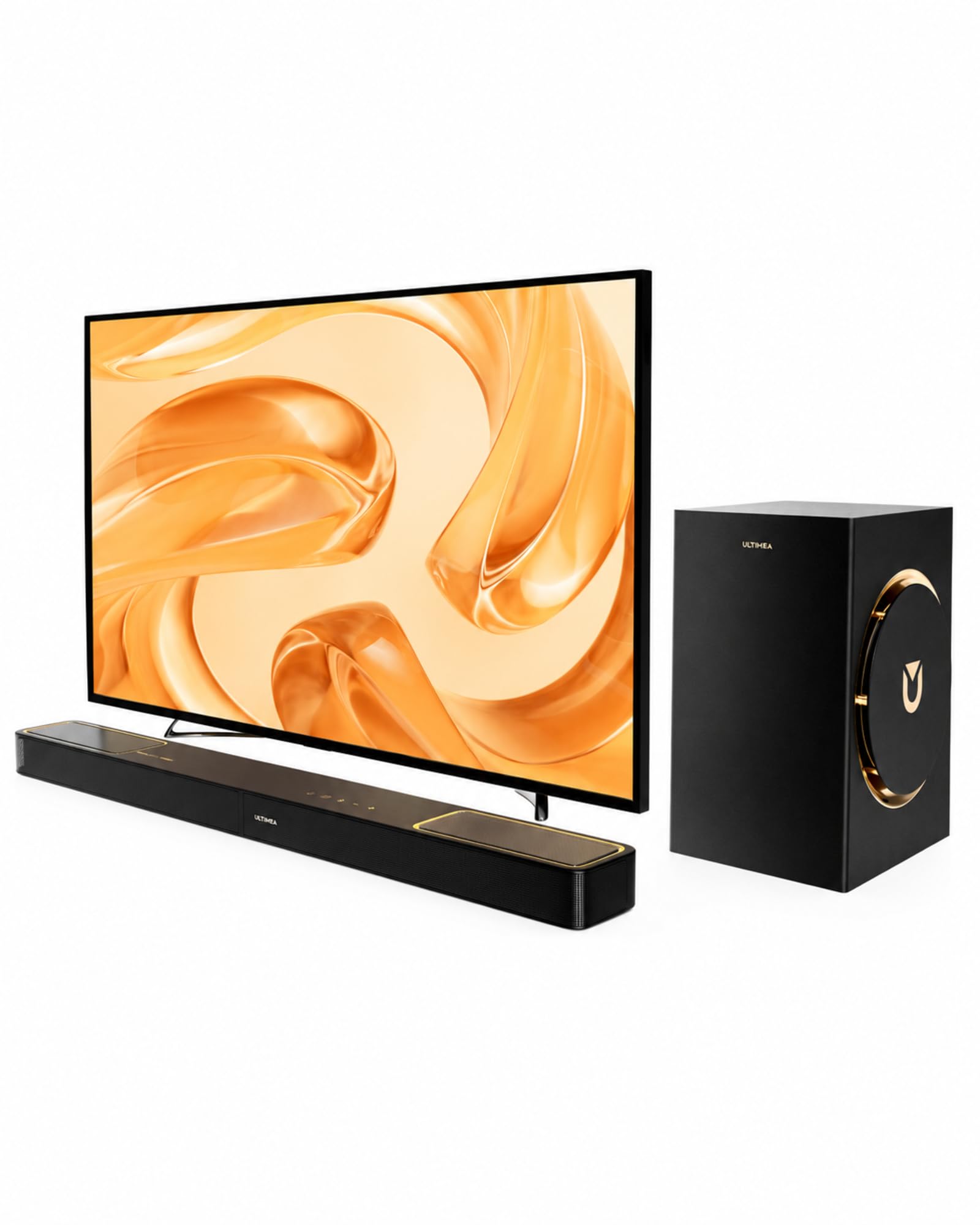
Height effects without a single rear speaker or a receiver in sight.
Not everybody wants to buy a pair of boxes, run speaker cable and reconfigure an AV receiver. The Skywave F30 Boom is a 3.1.2-channel bar that does the height work itself, with front-firing drivers, up-firing drivers and a 6.5″ subwoofer all in one package. The up-firing channels use neodymium internal magnets and large 18-core voice coils, which is the engineering behind pushing vertical sound with enough focus to read as overhead.
The spec sheet is unusually detailed for a bar at this level. HDMI eARC supports up to 37Mbps of bandwidth, enough for lossless 3.1.2 audio, and it is a genuine step over standard ARC which compresses the signal. CEC means your TV remote powers it on and off with the screen. BassMX tuning takes the subwoofer down to 38Hz, Bluetooth 5.4 keeps the wireless link stable, and the app exposes a 10-band graphic EQ alongside 121 preset sound settings if you like to tune.
Room size decides how happy you will be. In a modest living room the height effects add real overhead dimension and dialogue stays clear; in a large space the 6.5″ subwoofer runs out of authority and the overall sound thins out. One format caveat: this bar does not decode DTS. If your disc collection leans that way, check before you buy.
The no-clutter route: One bar, one subwoofer, an included HDMI eARC cable and a wall-mount kit. Value is where this earns its keep — the height effect arrives without a receiver, extra speakers, or a cable run to the back of the room.
Grab this if: you want overhead sound in a normal-sized living room and no appetite for component shopping.
Look elsewhere if: your library is built on DTS soundtracks or your room is on the large side.
6. Klipsch RP-140SA Dolby Atmos Speaker

Built to sit quietly on top of the floorstanders you already own and add a ceiling above them.
Klipsch designed the RP-140SA as an elevation module, and the word module is doing real work. It is meant to rest on a floorstanding or bookshelf speaker you already own, fire upward and reflect off the ceiling to add the overhead layer. Its wide, enveloping overhead field, rather than a narrow beam of effect, is why it has outlasted a lot of newer Atmos boxes.
The mount is the part that surprises people in a good way. There is a keyhole slot on the back of each cabinet, so with no brackets and no extra hardware you can hang the pair as front or rear height channels near the ceiling and angle them down. Owners who started with the ceiling-bounce approach and switched to wall-mounting report the overhead effect gets noticeably stronger, particularly on higher or awkward ceilings.
Value is the split opinion, and it is fair to flag. As height channels these do their job, but at this tier you are paying for Klipsch build and finish, and a listener who only wants subtle overhead cues may find a cheaper pair covers the same ground. Cross them at 100Hz (80Hz is possible) and let your sub handle the rest. For a 5.1.2 build attached to existing towers, this is the least fussy way in.
Do the mount: The keyhole slot is the underrated feature here — it turns these from ceiling-bounce modules into proper downward-aimed height channels in a few minutes.
This one is for: anyone with towers already in place who wants an Atmos layer with the same Klipsch voicing.
Consider the RP-500SA above instead if: you want the switchable surround option — this cabinet is height-only by design.
7. Hisense AX5140Q Soundbar
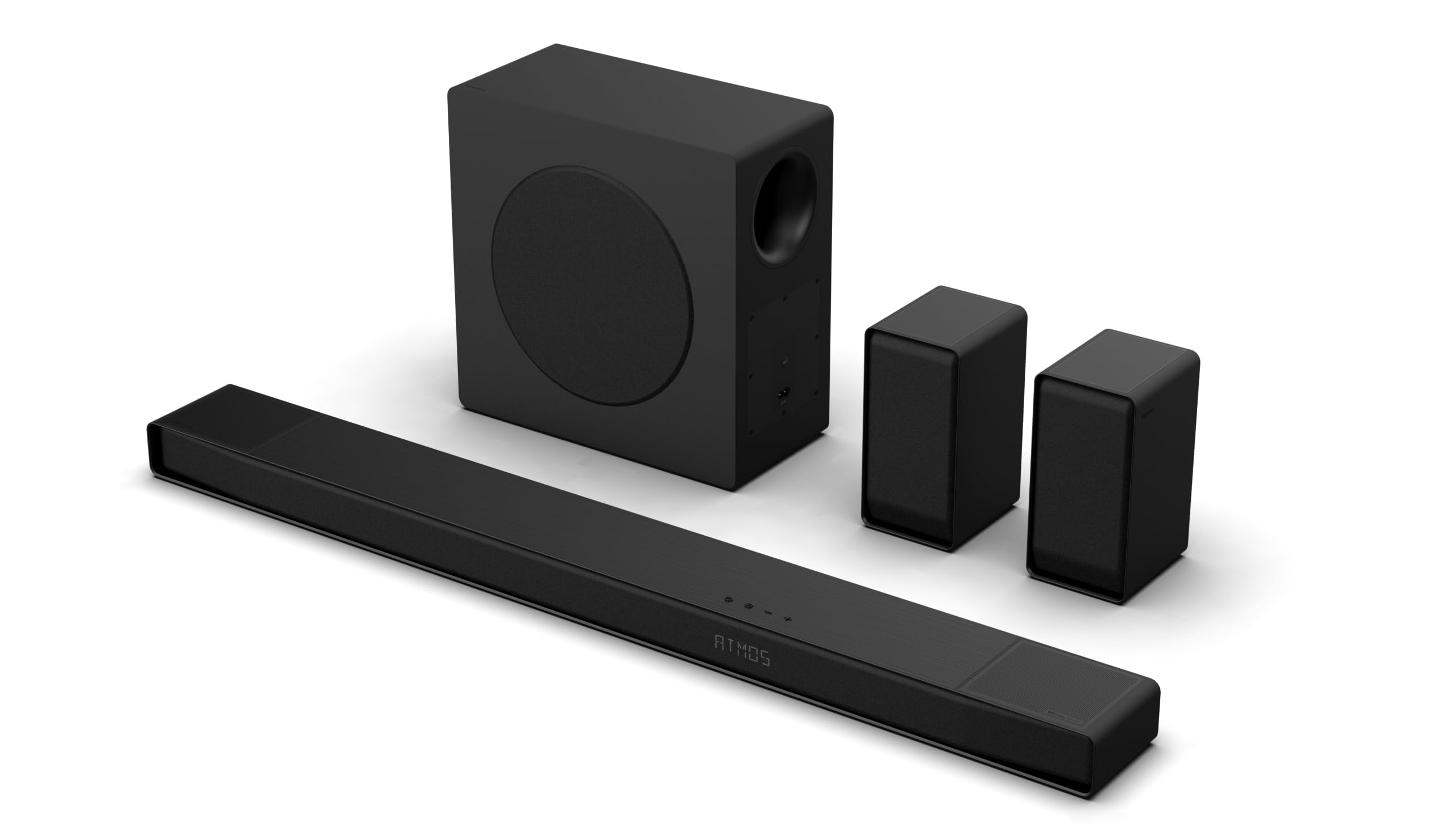
Fourteen speakers, two formats and one box — the whole 5.1.4 room, assembled for you.
You get six front-firing drivers, two up-firing drivers, four surround speakers and a 6.5″ subwoofer in this kit. That adds up to 5.1.4 channels, meaning height effects and true rear surround from a package that arrives pre-matched. The subwoofer is wireless, so it goes wherever the room allows, and bass reaches down to 40Hz. Both Dolby Atmos and DTS:X decode here, so a disc library is covered as well as streaming.
Setup is where this scores its cleanest win. HDMI eARC (the audio-return channel that sends sound back over one cable) carries audio over a single included cable and lets one remote control compatible devices. Bluetooth 5.3 handles streaming, and 4K HDR pass-through keeps the video chain untouched. Seven Quick Touch EQ presets (sound settings) on the remote cover movies, music and news, and pairing is automatic. Owners describe it as loud and cinematic once dialled in, with clear dialogue and convincing channel separation.
The trade-offs are real but specific. Rear satellites are powered and each needs its own cable to a wall outlet, so plan the placement. Dolby signals can arrive quiet and benefit from the Night or Voice modes. And the sound itself is polarising — plenty of buyers call it an excellent low-cost home theater, while others find the center channel wants more muscle. A few eARC handoffs glitch now and then and need a cable reseat.
Where it delivers
- 5.1.4 channels with genuine rear surrounds and up-firing drivers included.
- Wireless 6.5″ subwoofer reaching down to 40Hz.
- Dolby Atmos and DTS:X decoding, plus 4K HDR pass-through.
- Seven EQ presets and HDMI eARC over one cable.
Plan around this
- Each rear satellite needs its own power outlet.
- Center channel can feel underpowered for some viewers.
- Occasional eARC cut-outs that clear after a cable reseat.
Reach for this if: you want the full surround and height effect from one purchase and are happy to run power to four satellites.
Step back if: you already own a receiver and good mains — you are paying again for hardware you already have.
8. SVS Prime Elevation Speaker (Pair) – Premium Black Ash
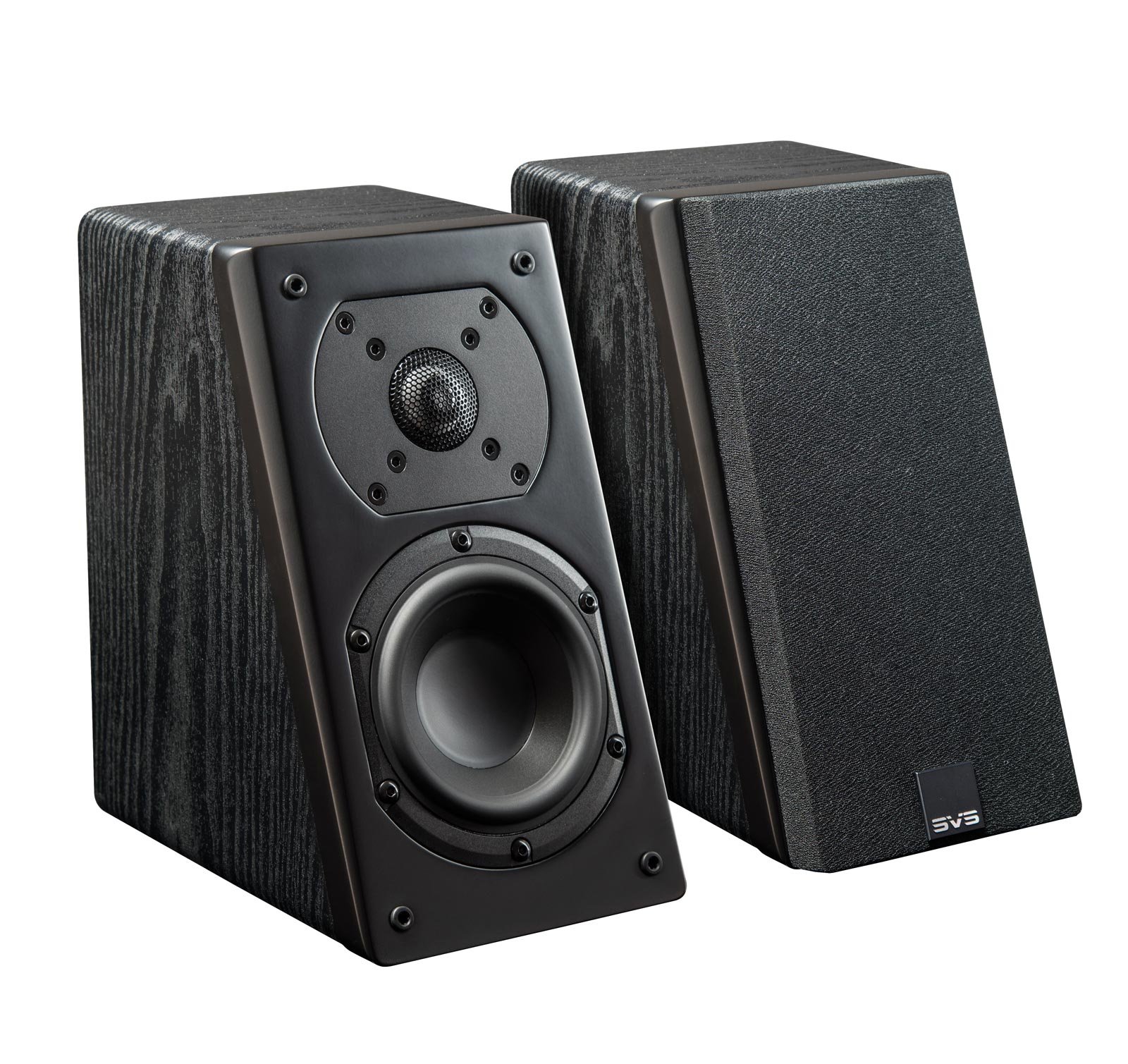
It skips the ceiling bounce entirely and fires straight at your seat.
SVS takes a different route from most of this list. Instead of pointing up and hoping the ceiling cooperates, the Prime Elevation radiates full-range sound directly at the listener. That sidesteps the frequency limits and perfect-room conditions a reflective design needs — and it is why sloped or vaulted ceilings suit this speaker rather than defeat it. A 1″ aluminum dome tweeter and a 4.5″ mid-woofer sit behind an angled baffle, with a SoundMatch crossover tying them together inside an acoustically inert cabinet.
Mounting is the real differentiator. The multi-angle wall bracket lets you aim the cabinet up-firing, down-firing, side or rear-firing, or straight overhead on the ceiling. The angled baffle means you can hang it high on a wall instead of cutting into the ceiling, and the setup template speeds the job. Owners compare its build to far more expensive speakers, which is what puts it at the top of this range.
Two practical quirks come with the territory. Connections are bare wire only, with no room for banana plugs, and pin connectors work better than spade lugs over time. The mounting pins can also be fiddly to seat on first install. At this price it is a whole-system decision rather than an impulse add-on, but a pair like this can carry height duty, surround duty or even front left-center-right if your room layout is awkward.
The straight-line advantage: Direct-radiating sound is why these hold up where ceiling-bounce speakers falter — no reflection, no dependence on a flat ceiling, and full-range output where a module hands bass off to the sub.
Worth the step up for: rooms with sloped ceilings, or anyone who wants one speaker that can be re-aimed as their layout changes.
Hold off if: you want plug-and-play cabling — bare-wire-only terminals will frustrate anyone used to banana plugs.
9. Polk Audio Signature Elite ES90 Speaker Pair

A big 5.25″ woofer in a module that simply sits on the towers you already own.
The ES90 leads with its cone: a 5.25″ mica-fortified polypropylene midrange woofer, which Polk says offers 75% more surface area than typical 4″ drivers. That extra area is what gives overhead effects body instead of a thin cue, and it fills larger rooms more convincingly. Up top, a 1″ Terylene dome tweeter handles the sharp details — jets passing, glass breaking above the frame — with the imaging to place them.
Setup could not be simpler. These modules rest on top of Signature Elite ES20, ES55 or ES60 speakers, or the earlier S20, S55 and S60 models, and a heavy rubber base holds them steady without hardware. Dolby Atmos, DTS:X and IMAX Enhanced content all come through once you pair them with a 4- or 8-ohm receiver with at least seven channels. The MDF cabinet keeps resonance down, and the shared driver technology with the wider Elite line means the sound blends rather than announces itself.
Price is the honest conversation. The value question splits opinion: this pair costs as much as the SVS above but offers fewer mounting options, since it is designed to sit, not hang. If your Polk towers are already in place and you want a matched Atmos layer with the least possible fuss, that trade makes sense.
The Polk-owner shortcut: Common driver technology across the Elite line is the entire pitch — the ES90 slots in above ES20, ES55 or ES60 speakers and sounds like it belongs there.
Pick these up if: you already run Polk Signature Elite or S-series towers and want the matching overhead layer.
Choose differently if: you need to wall-mount — this module is built to sit on a speaker, not hang from one.
Know the Specs
Up-Firing Drivers and Ceiling Reflection
An up-firing driver aims sound at your ceiling, and the flat surface bounces it back down to your seat. It works best with a flat ceiling at a normal height — roughly nine feet or under, from what buyers report in practice. A sloped or vaulted ceiling scatters the reflection, and the overhead effect weakens. That is when a wall-mounted or direct-radiating speaker becomes the better tool.
Impedance, Sensitivity and Your Receiver
Impedance, measured in ohms, tells you how hard a speaker is for an amplifier to drive — most height modules here are built for 4- and 8-ohm amplifiers. Sensitivity, in decibels, describes how loud a speaker gets for a given amount of power, so a higher figure means less strain on your receiver. Match both to the specs on the back of your amp before you buy, and confirm the receiver supports Dolby Atmos or DTS:X.
Common Questions
Do I need a special receiver to run height speakers?
Will up-firing speakers work with a vaulted ceiling?
How high should I mount a wall height speaker?
Do height speakers need their own subwoofer?
Can I use bookshelf speakers as height channels?
What is the difference between 5.1.2 and 5.1.4 height setups?
Are bare-wire terminals or banana plugs better for height speakers?
Do I need a soundbar or separate height speakers?
Can height speakers double as surround speakers?
How far apart should two height speakers sit?
The Bottom Line
For most people building a height layer, the height speakers winner is the Klipsch RP-500SA. Its switchable crossover lets one pair serve as Atmos modules now and surround speakers later, and the 5.25″ woofer gives overhead effects real weight. If you need to hang your height channels on an awkward wall, grab the Polk Audio OWM3 for its seven orientations and 4″ cabinet depth. And for a sloped or vaulted ceiling where the ceiling bounce simply will not work, reach for the SVS Prime Elevation — it fires straight at the seat instead.
How we choose
We do not accept paid placement. Every pick is matched to a real buyer and a real use-case; we do not hands-on test units.
Sources
Specifications: manufacturer listings and product documentation. Review insights: verified customer reviews, as of October 2026. Pricing: not shown on this page (it changes often); check the current price via the retailer link.
As an Amazon Associate, Aappliancez earns from qualifying purchases. This does not affect which products we feature.