Disclosure: Some links in this post are affiliate links. As an Amazon Associate I earn from qualifying purchases, at no extra cost to you. Learn more
Specs are compiled from manufacturer listings and verified buyer reviews and can change over time — please confirm the key details on the product page before buying.
If the first step out of bed sends a sharp stab through your heel, you do not need a drawer full of gimmicks — you need one insert matched to your arch height and your body weight. That is the whole game here. A deep heel cup that cradles the heel and a firm arch that stops the plantar fascia from overstretching is what separates an insert that works from one that just feels soft for a week. Below you get eleven real options, each matched to a different foot and a different job, sorted so you can pick the right one on the first try.
This guide is built by comparing the manufacturers’ published specifications and the patterns across verified customer reviews, so you get each pick’s real strengths and trade-offs instead of marketing spin.
Heel pain is not one problem, so the fix is not one insert — the deep cup, the arch height, and the weight rating decide whether it helps or hurts. This breakdown of heel support inserts covers exactly that, one pick at a time.
Top Picks

How To Choose The Best Heel Support Inserts
Most people buy the softest insert they can find and then wonder why the heel pain returns in a month. Soft foam cushions the impact but does nothing to hold the arch, and the arch is what controls how much the plantar fascia stretches with every step. The insert you want does two jobs at once — it cushions the heel and it holds the arch in the right position for your foot.
Match the arch height to your own foot, not to the marketing
A high arch insert under a flat foot pushes the foot into a shape it cannot hold, and the strain travels up to the knee and lower back. Look for models that offer more than one arch height, or start with a moderate profile and build up. If you already know you have high arches, a taller shell is the one to reach for.
Full-length versus 3/4 versus heel cup
A full-length insole runs heel to toe and replaces the shoe’s own footbed, so it needs a shoe with a removable insole to sit flush. A 3/4 insert stops before the toes, which saves room in tight dress shoes and heels. A heel cup is the smallest option and sits only under the heel — it cushions impact without changing how the whole shoe fits.
Weight rating is not a marketing number
Inserts built for heavier bodies use denser foam and a stiffer arch shell, and they hold their shape longer under load. If you are over 200 lbs, look for the models that name a load rating on the box. A lightweight insert under a heavy frame flattens out, and a flattened insert stops supporting the arch within weeks.
Trim-to-fit versus no-trim sizing
Some inserts arrive sized to your shoe and need no cutting at all. Others come as a full-length blank you trim along the printed guides to match your shoe. Trim-to-fit gives a closer match but takes patience — cut a little at a time and test the fit before removing more material.
Side-by-Side Comparison
| Model | Best For | Arch Profile | Fit Type | Load Rating | Amazon |
|---|---|---|---|---|---|
| Dr. Scholl’s Plantar Fasciitis Relief (Women)★ Best Overall | Everyday walking shoes | Firm arch, deep heel cup | Full-length, trim-to-fit | — | Amazon |
| Dr. Scholl’s Custom FiT Comfort CF730Best Cushioning | Athletic and sneaker wear | Flexible 3D arch | Full-length, no trim | 220+ lbs | Amazon |
| Orthostride Orthotic with Metatarsal PadsBest for Forefoot Pain | Ball-of-foot pain | Ergonomic arch, deep U heel cup | Full-length, trim-to-fit | — | Amazon |
| Psveb Professional Heavy Duty | Work boots and long shifts | Golden Triangle three-point support | Full-length, no trim | 230+ lbs | Amazon |
| BloomLab Gel Heel Cups (2 Pack) | Instant heel cushioning | Gel heel cup | Heel cup only | — | Amazon |
| Welnove 8-Pair Gel Arch Supports | Multiple shoes, heels | 0.3″ or 0.47″ gel arch | Adhesive arch pad | — | Amazon |
| WalkHero Arch Support Inserts | All-day standing | Rigid 3D arch, U heel cup | Full-length, no trim | — | Amazon |
| WalkHero Plantar Fasciitis Insoles | Plantar fasciitis pain | Semi-rigid arch, deep heel cup | Full-length | — | Amazon |
| OUOKK Arch Support Inserts | Tight and dress shoes | 30mm arch, 3 heights | 3/4 length, no trim | 230+ lbs | Amazon |
| BestHalo Heavy Duty | High arches, work boots | High arch, deep heel cup | Full-length, trim-to-fit | 220+ lbs | Amazon |
| Kimihome Plantar Fasciitis Insoles | Heavy frames, XL feet | Carbon-fiber high arch | Full-length, cut to size | 220+ lbs | Amazon |
Detailed Reviews
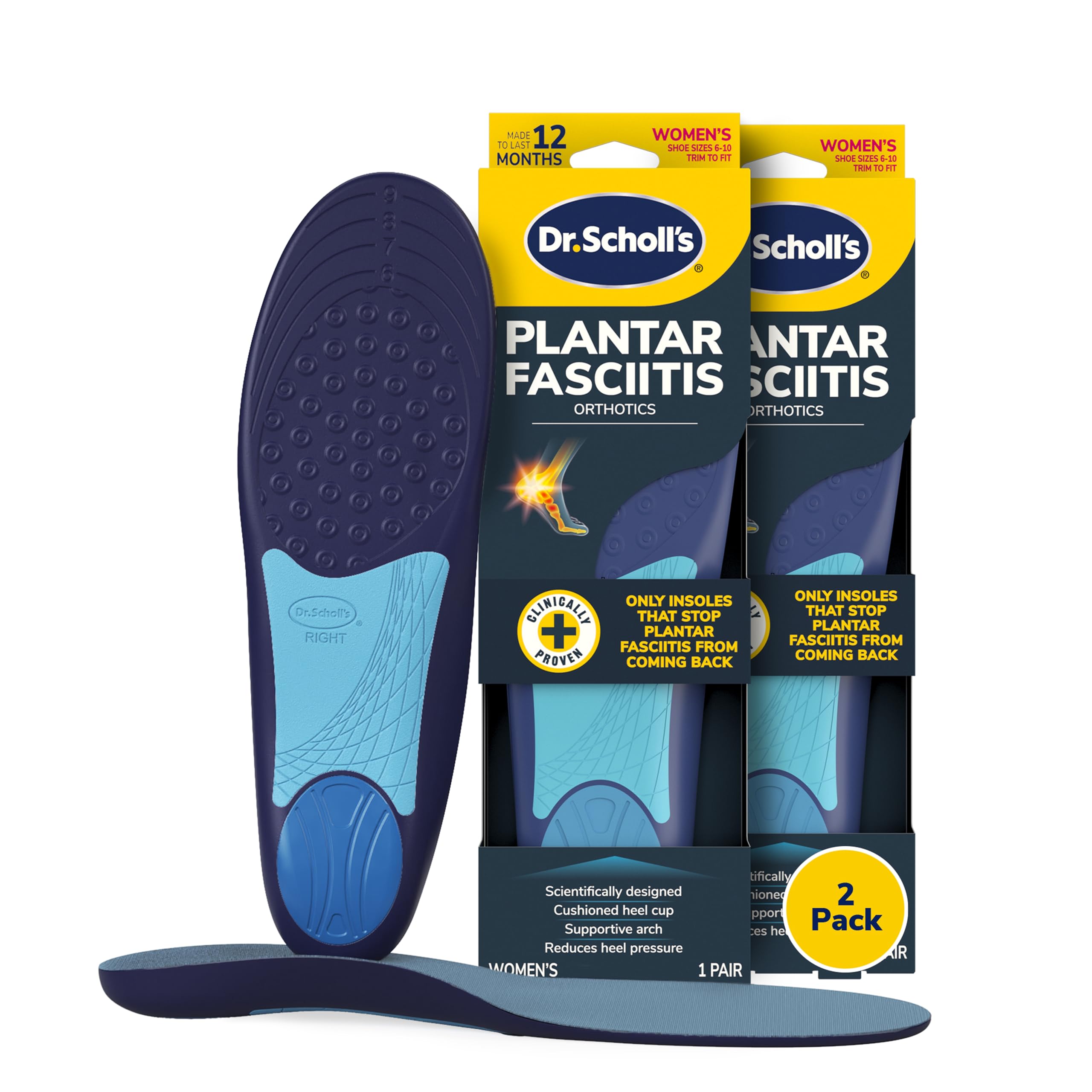
1. Dr. Scholl’s Plantar Fasciitis Relief Insoles for Women
Our pick — 4.5+★ from 250+ verified ratings; the strongest balance of quality and price.
The women’s full-length insert with a deep heel cup that eases that first-step stab.
This insert earns its spot for most women because it does two jobs at once: a deep heel cup absorbs shock, and a firm arch stops your plantar fascia (the band under your foot) from overstretching. It runs the full length of the shoe, so you get support from heel to toe, not just under the heel. The trim-to-fit blank lets you size it to dress shoes, tennis shoes, or boots. It needs no break-in — one woman with a narrow size 9 reported all-day comfort from day one, with her feet still fine after hours of standing.
The relief is what buyers mention most: one long-term wearer put these in all her walking shoes and said: “Haven’t had issues with plantar fasciitis since I started using them in all my walking shoes.” One long-term wearer put these in all her walking shoes and said: “Haven’t had issues with plantar fasciitis since I started using them in all my walking shoes.” Another buyer said they restored her active lifestyle — she went hiking the same day after months of not being able to, and no longer faced the cost of the pricier pair her podiatrist recommended. That is a pattern, not a one-off.
The honest catch is the arch. Some women find the support firm enough to feel it, and a few say it is not strong enough for their arch — thinner than they wanted. If you need a taller, more structural arch, look at a high-arch model. This one is built for a moderate arch and everyday shoes. Still, with 4.5+ stars across a solid base of ratings, it is the crowd favorite for a reason: the fit, the relief, and the ease of use all line up.
What earns its spot
- Deep heel cup absorbs shock on the first step
- Firm arch holds the fascia and eases morning pain
- No break-in needed for most wearers
- Trim-to-fit works across dress shoes, sneakers, and boots
Worth knowing before you buy
- Arch support reads mixed — some want a taller, firmer shell
- On the thin side if you need heavy structural support
The best first buy: Women with a moderate arch who want full-length support that fits the shoes already in the closet.
If your arches are very high: step up to a taller-profile insert — this one is built for the middle.
2. Dr. Scholl’s Custom FiT Comfort CF730
The heel-to-toe cushioned pick for people who stand all day and weigh over 220 lbs.
The number that matters here is the build — multi-layer foam cushioning across the full footbed, rated for people who weigh 220+ lbs. That rating is not decoration. Heavier frames flatten soft foam quickly, so an insert built for that load keeps its cushioning through a full shift. It targets the heel, arch, and ball of the foot together, so you are not just cushioning one spot and leaving the rest to take the beating. And it needs no trimming if your shoes have a removable insole.
What the long-shift crowd keeps coming back to is the durability. The quality holds up, and that is the word most often repeated about it. A buyer in the oil and gas business, walking for over 20 years, reports these make “wearing safety boots comfortable.” Restaurant, hospital, and warehouse workers get the most out of it. One woman on 10-hour healthcare shifts called it life-changing for her feet, legs, and back.
The catch is the arch shape. It is a flexible 3D arch, and for people with flat feet the rise can feel too high — one buyer with flat feet had to return it because the arch pushed up too far. The toe end is also narrow for wide-toe-box shoes. So if your feet are genuinely flat, test the arch before committing. If you want a semi-custom feel without the custom price, this is a smart middle ground.
The value read: The multi-layer foam and the 220+ lbs rating put it in a class above the thin inserts, and the no-trim fit makes it easy to drop into sneakers and athletic shoes. It handles high-impact activity like Pickleball without the heel loading up.
The honest trade-off: The arch is comfortable for standard and high arches but too much for truly flat feet, and the toe box runs narrow for wide shoes. Pick based on your arch, not your shoe.
Pick this if: You are on your feet for long shifts, weigh 220+ lbs, and want cushioning that does not quit.
Think twice if: Your feet are very flat — the arch rise will feel like too much.
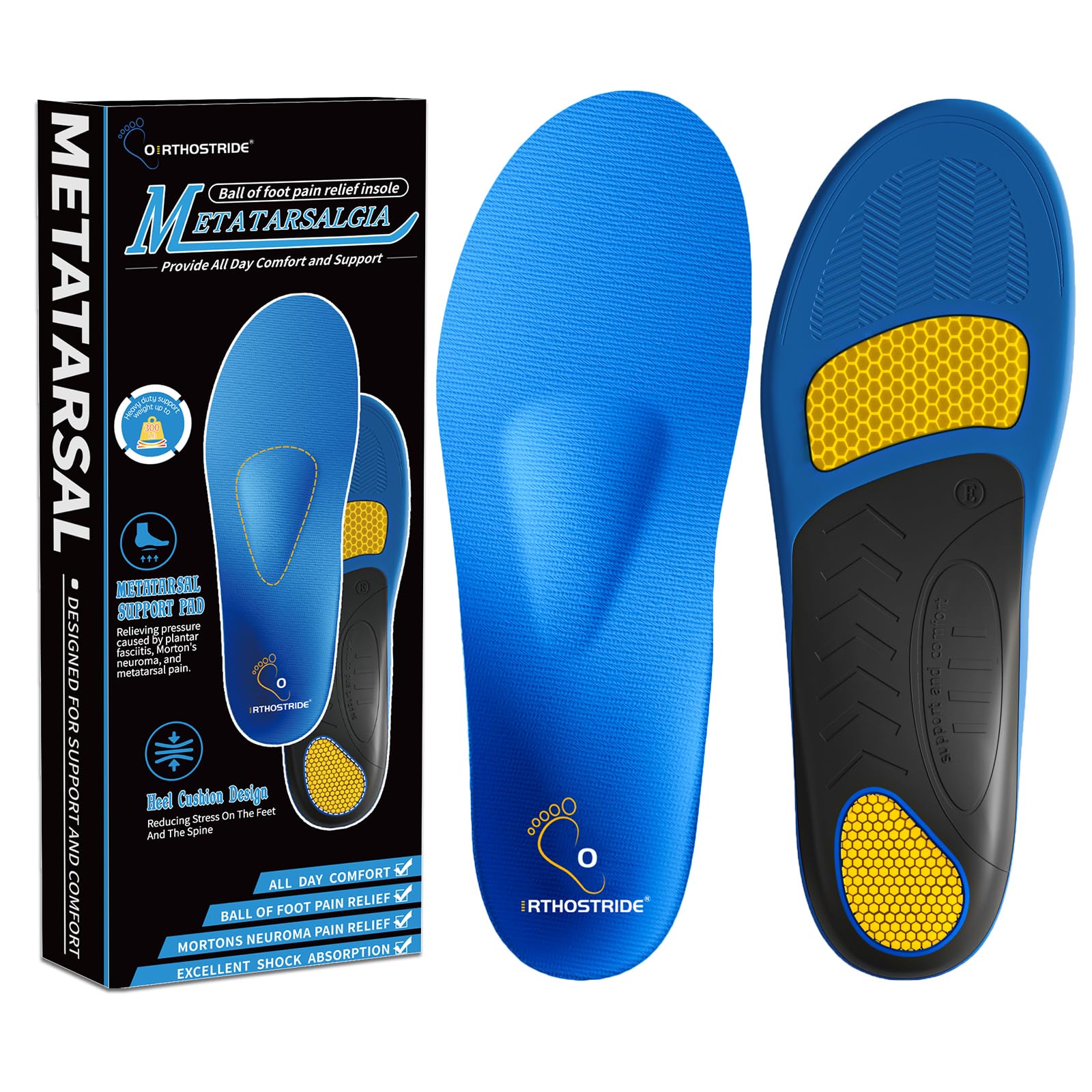
3. Orthostride Orthotic Insoles with Metatarsal Pads
The insert that also cushions the ball of your foot, not just the heel.
If your pain sits forward of the heel — metatarsalgia, Morton’s neuroma, that burning under the ball of the foot — the built-in metatarsal pads here are the reason to look. They lift and cushion the forefoot so weight spreads out instead of concentrating under a few bones. Underneath that, the ergonomic arch holds up fallen arches and the deep U-shaped heel cup keeps the heel from sliding. It is a full-length blank at 8.15 ounces, slightly heavier than the Dr. Scholl’s women’s pair at 8.11 ounces — a hair more material underfoot.
Fit is the honest story with this one. You will likely need to trim it, and the toe area is genuinely thick — around a quarter inch — which can crowd the toes in a flexible sneaker. The brand steers you toward roomy footwear for this reason: wide-fit sneakers, work boots, athletic shoes. The people who get the most from it are those who break it in slowly. Support is what it does best, and the spring of the plastic arch gives a lift some wearers find genuinely pleasant.
For the right foot, it delivers. One wearer described the pain in her foot completely going away; another found the arch spring a welcome change from the Aetrex she had worn for years. At 3.5+ stars, it is the most polarizing pick on the list — but the reason to buy is specific: forefoot relief plus arch and heel support in one piece. Choose it for boots and roomy shoes, not for slim sneakers.
Why it stands out
- Metatarsal pads take pressure off the ball of the foot
- Deep U heel cup stabilizes the heel and ankle
- Springy plastic arch adds lift under the foot
- Shock-absorbing PU foam keeps feet cooler
Where it asks patience
- Thick toe end cramps flexible sneakers
- Trim-to-fit takes careful cutting
- Needs a multi-day break-in before it settles
Reach for this if: Your forefoot, not just your heel, is the problem — and your shoes are roomy enough to host a thicker insert.
Look elsewhere if: You wear slim sneakers or want a no-trim, out-of-the-box fit.
4. Psveb Professional Heavy Duty Support Pain Relief Orthotics
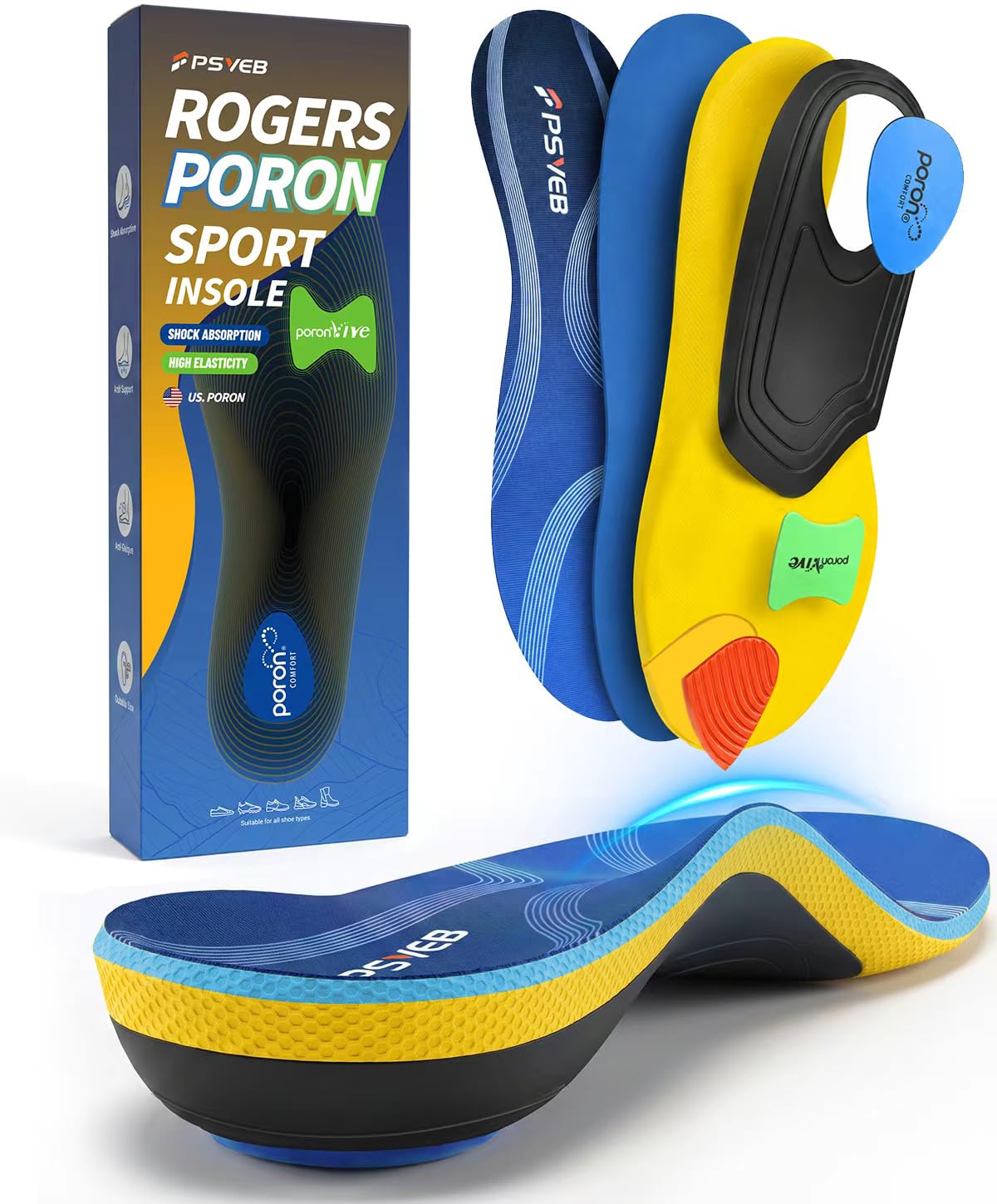
The heavy-duty favorite for 230+ lbs frames and work boots, at the budget end.
The most striking thing about this insert is how many people rate it, given where it sits on price. 1,000+ ratings and 4.0+ stars make it the highest-volume heavy-duty pick here. The reason is simple: double PORON cushioning (a shock-absorbing foam) paired with a three-point “Golden Triangle” arch that supports the forefoot, arch, and heel at once. Built for 230+ lbs, and 5.93 ounces on the scale — light enough to not weigh down the boot. The deep U heel cup holds the foot and fights side-slip while you walk.
Owners on their feet all day are the ones who rave about it. Owners on their feet all day praise the quality and the comfort, and work boots are where it shines. A buyer in work boots felt the difference on day one — the heel cushion doing its job. If you have foot issues and stand for a living, this is the one people keep recommending to each other.
The one nuance is thickness. A portion of wearers find them a touch thicker than they pictured, which matters most in snug shoes. In work boots or roomy sneakers it is a non-issue. For a budget pick, this is a genuinely strong option — heavy-duty support without the hit to the wallet. If you want firm, stable, and built for a heavy frame, this delivers.
The standout: Three-point arch support plus double PORON cushioning at a budget-friendly tier is a tough combination to beat here. It cradles the foot and keeps the arch lifted through a whole shift.
Size it to your shoe: Thickness is the only real gripe — a handful find it thicker than expected. Boots and roomy shoes take it easily; very snug shoes may not.
The budget winner: Anyone over 230 lbs who wants firm, stable arch support in work boots without paying premium prices.
Keep in mind: Snug-fitting shoes may feel cramped — reach for roomier footwear.
5. BloomLab Gel Heel Cups 2 Pack

The soft silicone cup that slides into any shoe and cushions the heel from the first step.
If your pain is concentrated in the heel and you want something you can drop into almost any shoe — a dress shoe, a walking shoe, a casual sneaker — these silicone gel cups are the simplest fix on the list. They are not a full-length orthotic, and that is the point. The low-profile design stays discreet, and at 2.08 ounces for the pair they are barely noticeable underfoot. The non-slip gel base helps them stay put, and the silicone won’t flatten the way cheap foam does.
Heel pain is what it targets, and that is what owners talk about most — the relief on the first step out of bed, the ease of a morning walk or a full day on hard floors. The cushioning is the draw: owners compare the feel to a squishy cloud under the heel. The slim profile fits sneakers and dress shoes both. One active mom with 10k+ daily steps and kids to chase found the nightly knee aches and leg fatigue dialed back, and the cups just disappear into her shoes.
The honest nuance: this is a cushion, not a cure, and the arch is not what it fixes. They can shift in a loose shoe or a humid environment, and the cushion is a touch wide for very narrow shoes. If your primary issue is a flat arch rather than heel impact, a full-length insert will do more. But for plantar fasciitis heel pain and heel spurs, these are the easiest, kindest starting point.
The simple truth: Slim, reusable, washable, and ready to wear with no break-in. A 2-pack means you can keep one in your work shoes and one in your weekend pair.
Set your expectation: The silicone cushions and absorbs shock; it does not hold up an arch. In very loose shoes or very narrow ones, it may not sit perfectly still.
The easy add-on: Anyone with heel-first pain who wants a discreet cup that fits most shoes and needs no trimming.
Not the whole answer if: Your main problem is a collapsed or flat arch — pair it with an arch insert instead.
6. Welnove 8-Pair Gel Arch Support Insoles

Eight pairs of stick-on gel arch pads that go where full inserts cannot.
Eight pairs. That is the reason to look here — a large set of soft gel arch pads you stick inside the shoe, so you can outfit every pair you own without buying one insert per shoe. They come in two heights, 0.3″ and 0.47″, so you can match the lift to your arch rather than guessing. The self-adhesive design means no trimming and no shifting: press them in and they stay. They are made for high heels, boots, sneakers, cleats, loafers, and even sandals — the places a full-length insert will not go.
What owners praise most is how well the adhesive holds — the pads stay put through a whole day, even in open-toe and open-back dress shoes. The arch support ranks right alongside it. That is the combo that makes them useful: they sit exactly where your arch needs lift, and they do not creep around while you walk. For a buyer with extremely flat feet, daily wear across all shoes — including flip flops — eased shin pain over several months.
Fit and adjustability are the mixed notes. The shape does not suit every arch, and a few wearers found the edges bothered the arch regardless of placement. Start with the lower 0.3″ height and see how your foot reacts before moving up. The adhesive earns solid marks, though a couple of buyers found it only adequate for their needs. At 4.0+ stars, it is a strong, flexible fix.
Where they win
- Eight pairs cover every shoe you own
- Two heights — 0.3″ and 0.47″ — match your arch
- Sticks in place all day without trimming
- Works in heels, sandals, and cleats where full inserts cannot go
Watch for this
- Shape may not suit every arch
- Adhesive is good but not perfect for everyone
Best for a whole shoe collection: Anyone who wants arch lift in heels, sandals, and flats, not just sneakers.
Skip if: You need a full-length structural insole for heavy support.
7. WalkHero Arch Support Inserts
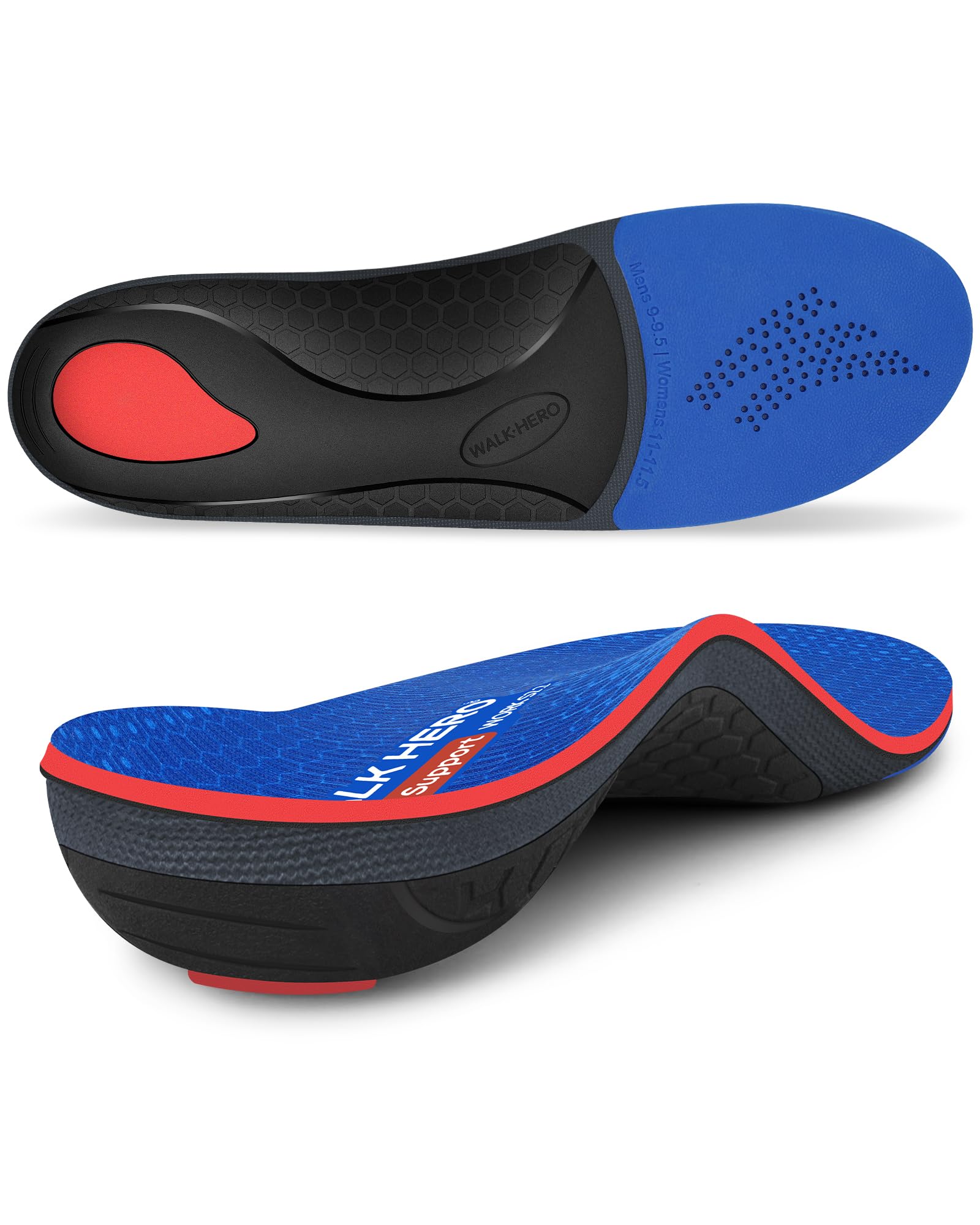
The rigid-arch workhorse for all-day standing, with no trimming required.
The rigid arch is the point here. Flimsy stock insoles flatten under load and stop supporting anything within weeks; this one uses a stiff shell with a 3D contoured arch and a deep U-shaped heel cup that locks the heel in place. It is built to fight overpronation and flat feet, not just cushion. The high-density EVA base with thickened heel pads and forefoot buffers spreads impact so it reaches your knees and ankles softened. And it is sized to your shoe with no cutting — pick your regular size and it drops in snug.
Arch support is what owners talk about most, and the relief shows up across foot, knee, and back complaints. The proof is how far it reaches beyond the obvious buyer. A parent who had always bought computer-measured orthotics for a son with a raised arch found these supported him “perfectly for a fraction of the price.” A size 8.5 wearer fit her Brooks shoes with no trimming. Another on 12-hour shifts had sore, swollen feet and ankles eased.
The catch is genuinely high arches. The rigid shell is firm, and one wearer with very high arches found her feet hurting by the end of a workday. The arch is moderate — not the tallest out there. Treat the first 2–3 hours as a break-in and build up over a week or two. For moderate arches and long standing shifts, this is among the most reliable mid-range picks you can buy.
Why it performs: A rigid arch and a deep heel cup working together stop the foot from collapsing under a long day’s load. Owners count on it through 12-hour shifts.
Don’t rush it: The firm shell feels different from a soft insole. Wear it 2–3 hours a day at first — by the end of a week or two, most feet have adapted.
Best for moderate arches: Commuters, hikers, and long-shift workers who want a firm shell under a whole day’s standing and walking.
Where it falls short: Very high arches may need a sturdier, taller support than this one gives.
8. WalkHero Plantar Fasciitis Pain Relief Insoles
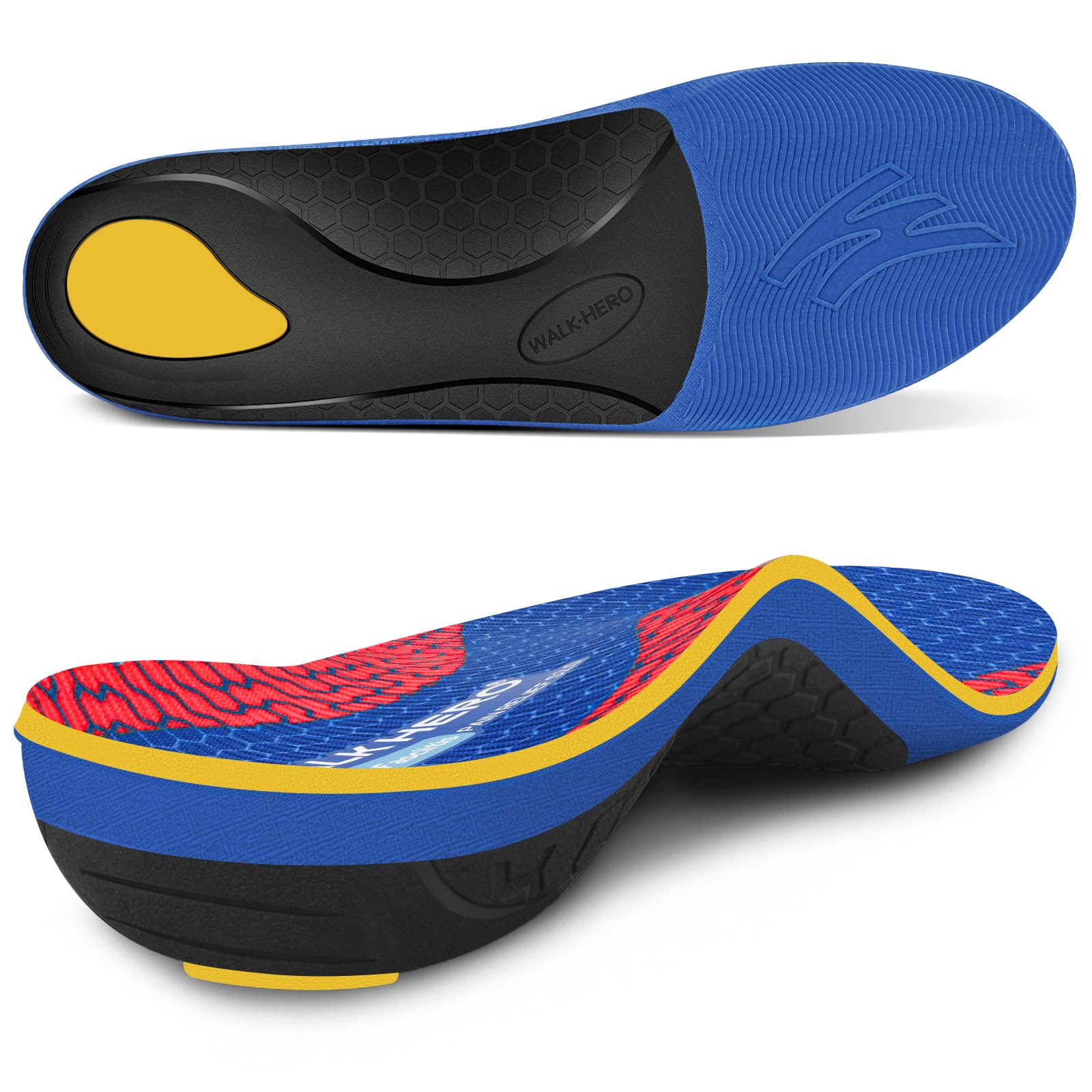
A semi-rigid shell that moves with your foot, made for plantar fasciitis pain.
Where the sister WalkHero pick above uses a rigid shell, this one is semi-rigid — flexible enough to let the foot move naturally, firm enough to hold shape. For plantar fasciitis that is often the right balance: enough structure to stop the fascia overstretching, but not so stiff that the foot fights it. The deep heel cup stabilizes the heel and takes strain off the fascia, and a reinforced PU shock-absorbing pad in the heel cup adds cushioning right where the impact lands. Multi-layer foam and EVA spread the load underfoot.
This one is known for pain relief, and that is why people keep reaching for it. Buyers report it eliminating plantar fasciitis pain outright, and one walks 6 miles a day with minimal discomfort. The clearest testimonial comes from a buyer who switched it into daily work shoes for instant relief on a size 12 with no trimming, and from a wearer who was completely pain-free after a day of adjustment — clearing that hurdle better than the insoles the podiatrist had made.
The honest caveat is wear over time for heavier wearers. Some over 200 lbs find it softens and wears quicker than they expected. In narrow shoes it can also feel less secure than in a roomier pair. It is not the insert for a heavy foot that wants a rigid shell for the long haul — the heavier-duty picks suit that better. For standard feet and moderate budgets, though, it is a standout.
The semi-rigid middle: A flexible-yet-firm shell with a deep heel cup is the combination most plantar fasciitis buyers are actually looking for — structure without the board-like feel.
The weight note: Under 200 lbs it holds up well. Over 200, expect it to wear faster than a heavy-duty model.
For standard arches: Buyers with plantar fasciitis who want support that still lets the foot move.
Look at a heavier-duty pick if: You are over 200 lbs — those shells hold their shape longer.
9. OUOKK Arch Support Inserts

A 3/4-length insert that slides into a tight shoe without crowding the toe.
Half the battle with heel inserts is that a full-length insole will not fit a dress shoe or a heel without lifting your foot out of place. This one is 3/4 length — it runs heel to just behind the toes, so it stays clear of the toebox and saves space. It is rated for 230+ lbs, uses a 30mm ergonomic TPU arch for lift, and comes in three arch heights so you can match the support to your own arch type. At 3.2 ounces, it adds almost nothing to the shoe.
What people praise most is the quality and the arch support together. For a thin insert, it pulls off support without bulk — a wearer in dress shoes noted they are thin but still lift the arch and keep feet less tired after hours. The three height options matter for anyone who has struggled with a one-size arch. It works inside tight shoes and loose shoes, indoor flats, outdoor hiking shoes, and all-day heels.
It is not for every foot, though. One wearer with a medium arch found it flexible rather than rigid, and it would not stay put — a placement challenge that also shows up for some with a tiny heel and low lift. The 3/4 length cannot do what a full-length insert does for forefoot support. At 4.0+ stars, it is a strong fit for shoes that will not take a full insert — reach for it when the shoe box is the constraint.
Fit first: The 3/4 length and thin build are the whole reason to choose it — nothing else on the list slides into a dress shoe or heel this easily.
Check your arch type: Three heights sound generous, but if your arch is genuinely medium, test the fit — some find it too flexible and prone to shifting.
Reach for this if: Your shoes are tight, you need a thin insert, and a full-length insole would crowd your toes.
Not ideal if: You want a rigid, firmly anchored arch under a heavier load.
10. BestHalo Heavy Duty Plantar Fasciitis Insoles
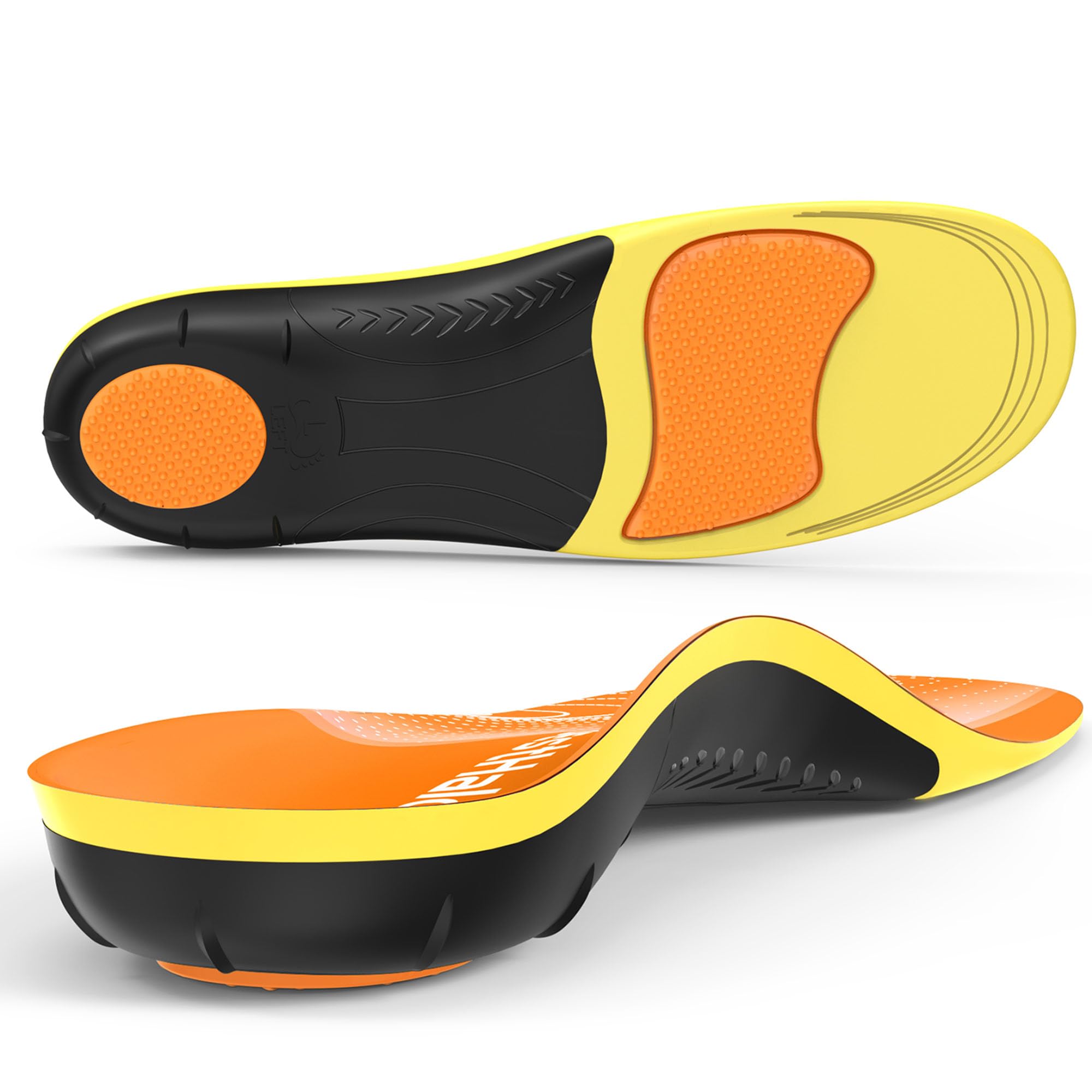
The high-arch, high-cushion pick built for 220+ lbs and long days in work boots.
High arches are the ones most inserts leave behind. This one is designed around them, with a tall structured arch that improves foot and leg alignment instead of just cushioning the heel. Premium EVA foam and gel combine for shock absorption, and a deep heel cup stabilizes the heel and controls overpronation and supination. Rated for 220+ lbs, at 9.14 ounces. The trim-to-fit design lets you adjust for different shoes and sizes — sneakers, casual shoes, work boots.
Cushioning is the star of this one. Owners describe walking on a cushion of cloud-soft gel, and the heel and arch hold up through 8-12 hour days. Quality and pain relief are what they talk about most. The evidence is concrete. One buyer with very high arches had significant relief after one day on a job that required constant walking, standing, and pivoting, and her toe pain and stiffness eased as the arch lifted. A woman size 9 found the fit right from the start, no trimming required, and paired it with side support for her lower back from standing all day.
The one thing to plan for is the adjustment. A firm high arch feels foreign at first — the brand suggests 2–3 hours a day for the first 3–7 days before working up. A few wearers find it thicker than expected in snug shoes. For high arches and heavier frames, though, it is the pick that does the most for the least amount of fuss. If your arches are low, though, this will push where your foot cannot follow.
Built for high arches
- Tall structured arch designed for high-arch feet
- EVA and gel cushioning under the heel
- 220+ lbs load rating for heavy frames
- Trim-to-fit for boots, sneakers, and casual shoes
What to expect
- Needs a short adjustment period for the tall arch
- Can feel thick in snug shoes
Made for high arches: Buyers with tall arches who want real lift and heavy-frame support in work boots.
Go low if: Your feet are flat — this arch will fight your foot shape.
11. Kimihome Plantar Fasciitis Arch Support Insoles XL

The carbon-fiber shell that holds its shape for heavy frames and XL feet.
Carbon fiber in the arch is the premium difference here. It gives the shell hardness and durability so it will not deform, and the high arch support stays consistent even after months of daily use. Designed for up to 220 lbs, with gel pads under both the heel and the forefoot to absorb shock. The PU build and silk-like fabric cover keep it comfortable, and a specific anti-slip base stops it sliding inside the shoe. An XL size that fits wide, large feet — the gaps most inserts leave. Washable, and built for long-term daily use.
Arch support is what owners mention most, and it shows up across foot and knee complaints. The most telling pattern is body-wide relief. One buyer with overpronation-related hip and back pain found relief after one day in the inserts, working all day in healthcare with no ankle, foot, or hip pain, and bought a second set for both work shoes. The rubber bottom kept it from sliding — a real win for a heavy-duty insert. For a large frame that needs a shell that holds up, this is a serious contender.
You should know the fit is variable. It runs narrow, and some wide feet find it unsuitable; the arch also runs long on one foot for some wearers, and a few find the cushioning at the ball of the foot thin. At 4.0+ stars, it is respected rather than universal. The brand’s own advice — wear it 3-5 hours the first couple of days and build up — applies here more than most. If you want durability and a consistent high arch, it earns its premium spot.
The premium case: A carbon-fiber high arch is about longevity as much as support — the shell resists the deformation that flattens softer inserts over time.
The size caution: Narrow build and a long arch mean wide feet and certain foot shapes will not fit well. Check sizing carefully before you commit.
For long-term durability: Heavier frames and XL feet who want a shell that holds shape month after month.
Choose another if: Your feet are wide or your arch is short — this one runs narrow and long.
Know the Specs
Arch height — the number that decides comfort
Arch height is how far the support rises under the middle of your foot. A support that is too tall for a flat foot pushes the foot into a shape it cannot hold, which can send strain up to the knee and lower back. Supports that offer more than one height — like the Welnove pads at 0.3″ and 0.47″ or the OUOKK inserts with three arch heights — let you pick lift that matches your own foot instead of guessing.
Heel cup depth — what stops the heel sliding
The heel cup is the bowl at the back of the insert that cradles your heel. A deep U-shaped cup keeps the heel from sliding side to side, which steadies the whole foot and takes the sideways stress off the ankle. This is the part that absorbs the impact of each step, so it matters most if your pain hits on the first step out of bed or after a long day on hard floors. A shallow cup cushions less and lets the heel move around inside the shoe.
Load rating — the weight an insert is built to carry
Inserts rated for 220+ lbs or 230+ lbs use denser foam and a stiffer shell so they hold their shape under a heavier frame. A lighter insert under a heavy body flattens out, and once it flattens it stops supporting the arch. If you are over 200 lbs, match the rating to your weight — several picks here, including the Dr. Scholl’s CF730, Psveb, BestHalo, OUOKK, and Kimihome, name a load rating on the box.
Break-in period — why a firm orthotic feels odd at first
A firm arch support is not a soft insole, and your foot has to adjust to the new shape. Brands here suggest starting with 2–3 hours a day and increasing wear over one to two weeks. That is normal, not a defect — a shell that gives instantly usually stops supporting quickly too. Push through the first week slowly, and if the pressure does not settle, the arch height is probably wrong for your foot rather than the insert being faulty.
Common Questions
How do I know which arch height I need?
Will a heel support insert fit inside dress shoes or heels?
How long does a firm arch support insert last?
Do I need to trim the insert to fit my shoe?
Can a heel cup alone fix plantar fasciitis?
Why does a new insert hurt at first?
Is a full-length insole better than a 3/4 insert for heel pain?
What weight rating should I look for if I am over 200 lbs?
Can I move one insert between different pairs of shoes?
Do gel inserts last as long as foam or carbon-fiber ones?
The Bottom Line
For most people, the heel support inserts that make the strongest case are the Dr. Scholl’s Plantar Fasciitis Relief Orthotic Insoles for Women, because a deep heel cup and a firm arch cover the two jobs that actually stop heel pain — and it needs no break-in. If you want heavy-duty support at a budget-friendly tier, the Psveb Professional Heavy Duty is the one to grab. And for high arches and work boots, the BestHalo Heavy Duty gives you the tall structured arch most inserts leave out.
The quick rule: match the arch to your foot, match the load rating to your weight, and match the fit type to the shoes you actually wear. Do those three and you will not need to buy twice.
How we choose
We do not accept paid placement. Every pick is matched to a real buyer and a real use-case; we do not hands-on test units.
Sources
Specifications: manufacturer listings and product documentation. Review insights: verified customer reviews, as of October 2026. Pricing: not shown on this page (it changes often); check the current price via the retailer link.
As an Amazon Associate, Aappliancez earns from qualifying purchases. This does not affect which products we feature.