Disclosure: Some links in this post are affiliate links. As an Amazon Associate I earn from qualifying purchases, at no extra cost to you. Learn more
Specs are compiled from manufacturer listings and verified buyer reviews and can change over time — please confirm the key details on the product page before buying.
If your wrist aches after a stack of paperwork, the punch is the problem, not you. A heavy duty 3 hole punch solves this with a longer lever, sharper heads and a stable base, so a thick report goes through on one firm push instead of five grindy attempts. The picks below range from a light-touch desktop lever to an electric model that does the work on a button press, and each one is chosen for how cleanly it cuts and how little effort it asks of your hand.
This guide is built by comparing the manufacturers’ published specifications and the patterns across verified customer reviews, so you get each pick’s real strengths and trade-offs instead of marketing spin.
You will see what each punch actually promises, where the rated sheet count and the real comfortable stack usually part ways, and which model fits a busy copy room versus a home desk drawer. The details that decide a heavy duty 3 hole punch are the lever ratio, the sheet ceiling and the chip tray, not the brochure wording.
Top Picks

How To Choose The Best Heavy Duty 3 Hole Punch
The biggest mistake buyers make is treating the rated sheet count as the number they should routinely hit. Almost every heavy duty punch is rated at its absolute ceiling with fresh, standard-weight paper, and the smooth, comfortable stack sits below that. Read the rating as headroom, then buy a punch one step above your typical pile and you will never fight it.
Match the capacity to your real stack
A punch rated at 40 sheets is built for occasional thick reports, not a daily diet of 40 sheets. If you file a few sheets at a time, a 10-sheet desktop model is plenty. If you bind training manuals or client files, aim well above the stack you actually handle so the lever stays easy and the heads stay sharp for longer.
Look at the lever, not just the heads
The amount of hand pressure you feel comes from the lever design. Some models use a longer effort arm to cut the force you need, and a light-touch handle lets a whole stack go down with a light push. If anyone in your office has arthritic hands or a weak grip, check the lever ratio before the sheet count.
Check hole size, depth and the paper guide
Three-ring binders need the holes lined up to a standard spacing, and a punch that creates clean 9/32 inch holes with the right depth lines up with standard binders. A fixed paper guide keeps every sheet in the same spot, so a stack of 600 pages ends up with holes that sit in a straight line rather than drifting sheet to sheet.
Side-by-Side Comparison
| Model | Best For | Sheet Capacity | Hole Diameter | Operation | Amazon |
|---|---|---|---|---|---|
| Swingline Precision Pro (74086)★ Best Overall | Everyday desk filing | 10 sheets | 0.28 inches | Manual | Amazon |
| XOOL XL-3HPMost Versatile | Varied binder and card formats | 40 sheets | 0.28 inches | Manual | Amazon |
| Eagle EG-1680BA | Hands-free office punching | 20 sheets | 0.27 inches | Electric | Amazon |
| CARL HC-340 | Long-life heavy batches | 40 sheets | — | Manual | Amazon |
| AFMAT HP18 | High-volume textbook work | 50 sheets | 0.28 inches | Manual | Amazon |
| Officemate Deluxe 90100 | Busy shared workspaces | 45 sheets | 0.28 inches | Manual | Amazon |
| Swingline LightTouch 74357 | Low-effort custom hole patterns | 40 sheets | 9/32 inch | Manual | Amazon |
Detailed Reviews
1. Swingline Precision Pro 74086
Our pick — 4.5+★ from 950+ verified ratings; the strongest balance of quality and price.
The metal desk punch that adjusts between two and three holes and never fights a normal stack.
This is the pick for the home desk and the small office where paperwork arrives in thin batches, not warehouse stacks. It punches through up to 10 sheets at a time and cuts clean, precise holes at 0.28 inches, which is the size a standard three-ring binder is built to accept. The black and gold finish is the model’s own look — the listing also shows a white and gray colorway if the gold reads too loud for your desk.
What wins people over is the build itself: the body is metal, not plastic, and the two-to-three-hole adjustment lets you swap between binder formats without a second tool. Buyers report it as “much better than I expected, especially for such a good price” and note that the hole positions are easy to shift. The patented pin technology is the part that keeps each punch landing in the same spot sheet after sheet, which is what actually matters when you are feeding a binder.
Be clear about its ceiling, because 10 sheets is a hard number. If your filing runs 20 sheets at a time, this punch will make you work for it and should be skipped in favor of the XOOL or AFMAT picks below. Where it wins is simplicity — a light desktop footprint, a chip tray that slides out to dump cleanly, and no lever fight on a normal report.
What earns the top spot
- Metal body with a black and gold finish that looks sharp on a desk
- Adjusts between 2-hole and 3-hole layouts
- Patented pins keep hole placement consistent
- Removable chip tray makes cleanup a one-second job
Where it runs out of steam
- 10-sheet ceiling is thin for any real filing volume
- A manual lever means thick stacks need more than one push
Made for: thin-day-to-day filing on a single desk, where a clean hole and a tidy footprint beat brute capacity.
Pass it by if: your normal pile already runs past 10 sheets, because you will want the headroom of a heavier punch.
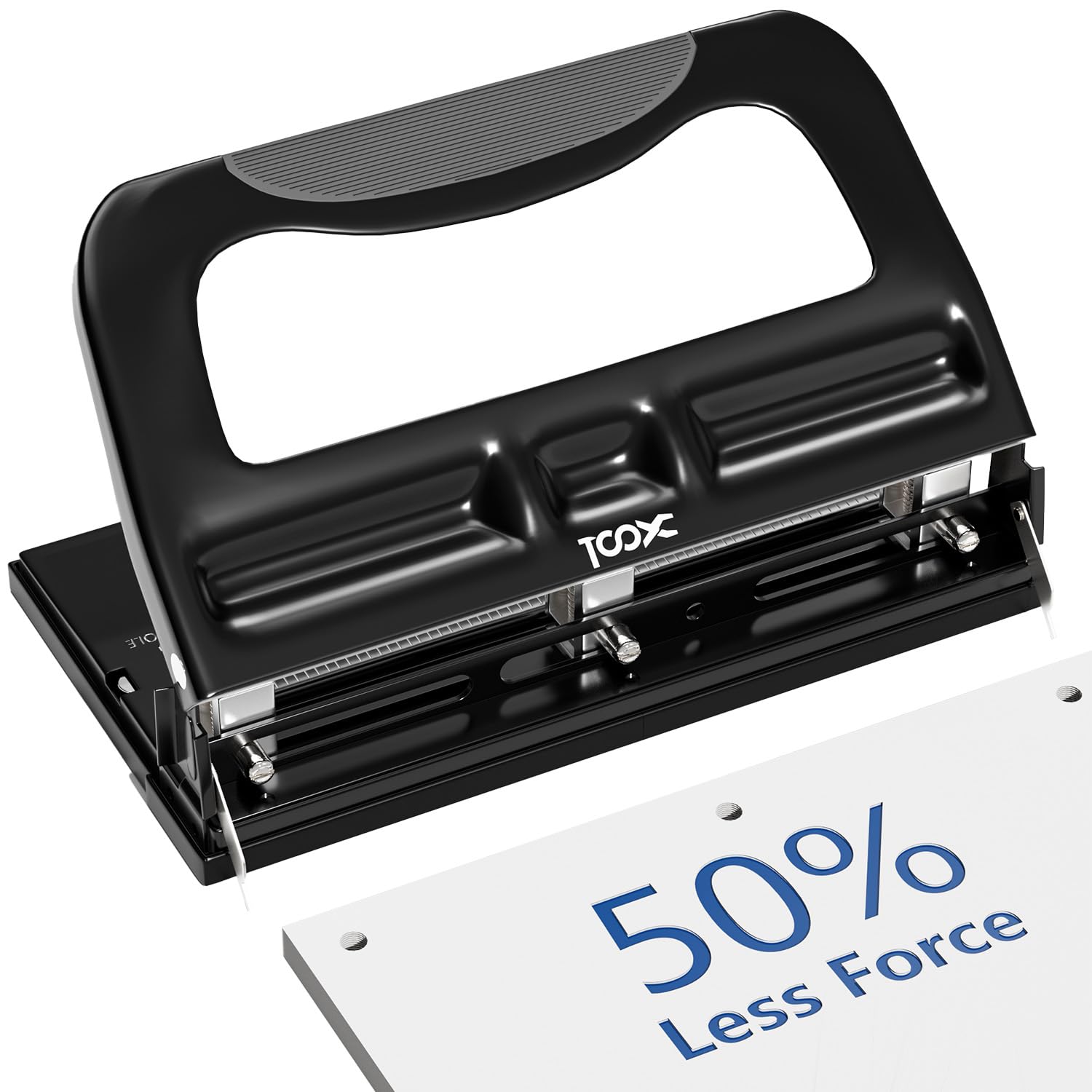
2. XOOL XL-3HP 3 Hole Punch
A chunk of steel that switches formats and does not slide across the desk while you lean on it.
If you punch file cards, A4 sheets and US Letter pages in the same afternoon, this is the one to look at first. The punch heads are fully adjustable between two-hole and three-hole settings, so the same tool handles a card box and a binder without a second machine. It is rated at 40 sheets of 70gsm paper and cuts round 7mm holes, which is the 9/32 inch size that drops straight into a standard binder ring.
The spec sheet says a lot here. At 1.76 kg this is 2.3 times the weight of the Eagle electric punch at 0.77 kg, and that mass is exactly why it sits still instead of chasing your paper across the desk. Its lever is also built to demand up to 50 percent less hand pressure than a standard model, which is the difference between one firm push and a two-handed shove on a thick stack. Owners describe it as solid and stable in use, and the recurring note is that the rated 40-sheet figure is optimistic — several treat 30 sheets as the honest working number and are perfectly happy.
One practical quirk: the punch heads use a screwdriver to shift position rather than a quick preset lever, so switching hole spacing is a setup job, not a mid-task flick. Its built-in ruler guide and end stopper keep your sheets lined up once you have set it, which is the trade most people will happily make. skip it if you change hole spacing minute to minute; take it if you set a format and punch all day.
The honest buying call: pick it when one punch has to serve several binder and card formats without budging from the desk.
The catch worth knowing: changing hole spacing needs a screwdriver, so set your format before you start a run.
3. Eagle Electric 3-Hole Punch, 20-Sheet Capacity (EG-1680BA)

Press a button and the machine does the punching — your shoulders get the afternoon off.
For anyone whose wrist decides how much filing gets done, this is the pick that removes the lever entirely. It runs on the included AC adapter or on 6 AA batteries, so you can carry it to a table without hunting for an outlet. A button press sends the head through up to 20 sheets and cuts clean 0.27 inch holes, with a paper guide holding each stack square to the ring.
Its footprint is telling: at 0.77 kg it weighs less than half of the XOOL at 1.76 kg, and it measures 9.85 inches long against the XOOL’s 10.4 inches. That makes it the one you can tuck into a drawer or a tote without a second thought. Quality and reliability are what the reviews circle back to again and again, and the alignment gets called out directly — holes that sit where a standard binder expects them. The chip tray holds the scraps until you are ready to dump them, so there is no confetti across the desk.
The honest catch is sound. The motor is audible, and while some find the noise perfectly fine, others find it louder than a lever. Set it on a solid surface and it stays put, but a wobbly card table will amplify the buzz. It also tops out at 20 sheets, so a heavy binder run still needs a manual heavy hitter.
Where it shines: the one-touch button replaces the whole lever-pull motion, so a long filing session no longer taxes your arm. Cord or battery operation makes placement flexible, and the compact 0.77 kg body stores easily when the work is done.
What to accept: it is louder than a manual punch and its 20-sheet ceiling is modest, so treat it as the comfort option rather than the volume option.
Reach for this if: hand and shoulder strain is the deciding factor and you want the machine to carry the effort.
Look elsewhere if: your stacks routinely pass 20 sheets or you file in a room where motor noise is a problem.
4. Carl Medium-Duty 3 Hole Paper Punch, 40 Sheet (HC-340)

A 3.7-pound steel punch with a fixed guide that squares every 8.5 by 11 inch sheet automatically.
The first thing you notice is the weight. At 3.7 pounds this is the heaviest manual punch on this list, and that heft is doing real work — the non-skid rubber base locks the unit down so a one-handed punch does not drag it sideways. Hardened precision-ground all-steel punch heads take a 40-sheet stack and cut clean holes without tearing or leaving hanging chads.
Durability is the headline the reviews keep landing on, and it holds up in the details: heavy-duty springs, a large chip tray that slides out, and a handle that locks down for storage. The other thing owners notice is the fixed-position paper guide, which squares up 8.5 by 11 inch sheets automatically — no eyeballing, no slipping, no adjustment. Push a whole office’s paperwork through it and the guide keeps hole placement identical from the first page to the six-hundredth.
That fixed guide is also the catch. This punch is set for standard 8.5 by 11 inch paper and non-adjustable holes, so half-letter sheets or cardstock need a different tool. The 40-sheet rating is also a ceiling — it will take 40 sheets of standard paper, but a run of several hundred deserves a higher-capacity machine. An occasional unit has shown up with a battered shipping box, so check the box before you recycle it.
Why it earns its keep
- All-steel heads and springs built for years of daily use
- Fixed paper guide lines every sheet up without fuss
- Non-skid base keeps it planted during one-handed punching
- Large chip tray slides out for quick emptying
- Handle locks down for safe, compact storage
The trade-offs to weigh
- Fixed holes and guide are set for 8.5 by 11 inch paper only
- 40 sheets is the max, not a target for daily heavy runs
Best suited to: a home office or classroom that feeds standard letter paper through in steady daily batches.
Think twice if: you punch half-letter sheets and cards, since the fixed guide will not adjust to them.
5. AFMAT 3 Hole Punch Heavy Duty, 50-Sheet (HP18)

A 50-sheet rating and a longer effort arm that cuts hand pressure by 50 percent.
Here is the punch for a college student who buys used textbooks and needs them in binders, or a copy room that blasts through reams. It is rated for 50 sheets of 21lb copy paper and comes with three adjustable punch heads, so you can shift between a standard three-hole layout and a two-hole setup by moving the heads. Holes come out at 0.28 inches, the standard binder size. The 50 percent reduced effort claim is backed by a longer effort arm built on the principle of leverage, and reviewers who punch 600-plus page books by hand say a stack goes down like a knife through butter.
The build matches the job. The metal body weighs 4.79 pounds, which is a lot of cast metal for a manual punch and is exactly why the unit sits still under a leaning push. An integrated metal paper guide has marked measurements for lining up different sheet sizes, and it folds away against two steel buckles when you are done. The recurring gripe, sized honestly, is weight — some find it light and others find it very heavy, so expect a substantial desk presence rather than a slim drawer tool.
Where the capacity claim needs a sober read is at the top end. Owners who punch large textbooks describe 30-plus sheets as routine and 50 as the outer limit, so this is a punch that does its best work several sheets below its rating. If you only ever punch a handful of pages, an entry-level punch will do the job for less; if you have been waiting for a machine that makes bulk filing painless, this is the one.
Built for: anyone binding thick reports, textbooks or manuscripts in volume who wants one push per stack.
Consider a smaller punch if: a few sheets per day is all you file, because this one is a hefty piece of metal to keep for that.
6. Officemate Deluxe 3-Hole Punch, 45 Sheet Capacity (90100)

The 45-sheet shared-office punch with anti-slip feet and a padded grip that stays put under a leaning push.
This one is built for the desk a whole team rotates through — heavy metal construction, a 12.21 inch footprint that gives the lever room to work, and anti-slip rubber feet that keep it from wandering. It is rated at 45 sheets and cuts standard 0.28 inch holes, with a fixed paper guide that squares up a stack for three-ring binders automatically.
The handle has a padded grip, which matters on a punch this beefy: the base is around 3 pounds of steel according to reviews, and you can settle it with one hand while the other works the lever. The chip drawer has a see-through window so you can spot when it needs emptying without prying it open, and the handle locks down for compact storage. Owners who punch from 10 to 20 sheets at a time describe clean, crisp cuts with no jams, and a classroom teacher who already had one at home bought a second for the room.
Read the capacity in the same sensible way you would any heavy punch. The 45-sheet figure is a ceiling, and owners who punch manuals say 20 to 25 sheets is the comfortable working stack on the arm. There is also a lock that leaves the handle down by default and needs a lever release before the first punch — nothing wrong with the machine, just a small surprise if you skip the instructions.
What stands out: stability. The rubber feet keep the base planted while the padded handle absorbs the pressure of a thick stack, so one person can run a whole shared desk without chasing the punch around.
The one thing to note: the rated 45 sheets is best read as a maximum; a 20 to 25 sheet stack is the comfortable daily load.
Right choice when: several people share one filing station and you need a punch that stays put and empties fast.
Skip the leap if: you punch past 25 sheets at a time, since a higher-capacity model will save your arm.
7. Swingline LightTouch 74357
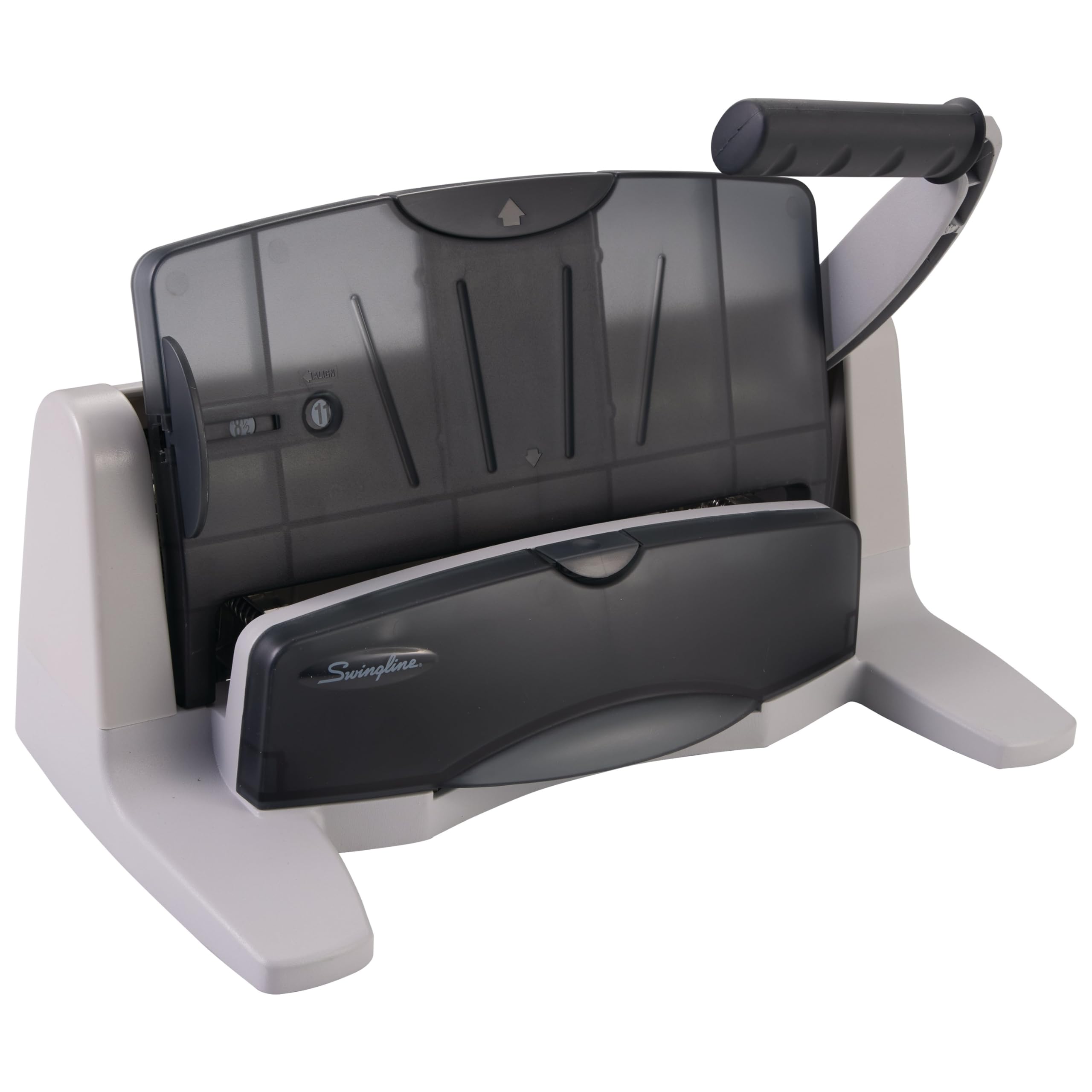
One 40-sheet lever punch that accepts anywhere from two punch heads to seven.
If you ever need a non-standard hole pattern — side-tab filing, a two-ring binder, or a custom layout — this is the only punch on the list that will do it. It ships with 3 punch heads but the patented system accepts anywhere from 2 to 7, and additional heads are sold separately. Capacity sits at 40 sheets with 9/32 inch holes, and the lever is built to need 50 percent less manual force than a traditional desktop punch, so a light touch gets a full stack through.
The paper handling is what owners single out. Sheets go in vertically rather than lying flat, which keeps your hand out of the way of the lever, and an adjustable paper guide squares each stack for clean placement. A removable reservoir in the base catches the punchouts so you just lift it out and tip it into the bin. The punch heads and lever are fused together to add strength, and the whole thing is backed by a limited lifetime warranty. The recurring negative is durability, and it deserves an honest mention: a few users report issues over long heavy use, so this is a punch to buy for the custom pattern rather than for the pound-it-all-day job.
At 5.2 pounds it is the heaviest lever punch here, so plan on a dedicated spot rather than shuffling it in and out of a drawer. Reach for it when the custom hole count is the reason you are buying; if you only ever need three standard holes, the Carl or the AFMAT will give you more punch for the same effort.
The real argument for it
- Adjustable heads cover 2 to 7 holes, so custom layouts are possible
- 50 percent reduced force lets a light touch take a full stack
- Vertical paper placement keeps hands clear of the lever
- Jam-free heads and a removable chip reservoir
- Covered by a limited lifetime warranty
What you give up
- Extra punch heads for other patterns are sold separately
- At 5.2 pounds it needs a dedicated spot on the desk
- Durability is a mixed report under long, constant heavy use
Pick this one when: a non-standard hole pattern is the whole reason you are shopping, and 2 to 7 heads is the flexibility you need.
Not the right tool if: three standard holes are all you ever punch, because the extra flexibility goes unused.
Know the Specs
Sheet Capacity
This is the maximum number of sheets a punch will take in one push with fresh, standard-weight paper. Treat it as headroom rather than a daily target. A punch rated at 40 sheets will do a comfortable 25 to 30 in normal use, so buy above your typical pile if you want the lever to stay light. Thicker cardstock or coated paper reduces the real number further.
Hole Diameter and Depth
Hole diameter is the width of the circle the punch cuts, and depth is how far in from the paper edge it sits. A 9/32 inch hole, or roughly 7mm, is the standard size for three-ring binders, and the punch depth determines whether those holes line up with the rings. If the depth is off, the pages bind and tear at the ring even when the holes look clean.
Lever Effort and Ratio
A low-effort lever uses a longer effort arm on the handle so the same hand force produces more cutting pressure at the punch heads. That is the whole idea behind the 50 percent reduced effort figures on some models. If anyone using the punch has a weak grip or arthritis, compare lever ratios first — a heavy punch with a good lever beats a light punch with a bad one.
Paper Guide and Chip Tray
The paper guide is the fence that squares a stack against the punch head. A fixed guide does one paper size perfectly with no setup, while an adjustable guide handles multiple sizes but needs setting. The chip tray catches the little punched circles; a slide-out drawer or see-through window means you can empty it quickly and see when it is getting full.
Common Questions
Will a heavy duty 3 hole punch cut through cardstock or laminated sheets?
How many sheets can I really punch at once on a 40-sheet model?
What is the difference between an electric and a manual 3 hole punch?
Do these punches make standard holes for three-ring binders?
Can a 3 hole punch be adjusted to punch two holes instead?
How do I stop punched paper from jamming the punch heads?
Is a heavier punch better than a lightweight one?
How often should I empty the chip tray?
The Bottom Line
The best heavy duty 3 hole punch for most desks is the Swingline Precision Pro, because it punches clean binder-ready holes in a metal body that adjusts between two and three holes and never fights a normal stack. If you bind thick books or manuals, the AFMAT HP18 takes the 50-sheet load with a lever built to spare your hand. For a shared filing station that takes a steady daily beating, the Carl HC-340 is the one that will still be working years from now.
How we choose
We do not accept paid placement. Every pick is matched to a real buyer and a real use-case; we do not hands-on test units.
Sources
Specifications: manufacturer listings and product documentation. Review insights: verified customer reviews, as of October 2026. Pricing: not shown on this page (it changes often); check the current price via the retailer link.
As an Amazon Associate, Aappliancez earns from qualifying purchases. This does not affect which products we feature.