Disclosure: Some links in this post are affiliate links. As an Amazon Associate I earn from qualifying purchases, at no extra cost to you. Learn more
Specs are compiled from manufacturer listings and verified buyer reviews and can change over time — please confirm the key details on the product page before buying.
If you want the short answer: buy a tile with a raised drainage base and real thickness, because thin plastic sitting flat on hot concrete is what bakes your feet and warps by August. The pick that balances those two things best here is the Acacia interlocking tile, and the rest of this page explains why the other four still earn a place depending on your patio, your budget, and how much sun that surface takes.
This guide is built by comparing the manufacturers’ published specifications and the patterns across verified customer reviews, so you get each pick’s real strengths and trade-offs instead of marketing spin.
Deck tiles either trap heat or shed it, and that single design choice decides how usable your patio feels in July. The picks below are ranked on thickness, drainage, and how they hold up underfoot, so you can choose the right tile for heat resistant composite decking without guessing.
Top Picks


How To Choose The Best Heat Resistant Composite Decking
A hot patio fails in two ways. The surface itself gets too hot to stand on barefoot, and the tile traps water underneath so it warps, lifts, or grows slippery. Every tile on this list is judged against those two failures first, then against how easy it is to install and cut.
Start with the base, not the top
A raised base lifts the walking surface off the concrete so air moves underneath. That air gap lets heat escape and water drain away instead of pooling on the concrete. Tiles with open channels and a raised grid dry faster after rain and feel noticeably less oven-like in direct afternoon sun.
Thickness tells you how it will feel and how long it lasts
Thicker tiles spread weight better and resist bowing when the sun hits them. Thin tiles are lighter to carry but flex more underfoot and are quicker to lift at the edges. Check the stated thickness in inches or millimeters before you compare anything else.
Match the material to your climate
Hard plastic shrugs off rain and cleans with a hose. Acacia hardwood gives you a real wood look and a smooth barefoot surface, but it wants drainage underneath. Wood-fiber composite with a polymer coating resists fading and cracking and sits between the two on price.
Work out your coverage before you order
Each pack states how many tiles it holds and the square footage it covers. Measure your patio, divide by that coverage figure, then add a spare pack for edge cuts and mistakes. Cutting a tile usually destroys the offcut, so running short mid-project means a second order and a color-batch risk.
Side-by-Side Comparison
| Model | Best For | Material | Tile Thickness | Coverage Per Pack | Amazon |
|---|---|---|---|---|---|
| ToLanbbt Plastic Interlocking Deck Tiles★ Best Overall | Drainage-first wet areas | Plastic | 0.79 inches | 9 tiles / 9 sq ft | Amazon |
| Goovilla Plastic Interlocking Deck TilesBudget Cover | Budget patio cover over ugly concrete | Plastic | — | 9 tiles | Amazon |
| Acacia Interlocking Deck Tiles | Barefoot comfort and real wood look | Acacia Wood | 0.9 inches | 9 tiles / 9 sq ft | Amazon |
| Nicoman Garden Decking Tiles Cosmopolitan | Moderate-traffic terrace edges | Rubber | 15 millimeters | 10 tiles | Amazon |
| NewTechWood UltraShield Naturale | Long-term sun and wet-area composite | Composite | 0.88 inches | 10 tiles / 10 sq ft | Amazon |
Detailed Reviews
1. ToLanbbt Plastic Interlocking Deck Tiles 9 Pack 12″x12″
Our pick — 4.5+★ from 1,000+ verified ratings; the strongest balance of quality and price.
A dry path over wet concrete, built from tiles that refuse to sit flat in water.
The thing that makes this one the safest buy is its drainage engineering. Each tile is split into 4 flat pads and 3 open drains, so water runs straight under the surface instead of standing on it. Water runs under the pads instead of standing on them, so the surface stays dry and never turns into a heat-trapping puddle. Pool surrounds and covered porches are exactly where this design pays off.
Each tile measures 12″ L x 12″ W x 0.79″ H, and the 9-pack covers a total of 9 square feet. At 0.79 inches it is thinner than the 0.9-inch Acacia tile further down. The Acacia gives you more material underfoot; this one gives you more gap for water and air. Hardness matters too — the manufacturer uses a high-hardness plastic rated for load bearing and stability, and states it resists fading, cracking, and warping.
The plastic is non-slip, weatherproof, and handles wind, moisture, and heat. Because it is plastic, you can cut it to fit with snips or heavy-duty scissors according to the review pages. One caution from the manufacturer that you should take seriously: don’t leave these in direct sunlight for extended periods. Treat this as a shaded patio, porch, or wet-area solution rather than a full-sun deck surface.
Why this one earns the top slot
- 4 flats and 3 drains per tile let water run underneath, so the surface stays walkable
- 0.79-inch thickness gives it enough body to stay stable under normal foot traffic
- Snap connection presses tight and resists pulling apart, unlike loose-click cheap tiles
- Cuttable with hand snips, which saves you dragging out a power saw
What to plan around
- The maker advises against long sun exposure, so a full-sun deck is a stretch
- The locking tabs can work loose under shifting weight, so seat every buckle firmly
- Plastic underfoot feels firm rather than cushioned
Reach for this: pool edges, covered porches, basement slabs, and any spot where rainwater collects and you need a dry line to walk on.
Look elsewhere if: your patio bakes in open sun all day with no shade, because the maker itself flags prolonged direct light.
2. Goovilla Plastic Interlocking Deck Tiles, 9 Pack 12″x12″
The cheapest way to hide a cracked concrete slab without pouring anything new.
Goovilla’s drainage story runs deeper than most tiles at this level: 8 flats and 6 drains across the face, plus a rhombic pattern on the back that adds grip and lifts the tile off the ground. The rhombic back lifts the tile off the ground, so air moves underneath and the surface stays drier and cooler than a flat-laid tile. High-density plastic is the material, and the maker states it resists expanding under direct sun, rainstorms, and snowstorms.
The snap design is the other upgrade here. Rectangular clips pull neighboring tiles closer together than the round snaps on some competing tiles, and the whole set goes down without tools. Rectangular clips grip tighter than the round snaps on cheaper tiles, so the joints hold instead of popping free underfoot. Setup is genuinely quick.
Here is where your expectations need to be set. Durability is the split opinion on this tile — the reviews land on both sides, with some finding it tough and others calling it flimsy under heavy objects or heavy foot traffic. A few report tiles arriving already damaged, and buyers report “Before you place them down in the yard, please inspect each and every one of the tiles as we had 4 tiles with holes on each of them.” Check the whole box on arrival, before anything goes down. Cutting is also tricky — corner pieces take real effort, and a miter saw works better than a wire cutter for anything beyond a couple of tiles.
The honest read on durability: treat this as a light-traffic cover for a rental, a basement, or an ugly cement slab, not a permanent surface for a hot tub or an outdoor kitchen. Used that way, it does its job and does it cheaply.
One more thing to plan: color can drift between boxes and between lots, so lay out tiles from every box before you commit to a pattern and order a spare pack for cuts.
Worth it when: you need quick, tool-free coverage of a worn patio or damp basement floor and you are not putting heavy furniture on top of it.
Think twice if: the tiles will take constant traffic or heavy loads, where thicker tiles hold up better.
3. Acacia Interlocking Deck Tiles Golden Teak Striped
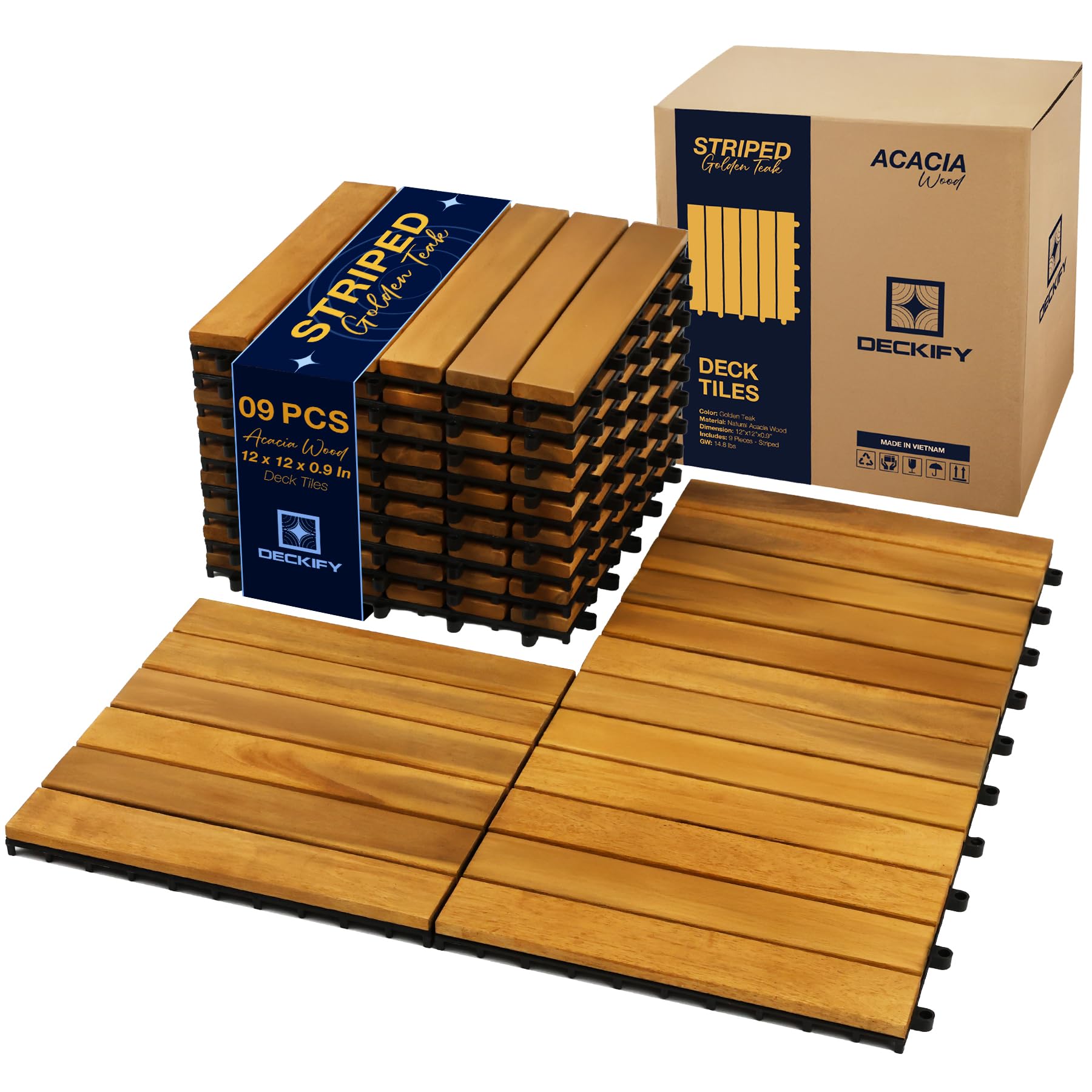
Real hardwood under your feet, thick enough to feel like an actual deck.
Start with the number that changes the walk: 0.9 inches of solid acacia. That is the thickest tile on this page and noticeably chunkier than the 0.79-inch ToLanbbt plastic tile. More material means a sturdier feel and a surface that spreads load without flexing. The maker rates it to support up to 490 lbs for everyday use, which is the most specific load rating in this group.
The finish is linseed oil, and the maker calls the resulting surface smooth and suitable for bare feet. Deep-groove slats and a raised PPC base channel water away, so rain passes under the wood instead of sitting on it and soaking in. The linseed-oil finish and raised PPC base together resist heat and UV across multiple seasons. Its listed features include heat resistance, moisture resistance, and scratch resistance.
Quality is what wins people over on this tile, and the installation is a close second — clips lock by hand in minutes with no tools or sealant. Owners mention “Perfect for our outdoor shower! We wanted something nice but not expensive. These tiles look great and are sturdy.” One buyer on gravel said it went together easily. The recurring gripe is color, not build: the gray shown in the listing reads browner in person. Sturdiness also splits opinion — some call it stable, others find it less so. If your ground is not level, this tile is not the answer; flat ground is the requirement.
The value angle: you are paying for hardwood and a load rating, and both show up the moment you step on it. Each set covers 9 sq ft, and it trims with a wood saw at edges.
The trade-off: wood needs the drainage base to work as intended, and the color you receive may drift from the photos.
Go for this: an outdoor shower pad, a small balcony, or any spot where you walk barefoot and want warmth underfoot plus a wood look.
Skip the upgrade if: your ground is uneven or you need a perfectly matched gray finish.
4. Nicoman Garden Decking Tiles Cosmopolitan Patio

A rubber tile that goes down fast and asks you to keep the load light.
This is the shortest tile here at 15 millimeters thick (about six tenths of an inch), and 10 tiles come in the pack. The click connection is the selling point: the maker describes it as requiring no technical expertise, and the pieces snap together by hand. Rubber is the material, and it handles weather across all seasons without the wood-look upkeep. Sweep it or hit it with a hose and you are done.
The load limit is the honest catch, and the manufacturer states it plainly — these are not for heavy loads and are meant for moderate weight-bearing use. A bench, walkway, or terrace edge is fine; a grill or full outdoor sofa set exceeds the moderate load rating. Ground flatness matters too: for weight-bearing use, the surface underneath needs to be genuinely level.
Owners praise the look and the straightforward install. Customers note “Look nice, just need a couple of packs for I front of a bench. Easy to put down, do the job!” The friction points are color and condition — a color batch can come out darker than an earlier order, which is a problem if you are extending an existing run, and damaged tiles sometimes show up in the box. Inspect before you lay them and set the damaged ones to the outer edges, as one installer did.
Where it fits: light-traffic spots like a bench surround, a gravel extension, or a small walkway where a compact rubber tile is more practical than a thick one.
Where it does not: anything that needs to carry real weight or match an existing grey exactly.
Best match: small accents and moderate-traffic areas where you want a rubber tile that installs in minutes.
Not the one for: heavy furniture, hot tub surrounds, or expanding an older batch of the same color.
5. NewTechWood UltraShield Naturale Composite Deck Tiles
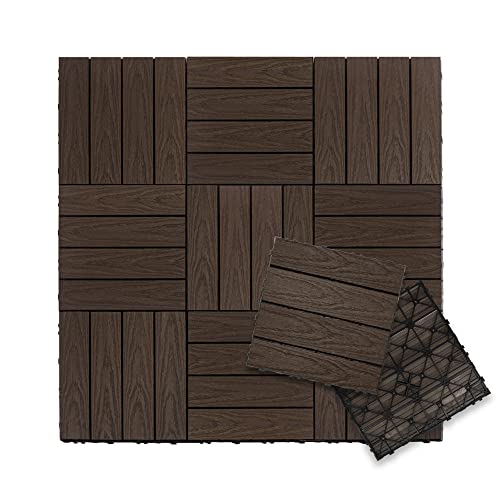
The premium composite tile that locks on all four sides and handles the wet spots.
NewTechWood builds these from high-density polyethylene plastic mixed with wood fibers and wraps them in a polymer coating, which is what puts them in the composite family rather than plain plastic. That build resists wear, fading, cracking, and bending. It is the priciest tile on the page, and the quality is the reason owners keep naming. At 0.88 inches thick, it sits just under the Acacia tile’s 0.9 inches and above the 0.79-inch ToLanbbt. Each box holds 10 pieces covering 10 sq ft.
The 4-way interlocking design is a real difference from one-direction tiles. Reviewers point out the pieces “lock together on all sides,” which means you can run patterns and pull a single board for a cut without tearing up the run. A raised base lets water drain underneath, so the surface stays dry and you are not standing in pooled water after rain. Cleaning is a wipe or rinse, with a household cleaner a few times a year for anything stubborn. One installer noted they cut easily with a jigsaw.
Value is the split opinion here — plenty find the price high, and a few say dirt settles into the texture of the slats. Service fills the gap: when a box went missing, the replacement came quickly, and the brand sent spare pieces beyond what was expected. Buyer sentiment summed up “We first bought a cheaper version, instantly returned because it felt like poor quality. Ordered these instead and the difference is night and day.” Treat delivery lead time as part of the plan — one note flagged adding days to the schedule before a project starts.
The composite advantage
- Wood-fiber plus polymer coating resists fading, cracking, and bending
- 4-way interlock lets you build patterns and swap single boards for cuts
- Raised base drains water, so it holds up in wet areas and over concrete
- 0.88-inch thickness gives a firm, stable walk
The cost of the upgrade
- The highest price of any tile here, and value draws mixed feedback
- Dirt can settle into the slat texture, so periodic deeper cleaning helps
- Only works with other NewTechWood deck tiles
Choose this when: your budget allows for composite that resists sun damage and stays usable around water, pools, and outdoor kitchens.
Consider the alternatives if: you are covering a large area on a tight budget, or you need to mix tiles from another brand.
Know the Specs
Raised Base and Drainage Channels
A raised base lifts the walking surface off the concrete so air moves underneath. Open channels let water run away instead of pooling, which keeps the surface drier and cooler. When you compare tiles, look at how many flats and drains each one has — more gaps means better drainage. The ToLanbbt tile runs 4 flats and 3 drains; the Goovilla runs 8 flats and 6 drains.
Tile Thickness
Thickness is measured in inches or millimeters and tells you how much material sits under your foot. A thicker tile spreads weight better and resists bowing under sun. On this page that ranges from 15 millimeters (Nicoman) up to 0.9 inches (Acacia), with NewTechWood at 0.88 inches and ToLanbbt at 0.79 inches. Always check which unit the listing uses.
Material: Plastic, Wood, or Composite
Hard plastic resists moisture and cleans easily but feels firm. Acacia hardwood gives a smooth, warm surface and needs drainage underneath. Wood-fiber composite mixed with polymer coating resists fading and cracking and sits between the two. Match the material to how much sun and water the spot gets.
Coverage Per Pack
Each pack states how many tiles it holds and the square footage it covers — 9 sq ft for both the ToLanbbt and Acacia packs, and 10 sq ft for NewTechWood. Measure your area, divide by that figure, then add a spare pack. Cutting a tile usually ruins the offcut, so extra tiles save you a second order.
Common Questions
Will these tiles get too hot to walk on in direct summer sun?
How many packs do I need for a patio?
Can I cut these deck tiles to fit around corners and posts?
Do I need to prepare the ground before laying deck tiles?
What is the difference between plastic, wood, and composite deck tiles?
How do these tiles drain water after rain?
Will the tiles stay locked together when I walk on them?
Can I use these tiles around a pool or outdoor shower?
Can I mix tiles from different brands?
How do I clean and maintain composite deck tiles?
The Bottom Line
For most patios, the strongest choice among these heat resistant composite decking options is the ToLanbbt Plastic Interlocking Deck Tiles because its 4-flat, 3-drain design keeps the surface dry and walkable where water collects, and the snap fit holds tight. If you want hardwood thickness under bare feet, the Acacia Interlocking Deck Tiles deliver 0.9 inches and a 490-lb load rating. And for composite that resists fading around pools and outdoor kitchens, the NewTechWood UltraShield Naturale is the one to reach for. Match the drainage design and thickness to your spot, and the surface stays walkable through the hottest months.
How we choose
We do not accept paid placement. Every pick is matched to a real buyer and a real use-case; we do not hands-on test units.
Sources
Specifications: manufacturer listings and product documentation. Review insights: verified customer reviews, as of October 2026. Pricing: not shown on this page (it changes often); check the current price via the retailer link.
As an Amazon Associate, Aappliancez earns from qualifying purchases. This does not affect which products we feature.