Disclosure: Some links in this post are affiliate links. As an Amazon Associate I earn from qualifying purchases, at no extra cost to you. Learn more
Specs are compiled from manufacturer listings and verified buyer reviews and can change over time — please confirm the key details on the product page before buying.
If your west-facing room turns into an oven every afternoon, the fix is usually a sheet of reflective film on the glass — not a new air conditioner. Heat blocking window film works by bouncing solar energy back outside before it warms the glass, and the right roll can drop a sun-baked room by several degrees for a fraction of what cooling hardware costs. The tricky part is that “heat blocking” covers three very different products: thin reflective tint for clear glass, bubble foil for solid coverage, and ceramic tint for cars and long-term clarity. This guide separates them so you buy the sheet that matches your window, not the one with the loudest label.
This guide is built by comparing the manufacturers’ published specifications and the patterns across verified customer reviews, so you get each pick’s real strengths and trade-offs instead of marketing spin.
Some rolls are peel-and-stick tint that keeps your view, while others are opaque foil that blacks a window out entirely. Below you’ll find the strongest performers in each style, ranked by how well they actually cut solar gain. These are the picks worth weighing when you want the best heat blocking window film for a hot room.
Top Picks
How To Choose The Best Heat Blocking Window Film
Start with one question: do you need to keep looking through the glass? If yes, you want a reflective or tinted film that stays transparent. If the window is behind blinds or faces a garage door you never look through, bubble foil blocks far more heat because it is completely opaque. Buying the wrong style is the number one reason people end up disappointed.
Match the film to the glass, not the label
Peel-and-stick adhesive film needs smooth, single-pane glass to bond properly. Coavas states this plainly — their film is not recommended for frosted, textured, or processed glass. Static cling sheets are more forgiving and removable, but they lift at the edges on humid windows if the glass isn’t spotless before you start. Check your glass type before you order anything.
Read the infrared number, not just the UV number
Almost every film on this list blocks UV rays, so that figure rarely separates them. The number that changes how a room feels is infrared rejection — the portion of solar heat the film bounces away. Volcanics lists 85% infrared rejection, Jahoot lists 85%, and Bloss lists 82%, and those figures track closely with how cool a room stays in direct afternoon sun.
Plan for the night-time privacy flip
One-way mirror film works on a lighting difference: it hides you when it’s brighter outside than in. Once your indoor lights are on after dark, the effect reverses and people outside can see in. Every one-way film here carries that same caveat, so pair it with curtains if the window faces a street or a neighbour.
Side-by-Side Comparison
| Model | Best For | Style | UV Block | Coverage / Size | Amazon |
|---|---|---|---|---|---|
| DGSL Double Reflective Bubble Foil★ Best Overall | Big windows, garage doors, RV | Opaque bubble foil | — | 39.17 sq ft | Amazon |
| Jahoot One Way Privacy FilmEasiest First Install | Small windows, first-time installers | Static cling one-way | 95% | 9.67 sq ft | Amazon |
| Coavas One Way Privacy FilmMost Popular | Whole-house tint on a budget | Peel & stick one-way | 100% of UV protection | 17.5″ x 118″ | Amazon |
| YoleShy Bubble Insulation | RV windshields and camper windows | Opaque bubble foil | — | 48″ x 10 ft | Amazon |
| Pamagoo Ceramic 5% VLT Roll | Car and truck windows | Ceramic adhesive tint | 99% | 20″ x 20 ft | Amazon |
| winemana Reflective Roll | Rental rooms and DIY windows | Opaque bubble foil | — | 48″ x 10 ft | Amazon |
| Volcanics One Way Film | Large sliding doors, decor | Static cling one-way | 99% | 35.4″ x 78″ | Amazon |
| Bloss One Way Privacy Film | Bedrooms and kitchens | Peel & stick one-way | 90% | 29.5″ x 118″ | Amazon |
| BDF NA35 Sun Control Film | Heat control that keeps daylight | Peel & stick tinted | 99% | 36″ x 12 ft | Amazon |
| United Universal 20% VLT Roll | Bulk tinting projects | Dyed PET adhesive | 99% | 200 sq ft | Amazon |
| Snapguard Ceramic 70% Tint | Clear ceramic for bright rooms | Ceramic adhesive | 99% | 36 sq ft | Amazon |
Detailed Reviews
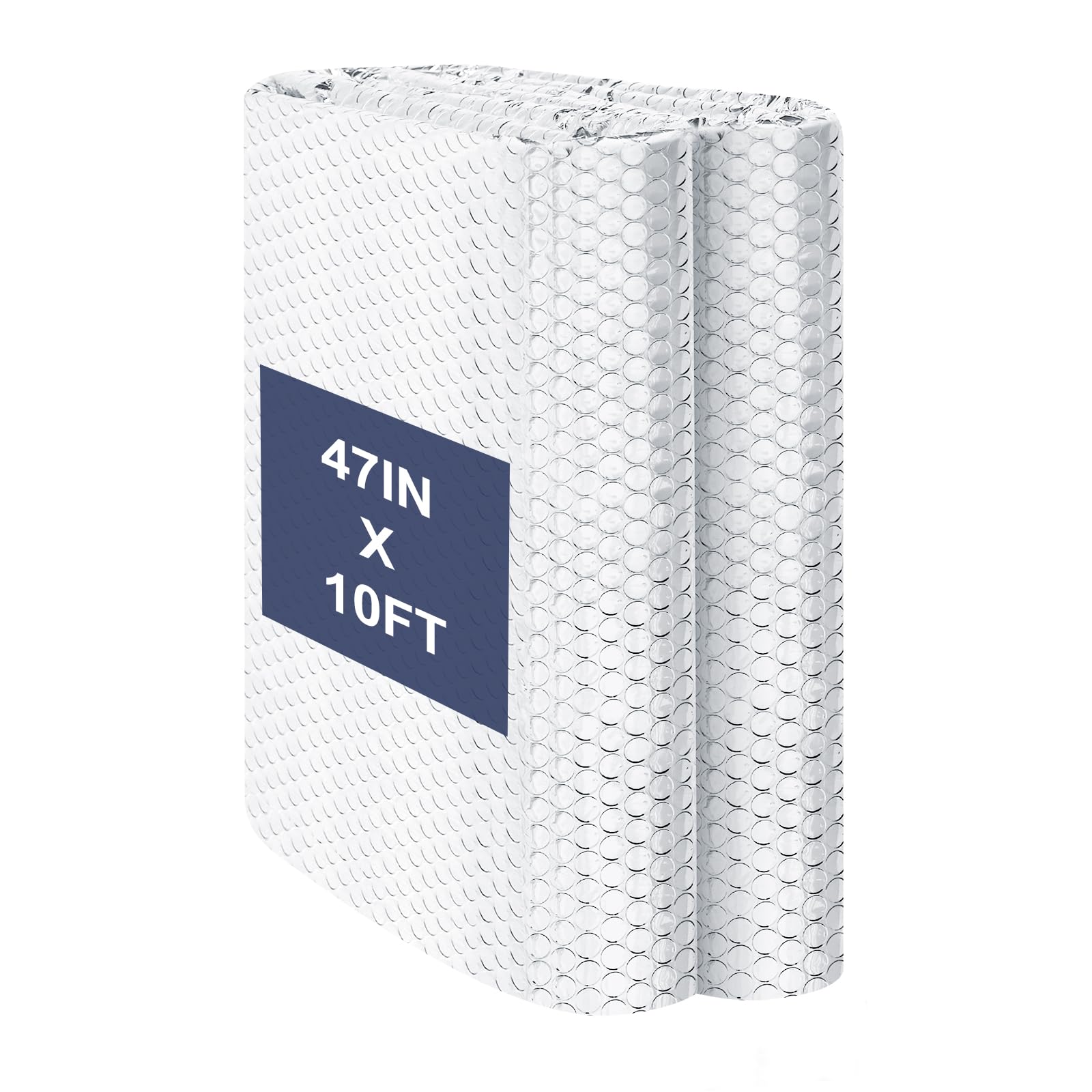
1. DGSL Double Reflective Bubble Foil Insulation 47IN X 10FT
Our pick — 4.5+★ from 1,000+ verified ratings; the strongest balance of quality and price.
The foil sheet that turns a west-facing bay window into a cool, dark cave.
Here’s the math that makes this one the pick: 47 inches by 10 feet gives you a coverage area of roughly 39.17 square feet, and one roll swallows most of a single large room’s windows. Compare that to the Jahoot film at 9.67 square feet and the gap in coverage is obvious. For a buyer trying to treat a bay window or a garage door in one pass, the DGSL covers the job with room to spare.
It’s built from reflective double aluminum foil laminated over a bubble core, with an opaque silver face. That opacity is the whole point. Unlike a one-way tint that still lets the sun pour through, the foil physically bounces it back — buyers report the foil dropping room temperatures by 8-10 degrees after install. It goes on with the 60 self-adhesive pads in the box and cuts to size with scissors or a utility knife.
You feel the difference as a cooler room, not a spec sheet. Owners mention using this film on attic doors and garage walls as well as windows, and one reviewer wrote: “Covered 2 west-facing bay windows; maintained thermostat set temp until ~5pm with only 2° rise vs normally raising to 79° and running portable A/C.” The trade-off is clear: it’s opaque, so you lose the view completely, and folding it back into a neat roll after removal takes some patience.
What earns its place
- 39.17 square feet covers a large window or a garage door in one roll
- Double aluminum foil over bubble blocks heat far harder than thin tint
- 60 self-adhesive pads included, so nothing extra to buy
- Not easily scratched and reusable season after season
The honest trade-off
- Fully opaque, so it ends the view entirely
- Cuts to size but refolding it neatly takes care
Reach for this if: you have a big sun-blasted window, a garage door, or a room you never need to look out of.
Pass if: your window is a focal point that has to keep its daylight and view.
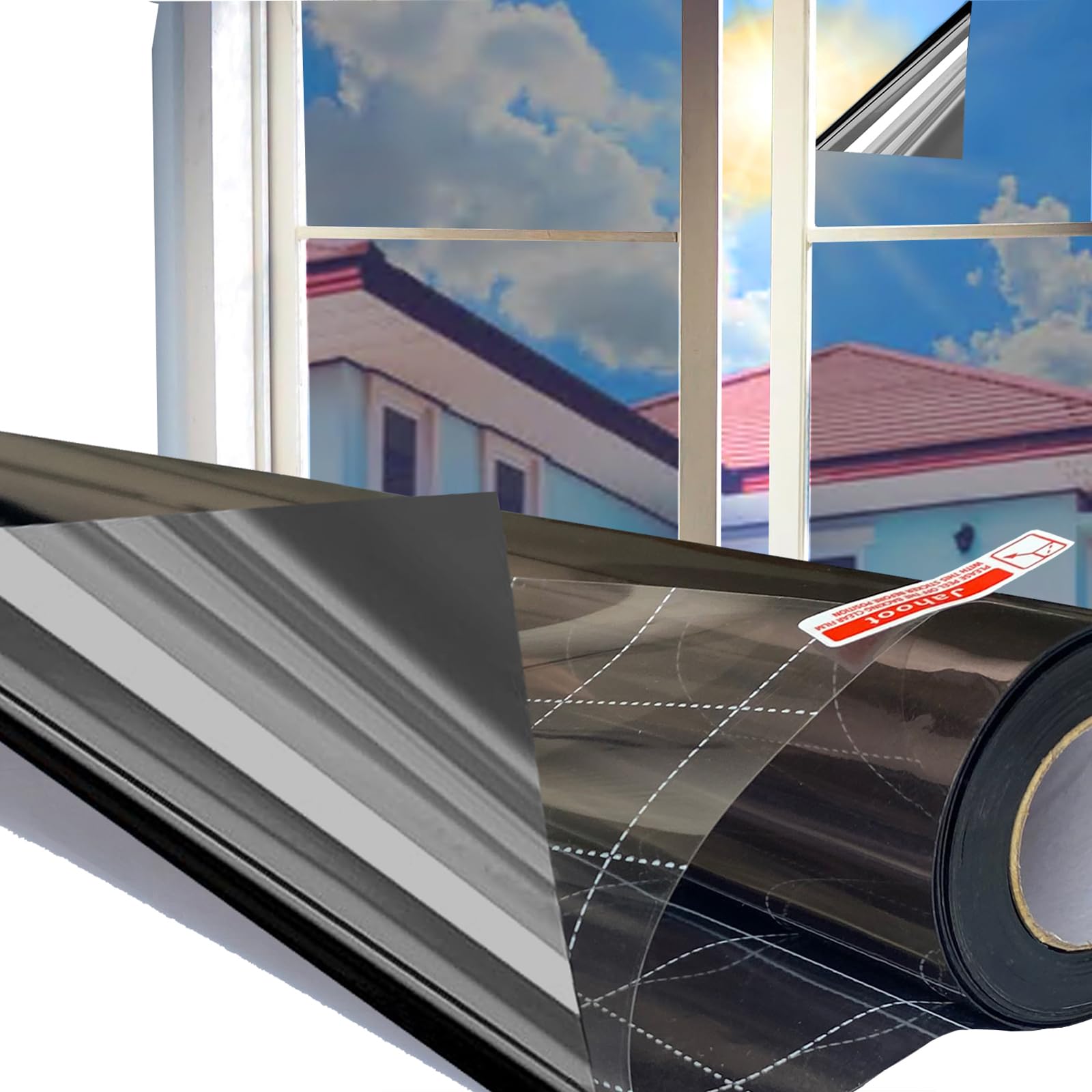
2. Jahoot One Way Window Privacy Film with Grids
The film that finally tells beginners where to cut a straight line.
Most tint goes crooked because the backing gives you nothing to follow. Jahoot solved that with grid lines printed on the protective backing, so you can mark and slice along a straight edge. On a 17.7 inch by 78.7 inch roll that honesty about cutting matters — one slip and the whole strip is off-square. It’s a small detail, but it’s why people finish in one sitting; customers note: “Applied to two windows in ~15 mins.”
The heat numbers are solid for the entry tier. It reflects up to 85% of the sun’s infrared light, blocks 95% of UV rays, and still lets 12% of visible light through so the room stays bright. That last figure is the key: this is not a blackout film. It’s a daytime mirror that hides you from the street while your room still reads as daylit.
What most impresses is the look — the mirror face almost disappears into the glass, and it’s the standout quality that keeps the star score at 4.0+. The recurring gripe is adhesion, and it’s fair to flag: a static-cling film needs spotless glass and plenty of soapy water, or an edge curls. Prepare the pane properly and it stays put.
Why it made the cut: grid-line backing plus static cling means you can reposition before it sets, so a first-time tinter can fix mistakes instead of scrapping the strip. It fits small to medium windows — one kitchen or bedroom pane rather than a wall of glass.
Good match for: a renter tinting one or two windows who wants a mistake-tolerant film.
Only frustration: a fine glassy surface is mandatory for adhesion, so dusty or textured panes are not the job for it.
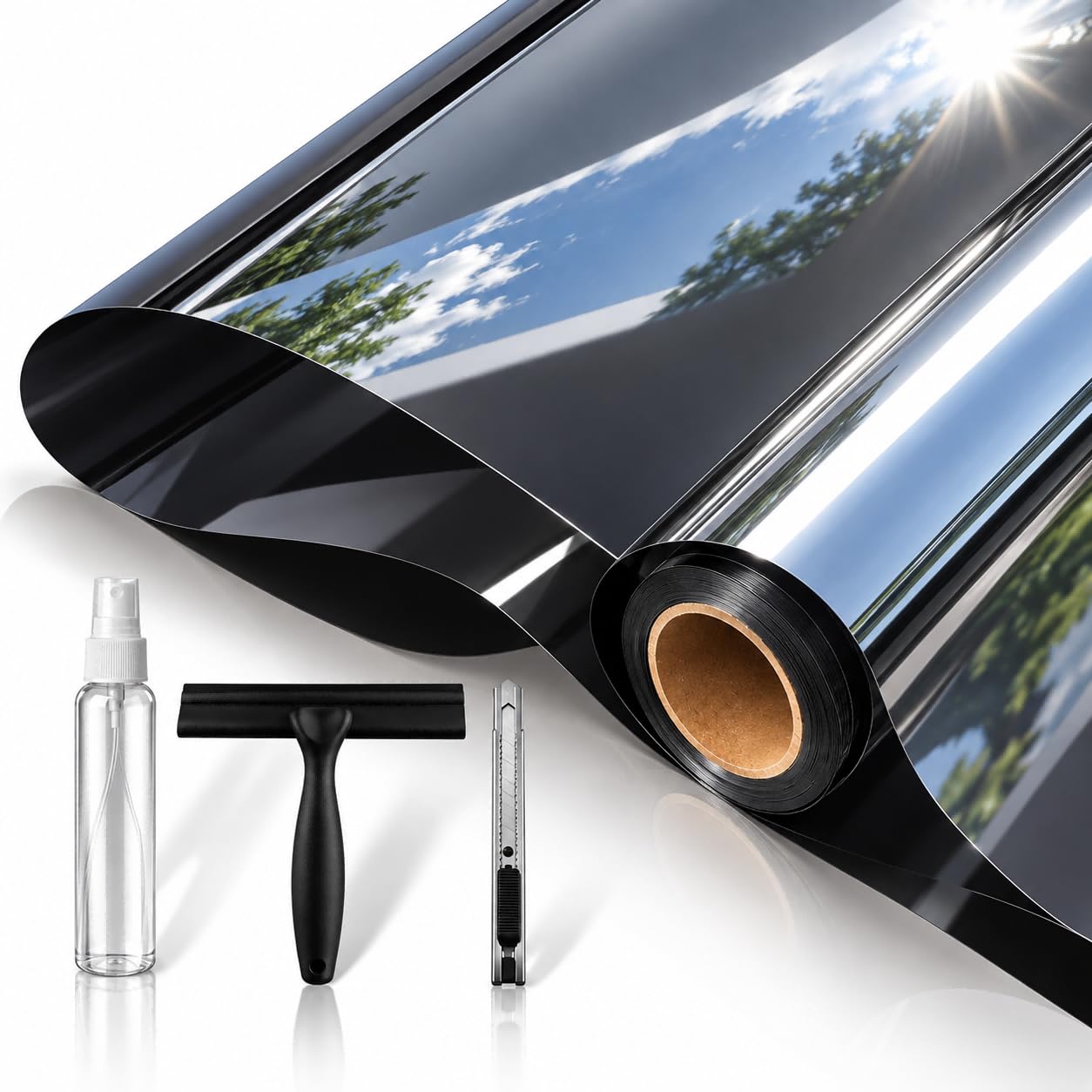
3. Coavas One Way Window Privacy Film 17.5″X118″
The crowd favorite: 14,000+ ratings and a squeegee in the box.
This is the most-reviewed film in the guide, with 14,000+ ratings, and its strength is that you can install it the day it arrives. The package includes a dual-sided squeegee, a precision utility cutter, and a spray bottle — no separate trip for tools. The sheet runs 17.5 inches wide by 118 inches long, giving long coverage for a sliding door or a row of windows from one roll.
The performance numbers are the reason it keeps selling. It reflects 90% of infrared solar heat and blocks 98% of UV rays, and it’s a thicker PET film than the entry picks, so it adds a shatter-resistant layer to the glass. Owners who measured before and after logged a real difference — one owner measured roughly a 20°F floor-temperature gap between the treated and untreated window. Just know the glass itself gets hotter to the touch, because the film is absorbing and reflecting the heat, not making it vanish.
The one honest fit note: it is darker than the swatches suggest. Buyers consistently say it’s “genuinely dark” rather than a light tint, which is great for glare on a TV and less great if you wanted a barely-there shade. It’s for smooth single-pane glass only — textured or frosted panes will not take it. As owner experience puts it: “Cut 2–3°F, eliminated most glare, house stays cooler.”
The value read: the included tools and 3-year manufacturer warranty mean this film comes with support most budget rolls skip entirely. For a homeowner tinting a whole side of the house, the long 118-inch length beats piecing together short strips.
Worth buying if: you want to tint a full sliding door with tools already in the box.
Think twice if: you’re chasing a light, barely-visible tint — this one reads dark on the glass.
4. YoleShy Bubble Window Insulation 48IN x 10FT

Built for the RV windshield that turns a camper into a greenhouse by noon.
Cut this to the shape of an RV windshield and the interior stops cooking. The sheet is double-sided aluminum foil over vacuum-sealed polyethylene bubble (a layer of air pockets sealed in plastic), which gives it a stiff, almost cardboard-like body. That stiffness means it holds its shape when you fold it, which matters when you’re stowing it in a camper.
It arrives at 48 inches by 10 feet and comes with 12 hook-and-loop fasteners for mounting without tools. The material is lightweight and repositions easily, so you can line it up on the glass before pressing the fasteners down. It handles both jobs — blocking harsh summer sun and keeping warmth in during winter — because the reflective foil works in either direction.
What wins people over is the grunt of the material; it’s genuinely thick, and users say it blocks sun and heat well enough to stabilize an interior. The mixed note is worth knowing: it ships folded, so creases are present from day one, and the adhesive on the fasteners is the weaker link for some. Use your own tape on stubborn frames and it holds. Trimmed to size, it’s the tidy answer for a camper or a window behind blinds you never open.
Where it shines: RV windows, garage doors, and any pane you cover and forget about. The 48-inch width spans a full camper windshield without seams.
Suited to: camper and garage owners who want a removable barrier for the hottest and coldest weeks.
The heads-up: the fasteners can let go on rough frames — a strip of packing tape solves it.
5. Pamagoo Window Tint Car 5% VLT, 20″ x 20′ Ceramic Roll

The ceramic tint for a car cabin that bakes in an open lot.
Five percent VLT (visible light transmission, the share of daylight that passes through) is about as dark as tint gets before it turns a windshield into a slab, and here that darkness comes with real heat-blocking credentials. The roll is built on a nano ceramic coating (a thin ceramic layer that reflects heat) that blocks 99% of UV rays and 89% of infrared rays. That infrared figure matters most when the goal is keeping a parked car’s cabin cooler and shielding the dash from sun cracking. It’s also rated scratch and abrasion resistant, so the coat doesn’t scuff off with normal cleaning.
The roll comes 20 inches wide and 20 feet long, so it covers a sedan’s side and rear glass with plenty of material, and it’s rated for both flat and lightly curved glass. It also knocks down oncoming headlight glare at night and delivers the one-way look drivers want — clear view out, darker looking in. Expect to follow the included manual and video, because the curing process needs care.
The honest part: ceramic film this dark is unforgiving if you’re a first-timer. It’s thinner than professional shop film and the looped edges of the roll need careful handling, and some reviewers point out the film not bonding as firmly as a shop install would. That’s born out across the mixed feedback, so buy it for the weekday commute tint job, not for a show car.
Why drivers pick it
- 5% VLT gives deep privacy and strong glare cut
- Ceramic coating blocks 89% infrared and 99% UV
- Scratch-resistant surface holds up to cleaning
- 20 feet of material covers a whole vehicle
Be ready for
- Thin film that punishes sloppy alignment
- Bonding can be fussier than a pro shop install
Best fit: a confident DIYer tinting their own car windows for privacy and heat relief.
Not for: someone hoping for a flawless professional finish on the first attempt.
6. winemana Window Insulation Roll 48IN x 10FT

The roll that covers four large windows and tucks in a drawer after.
There’s a renter-friendly advantage to this one: it rolls up and stores flat, so you can put it up for the worst weeks of summer and stow it when the temperature breaks. The sheet is 48 inches by 10 feet, built from multi-layer reflective aluminum that blocks up to 90% of solar radiation, and the maker lists it as a 50% PET, 50% Mylar blend. It’s tear-resistant and shrugs off outdoor exposure.
Because it’s opaque foil, it does the heavy lifting a clear film can’t — it’s the difference between “shaded” and “blocked.” One owner covered four large windows and two small ones from a 15-foot pack and measured an average of about 2°F cooler even with the AC off. The material cuts with scissors, mounts with tape or the sticky pads you supply, and goes behind blinds without looking messy.
The recurring subject in the feedback is the thickness — several buyers find it thinner than expected and recommend doubling it on big windows, layering two sheets with an air gap. Do that on a large pane and it performs like significantly heavier foil. It arrives without adhesive, so plan for your own tape or hook-and-loop before it shows up.
Real-world read: a second owner bought it again to cover RV windows in Texas heat and logged a “huge difference” in keeping the rig cool. The 48-inch width covers standard windows without piecing.
Pick it for: a rental, a kids’ room, or an RV where you want removable coverage you can roll up and reuse.
Know going in: no adhesive is included and thicker is better — double it on large glass.
7. Volcanics One Way Window Privacy Film 35.4″ x 78″

The film with a fan club so large the mirror finish becomes a design feature.
The scale of this one is hard to ignore — it’s the most-rated film in the guide by a wide margin, and the thing people rave about is how it looks. It turns a bright window into a soft, silvery mirror by day, and it plays with light in a way that reads more like decor than a utility sheet. The static cling sheet is 35.4 inches wide and 78 inches long, so it covers a big sliding door or a wide picture window.
The heat numbers hold up to the looks. It blocks up to 99% of UV rays and 85% of infrared rays, and the maker claims the film can cut energy bills by up to 30% — treat that as their claim, and lean on the UV and infrared figures as the real story. It goes on adhesive-free, so it peels off with no residue and can even be reused on another window. A scraper, a cutting knife, and a watering can for applying come tucked inside the paper tube.
The one mixed point is adhesion: static cling film is only as good as the glass beneath it, and on a dusty or imperfect pane an edge can lift. Clean the glass thoroughly and squeegee firmly, and it clings for the long haul — one reviewer noted a month in with no re-application needed and no edge curl. It’s the film to choose when the window is visible from the street and you want a polished look, not a matte frost.
The case for it
- Static cling installs and removes with zero residue
- 99% UV and 85% infrared rejection
- Large 35.4″ x 78″ sheet for wide glass
- Tools included inside the tube
What to expect
- Adhesion depends on a spotless glass surface
- Mirror effect flips to visible-in at night with interior lights on
Made for: a street-facing picture window where you want privacy without losing the daylight.
Skip if: you can’t prep a clean, smooth pane or you expect real blackout privacy.
8. Bloss One Way Privacy Window Film 29.5 x 118 Inches Silver

A generous long roll for tinting the whole bedroom wall in one go.
At 29.5 inches wide and 118 inches long, this roll is built for coverage — long enough to wrap a big window or split across a couple of smaller panes. It reflects 82% of infrared rays and blocks 90% of UV, which brings a hot bedroom down without making it gloomy, since some daylight still gets through. It’s a peel-and-stick film, so it sets faster than static cling and stays bonded.
The upside of the stickier install is that it doesn’t lift at the edges the way a cling can. The downside is that it’s less forgiving of bubbles during application — you need a clean pane, plenty of soapy water, and a squeegee to push the air out. The flip side: it’s the film to reach for when you’d rather a sheet stay put permanently than reposition it later.
The honest catch is the night problem every one-way film shares: once inside light beats outside light, the mirror flips and people can see in. Pair it with curtains after dark and the daytime privacy holds. On install, the reported reality is that clean, smooth glass makes or breaks it — a texture or dust will send it lifting, so a flat single pane is the reliable surface.
Who it clicks for: a bedroom or kitchen where you want midday privacy and heat cut on a large pane without paying for long custom rolls.
Right choice when: you’re covering a tall or wide window and want the film to bond permanently.
Mind this: bubbles are hard to work out once set, so a clean squeeggee job matters from the first minute.
9. BDF NA35 Window Film 36in X 12ft

The film that rejects heat while still letting a room read as daylight-bright.
The NA35 sits in a smart spot: it’s a medium, black-finish tint that keeps a lot of light coming through while cutting the radiant heat that makes barefoot floors hot. It’s a one-ply PET performance film 36 inches wide by 12 feet long, and the “medium” here means minimal view-shielding — so you get heat control without turning the room into a cave. In a bright kitchen or sunroom, that balance is the whole selling point.
The strength is heat rejection. Owners who tested it barefoot report the tinted carpet is noticeably cooler than the untreated section, and one owner cut electricity usage substantially by relying on window ACs instead of central cooling. It also blocks 99% of UV, which protects furnishings from fading. The kit includes the razor and squeegee, which several buyers rate as genuinely good.
Here’s the friction: this film is sensitive by nature, so a single fold becomes a permanent wrinkle — handle it gently and soak both sides with lots of soapy water before laying it down. The privacy side is mixed, since NA35 lets a lot of light through and is only lightly view-blocking. If you want a dark window, pick a darker VLT; if you want heat control and daylight, this is the better trade.
Where it earns its keep: a sunroom or a window with a TV nearby. Buyers cut glare enough to watch the screen during the day, and the film is nearly invisible inside once cured.
Handle with care: the performance adhesive is not forgiving of creasing, so install with a helper on big panes.
Ideal for: a bright room where heat is the enemy but you still want the daylight.
Look elsewhere if: you need strong privacy or a blackout look — this medium shade won’t deliver it.
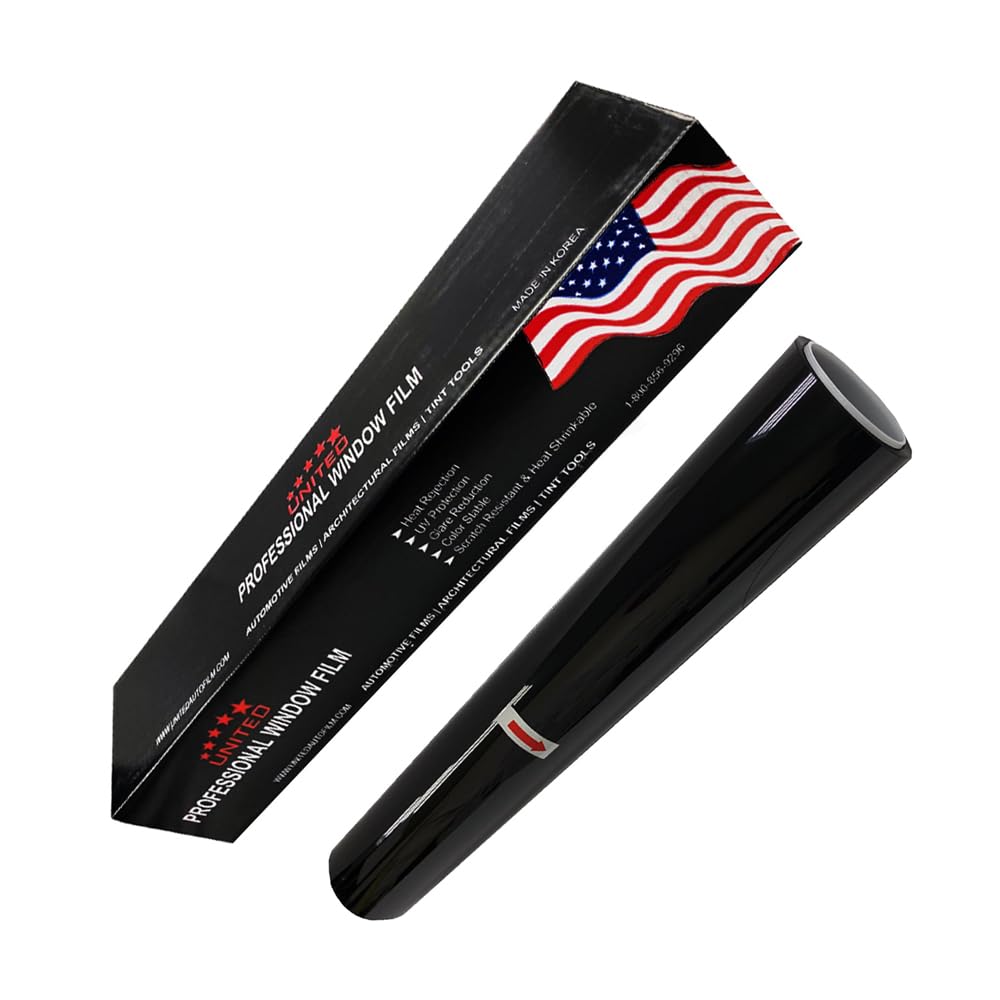
10. United Universal Black Window Tint Film 24″ x 100′ 20% VLT
One enormous roll for the person tinting a car, a truck, and a couple of home windows.
Two hundred square feet of 20% VLT film is what you buy when you’re tinting more than one surface. The roll is 24 inches wide by 100 feet long, made of 1-ply dyed PET, and rated to block 99% of UV rays and cut heat and glare. For a whole vehicle plus a few of the home’s sun-facing windows, the length means you’re not stopping halfway to reorder.
The reason it earns a place is the value that comes with the volume — one owner covered home front windows with it and found it cut heat noticeably at 98°F outside. The 20% VLT gives deep daytime privacy and a dark, cohesive look across the glass, though it does not hide the interior at night. It’s rated for cars, trucks, SUVs, and home windows, so a single roll solves several jobs.
The fair warning is in the installation, not the performance: this is thin film that wrinkles and creases if you rush the liner peel, and shrinking it around curves takes practice. Professionals manage it; a first-timer should expect a learning curve and start on a flat pane before tackling a curved windshield. That’s the trade for getting 200 square feet from one roll.
The right buyer: someone tinting multiple vehicles or home windows who doesn’t mind learning on a flat practice pane first.
Know the limit: thin film creases under impatient hands, so fit it slowly on curved glass.
11. Snapguard Solutions Ceramic Window Tint 3′ x 12′ (70%)

A nearly clear ceramic tint for people who refuse to give up the view.
At 70% VLT, this is a light ceramic film — the sort you put on when the goal is heat and UV rejection with almost no visible tint. It’s rated to block up to 99% of UV rays and 95%–99% of infrared rays, and it comes in 7 custom shade strengths so you can dial the darkness to the room. The roll is 36 square feet, 3 feet by 12 feet, at just 2 mils thick — thin enough that it applies with a heat gun and lays flat.
Ceramic is the premium technology here because it rejects heat without the metallic look of first-generation reflective film. That means the window still reads clear, so the film suits a living room or office where you want the light and the view intact. It is adhesive-backed, and the maker says it won’t discolor or peel when applied correctly, though that requires care and a heat gun.
Honesty time: this is the least-proven film in the guide, and the feedback splits sharply. Some buyers loved the clear look and easy install; others found it wrinkled on cutting and saw no meaningful temperature drop on a south-facing sill. The important thing is to know it’s a clear heat-control film, not a privacy or blackout solution, and to set expectations around that. Its 99% UV figure and clear ceramic construction are the honest reasons to consider it.
For you if: you want heat rejection on a bright room and cannot lose the view or the daylight.
Be realistic about: the clear look means no privacy benefit, and installation needs careful heat-gun technique.
Know the Specs
VLT (Visible Light Transmission)
VLT is simply how much daylight the film lets through, written as a percentage. A 70% film looks almost clear, while a 5% film reads nearly black. Lower VLT means more privacy and less glare but a darker room; higher VLT keeps the room bright but reveals more of the interior from outside. Match VLT to whether the window is a focal point or a pane you cover and forget.
Infrared Rejection vs UV Block
UV rays cause fading and skin damage; infrared rays are what actually heat a room. A film can block 99% of UV and still be weak against heat if its infrared number is low. When you compare films, look at the infrared percentage first — it is the figure that tells you how much solar heat the sheet bounces back outside.
Common Questions
Will heat blocking window film actually lower my room temperature?
Will a one-way privacy film keep people from seeing in at night?
Can I put window tint on double-pane or insulated glass?
Does heat blocking film reduce how much light comes into the room?
How long does the film take to install, and will it peel?
Is reflective film better than the clear ceramic tint?
Can I remove the film without damaging the glass or leaving residue?
Will window film protect my furniture and floors from sun damage?
Can I use bubble foil insulation on an RV or garage door?
Do heat blocking films work in winter too?
The Bottom Line
For most rooms, the heat blocking window film winner is the DGSL Double Reflective Bubble Foil because it brings 39.17 square feet of opaque double-foil coverage that turns a sun-blasted window or garage door into a cool, shaded surface with 60 adhesive pads already in the box. If you want to keep the view and add daytime privacy, grab the Volcanics One Way Film — it pairs 99% UV and 85% infrared rejection with a 35.4″ x 78″ sheet and tools tucked inside the tube. And for a big-room tint job where you want heat control without losing the daylight, the BDF NA35 is the one to reach for, thanks to its 99% UV block and its light-through, medium finish.
The single honest nudge: the DGSL is the crowd favorite here at 4.5+ stars across 1,000+ ratings, and it happens to be the lowest-effort way to feel a difference this weekend — no squeegee technique required, just cut, stick, and cool down.
How we choose
We do not accept paid placement. Every pick is matched to a real buyer and a real use-case; we do not hands-on test units.
Sources
Specifications: manufacturer listings and product documentation. Review insights: verified customer reviews, as of October 2026. Pricing: not shown on this page (it changes often); check the current price via the retailer link.
As an Amazon Associate, Aappliancez earns from qualifying purchases. This does not affect which products we feature.