Disclosure: Some links in this post are affiliate links. As an Amazon Associate I earn from qualifying purchases, at no extra cost to you. Learn more
Specs are compiled from manufacturer listings and verified buyer reviews and can change over time — please confirm the key details on the product page before buying.
Your Apple Watch is a superb everyday tracker, but the moment you start sweating hard it can lag, spike, or lose the beat — especially on intervals, cold mornings, and wrist-heavy lifts. The fix is a dedicated Bluetooth heart rate monitor paired to your Watch, and for most people that means an armband strapped just above the elbow. It reads the same pulse your Watch chases, but from a steadier spot with fewer motion artifacts.
This guide is built by comparing the manufacturers’ published specifications and the patterns across verified customer reviews, so you get each pick’s real strengths and trade-offs instead of marketing spin.
You do not need to replace your Apple Watch to get better numbers. A Bluetooth chest strap or armband pairs straight to the Watch, and apps like Polar Beat and Strava pull the data into Apple Health. Below I break down how pairing really works, which sensors hold a steady beat through intervals, and how to choose a heart rate monitor with Apple Watch that fits your training.
Top Picks


How To Choose The Best Heart Rate Monitor With Apple Watch
The first thing to understand is that your Apple Watch does not need a special “Apple” strap. Any monitor that broadcasts over standard Bluetooth — the same wireless language your phone and earbuds use — can send heart rate to the Watch. The strap does the sensing; the Watch just displays it.
Chest strap or armband
A chest strap sits against your ribcage and picks up the heart’s electrical signal directly, which is why it tends to be the steadiest option during hard efforts. An armband wraps around your upper forearm and reads blood flow with an optical sensor — a light-based reader. Armbands are easier to put on and cleaner to wear, while chest straps often track faster changes.
Bluetooth first, ANT+ second
For Apple Watch pairing, Bluetooth is the connection that matters. ANT+ is a separate wireless standard used mostly by Garmin watches and bike computers, so treat it as a bonus rather than a requirement. A monitor that offers both simply gives you more places to use it later.
Battery and charging style
Coin-cell straps run for months and are swapped with a new battery. Rechargeable armbands and straps need a cable or dock, but you never hunt for a button cell. Check the claimed battery hours against how often you train — a monitor rated for 35 hours is a different ownership experience than one rated for 110.
Side-by-Side Comparison
| Model | Best For | Style | Battery | Connectivity | Amazon |
|---|---|---|---|---|---|
| COROS Heart Rate Monitor★ Best Overall | Everyday training and easy pairing | Armband | 38 hours active / 80 days standby | Bluetooth | Amazon |
| CYCPLUS Heart Rate Monitor Armband H1Best Battery | Long battery and multi-device use | Armband | 110 hours | Bluetooth 5.1 / ANT+ | Amazon |
| COOSPO HW9 | Zone training with LED feedback | Armband | 35 hours | Bluetooth 5.0 / ANT+ | Amazon |
| SUUNTO Smart Heart Rate Belt | Suunto watch owners and HIIT | Chest belt | — | Bluetooth | Amazon |
| Polar H9 | Budget chest-strap accuracy | Chest strap | 400 hours | Bluetooth / ANT+ | Amazon |
| Polar H10 | Precision-first training | Chest strap | 400 hours | Bluetooth / ANT+ / 5 kHz | Amazon |
| FITCENT Rechargeable Chest Strap | Gym machines and rechargeable value | Chest strap | 30 days per charge | Bluetooth 5.0 / ANT+ / 5.3 kHz | Amazon |
Detailed Reviews
1. COROS Heart Rate Monitor
Our pick — 4.0+★ from 2,500+ verified ratings; the strongest balance of quality and price.
The armband that switches itself on the second you slide it up your arm
What makes the COROS worth starting with is that it removes the two chores that make people quit a separate heart rate monitor: remembering to turn it on, and remembering to charge it. Built-in wear detection — a sensor that knows the band is against skin — powers the unit on and off automatically, and it reconnects to your paired devices every time you start a workout. In practice you strap it on, glance at your Apple Watch, and the number is already there.
The comfort explains why it wins on long sessions. The nylon band lays flat around your upper forearm and locks with a textured surface, and the buckle slides so you set the tension yourself. Unlike a chest strap, there is no gel or water routine before it reads — it just goes on clean skin. The sensor sits under a scratch-resistant cover in a body that is tough enough to knock around in a gym bag. You can also lift the sensor out and wash the fabric band, which is why it never gets that sour smell chest straps develop.
You get 38 hours of full operation or 80 days of standby on a single charge, and a magnetic cable recharges it in 2 hours. Know the boundaries before you buy: COROS states this band is built for measuring heart rate during sports and activities, not for all-day daily tracking. Apple also limits what third-party apps can pull into the Watch’s own fitness app. You do get clean data through a companion app or Strava. It ships with a USB cable but no Type-C adapter, so check your wall brick drawer. The large band fits an arm circumference of 9.4 to 16.9 inches.
Why it tops the list
- Wear detection turns it on and off by itself — nothing to remember before a run
- Soft, breathable nylon band that comes off the sensor for easy washing
- 38 hours of active use, 80 days standby, 2-hour magnetic recharge
- Reads steadier than wrist sensors during hard efforts, per owner consensus
Where it stops short
- Not intended for all-day heart rate tracking, only workouts
- Charges by a proprietary magnetic cable; no Type-C adapter in the box
- Runs on the pricier side of the armband group
Made for: runners, lifters, and everyday trainers who want a set-and-forget band that pairs cleanly with an Apple Watch.
Know first: it is a workout sensor, not a 24-hour tracker — the band is designed for training sessions only.
2. CYCPLUS Heart Rate Monitor Armband H1
A 110-hour runtime that tells you to stop hunting for charging cables
Numbers put the CYCPLUS in a class of its own on stamina. It holds 110 hours of battery against the COOSPO HW9’s 35 hours — roughly a 3.1x gap — and refills fully in 30 minutes from the magnetic charger. For anyone training a few times a week, that is the difference between charging weekly and charging a handful of times a season.
CYCPLUS rates the sensor at ±1 BPM during exercise, the accuracy cyclists want for zone work. Heart rate zones are shown with an on-band LED: green for up to 80 BPM, orange between 80 and 140 BPM, and red once you pass 140. That means you can glance at your own arm mid-interval rather than taking your hand off the bars to read a watch. Connectivity covers Bluetooth 5.1 and ANT+, so it talks to Garmins, Wahoo units, bike computers, and smartphones. Owners call out its device-to-device connection as the strongest part of the package.
Here is the honest catch. The band attaches with plastic clips, and the durability and quality aspects show up as the most-discussed problems in owner feedback. Buyers report the plastic band mount cracking and leaving the unit unusable, while customer support has replaced failed units quickly. Treat the band as a wear item and you will get on fine. It is IP67 water resistant, which covers sweat and rain but not a swim.
Why riders reach for it: the 110-hour battery and 30-minute top-up mean it is always ready, and the zone LEDs keep your eyes on the road.
The honest limit: the band mount is the weak point — the recurring gripe is plastic cracking at the attachment, so handle it gently.
Grabs your attention if: you train on a bike computer or Garmin and hate charging gear.
Look elsewhere if: you swim laps — IP67 does not cover submersion, and the strap wants careful handling.
3. COOSPO HW9 Heart Rate Monitor Armband

Zone-colored light and a buzz on your arm when you push too hard
The COOSPO HW9 is the one to pick if training by heart rate zone is the whole point. It carries a 5-color LED indicator that shows your zone at a glance, plus a vibration warning when you exceed your maximum heart rate or your own customized ceiling. You set that max value in the Heartool or Coosporide app, which means the buzz is tuned to you rather than a default.
Its optical sensor is rated to ±1 BPM and also logs heart rate variability, the beat-to-beat gap endurance athletes read for recovery. Battery runs up to 35 hours with a magnetic charger. Bluetooth 5.0 and ANT+ mean it works with bike computers, running watches, Peloton, DDP Yoga, and Wahoo. Two simultaneous Bluetooth connections are supported, so you can feed a phone app and a Watch at the same time.
Two things need managing. Owners mention the band has no auto shut-off, so if you forget to power it down after training it steadily drains — long-press the button to switch it off. The elastic strap also stretches out sooner than expected, so the fit loosens over months. More seriously, some units have broken at the plastic band support around the 5–6 month mark. That is the durability aspect showing up repeatedly, and it is worth keeping the purchase receipt handy.
What wins people over: the color zone light and customizable max-heart-rate vibration give you coaching cues on your wrist or forearm without staring at a screen.
The trade-off to weigh: no auto shut-off drains the battery if you forget, and the strap and plastic mount have a finite life.
Worth grabbing if: you want visible zone feedback and a vibration alert at your chosen ceiling.
Better to skip if: you want a band you can forget about completely — this one needs the button pressed to power down after training.
4. SUUNTO Smart Heart Rate Belt

A tiny mesh belt built for Suunto watches, and it sits unnoticed under a shirt
Suunto built this belt at a lean 0.04 kg with a mesh strap, which is why the size is the first thing you notice on your chest. It is designed for sports where a wrist reading is not practical, and it pairs over Bluetooth to phones and Suunto watches. The brand has been making dive and outdoor gear since 1936, so the belt is built to the same durable materials as the rest of that kit.
If you already wear a Suunto watch, this is the natural companion. People use it for HIIT, weightlifting, and cycling, and the connection to a Suunto watch tends to be the strongest part of the experience. Owners describe the build quality as the standout, with a compact sensor that belongs in the same family as the watch on your wrist.
The catch is compatibility and a specific blind spot. Some buyers find it requires a phone connection to register heart rate properly, and it does not read heart rate during pool lap swimming — so it covers the deck but not the water. A few report needing to re-sync with a phone or watch once or twice every few months. If your Apple Watch is your main display, confirm Bluetooth pairing works with your setup before you commit.
The case for it: an ultra-light belt that reads cleanly during lifting, cycling, and HIIT, with a mesh strap that barely registers on your skin.
Where it stops: it will not track heart rate underwater during laps, and mirroring readings into the Apple Watch takes a setup check.
Reach for this if: you train with Suunto gear and want a featherweight belt that vanishes under a shirt.
Think twice if: you expect it to read during pool swimming or would rather have a one-piece armband you do not have to wet down.
5. Polar H9 Heart Rate Sensor

The classic chest-strap entry point, running on a button cell for 400 hours
The Polar H9 gets you into the chest-strap method without high-end money. It runs on a CR2025 button cell rated for 400 hours of use, so most people swap a battery once a year rather than remember a charging cable. The sensor connects over Bluetooth and ANT+, works with phones, tablets, and laptops, and comes with the soft strap and a getting-started guide. Two band sizes are offered: XS-S covers a 20 to 26-inch chest, and M-XXL covers 26 to 36 inches.
As an Apple Watch companion, it does what a chest strap is meant to do — deliver a steady electrical read that your Watch cannot reliably produce during intervals. One owner setup detail: dampen the electrodes with a little water before you wear it for a faster startup, and unsnap the sensor from the strap between sessions to save the cell. The strap auto-powers on when worn and off when removed, so there is no button to hunt for.
The truth to know is that Polar’s own owner feedback is genuinely split. Among chest strap buyers, reliability is the most-discussed topic, so treat the H9 as a sensor that behaves beautifully for many owners and occasionally needs the strap cleaned or replaced to keep readings steady. The strap can also slide on runners with a larger build. That is not a defect in every unit, but it is the wear point to watch.
The value argument
- 400-hour CR2025 button cell means charging is not a routine
- Works with all HRM-compatible equipment over Bluetooth and ANT+
- Two band sizes fit a 20 to 26-inch or 26 to 36-inch chest
- Auto powers on when worn, off when removed
What to plan around
- Reliability is the most-discussed owner topic, so expect the strap to need cleaning or replacement over time
- The strap can slide during runs for larger-chested users
- Electrodes work best dampened with water before you start
Reach for this if: you want the familiar chest-strap ride right and a battery you never think about.
Skip if: you would rather not dampen electrodes and adjust a chest band — an armband will suit you better.
6. Polar H10 Heart Rate Monitor Chest Strap
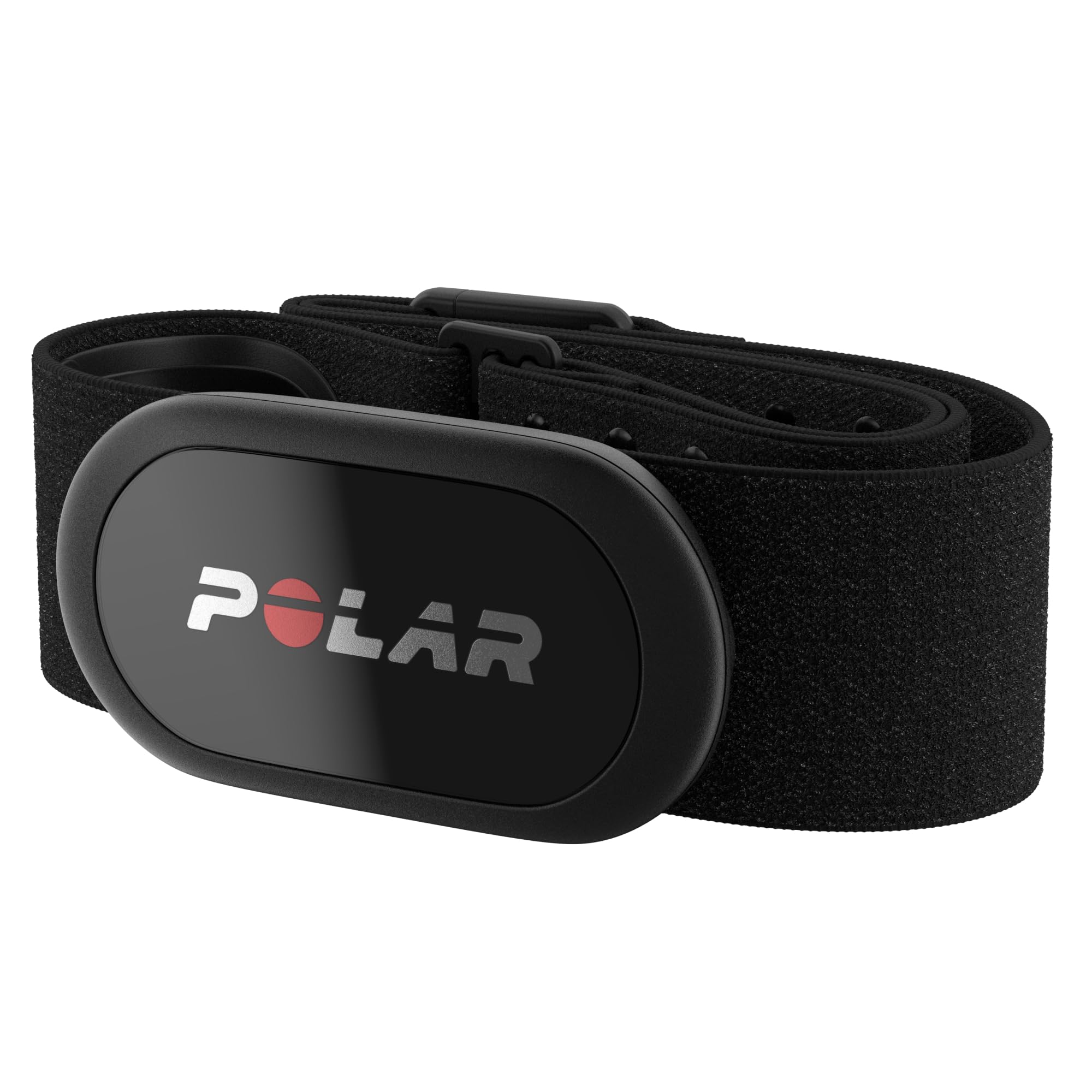
Precision-first chest strap with three connection routes and a pro-grade strap
If accuracy is the reason you are shopping, the Polar H10 is the pick that earns its premium. Polar calls it the most accurate sensor it has made, and it runs Bluetooth, ANT+, and 5 kHz at once — two Bluetooth connections plus an ANT+ link simultaneously. That matters if you want your Apple Watch and a gym machine fed the same data at the same time.
The Polar Pro strap is the visible upgrade over the H9: improved electrodes, an easy-to-use buckle, and silicone dots that hold it flat against the chest. Owners who came from cheaper straps describe the firmer band staying put through runs instead of rolling under the chest. Battery is again a CR2025 button cell rated for 400 hours. The body is listed at 2.82 ounces, and Polar advertises the sensor as waterproof.
Polar itself is candid that pairing is not always smooth. Some buyers find it pairs smoothly to phones and Garmin units, while others report dropouts and a stubborn app pairing sequence. The strap can also wear over months, which shows up as erratic readings — a fresh strap generally fixes it. Treat it as a top-tier sensor with a setup that rewards a little patience, and it will deliver.
The anchor spec: triple connectivity — Bluetooth, ANT+, and 5 kHz — running at once is why serious training setups choose the H10.
Know going in: pairing is the recurring friction point across Polar’s reviews; a worn strap can also introduce erratic readings.
Reach for this if: you want the most precise chest read Polar makes and can feed a Watch and a machine from one sensor.
Look elsewhere if: you want fuss-free pairing from the start — the H10 rewards patience with setup.
7. FITCENT Rechargeable Heart Rate Monitor Chest Strap

A rechargeable strap that talks to older gym machines as well as your phone
What sets the FITCENT apart is the third radio standard. Alongside Bluetooth 5.0 and ANT+, it broadcasts 5.3 kHz — the older signal that legacy treadmills, ellipticals, and gym equipment read natively. That means you can pair to your iPhone and step onto a Bowflex or SOLE machine without a separate sensor. Owners with older fitness equipment find this is the feature that keeps it in rotation.
It recharges on a wireless dock rather than swapping cells. A 1.5-hour charge is rated for 30 days of daily workouts at an hour each. The body carries an IP68 rating, which means it handles submersion up to 10 metres and keeps working through sweat and rain. Drop it in your bag wet without worrying. It works with DDP Yoga, Peloton, Strava, and Zwift, and pairs to a Garmin watch or iPhone without drama.
The real caveat is long-term reliability. Two units failing after roughly 2 years of regular use is the kind of story that shows up among FITCENT owners, and that is worth going into with eyes open. A front-facing LED also blinks during operation and can show through a light workout shirt — a small thing, but noticeable. With ANT+ present, you get the widest gym compatibility in the group, which is why it sits here despite the higher outlay.
Why it earns its place: 5.3 kHz compatibility plus ANT+ and Bluetooth makes it the most gym-machine-friendly strap here, and the wireless charging dock means no battery swaps.
The trade-off: long-term durability is the question mark — a couple of owners have had units fail after roughly 2 years of use.
Worth the extra if: your routine includes older cardio machines that read 5.3 kHz alongside your Apple Watch.
Skip if: you want the freshest radio tech and no sight of a blinking light through your shirt.
Know the Specs
Battery Hours vs. Days
Battery is where ownership friction lives. Button-cell straps are rated in hours — the Polar H9 and H10 run 400 hours on a CR2025 — and most owners swap that cell about once a year. Rechargeable armbands and straps quote shorter hours, from 35 up to 110, but you refill them from a cable or dock. The FITCENT quotes 30 days on a 1.5-hour wireless charge. Match the rated hours to how often you train, and you will know whether it is a monthly charge or a once-a-season top-up.
Bluetooth, ANT+, and 5.3 kHz
Bluetooth is the connection your Apple Watch actually uses, so treat it as the non-negotiable. ANT+ is a second wireless standard that Garmins, Wahoo units, and many bike computers and gym machines read — it is a bonus, not a must. The 5.3 kHz signal is older treadmill and gym-equipment technology, and the FITCENT is the pick that supports it. A monitor with all three routes plugs into the widest set of devices.
Common Questions
Will a Bluetooth heart rate monitor pair directly with my Apple Watch?
Does an armband read as accurately as a chest strap?
Can I use these monitors with a Garmin watch at the same time as my Apple Watch?
How long does a CR2025 battery last in a chest strap?
Are these monitors waterproof enough for swimming?
Do I need an app to see the data, or does my Watch show it?
Which monitor fits a larger chest or arm?
Are armbands or chest straps better for lifting and HIIT?
Why do some owners say the strap wears out and readings get erratic?
The Bottom Line
If I had to point one person to one pick, it is the COROS Heart Rate Monitor. It removes the two chores of heart rate training — switching it on and remembering to charge it — and stays comfortable on your forearm through intervals, lifting, and long runs. For the rider who wants battery headroom and bike-computer connectivity, the CYCPLUS H1 is the choice with the 110-hour runtime. And if the numbers have to be as precise as possible and you do not mind a little setup, the Polar H10 remains the sensor to beat.
How we choose
We do not accept paid placement. Every pick is matched to a real buyer and a real use-case; we do not hands-on test units.
Sources
Specifications: manufacturer listings and product documentation. Review insights: verified customer reviews, as of October 2026. Pricing: not shown on this page (it changes often); check the current price via the retailer link.
As an Amazon Associate, Aappliancez earns from qualifying purchases. This does not affect which products we feature.