Disclosure: Some links in this post are affiliate links. As an Amazon Associate I earn from qualifying purchases, at no extra cost to you. Learn more
Specs are compiled from manufacturer listings and verified buyer reviews and can change over time — please confirm the key details on the product page before buying.
A flutter can start in the checkout line, and by the time you reach a drawer monitor it is gone. What you need is a device that records your heart the moment an episode begins. The KardiaMobile Card earns the top spot for that job. It records a medical-grade EKG (a tracing of your heart’s electrical signal) in 30 seconds. It detects AFib, bradycardia, tachycardia, and normal sinus rhythm with no subscription. Everything below is chosen for one job: helping you and your doctor see an irregular rhythm.
This guide is built by comparing the manufacturers’ published specifications and the patterns across verified customer reviews, so you get each pick’s real strengths and trade-offs instead of marketing spin.
Some picks here are single-lead EKG strips, others are blood pressure cuffs that screen for AFib, and a few are wearables that watch your rhythm all day. The deciding question is how your symptoms actually show up. The right pick saves a dated EKG trace your doctor can read.
Top Picks
How To Choose The Best Heart Monitor for Afib
Your doctor will ask one question first: “What did your heart look like when you felt the flutter?” A monitor that only stores a heart-rate number gives a thin answer. A monitor that saves a dated EKG strip answers it properly.
Single-lead EKG or cuff-based screening?
A single-lead EKG reads the rhythm through your fingertips and saves a trace you can print or email. That is the format that confirms an irregular rhythm. A cuff with AFib detection screens your rhythm on each reading. It catches more days but shows less detail per event. If your episodes come and go fast, favor the EKG. If you already log blood pressure daily, a screening cuff does double duty.
Watch for the pacemaker line and the cuff limit
Check the implant rule before you spend a cent. The KardiaMobile Card is not tested or recommended for use with pacemakers and ICDs (implanted defibrillators). The Withings BPM Vision states it is incompatible with pacemakers. Cuff sizes are the other quiet dealbreaker. The OMRON Gold and Garmin Index BPM both fit arms from 9 to 17 inches. The Withings BPM Vision standard cuff covers 8.7 to 16.5 inches.
Does it need a subscription?
No-subscription designs let you record and share the basic EKG without a recurring fee. Several Kardia functions beyond the core detections sit behind an optional paid membership. The Bioheart bundle includes a 12-month subscription in the purchase. Know which model you are buying before you commit.
Side-by-Side Comparison
| Model | Best For | Monitor Type | AFib Detection | Battery | Amazon |
|---|---|---|---|---|---|
| KardiaMobile Card★ Best Overall | Wallet EKG anywhere | Single-lead EKG card | Yes, plus brady/tachy | Built-in, minimum 2,000 EKGs | Amazon |
| OMRON GoldBest Value | Blood pressure plus rhythm checks | Upper-arm cuff | Yes | 4 AA included | Amazon |
| Polar H10Top Performer | Training and long HR sessions | Chest strap | No | CR2025, 400 hours | Amazon |
| Garmin Index BPM | Garmin Connect trend tracking | Upper-arm cuff | Blood pressure and heart rate | 4 AAA, up to 9 months | Amazon |
| Withings BPM Vision | Big readable cuff display | Upper-arm cuff | Blood pressure and heart rate | 1-year battery life | Amazon |
| Fitbit Sense 2 | All-day wearable with ECG app | Smartwatch | Yes, ECG app | 6+ day battery | Amazon |
| Bioheart Chest Strap | Round-the-clock rhythm recording | Chest strap | Continuous rhythm | 48 hours | Amazon |
| Withings ScanWatch Light | Watch looks, long battery | Hybrid smartwatch | No AFib detection listed | 30-day battery life | Amazon |
Detailed Reviews
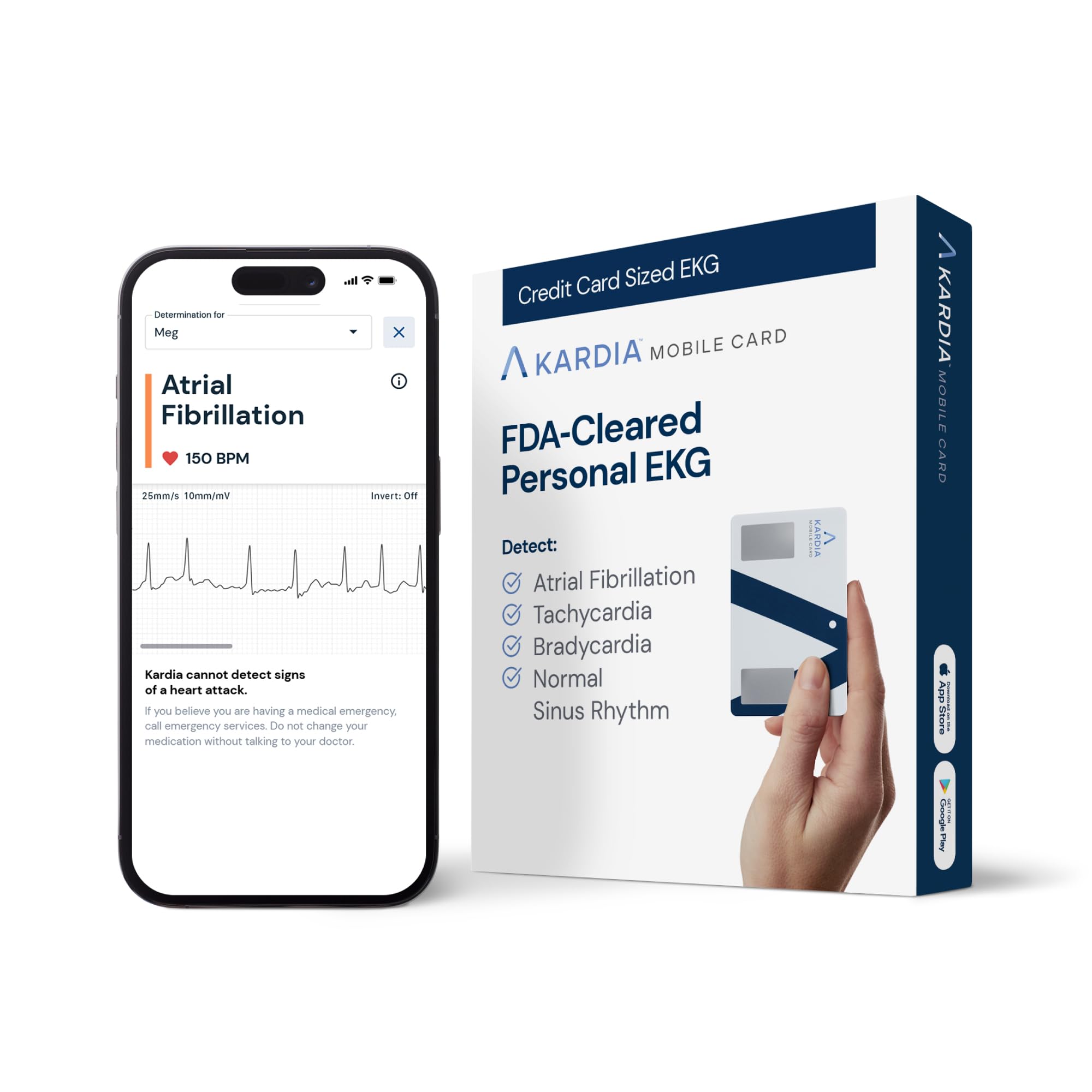
1. KardiaMobile Card Credit-Card Sized EKG
Our pick — 4.0+★ from 3,500+ verified ratings; the strongest balance of quality and price.
A wallet-sized EKG that records your heart in 30 seconds, no subscription needed.
It wins the top slot because it rides in your wallet at 7.4 grams, so the EKG recorder is on hand the moment a flutter starts in a checkout line. You press your fingers on the sensors for a 30-second recording. The free Kardia app then saves and shares the trace with your doctor. It detects AFib, Bradycardia, Tachycardia, and Normal Sinus Rhythm.
That portability is the whole point: a 7.4-gram card you never leave home without is a card you actually record with. One buyer picked it up after surgery-triggered AFib and used it on a guest with a racing pulse. The card showed 176bpm with AFib symptoms repeatedly. The ER cardiologist confirmed the diagnosis from the printed ECGs and changed treatment. Another owner, four years into using a six-lead device, keeps the card as a wallet backup for exactly this reason.
The catch is the trail of small annoyances. The battery is built in and serves a minimum of 2,000 EKGs, but it cannot be replaced. One buyer returned theirs for that reason and switched to a Kardia model with a replaceable battery. The app nudges toward an optional KardiaCare membership for extra detections. The device is also not tested or recommended for use with pacemakers and ICDs, and it does not check for a heart attack. As the review pages sum it up: capture the rhythm to show your physician.
credit-card EKG portability
- 30-second medical-grade EKG with no WiFi, cords, or computer needed — it pairs by Bluetooth to your phone
- Detects AFib, Bradycardia, Tachycardia, and Normal Sinus Rhythm, no subscription required
- 7.4 grams and card-thin, so it lives in your wallet instead of a drawer
- Built-in battery rated for a minimum of 2,000 EKGs, and auto-shuts off after 10 seconds idle
single-lead limits
- Battery is sealed in, so the whole card retires when it does
- App pushes an optional paid membership for extra features
- Not for pacemaker or ICD users, and does not detect a heart attack
travel-ready heart checks: you want a doctor-ready EKG trace in your wallet for those sudden flutter moments.
needing multi-lead detail: you have a pacemaker or ICD, or you insist on a user-replaceable battery.
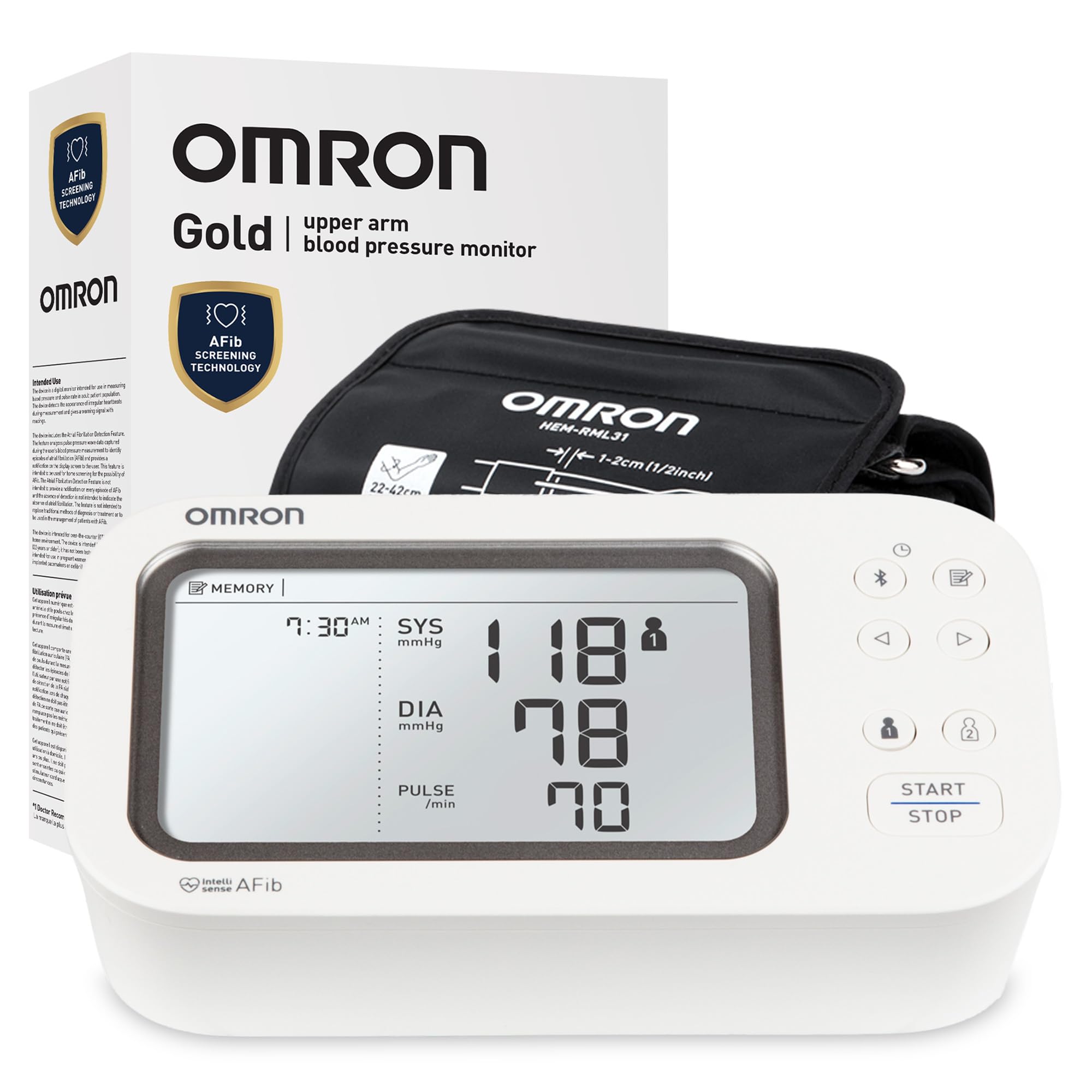
2. OMRON Gold Blood Pressure Monitor & Upper Arm Cuff
A morning cuff that screens your rhythm every time it checks your blood pressure.
If you already take a blood pressure reading every morning, this cuff turns that habit into a rhythm check too. It runs OMRON’s own Atrial Fibrillation Detection on every reading, so unusual beats get flagged without you doing anything different. A High Morning Average Indicator watches for morning spikes. The free OMRON connect app stores unlimited readings via Bluetooth and syncs with Apple Health and Google Fit.
The heart of the package is the dual-display workflow: it shows your current reading next to the previous one. TruRead averages three consecutive measurements. A cuff wrap guide lights up to tell you whether the fit is secure. The wide-range D-ring cuff fits arms 9 to 17 inches, and the box includes the storage case and four AA batteries.
Here is the line most listings bury: the unit will not display a blood pressure reading when it detects AFib, because a reading during an irregular rhythm is likely inaccurate. That is a sensible guard, but it means an episode produces a flag rather than a number. A buyer called this out as undisclosed in the Amazon description. One owner also found the AFib check only covers that 30-second reading, so a brief episode can slip past. Pair it with an EKG device if your priority is capturing the trace itself.
clinical-grade upper arm fit: the routine BP check becomes a rhythm screen. You get a light that catches a sloppy cuff wrap and two users get separate records.
cuff size constraints: AFib detection here is a flag, not a tracing. You get a warning, not the beat-by-beat evidence a cardiologist would want to read.
wanting wrist freedom: a printable EKG strip — this cuffs up and flags, it does not trace.
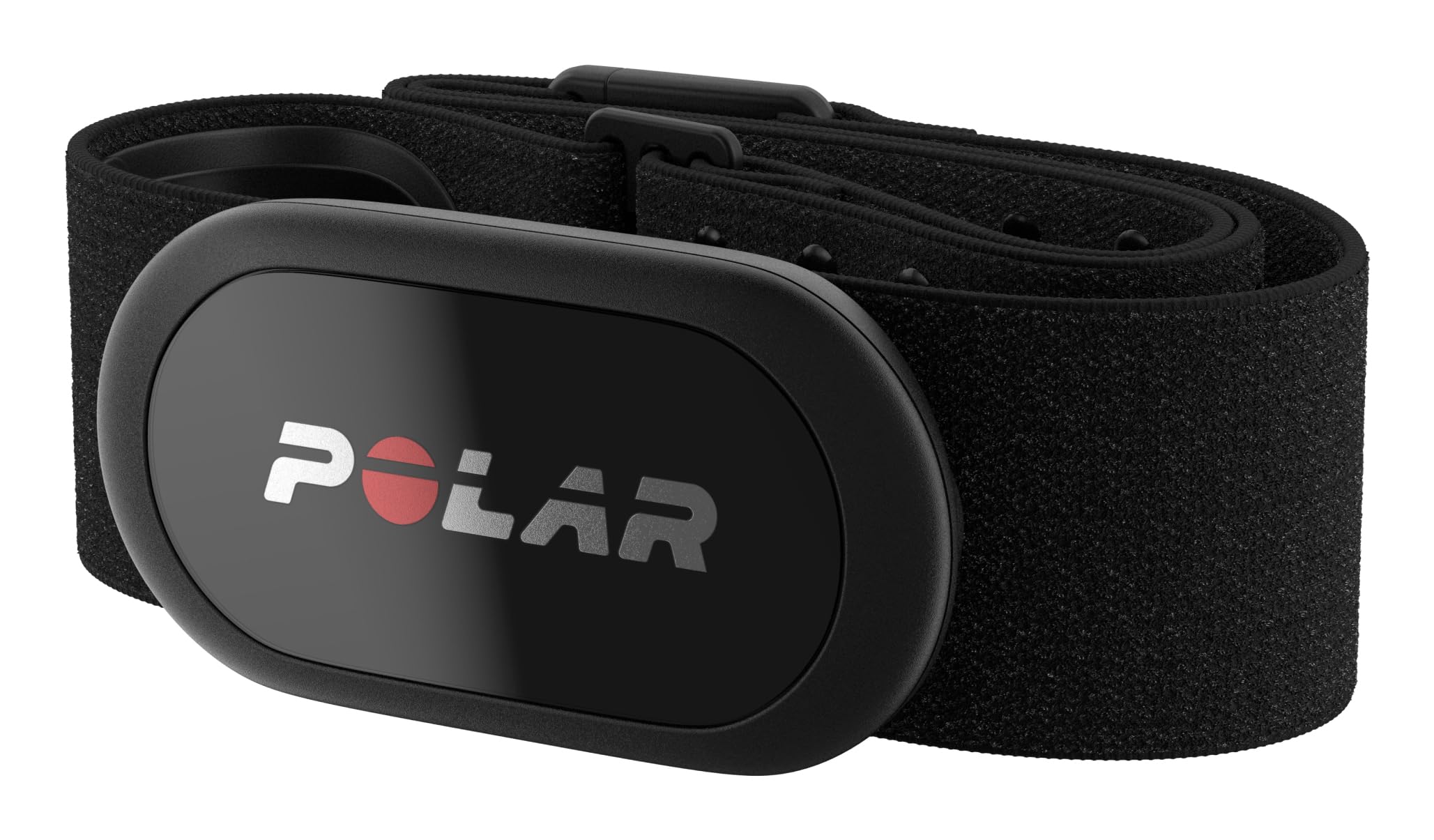
3. Polar H10 Heart Rate Monitor Chest Strap
The chest strap that holds a rock-steady signal through every workout and keeps a session in memory.
A CR2025 button cell (a small coin-shaped battery) rated for 400 hours of use is what earns this strap its place. If your AFib flares during exercise, that long battery plus internal memory for multiple hours means you can record without your phone nearby. It is fully waterproof, and the strap’s electrodes, buckle, and silicone dots keep it comfortable and interference-free.
Accuracy is the reason to pick it: the wide sensor area tolerates some misplacement and fires 0 when the signal drops instead of freezing on a stale number. The wide sensor area tolerates some misplacement. One owner’s runs matched the readout from a pacemaker clinic, with the cardiologist and RN both impressed. It also fires 0 when the signal drops rather than freezing on a stale number. That matters when you are reading your own rhythm live.
The polarizing part is the app. Pairing can be convoluted and, in some cases, fails outright. Worn for long stretches, the strap materials can degrade over months, and the fix is usually a fresh strap rather than a new sensor. Use a CR2025 cell only — the maker warns other sizes can damage the sensor. Note that the device gets confused during A-fib, so keep it as a training and general-HR tool rather than your AFib documentation.
workout heart zones: you train hard, need a waterproof sensor with stored memory, and want the rock-steady HR accuracy athletes chase.
all-day wear ease: you need a trace your doctor can diagnose from — this is a heart-rate tool, not an EKG recorder.
4. Garmin Index BPM Smart Blood Pressure Monitor

The cuff that quietly turns every reading into a shareable report in Garmin Connect.
Up to 16 users can sync their own accounts, which is the spec that puts this cuff ahead of the Withings BPM Vision for a two-person household. It is an FDA-cleared (cleared by the U.S. Food and Drug Administration) upper-arm blood pressure monitor. It delivers systolic and diastolic blood pressure plus heart rate, with an integrated display and no app needed to see a reading. Wi-Fi sync pushes your results into Garmin Connect, where 7-day, 4-week, and 1-year reports export to PDF for your doctor. The adjustable cuff fits arms 9 to 17 inches.
What earns its keep over time is the Wi-Fi sync — readings land in Garmin Connect without you retyping a single number. Owners of over a year describe the one-touch 3X reading mode as the go-to for early mornings. They call the automatic cloud sync the underrated part, since Garmin Connect turns it into printable blood pressure spreadsheets. Battery life is up to 9 months on four user-replaceable AAA batteries.
The honest trade-off is that a cuff screens rhythm rather than tracing it. The 3X mode also averages your three readings into one entry instead of keeping each pair separate. This is a pressure-and-trend tool, not a single-lead EKG. If a diagnostic trace is the goal, the wallet card above records what this cannot.
Garmin sync simplicity: 16-user sync, Wi-Fi data flow, and PDF trend reports make it the natural choice for Garmin owners.
Garmin-only ecosystem: it reports blood pressure and heart rate and leaves the rhythm diagnosis to an EKG device.
Garmin watch owners: the Garmin Connect user who wants pressure trends and doctor-ready PDFs without manual entry.
mixed-device households: capturing a beat-by-beat EKG during an episode — buy it as a companion, not a replacement.
5. WITHINGS BPM Vision Blood Pressure Monitor
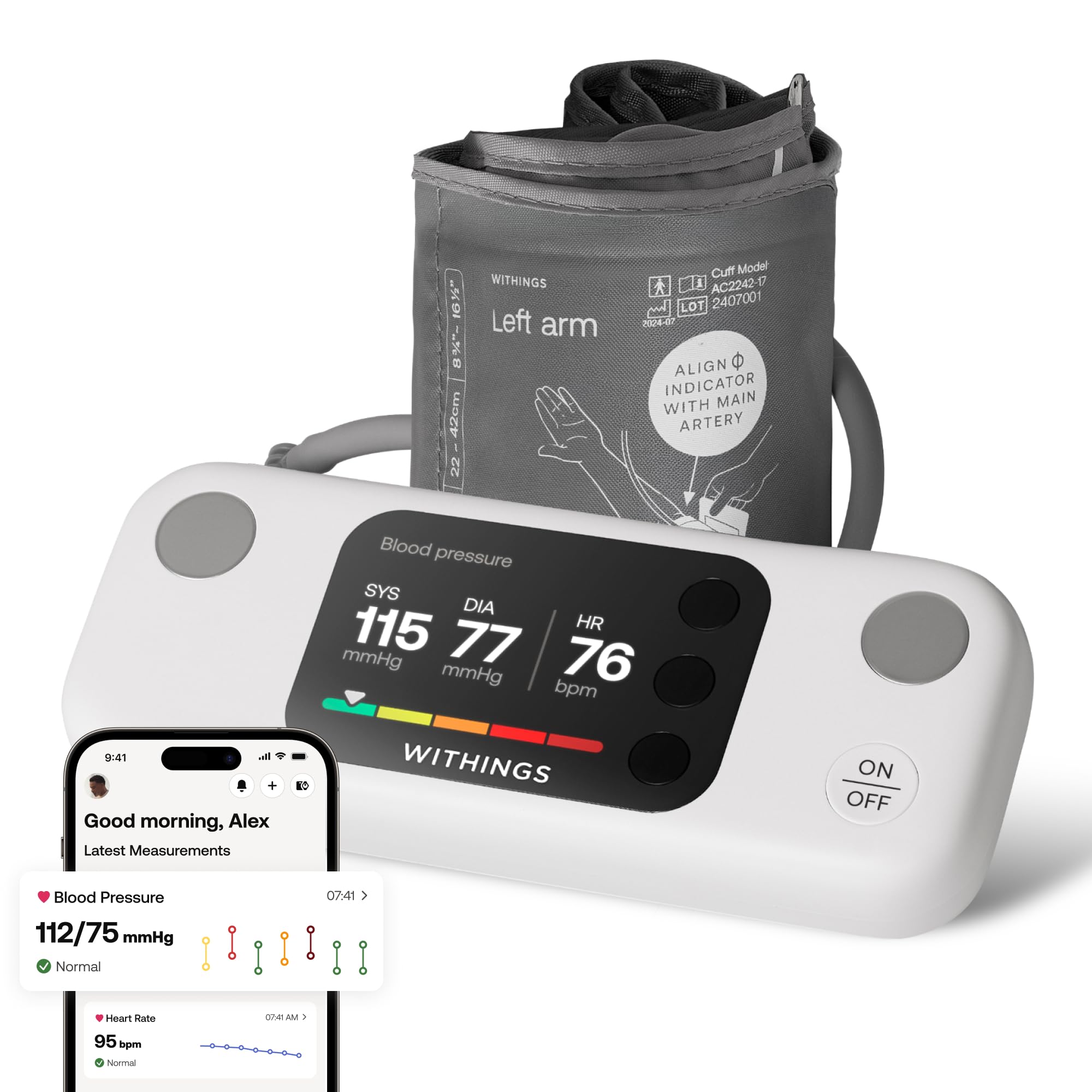
A big color screen and color-coded AHA feedback take the guesswork out of every reading.
A 2.8-inch LCD (measured diagonally across the screen) shows systolic and diastolic blood pressure plus heart rate in large type, so you can read it from across a sofa. Color-coded feedback compares your result against the American Heart Association’s hypertension levels. That means you see at a glance whether a number sits in a normal band or a high one. Built-in tutorials walk you through taking each reading under ideal conditions, and the protective case doubles as a stand.
What wins people over is the solid build and the large 2.8-inch readout you can see from across a sofa. Owners describe it as quiet, fast to set up, and reliable, with readings that match the doctor’s office. It syncs automatically via Wi-Fi or Bluetooth into the Withings app for unlimited storage. The standard cuff fits arms 8.7 to 16.5 inches, and battery life runs about a year.
Two limits to know before you buy. It is incompatible with pacemakers, full stop. And for the AFib shopper, this is a screening cuff with color feedback — it does not save a single-lead EKG trace you can hand a cardiologist. Two household users also cannot share one phone, so each person needs their own device or app pairing.
readable large numbers: anyone who wants a big, legible cuff reading with instant AHA color context and year-long battery confidence.
budget-focused buyers: you wear a pacemaker or need a diagnostic rhythm trace rather than a screening flag.
6. Fitbit Sense 2 Advanced Health Smartwatch

A wrist-worn ECG app and irregular rhythm notifications riding a 6+ day battery.
You get AFib checks folded into a watch you wear all day anyway. It includes an ECG app (an app that records your heart’s electrical signal) for atrial fibrillation assessment and irregular heart rhythm notifications. You also get SpO2 (blood oxygen level), a health metrics dashboard, and all-day stress detection with a Stress Management Score. Built-in GPS tracks workouts, it resists water to 50 meters, and the battery runs 6+ days.
The catch is that the ECG feature is finicky in practice. The seller’s conditions help — a clean, dry wrist and still fingers — but the finger placement takes patience and results can come back inconclusive. This is a general wellness watch with an AFib-check layer, not a dedicated rhythm recorder. If single-lead EKG quality is the whole point, the wallet card earns your money instead.
all-day health tracking: ECG app, irregular rhythm notifications, SpO2, 50-meter water resistance, and 6+ days between charges.
subscription for insights: the ECG reading can be hard to capture cleanly, so a clear trace is not guaranteed on the first try.
daily wellness routines: you want one watch for fitness, sleep, stress, and occasional heart-rhythm checks.
offline-only users: the clean single-lead trace you would hand to a cardiologist during an episode.
7. Bioheart 24/7 Continuous Heart Monitor Chest Strap
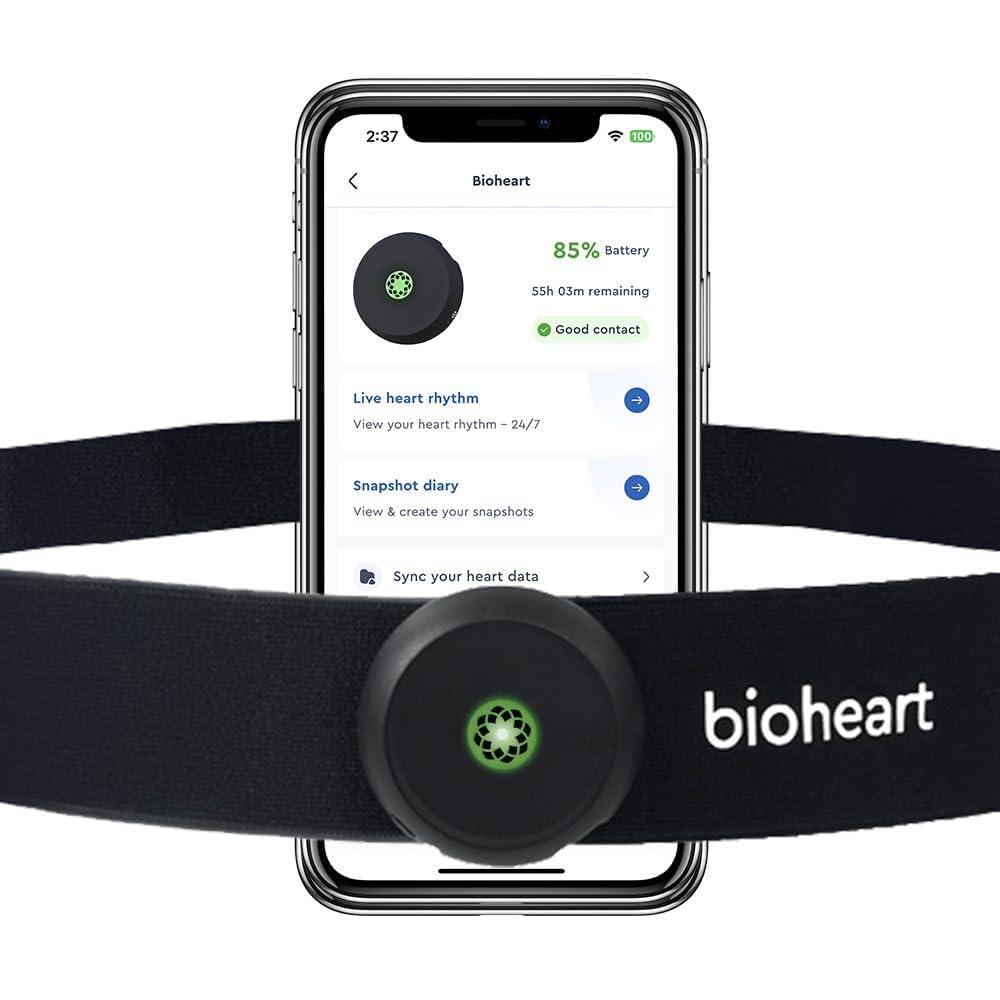
Continuous chest-strap rhythm capture that keeps recording while you leave your phone behind.
Recording your rhythm nonstop for 24 hours beats a single reading for catching a brief episode. The Bioheart does exactly that: it records your heart rhythm continuously while worn and stores the trace on the device without a phone nearby. You get 3 different rhythm views and an event button that logs a beat-by-beat snapshot. The bundle includes a 12-month subscription, the device, band, and charger. The band is removable, washable, breathable, and waterproof, with built-in electrodes.
Owners pair it with exercise to build a full-day picture. They then generate data stripes to share with a doctor or trainer. Battery life is rated at 48 hours per charge.
The honest downside is build consistency. Reports of a unit failing within weeks exist, though some replacements succeed. The company has been described as responsive when issues crop up. This is a tool with a monthly subscription baked in, so factor that into how long you plan to use it. If durability certainty is your priority, the Kardia card above is the simpler bet for documentary EKGs.
round-the-clock monitoring: you need a full 24-hour rhythm profile and want continuous capture away from your phone.
light sleepers: a recurring subscription or a device that may need replacing inside a year is a dealbreaker for how you monitor.
8. Withings ScanWatch Light Hybrid Smartwatch

A classic-looking watch that tracks resting heart rate and steps for up to 30 days per charge.
For someone who wants heart and activity data without a screen on their wrist, the ScanWatch Light trades the glowing rectangle for an analog face. It tracks resting heart rate, activity and steps, sleep, cycle tracking, and connected GPS, all with a 30-day battery life. Stainless steel case, buckle closure, and a fluoroelastomer band make it look like a normal watch. The Withings app presents clear trends for you and your doctor.
The resting heart-rate trend is the standout daily-use benefit. One owner reports the resting heart-rate tracking lower their average heart rate over time, with sleep tracking improving bedtime consistency and blood oxygen included. The battery is the other draw — the app syncs with MyFitnessPal and vibration notifications keep you on track.
This is a wellness watch, not an AFib diagnostic device. Its specifications list heart rate monitoring, activity tracking, sleep, and cycle tracking, not an irregular-rhythm alert. If AFib documentation is the goal, look at the EKG card at the top of this list. And if fragility bothers you, the glass scratches easily and the analog time must be reset after charging.
watch-first minimalists: track resting heart rate and sleep while looking like a proper watch, with up to 30 days between charges.
app-heavy users: anyone whose core need is an AFib alert or an EKG trace — this reports trends, not rhythms.
Know the Specs
Single-Lead EKG vs. Screening Cuff
A single-lead EKG records the electrical rhythm through your fingers and saves a trace your doctor can read. That is the format that documents an irregular beat. A screening cuff flags an unusual rhythm during a blood pressure reading but does not save the trace. Use the EKG to capture the event; use the cuff to watch trends every day.
Pacemaker Compatibility
Some monitors state plainly that they are not for pacemaker or ICD users. The KardiaMobile Card and the Withings BPM Vision both carry that limit. If you have an implanted device, check that line first. It can rule out an otherwise excellent monitor in a single glance.
Battery Life and Subscription Terms
Battery specs run from a build rated for a minimum of 2,000 EKGs up to a year or more on a cuff. Equal to that is the subscription question: some monitors charge for extra detections, and one bundle includes a 12-month subscription in the price. Read both before you commit.
Cuff Fit
A cuff that pinches or sits loose gives you poor readings. Most upper-arm cuffs here fit an arm range of roughly 9 to 17 inches. Measure your arm circumference before you buy, so you are not fighting an ill-fitting band on every check.
Common Questions
Does a heart monitor for AFib replace a visit to my cardiologist?
Can I use the KardiaMobile Card if I have a pacemaker?
Why will a blood pressure cuff refuse to show a reading during AFib?
How long does the KardiaMobile Card battery last?
Do I need a subscription to use a personal EKG monitor?
Will a chest strap capture an AFib episode?
What arm size do these cuffs fit?
Does the Fitbit Sense 2 give me a printable ECG for my doctor?
Can two people share one of these heart monitors?
Is a hybrid watch like the ScanWatch Light suitable for AFib tracking?
The Bottom Line
For most people, the heart monitor for afib winner is the KardiaMobile Card — it records a 30-second medical-grade EKG anywhere, detects AFib without a subscription, and lives in your wallet so it is there when a flutter hits. If you already check blood pressure daily, the OMRON Gold screens your rhythm with every reading and gives you a cuff that fits 9 to 17 inches. And if you need a full day of continuous recording, the Bioheart captures rhythm around the clock with 48-hour battery life. Whichever you choose, buy the tool that records the evidence your doctor needs.
How we choose
We do not accept paid placement. Every pick is matched to a real buyer and a real use-case; we do not hands-on test units.
Sources
Specifications: manufacturer listings and product documentation. Review insights: verified customer reviews, as of October 2026. Pricing: not shown on this page (it changes often); check the current price via the retailer link.
As an Amazon Associate, Aappliancez earns from qualifying purchases. This does not affect which products we feature.