Disclosure: Some links in this post are affiliate links. As an Amazon Associate I earn from qualifying purchases, at no extra cost to you. Learn more
Specs are compiled from manufacturer listings and verified buyer reviews and can change over time — please confirm the key details on the product page before buying.
You hear the car rumble but miss the kettle, and you catch every vowel your wife says but lose the consonants that carry the meaning. That is high frequency hearing loss, and it needs a device tuned for clarity up top — not just a louder box. Below are the over-the-counter hearing aids that give you real control over high frequencies, which models keep speech crisp, and which ones ask for patience.
This guide is built by comparing the manufacturers’ published specifications and the patterns across verified customer reviews, so you get each pick’s real strengths and trade-offs instead of marketing spin.
You will see frequency range in hertz, gain in decibels, and how a phone app changes the sound per ear. Every pick here is a real OTC device with its own personality, so read on to see which of these hearing aids for high frequency hearing loss fits the way you actually live.
Top Picks

How To Choose The Best Hearing Aids for High Frequency Hearing Loss
High frequency loss is a clarity problem, not a volume problem. You can hear a person is talking and still not understand the word. So the device has to lift the upper range — the s, f, th, sh sounds — without also lifting the fridge hum. That is the whole job.
Look for a frequency range, not just an amplifier label
An amplifier raises everything equally. A real hearing aid is tuned across a frequency range, and the top end of that range is where your consonants live. A device stated to reach up to 8500Hz is designed to reproduce those upper details. A device with no stated range and a fixed set of modes is closer to an amplifier.
Decibels of gain tell you how much loss it can cover
Gain is how much extra loudness the aid can add, measured in decibels (dB). A 50dB device handles moderate loss; a 41dB device suits mild to significant loss. If your loss is severe in one ear, a device built for that range will distort before it helps — check the stated gain before you buy.
Self-fitting versus clinic tuning
An in-app hearing test lets the aid build its own profile, which is fast and needs no appointment. Clinic-level tuning lets an audiologist shape individual frequencies. Both approaches work, but only one fits in your pocket on a Tuesday evening.
Side-by-Side Comparison
| Model | Best For | Highest Stated Frequency | Max Gain | Runtime Per Charge | Amazon |
|---|---|---|---|---|---|
| EARGO 8★ Best Overall | Near-invisible in-canal wear | — | — | Up to 16 hours | Amazon |
| Nova Hearing AidsBudget Champion | First-time users on a tight budget | — | — | 20 hours | Amazon |
| Vivtone Lucid508Top Performer | Simple behind-ear amplification | — | 41dB | 25 hours | Amazon |
| ELEHEAR-Beyond | App control and long runtime | — | 50dB | 20 hours | Amazon |
| NVBOTY M2219 | Button-only operation | — | 43dB | 25 hours | Amazon |
| Vivtone Xpure 2.0 | Bluetooth calls and streaming | — | — | 24 hours | Amazon |
| ELEHEAR-Beyond Pro | Highest stated frequency detail | 8500Hz | — | 20 hours | Amazon |
| Sennheiser All-Day Clear | Comfortable all-day RIC wear | — | — | Up to 24 hours | Amazon |
| Jabra Enhance Select 500 | Audiology support included | — | — | — | Amazon |
Detailed Reviews
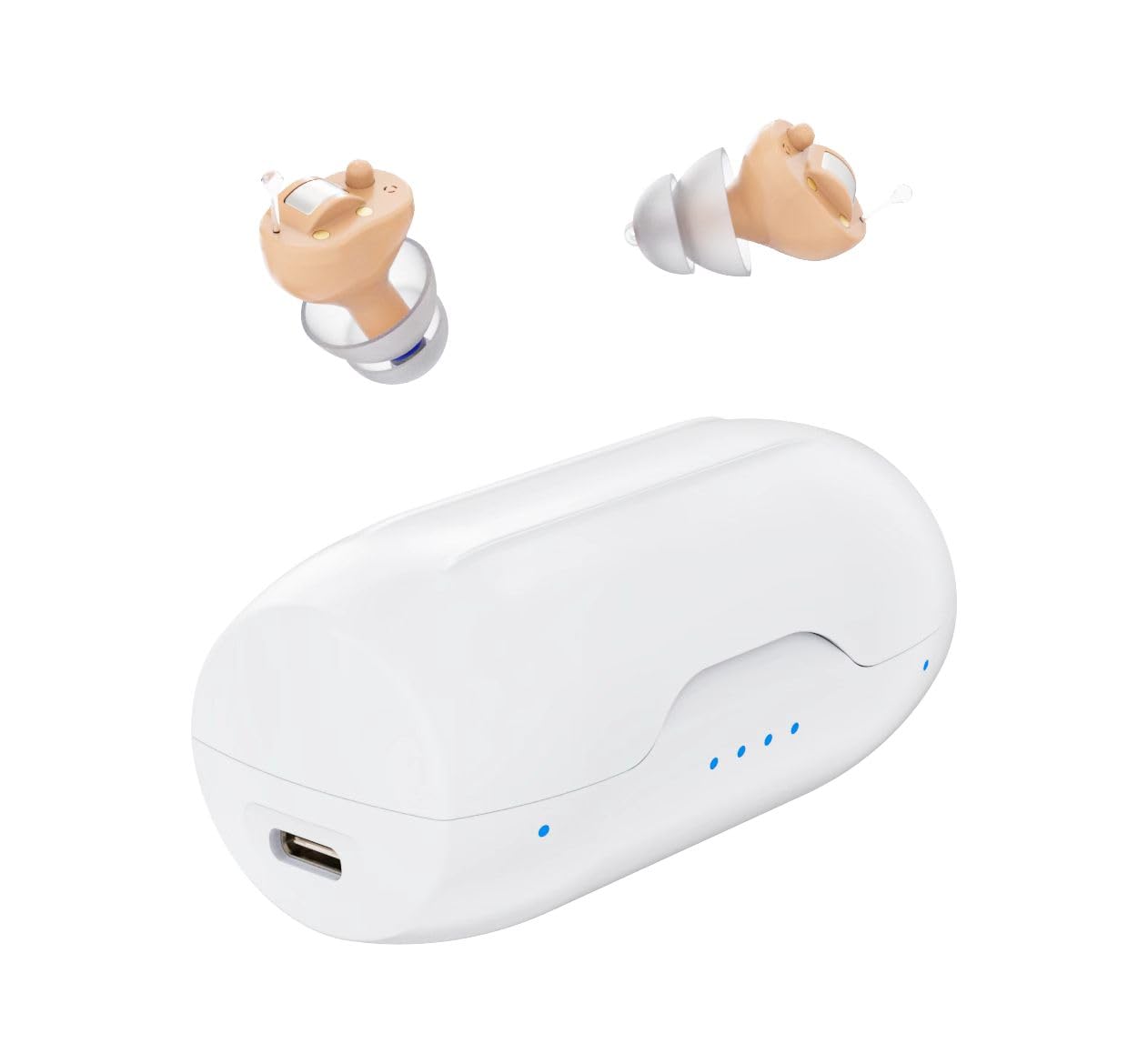
1. EARGO 8 Self-Fitting OTC CIC Hearing Aids
A completely-in-canal aid that hides in your ear and runs up to 16 hours per charge.
If your high frequency loss comes with vanity — you simply will not walk around with a device hooked over your ear — this is the pick. The EARGO 8 is a completely-in-canal (CIC) design, meaning the whole unit sits down inside the ear canal and vanishes from view. It carries an IP68 rating, which is the highest dust and water resistance rating a device can hold, so sweat and a rainy walk are not a problem. Self-fitting happens through the Eargo app’s Sound Match feature, or you skip the app entirely and use one of the 4 preset programs that come ready from the start.
Battery is a stated up to 16 hours of listening per charge, and the extended-life charger holds up to 14 full recharges — roughly 2 weeks away from a wall socket. That matters if you travel or keep the case in a bag. Owned since May 2025, it also ships with a 2-year warranty that includes unlimited repairs and a one-time loss or damage replacement.
Here is the honest catch: the sound engine and the discretion are genuinely strong, but the app-based support around it has been unstable. A verified 3-star review reads: “Company is leaving USA and support for the app will end.” That is a worry about the platform’s future, not a today problem with the hardware — but factor it in if the app is central to how you plan to use these. Separately, some users report the bud does not stay put in the canal without experimenting on eartip size. The package includes 3 sizes of Trumpet eartips, so budget a few evenings to get the fit right.
What earns it first place
- IP68 rating — the top dust and water resistance rating available on a hearing device
- Completely-in-canal build that stays out of sight
- 16 hours of listening per charge, with the charger holding up to 14 full recharges
- 2-year warranty including unlimited repairs and one-time loss or damage cover
- Sound Match self-fitting per ear through the app, or 4 presets for non-app users
Where it asks patience
- App support continuity is uncertain after a publicly raised company-exit concern
- Getting the bud to stay seated can take trial and error across the 3 eartip sizes
- Not Bluetooth earbuds — no music streaming or phone calls through these
Pick these if: you want the device to be genuinely invisible and you are comfortable self-fitting through an app or a raw preset.
Think twice if: you need phone calls and music streaming from the same device — these do not stream at all.
2. Nova Hearing Aids for Seniors Adults
A 1.5-hour charge buys 20 hours of use, so a forgotten overnight plug-in costs you a morning.
Nova’s pitch is built around the person who puts an aid in at breakfast and wants it to still be working at dinner. The 1.5-hour charge buys 20 hours of use, and the drying case automatically pulls moisture out while the aids sit in it — which is a genuine help for anyone whose ears get humid through the day. The maker’s own chip is stated to reduce background noise by 80%, and the feedback cancellation is designed to kill the whistle when you lean in for a hug.
Buyers praise the build most of all. The quality of the assembly earns more goodwill than any other trait here, with sound clarity right behind it. The repeated theme in the feedback is that people do not get the whistling that drove them away from cheap amplifiers. A verified 4-star review puts it plainly: “These things are outstanding… Limited feedback, good volume adjustment, more of a natural tone of people speaking.” One 5-star reviewer notes the company is upfront that these are amplifiers, not full hearing aids — useful honesty when you are deciding what to expect.
The caveat is volume control. Adjusting up and down means cycling through each step rather than jumping straight to your level, and the 3 sound modes feel similar rather than distinct to some ears. The package measurement gap between this and the EARGO 8 is small either way — 10.86 ounces against 10.58 ounces — so neither is a burden in a handbag. Nine pairs of soft tips come in the box, which is the right number for hunting down a fit that does not screech.
The noise-reduction reality: the 80% background noise cut is stated for the chip, not promised for every room. One long-term user notes TV dialog drops when an appliance kicks on in the background, so treat it as strong in quiet rooms and decent in moderate ones.
Reach for this if: this is your first device, the budget is tight, and charging speed matters more than surgical frequency shaping.
Look elsewhere if: you want independent per-frequency tuning rather than a step-through volume cycle.
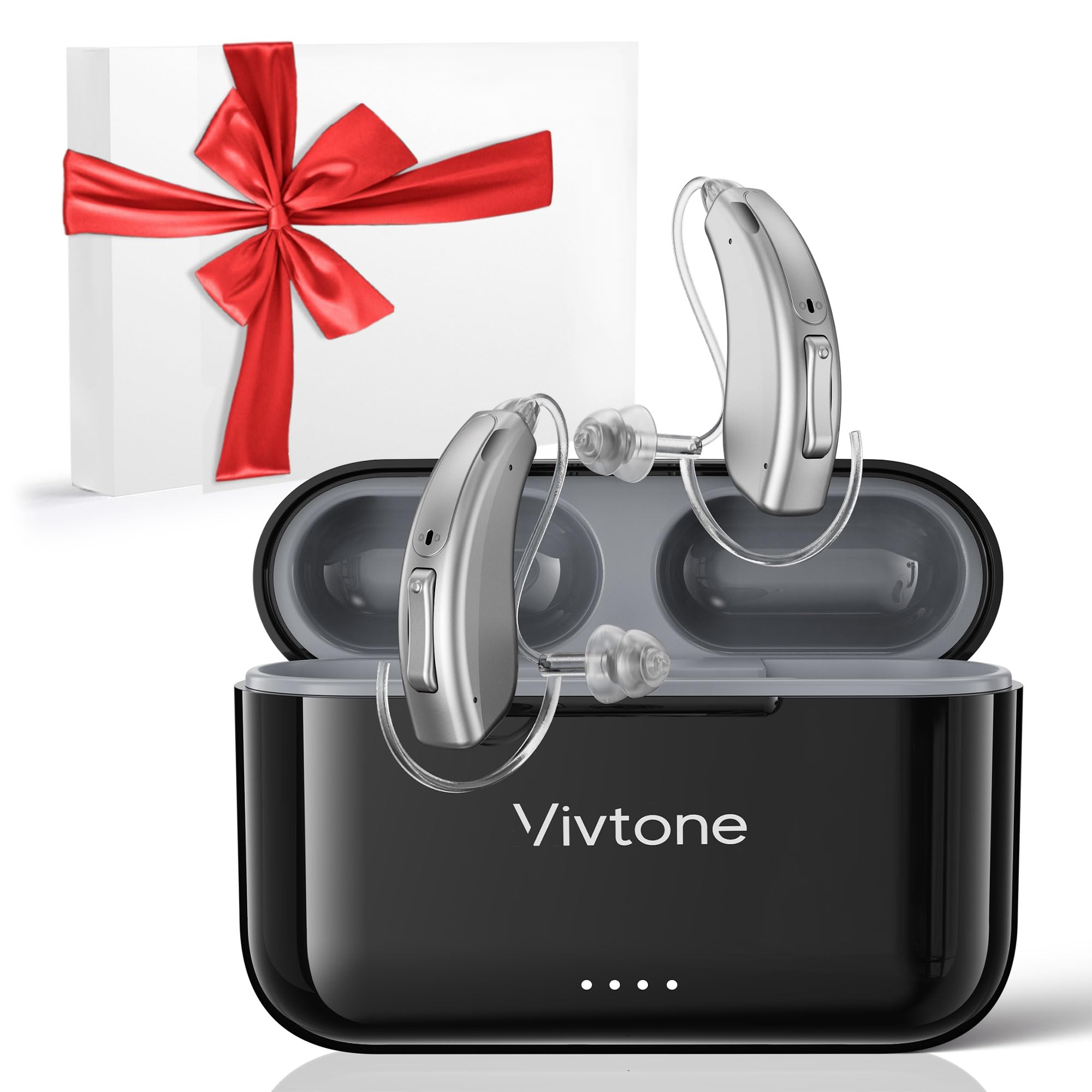
3. Vivtone Lucid508 Rechargeable BTE Hearing Assist
Two hours of charging gives 25 hours of use, and the case adds 4 more full charges.
Behind-the-ear devices suit people who want something easier to handle than an in-canal bud — bigger to grip, harder to lose in a carpet. The Lucid508 states a peak sound gain of up to 41dB and is aimed at mild to significant loss, which covers a lot of the high frequency crowd. Its multi-channel digital processing is the reason a quiet mode and a noisy mode can do genuinely different jobs: one keeps things natural, the other pulls the human voice forward while pushing background down.
The charging story is the standout. Two hours fills the aids for 25 hours of use, and the recycle case tops both units up 4 times over — a stated 125 hours of backup power in total. The auto-on/off feature means lifting an aid out switches it on and dropping it back in switches it off, so there is no tiny switch to fumble at 7am. One owner of a 94-year-old mother writes: “She is able to use these easily and the sound is perfect.” That simplicity is worth a lot when the wearer is not the person setting them up.
Where it falls short is fine detail at the top. The 3-star review flags “lots of clipping at slightly improve volume levels” — the sound breaks up when pushed. If your loss needs real upper-range lift and you like to turn things up, that ceiling will show. It is also worth understanding what this is: a multi-channel hearing assist, not an app-tuned device with per-frequency sliders. One 4-star reviewer puts it well — recommendations make sense “only if simple amplification needed.”
For the family doing the setup: the automatic on/off and the two-room modes are what makes this a sensible handover to a parent — minimal decisions, no app required, and a case that stays charged for days.
The warranty adds real confidence: a stated 3-year cover, plus support staff who have walked owners through a charging fault by phone rather than insisting on a return. For a first behind-ear device with no smartphone dependency, this one holds together well.
Suits you if: you want a wear-and-forget behind-ear aid with a case that keeps charge for days and zero app involvement.
Look past it if: you need per-frequency shaping or you listen at higher volumes — the clipping is the documented limit.
4. NVBOTY M2219 Rechargeable Hearing Aid
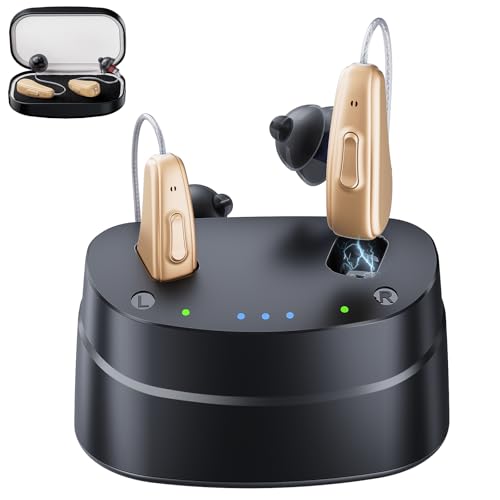
No app at all: one button cycles five volume steps and a memory function restores your last setting.
Some people do not want to pair anything. The M2219 keeps control physical: a single click on the Volume+ button moves you up or down a step, a 3-second hold switches it on or off, and the smart memory function restores your last setting the next time you power up. Five levels is a small ladder, but it is a predictable one.
The amplification figure is 43dB±5dB, and the chip is stated to tackle feedback and provide active noise cancellation. Run time is up to 25 hours on a full charge, extended to a stated total of up to 100 hours with the charging case, and a 3-hour charge refills it. Three ear tip sizes ship in the box, and the compact case is sized to drop in a pocket or bag.
Be clear-eyed about this one, because the spread of experiences is wide and the total volume of feedback is small — 10+ ratings, at 3.0+ stars. Some buyers report the volume steps all land louder than they want, and that the noise-cancelling claim reads bigger on the box than in the room. Others find the sound lands cleanly and the fit comfortable. For high frequency loss specifically, the five fixed steps will not shape the upper range the way an app-based frequency slider does, so treat this as an amplified option rather than a tuned one.
The real trade-off: you get the simplicity of deck-button control and a stated 100 hours of total case-backed listening, but you give up the frequency-by-frequency adjustment that makes a real difference with consonant clarity.
Best for: the wearer who refuses to touch a smartphone and wants a straightforward button-operated pair.
Not the one if: your primary goal is lifting high frequency speech detail — this amplifies broadly.
5. ELEHEAR-Beyond OTC Hearing Aids

50dB of gain plus independent in-app frequency adjustment lets you lift consonants without raising the whole room.
Here is where the high frequency story sharpens up. The ELEHEAR-Beyond offers 50dB amplification, and — critically — its app lets you adjust volume, frequency, sound directionality, and environment profiles individually. That frequency control is the exact lever someone with high frequency loss needs, because it lets you lift the consonants without making the whole world shout. The VocClear AI tech is stated to boost speech clarity by 17% and cut 24dB of background noise, and there are 4 scene modes you switch with a tap.
Stamina is the other argument. A single charge gives up to 20 hours, the case adds 4 more charges for 100 hours in total, and 15 minutes on the charger delivers 6 hours of runtime — a genuine rescue when you forgot to plug it in overnight. Nine dome sizes ship in the box, which is more fit options than most rivals offer. Owners single out the adjustable, app-driven nature most: the ability to shape input direction and tailor the profile to a room is the trait the most people flag as the reason they bought.
The honest limit: noise cancellation is the most-discussed gripe here, and it is fair — these cut noise, they do not remove it, and a loud restaurant will still require work from you. That is true of nearly every OTC aid, but do not expect the app to solve it entirely. Comfort also takes a week or two of adaptation for some ears before it settles.
Why it lands high on this list
- 50dB amplification — the highest stated gain of the app-controlled picks here
- Independent frequency adjustment in the app, which is the key lever for upper-range loss
- 15-minute fast charge gives 6 hours of runtime
- 9 dome sizes included for fit
- 4 scene modes and Bluetooth streaming for calls and media
What to expect going in
- Noise cancellation in a packed room is the most-debated aspect — it helps, it does not erase the room
- Some users take a couple of weeks for ear comfort to settle in
- Dome type matters a lot — the wrong one causes feedback
Make this your pick if: you want to be your own tuner and shape specific frequencies from your phone.
Go for a different one if: you expect the app to fully silence a busy diner.
6. Vivtone Xpure Bluetooth Hearing Aids 2.0

A receiver-in-canal aid that pairs over Bluetooth for calls and music, with 3 hours of streaming per charge.
The Xpure 2.0 is a receiver-in-canal (RIC) design, which means the speaker sits down in the canal and the body rests behind the ear. That arrangement is the reason the maker claims reduced distortion and feedback. It pairs over Bluetooth with iOS 12 and Android 11.0 or newer devices for calls and audio, and you can fine-tune volume and frequency either from the free companion app or from the buttons on the body.
Charging is fully complete in 2.5 hours for both the aids and the case. That yields a stated 24 hours of hearing aid use, or 3 hours of Bluetooth streaming — a short window if you plan to listen to podcasts all morning. The recycle case is stated to provide a full week of standby power. Multiple preset modes cover quiet conversation, noisy restaurants, and outdoors, and there is real-human phone support when something goes wrong.
Now the part you need to hear. This is a split-personality device, and the split runs along how severe your loss is. For mild-to-moderate loss with a strong streaming habit, owners describe calls coming through cleanly on both ends and the replacement process working when a mic fails. For anything heavier, the ceiling shows. One 3-star owner who kept theirs describes needing the maximum output setting pushed to roughly 80% just to avoid distortion, and calls the domes undersized for a larger canal. A 1-star report describes a left aid failing after 2 days and the second after a month, with 5-hour real-world run time and squealing.
The split personality: Bluetooth is its headline gift, but streaming drains the battery fast. You get 3 hours of music against 24 hours of plain hearing assistance, so treat audio as an occasional extra, not a constant companion.
Great fit for: someone with mild-to-moderate loss who takes calls constantly and wants one device for ears and phone.
Wrong choice if: your loss is severe or you expect all-day music streaming from a hearing aid.
7. ELEHEAR-Beyond Pro Bluetooth Hearing Aids
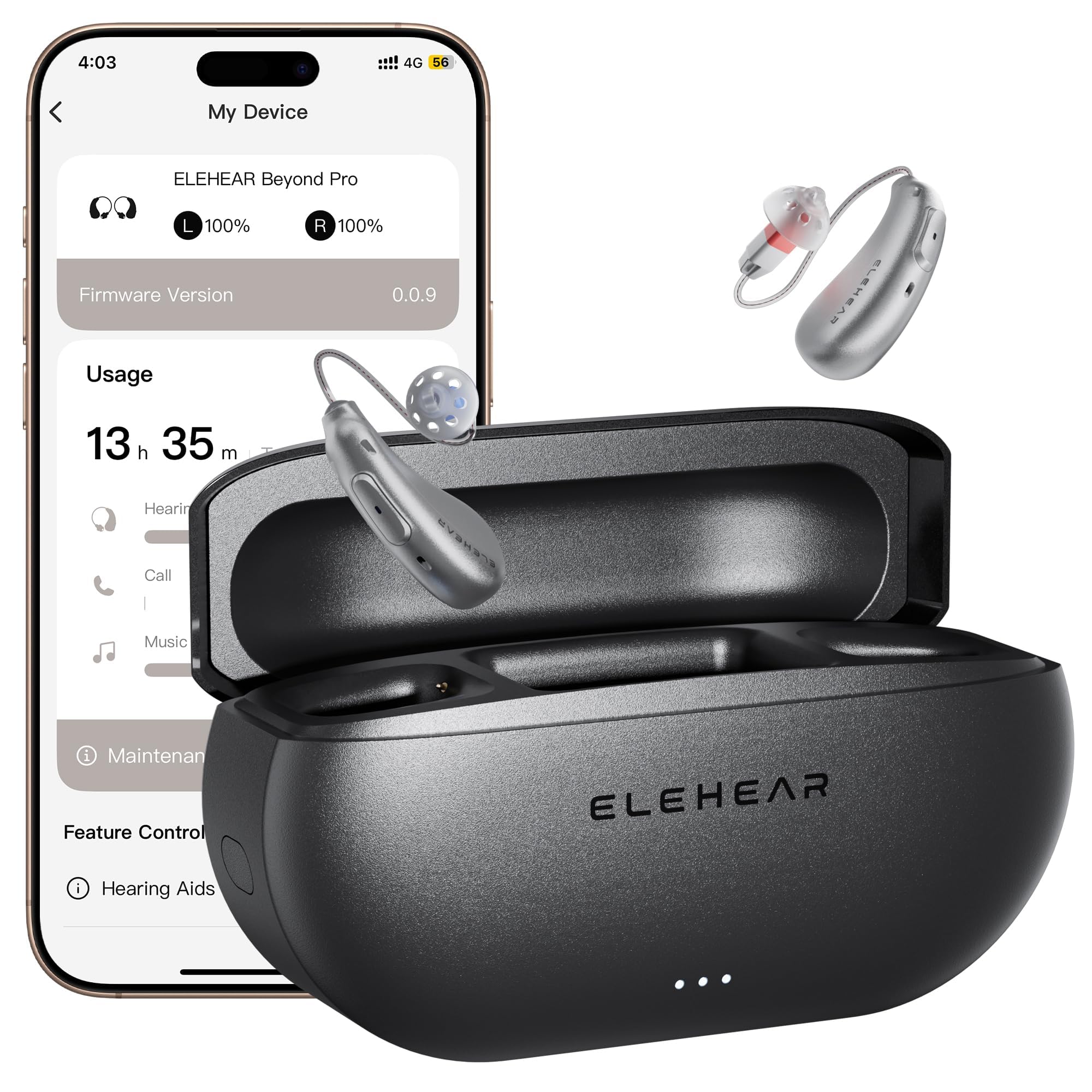
The only pick with a stated frequency ceiling: 8500Hz of high-frequency detail at 8ms latency.
If you are shopping specifically for high frequency loss, read this spec line carefully. The Beyond Pro is stated to reproduce enhanced high-frequency detail up to 8500Hz (hertz, the measure of pitch — higher numbers mean higher sounds). It runs at an ultra-low latency of 8ms (milliseconds, the delay between the sound arriving and reaching your ear), and 8ms is fast enough that your own voice will not sound like a stranger’s. VocClear 2.0 is stated to deliver 30% clearer speech, and the app gives you independent frequency adjustment — which is what makes that 8500Hz ceiling usable rather than a printed number.
The daily logistics are tidy. A 15-minute fast charge gives up to 6 hours of use, a full charge gives up to 20 hours, and the case adds 4 full charges. A featherlight receiver-in-canal design turns on and off by leaving or entering the case, and multiple dome sizes ship in the box. The app also carries 20 soundscapes and a real-time AI translation feature covering 20 languages — a bonus you will either love or ignore.
The honest catch is that clarity in this league comes with a cost in consistency. The app runs 3 channels for manual adjustment, and for anyone used to a full equalizer that will feel coarse. A long-term owner who had a good first run describes the aid failing after 7 months and the replacement wire failing again 2 months later, plus aids slipping while chewing and feedback from a coat collar. Buyers who tune the frequency range to their own ears tend to love it; buyers who expect it to work without adjustment tend to struggle.
Where it genuinely leads: compare the stated frequency range against the rest of this list and it is the only device that puts a number on its upper ceiling — 8500Hz against no stated figure elsewhere. That is the metric that matters most when consonants are what you are missing.
The one to buy if: your priority is the highest stated high-frequency reproduction on this list and you are willing to spend time in the app tuning it.
Pass if: you want a device that works well with zero adjustment — the coarse 3-channel manual control will frustrate you.
8. Sennheiser All-Day Clear Bluetooth Hearing Aids

A receiver-in-canal aid from Sennheiser, rated for up to 24 hours of continuous use.
Sennheiser brings its audio heritage to the OTC (over-the-counter, sold without a prescription) shelf. The All-Day Clear uses a receiver-in-canal (RIC) design — the familiar shape where a small wire runs from a body behind the ear down into the canal. The maker states the rechargeable battery offers up to 24 hours of continuous use, depending on how you use it. It automatically adjusts to the sound environment around you and is aimed at adults with mild to moderate loss. Setup is entirely in the app, with no audiologist appointment needed, and it is FDA cleared and backed by a 30-day trial.
Comfort is where this one consistently wins. Owners describe wearing it all day without thinking about it, and the package includes 8 ear tips in S/M/L plus wax guards and a cleaning brush. Bluetooth pairs to iOS or Android for hands-free calls, music, podcasts, and audiobooks, and the auto-adjusting sound means less fiddling mid-conversation. Effectiveness and reliability are the traits most praised by owners, and a prescription user since 2019 compared these favorably to ReSound RIC and Starkey ITE models on sound and streaming.
Where it asks patience: the app offers only 2 sound profiles and limited advanced settings, so if you want to shape individual frequencies you will feel boxed in. Multiple buyers flag that in a noisy room these amplify everything rather than isolating a voice, and some report a background hiss in quiet spaces. There is also a practical gotcha — the charging case has no internal battery, so it needs to be plugged in. And for long-term ownership, the replacement eartip supply has been an issue for at least one buyer, so plan to care for the tips you get.
The obvious choice if: comfort and all-day wear matter more to you than deep frequency customization, and you like using a name-brand audio product.
Worth skipping if: you need per-frequency tuning or you primarily struggle in loud restaurants.
9. Jabra Enhance Select 500 OTC Hearing Aids

The premium pick for people who want a real audiologist in their corner, even over the counter.
This is the closest thing on the list to clinic care without the clinic. The Select 500 is a Jabra Enhance device with audiology services included — meaning remote testing and setup performed by professionals by phone. It streams calls, music, and media from iOS or Android, supports Bluetooth LE Audio and Auracast, and uses a micro design the maker describes as its smallest and most advanced, ergonomically shaped for all-day comfort. It is built for complex listening situations like picking out multiple speakers at a loud party, and comes with a stated 3-year warranty.
The performance claims are real enough that a 5-star owner chose them over far costlier clinic aids, noting they work better than prior high-priced pair with no audiologist visit needed since Jabra set them up remotely. Another describes clear volume and environment control from the app for restaurant noise. The hands-free tap control works like earbuds — double-tap your ear or the aid to answer a call.
The critical catch is the return window. Jabra’s own 100-day return policy applies only to units bought directly from Jabra; buy on Amazon and you are held to a 30-day policy. That is a real constraint for hearing aids, which need a fit-and-adjustment period to settle. One buyer reports needing a two-week wait for a Jabra consult, leaving only days to evaluate inside the Amazon window. Others find the sound not loud enough in general conversation, and one reports the aids disconnecting after initial pairing and failing the reconnect steps.
Buy it if: you want a dedicated professional to tune your device remotely and you value broad streaming and Auracast support. Think hard if: you might need a longer trial than 30 days to decide — a genuine risk with any hearing aid, and the biggest single reason to buy here.
Worth it for: buyers who want real audiology guidance packed into an OTC device and will use the app-based support.
Look elsewhere if: you need more than 30 days to be sure they work for you.
Know the Specs
Frequency Range (Hz)
Frequency is pitch, and it is measured in hertz (Hz). Low frequencies carry the rumble and the vowel sounds. High frequencies — the s, f, th, sh — carry the clarity that lets you pick out one word from another. When a device lists a ceiling like 8500Hz, it is saying it can reproduce those upper details. Devices that list no range lean toward amplifying the whole spectrum instead of shaping the top. For high frequency loss, the ceiling is the spec worth chasing.
Gain (dB)
Gain is how much extra loudness a device can add to the incoming sound, measured in decibels (dB). A device with 50dB of gain has more headroom to reach a moderate loss than one with 41dB. Higher gain is not automatically better — if the amplification is not shaped by frequency, more gain just means a louder blur. Pair a stated gain figure with a stated frequency range to know what a device can really do.
Runtime and Fast Charge
Runtime is how long the aids run on a single charge, and it trades off against streaming and amplification level. A device rated for 20 hours may last far less if you stream audio. Fast charging matters more than the headline number for most people: 15 minutes delivering 6 hours means a forgotten overnight charge is not a lost day. The charging case backup figure tells you how many days the case can extend operation before you need a wall socket.
Self-Fitting vs. Audiologist Fitting
Self-fitting means an in-app hearing test builds a sound profile for each ear — no appointment, no travel. It works well for mild to moderate loss and gives you personal control. An audiologist fitting lets a professional shape individual frequencies around a measured audiogram, which is a real advantage for complex or asymmetric loss. Many OTC devices now split the difference by offering remote professional support alongside the app, which is a middle path worth knowing about.
Common Questions
Will an OTC hearing aid actually help with high frequency hearing loss?
What does 8500Hz mean on a hearing aid?
Is a 41dB or 50dB hearing aid better for my loss?
Can I use a hearing aid as a Bluetooth earbud for calls and music?
How long does the battery last on a rechargeable hearing aid?
Will my hearing aid whistle or squeal in my ear?
Do I need a smartphone to set up and use a hearing aid?
What is the return window for an OTC hearing aid bought on Amazon?
Can a hearing aid distinguish a voice in a loud restaurant?
Are rechargeable hearing aids better than ones with replaceable batteries?
The Bottom Line
For most people with high frequency hearing loss, the winner is the EARGO 8. Its in-canal design and IP68 rating (a dust and water-resistance score, where 6 means dust-tight and 8 means it survives a dunk) let you wear it every day without a second thought, and the self-fitting app or four presets handle setup. If your priority is shaping the upper range by ear, the ELEHEAR-Beyond Pro is the one — its stated 8500Hz ceiling is the only high-frequency figure named on this list. And for a straightforward, family-friendly behind-ear aid that a parent can operate without a phone, the Vivtone Lucid508 is the sensible reach.
How we choose
We do not accept paid placement. Every pick is matched to a real buyer and a real use-case; we do not hands-on test units.
Sources
Specifications: manufacturer listings and product documentation. Review insights: verified customer reviews, as of October 2026. Pricing: not shown on this page (it changes often); check the current price via the retailer link.
As an Amazon Associate, Aappliancez earns from qualifying purchases. This does not affect which products we feature.