Disclosure: Some links in this post are affiliate links. As an Amazon Associate I earn from qualifying purchases, at no extra cost to you. Learn more
Specs are compiled from manufacturer listings and verified buyer reviews and can change over time — please confirm the key details on the product page before buying.
If high-frequency loss has stolen the crisp parts of speech — the s, f, th and t sounds, birdsong, a grandchild’s voice from the next room — the biggest decision you face is not volume. It is whether a device can lift those treble sounds back up without turning every restaurant into a wall of squeal. That is what separates a hearing aid worth owning from a drawer ornament, and it is exactly what this comparison sorts out for you.
This guide is built by comparing the manufacturers’ published specifications and the patterns across verified customer reviews, so you get each pick’s real strengths and trade-offs instead of marketing spin.
Every over-the-counter option here is self-fitting to some degree, so the real work is matching gain, feedback control and app support to your own audiogram. Below you’ll find the honest strengths and the catch on each model, so you can pick a hearing aid for high frequency loss that actually restores the treble instead of just making everything louder.
Top Picks
How To Choose The Best Hearing Aid for High Frequency Loss
High-frequency loss is a very specific problem, and it needs a very specific fix. You still hear low sounds fine, so a plain amplifier just makes the bass louder and leaves consonants buried. What you need is a device that can push gain up in the treble range while keeping feedback (that squeal when amplified sound leaks back into the mic) under control.
Before you compare any two models, get a recent audiogram. Every app-based fit here works from a hearing test, and the closer that test is to a real one, the better your result. A device with a wide frequency range and per-ear tuning will fit your loss profile far more closely than a fixed preset that only suits the average ear.
Look at the frequency ceiling, not just the decibel gain
For high-frequency loss, the top of the frequency range is where the useful detail lives. A model that tops out higher can reproduce the sibilant sounds in speech and the upper harmonics in music. Compare the published maximum frequency carefully — it is one of the few specs that speaks directly to whether the treble is genuinely covered.
Feedback management and dome fit decide your comfort
The whistle you may have heard from older aids comes from amplified sound escaping your ear canal and hitting the microphone again. Good feedback cancellation and a properly sealed dome together prevent it. Many owners find the difference between a whistling aid and a silent one is simply the dome choice, so check which sizes ship in the box and whether a closed dome is offered.
Side-by-Side Comparison
| Model | Best For | Max Frequency | Runtime | Key Tech | Amazon |
|---|---|---|---|---|---|
| Yeasound RIC800★ Best Overall | Overall clarity and value | 8000Hz | 23 hrs (12 streaming) | AI noise reduction, 5 profiles | Amazon |
| Jabra Enhance Select 700Clinic Support | Clinic-style audiology support | — | All-day rechargeable | SoundScape Auto Focus, LE Audio | Amazon |
| Lexie B2 PlusBose-Tuned | Self-fitting with Bose tuning | — | Rechargeable case | Powered by Bose algorithms | Amazon |
| Wave (Cearvol) | Touchscreen case control | — | Up to 28 hrs total | NeuroFlow AI 2.0, Bluetooth 5.3 | Amazon |
| ELEHEAR Beyond | Long battery and AI gain | — | Up to 100 hrs total | VocClear AI, 50 dB gain | Amazon |
| BlaidsX Neuro | Precise audiogram matching | 250–8k Hz | 12–20 hrs | 32 DSP channels, dual mic | Amazon |
| Vivtone Xpure | Bluetooth streaming value | — | 24 hrs (3 streaming) | RIC design, preset modes | Amazon |
| ELEHEAR Beyond Pro | High-frequency detail and fast charge | Up to 8500Hz | 20 hrs + 4 charges | VocClear 2.0, 8ms latency | Amazon |
| Audien Ion Pro 2 | Simple buttons and UV cleaning | — | 16 hrs (48 with case) | 3 modes, 6 profiles | Amazon |
| iBstone AuraLink | App fitting and Bluetooth 5.4 | — | UV charging case | AI noise reduction, IP68 | Amazon |
Detailed Reviews
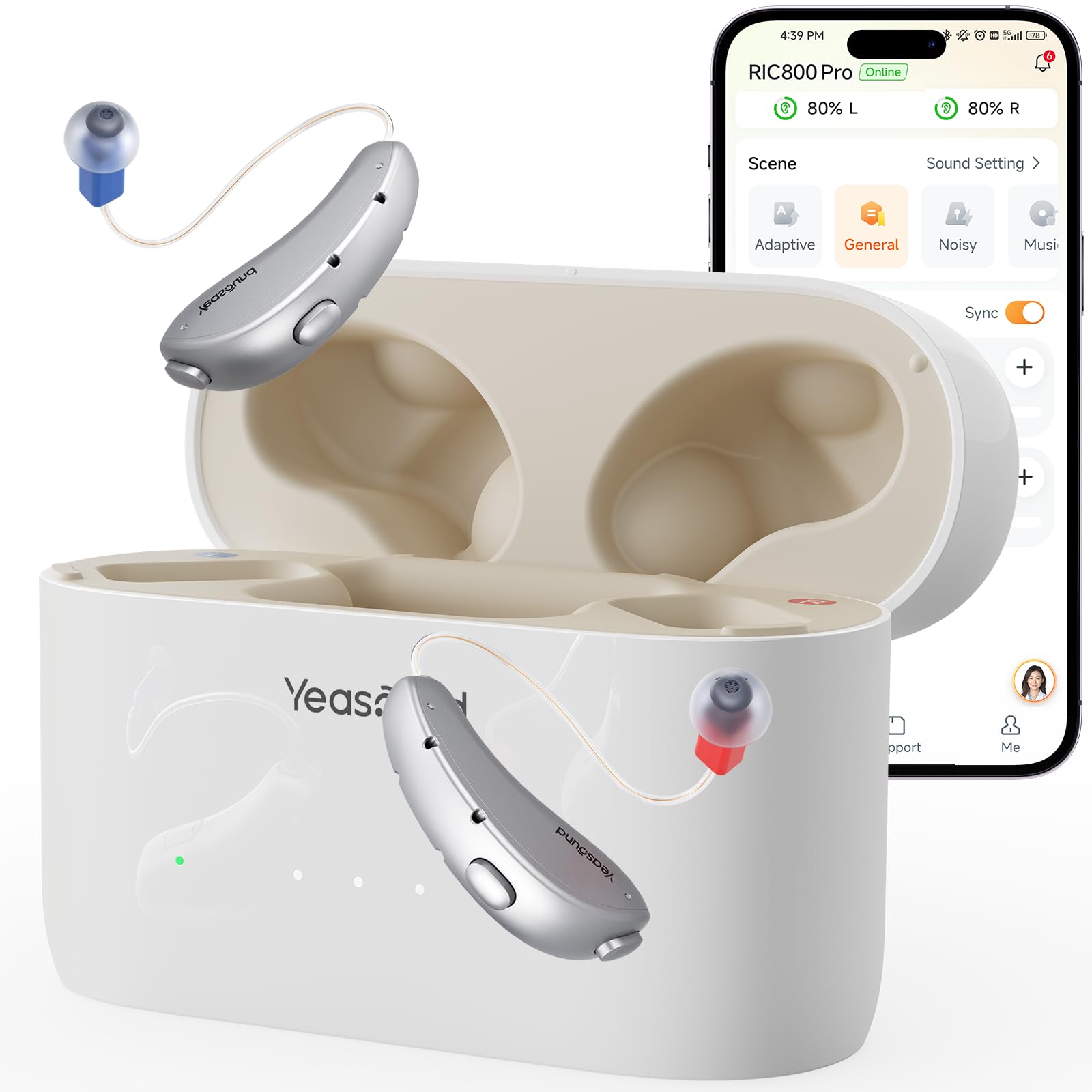
1. Yeasound RIC800 Hearing Aids
Our pick — 4.0+★ from 80+ verified ratings; the strongest balance of quality and price.
The one that pushes detail all the way up to 8000Hz and keeps the whistle out.
What makes the RIC800 an obvious fit for high-frequency loss is the audio ceiling. It reaches up to 8000Hz, the range where s, f, th and t sounds live, so speech stops sounding muffled and starts reading as distinct words. A processing speed of 5.3ms keeps conversation and TV audio in sync with the picture, which kills the lip-flap delay older users find so distracting.
The hardware side is just as practical. Each earpiece weighs 0.088 ounces and measures 1.23 inches long, so it hides behind the ear and you stop thinking about it. Wireless charging removes the fiddly contact pins that so often fail. You get up to 23 hours in hearing mode or 12 hours in Bluetooth streaming, and the portable case adds three more full charges for roughly 4–5 days of use away from an outlet.
Where it wins people over is plain effectiveness: the AI noise reduction genuinely cuts background chatter and screech so voices come forward. A buyer who cycled through a handful of prescription and over-the-counter aids says the sound is “clear sound,no feed back just clear sound,” and another household swapped out a far pricier professionally fitted pair because this one worked as well or better. Five specialist profiles (Adaptive, General, Noisy, Music, Outdoors) let you jump straight to the right sound for the room you are in.
Why it earns top spot
- 8000Hz frequency range directly targets lost consonant detail
- 5.3ms processing keeps TV and conversation in sync
- Wireless charging case, IPX8 waterproof, three extra full charges
- Five modes cover noisy rooms and outdoors without app fuss
Honest edges to know
- Streaming default volume can arrive hot and needs trimming
- Thin, deeply recessed ear canals may find the slim wire fussy to seat
Who it suits: anyone whose main complaint is consonants vanishing and who wants a discreet, self-fitting pair with strong noise handling.
One caveat: expect a short settling-in period and use the iPhone Hearing Devices menu for pairing rather than plain Bluetooth.
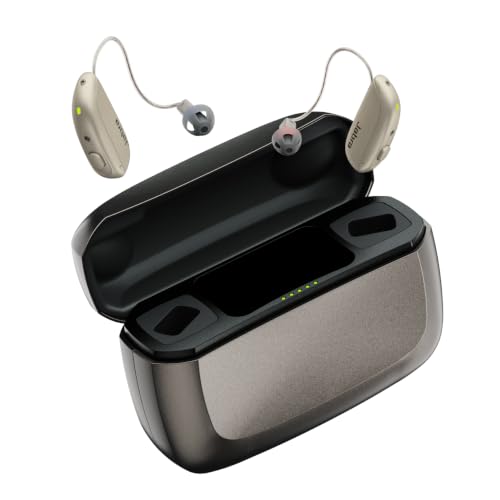
2. Jabra Enhance Select 700
Clinic-level fitting support in a receiver-in-ear shell about the size of a coffee bean.
The Select 700 is for the buyer who wants an audiologist in the loop without clinic overhead. It pairs licensed audiology support with SoundScape and Auto Focus, which adapt the sound in real time, so voices sharpen in busy rooms without you touching a dial. For high-frequency loss, the payoff is that the mids and treble are tuned against your own hearing test rather than a one-size preset.
The build is slim at 1.04 inches long and 0.3 inches wide, and it streams calls and media from Apple or Android devices, including Bluetooth LE Audio and Auracast. Tapcontrol lets you double-tap your ear to answer a call, exactly like earbuds. Comfort matters most over long days, and this sits in the “forget you’re wearing it” territory whether you’re in church, the car or a restaurant.
Owners praise the sound quality most, and it earns that: it beats a far pricier prescription setup in restaurants, cars and calls, with a companion able to hear “every word spoken” thanks to per-ear tuning. The recurring gripe is reliability — a small number of units fail and need warranty replacement, though support responds fast. The catch to weigh is music: this is a speech-first aid, and owners who want rich music are steered toward earbuds instead. Note that the top pick here holds a higher score than this one at fewer ratings, so consider the Jabra the support play, not the safest numerical bet.
Support over self-service: real audiologist programming plus hands-free call answering make this the choice for a first-time wearer who wants a professional in the loop.
Not a music machine: it’s tuned for speech, and streaming quality for music and calls is the area owners most often flag as weaker.
Reach for this if: you want remote audiology fitting, remote tuning changes and hands-free calls from an Apple or Android phone.
Look elsewhere if: your priority is music fidelity or Bluetooth audio off the phone for video and media.
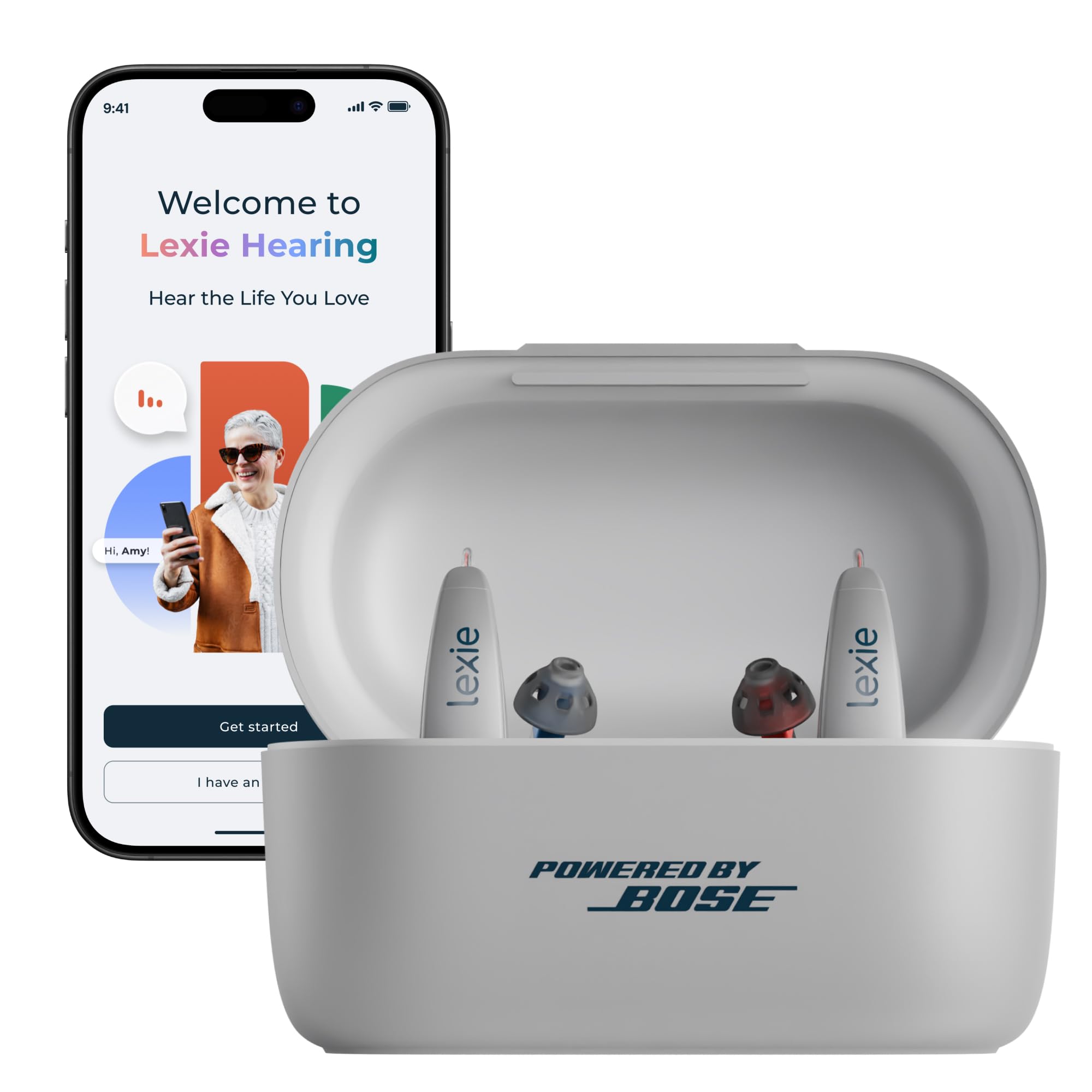
3. Lexie B2 Plus Powered by Bose
Bose audio algorithms plus self-fitting that lets you shape treble and bass to your own ears.
If you want to tune the treble yourself rather than accept a preset, the Lexie B2 Plus hands you the sliders. The free app runs a hearing test and lets you adjust Treble, Bass, World Volume, Balance and Directionality, then save from 4 Environment Programs up to 10 of your own. The amplifier itself is built on Powered by Bose algorithms, including Noise Management, Wind Noise Management, Impulse Noise Reduction and Feedback Management — the last of which matters most when you are lifting high frequencies.
For high-frequency loss specifically, the treble slider and the multiple dome sizes give you a real shot at a sealed fit, which is the single best defence against the whistle. Owners with tinnitus and high-frequency loss call this the cheapest and best pair they have owned after several pricier sets. They note the app-based test customises amplification the way a clinic would and that word clarity in streaming is good.
The honest trade-off is reliability over time. A few units developed swishy noises or intermittent muting after several months, and the app has wiped saved environments on occasion. Setup can also test your patience the first hour. Get past that and the sound and comfort hold up well, and the wireless charging case is small and sturdy. The smart move is to save a closed dome for significant loss, wear it in short stretches at first and confirm the aids seat fully in the charger.
What buyers like
- Treble and bass sliders plus up to 10 custom programs
- Bose noise and feedback management under the hood
- Multiple dome sizes for a tighter seal against whistling
- Light, discreet fit built for all-day comfort
What to weigh
- Some units lose reliability after half a year
- App setup and registration can be fussy the first time
Best for: self-fitters who want to shape the high-frequency response by hand and value the Bose name behind the processing.
One thing to know: plan a patient first-week setup and verify the aids seat correctly in the charger each time.
4. Wave OTC Hearing Aids (Cearvol)
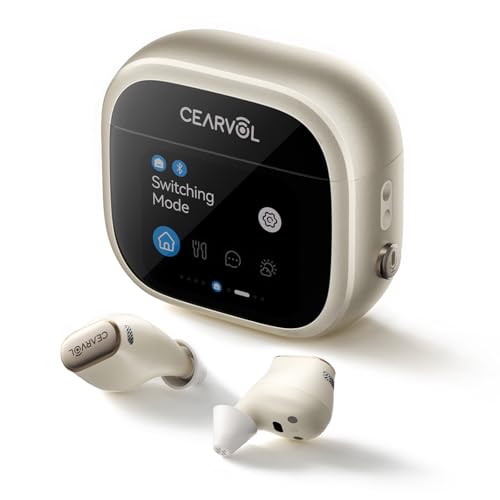
A hearing aid whose charging case doubles as a touchscreen remote and a TV microphone.
Wave’s standout is control that doesn’t depend on a phone. The charging case has a touchscreen where you adjust left and right volume independently, switch modes and take calls. Under the hood, NeuroFlow AI 2.0 uses deep neural networks to deliver 3ms ultra-low latency and 20dB noise reduction, with a claimed 24% clearer speech, a figure aimed at consonant detail.
Feedback control is a real priority here. AFC 2.0 cancels squeals and OVR 2.0 reduces the echo of your own voice. It also ships with single and double-layer ear tips in S through XL, and getting the fit right matters: owners are clear that you must twist the aid in for a proper seal or the whistle starts. Direct AUX-IN lets you cable the case to a TV or laptop for lag-free private audio, and there’s a remote-mic trick that turns the case into a mic for catching sound across a large room.
The design is more functional than invisible. One buyer calls them “a little clunky,” while praising the case control. The touchscreen can pick up fingerprints and the fit runs tight for some ears, and the older complaints centered on the app failing and support being hard to reach. Battery runs about 10 hours in indoor and conversation mode or around 6 hours in restaurant and outdoor mode, where it defaults to stronger noise reduction.
Control without the phone: the touchscreen case and AUX-IN make this a good pick for a TV-heavy household or someone who dislikes phone menus.
Fiddly to seat: getting a proper seal is essential and the screen marks easily, so make sure the tips and twist-in technique work for your ear.
Choose it if: you want big buttons and a screen instead of app menus, plus a way to pipe in TV audio without a phone.
Two things to check: the restaurant and outdoor mode drops to around 6 hours, and the fit needs a firm seal to stay silent.
5. ELEHEAR Beyond

More hearing time than any other pick here — up to 100 hours before you need an outlet.
The specification that defines the Beyond is power. Up to 20 hours on a single charge, then the case adds four more full cycles for up to 100 hours total. For someone who forgets to charge or travels a lot, that alone is a reason to shortlist it. VocClear AI technology delivers up to 50 dB maximum gain and 24 dB noise attenuation, and it’s built for the mild-to-moderate range where high-frequency loss usually sits.
The app carries serious features: per-ear volume, tone adjustment, AI translation, a serene sound relief option and telephone speech enhancement. Owners appreciate that the aids turn on and off automatically when you lift them out or place them back in the case, and that multiple dome sizes let you hunt down a seal.
What wins people over across that many buyers is how well it holds up as a daily driver — a couple of big life changes stand out. One family replaced phonak aids costing far more and found their hearing “twice improved,” while another user now catches background hums and fan noise they used to miss. The honest caveat sits in the treble: some find music sounds tinny or, in one account, underwater, and one wearer found restaurant noise a struggle. Battery life is generous, but a few wish for more on prolonged heavy use. Tinnitus relief is reported as a real benefit by some.
The case for it
- Up to 50 dB gain with 24 dB noise attenuation for speech lift
- Up to 100 hours total with four extra case cycles
- Auto on/off when you lift out or replace in the case
- Rich app with translation, tone adjustment and tinnitus help
The catch
- Music can sound tinny to some ears
- Noisy dining rooms are a struggle for a few wearers
Suits you when: battery anxiety is a worry and you want a wide app toolkit for a mild-to-moderate profile.
Not ideal for: music lovers or buyers whose main challenge is surviving a loud restaurant.
6. BlaidsX Neuro Hearing Aids
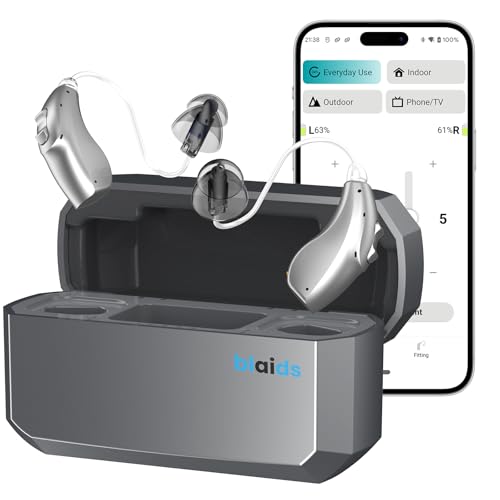
For the buyer who wants to pick an audiogram curve and stream it straight into their aids.
Blaids built the Neuro around frequency precision. You choose a matching audiogram across 250–8k Hz so the device fits your exact high-frequency profile instead of a generic preset. Behind that sit 32 DSP channels and a directional dual microphone setup with wind and transient noise management, plus feedback reduction. That combination is why this appears on a list about high-frequency loss at all — it lets you dial the treble curve to your own chart.
It’s built to survive real life too. The certified IP67 shell is sweat-proof, and the thin receiver measures 0.5mm, with the aid at 27mm tall. It streams audio for up to 12 hours on the ASHA protocol and lasts 12–20 hours on a single charge. A 2-year factory warranty and a loss-replacement plus free repair program round out the ownership picture.
What wins people over is how straightforward it is to live with: setup runs about 10 minutes, voices sound natural rather than tinny, and family members report the TV turned down twice. One buyer got complete resolution after an early unit quit — the company’s CEO stepped in and swapped the set. The honest caveat is that early hardware failures do appear in a small share of units, so keep the warranty close and test the batteries hard in the first weeks.
Fit to your curve: a 250–8k Hz audiogram selector and 32 DSP channels give unusually fine control over how much treble you get.
Test early: a small handful of buyers hit a dead or non-charging aid, so make the two-week mark your stress test.
Worth it for: a buyer who has an audiogram in hand and wants to match it closely while keeping long streaming sessions covered.
Look elsewhere when: you need the simplest possible setup, or can’t make time to verify the hardware in the first weeks.
7. Vivtone Xpure Bluetooth Hearing Aids

A receiver-in-canal aid that makes calls and music easy, for a mild-to-moderate profile.
Vivtone positions the Xpure for the person who wants an aid that doubles as a headset. The receiver-in-canal design minimises distortion and feedback, and the companion app or onboard buttons let you fine-tune volume and frequency to shape the gain to your own ear. Multiple preset modes cover quiet conversations, noisy restaurants and outdoors, so you can jump straight to the setting the room calls for.
Charging is quick, at 2.5 hours for both the aids and the case. The result is up to 24 hours in hearing mode or about 3 hours of Bluetooth streaming, and the case provides a week of standby power. It’s compatible with iOS 12 and Android 11.0 or newer, and it has real-human phone support if you hit a snag.
The honest picture is mixed. Some buyers love it for calls, apps, music and video with a modern phone, and support has come through with replacements when a mic failed. Others note a tinny edge, background white noise and short charge life on heavy days. The fit works for many but can be tight for larger ear canals, and it is underpowered for anything beyond mild-to-moderate loss. That sizing point is the main thing to weigh before you buy.
What stands out
- RIC build keeps feedback and distortion low
- Fast 2.5-hour charge and 24-hour hearing runtime
- Bluetooth calls and music with app tuning
- Real-human phone support for setup issues
Where it limits
- Mixed sound reports with some tinny notes
- Can run tight in larger ear canals and underpowered for more significant loss
Pick it for: a mild-to-moderate loss where calls and streaming matter as much as conversation.
Think twice if: your loss runs deeper, your ear canals run wide, or you stream for long stretches every day.
8. ELEHEAR Beyond Pro
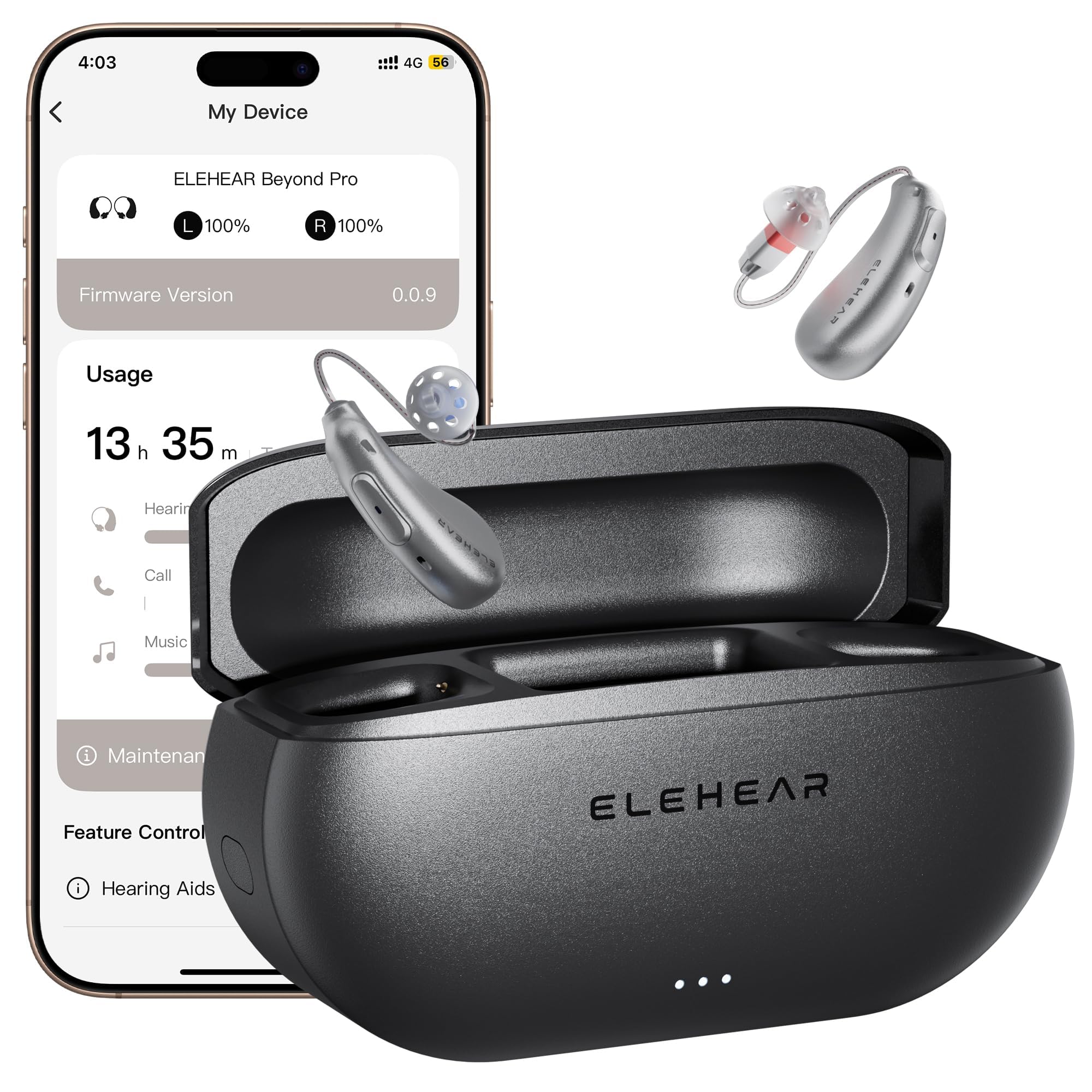
On paper the strongest high-frequency coverage here, with detail up to 8500Hz.
For high-frequency loss this is the headline number: VocClear 2.0 claims 30% clearer speech and high-frequency detail up to 8500Hz, with 8ms latency. That ceiling runs above the 8000Hz top of the RIC800, which means a little more of the upper harmonics in music and the sharpest consonant edges in speech. The result is the natural, un-muffled voice that treble loss steals.
It’s also built for real life. A 15-minute fast charge delivers up to 6 hours, and a full charge runs up to 20 hours, with the case adding four more cycles. The featherlight receiver-in-canal shape and multiple dome sizes help you find comfort, and the aids switch on and off automatically as you lift them out or put them back. The app adds 20 soundscapes and, unusually, real-time AI translation in 20 languages.
Owners praise it as a real alternative to prescription aids: one 72-year-old long-time wearer said the sound “rivals/bests prescription aids,” and another paired it against a far pricier single-ear prescription and called it better value. The trailing edge is in noise — a few find it weak in loud rooms and note feedback with coats. One unit failed after 7 months, so treat the warranty as part of the package. Overall the high-frequency detail is the reason to buy this over the standard Beyond.
Treble-first tuning: the 8500Hz ceiling and 8ms latency make this the pick for someone whose main frustration is hearing upper frequencies clearly again.
Fast top-ups: 15 minutes buys up to 6 hours, which suits an active day away from the charger.
Go for it if: you want the most extended high-frequency response here and a charge you can top up in minutes.
Weigh this first: noisy rooms and heavy coats can trigger feedback, so a sealed dome and careful fit matter.
9. Audien Ion Pro 2
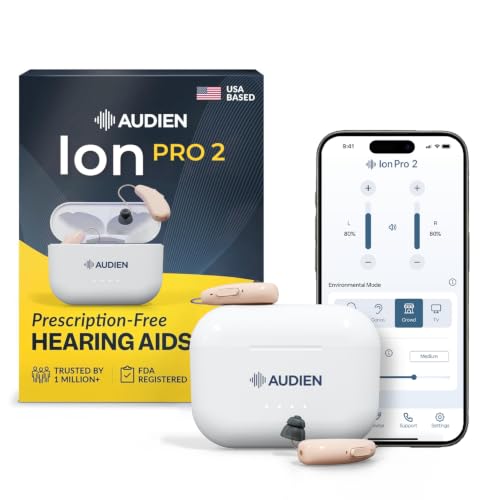
Two buttons, three modes and a case that sanitises while it charges.
If app menus frustrate you, the Ion Pro 2 is built to be handled. A simple two-button design lets you switch modes and adjust volume with a quick press, and you get 3 hearing modes with 6 custom profiles to fine-tune the fit. Developed with Grammy-winning sound engineers, it targets mild to moderate loss with more gain than in-canal aids.
Two features stand out. First, the charging case runs UV self-cleaning, which helps keep the sound path clear and the aids fresh. Second, battery is generous: up to 16 hours of hearing or 7+ hours of streaming on a single charge, and up to 48 hours total with the case. It streams calls, music and TV, and it’s compatible with iPhone 11 or newer and select Android devices on Android 13+.
Owners value how simple it is to get running: phone-synced in about 5 minutes, with the app reducing background noise well — the very thing that buries high-frequency detail. One long-time aid user since 1995 found it could not help conversations on any setting, so this is not the pick for significant loss. For the majority, though, the 3 background-noise settings do their job, and the price-to-simplicity balance is what they praise.
Where it shines
- Two-button control: no tiny dials or app-only menus
- UV self-cleaning charging case keeps aids hygienic
- Up to 16 hours per charge and 48 with the case
- 3 modes, 6 profiles and 3 background-noise levels
Where it may not fit
- One severe-loss user found it couldn’t cut through noise
- Not designed for profound loss — it’s aimed at mild to moderate
Best fit for: a buyer who wants big buttons, auto-cleaning and good noise control without learning an app.
Skip if: your loss is more than moderate, where a clinic-prescribed device is the safer route.
10. iBstone AuraLink Bluetooth Hearing Aids
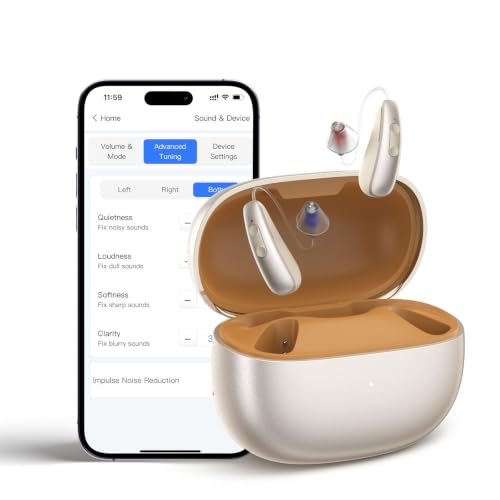
A rugged, app-tuned aid with the newest Bluetooth standard and a UV charging case.
The AuraLink leans on intelligence and durability. Adaptive AI continuously tailors the sound in real time to cut background noise and whistle, and it’s aimed at mild to moderate loss in the 25–85 dB HL range. The free AuraFit app runs a hearing check, delivers a precise fit and enables tinnitus masking, so you can shape the high-frequency response without a clinic visit.
Connectivity and toughness are its other strengths. Bluetooth 5.4 promises lower power draw and steadier links to iOS and Android, while IP68 sealing handles sweat, rain and dust, and the case adds UV sanitising. The lightweight receiver-in-canal shape sits behind the ear, with multiple dome shapes and sizes for a secure, comfortable fit.
For a newer model, the pattern is promising: clear sound, good background-noise reduction in crowds and app controls for fine-tuning come up often, and the compact case with comfortable fit is well received. The caveat is that a few with deeper loss found the sound too sharp or not enough of a backup, and one buyer had a hardware failure plus a slow replacement. Try the fit and the tone settings early, and this becomes a solid app-first choice.
Built for the day: IP68 protection plus a UV charging case make this a good fit for active users who worry about sweat and rain.
App does the work: the AuraFit app handles the hearing check, precise fitting and tinnitus masking in one place.
Try this when: you want app-first fitting, modern Bluetooth and a rugged build that shrugs off weather.
Think first if: your loss runs toward the severe end, where a clinic-grade device is a better match.
Know the Specs
Maximum Gain and Frequency Range
Gain is how much louder the aid can make a sound, measured in decibels (dB). Frequency range is the highest pitch it can reproduce, shown in hertz (Hz). For high-frequency loss, the Hz ceiling tells you whether the aid can bring back the crisp s and f sounds, while the dB gain tells you how much overall lift it offers. Match both to your audiogram so you aren’t over- or under-boosted.
Feedback Cancellation and Dome Fit
Feedback is the squeal that happens when amplified sound leaks out of your ear and re-enters the microphone. Feedback cancellation systems detect and dampen it. The dome — the soft tip that seals the ear canal — is just as important, since a loose or wrong-size dome lets sound escape. Many owners find a sealed, correctly sized dome stops the whistle as much as any software.
Runtime and Charging Case
Runtime is how long the aids run on a single charge, in hours, while the case adds extra full cycles. A model with longer runtime and a case that holds several charges means you charge less often. Look at the streaming runtime separately, since Bluetooth streaming drains faster than hearing mode.
Bluetooth and App Control
Bluetooth lets the aids stream calls and media and pair with the fitting app. A newer standard like Bluetooth 5.4 tends to use less power and hold a steadier link. The app matters for high-frequency loss because it lets you run a hearing test, adjust treble and volume per ear, and save profiles — so you can fine-tune the sound to your own ears.
Common Questions
Will an OTC hearing aid actually help high-frequency loss?
How do I stop the squealing whistle when I turn the treble up?
What frequency range do I need for clear speech?
Can I stream phone calls and music through these aids?
How long does the battery last on a single charge?
Do I need an app to fit these, or can I do it on the device?
Are these aids waterproof enough for daily wear?
Is a clinic-prescribed aid better than these over-the-counter models?
What if I have very large or narrow ear canals?
Can a hearing aid also help with tinnitus?
The Bottom Line
For most buyers chasing high-frequency loss, the win comes from a device that pushes treble detail up without letting feedback take over — and on that balance the Yeasound RIC800 is the one to start with. It reaches up to 8000Hz, adds five noise profiles and wireless charging, and it hides behind the ear at 0.088 ounces. If you would rather have an audiologist tuning remotely, the Jabra Enhance Select 700 brings licensed support and hands-free calls. And when the very top of the frequency range is your priority, the ELEHEAR Beyond Pro carries detail up to 8500Hz with a 15-minute top-up.
The honest verdict: a sealed dome and a matched audiogram beat any spec sheet. Buy the model whose dome sizes, app controls and feedback handling line up with your own ears, use the app’s hearing test to shape the treble, and give yourself a couple of weeks to adjust. Do that, and the s, f and th sounds return to speech.
How we choose
We do not accept paid placement. Every pick is matched to a real buyer and a real use-case; we do not hands-on test units.
Sources
Specifications: manufacturer listings and product documentation. Review insights: verified customer reviews, as of October 2026. Pricing: not shown on this page (it changes often); check the current price via the retailer link.
As an Amazon Associate, Aappliancez earns from qualifying purchases. This does not affect which products we feature.