Disclosure: Some links in this post are affiliate links. As an Amazon Associate I earn from qualifying purchases, at no extra cost to you. Learn more
Specs are compiled from manufacturer listings and verified buyer reviews and can change over time — please confirm the key details on the product page before buying.
If you want the healthiest butter, the short answer is ghee — butter that has been simmered until the water and milk solids are removed, leaving a pure golden fat that keeps on the shelf and takes high heat without burning. The pick that suits most kitchens is the Ancient Organics Ghee, a certified organic, grass-fed jar with a clean, lightly nutty flavor and a shelf life that stretches well past what a stick of butter manages. Below are five jars worth your money, each matched to a different kind of cook.
This guide is built by comparing the manufacturers’ published specifications and the patterns across verified customer reviews, so you get each pick’s real strengths and trade-offs instead of marketing spin.
Every jar here is grass-fed and clarified, so the real differences come down to milk source, smoke point, and how the fat behaves in your pan, and this guide covers the Healthiest Butter choices that hold up to daily cooking.
Top Picks
How To Choose The Healthiest Butter
Clarified butter is butter with the water and milk solids cooked off, which is why it survives on a pantry shelf and why it does not spit and blacken in a hot skillet the way a stick of butter does. That single change — removing the milk solids — is what makes ghee the practical answer for anyone frying, roasting, or browning at high heat. Here is what actually separates one jar from the next.
Check the smoke point before anything else
Smoke point is the temperature at which a fat begins to break down and throw off acrid smoke — and it is the number that decides whether a ghee is a frying fat or just a finishing fat. One jar here is rated to 485°F and another to 482°F, both comfortably above the heat you use for sautéing onions or searing meat. If you plan to deep-fry or roast at high oven temperatures, that figure matters more than any flavor note on the label.
Certifications and milk source tell you what is being claimed
Look for USDA Organic and a named certifier such as CCOF, because those are third-party checks rather than a brand’s own say-so. Grass-fed and pasture-raised claims are worth reading closely too — one jar here sources from both California’s Northern Coast and New Zealand, where the cows are described as having pasture access 24/7/365. That is a sourcing claim, not a flavor guarantee, so treat it as one input among several.
Match the jar size to how fast you cook
Ghee does not need refrigeration, but it does not last forever once opened, so buy a size you will actually finish. A 16-ounce jar suits a household cooking with it daily, while a 9-ounce jar is the smarter first buy if you are still deciding whether you like the taste. Several owners here mention going through a smaller jar in a matter of weeks before stepping up to the larger size.
Side-by-Side Comparison
| Model | Best For | Size | Certification | Milk Source | Amazon |
|---|---|---|---|---|---|
| Ancient Organics Ghee★ Best Overall | Everyday cooking and baking | 9 Ounce | USDA, CCOF, Kosher | Cow (grass-fed) | Amazon |
| The Ghee Co Grass Fed GheeBest Value | High-volume daily kitchens | 16 Ounce | Non-GMO | Cow (Grade AA butter) | Amazon |
| Mt. Capra Goat Milk Ghee | Cow-dairy-sensitive cooks | 10 Fluid Ounces | — | Goat (pasture-raised) | Amazon |
| Gold Nugget Traditional Ghee | High-heat searing and roasting | 16 Ounce | USDA, CCOF | Cow (grass-fed, full-year pasture) | Amazon |
| Pure Indian Foods Organic Grassfed Ghee | Everyday sautéing and coffee | 14 Ounce | Organic | Cow (pasture-raised) | Amazon |
Detailed Reviews
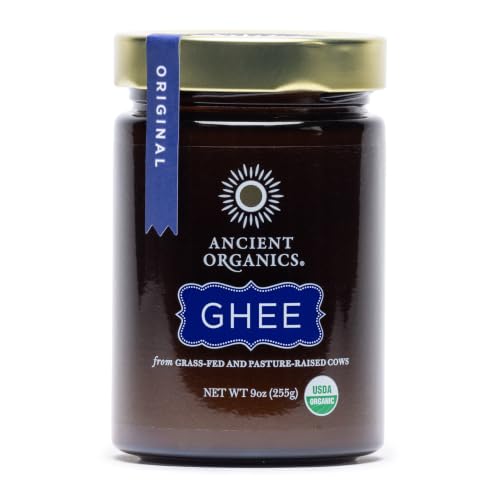
1. Ancient Organics Ghee — Organic Grass Fed Ghee Butter, 9 Oz
Our pick — over 4.5★ from 900+ verified ratings; the strongest balance of quality and price.
The certified-organic jar that made supermarket ghee feel pointless — and it disappears before it can turn.
This is the pick for the cook who wants one jar that handles everything: frying, baking, spreading, and finishing. Ancient Organics is USDA, CCOF, and Kosher certified, and it is made from grass-fed cows with very low trace amounts of lactose and casein, so people who react to regular butter often find this one sits easier. The ghee also brings in Omega 3 and Omega 9 fatty acids along with vitamins A, D, E, and K, and it is naturally high in CLA (conjugated linoleic acid, a fatty acid found in dairy fat).
The flavor is where it earns its keep. What wins people over is a taste that is pleasant and neutral rather than loud — somewhere in that soft, creamy middle, closer to mayonnaise than to a hard block of butter. That mildness is exactly why it disappears into a pan of scrambled eggs or a tray of baked goods without announcing itself. Buyers report going through it for cooking and baking alike and noticing no strange aftertaste at all, which is the whole point of a neutral cooking fat.
Here is the fairness check: this is the smallest jar on the list at 9 ounces, so a household frying daily will empty it fast. The counter-argument from the review pages is blunt and convincing: cheaper ghee gets thrown away once it turns rancid, and that waste erases the savings. One owner put it plainly: “After throwing away store bought ghee multiple times I decided to try this.”
Where it pulls ahead
- A neutral, lightly nutty flavor that slips into both sweet baking and savory frying without fighting the food.
- USDA, CCOF, and Kosher certified, with very low trace lactose and casein for sensitive eaters.
- Carries Omega 3, Omega 9, vitamins A, D, E, and K, plus naturally occurring CLA.
- Cosmetic packaging and a long expiry that keeps it fresh in the cupboard far longer than a butter stick.
What to weigh first
- The 9-ounce jar is the smallest here, so heavy cooks will restock often.
- It is the pricier end of the shelf, and plenty of shoppers hesitate on cost before re-buying.
Reach for this if: you want one certified-organic jar that cooks, bakes, and spreads without adding its own flavor to the dish.
Think twice if: you fry in volume most nights — the 9-ounce size will run dry well before the larger 16-ounce jars on this list.
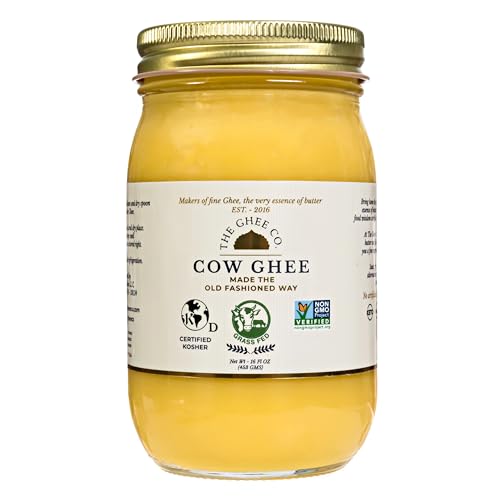
2. The Ghee Co Grass Fed Ghee, 16 oz Glass Jar
Sixteen ounces of Grade AA butter in a glass jar — the everyday jar for a cast iron pan.
For a big household that goes through ghee constantly, this is the volume play. It is made from USDA Grade AA butter and certified Non-GMO, and it arrives in a glass jar rather than plastic — a detail owners raise again and again, partly for the quality and partly because they would rather not store their cooking fat in plastic. At 16 ounces it is also the lightest jar here at 1 pound, and noticeably smaller than the Gold Nugget 16-ouncer, which weighs 1.6 pounds in its packaging.
The quality is the headline. What buyers praise most is how the fat performs — it melts readily and spreads easily, whether you are slicking a pan for mushrooms and onions or whipping it into garlic olive oil. It is described as spreadable straight from the jar and as a fine base for sautéed rice, proteins, and vegetables. Long-term users lean on it hard: owners mention ten years of steady use since going keto, and one repeats that it keeps cast iron seasoned with less product per serving than expected.
The catch is honest and specific — the aroma splits buyers. Some call it amazing; a few say it fills the house when it hits a hot pan. There is also a consistency question, because arriving separated and grainy is a complaint that shows up. Letting the jar sit at room temperature and stirring it back together usually settles that, but it is worth knowing before you open it. Unlike the Ancient Organics jar above, there is no USDA Organic or CCOF certification here — the claim is Non-GMO and Grade AA butter, not organic.
The value argument: a full 16 ounces at the friendlier end of the shelf, in glass, from Grade AA butter — and the review pages back the taste rather than just the size. Owners describe it as the best-tasting ghee they have tried, with a spreadable texture that doubles as a straight-from-the-jar butter substitute.
The one honest trade: that punchy aroma is a coin flip. If a strong buttery smell drifting through the kitchen bothers you, this may not be your jar — the milder Ancient Organics is the calmer choice.
My read: the jar to buy if you cook with ghee every single day and want the most ounces for the least fuss, in a material you are happy to keep on the counter.
Skip the upgrade: you do not need certification paperwork to fry an egg — if Non-GMO and Grade AA butter is enough for you, this delivers without the organic premium.
3. Mt. Capra Goat Milk Ghee, Pasture Raised and Unsalted
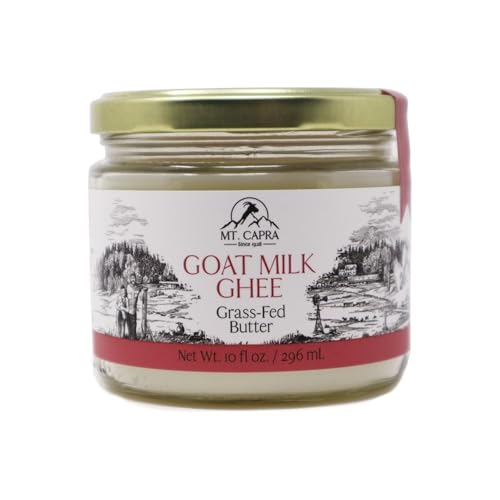
The jar for anyone who gave up on cow butter — goat milk instead, and a white color that surprises first-timers.
If cow dairy is the problem, this is the jar to try. It is made from goat milk rather than cow milk, pasture-raised and unsalted, from a family-run farm in the Pacific Northwest. Goat milk fat is often described as gentler on digestion than cow fat, and this ghee is pitched as a low-allergy alternative to cow or soy. It carries 59 servings, weighs 10 ounces, and measures 1.8 x 5.5 x 2 inches — compact enough to tuck on a narrow shelf, and the lightest jar here next to the Ancient Organics 8.96-ounce package.
Expect it to look different. Goat milk ghee is white rather than the deep gold of cow ghee, which throws people off until they taste it. Customers note finding it mildly scented and smoothly spreadable, with the creaminess doing the work in soups and on popcorn, and no goat tang behind it. What wins people over is the texture and the surprisingly clean flavor — the kind of thing that converts a skeptic who was braced for something barnyard. As one enthusiastic buyer put it, family members with a cow dairy sensitivity have no reaction to this one.
The practical limit is size. This is a 10-fluid-ounce jar, and the recurring gripe in the reviews is that it is the largest available — nothing bigger exists yet on this product line. If you fall for it, you will be reordering more often than you would like. The value question also splits, with some finding the smaller jar harder to justify against bigger cow-ghee tubs. And note this is a cooking fat for sautéing, baking, and stirring into coffee, not a spread meant to taste like salted table butter.
What makes it different
- Goat milk base, pasture-raised and unsalted, from a family-run Pacific Northwest farm.
- A 485°F smoke point — high enough for sautéing, baking, and frying without burning.
- Shelf-stable and needs no refrigeration, so it lives happily in a cupboard.
- Smooth, creamy texture that buyers describe as mild rather than goaty.
The honest limits
- It pours white, not gold — first-time buyers frequently expect the wrong color.
- The 10-fluid-ounce jar is described as the biggest size currently made, so heavy users restock often.
Pick this if: cow dairy has been a problem for you or someone in the house and you have been cooking with seed oils instead.
Look elsewhere if: you want a bulk jar to fry with all month — the Gold Nugget 16-ouncer gives you far more fat per reorder.
4. Gold Nugget Traditional Ghee, USDA Organic 16oz

A 482°F smoke point and a color people photograph — the searing jar for cooks who push their pans.
Gold Nugget is the pick for the cook who treats ghee as a tool, not a toast topping. The smoke point sits at 482°F, which is right at the top of this lineup and high enough to sear and roast without the fat turning bitter. It is USDA Organic and certified organic by CCOF, full-year pasture-raised and grass-fed, clarified and spreadable, and it brings vitamin A, D, K2, and Omega 3s to the jar. It is also keto and paleo friendly, and at 16 ounces / 1.6 pounds it is the heaviest, largest jar here — bigger than the 9-ounce Ancient Organics and heavier than the 16-ounce Ghee Co’s 1 pound.
The texture and flavor are what keep people loyal. It reads as silky and velvety, full-flavored and fresh but not greasy or grainy — and notably it avoids a strong nutty taste, the kind you get when milk solids have been over-fried during clarifying. Cooks here use it for sautéing vegetables and eggs, for eating straight off a spoon, and even, in one case, for coffee until the flavor won them over for vegetables and spreads instead.
Two practical notes from the review pages worth taking seriously. First, store it somewhere semi-cool and keep it away from the stove — heat near a burner will melt it down. Second, the aroma divides opinion, with some loving the scent and others finding it a touch strong when it hits a hot pan. At 1.6 pounds in a 7.95 x 4.33 x 4.29 inch package, it also takes more shelf or cupboard room than the small jars, so plan the spot before it arrives.
Why cooks commit to it: multiple buyers describe switching from making their own ghee out of grass-fed unsalted butter to buying this one instead — and a handful claim the flavor rivals the best artisan butters they have had anywhere in the world. That is high praise for a cooking fat.
Where it asks patience: the aroma is polarizing and the jar is genuinely large, so you need a cool, dark spot that can take a 1.6-pound tub out of the rotation.
Best for: searing, roasting, and serious stovetop cooking where a 482°F smoke point is doing real work.
Not your jar if: you want a small starter size or prefer a faint-smelling fat — the 9-ounce Ancient Organics is both smaller and milder.
5. Pure Indian Foods Organic Grassfed Ghee, 14 oz
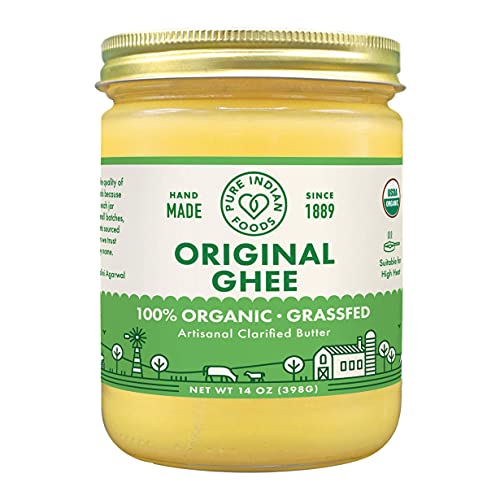
Slow-cooked in small batches the traditional way — the jar for people who want clean fat without shortcuts.
Pure Indian Foods is for the buyer who reads the ingredient list first and wants nothing on it but butterfat. The ghee is 100% grassfed and organic, sourced from pasture-raised cows, and slowly cooked to remove the milk solids — which is why it works for keto, paleo, Whole30, and dairy-sensitive diets. It is made in small batches using traditional Ayurvedic preparation, and it carries a high smoke point suited to sautéing, frying, and roasting without burning. At 14 ounces it sits between the 9-ounce and 16-ounce jars here, and its 1.5-pound package is a little lighter than the Gold Nugget’s 1.6 pounds.
The report from the kitchen is consistent: it is delicious, it is versatile, and it earns its place in coffee, baking, bulletproof drinks, and everyday pan work alike. What buyers praise most is the taste — rich and clean, doing its job in a hot skillet without falling apart, and one owner specifically singles it out for cooking meat at high temperatures. It is shelf-stable and long-lasting, so there is no rush to finish the jar before it turns. The ingredient list being short and simple is repeatedly the reason people stay with it.
The honest wrinkle is aroma, and it is the most-split point in the reviews. Some call the scent wonderful; others find it stronger than they expected, especially in a confined kitchen. Consistency also draws mixed notes — a few jars apparently behave differently from the last. If you tend to be sensitive to a strong buttery smell while cooking, that is the thing to weigh before committing to a larger jar.
What buyers keep coming back for: the uncomplicated ingredient list and the fact that it holds up under high heat, whether you are searing meat, roasting vegetables, or stirring a spoonful into a morning coffee for extra richness.
The honest trade: that strong scent is divisive and jar-to-jar consistency is not perfect. A smaller 9-ounce start is the careful move if strong cooking aromas bother you — though this 14-ouncer is the better value per ounce if they do not.
Reach for this if: you want grassfed, organic, slow-cooked ghee with a short ingredient list and a smoke point that handles high-heat meat cooking.
Look elsewhere if: a bold buttery aroma puts you off, or you need the bulk of a 16-ounce jar — the Gold Nugget or Ghee Co sizes suit heavy households better.
Know the Specs
Smoke point
The smoke point is the temperature at which a fat starts to break down and smoke, and it decides what you can safely cook in it. A ghee rated to 485°F or 482°F — like two on this list — can take a searing pan or a high oven without burning. A fat below that threshold will turn acrid and bitter before the food is done, which is why ghee beats butter for high-heat work: butter browns and burns long before ghee does.
Certifications and milk source
USDA Organic means a third party has verified the farming and processing practices behind the product, and a named certifier like CCOF adds a specific stamp to look for on the label. Grass-fed and pasture-raised describe what the cows ate; one jar here sources from California’s Northern Coast and New Zealand, with cows described as having pasture access 24/7/365. Treat all of these as sourcing claims rather than flavor promises, and match them to what matters to you.
Milk source: cow versus goat
Most ghee comes from cow milk, but goat milk ghee is made from goat milk fat instead. Goat milk fat is described as gentler on digestion than cow fat, which is why one jar here targets buyers seeking a low-allergy alternative. The goat version also pours white rather than gold, and it performs the same way in cooking — sautéing, baking, frying — despite the color difference.
Jar size and shelf stability
Ghee lasts on the shelf because the water and milk solids are cooked off, which is what removes the usual rancidity risk of butter. Size still matters, though, because once you open a jar you are working against its freshness every time you cook. A 9-ounce jar suits a first-time buyer still deciding on the taste, while a 16-ounce jar makes more sense for a household frying daily — most owners land on the larger size after going through a small jar quickly.
Common Questions
Is ghee actually healthier than regular butter?
What smoke point should I look for in ghee for frying?
Does grass-fed ghee need to be refrigerated after opening?
Can I use ghee if I’m sensitive to dairy?
How long does a jar of ghee last once opened?
Why does goat milk ghee look white instead of gold?
Is grass-fed ghee better than non-grass-fed for cooking?
What does certified organic mean on a ghee label?
Can I use ghee in coffee and baking as well as frying?
Is it worth paying more for a smaller jar of ghee?
The Bottom Line
For most cooks, the healthiest butter winner is the Ancient Organics Ghee because it carries USDA, CCOF, and Kosher certification, stays mild enough to disappear into baking and savory cooking alike, and keeps remarkably well on the shelf. If you want the most ounces for the least fuss, grab the The Ghee Co Grass Fed Ghee — 16 ounces in a glass jar from Grade AA butter. And for anyone who has trouble with cow dairy, the Mt. Capra Goat Milk Ghee is the one to reach for.
The one nudge worth making: the Ancient Organics jar holds the strongest certified-organic case here, and the review pages back it — one buyer sums up the whole argument with “the quality and flavor are fantastic.” If you have thrown away supermarket ghee before, that is the jar to try next.
How we choose
We do not accept paid placement. Every pick is matched to a real buyer and a real use-case; we do not hands-on test units.
Sources
Specifications: manufacturer listings and product documentation. Review insights: verified customer reviews, as of October 2026. Pricing: not shown on this page (it changes often); check the current price via the retailer link.
As an Amazon Associate, Aappliancez earns from qualifying purchases. This does not affect which products we feature.