Disclosure: Some links in this post are affiliate links. As an Amazon Associate I earn from qualifying purchases, at no extra cost to you. Learn more
Specs are compiled from manufacturer listings and verified buyer reviews and can change over time — please confirm the key details on the product page before buying.
You’ve got a working old television and a streaming stick, but the TV only has a coax screw terminal on the back, so there’s no port to plug the stick into. The fix is a small box called an HDMI digital RF modulator: it takes the HDMI signal from a Roku, Fire Stick, game console, or Blu-ray player and turns it into an old-fashioned analog TV channel your set can actually tune. Most buyers should start with the kurtmark HDMI to RF Modulator for TV: it ships with the HDMI cable and power adapter, and its CH3/CH4 switch lets you dodge a local station. Everything below is sorted by what each box actually does, so you can match one to your specific set instead of guessing.
This guide is built by comparing the manufacturers’ published specifications and the patterns across verified customer reviews, so you get each pick’s real strengths and trade-offs instead of marketing spin.
One fact trips up most first-timers: an HDMI digital RF modulator only converts HDMI in to coax out, never the reverse. That single fact decides whether a given unit will work on your setup at all.
Top Picks
How To Choose The Best HDMI Digital RF Modulator
Three things decide whether a modulator works in your living room: which way the signal travels, which analog TV format your set can tune, and how many source types you need to feed in. Get those right and the rest is convenience: included cables, remote control, channel flexibility. Get them wrong and the box sits in a drawer no matter how well it is built.
Check the direction first, honestly
Every unit here converts HDMI into a coax TV channel. None of them do the opposite. If your goal is to take a coax signal and put it onto a modern HDMI television, this is the wrong category of product entirely, and each listing says so plainly. Read that line first, because a reverse-direction mismatch is the most common reason a modulator gets sent back.
Match the output format to your television
These modulators output an analog signal — NTSC (the old US analog TV format) in the North American models, with some supporting PAL (the European analog format) as well. An older CRT or a set with an analog tuner will lock onto that signal fine. A newer television that only tunes digital ATSC channels (the format that replaced NTSC) may not see it at all through its antenna input. Check your TV’s own tuner spec before ordering, because no modulator can add a tuner your television does not have.
Decide how many sources you need to plug in
A single HDMI input covers a streaming stick or one console. If you also want to connect a DVD player, a VCR, or a cable box through composite RCA jacks (the yellow/white/red connectors), you need a model with both HDMI and RCA inputs. That dual-input flexibility costs a little more, but it saves swapping cables every time you switch sources.
Side-by-Side Comparison
| Model | Best For | Input Type | Output Channels | Included Cables | Amazon |
|---|---|---|---|---|---|
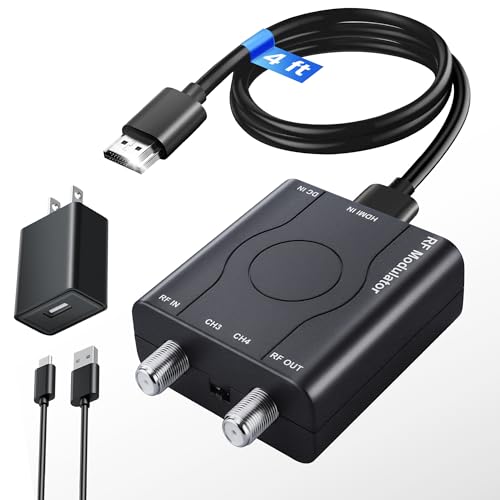
| kurtmark HDMI to RF Modulator for TV★ Best Overall | Plug-and-play HDMI to an older set | HDMI | CH3 / CH4 (NTSC) | 1.2M HDMI cable + power adapter | Amazon |
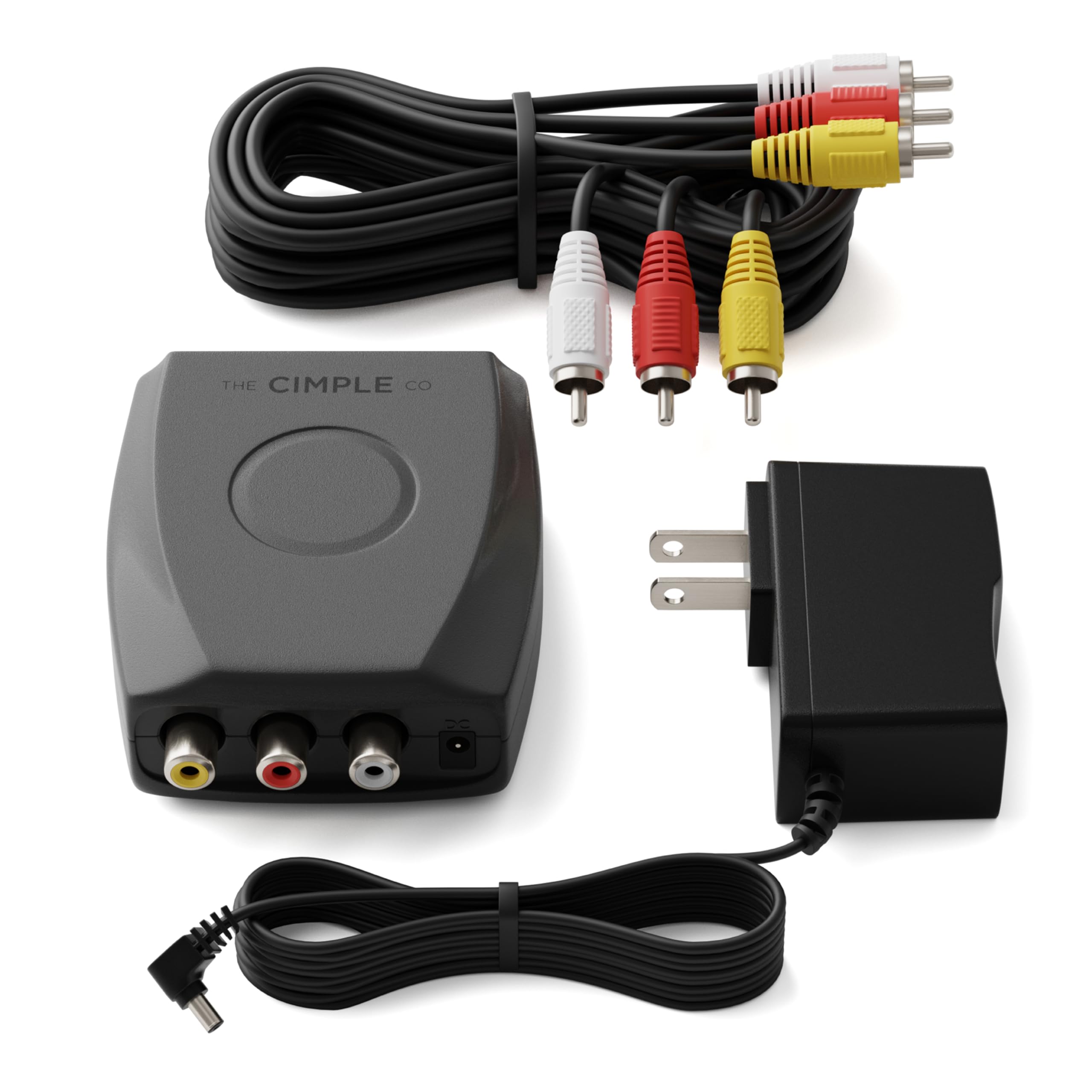
| THE CIMPLE CO RF Modulator for TVBest for CATV | Composite RCA gear on a coax-only CRT | RCA composite | CH3 / CH4 (NTSC) | RCA/composite A/V cable + power supply | Amazon |
| AoeSpy HDMI RF Modulator Coax Converter | Adjusting picture size and image settings | HDMI | CH3 output | Male F-type cord | Amazon |
| AoeSpy HDMI RF Modulator VHF UHF AV to Coaxial Converter | Full-band channel tuning across VHF and UHF | HDMI + RCA | VHF / UHF, up to 136 channels | Not listed | Amazon |
| FOSA HDMI to RF Modulator HDM61 | Straight HDMI-to-coax conversion, nothing extra | HDMI | CH3 / CH4 (NTSC) | Power supply cable | Amazon |
| Tangxi HDMI Modulator RF Modulator | PAL or NTSC sets with HDMI and AV sources | HDMI + AV | VHF / UHF, optional output channel | Not listed | Amazon |
| Bewinner HDMI RF Modulator Adapter | CATV and CCTV setups needing HDCP 1.4 | HDMI, RF in/out | CH3 / CH4 (NTSC) | Not listed | Amazon |
Detailed Reviews
1. HDMI to RF Modulator
Our pick — over 4★ from 250+ verified ratings; the strongest balance of quality and price.
The box that turns one HDMI port into a channel your 1989 CRT can already tune.
This kurtmark box earns the top spot because it arrives complete: a 1.2M HDMI cable, a power supply adapter, and a power supply cable all sit in the box, so there is no second order to place before you can watch anything. It accepts HDMI input at up to 1080P and pushes out an analog NTSC signal (the old US broadcast format) on channel 3 at 61.25MHz or channel 4 at 67.25MHz — so your set tunes it exactly like a broadcast station. Plug a Fire TV Stick, PS5, Xbox, Nintendo Switch, Apple TV, or Blu-ray player into a television with nothing but a coax screw terminal on the back. Nothing here needs a driver or an app — the listing describes it as plug and play, and buyers report setup around five minutes from unboxing to picture.
A built-in PLL control circuit (a chip that keeps the output frequency locked) holds the VHF frequency steady, and output runs at a rated 80 ± 5 dBµV with the standard NTSC M audio system at 4.5MHz — which in practice means the picture stays stable instead of drifting. Owners mention pairing it with old VHF-only sets, including one who picked up an original 1989 Sharp CRT, and saying the picture looks better than they expected from an analog channel. The ABS plastic housing is compact and sturdily built, doing its job without adding bulk.
One behavior is worth planning around, and it comes straight from the review pages: “Works but every week or two it stops working until I unplug the power for a minute.” What solved it for that owner was moving the modulator onto a switched outlet on the receiver, so it powers down each night with the rest of the rack. If your setup has no switched outlet handy, expect to reach behind the TV for a quick power cycle now and then. It is a minor rhythm to learn, not a reason to look elsewhere.
Where It Earns Its Place
- Everything needed to start watching arrives in one box — 1.2M HDMI cable, power adapter, and power cable
- CH3 at 61.25MHz and CH4 at 67.25MHz give you two spots to dodge a local station
- Handles 1080P, 1080i, 720P, 576P, and 480P HDMI input, so streaming sticks and modern consoles both feed it fine
- PLL control keeps the VHF frequency locked in for a stable picture
What To Plan Around
- An occasional power cycle is the usual fix if the picture drops out mid-week
- Not compatible with Mac Mini or laptops, per the manufacturer’s own list
- Output is analog NTSC only — a digital-only tuner will not see it
Reach for this if: you have a streaming stick or console and a coax-only television, and you want the shortest possible path from unboxing to a working channel.
Then look at the CIMPLE CO instead if: your sources are composite RCA devices like a VCR or a retro console, since this unit takes HDMI in only.
2. THE CIMPLE CO RF Modulator
For the VCR, the DVD player, and the Super Nintendo — not the streaming stick.
This converter takes composite RCA video and audio (the yellow/white/red plugs) and turns them into a channel 3 or channel 4 signal — and it does not accept HDMI at all. That is exactly why it holds a place on this list: it handles the whole shelf of older gear, including VCRs, Blu-ray and DVD players, satellite and cable boxes, camcorders, and retro game consoles, with one box and the included RCA A/V cable. The manufacturer is also explicit that it will not work in reverse.
Setup is as simple as the category gets: plug in the RCA leads, slide the switch to your chosen channel, run coax from the modulator to the TV, and connect power. Buyers consistently describe it as shockingly simple, and note that the picture from a CRT lacking RCA ports is nearly indistinguishable from a direct connection after a short round of color tweaking on the television itself. It switches between CH3 and CH4, so you can sidestep a local station the FOSA’s single channel cannot. The housing is compact and light at 6.72 ounces, and it carries a 10-year warranty, the longest in this lineup.
Two honest constraints come with it. Picture quality is genuinely a mixed bag in owner reports — some get a clean image, others find it soft, and a CRT-only buyer who returned it described the result as the worst fuzziness they had seen. Those complaints tend to trace back to signal conditions on a particular set rather than a defect, but it is a real variable. More important: check your TV’s tuner. This outputs analog NTSC, and one reviewer warned plainly that newer sets with antenna ports may support only digital ATSC, in which case nothing here will appear on screen. Test your television before you commit.
Why older gear owners keep it: composite RCA in, coax out, a channel switch, and a 10-year warranty — the most straightforward conversion path for a VCR or retro console feeding a CRT.
The honest catch: image quality varies from set to set, and it is useless on a digital-only tuner.
Best matched to: anyone with a coax-only CRT and a stack of RCA devices to connect.
Wrong turn if: your source is an HDMI streaming stick — buy the kurtmark above instead.
3. HDMI RF Modulator Coax Converter

The one you can actually fine-tune from the couch, remote in hand.
Its remote control is the reason it beats every other box here on adjustability: it shifts zoom, amplitude, brightness, contrast, and chroma (color intensity), plus moves the output screen up and down. That matters if your source material is widescreen and your television is a 4:3 CRT — owners converting retro consoles report it handles the 16:9 to 4:3 squeeze, and the on-screen zoom and crop controls work as advertised.
The unit converts HDMI from PS4, PS5, Xbox, Nintendo Switch, VCR, DVD, Roku, Fire Stick, cable boxes, laptops, and PCs into analog RF for older televisions, and it can also act as a long-distance HDMI extender across rooms. Signal strength is one of its genuine strengths — retro console users note a strong RF signal with no latency and no tearing, which is not something every converter in this class manages. It outputs PAL-BG, PAL-I, PAL-DK, and NTSC-M (two families of analog TV formats), so confirm your television supports one of those four before ordering. It is HDMI-in only, and the manufacturer states clearly it will not convert RF back to HDMI.
Two quirks to weigh. First, picture settings do not survive a power cycle, so tweaks need redoing after the box loses power. Second, and more significant, the remote is the weak link: one owner put it bluntly — “Never buy the product the box is good but the remote that has all the controls always breaks and make the box less useful.” Treat the remote gently and it should hold up, but this is the most control-heavy design in the lineup and the most dependent on its handset. The zoom is also reported as not quite sufficient for full overscan on some sets. Accept those two limits and the picture control here is class-leading.
The picture-control case: remote-driven zoom, brightness, contrast, and chroma adjustments make it the most tunable option for getting a watchable image out of old hardware.
Handle with care: settings reset on power loss, and the remote itself is the part most likely to give you trouble.
Choose this when: you want granular control over how the picture lands on an older screen and you do not mind re-dialing it in occasionally.
Choose differently if: you want a set-and-forget box with a physical channel switch and no handset to lose.
4. HDMI RF Modulator VHF UHF AV to Coaxial Converter
136 channels of tuning range, a digital display, and a channel switch — plus a learning curve.
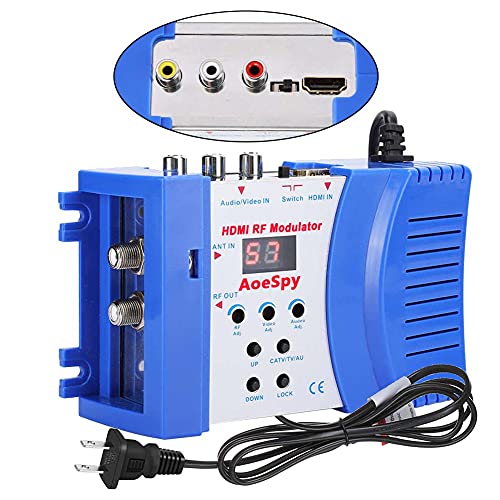
Where the kurtmark box gives you only CH3 and CH4, this one lets you park the output almost anywhere on the dial: it tunes across VHF and UHF with up to 136 channels full band. Start with the flexibility: this box takes both HDMI and composite RCA CVBS input (CVBS is the raw analog video signal), supports NTSC and PAL, and shows the channel on a digital display with a selectable switch. An F-type female coax input lets you feed in a cable box or HD tuner while a separate RF output sends the signal to your TV or a splitter for other rooms. Audio volume and video brightness are both adjustable.
Owners who get it dialed in tend to stay happy: one long-term user reports two or more years of service with a clear picture running straight to the TV, and another notes the output can be set to any channel, not just 2 or 3, with other channels passing through cleanly via the RF input. The catch is the setup process. Documentation is described as obtuse or unclear across multiple accounts, and the open up sequence for channel selection — hold the lock button, pick a channel group, set the channel, relock — is not intuitive. One buyer also notes the box lacks the output power to feed several televisions at once and needed a 24db distribution amplifier to cover more than one set. Budget for a patient first evening, and consider that amplifier if you plan to run several rooms.
Another honest note: some customers note channel mapping running out of order, with a setting labeled for one channel showing up two or three positions off. All the frequencies work, they simply are not where the labels suggest. This is the most capable tuner here for someone willing to learn it, and the most frustrating for someone who wants a single switch and nothing more.
Why It Stands Out
- Up to 136 channels across VHF and UHF, plus a digital channel display
- Both HDMI and RCA CVBS input, NTSC and PAL format support
- Adjustable audio volume and video brightness on the box itself
- F-type female coax input passes other channels through while it modulates
What You Are Signing Up For
- Instructions are unclear enough that several owners struggled with first setup
- Channel labels and actual frequencies can run out of order
- Output power is limited — multi-TV setups may need a distribution amplifier
The right call for: a hobbyist who wants to choose their own output channel and will read the manual twice.
Not the right call for: a plug-and-play buyer who just wants channel 3 to work tonight.
5. FOSA HDMI to RF Modulator, HDMI Coaxial Converter, HDM61

A no-frills single-channel converter that works the moment you connect it.
The HDM61 does one job: HDMI in, analog channel out. It supports NTSC output at channel 3 (61.25MHz) and channel 4 (67.25MHz), uses 1080P PLL control (a circuit that holds the frequency steady) on a VHF working frequency, and supports HDMI 1.4 and HDCP 1.4 (HDCP is the copy-protection handshake that lets protected content play). The housing is ABS plastic, the package includes a power supply cable and instruction manual, and there is no driver to install. When it works, it works immediately — reviewers point out it converting from HDMI to RF with no setup at all, just cables connected and the modulator doing the rest.
That said, it outputs on one channel only, while the kurtmark above gives you CH3 and CH4. If a local broadcast station sits on channel 3 in your area, you have less room to dodge it here. On the flip side, the frequency response is listed at 61,250,000Hz and the maximum sample rate at 192KHz, and it works with Windows and macOS source machines alongside Blu-ray players and game consoles.
Reliability is the genuine question mark. A portion of owner feedback describes units that arrived defective or produced no video signal, while a separate complaint describes buzzing in the coax connection when the signal is split rather than run straight — one buyer found it “Only works if connected to coax alone. Will not work when split with HDMI connection.” It is a low-volume product with a small review history, so treat the straight-cable, single-TV use case as the safe path. On a clean, direct connection it does its single job well and at a simple price.
Where it wins: a single-purpose HDMI-to-NTSC conversion with HDCP 1.4 and HDMI 1.4 support, ready to use with no driver.
Where it is limited: one channel only, and reports of defective units mean testing on arrival matters.
Pick this for: a direct one-cable run from a game console or Blu-ray player to a single older TV.
Pass on it if: you plan to split the signal across multiple sets, or you want a choice of output channels.
6. Tangxi HDMI Modulator RF Modulator for PAL NTSC Format
Dual-format output that speaks both PAL and NTSC, with an optional channel dial.
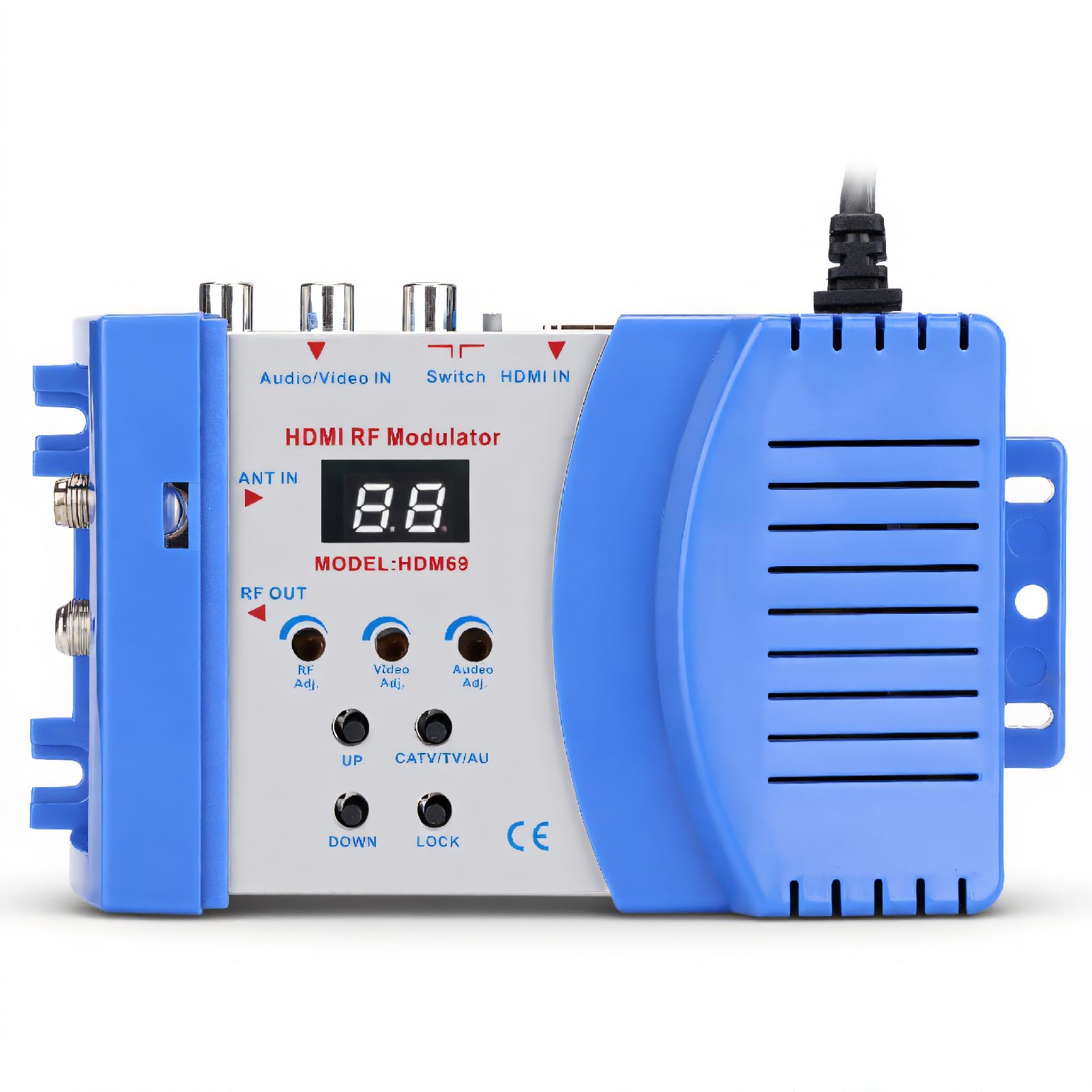
This is the only modulator in this lineup that lists PAL and NTSC output side by side, which makes it the first place to look if you are working with a European or otherwise PAL-format television. The HDM69L model supports VHF and UHF dual working frequency (both channel bands), takes HDMI and AV input, and accepts a 90 to 240 volt plug range — useful if the set it feeds lives outside North America. Resolution support covers 1080P, 1080i, 720P, 576P, 576i, and 480p, and the AV output level is adjustable.
The build uses ABS and metal materials, and the F-type connector seats securely according to owners. Retro-focused buyers describe it as a good gift for the vintage-console crowd, and one long-term note worth knowing: settings are retained after a power outage, which is not universal in this category. The housing is small and light, and the listing notes the unit does not require a driver.
The honest story here is instructions. Multiple owners say the unit is not truly plug-and-play and the manual could be clearer — you will likely need a few minutes of experimentation before the picture locks in. There is also an adjustment dial that takes a tiny Philips screwdriver, and it controls brightness only, without affecting overall image quality. One owner whose AV input worked fine found the HDMI input defective on arrival and returned it, so test both inputs the day it arrives. Get past setup and this is a solid multi-format converter for an unusual TV.
The reason to choose it: PAL and NTSC output in one box, plus VHF/UHF dual frequency and a 90–240V plug range that travels.
The reason some return it: setup instructions are thin, and not every unit arrives with both inputs working.
Made for: a PAL-format or multi-region television in a home where the buyer is comfortable experimenting with settings.
Look past it if: you have a US NTSC set and simply want the fastest working conversion.
7. Bewinner HDMI RF Modulator HDM61
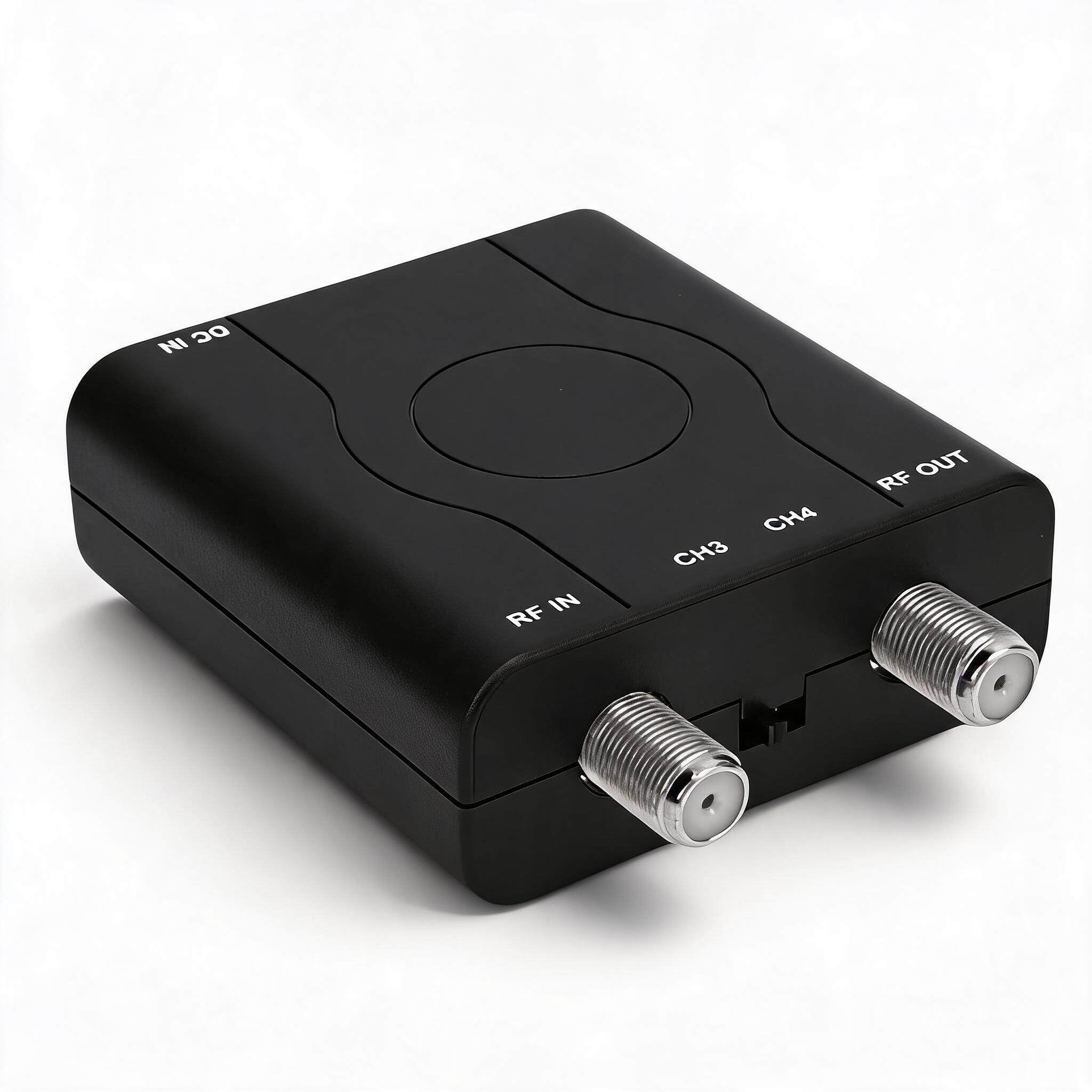
A CATV-oriented converter that plugs in and needs no drivers.
Bewinner’s adapter wins on compatibility breadth rather than convenience features: it supports NTSC output at CH3 (55.25MHz) and CH4 (62.25MHz) — note those frequencies sit lower than the channel 3 and 4 figures on most of the boxes above, which matters if you are trying to avoid a crowded local dial. It handles 1080p, 1080i, 720p, 576p, 576i, and 480p input, supports HDMI 1.4 and HDCP 1.4 (the copy-protection handshake), and is described as compatible with local CATV systems (community cable TV). The housing is ABS plastic and the unit is intended for plug-and-play use with no driver installation.
The intended audience is broader than the pure retro-TV buyer. Bewinner lists PCs, laptops, game consoles, cameras, TV boxes, DVD players, and CCTV and DVR gear as supported sources, so this is a sensible pick if you are feeding a surveillance feed or a distribution system into a coax run rather than reviving one old television. It runs on 5 volts of direct current and offers RF input and output alongside the HDMI port, giving it a small edge in flexibility over single-direction converters. Note that it ships without a power plug, so plan for your own 5V supply.
Be straight about the confidence level: this is the least-proven option in the lineup, with essentially no meaningful owner feedback to lean on yet, and the listing’s PAL control language alongside NTSC frequencies is worth clarifying with the seller before you buy if PAL matters to you. If you need a CATV or CCTV feed converted and you want a low-risk entry point, it fits. If you want a well-worn path with hundreds of owners behind it, the kurtmark and CIMPLE CO boxes above are safer ground.
What it offers: HDMI and RF input/output with HDCP 1.4, NTSC CH3/CH4 output at 55.25MHz and 62.25MHz, and a CATV-friendly design that needs no drivers.
What to verify first: it ships without a power plug, and PAL support is unclear from the listing text.
Suited to: CCTV, DVR, or CATV distribution setups that need an uncomplicated coax feed.
Step up if: you want proven reliability — the kurtmark or CIMPLE CO have the track record this one does not yet.
Know the Specs
Output Channels And Why There Are Rarely More Than Two
Channel 3 and channel 4 are the two standard resting spots for consumer RF modulators, and the reason is simple: those two frequencies sit at the edge of the broadcast band where they are least likely to collide with an active station. So your picture arrives on a fixed frequency instead of fighting a live channel. An HDMI digital RF modulator that outputs on CH3 or CH4 sends your video to a specific frequency your television already knows how to tune. The two channels give you a fallback — if one looks snowy because a local signal is using it, switching to the other usually clears it up. Higher-end units like the AoeSpy multi-channel converter expand this to the full VHF and UHF band, which is why they cost more but let you dial the output far away from any interference.
NTSC Output Versus ATSC Input, And Why It Confuses Buyers
NTSC and ATSC are two different television broadcast systems, and knowing which one your TV tunes saves you a wasted purchase. NTSC is the older analog standard, and every modulator here outputs in it or in the PAL analog system. ATSC is the digital standard that replaced it. The confusion hits because a modern television may have a coax antenna port that only tunes ATSC digital channels — meaning a perfectly working analog modulator can send it a signal the set simply cannot recognize. That is why checking your TV’s tuner spec before you buy matters so much. An older CRT or a set with an analog tuner sees the modulator’s signal immediately. A newer digital-only tuner may see nothing at all.