Disclosure: Some links in this post are affiliate links. As an Amazon Associate I earn from qualifying purchases, at no extra cost to you. Learn more
Specs are compiled from manufacturer listings and verified buyer reviews and can change over time — please confirm the key details on the product page before buying.
If your dog has a collapsing trachea, the harness you choose matters more than almost any other piece of gear you own. A collar puts direct pressure on the windpipe every time your dog pulls — a harness moves that force to the chest and shoulders instead. The seven picks below all do that job, but they do it differently, and the right one depends on your dog’s chest shape, how they walk, and how much padding their throat can tolerate.
This guide is built by comparing the manufacturers’ published specifications and the patterns across verified customer reviews, so you get each pick’s real strengths and trade-offs instead of marketing spin.
You will see the trade-offs spelled out — the escape risks, the sizing quirks, the padding gaps. Every pick here earns its place, but not every pick fits every dog. The right harness for dogs with tracheal collapse keeps pressure off the throat while staying secure enough that your dog cannot wriggle free mid-walk.
Top Picks
How To Choose The Best Harness for Dogs With Tracheal Collapse
The whole point of a tracheal-collapse harness is redirecting force away from the neck. A collar tightens around the windpipe when your dog pulls — a harness spreads that pull across the chest and shoulders instead. Everything below follows from that one idea.
Where the leash attaches matters more than anything else
A front attachment point (sometimes called a front ring or martingale loop) turns your dog slightly toward you when they pull, which slows them down. A back attachment sits between the shoulder blades and leaves the throat completely clear. Both keep pressure off the windpipe. The difference is control style, not safety.
Neck opening versus step-in design
Step-in harnesses let your dog walk into the gear with all four paws on the floor. Over-the-head designs slip over the ears. For a dog with a sensitive throat, a step-in or side-buckle design means less handling around the neck during put-on and take-off.
Padding: where it sits and how much
Padding along the chest and belly panels cuts down on chafing during long walks. Padding around the neck matters too — even a well-designed harness can rub if the straps are thin or stitched in a way that catches fur. Look for closed-cell foam or memory foam in the chest panel and smooth webbing elsewhere.
Sizing and escape risk
Measure chest girth at the widest part of the ribcage, not the neck. On a dog with a collapsing trachea, a loose harness that slides can shift pressure points mid-walk. And some dogs learn to back out of a harness entirely — if yours does, an escape-free contracting frame is the safer bet.
Side-by-Side Comparison
| Model | Best For | Weight | Adjustment Points | Leash Attachments | Amazon |
|---|---|---|---|---|---|
| Ruffwear Front Range★ Best Overall | Everyday walks and long hikes | 5.44 oz | 4 | Front V-ring + back V-ring | Amazon |
| Hurtta Casual ECO Y-HarnessMinimalist Pick | Minimal, lightweight everyday wear | 0.08 kg | 2 girth buckles | Front ring + back ring | Amazon |
| Puppia Vivien Vest | Tiny dogs and stylish daily walks | 1.6 oz | Hook-and-loop sizing | Back only | Amazon |
| PetSafe Easy Walk Comfort | Strong pullers who need redirecting | — | 5 | Front martingale + back loop | Amazon |
| DOGGYKINGDOM No Choke Vest | Night walks and small dog control | — | Chest + belly straps | Back only | Amazon |
| Gooby Comfort X One | Choke-free step-in for small dogs | — | Girth only | Back metal ring | Amazon |
| Gooby Escape Free Memory Foam | Dogs who back out of harnesses | 2.72 oz | 4 | Back ring | Amazon |
Detailed Reviews
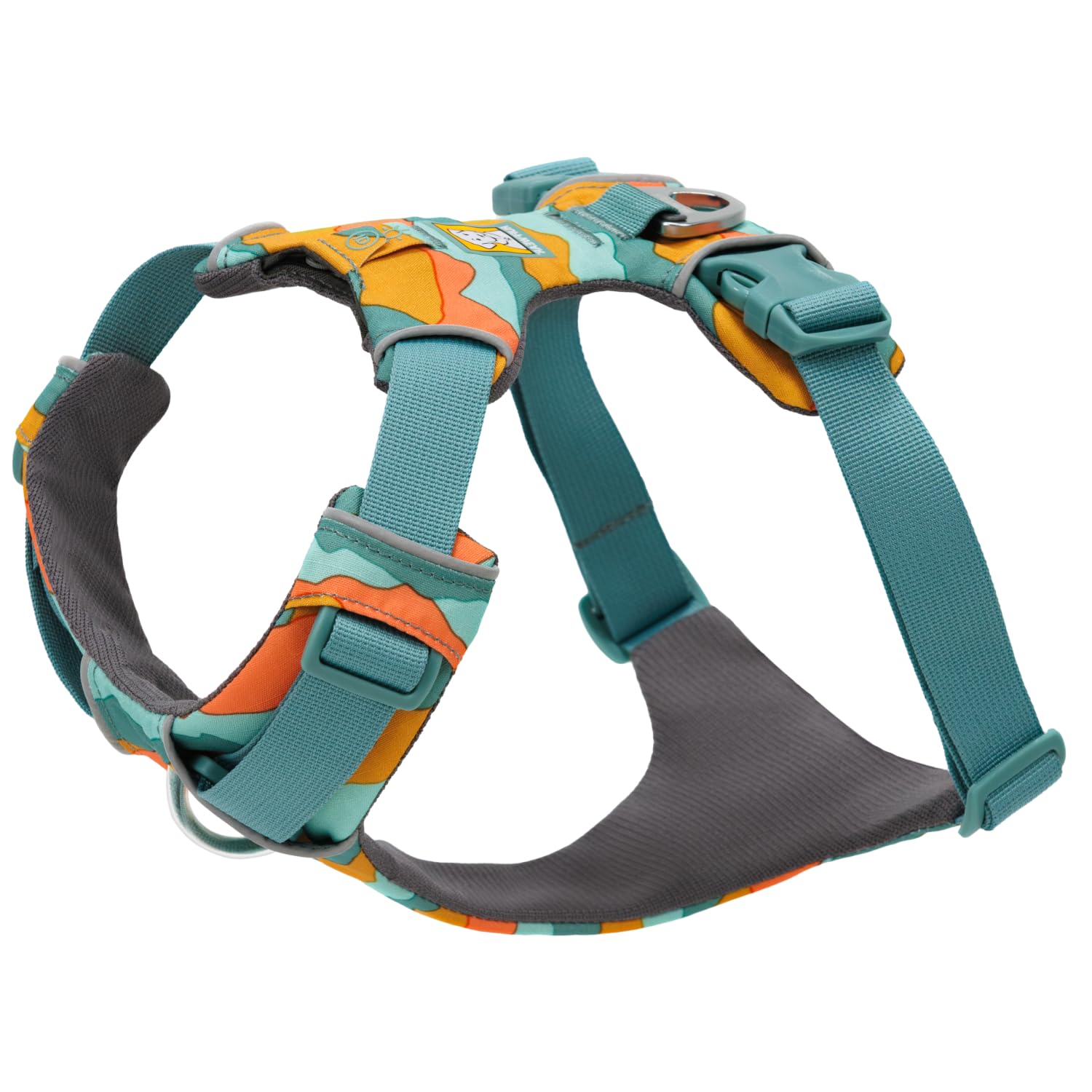
1. Ruffwear Front Range Dog Chest Harness
Our pick — 4.5+★ from 19,000+ verified ratings; the strongest balance of quality and price.
A foam-padded chest harness with a front and back leash point, built for dogs that cannot wear a collar.
The Ruffwear Front Range is the crowd favorite here — 4.5+ stars across 19,000+ ratings — and it earns that glow in the details. The closed-cell foam padding in the chest and belly panels is what owners rave about most; it keeps a dog comfortable through multi-hour hikes without chafing. Weighing 5.44 ounces, it is substantial enough to feel real in your hands without dragging your dog down — the Puppia below tips the scale at just 1.6 ounces, so the Ruffwear is the beefier option by far.
Where it separates from a basic strap harness is the dual attachment system. There is an aluminum V-ring on the back for everyday walks and reinforced webbing at the chest for redirecting a dog that pulls. On a tracheal-collapse dog, that chest point is the one you want to use — it moves force away from the windpipe onto the sternum. Four points of adjustment let you dial in a fit across a wide range of body shapes, and the reflective trim plus Beacon Light loop add visibility at dawn and dusk.
What wins people over is fit and quality — buyers report a properly adjusted harness handles everything from a Golden Retriever to a Boxer in the same XL size, and the neck and girth straps keep the pressure vertical rather than tight. The honest catch is the escape question. Some dogs can back out if the fit is not snug enough, and the chest webbing area under the front legs is stitched, not fully padded, which can itch a dog with thin fur. Sizing up carefully is the answer, and Ruffwear publishes a sizing chart and how-to-fit video to help.
Where this one delivers
- Closed-cell foam padding across chest and belly keeps pressure off the throat on long walks
- Dual attachment points give you a chest redirect option when the dog pulls
- Four points of adjustment fit a genuine range of body shapes
- Reflective trim and Beacon Light loop for dawn and dusk visibility
What you should know before buying
- Chest stitched area is unpadded — may itch a thin-coated dog
- A loose fit can let a determined dog back out
- At 5.44 ounces, it is noticeably heavier than mesh-style options
Reach for this if: you want one harness that handles daily walks, hikes, and a dog who pulls — with real padding between the chest panel and the throat.
Measure first: the unpadded stitched strip under the chest is the one real comfort gap, so fit it snugly and watch for rubbing.
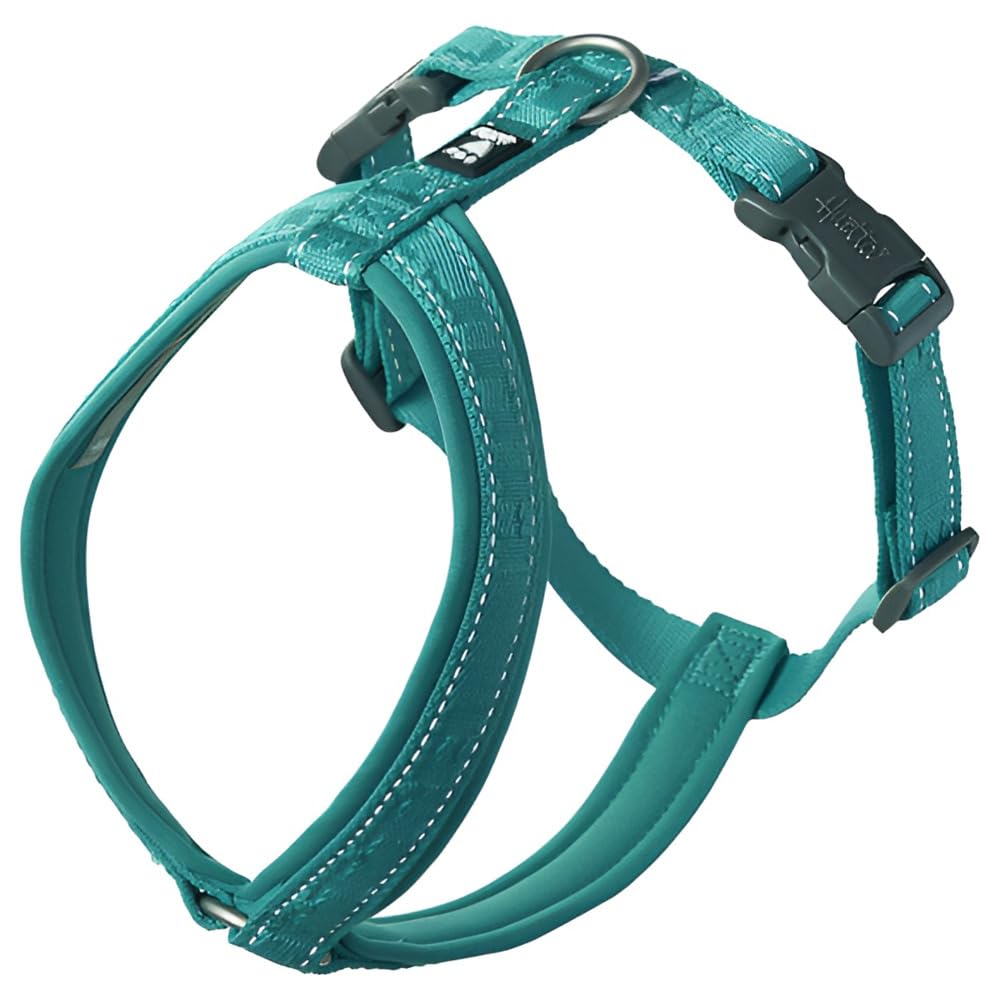
2. Hurtta Casual ECO Dog Y-Harness
A Y-shaped frame that lets the shoulders move free — and never crosses the windpipe.
The Y-harness shape is the thing to notice here. The straps run down either side of the chest in a Y rather than across the windpipe, so your dog gets full shoulder rotation without anything pressing on the throat. Padding is light by design — this is for dogs who overheat easily or who find bulk bothersome.
Getting it on is a two-buckle job without lifting any legs. The buckles sit on both sides and open wide, so you thread the head through and snap both girth straps. On a dog with arthritis or a sore neck, that matters. There is a front ring and a back ring on the webbing, and the 3M reflectors are built right into the webbing for night visibility. But owners mention sizing has to be right — size 20-24 inches fits a 30 lb pug with a 16 inch neck and 23 inch torso, and the neck is not adjustable on most sizes.
What owners keep coming back to is comfort and durability — the neoprene chest padding sits soft against fur, and the webbing itself is thick and tough. The honest catch is the limited adjustability. With only girth buckles to work with, a lean or narrow-chested dog can end up with a front strap that shifts sideways, and a dog with an athletic build may find the neck opening slips. Measure your dog’s chest girth carefully before you commit. The 0.08 kg weight puts it in a genuinely light class — noticeably lighter than the 5.44 ounce Ruffwear above.
Fit is the whole test: measure chest girth at the ribcage, not the neck. The Y-frame is comfortable and aerodynamic, but there is little room to correct an in-between size.
Worth knowing: the front ring joins all three straps without stitching, which many owners say gives a cleaner, more stable connection than strap-and-stitch designs.
Pick this one for: a small-to-medium dog who runs hot, hates bulk, and has a chest you can measure accurately.
Look elsewhere if: your dog has a narrow build that tends to slip out of fixed-neck harnesses.
3. Puppia Vivien Vest Dog Harness

A 1.6-ounce air-mesh vest that steps on over the paws and spreads leash load across the chest.
At 1.6 ounces, there is almost nothing to this harness. The polyester air mesh body is breathable, and the step-in design means your dog walks forward into the gear with paw-led ease. For a small dog whose throat is fragile, the vest shape distributes load across the chest without the narrow strap pressure a collar puts on the windpipe.
The closure is hook-and-loop with a quick-release buckle — the velcro does most of the sizing work, which means adjusting to a new size takes seconds. Customers note a six-month-old 14 lb pug fits the sizing perfectly, and the ruffled details draw regular compliments on walks. But the consensus on fit is mixed — this one runs small, and most buyers need to look at the size chart carefully before ordering. At 14.96 inches chest for the Medium, that is worth measuring twice.
The honest catch is durability long-term. It is a lightweight vest, and the mesh body will not stand up to a dog who scratches at it or pushes through dense brush the way a padded nylon harness will. That said, if your dog’s daily loop is a sidewalk and a patch of grass, the comfort and simplicity win. One owner reports a Shih-Tzu wearing this vest came through a bad NYC leash incident without injury.
Why small dogs like it: the vest shape spreads leash force across the chest and off the windpipe, while the air mesh keeps a tiny dog from overheating on warm days.
Size up one: the recurring buying question here is fit, and a harness that runs small needs to be ordered against the chest measurement, not the neck measurement.
Best for: toy and small breeds under 15 lbs who need a gentle, lightweight chest harness for short daily walks.
skip it if: you need a harness that survives rough terrain or a dog who scratches at gear.
4. PetSafe Easy Walk Comfort No Pull Dog Harness

A five-point adjustable harness with a front martingale loop that redirects pulling onto the chest.
A front martingale loop is a strap that tightens slightly against the chest when the dog pulls, encouraging them to slow down. That is the core of the Easy Walk Comfort design. Because the leash forces are on the chest and shoulders, the windpipe is left alone. Five points of adjustability across the neck, body, and underbody get the fit right, and full-body padding spreads the pressure.
The sharp edges are around the front clip in real use. Owners of strong pullers report the front clip can pull the harness to one side and yank the shoulder joint back when the dog lunges at a trigger. That is why some switch to the back clip for casual walks and keep the front only for training sessions. The top handle is a genuine help — a firm grip near other dogs or on steep steps is exactly what a reactive dog owner needs.
The honest catch is that this is a heavier, more structured harness than the mesh vests. A heat-sensitive senior can still wear it comfortably because the padding is breathable, and one buyer with a 38 lb Aussie mix reports the M/L fits with no rubbing behind the front legs. But measuring matters — the sizing is not forgiving, and a loose fit slides. Sizing to the chest (neck 17, chest 22, girth 33 inches for one 67 lb dog in M/L) gives you the best chance of a snug fit.
What the no-pull frame does
- Front martingale loop redirects pull impulse onto the chest
- Full-body padding keeps the chest and shoulders comfortable
- Five points of adjustment for a dialed-in fit
- Back clip and top handle for relaxed walks and tricky terrain
What to watch for
- Front clip can twist sideways on a hard lunge
- Fit takes some tuning and can slide on the wrong size
- More structure and bulk than a mesh vest
This is for: the medium-to-large dog who is a committed puller and needs leash training with the throat out of the equation entirely.
Consider a vest instead if: your dog is a small breed or heat-sensitive senior who does better with less structure.
5. DOGGYKINGDOM No Choke Dog Harness with Handle

A reflective chest harness with a wide 3M stripe and a single side buckle you can close one-handed.
For evening walks the visibility is the star. A wide 3M reflective stripe runs across the front — big enough to catch a headlight from a distance. The frame distributes leash force across the chest and shoulders rather than the neck, which is the whole reason it works for a dog with a collapsing trachea. Nylon construction, a stainless-steel D-ring, and a secure buckle round out the hardware.
Getting it on takes about two seconds once you have the fit dialled in. The head slips through and one side clip closes; owners describe doing it one-handed while the dog stands still. Plush padding and breathable mesh reduce the rubbing that lighter harnesses cause behind the front legs. The included velcro patches on both sides of the chest give you a place to write your phone number or stick a name tag on.
The honest catch is that “no pull” in the name oversells the pulling control. The harness prevents the strangling pressure of a collar, but it does not stop the dog from pulling — the pull prevention is mixed in owner reports, and the plastic buckles do not always hold up. On the plus side, owners love the fit and the look, and the sizing is friendly — a 28 lb Frenchie with a 22 inch chest wears a small, and the over-head slip-on is easier than a step-in for many dogs. Hand wash only, worth noting.
Why it earns a slot: a broad reflective stripe, full chest and belly padding, and a handle on top for lifting a small dog over obstacles or through a crowd.
What to watch: the plastic side buckles and the strap tension are the common weak points — tighten the belly strap before a walk and check the buckles after a few weeks.
Choose it when: your walks happen after dark and you want your dog lit up from the front and sides.
Pass if: you need a true anti-pull trainer or your dog is a strong lunger who tests plastic buckles.
6. Gooby Comfort X One Dog Harness

A deep V-neck frame that routes pulling force to the girth and keeps the throat completely clear.
The frame is the whole story. The Comfort X One uses a deep V neckline rather than a straight chest strap, so the leash load moves to the chest and girth instead of pressing on the top of the windpipe. It is a step-in design, which means your dog walks in and you snap both buckles without lifting any legs. The shock-absorbing body also softens the tug when your dog hits the end of the leash.
Owners of small and medium dogs report the fit is genuinely comfortable — a 133-count comfort pattern, with fit and secure attachment close behind. One owner of a 15-year-old beagle with tracheal collapse reported less coughing after switching to this harness. The heavy-duty metal back ring works as a seatbelt anchor too, which is handy on car rides.
The honest catch is sizing. Gooby’s size ladder is not intuitive — one buyer found their 28 lb Cocker needed an XL while a 17 lb Maltipoo fit M/L. The only adjustment point is the girth, so the chest strap has to fit as-cut, and the head opening runs tight on a big-headed dog. Puppies in the smaller sizes outgrow them quickly. Order by your dog’s girth measurement and expect to size up if you are between sizes. The other reality: at XS it may be too tight, at S too loose, so try the measurement chart first.
Where the V-neck wins
- Deep V frame keeps the windpipe entirely unobstructed
- Step-in design with two snap buckles for quick on and off
- Comfortable fit for small dogs with narrow chests
- Heavy-duty metal back ring doubles as a seatbelt attachment
Sizing and adjustment cautions
- Only the girth is adjustable — the chest strap has to fit as-cut
- Gooby sizes run small and need accurate girth measurement
- Tight head opening for big-headed dogs
The right pick for: a small dog with a narrow chest and a sensitive throat whose owner wants one quick snap-closure step-in.
Order by girth only: the chest strap has no slack adjustment, so a misjudged measurement is the biggest risk here.
7. Gooby Escape Free Memory Foam Harness

A memory-foam harness whose patented back frame contracts when your dog backs away, closing the escape route.
This is the pick for the dog who has learned to back out of gear. The Escape Free frame is patented (US 10,130,076 B2 and US D798,508 S) and works by contracting around the back when your dog pulls backward. That kills the escape route. It sits at 2.72 ounces, so it is light enough that a small dog can wear it without strain and sleep in it if the day drags.
The memory foam padding is the other draw. It distributes the leash force across the chest, and the fleece lining makes it warm and soft against fur — a genuine plus for a small breed on cool mornings. The four-point adjustment means a dialed fit across chest, girth, and back is achievable, and the step-in design keeps your dog’s neck out of the equation entirely. Reviewers point out no escape attempts succeed and no discomfort chafing even when the dog rolls in it.
The honest catch is sizing. The fit is mixed in owner reports — some say the Medium is true to the 15-20.5 inch chest range, while others found it ran small and had to return. Measure exactly, because incorrect sizing breaks the escape-free function: the whole mechanism depends on the harness hugging the back with no gap. The largest size fits dogs up to around 35 lbs, so it is not for larger breeds. For a dog who backs out of everything else, though, this is the one worth the fitting effort.
What makes it different: the contracting back frame is the safety net for a dog who has slipped a harness before — the fit tolerance is narrow, but the payoff is a dog who cannot walk out of the gear.
Go with this: if your dog backs out of harnesses and you need the fit to stay on during a walk downtown.
Choose another size up: if you are between the Medium and Large — the escape function needs a snug back, so measure the chest at the widest point before ordering.
Know the Specs
Leash attachment points
A front attachment point sits on the dog’s chest and turns them toward you when they pull. A back attachment sits between the shoulder blades and leaves the throat free. On a dog with a collapsing trachea, either works as long as you are not clipping onto a collar. The PetSafe Easy Walk Comfort and Ruffwear Front Range both give you a front and a back option; the Hurtta and Puppia and DOGGYKINGDOM use a back ring or a front-and-back combination depending on size.
Chest girth measurement
Chest girth is the distance around the widest part of your dog’s ribcage, just behind the front legs. For most harnesses here, that number — not neck size — decides the fit. The Gooby Escape Free fits a Medium chest of 15 to 20.5 inches, while the Puppia Medium runs to a 14.96 inch chest and the DOGGYKINGDOM small covers 20 to 24 inches. Always measure before ordering.
Weight and bulk
Harness weight runs from 1.6 ounces (Puppia Vivien) to 5.44 ounces (Ruffwear Front Range). A light harness means less to carry on long walks, but usually less padding too. A heavier one gives you more foam and stronger webbing. Match weight to your dog’s size and walk length — a 6 lb toy breed does better in a lighter vest.
Padding and materials
Closed-cell foam (Ruffwear), memory foam (Gooby Escape Free), neoprene (Hurtta), and mesh (Puppia, DOGGYKINGDOM) are the four common padding families. Foam and neoprene handle long walks; mesh handles heat. Look for padding in the chest panel and smooth webbing around the neck to cut rubbing.
Common Questions
Will a harness stop my dog from coughing with a collapsing trachea?
Should I measure my dog’s neck or chest for a harness?
What is the difference between a Y-harness and a V-neck harness?
How do I know if my dog can escape from a harness?
Can a harness help a dog who pulls hard on the leash?
Is a step-in harness better for a dog with a sore throat?
How tight should a harness fit for a tracheal-collapse dog?
What is a martingale loop on a dog harness?
Can I leave a harness on my dog all day?
Which harness is best for a small dog that pulls and has a collapsing trachea?
The Bottom Line
For most dogs with a collapsing trachea, the harness for dogs with tracheal collapse winner is the Ruffwear Front Range — foam-padded chest and belly panels, four points of adjustment, and a dual leash system that lets you run the lead off the chest instead of the throat. And when the fit is dialled in, it holds a high score from a very large field of owners.
If you want a lighter, more aerodynamic cut, reach for the Hurtta Casual ECO. And for a small dog that backs out of gear, the Gooby Escape Free Memory Foam closes the gap with a contracting back frame. The single nudge: buy one of these and fit it snug — some dogs still slip out, and the escape-free or four-point adjustable designs give you the best chance of a settled walk.
How we choose
We do not accept paid placement. Every pick is matched to a real buyer and a real use-case; we do not hands-on test units.
Sources
Specifications: manufacturer listings and product documentation. Review insights: verified customer reviews, as of October 2026. Pricing: not shown on this page (it changes often); check the current price via the retailer link.
As an Amazon Associate, Aappliancez earns from qualifying purchases. This does not affect which products we feature.