Disclosure: Some links in this post are affiliate links. As an Amazon Associate I earn from qualifying purchases, at no extra cost to you. Learn more
Specs are compiled from manufacturer listings and verified buyer reviews and can change over time — please confirm the key details on the product page before buying.
A barrel-chested dog is a sizing nightmare. You measure the chest, order the size the chart says, and the harness either strangles the shoulders or slides sideways halfway around the block. The fix is not a bigger size — it is a harness with a wide chest plate, straps that sit clear of the armpits, and a neck opening that clears a thick head. Below are seven models that genuinely handle a deep, broad ribcage. You will also see what to measure before you click buy, and the one spec that decides whether a harness works on a bulldog, pit mix, or shepherd cross.
This guide is built by comparing the manufacturers’ published specifications and the patterns across verified customer reviews, so you get each pick’s real strengths and trade-offs instead of marketing spin.
On a wide-chested dog, chest girth decides the size before any feature does, so measure first and shop second. Below you’ll find every spec that matters for picking the right harness for barrel chested dogs.
Top Picks

How To Choose The Best Harness for Barrel Chested Dogs
The mistake almost every wide-chested owner makes is sizing by weight. A bulldog and a greyhound can weigh the same and need completely different harness shapes. Chest girth — the full loop of tape around the widest part of the ribcage, just behind the front legs — is the number that actually maps to a size chart. Measure it snug, not tight, and write it down before you shop.
Measure the chest, then check the neck opening
A thick-chested dog usually also has a thick neck and a broad head. A harness that slips over the head needs a neck hole wide enough to clear the ears and skull without a fight. If the neck opening is tight, you will be wrestling the harness on every single walk. Look for a wide neck hole or a design with side-release buckles at the chest so all four paws stay on the ground.
Decide if you need front-clip control
A front clip (a leash ring on the chest) redirects a dog sideways when it lunges, which is why it helps with hard pullers. A back ring sits between the shoulder blades and suits a dog that already walks politely. Some harnesses give you both, which is the flexible choice if your dog pulls on some days and heels on others. Know which ring you will actually use before you buy.
Check the padding where the straps cross the armpits
On a deep-chested dog, the strap that runs behind the front legs carries a lot of load. Closed-cell foam or neoprene padding in that zone is what stops chafing on long walks. Bare webbing stitched flat can rub a thin-coated dog raw within a mile. If your dog has short fur, prioritize padding over pattern.
Side-by-Side Comparison
| Model | Best For | Adjustment Points | Leash Rings | Padding | Amazon |
|---|---|---|---|---|---|
| Ruffwear Front Range★ Best Overall | Everyday walks and travel | 4 | Back V-ring plus chest webbing | Closed-cell foam chest and belly panels | Amazon |
| Spark Paws No-PullStrongest Puller Pick | Strong pullers in large breeds | 3 adjustable clips | Front and back D-rings | Neoprene interior | Amazon |
| PetSafe Easy Walk Comfort | First-time no-pull buyers | 5 | Front martingale loop plus back loop | Full-body padding | Amazon |
| BULLHUG Adjustable | Bulldogs, Frenchies and pugs | 2 (Velcro chest plus bottom plastic) | Beefy metal back ring | Not stated | Amazon |
| ICEFANG Quick-Moving Tactical | Big dogs that need handle control | 5 | Rotating V-shaped metal clip | Padded chestplate | Amazon |
| Wilderdog Lightweight | Trail hikes and warm weather | Neck and shoulder straps | Chest and back D-rings | Not stated | Amazon |
| Carhartt Nylon Duck No Pull | Daily wear in rough weather | Fully adjustable chest and belly | Front and back D-rings | Spacer mesh backing | Amazon |
Detailed Reviews
1. Ruffwear Front Range Dog Chest Harness
Our pick — 4.5+★ from 19,000+ verified ratings; the strongest balance of quality and price.
The crowd favorite that dials in a deep chest without pinching anywhere.
The case for the Ruffwear Front Range starts with four points of adjustment — a strap at the neck and three along the body that you tighten independently. On a barrel chest, that matters because you can widen the ribcage loop while keeping the neck snug, instead of forcing one compromise size over a dog with a broad build. Owners of two very differently shaped seventy-pound dogs report the same harness fit both because of that flexibility.
Comfort is where this one earns its place, and the closed-cell foam padding (a firm, squish-resistant foam) in the chest and belly panels is the reason. That padding is what makes long hikes and all-day wear tolerable on a broad-chested dog. Buyers keep naming comfort and fit as the two things they notice. One review page sums it up: “This is a great little harness for my new sheltie puppy adjusting to the big city in all its sights and noises.” A harness that does not press the throat is what keeps a dog calm on a noisy street.
The honest catch is that a dog which spooks and reverses can back out of it with effort. Some owners note their dogs can back out of it with effort, so a dog that spooks and reverses needs a snugger fit than the chart suggests. At 5.44 ounces it stays light on the shoulders, and the reflective trim plus the Beacon Light loop keeps a dark-coated dog visible at dawn. For daily walks, travel, and hiking with a wide-chested dog that walks reasonably well, this is the safest all-round call.
What earns it the top spot
- Four independent adjustment points stretch over a deep ribcage without choking the neck
- Closed-cell foam in the chest and belly panels heads off chafing on long walks
- A back aluminum V-ring plus reinforced chest webbing gives you two ways to attach a leash
- Weighs just 5.44 ounces with reflective trim and a Beacon Light loop for low light
- Owners routinely fit two mismatched body shapes into the same model
Where it needs watching
- A dog that reverses hard can back out with effort — size down if your dog spooks
- The unpadded stitched seams on the underside can itch a hairless or thin-coated dog over time
Worth grabbing for: a broad-chested dog that walks decently and needs a comfortable, adjustable everyday harness you can also hike in.
Look elsewhere if: your dog is a confirmed escape artist that backs out of harnesses — you want something with a tighter neck and chest wrap instead.
2. Spark Paws Large Dog No-Pull Harness
A Y-shaped control harness built for the biggest, strongest chests on the block.
If your dog is a hundred pounds of muscle and still learning to walk politely, the Spark Paws front clip gives you a lever. The no-pull geometry routes the leash to a ring on the chest, which turns a forward lunge sideways rather than letting the dog dig in and tow. Buyers with an 85-pound pitbull report the large fits with room to spare, and the multiple attachment points let you switch from the front clip for training to a back ring for casual walks.
The heavy-duty build is the point here. Premium nylon, metal alloy D-rings, triple stitching, and neoprene padding on the inside add up to a harness that is safety-tested to take load from a strong dog. The padding also protects a deep chest from chafing on the spots where straps usually dig in.
The catch is sizing confidence. The chart claims coverage up to 150 pounds, but the harness is cut to the body, not to the scale. A wide-chested dog can be far larger around the ribs than its weight suggests. As buyers report: “Didn’t even come close to fitting my 60 pound pitty, said fit up to 150 pounds… seriously?” If your dog measures between sizes, size up on girth and use the three clips to take out the slack. If your dog is bulky through the middle, expect a snugger fit than the weight band implies.
My honest read: this is a control harness first and a comfort harness second. It is worth it if you are actively working on pulling with a big dog that has already failed a standard harness, and the front clip plus neoprene lining is a strong combination for that job.
Downsizing note: measure the chest with a tape before ordering and ignore the dog’s weight — the girth is where this one lives or dies.
Reach for this if: your large dog pulls and you want a front clip to redirect the effort without pressure on the throat.
skip it if: you are shopping by weight alone — the chest measurement is the deciding number, not the breed label.
3. PetSafe Easy Walk Comfort No Pull Dog Harness

Five straps to dial in a wide chest, at the friendliest entry point.
What separates the PetSafe Easy Walk Comfort from the pack is the front martingale loop — a leash ring on the chest that tightens a little as the dog pulls and then eases off when it stops. Five points of adjustability give you a lot of room to tune the neck, body, and underbody straps separately, which is exactly what a dog with an uneven frame needs. Owners of a 38-pound Aussie mix with a bulky chest and a pointy head report the M/L fits once all three zones are adjusted, and that the design keeps the rig centered instead of sliding into the armpits.
The full-body padding and the strong top handle are the two features owners rely on most. The handle lets you hold the dog close near other dogs or steady it on steep steps, and the back loop gives you a second attachment option for trail walks. The consensus on the ground is that this is a quality, easy-on harness for the money.
Where the Easy Walk asks for patience is fit stability. The recurring note is that the harness can shift as the dog moves, and the straps are not always quick to tighten or loosen once they are set. A 67-pound dog with a 33-inch girth fits in the M/L range, but a dog near the top of a size band may want the larger option. Set it once with the dog standing still, walk a short loop, then adjust again before you trust it on a long hike.
Why first-time buyers like it
- Five adjustment points let you tune the neck and body separately for an uneven chest
- Front martingale loop discourages pulling without pressure straight on the throat
- Full-body padding plus a strong top handle for close control and steep steps
- Back loop for faster-paced walks once the dog stops pulling
Where it asks for patience
- The fit can shift as the dog moves — expect to re-tighten after a walk or two
- Underbody straps are not the easiest to loosen quickly once set
The right call for: a broad-chested dog that pulls and an owner who wants a padded, handle-equipped harness with a chest control loop at a budget-conscious tier.
Think twice if: your dog sits at the very top of a size band — size up to leave room for the fit to settle.
4. BULLHUG Adjustable Dog Harness

Cut for the potato-shaped chest, not a greyhound with extra straps.
Bulldogs and Frenchies have a shape no generic harness accounts for: a huge head, a thick neck, and a chest that sits low and wide. The BULLHUG is designed around that, with a wide neck hole that clears a big head and a body wrap that goes over the chest rather than pressing on the throat. You slip it over the head and close one side-release buckle. Owners of a “potato-shaped Frenchton” report no sagging and extremely easy on and off, and the shape checks a box that generic harnesses miss.
The adjustability is where this one shines for a growing or hard-to-fit dog. Velcro around the chest lets you size the harness precisely to the body, and a second plastic adjustment underneath tightens it further. That is why owners mention room to grow and no choking, even on a stubborn bulldog. Fit is the top thing owners call out, with quality close behind. A “beefy metal leash ring” on the back and a top handle you can fold flat under Velcro round out the package.
The one real limit is leash placement. There is no chest clip — only the back ring — so a serious puller will not get the sideways redirection a front clip provides. If your Frenchie only pulls at the mailman, the back ring plus handle is enough. If it pulls hard every walk, you want a harness with a front option instead. Sizing is also precise rather than generous — the medium fits a 24-inch chest fully tightened — so measure the chest and pick accordingly.
The fit story: this harness exists for the dog whose chest reads like a barrel and whose head is wider than its neck. The Velcro chest adjustment is what lets it follow a squishy build without pinching.
One caveat: back-ring only means a heavy puller gets a handle-assisted walk, not true no-pull control.
Built for: English bulldogs, Frenchies, pugs, and pocket bullies whose broad, low chest makes standard harnesses slip and choke.
Not ideal for: a determined puller that needs a front leash ring to redirect the pull.
5. ICEFANG Quick-Moving Tactical Dog Harness
Metal buckles rated to take the load, built for a dog that pulls like a truck.
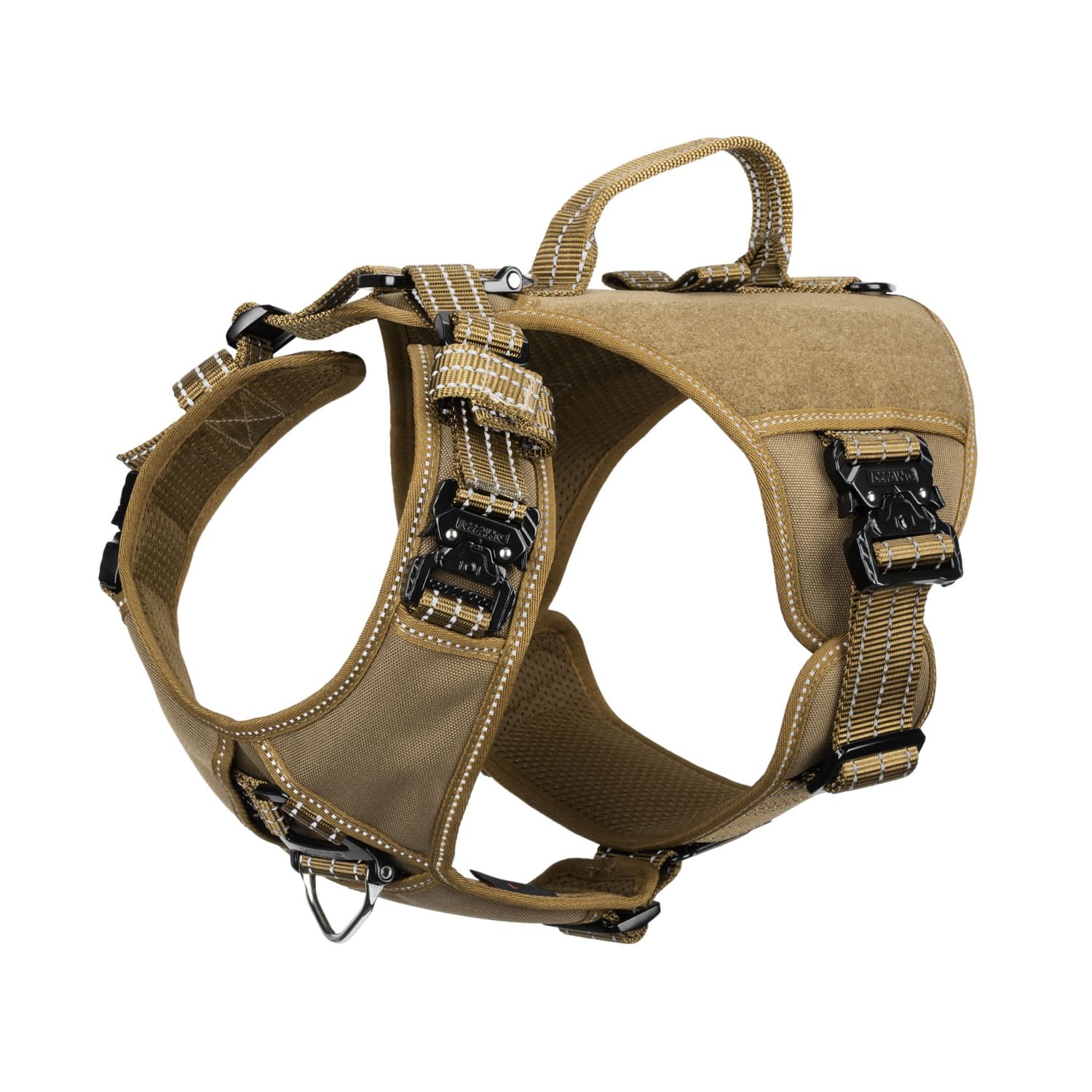
Most harness failures happen at the seams under load. The ICEFANG routes the tension through four quick-release metal buckles rated at 2800N (a measure of pull force, roughly 630 pounds of load) and a rotating V-shaped metal leash clip built into the metal component. So a sudden lunge pulls on the hardware, not the stitching or the fabric. On a 90-pound lunger, that hardware takes the shock instead of the stitching. A Y-shaped chestplate keeps the vest centered on the chest and stops it sliding left or right, and the padding inside the chestplate eases pressure on the shoulders.
Five adjustment points across three separate components make the fit genuinely tunable, and customers note an XL fitting a dog between L and XL comfortably with room to spare. The cut at the rear of the front legs and armpits gives the dog freedom to run, and the four quick-release buckles make it fast to get on and off a wiggly dog. Reflective weave and a control handle top it off; the handle earns its keep when the dog needs a steadying grab.
The recurring gripe is buckle security. Some owners find the buckles can come loose, so check they are fully clicked every time you put it on. That is a small habit to build, but for a dog that pulls hard, it is worth a glance before every walk. Sizing runs per the chart, but a 60-pound pit mix in a large had room to spare, so a barrel chest may fit better in a size that matches the chest rather than the dog’s weight.
Built for the hard puller
- Four metal buckles rated at 2800N carry the pull force through hardware, not seams
- Five adjustment points and a Y-shaped chestplate keep the vest centered
- Fast on and off with four quick-release buckles
- Reflective weave and a control handle for low-light and crowded settings
The trade-off to know
- Some units have buckles that can work loose — make sure they click before each walk
- Tactical styling runs bulkier than a simple strap harness
For the strong dog: a puller with a wide chest who needs hardware-rated strength and a handle to steady it.
Skip if: you want a minimalist, quick-on strap harness — this one leans tactical and full-coverage.
6. Wilderdog Lightweight Dog Harness
The trail harness that slides over the head and keeps four paws on the ground.
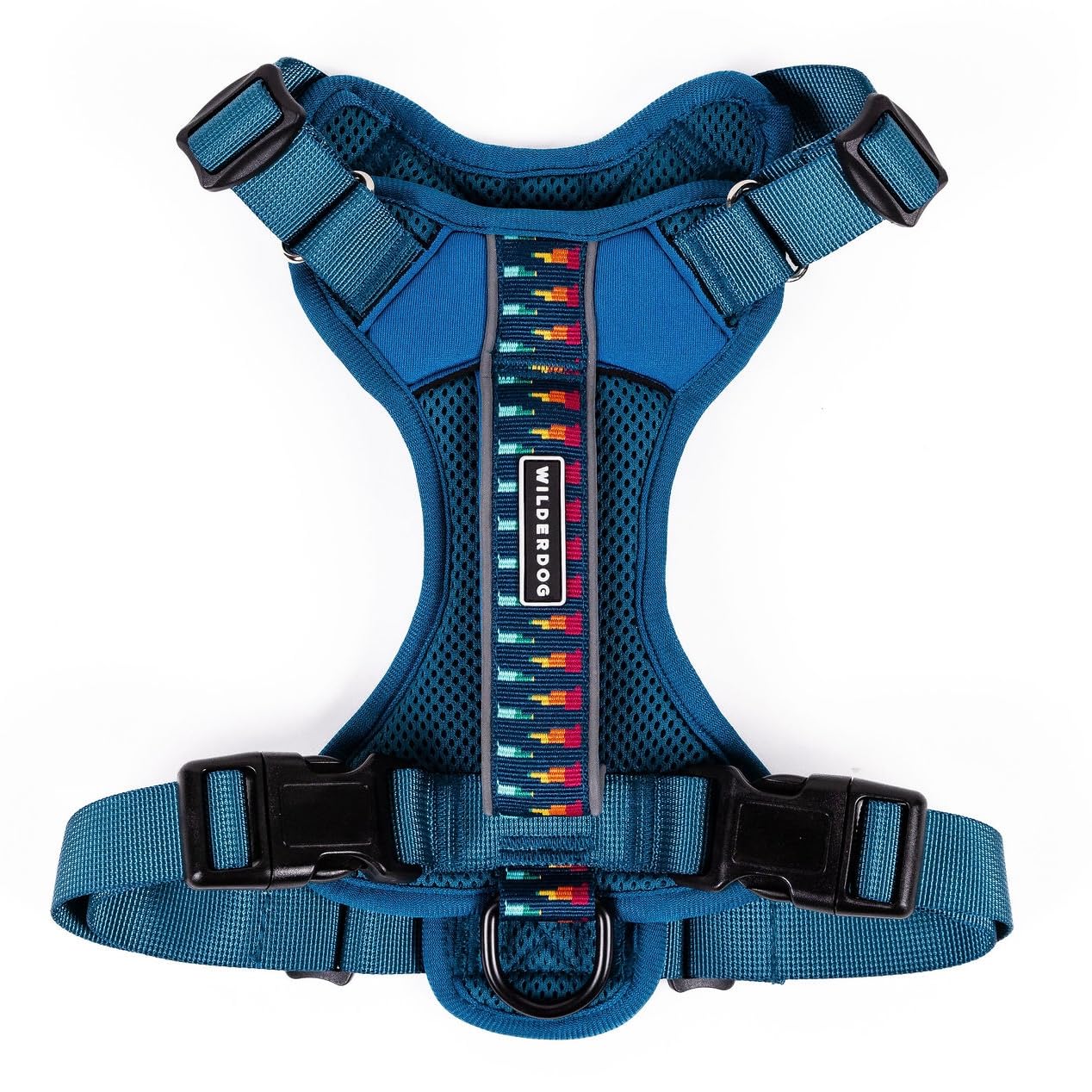
At 8 ounces in a large, the Wilderdog is the lightest pick here — made for warm weather and long miles where a heavy padded vest would just add heat. The design slips over the dog’s head and clips two side-release buckles at the chest, so all four paws stay on the ground, and both the neck and shoulder straps are fully adjustable. Owners of a dog that “slips harnesses like no other” report this is the first harness the dog could not back out of, which says a lot for a lightweight piece of gear.
Two D-ring attachment points — one on the chest, one on the back — give you a front option for redirecting a pull and a back option for cruising. Reflective stripes run across the straps, and the top handle lets you lift your dog over a boulder or grab it close on a narrow section of trail. Owners here most often report that their dog stops scratching at this harness once the straps are set.
The honest limit is a hard lunge: a 90-pound pit mix tore the woven material when it hit the end of the leash. A 90-pound pit and bull mix shredded this harness when it lunged at a squirrel — the woven material is cut for everyday walks and trail adventure, not for dogs that hit the end of the leash hard. If your dog is strong and prone to lunging, the lighter build is a liability; if it is a moderate walker, the low weight is a real bonus. Owners wanting a step less bulk also note the fit is designed a touch shorter for breathability, so check the strap sits clear of the armpit.
Where it wins: low weight, reflective coverage, and a head-slip design that keeps paws planted. Great for a barrel-chested dog that overheats or one you hike with in warm weather.
Where it gives up: a hard lunge can tear the lighter material — this is a walker’s harness, not a heavy-duty control harness.
Pick it for: a broad-chested but manageable dog that needs breathable, reflective gear for walks and trail hikes.
Pass if: your dog lunges hard enough to stress the material — you want the metal-hardware options above instead.
7. Carhartt Nylon Duck No Pull Dog Harness

Rain-ready duck fabric that shrugs off weather and softens the pull.
The Carhartt Nylon Duck harness is built from 500-denier polyester with Rain Defender durable water repellent (DWR) — a coating that makes light rain bead up instead of soaking in. For an owner who walks in drizzle or lives somewhere damp, that is the feature that separates this from a plain nylon harness. A martingale chest strap adds a no-pull function by gently checking the pull, and the yoke-style over-the-head fit with fully adjustable chest and belly straps lets you shape it around a wide chest.
The spacer mesh backing is the comfort piece. It is the breathable layer between the harness and the dog’s coat, which keeps a deep-chested dog cooler on a long walk. Reflective low-light stitching runs through the build for evening visibility.
The chest girth chart runs small to extra large, from 16 to 46 inches, so a genuine barrel chest has a size to fit it. Two leash clips instead of one give you front and back options. What owners flag is value: some feel it is worth the money for the build, others feel the brand name adds cost without enough extra. If you walk in drizzle or mud, the 500-denier duck fabric and Rain Defender coating are what you are paying for.
Why it holds up: a 500-denier polyester shell with water-repellent coating and a martingale chest strap make this a rain-or-shine, all-weather workhorse for a broad dog.
The honest note: the straps can bunch when the dog turns, and the pricing sits at the premium end for a daily-wear harness.
Best for: a wide-chested dog that walks daily through wet or muddy weather and needs gear that shrugs off the elements.
Look on if: you want a bargain strap harness — the build justifies the price only if you value weather resistance and durability.
Know the Specs
Chest Girth
The full loop of tape around the widest part of the ribcage, just behind the front legs. This is the number that maps to a size chart for a barrel-chested dog, not weight, because two dogs can weigh the same and have very different chest dimensions. Measure it snug and write it down.
Adjustment Points
The number of straps you can tighten or loosen independently along the neck and body. More adjustment points let you widen the chest loop while keeping the neck snug, which is how you fit an uneven, broad-chested frame without a compromise size.
Front Clip vs Back Ring
A front clip is a leash ring on the chest that redirects a lunge sideways — useful for a hard puller. A back ring sits between the shoulder blades and suits a dog that walks politely. Some harnesses offer both, letting you switch by the type of walk.
Padding Material
The layer that sits between the strap and the dog’s coat, often closed-cell foam or neoprene. On a deep chest, the underbody straps carry real load, so padding at the armpits and belly is what stops chafing on long walks — especially for a thin-coated or hairless dog.
Common Questions
How do I measure my barrel-chested dog for a harness?
Why does my harness slide to one side when my dog walks?
Is a front clip or a back ring better for a strong puller?
Will a wide-neck harness fit a bulldog or French bulldog?
How tight should a no-pull harness be on a deep chest?
Can a harness rub the armpits on a broad-chested dog?
Do I size a harness by weight or by chest girth?
Which harness is safest for a dog that backs out of everything?
Is a padded harness too hot for summer walks?
What does Rain Defender mean on a dog harness?
The Bottom Line
The harness for barrel chested dogs that gets the most right is the Ruffwear Front Range. Four independent adjustment points, closed-cell foam in the chest and belly, and a back V-ring plus chest webbing let it wrap a deep chest comfortably and securely for daily walks and hiking. If your priority is redirecting a hard puller, the Spark Paws No-Pull pairs a front clip with metal D-rings. For a bulldog or Frenchie with a low, wide chest and a big head, the BULLHUG is the one cut around that shape. And if your dog pulls like a truck, the ICEFANG puts the load on metal buckles instead of seams. Measure the chest before you order, size for the girth rather than the weight, and you will land on a harness that finally stays put.
How we choose
We do not accept paid placement. Every pick is matched to a real buyer and a real use-case; we do not hands-on test units.
Sources
Specifications: manufacturer listings and product documentation. Review insights: verified customer reviews, as of October 2026. Pricing: not shown on this page (it changes often); check the current price via the retailer link.
As an Amazon Associate, Aappliancez earns from qualifying purchases. This does not affect which products we feature.