Disclosure: Some links in this post are affiliate links. As an Amazon Associate I earn from qualifying purchases, at no extra cost to you. Learn more
Specs are compiled from manufacturer listings and verified buyer reviews and can change over time — please confirm the key details on the product page before buying.
Oak cabinets are the hardest thing in your kitchen to dress up, because the wood already has a strong grain and a warm tone — bolt on the wrong metal and the whole room fights itself. The short answer: go stainless steel or brushed nickel for a clean contrast against honey oak, go antique brass if you want warm-on-warm, and always match the hole spacing before you match the color. This guide covers five pulls and knobs that actually work on oak, plus the measurements you need to check before you order a single screw.
This guide is built by comparing the manufacturers’ published specifications and the patterns across verified customer reviews, so you get each pick’s real strengths and trade-offs instead of marketing spin.
Oak is forgiving to hardware and punishing to mistakes — a pull that looks right in the listing photo can vanish against a golden grain. The picks below are ranked for how they read on real oak doors, and the comparison is your fastest route through hardware for oak cabinets.
Top Picks


How To Choose The Best Hardware for Oak Cabinets
Oak has an open, visible grain and a strong yellow-to-honey cast, and that single fact drives every decision here. A dark handle disappears into a shadowed grain line. A bright chrome handle throws light back at you and reads crisp. Your job is to pick which of those two you want, then confirm the pull physically fits the holes already drilled in your doors.
Measure hole center spacing before anything else
Hole center spacing (often written CC) is the distance from the middle of one screw hole to the middle of the other. If your oak doors are already drilled, this number is fixed and non-negotiable — a 3-inch pull will not fit a 5-inch hole pattern. Measure center-to-center with a tape, not edge-to-edge. Knobs are the exception: they use a single hole, which is why a knob swap is the cheapest way to change an oak kitchen.
Match the finish to the grain, not to the trend
Stainless steel and brushed nickel give oak a modern, high-contrast look because cool metal against warm wood reads as deliberate. Antique brass and champagne bronze go the other way — they lean into the warmth, which suits traditional oak and reads calmer on a honey finish. Matte black is the boldest option and works best when your oak is lighter or your counters are dark.
Thick oak fronts need the right screw
Oak drawer fronts are often thicker than the plywood on cheaper cabinets, so short screws bottom out before they bite. Look for pulls that ship two screw lengths, and favor breakaway screws that snap to a custom length. Several picks below include exactly that, and it saves a second trip to the hardware store.
Side-by-Side Comparison
| Model | Best For | Type | Hole Spacing | Material | Amazon |
|---|---|---|---|---|---|
| Ravinte Decor 10 Pack Black Cabinet Handles 3″★ Best Overall | Whole-kitchen refresh | Pull Handle | 7.6 centimeters | Stainless Steel | Amazon |
| Asidrama 10 Pack 5 Inch Champagne Bronze PullsWarmest Match | Warm traditional oak | Pull Handle | 5 inches | Bronze, Zinc | Amazon |
| Asidrama 10 Pack Brushed Satin Nickel Knobs | Knob-only swap | Knob | Single hole | Zinc | Amazon |
| Amerdeco 10-Pack Brushed Satin Nickel Knobs & Pulls | Small drawers and spice racks | Knob | Single hole | Zinc | Amazon |
| BEROSSA Antique Brass 3 Inch Pulls | Restoring old oak furniture | Pull Handle | 3 inches | Metal | Amazon |
Detailed Reviews
1. Ravinte Decor 10 Pack Cabinet Handles
Our pick — 4.5+★ from 600+ verified ratings; the strongest balance of quality and price.
The matte black square pull that makes honey oak look intentional instead of dated.
The number that earns this one first place is 7.6 centimeters — the hole center spacing, which is a hair under 3 inches and lines up with the most common pull pattern on older oak cabinetry. Black on a warm honey door is the highest-contrast combination on this list, so a dated grain suddenly reads as a design choice. And because the body is stainless steel rather than a plated pot metal, the finish holds up against the damp cloth you will inevitably wipe it with.
Installation is where this pull quietly beats the rest of the field. Each handle comes with two sets of screws — 2×25mm and 2×44mm — and the longer ones are detachable, breaking down into six lengths total. On a thick oak drawer front, that means you dial in the exact length instead of digging through a jar of spares. The screw count is not an afterthought here; it is the feature that turns a Saturday job into a two-hour one. As buyers report: “I order the 3” and 5” and use them in my office, kitchen, mud room, and laundry room.”
What wins people over, though, is the look — the square profile catches light on all four faces and gives the pull a bit of visual weight against a flat oak slab. It is a modern farmhouse read rather than a period one, so if your oak is original to a 1970s build and you want to preserve that character, the antique brass option further down suits better. The honest limit is size variety: this listing is the 3-inch pattern, so measure before you commit, and if your doors are drilled wider you will want a longer pull.
What Makes It The Pick
- Stainless steel body that resists rusting and flaking paint on a damp-wiped oak door
- Breakaway screws split into six lengths, so thick oak fronts get a proper bite
- Matte black finish delivers the strongest contrast against honey and golden oak
- The 7.6-centimeter hole spacing matches the most common existing drill pattern
Where It Stops Short
- Only the 3-inch pattern is on this listing — measure your doors first
- Matte black is a statement; it will not blend with darker stained oak
- The modern square shape skips period-style kitchens entirely
Right call for: a full kitchen or mudroom rehandle where you want one order to cover every door and you need the screws to fit thick oak.
Think twice if: your oak is stained dark — the black-on-black contrast flattens out and you lose the effect you are paying for.
2. Asidrama 10 Pack Cabinet Pulls
Five inches of muted bronze that leans into an oak kitchen rather than fighting it.
If your oak is traditional — raised panels, a honey or amber stain, a room that already has warm light — this is the pull that reads as though it belonged there all along. The champagne bronze is described by owners as a muted tone that sits slightly darker than typical bronze fixtures, and on golden oak that translates to a soft, low-contrast line along the door face. The 5-inch hole spacing gives you a longer grip than a 3-inch pull, which matters on big pantry doors where a short handle feels like pinching. Overall length runs 5.4 inches, width 0.43 inches, and it projects 1.2 inches off the door.
Compare it directly to the Ravinte above: that one is square, black, and 7.6 centimeters across the holes; this one is rounded, bronze, and 5 inches across the holes. Those are two entirely different kitchens. The rounded profile here has no crevices and no sharp edges, which is the practical reason it survives a busy household — a wipe with a cloth covers the whole surface.
The catch is the hardware inside the handle, not the handle itself. A portion of buyers hit screws that snapped off inside the pull during install, and the screw quality draws the most divided feedback in this listing. Order spares, go gently on the driver, and do not over-torque into oak — the wood is dense and it will fight back. Get past that and the ergonomics and weight are what people keep mentioning.
The oak-specific read: warm metal on warm wood is the safer aesthetic choice when you are not trying to modernize, and the 5-inch span suits wide drawer fronts that a small knob cannot cover.
The one thing to plan for: pick up a few spare screws of the same gauge before you start, because a snapped screw mid-install stalls the whole job.
Buy this one if: your oak kitchen is traditional and you want the hardware to disappear into the warmth rather than pop against it.
Pass if: you are chasing a crisp modern contrast — this finish is deliberately quiet, not striking.
3. Asidrama 10 Pack Brushed Satin Nickel Cabinet Knobs

One hole per door, no measuring, no new drill pattern — the oak upgrade you can finish in an evening.
Knobs use a single hole, and that one fact makes this the lowest-risk way to change how an oak kitchen looks. There is no hole spacing to match and no chance of drilling fresh oak and splitting it. Brushed satin nickel against a golden grain gives you a cool, clean line that reads as updated without going as stark as polished chrome, and the brushed texture hides fingerprints better than a mirror finish would.
What people respond to most is the substance — zinc alloy gives each knob real heft, and that weight is the first thing your hand notices when you pull a drawer open. The same material appears in the champagne bronze pull above, and it is the reason both feel denser than the price suggests. Owners mention the brushed finish still looks right after months of daily use, unlike thin-plated knobs that wear at the touch edge.
Here is the fair caveat: the finish and the fit both draw mixed feedback, largely around screws that did not suit every cabinet. Some doors need a longer screw than supplied, and a few owners cut theirs down to length. That is a five-minute fix, not a reason to walk away — but budget for it. Also measure your existing knob’s footprint, since this is a compact knob and it will look small on a very large oak drawer front.
Why it earns its slot: the 2-inch by 1-inch footprint and single-hole mounting mean it drops onto almost any existing oak knob hole without a template.
Worth knowing: the mixed feedback centers on screw fit rather than the knob body, so a small assortment of spare screws removes the only real friction.
The fit: anyone refreshing oak cabinet doors who wants the change done without touching a drill.
Look elsewhere if: you need a long handle for a wide pantry door — a single compact knob will feel undersized there.
4. Amerdeco 10-Pack Cabinet Knobs & Pulls

A tiny square knob for the narrow oak drawers nobody designs hardware for.
Look at the size difference between this and the antique brass pull later in the list. The BEROSSA pull measures 4.21 inches long by 0.35 inches wide; this Amerdeco knob measures 1.14 inches long by 0.98 inches wide — a compact square that is genuinely the right answer for small oak drawers like a spice rack or a cutlery insert. As customers note: “Perfect size for spice drawers.”
The brushed satin nickel finish is the same family as the Asidrama knobs above, so you can mix the two across an oak kitchen and the metal will read as one scheme. What separates this one is the shape — a square face on a 1.14-inch body catches light across flat planes and gives a small drawer a bit of visual structure that a round knob cannot deliver. Owners say the brushed satin nickel looks high-end on a drawer front, and several use it on a bathroom vanity as well as a kitchen.
Be honest about the size, though. The compact dimensions that make it right for a spice drawer make it feel small on a standard 24-inch oak cabinet door, and that is exactly what the mixed size feedback in the listing reflects. It is a specialist, not a whole-kitchen solution. One other thing worth planning: owners who mixed these with other brushed metals found the finishes did not quite match across brands, so buy your pulls and knobs from one line if you can.
Where It Wins
- The 1.14-inch by 0.98-inch body fits narrow oak drawers a full pull would overwhelm
- Zinc construction with a brushed satin nickel finish that hides prints
- Single-hole mounting means no new drill pattern in existing oak
- Square face adds structure to a plain drawer front
The Fair Warning
- Mixed feedback on size — it reads small on full-width cabinet doors
- Mixing this finish with brushed chrome pulls from another brand may not match
- Compact grip is less comfortable than a full pull on a heavy oak door
Reach for this if: you have small oak drawers, a spice rack, or a vanity that needs a knob with a little architectural shape.
Skip if: your kitchen is all wide cabinet doors — this knob will look lost on them.
5. BEROSSA Antique Brass Cabinet Pulls 3 Inch, 10 Pack
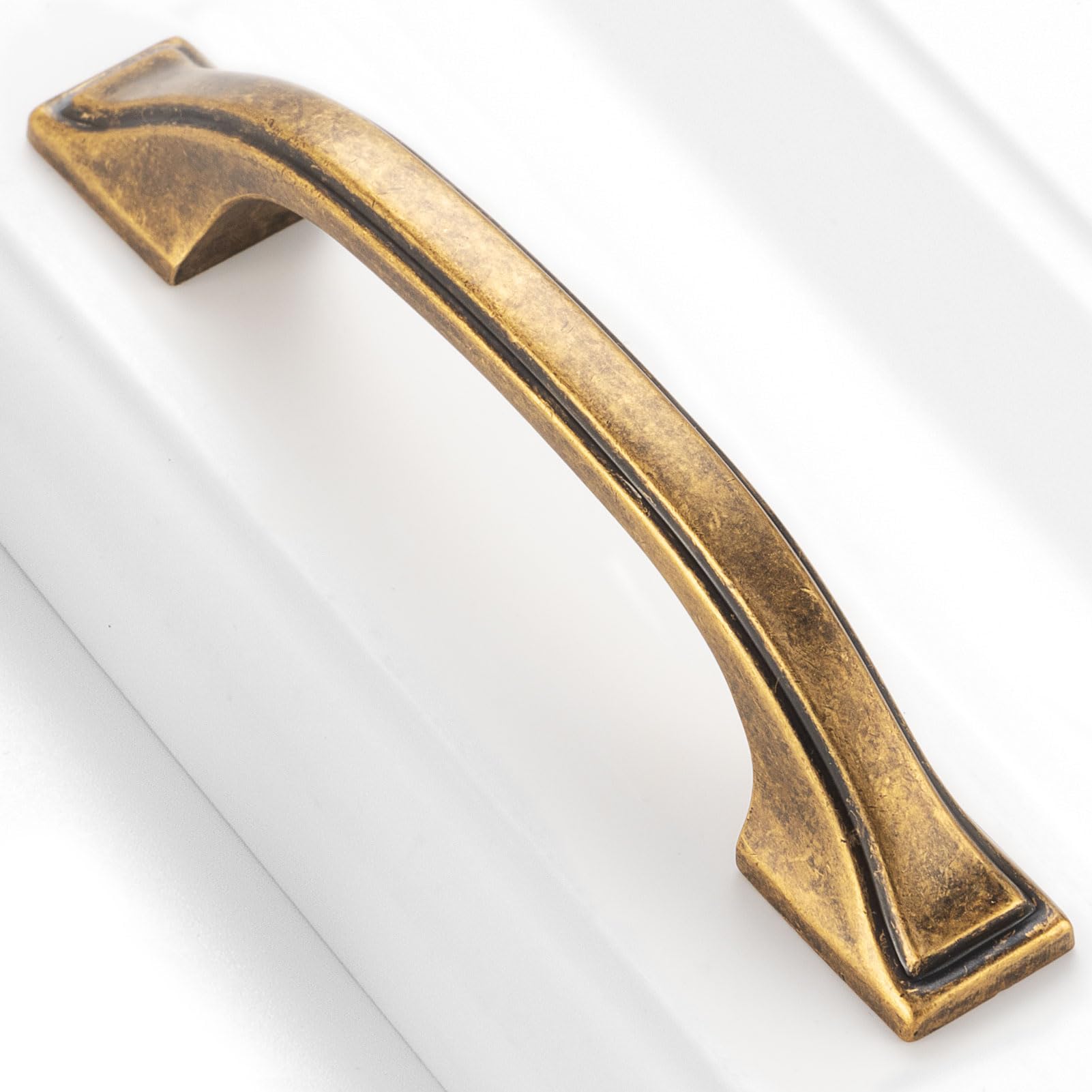
The brass pull for oak furniture you are rescuing, not replacing.
Oak furniture often outlives its hardware, and this pull is built for exactly that job. Antique brass on aged oak is the period-correct pairing — think dressers, bookcases, and vanities that were never meant to look modern. As reviewers point out: “I bought these to replace some really old ones on a set of bedroom furniture 40 years old that I am sanding and painting.” The hole centers are 3 inches (76mm), and each pull ships with 8-32 screws in both 1-inch and 1-1/2-inch lengths, so thinner cabinet doors and thicker furniture fronts are both covered.
Where it separates from the champagne bronze Asidrama is tone. That one is a muted, softened bronze; this one is genuinely brassy, with an oil-rubbed, brushed range in the finish. Owners call the tone not too gold and not a harsh brass — a middle ground that sits well against a sage green repaint or black stainless appliances. The brass body is solid rather than hollow, and each pull arrives individually wrapped to protect the finish in transit.
The one limitation you should know before ordering is pack flexibility. These come only in full packs, with no singles or supplementary packs available, so if you are one handle short on a project you are buying a whole set. Sizing is fixed at the 3-inch pattern with no longer option on this listing. For a furniture restoration or a small oak cabinet run, neither point bites. For an entire kitchen, plan your count carefully first.
The honest verdict: solid metal, correct antique tone, and a two-year aftersales guarantee that covers replacement or refund if something goes wrong.
The practical friction: full-pack-only ordering means overshooting your count is cheaper than undershooting it, so measure every door twice.
Best for: refinishing old oak furniture, restoring a traditional vanity, or any project where warm brass is the correct answer.
Not for: whole-kitchen jobs where your door count is still in flux — the full-pack-only option makes that math painful.
Know the Specs
Hole Center Spacing (CC)
This is the distance between the centers of the two screw holes on a pull, and it decides whether a handle drops into your existing oak door or forces you to drill fresh holes. Measure from hole center to hole center, never edge to edge, because the pull body adds extra length beyond the holes. The pulls here run 7.6 centimeters, 5 inches, and 3 inches, so confirm your number before ordering. Knobs skip this entirely — they use a single hole.
Handle Material
Stainless steel resists rusting and flaking, which matters on a cabinet front you wipe with a damp cloth regularly. Zinc alloy is a denser-feeling metal that gives a knob real weight in the hand, and it is what most mid-range knobs are cast from. Bronze brings a warmer tone and a heavier feel. All three hold up indoors; the difference you actually notice is how they feel when you pull a drawer open and how the finish ages at the touch point.
Finish and Oak Tone
Cool finishes — stainless steel, brushed satin nickel — sit in deliberate contrast against warm oak and read as a modern update. Warm finishes — antique brass, champagne bronze — echo the wood and keep a room feeling traditional. Matte black is the boldest contrast of all. Match the finish to your oak’s warm or cool tone rather than to whatever is trending, because the pull stays on that door for years.
Screw Length and Fit
Oak drawer fronts are often thicker than standard cabinet doors, so the supplied screw may bottom out. Pulls that ship two screw lengths, or detachable breakaway screws that snap down to a custom length, solve this without a hardware-store run. Always test-fit on one door before committing to the full install.
Common Questions
What hole spacing do I need for oak cabinet doors that are already drilled?
Will black pulls look good on honey oak cabinets?
Can I mix knobs and pulls on the same oak kitchen?
Do I have to drill new holes to install new hardware on oak cabinets?
Why do my screws bottom out in thick oak drawer fronts?
Is zinc alloy or stainless steel better for oak cabinet hardware?
How long do cabinet pulls and knobs last on oak cabinets?
Should I use antique brass or champagne bronze on traditional oak?
How do I stop oak from splitting when I fit new pulls?
The Bottom Line
For most oak kitchens, the Ravinte Decor 10 Pack Black Cabinet Handles is the winner — stainless steel that resists rust, a 7.6-centimeter hole pattern that matches older drill work, and breakaway screws that actually fit thick oak fronts. If your oak is traditional and you want warmth over contrast, the Asidrama Champagne Bronze pulls are the calmer choice, provided you have spare screws ready. For a knob-only refresh with no drilling, the Asidrama Brushed Satin Nickel knobs get the job done in an evening. And if you are bringing an old oak dresser or vanity back to life, the BEROSSA Antique Brass pulls are the period-correct match. Match your hole center spacing first, then pick your finish tone — those two decisions cover ninety percent of getting this right.
How we choose
We do not accept paid placement. Every pick is matched to a real buyer and a real use-case; we do not hands-on test units.
Sources
Specifications: manufacturer listings and product documentation. Review insights: verified customer reviews, as of October 2026. Pricing: not shown on this page (it changes often); check the current price via the retailer link.
As an Amazon Associate, Aappliancez earns from qualifying purchases. This does not affect which products we feature.