Disclosure: Some links in this post are affiliate links. As an Amazon Associate I earn from qualifying purchases, at no extra cost to you. Learn more
Specs are compiled from manufacturer listings and verified buyer reviews and can change over time — please confirm the key details on the product page before buying.
Hard water leaves a chalky ring around the water line and rough mineral crust under the rim, and ordinary bowl cleaner often just slides past it. The four options below all attack that crust differently — a disposable scrubbing wand, an acid-based liquid, a pumice stick, and a foaming detergent — so you can pick the tool that matches how hard your water actually is. If your bowl is chalky but not rock-solid, start with the wand. If the ring has been there for months, go acidic first.
This guide is built by comparing the manufacturers’ published specifications and the patterns across verified customer reviews, so you get each pick’s real strengths and trade-offs instead of marketing spin.
Below you’ll find the cleaner that fits your bowl — and your patience — including picks that lift old rings with almost no scrubbing. The right hard water toilet cleaner turns that chalky ring into a five-minute soak instead of a twenty-minute scrub.
Top Picks
How To Choose The Best Hard Water Toilet Cleaner
Hard water isn’t dirt — it’s dissolved calcium and magnesium that settle onto porcelain as a rough mineral layer. That layer clings, so the product you choose has to either dissolve it chemically or physically abrade it away. Most disappointments happen when a buyer picks a mild gel and expects it to lift a crust that has bonded for months.
Match the chemistry to the stain
Rust-brown and chalky white rings respond best to an acidic formula, because the acid reacts with the mineral and breaks the bond. A general-purpose cleaner works fine on everyday grime but tends to skate over a hard mineral ring. If your bowl has scale you can feel with a fingertip, lean toward an acid-based liquid or a pumice stick rather than a scented gel.
Cling time matters more than scrubbing force
Liquids that run straight down the drain pool at the bottom and leave the water-line ring dry. Foaming formulas and thick acidic gels stay put against the bowl wall so the acid has time to work. Give any acidic product a few minutes of contact time before you reach for a brush.
Decide if you want to touch the brush
Reusable brushes store germs and need rinsing. Disposable-pad systems click a cleaner-loaded head onto a wand and eject it into the trash, which keeps your hands clear of the bowl. The trade-off is ongoing refill purchases and a little more plastic waste per clean.
Side-by-Side Comparison
| Model | Best For | Format | Key Active | Reach | Amazon |
|---|---|---|---|---|---|
| Clorox ToiletWand Starter Kit★ Best Overall | Touch-free everyday cleaning | Disposable scrubbing pads | Preloaded Clorox cleaner | Long-handle wand | Amazon |
| Diversey CREW 04560 | Heavy rust and lime scale | Ready-to-use liquid | 23% HCI acid | Uniform bowl coating | Amazon |
| Powerstone Pumice Stone | Water-line rings and tubs | Pumice stone on a handle | Recycled pumice abrasive | 3” longer handle | Amazon |
| Don Aslett Safety Foam | Under-rim build-up | Foaming acidic detergent | Blend of four acids | Foam clings to bowl sides | Amazon |
Detailed Reviews
1. Clorox ToiletWand Starter Kit
Our pick — 4.5+★ from 145,500+ verified ratings; the strongest balance of quality and price.
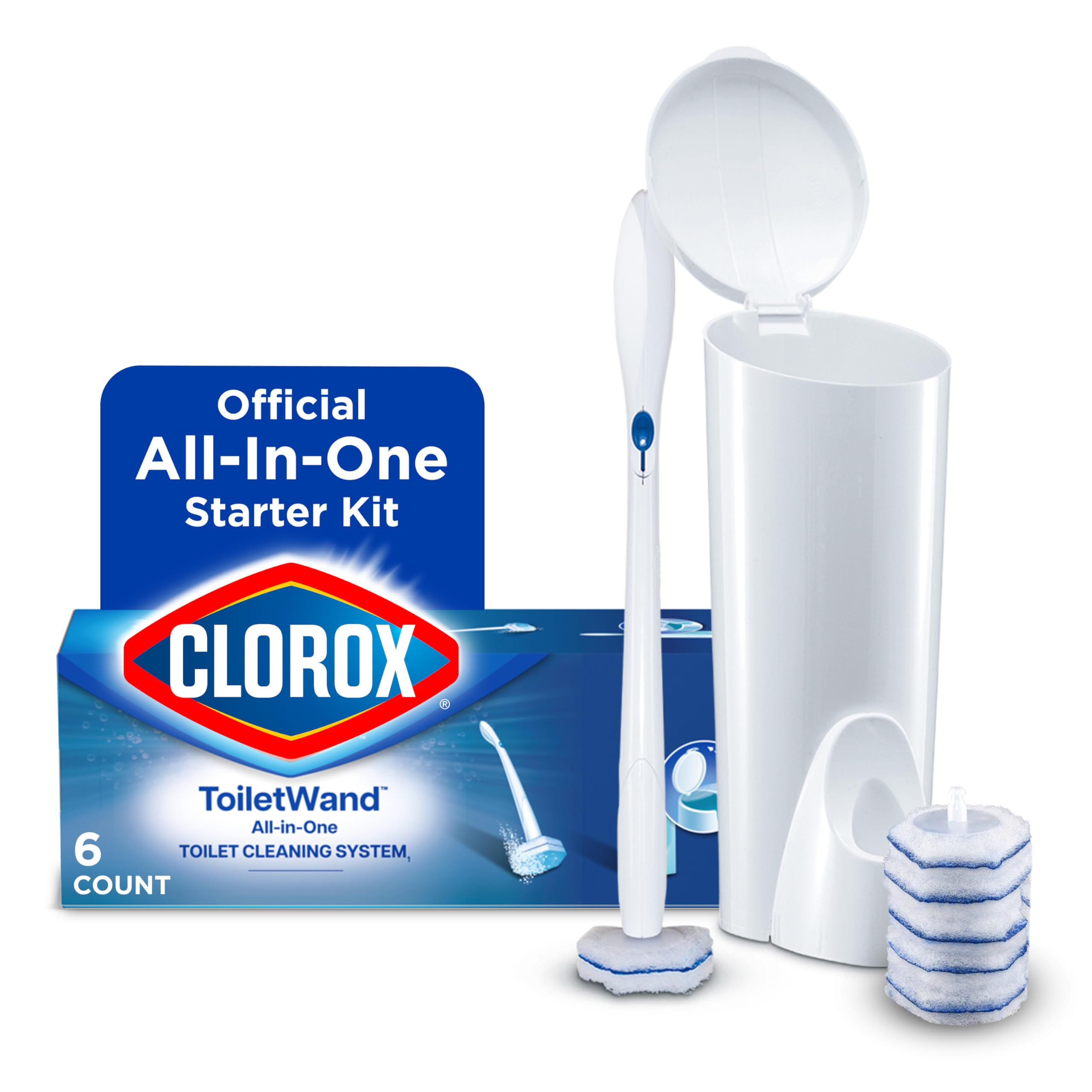
The wand with disposable heads that clicks off into the trash, so you never touch the bowl.
If your main gripe with hard water is the scrubbing and the mess — not a ring that’s been there for a year — this is the cleanest way to do a regular maintenance pass. Each head is a thick sponge pad preloaded with Clorox cleaner, so you load a cleaning solution and the scrubbing surface at the same time instead of juggling a bottle and a brush. The wand reaches 15.31 inches overall, so you get under the rim without kneeling, and the head clicks onto the handle and pops off into the bin when you’re done.
Clorox says the preloaded solution removes hard water and lime stains twice as fast as a toilet brush paired with a manual bowl cleaner, and the thick lathering pads back that up on fresh scale. On a maintenance schedule that’s plenty; on decade-old mineral crust you’ll want the acid-based pick below first. The real selling point for families is hygiene — the pad never goes back into a caddy or a holder, so there’s no damp brush sitting in the corner collecting bacteria. That’s why it’s a common default for weekly bathroom upkeep.
The honest catch is refills. The starter kit includes six heads, and once they’re gone you’re buying pads on a cadence, which some buyers find adds up over a year versus a bottle of liquid. A small number of users also report a head occasionally working loose mid-scrub, so press it on firmly before you go under the rim. The pad-caddy is compact enough for a small bathroom but takes up shelf space in a tight cabinet.
What earns it top spot
- Preloaded cleaner and scrubbing pad in one — no bottle-and-brush juggling
- Head ejects directly into the trash, so your hands stay away from the bowl
- Long handle reaches under the rim without kneeling
- Fresh solution every time means no germ-laden brush left to store
Where it asks more of you
- Ongoing refill cost after the six included pads run out
- More plastic waste per clean than a reusable brush
- A heavy, long-set mineral ring may need an acid product first
Grab this one if: you clean regularly and want the process to be quick, hygienic, and hands-off.
Look past it if: you’d rather buy one bottle and use it for months than reorder disposable heads.
2. Diversey CREW 04560 Toilet Bowl Cleaner

A 23% acid liquid built for rust, lime scale, and the deposits bleach leaves behind.
When a brown or chalky ring has already set, this product goes after the chemistry rather than the elbow grease. It’s a 23% HCI (hydrochloric acid) toilet cleaner — a genuinely acidic formula designed for periodic deep cleaning, not everyday wiping. The acid reacts directly with rust, lime scale, and uric acid deposits, breaking down months-old crust so it lifts with light brushing instead of scrubbing. Diversey lists disinfection against Pseudomonas aeruginosa, Staphylococcus aureus, and Salmonella choleraesuis as part of the job, according to the maker.
The word to remember is “soak.” Squirt it on, give it minutes to work, and the mineral bond breaks down so the stain lifts with light brushing. That’s how it handles deposits that bleach and abrasive pads leave behind. It also coats the bowl surfaces evenly, so the acid sits on the water-line ring instead of draining past it. The 32-ounce bottle gives you enough for several periodic deep cleans, and at 4.2 x 2.1 x 11.38 inches it stores easily on a shelf or in a bucket caddy.
Two things to respect. First, the fumes — it’s an acid, so ventilate the bathroom and keep it off skin and eyes. Second, some owners find it thin enough to run down the bowl wall rather than cling, so you may need to reapply to the upper reaches. Cost also draws mixed opinions, since it’s a smaller bottle than some household cleaners. Neither is a reason to skip it if you have a real limescale problem — but this is a deep-clean tool, not your daily spritz.
What it does best: it dissolves the minerals that ordinary cleaners glide over, so rust and lime rings come up with a soak instead of serious scrubbing. The acid attacks the deposit itself, and a five-minute dwell is often the whole job.
The trade-off to know: an acidic formula means fumes and a bottle that can run thin down the bowl side, so apply it cooler and let it dwell rather than expecting a thick clinging gel.
Reach for it when: you’re facing old rust or limescale and want a hard-clean liquid that does the work on contact.
Pair it with care if: your bathroom is small and poorly ventilated — run the fan and open a window first.
3. Powerstone Pumice Stone Toilet Bowl Cleaner

A recycled pumice stick on a longer handle that scours the water-line ring away.
Some rings simply won’t dissolve, and that’s where physical abrasion beats chemistry. This is a pumice stone on a handle, made from recycled materials and rated 20% denser than the standard stick, so it resists wearing down as fast as cheaper versions. Wet it, drain the bowl so the water doesn’t dilute the work, and rub the stone directly along the mineral line. The 3” longer handle lets you stand back and reach down without kneeling on the floor.
What makes it worth owning is that it doesn’t need a chemical at all. Pumice lifts hard water stains, rings, and limescale from porcelain, and it also works on bathtubs, sinks, and pools — so one tool covers several hard-water headaches. The denser pumice scours the ring without gouging porcelain, as long as you keep the stone wet. It weighs just 6.38 ounces, so it’s easy to control along a curved bowl wall.
The limit is geometry, not grit. The stone is a fixed length, so the area directly beneath the rim is hard to reach — that’s the one place the abrasive approach can’t fully get to. It also wears down over time, and heavy users may find it needs replacing sooner. Still, for a chalky white line at the water level, it’s about as direct as cleaning gets.
Why it wins the ring fight: a pumice stone removes the deposit by friction, so hard-water lines vanish in a few passes with no dwell time and no fumes.
Keep it in mind: the fixed length leaves the under-rim curve awkward, and the stone slowly wears down with repeated use.
Your pick if: you have a hard water line at the water level that acids and gels keep missing.
Not ideal if: the build-up sits mainly under the rim, where the stone can’t quite reach.
4. Don Aslett Safety Foam Toilet Bowl Cleaner

A four-acid foam that clings to the bowl walls to lift mineral build-up under the rim.
If your build-up hides under the rim, a liquid that drains away can’t help you — which is why this one foams. Don Aslett’s Safety Foam blends four acids into a detergent, and the foam stays stuck to the porcelain so the acid has time to work on the mineral layer. You pour it onto a bowl swab or johnny mop, work up the dense foam, and the bubbles adhere across the surface instead of pooling at the bottom.
That clinging action is the point. The formula is built to remove hard water lines and mineral build-up even under the rim, and the maker says a 32-ounce bottle covers up to 20 cleanings at 1-2 ounces per use. You get two bottles in the pack, so it lasts through a season of deep cleans. The four-acid blend targets set toilet rings, and users report bowls looking like new with minimal scrubbing.
The honest catch is application method and smell. You do not pour this directly into the toilet — it goes onto a swab or mop first, so you’ll need that tool on hand. A recurring gripe is the foaming action itself, since not everyone loves how much lather you have to push around, and the acid smell is noticeable. Cost also divides opinion, though the multi-clean bottle makes the value clearer when you factor in the cleaning count.
Why it earns a place: the foaming action is the difference-maker for under-rim build-up, where clinging beats runny. The four-acid formula gives it real mineral-fighting power, and two bottles cover a lot of deep cleans.
What to expect: you’ll need a bowl swab to apply it, the fumes are noticeable, and the lather takes some getting used to.
Choose it if: the staining lives under the rim and you want a foam that stays against the porcelain.
Think twice if: you want a pour-and-walk-away product or you’re sensitive to acid fumes.
Know the Specs
Acid strength (like 23% HCI)
Acid-based cleaners work by reacting with the calcium and magnesium in hard water, breaking the bond that holds the stain to the porcelain. A stronger acid formula reacts faster and can lift rust and heavy lime scale that a mild gel won’t touch. The trade-off is that strong acids need ventilation and careful handling, and they’re best for periodic deep cleans rather than daily use.
Abrasive versus chemical action
A pumice stone removes hard water rings by friction, scraping the mineral layer physically instead of dissolving it. That makes it fast and fume-free, but it works best on flat, reachable surfaces like the water line at the bowl bottom. Chemical cleaners reach where a stone can’t, which is why the two approaches often pair well — acid for the curve under the rim, pumice for the flat ring at the water level.
Foam and cling time
A cleaner only works while it’s in contact with the stain, so cling time matters as much as acid strength. Foaming or thickening formulas hold against the bowl wall rather than draining straight down, giving the active ingredients time to dissolve the mineral layer. That’s why a foam helps on vertical and under-rim surfaces, where a thin liquid would run off before it could do much.
Disposable pads versus reusable brushes
Disposable-pad systems trade ongoing refill buying for hands-off hygiene — each pad is loaded with cleaner and gets tossed after use, so nothing damp or germy stays in your bathroom. Reusable brushes cost less over time but need rinsing and storage. For hard water maintenance that you do weekly, the disposable route keeps the routine quick and clean; for occasional deep cleans, a bottle-and-brush setup is the simpler economy.
Common Questions
Will an acid-based cleaner damage my toilet’s finish?
Can I use a pumice stone on every toilet?
How do I get rid of the hard water ring right at the water line?
Why does my toilet get a hard water ring so quickly?
Is a pumice stone or an acid cleaner better for lime scale?
Can I use these cleaners in a septic system?
Do the disposable Clorox ToiletWand heads fit any handle?
How many uses do I get from the Don Aslett Safety Foam bottles?
Will these cleaners remove rust stains too, or just white scale?
Should I drain the toilet bowl before cleaning hard water stains?
The Bottom Line
For most households, the hard water toilet cleaner winner is the Clorox ToiletWand Starter Kit because it makes routine cleaning quick and touch-free, with a fresh cleaner-loaded pad every time. If you’re fighting an old rust or lime ring that has already hardened, reach for the Diversey CREW 04560 and let the acid soak do the work. And when the stubborn line sits right at the water level, the Powerstone Pumice Stone scours it away without a single chemical.
How we choose
We do not accept paid placement. Every pick is matched to a real buyer and a real use-case; we do not hands-on test units.
Sources
Specifications: manufacturer listings and product documentation. Review insights: verified customer reviews, as of October 2026. Pricing: not shown on this page (it changes often); check the current price via the retailer link.
As an Amazon Associate, Aappliancez earns from qualifying purchases. This does not affect which products we feature.