Disclosure: Some links in this post are affiliate links. As an Amazon Associate I earn from qualifying purchases, at no extra cost to you. Learn more
Specs are compiled from manufacturer listings and verified buyer reviews and can change over time — please confirm the key details on the product page before buying.
If you want one answer: buy the Plaud Note if your recording is mostly meetings and you want transcripts, and buy the Zoom H1 XLR if you need to plug real microphones into a tiny body. Everything else here is a different job. Some units chase 32-bit float (a recording mode that stores such a wide dynamic range you can fix levels after the fact), some chase battery endurance, and one is thin enough to forget you are carrying it. Decide which of those jobs is yours before you spend anything.
This guide is built by comparing the manufacturers’ published specifications and the patterns across verified customer reviews, so you get each pick’s real strengths and trade-offs instead of marketing spin.
Below you get seven recorders split by the work they actually do — pocket AI note takers, XLR field units, and simple dictation machines. The picks that follow cover every realistic budget and use case in this handheld recorder roundup, with the honest catches named for each one.
Top Picks


How To Choose The Best Handheld Recorder
Start with the question every buyer gets wrong: what are you recording? A meeting, a lecture and a live drum kit are three different problems, and no single handheld recorder solves all three well. Name the source first, then compare specs against it.
Match the machine to the source
If your audio is almost always a person talking, a voice-first unit with an app for transcripts will save you hours. If you record music, loud rooms or anything you will sync to video, you want stereo microphones and a way to set levels you trust. That is where 32-bit float earns its keep — it stores a wide dynamic range so a loud surprise does not clip into a ruined take.
If you plan to attach an external microphone, check the input before anything else. A 3.5mm input with plug-in power (a small voltage sent up the cable to drive a compact mic) covers lavaliers and small condensers, while XLR/TRS combo inputs take full-size studio mics and instruments.
The numbers worth checking
Battery hours tell you how long you can roll before worrying about power. Look at the listed figure beside the recording time, because a long standby number and a long recording number are not the same thing. Storage matters too: some units hold audio locally, others want a microSD card you supply. Neither approach is wrong, but one means a trip to the store before your first session.
The ergonomics nobody mentions
You will operate this thing in a hurry, often in low light. Buttons that do not light up, a tiny screen and menu trees that hide the input gain will cost you a take. If you mainly record in busy rooms, a tactile record button you can find blind is worth more than an extra menu option.
Side-by-Side Comparison
| Model | Best For | Recording Spec | Battery Life | Storage / Inputs | Amazon |
|---|---|---|---|---|---|
| Plaud Note AI Voice Recorder★ Best Overall | Meeting capture with auto transcripts | WAV, 112-language transcription | 30 hours | 64GB local, Bluetooth | Amazon |
| Zoom H1 XLRTop Performer | Filmmakers who need XLR mics in a pocket | 32-bit / 96kHz WAV | 10 hours | 1TB SDXC, 2x XLR/TRS | Amazon |
| TASCAM DR-07XP | Budget intro to 32-bit field recording | 32-bit float / 24 / 16-bit, 96kHz | 17 hours | 512GB microSD, 3.5mm in | Amazon |
| Zoom H4 Essential | Four-track music and podcast projects | 32-bit float, 4 tracks, 44.1–96kHz | 10 hours | 1TB SD, 2x XLR/TRS | Amazon |
| Plaud NotePin S | Wearable always-with-you notetaking | MP3, 112-language transcription | 20 hours | 64GB local, Bluetooth 5 | Amazon |
| Olympus WS-883 | Long-session lectures and interviews | Linear PCM / MP3 | 68 hours | 8GB built-in, USB-A | Amazon |
| Olympus WS-882 | Simple one-hand dictation | Linear PCM / MP3 | 68 hours | 4GB built-in, USB-A | Amazon |
Detailed Reviews
1. Plaud Note AI Voice Recorder
Our pick — 4.5+★ from 5,000+ verified ratings; the strongest balance of quality and price.
A card-slim note taker that turns a two-hour meeting into a summary you can actually use.
Here is the recorder for the person who leaves a meeting and cannot remember who agreed to what. The Plaud Note is 0.12 inches thin and 1.06 oz light, so it sits against a phone or in a shirt pocket without announcing itself. It records up to 30 hours continuously, which covers a full conference week on one charge, and holds up to 64GB of audio locally so a dead Wi-Fi signal never stops a session.
What people actually come back for is the app side. Recordings land as transcripts in 112 languages, and you pick from over 10,000 professional templates to spin a conversation into a mind map or a to-do list. As buyers report, it “accurately transcribes 6+ person meetings with voice tagging.” That is the pitch: you stop writing notes and listen instead. The dual-mode recording switches between phone call and in-person modes, with a vibration conduction sensor (a part that reads sound through the phone body) for cleaner call capture.
What wins people over is how much it does without a screen. Reviewers praise its functionality first and its reliability second — it works every time you press the button. The catch is the subscription. The free Starter Plan covers 300 transcription minutes a month, and going past that means the Pro or Unlimited tier. Budget for that recurring cost before you commit, because the hardware alone does not open up the summaries.
Where it earns its place
- 0.12-inch body and 1.06 oz weight disappear in a pocket
- 30 hours of continuous recording with 64GB of local storage
- 112-language transcripts plus over 10,000 summary templates
- Screenless design with dual-mode call and in-person capture
What to know going in
- Free plan stops at 300 transcription minutes a month
- Premium AI features sit behind a paid tier
- The charging port is small and easy to fumble
Buy this if: your recording is mostly people talking and you want the transcript written for you.
Keep looking if: you need XLR inputs for a real microphone — the Plaud has none.
2. Zoom H1 XLR Recorder
Two real XLR inputs on a body that slips into a jacket pocket.
Skip the built-in microphone debate entirely. The H1 XLR gives you two XLR/TRS combo inputs so you can plug a shotgun mic, a lapel, a mixing board or an electric instrument straight in. It records in 32-bit float at 96kHz, a mode that keeps quiet and loud audio in the same take without clipping, so a surprise laugh does not blow out the dialogue you actually needed.
Against the TASCAM DR-07XP below, this is the more flexible box for anyone who owns microphones. Both top out at 32-bit float, and the TASCAM adds 24-bit and 16-bit modes plus 44.1kHz and 48kHz options for simpler jobs. The Zoom counters with those dual XLR inputs, an OLED waveform display so you can see levels at a glance, and SDXC support up to 1TB for long shoots. Its 3.5mm stereo input and headphone output let you monitor while you roll.
The consensus among owners is that the audio quality is the star, with compact size and ease of setup right behind it. Wedding and live-event shooters keep making the same point: 32-bit float forgives a bad level in post, and two AA batteries outlast heavier four-cell rigs. The trade-off is the screen. It is small, the buttons do not light up, and it takes a short while to learn the layout in a dark room. Budget around 10 hours of battery and good-quality AAs — cheap cells fade fast under phantom-powered mics.
Why shooters reach for it: 32-bit float at 96kHz means a clipped take is almost never the reason you reshoot, and the XLR/TRS inputs cover the mics most freelancers already own.
The screen caveat: a tiny OLED and unlit buttons make it fiddly until you learn the layout, and 1TB SDXC support only pays off if you bring your own card.
Reach for this if: you already own XLR microphones and want pro capture without a bag full of gear.
Look elsewhere if: you record in near-total darkness and need backlit controls.
3. TASCAM DR-07XP Recorder

The field recorder that doubles as a two-in, two-out audio interface for your laptop.
Storage is the headline here, and the gap is enormous. This TASCAM takes microSD, microSDHC and microSDXC cards up to 512 GB, while the Olympus WS-883 below tops out at 8 GB built in — a 64.0x difference in raw capacity. For a podcaster or sound designer who wants one card to hold months of sessions, that is the deciding number.
The stereo AB/XY condenser microphones handle sources up to 125dB SPL (a measure of how loud a sound can get before the mic distorts), so a drum kit or a loud room does not flatten the take. Recording modes run across 32-bit float, 24-bit and 16-bit at 96kHz, 48kHz or 44.1kHz, plus MP3, which is more flexibility than most field recorders at this level. Plug it into a computer over USB-C and it becomes a 2-in/2-out audio interface, so it works as your desk mic as well as your field rig.
Owners most often single out the recording quality, and the specific praise is telling: 32-bit mode lets you adjust gain with almost no added noise or distortion. That is the real benefit — a badly set level is a fixable problem rather than a trashed file. The honest catch is handling noise. The built-in mics are not shock-mounted, so fingers on the body travel into the recording, and the menu takes some learning. Mount it on a stand and the issue largely goes away. Expect up to 17 hours on 2 AA alkaline batteries, which you supply.
Best at this price: 32-bit float recording plus a 2-in/2-out USB-C interface in one handheld body, with 512GB card support that dwarfs the Olympus units.
Handle with care: the mics are not shock-mounted, so hand-held grabs pick up bumps — use a stand for clean field audio.
Fits best: beginners and podcasters who want 32-bit safety without a big rig.
Think twice if: you record handheld in motion or want a card and batteries in the box.
4. Zoom H4 Essential Recorder

A four-track studio in your hand for the price of a two-track field unit.
Four tracks is the reason to pick this over the H1 XLR. You can lay down a stereo performance on the built-in X/Y mics, then add two more sources through the XLR/TRS inputs — a vocal mic and a guitar, say — without bouncing anything. Recording runs at 32-bit float across 44.1–96kHz sample rates, so clipping is handled the same forgiving way.
It also solves a problem most recorders ignore. Spoken menu guidance talks you through settings, which makes it usable for visually impaired creators and simply easier for anyone fumbling with a menu at a gig. Recording to your phone, tablet or computer over USB-C while a backup copy writes straight to SD card means a cable failure never costs you the take. SD support reaches 1TB.
What owners praise most is the audio quality, and the specifics back it up: detailed built-in stereo mics with strong stereo imaging and clean preamps. Condenser and 24V phantom mics sound excellent through it. One recurring honest note — high-gain dynamic mics such as an SM57 need a separate clean preamp to avoid hiss, so know your mic before you buy. Battery life is the other thing to plan around; at the highest quality setting it records for a limited stretch, though it auto-saves and starts a fresh file so you never lose everything. USB power is an option for long sessions.
Why the extra tracks matter
- 4-track recording with 32-bit float at 44.1–96kHz
- Two XLR/TRS inputs plus built-in stereo X/Y mics
- Spoken menu guidance for accessible operation
- Records to your device and SD card at the same time
Before you buy
- High-gain dynamic mics need a clean preamp to stay quiet
- Battery life is modest at top quality — bring USB power
- Buttons are small with little labelling
Pick it when: your project needs more than two sources captured at once.
Not your unit if: you only ever record one voice and want the simplest possible box.
5. Plaud NotePin S Voice Recorder
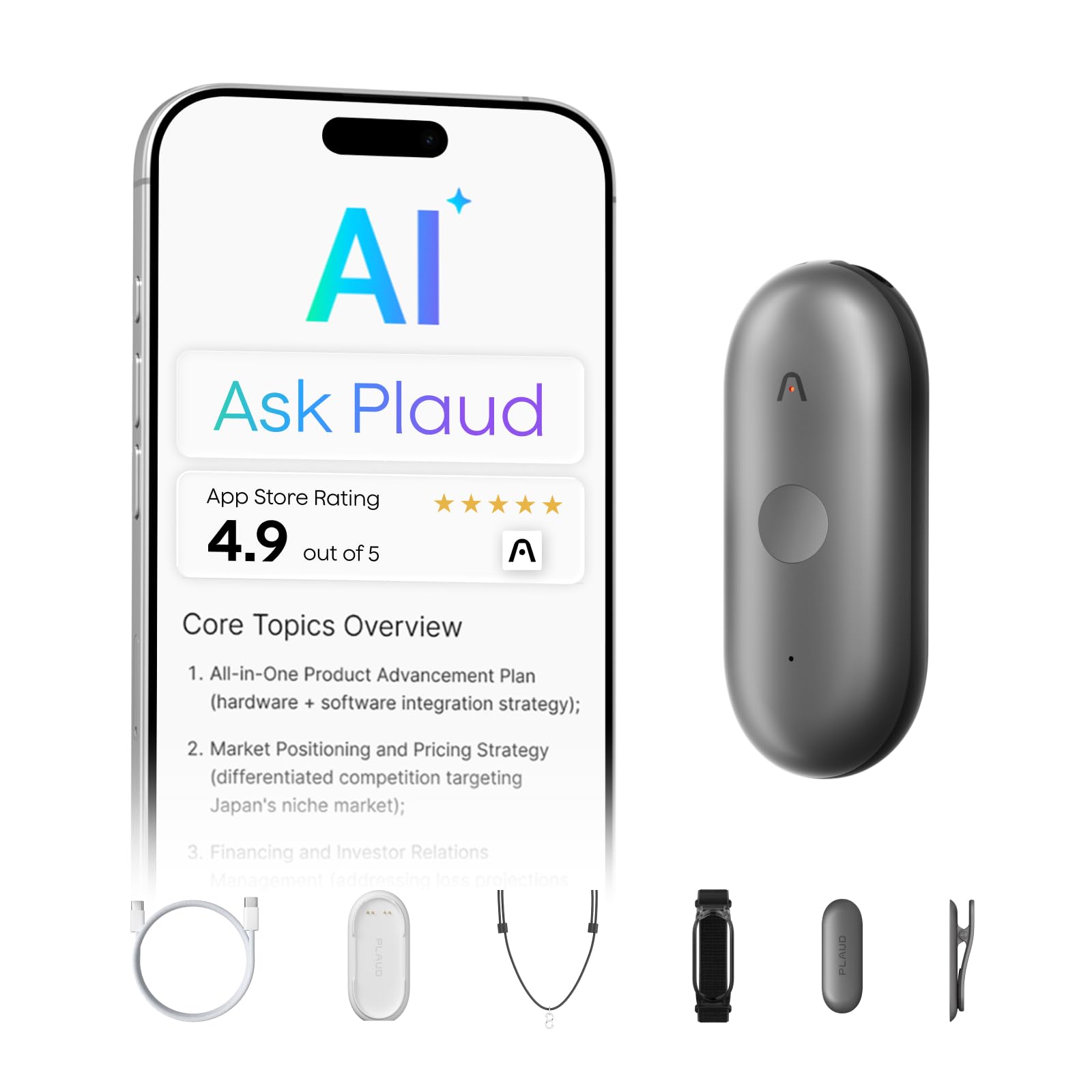
Wear it as a necklace or a pin and forget it is recording until you need the notes.
The NotePin S solves a problem the flat Plaud Note does not: getting the recorder onto your body so your hands stay free. At 0.61 oz it disappears on a lanyard, wristband, clip or pin, all four included in the box. A dedicated physical record button gives you a tactile press, and haptic feedback buzzes once to start and twice to stop, so you know it is running without looking.
Endurance is the stronger number here than on the Note. Plaud rates this one at 20 hours of continuous recording and 40 days of standby, against the Note’s 30 hours of recording — so the slimmer sibling actually rolls longer before it needs a charge. On the verified comparison figures, that 20-hour figure still sits under the 30-hour recording time of the Plaud Note, which is the trade for wearability. You still get 64GB of local audio for offline capture, plus the same 112-language transcription and 10,000-plus templates through the app.
Owners mention it changes the meeting itself: no scribbling, no half-listened conversation, just full attention and clean summaries afterward. Meeting recording and summarization are both heavily praised, and the accuracy holds up well enough for professional use. Where it divides opinion is the subscription, since the free Starter Plan gives 300 transcription minutes a month and the Pro tier runs 1,200. Some transcription names occasionally slip, so proofread serious documents. Wear it behind a name badge and it goes unnoticed.
What sells it: four included wear options, a physical record button with haptic confirmation, and Find My location built in — a genuinely hands-free way to capture a room.
The trade you accept: 20 hours of recording beats most rivals but trails the Plaud Note’s 30, and the paid tiers matter once you outgrow the free monthly minutes.
Made for: anyone in back-to-back meetings who wants notes without holding anything.
Wrong pick if: you need long uninterrupted field recordings or refuse a subscription.
6. Olympus WS-883 Voice Recorder

Weeks of lectures on one set of batteries, with a USB plug that slides out of the body.
This is the recorder for a semester of lectures or a long interview schedule. Olympus rates it at 68 hours of battery life, and the 8GB of built-in memory stretches to a maximum recording time of 2,080 hours in its most compressed mode. Plug the retractable USB-A straight into a laptop and it charges and offloads files with no cable to lose.
True stereo microphones, a low-cut filter (a setting that trims rumbling background noise) and Linear PCM plus MP3 formats give you a clean voice-focused capture. The 8GB is double what the WS-882 below carries, which matters if you record every day and hate clearing space. A 3.5mm headphone jack lets you spot-check audio, and the small built-in speaker is clear enough to verify a file on the spot.
What earns the most praise is the quality of the recordings themselves — clear, reliable voice capture with a battery that outlasts most schedules several times over. The recurring gripe is the menu, which some users find hard to navigate and, in some copies, arrives set to Japanese. Learn the layout once with the manual and it stops being a problem. Durability draws mixed notes, so treat the body with a little care. Copy MP3 files off regularly and 8GB is plenty.
The long-haul case: 68 hours of battery and 8GB built in means you can forget the charger for a week and still have room to record.
One thing to sort early: check the menu language on day one, since some units ship with Japanese menus that you will want to switch.
Best for: students, journalists and interviewers who record for hours and charge rarely.
Not ideal: musicians needing high-resolution stereo field audio.
7. Olympus WS-882 Voice Recorder

One-handed dictation that picks up the quietest voice in the room.
The WS-882 keeps it simple: press record, talk, plug the USB-A straight into a computer. It carries 4GB of internal memory and 1,040 hours of maximum recording time in its compressed mode, and it runs on the same 68-hour battery rating as the WS-883 above. Add file indexing and erase-selected-files controls and it covers the basics of everyday voice work without a menu deep-dive.
The one thing this machine does unusually well is quiet detail. It picks up a soft-spoken source across a room, which suits interviews, lectures and any setting where you cannot lean in close. Linear PCM and MP3 give you a choice between quality and file size. Stereo recording handles a wide space better than a single-mic dictation unit, and the status light and battery indicator tell you at a glance that it is working.
The most-praised quality is its pickup of faint sounds, and the practical notes matter here. It reads a microSD card only up to 32GB and has no USB recharging, so you swap 2 AAA batteries rather than plug in. The screen has no backlight, which makes it hard to read in dim rooms, and the manual is thin. None of that hurts straightforward voice capture, but if you want USB recharging, step up to the WS-883. At this price it is the sensible first voice recorder.
Go here if: you want dependable voice capture with the least fuss and the least spend.
Look up if: you need a backlit screen or built-in battery charging.
Know the Specs
32-bit float recording
This is a recording mode that stores a much wider dynamic range than the older 16-bit or 24-bit formats. In plain terms, you can set the level badly and still fix it afterward without the hiss or clipping you would get on a standard take. If you record unpredictable audio — a loud gig, a quiet interview — 32-bit float is the safety net that keeps the take usable.
XLR/TRS combo inputs
These are the full-size connectors used by studio and field microphones and instruments. A combo jack accepts either an XLR cable or a quarter-inch plug, so one input covers both. If you plan to use anything better than the built-in mic, having two of these is the single most important upgrade a handheld recorder can offer.
Battery hours versus recording time
Two numbers appear on many listings and they are not the same. Battery life is how long the unit runs, and recording time is how much audio its storage can hold. A long battery figure with limited memory still means you stop to offload files. Check both before planning a long day of capture.
Plug-in power on a 3.5mm jack
A small voltage sent up the cable to power compact microphones such as lavaliers. It lets you attach a tiny clip mic without a separate battery box. If you record interviews and want the mic on a collar rather than in your hand, this feature is what makes it possible on a recorder without XLR inputs.
Common Questions
Do I need 32-bit float if I only record meetings?
Can the Plaud Note record without an internet connection?
What is the difference between the Zoom H1 XLR and the Zoom H4 Essential?
Does the TASCAM DR-07XP come with a memory card?
Can I use a handheld recorder as a USB microphone on my computer?
Can I add a microSD card to the Olympus WS-883 or WS-882?
Do the Plaud recorders charge a subscription to get transcripts?
Which recorder has the longest battery life?
Will a handheld recorder pick up both sides of a phone call?
The Bottom Line
The strongest all-rounder in this handheld recorder lineup is the Plaud Note, because it turns speech into transcripts and summaries without you taking a single note. If you plug in real microphones, the Zoom H1 XLR gives you dual XLR inputs and 32-bit float in a pocket-sized body. And for hours of lecture capture on one charge, the Olympus WS-883 is the one to reach for. Buy for the job you actually record and one unit covers it.
How we choose
We do not accept paid placement. Every pick is matched to a real buyer and a real use-case; we do not hands-on test units.
Sources
Specifications: manufacturer listings and product documentation. Review insights: verified customer reviews, as of October 2026. Pricing: not shown on this page (it changes often); check the current price via the retailer link.
As an Amazon Associate, Aappliancez earns from qualifying purchases. This does not affect which products we feature.