Disclosure: Some links in this post are affiliate links. As an Amazon Associate I earn from qualifying purchases, at no extra cost to you. Learn more
Specs are compiled from manufacturer listings and verified buyer reviews and can change over time — please confirm the key details on the product page before buying.
You want your kid to gasp at a spider’s eyes, not squint at a blurry screen. That quiet moment only happens when the focus wheel actually cooperates — and plenty of these pocket microscopes make your child fight the dial instead of exploring. The picks below were chosen for one thing above all: a bright 2-inch screen your kid can actually see, and a focus that turns smoothly enough for small hands.
This guide is built by comparing the manufacturers’ published specifications and the patterns across verified customer reviews, so you get each pick’s real strengths and trade-offs instead of marketing spin.
A pocket scope that shows a leaf’s veins in color gets used; a lab-style scope stays on the shelf. Below, the real differences in magnification, storage, and battery that separate a toy from a tool for a child, and how to pick the best handheld microscope for kids.
Top Picks
How To Choose The Best Handheld Microscope for Kids
At a glance the five look alike: a small screen, a focus wheel, a plastic body. The differences that decide whether your child uses it for ten minutes or ten months hide in three places — the screen, the focus, and the lighting.
Start with the screen, not the magnification
Every pick here carries a 2-inch display, and that is no accident. A 2-inch IPS screen (a bright, wide-viewing display that shows the image flat, the way a phone screen does) lets a 5-year-old look at the picture without pressing an eye against a lens. That flat screen is why parents and grandparents end up borrowing it. When a screen is too small, a curious kid loses interest fast — a grandmother noted exactly that after a gift went over flat.
Treat the 1000X claim as a ceiling, not a promise
All five units list a 1000X maximum magnification, but a maximum is what the electronics can push, not what the optics deliver cleanly. Buyers who tested one of these models against a ruler reported far less usable magnification than the box suggested. The practical read: judge these scopes by how crisp the image looks at a comfortable distance, not by the biggest number printed in the listing.
Lighting and focus are the daily-use specs
Count the LEDs before you buy. Eight adjustable LED lights behind a diffuser mean your child can study a beetle at dusk or a coin under the sofa without hunting for sunlight. Then think about the focus wheel — every unit here uses a twist-to-focus dial, and smooth travel is the difference between a child working it alone and a parent constantly stepping in. A model with a coarse-and-fine dual dial gives wobblier hands more room to learn.
Side-by-Side Comparison
| Model | Best For | Screen | Magnification | Storage | Amazon |
|---|---|---|---|---|---|
| Acoath Microscope for Kids 1000X★ Best Overall | Curious kids who want a drop-resistant everyday scope | 2-inch HD IPS | 1000X max | 200 photos built-in (card for video) | Amazon |
| BMDSAE 1000X Pocket MicroscopeMost Gift-Ready | Families who want a gift-ready scope with a safety pedigree | 2.0-inch IPS | 1000X max (2MP camera) | 32M storage / 200+ photos | Amazon |
| SKYBASIC 2-inch IPS Handheld Microscope | Nature walks and houseplant pest checks | 2.0-inch IPS | 1000X max | 400 photos built-in (card for video) | Amazon |
| Ashfly 1000X Portable Magnifying Glass | Budding scientists aged 5-7 who want fun first | 2-inch HD IPS | 1000X max | 400 photos, no card needed | Amazon |
| WINWEND Kids Pocket Microscope | Share-the-fun scopes the whole family grabs | 2-inch digital | 100X-1000X range | 400 photos (card for video) | Amazon |
Detailed Reviews
1. Kids 1000X Handheld Digital Miniscope
Our pick — 4.5+★ from 1,000+ verified ratings; the strongest balance of quality and price.
The pocket scope a three-year-old can grab and focus without a grown-up hovering.
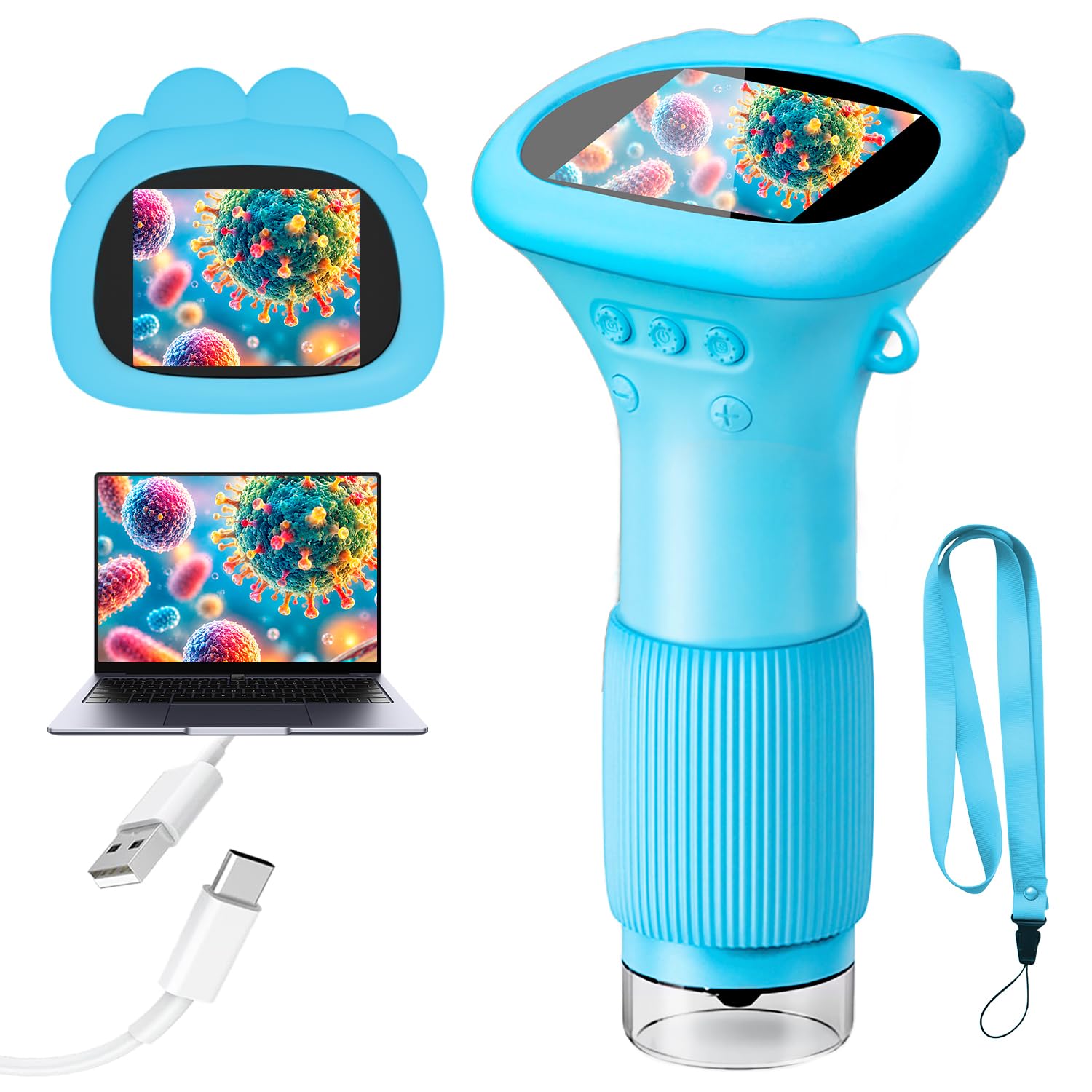
What makes the Acoath the pick at the top is how little help a child needs to get a picture. Press and hold the power button, then twist the focus wheel, and a leaf or a beetle snaps into a sharp image on the 2-inch HD IPS screen. No eyepiece to press against, no slides to set up. Kids from three and up are the stated audience, and the hands-on design backs it up.
The screen is the headline, but the build is what keeps it in the toy rotation. A removable, drop-resistant screen protector shields the display during playground tumbles, and a 50 cm lanyard keeps it swinging on a small shoulder rather than lying in the dirt. At 130 g it stays light enough for a child to carry on a whole walk. Inside, there is room for up to 200 photos with no card at all, and a memory card slot opens up video when your young scientist wants to record a whole bug hunt.
Lighting is where this one comfortably out-features its neighbours. Eight adjustable LED lights with three brightness modes mean your child can chase a snail at dusk or peer at a stamp under a table without the image going dark. Hook it to a laptop with the Type-C cable and it turns into a real-time display for the whole family to watch together — the kind of group moment owners keep describing. It pairs with Windows Vista through 11 and macOS X 11.0 or later. It holds 4.5+ stars across 1,000+ ratings, the strongest review record of the five.
What wins the room
- Eight adjustable LED lights in three modes keep the image bright in dim rooms and outdoors.
- Built-in storage for up to 200 photos, so discoveries save without a memory card.
- Type-C computer connection turns it into a shared big-screen view for the family.
- Drop-resistant screen protector and 130 g weight suit small, clumsy hands.
What to know before you click buy
- The buttons take a moment to learn — most kids figure them out without the manual.
- It is built for finding objects in the world, not stacking traditional glass slides.
Grab this one if: you want the safest all-rounder — bright screen, shielded display, and light enough to trail a child around the yard.
One honest limit: the button layout asks for a little patience on day one, and it is an explore-the-world scope rather than a slide-and-lens kit.
2. 1000X Handheld Digital Microscope 2.0″ IPS
A gift box, a safety pedigree, and oversized dials built for uncoordinated little fingers.
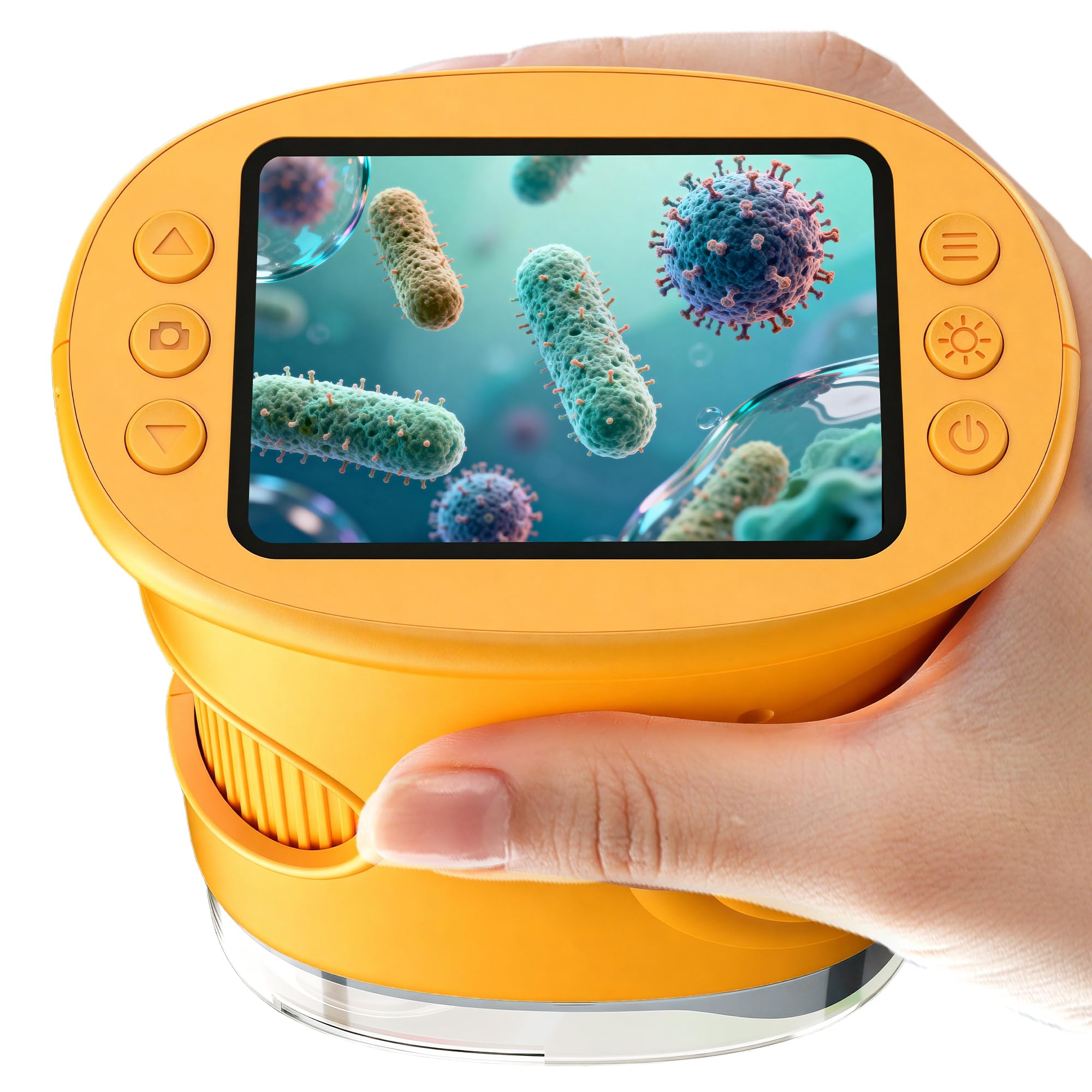
The BMDSAE arrives in gift-ready packaging and carries CE/FCC/CPC safety certifications, which is the kind of detail that matters when you are handing a device to a preschooler. The housing is eco-friendly ABS plastic with smooth, odorless edges, and the oversized focus dials are sized for hands that are still learning coordination. A shock-absorbent rubber casing is designed to survive playground drops.
Performance is where this one holds its own. It uses a 2MP camera for images and the same 2.0-inch IPS display for viewing, with an anti-shake design to keep a wired-up kid from losing the framing. The 8-LED system runs in Off, Medium, and High brightness modes with a diffuser to kill glare. Its 600mAh battery is rated for two hours of use and runs off USB or a portable charger for longer sessions.
Storage is generous next to the Acoath: 32M built-in holds 200+ high-res photos or AVI video, all exportable to Windows XP through 11 or Mac 11.0 and up. This is the pick where the honest caveat is biggest — the 1000X promise does not survive scrutiny. As the review pages sum it up, one tester: “NOT 1000x. In reality I measured it scientifically at 41X.” Kids still love it and it still shows individual thread fibers and fingerprints, but buy it for the fun and the safety build, not the number on the box.
Where the money goes: the safety certifications, the shock-absorbent shell, and the oversized dials are the real value — this is the toughest-feeling scope of the group for the youngest users.
The magnification reality: owners who tested it found the usable zoom far below the advertised ceiling. Think of it as a detail viewer for tricky small things, not a lab instrument.
Reach for this if: you need a birthday or holiday gift that arrives sturdy, certified, and boxed to impress.
Look elsewhere if: true high magnification is the draw — the claimed ceiling is the weakest link here.
3. SKYBASIC 2″ IPS Screen 1000X Handheld Digital Microscope
The scope that turns a houseplant mystery into a bug you can actually name.
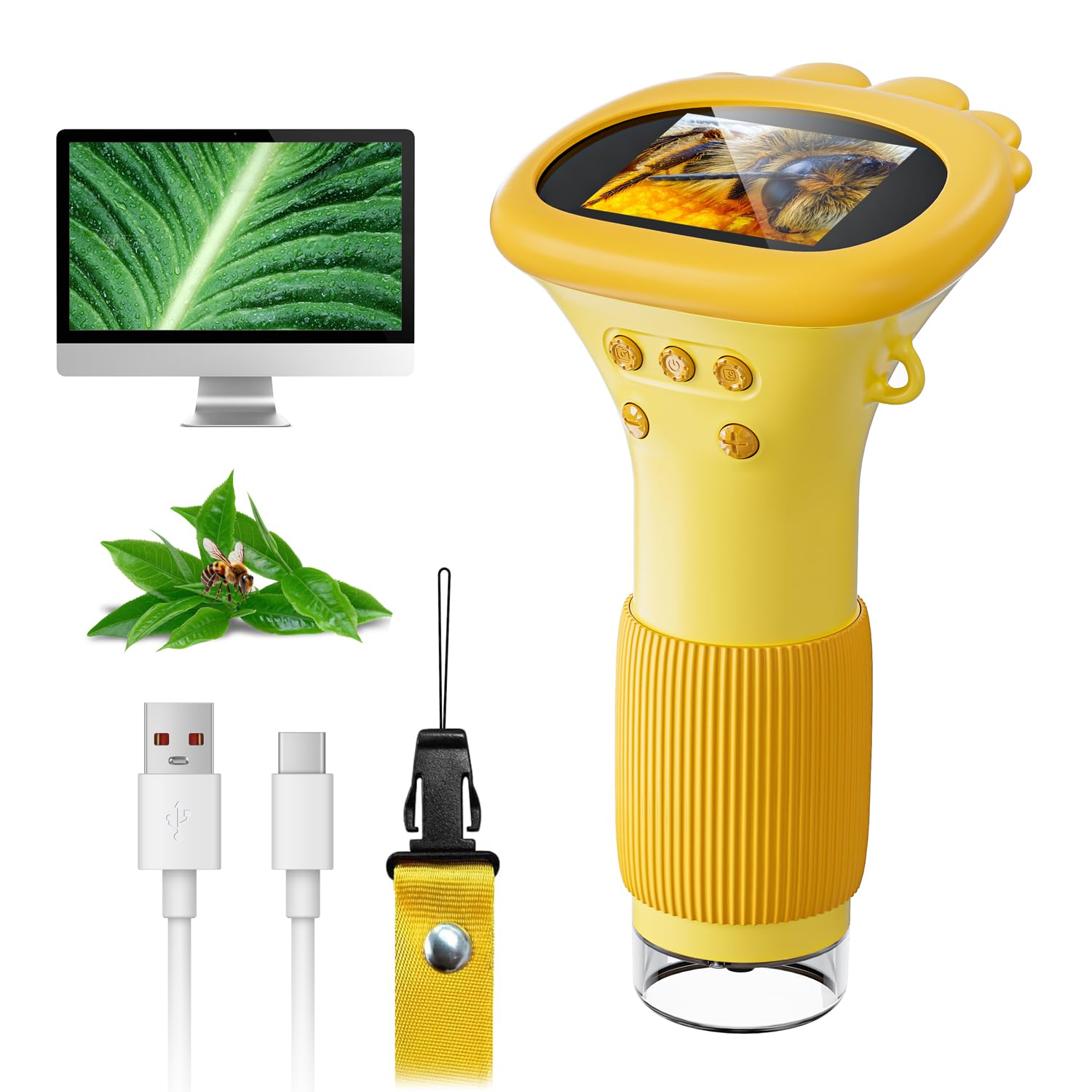
Here is the very specific buyer this one suits: a parent or kid who keeps plants, spots something crawling on a leaf, and wants to see it close. The SKYBASIC’s 2.0-inch HD IPS screen makes small crawling pests legible in real time, and the built-in dimmable LED light lets it work in a shaded corner. The 8 LED lights are adjustable, the build fits small hands, and the 130 g body heads outdoors on a lanyard without dragging.
Storage is the standout number here: room for 400 photos with no memory card at all. Video needs a TF card slipped in, which is a common omission note before you hand it over. The focus wheel turns to bring detail into view, and the device can jump to a computer over USB for a larger view — support runs to Windows Vista through 11 and macOS X 11.0 or higher.
The honesty note here is charging, not optics. from the start the battery may not be topped up, and buyers who gifted one without pre-charging found the wait deflating. A couple of units ran warm during charging and shut off, which is a reason to charge it on a counter rather than overnight. Give it a full charge the night before the birthday, and the surprise lands the way it should. For clarity, this scope’s crisp images and easy focus land it squarely in the same league as the two picks above.
Why it earns a spot
- Room for 400 photos built in, no memory card required for stills.
- Dimmable LED lighting lets kids study dark objects in low light.
- Detachable screen decoration and a lanyard make it carry-friendly outdoors.
- Smooth focus wheel brings detail into view without a fight.
Heads-up for gifting
- Arrives uncharged — top it up the night before you hand it over.
- Video recording needs a TF card that is not in the box.
Best fit for: backyard explorers and plant owners who want to name what is nibbling the leaves.
Plan around: the charge-and-card setup — do it before the wrapping paper comes off.
4. Ashfly 1000X Portable Magnifying Glass

Point it at a dead fly on the patio and a five-year-old is hooked.
The Ashfly’s 2-inch high-definition viewing screen renders colors richly, and the built-in storage for 400 photos means a discovery gets saved without hunting for a card. Three-level adjustable LED lighting keeps the image visible whatever the light outside is doing. It comes with a detachable screen decoration kit and a 50 cm lanyard, so it tags along on outdoor play and does not get lost in the grass.
What makes this one the budget-friendly hero is how much fun it delivers for the price. Kids point it at a dead fly and see every detail; they point it at their own hair and marvel. A young grandson even fixated on the eyeballs of whatever he found, and the whole family tends to grab it back. The 2-inch HD IPS eye-protection screen is easy on young eyes, and photos can be snapped and saved right from the scope.
The honest trade-off is focus independence. Some younger, smaller kids need an adult to help dial in sharpness at first, and the initial setup may need a hand. That is a learning curve, not a flaw — older kids in the 5-to-7 range warm to it quickly and get sharper with practice. Weight sits at 0.24 kg, light enough to carry all afternoon.
The fun factor: this is the pick that gets pointed at everything in the house and yard — the kids’ excitement is the whole point of the category, and it delivers.
The learning curve: the finer focus dial rewards a little adult coaching at first, so plan to sit with the youngest users for the opening session.
Pick it for: a five-to-seven-year-old who wants to poke the scope into everything and needs a scope that saves the moment.
The one snag: the very youngest kids may need you to steady the focus at first — easy to fix with ten minutes together.
5. WINWEND Kids Microscope Pocket Microscope

A 100X-1000X range and six brightness levels make it the one parents borrow.
Unlike the fixed-maximum scopes above, the WINWEND advertises a 100X-1000X magnification range, which means more room to sweep from a whole coin down to a single groove. A dual focusing system — coarse and fine dials working together — brings a specimen into view quickly. The 2-inch digital screen shows the image flat, so a child looks at a picture rather than squinting into a lens.
Plug in a USB cable and the view jumps to a PC screen, so the whole family can crowd around instead of one child squinting alone — buyers report grown-ups aiming it at their own grimy windowsills. The honest limits are the screen and the top-end zoom. The display sits on the low-resolution side, and zoom past the optical range is digital (software enlargement, not real lens power), so pushing to the advertised ceiling looks soft. One frustrated buyer put it plainly: “I would gladly pay triple for the same thing with a higher resolution screen and better magnification.”
The case for it
- A 100X-1000X range with coarse and fine focusing gets a specimen sharp quickly.
- Eight LEDs across six brightness levels keep the image clear in dim light.
- 400-photo storage with a card slot for video, plus a wrist band against drops.
- Weighs under 300 grams and suits both kids 5-12 and adults.
The honest catch
- The screen resolution is modest, so fine detail needs a steady hand.
- The top of the zoom range is digital, so pushing to the ceiling softens the image.
Go for this if: you want a scope the whole family passes around, with the most lighting adjustment of the group.
Skip the upgrade if: screen sharpness matters more than brightness — the display here is the trade-off.
Know the Specs
Magnification (the X number)
The “1000X” on the box is the maximum the electronics can push, not what you will see cleanly on a leaf. These scopes combine optical zoom with digital zoom, and the digital portion softens the image as it climbs. Judge a pick by how crisp the picture looks at a comfortable working distance. In practice, a scope that shows individual thread fibers, fingerprints, or a fly’s eye detail is doing its job, even if a ruler test comes up well short of the ceiling.
The IPS screen size
Young kids can actually use these scopes because of the 2-inch IPS display. IPS (in-plane switching, a screen type with a wide viewing angle) keeps the picture bright and clear when your child tilts the scope or a sibling leans in. The phone-style flat screen means no eyepiece pressed against the face, which is kinder to a fidgety three-year-old. Shrink the screen and interest drops fast, so the 2-inch class is the balance for a shared family viewing session.
Built-in photo storage
Storage decides whether a discovery is kept or lost. Several picks save up to 200 photos internally; others hold 400 without a card. Video almost always needs a memory card slipped in, and that card is rarely in the box. If your child wants to record a hunt, check the card slot and buy the card separately. A larger built-in store means fewer lost moments and less fuss for parents.
The LED light and the focus dial
Eight adjustable LED lights behind a diffuser are the standard here, and more brightness levels mean better results in dim light. The focus wheel is the part your child touches most — a smooth twist-to-focus dial, ideally with both coarse and fine settings, is what turns a novelty into a tool. If focus fights back, an adult ends up taking over, and the whole point of a kid’s scope is lost.
Common Questions
What magnification do these handheld scopes actually deliver?
Will the scope work for a three-year-old, or is that too young?
Do I need to buy a memory card to save photos?
Can these scopes connect to a computer for a bigger view?
How do I charge it, and does it come ready to use?
What is the difference between an IPS screen and a regular screen on these scopes?
Can these microscopes view traditional glass slides with specimens?
How long does the battery last on a handheld kids microscope?
Are these microscopes safe for young children?
The Bottom Line
For most families, the best handheld microscope for kids is the Acoath 1000X Handheld Miniscope. It pairs a bright 2-inch IPS screen with a drop-resistant protector, three lighting modes, and 200-photo storage in a 130 g body your child can carry all afternoon. If handing over a gift with confidence matters most, the BMDSAE 1000X Pocket Microscope brings certified safety, a shock-absorbent shell, and gift-ready packaging — just do not bank on the 1000X ceiling. Want a scope the whole family will wrestle over? The WINWEND Kids Pocket Microscope answers with a 100X-1000X range and six brightness levels. Whichever you pick, pre-charge it before the surprise and add a memory card if video is on the wish list — that small bit of setup turns a toy into an afternoon of discovery.
How we choose
We do not accept paid placement. Every pick is matched to a real buyer and a real use-case; we do not hands-on test units.
Sources
Specifications: manufacturer listings and product documentation. Review insights: verified customer reviews, as of October 2026. Pricing: not shown on this page (it changes often); check the current price via the retailer link.
As an Amazon Associate, Aappliancez earns from qualifying purchases. This does not affect which products we feature.