Disclosure: Some links in this post are affiliate links. As an Amazon Associate I earn from qualifying purchases, at no extra cost to you. Learn more
Specs are compiled from manufacturer listings and verified buyer reviews and can change over time — please confirm the key details on the product page before buying.
The camera that makes your vlog look professional is the one that keeps you in focus while you move and holds steady when your hands don’t. A vlogging camera lives or dies on three specs: stabilization for walking shots, face-tracking autofocus, and battery run time.
This guide is built by comparing the manufacturers’ published specifications and the patterns across verified customer reviews, so you get each pick’s real strengths and trade-offs instead of marketing spin.
Below you’ll find picks grouped by what they actually do best, from gimbal-stabilized pocket cameras that stay centered on your face to mirrorless bodies with swappable lenses. Every entry is weighed on stabilization type, autofocus tracking, sensor size, battery run time, and whether the audio is usable without a separate recorder — the things that decide whether a handheld camera for vlogging earns its place in your bag or sits in a drawer.
Top Picks


How To Choose The Best Handheld Camera for Vlogging
Start with how you film. If you walk, talk, and gesture while the camera rolls, stabilization is your first filter, because shaky footage is the fastest way to lose a viewer. If you sit at a desk and talk to a lens, autofocus and audio matter more than gimbal hardware.
Stabilization: Mechanical Gimbal vs Digital
A mechanical gimbal physically moves the camera to cancel your hand shake — that is what lets a pocket camera glide while you jog. Digital stabilization instead crops into the frame and shifts the image electronically, which can look smooth but softens detail and narrows your view. For vlogging where you are the subject and you move, a real 3-axis gimbal is the more forgiving tool.
Autofocus That Holds Your Face
Face and eye tracking keeps the camera locked on you as you lean in, turn, or step back. A system built on phase detection (which measures distance quickly) locks faster than a contrast-only system that hunts back and forth. If the camera lacks continuous autofocus entirely, you will be pulling focus by hand — fine for cinema, painful for solo vlogging.
Sensor Size and Low Light
A larger sensor gathers more light, so a 1-inch or APS-C chip in a dim room beats a tiny phone sensor. Bigger sensors also blur the background more at close range, which separates you from the wall behind you. The trade-off is size and weight — the bigger the chip, the less it slips into a pocket.
Side-by-Side Comparison
| Model | Best For | Sensor | Stabilization | Reported Run Time | Amazon |
|---|---|---|---|---|---|
| Blackmagic Design Pocket Cinema Camera 4K★ Best Overall | Cinematic narrative and interview work | 4/3″ sensor, 4096 x 2160 native | None built in (tripod or gimbal needed) | — | Amazon |
| Panasonic LUMIX G7 Digital Camera BundleBest Bundle | Getting a full vlogging kit in one box | 16MP Live MOS | None listed (tripod included) | — | Amazon |
| Xtra Muse Pocket CameraBest Value Pocket | Gimbal-smooth 4K on a budget | 1″ CMOS | 3-axis gimbal | 161 minutes | Amazon |
| DJI Osmo Nano Standard Combo (128GB) | Wearable POV and action vlogging | 1/1.3″ sensor | Stabilization with Vision Dock | Up to 200 minutes | Amazon |
| Canon PowerShot V10 | Pocket point-and-shoot simplicity | 15.2MP 1-inch CMOS | IS Off / On / Enhanced modes | 2 hours | Amazon |
| DJI Osmo Pocket 3 Vlog Bundle | One-camera solo vlogging | 1-inch CMOS | 3-axis mechanical gimbal | — | Amazon |
| Insta360 GO Ultra Creator Bundle | Hands-free wearable POV | 1/1.28″ sensor, 5nm AI chip | FlowState Stabilization, 360 Horizon Lock | 200 minutes (3 hours in Action Pod) | Amazon |
| Sony ZV-E10 with 16-50mm Lens | Grow-into-it content creation | 24.2MP APS-C Exmor CMOS | Interchangeable-lens body | — | Amazon |
| Canon PowerShot V1 | Streaming plus photo in one body | 1.4-Type, 22.3MP stills / 18.7MP video | Electronic IS (no OIS) | — | Amazon |
| Sony ZV-1 II Premium Compact | Wide-angle desk and travel talk videos | 1.0-type sensor | — | — | Amazon |
| Canon EOS R Full-Frame (Body Only) | Studio-grade video with swappable glass | 30.3MP full-frame CMOS, DIGIC 8 | In-lens IS via RF/EF lenses | — | Amazon |
Detailed Reviews
1. Blackmagic Design Pocket Cinema Camera 4K
Our pick — 4.5+★ from 750+ verified ratings; the strongest balance of quality and price.
The 4K cinema body that rewards patient shooters and punishes anyone expecting point-and-shoot ease.
The Blackmagic Pocket Cinema Camera 4K is the pick here for anyone chasing genuine cinema footage on a handheld budget. Its 4/3″ image sensor records at a native 4096 x 2160, giving you true 4K straight off the chip rather than an upsized imitation. The 13 stops of dynamic range are the real headline — that is how much difference the chip can hold between the brightest and darkest parts of a scene at once. Inside a bright window and a dark room in the same frame, both stay readable. Dual gain ISO up to 25,600 keeps grain in check when light gets thin.
Footage can be written to SD/UHS-II and CFast 2.0 cards, or straight to cheap external SSD storage over USB-C. That last option is the sleeper feature — buyers report one owner simply recording to a low-cost SSD drive rather than buying pricey fast cards. Audio comes from a built-in stereo microphone or external mics through either mini XLR or a 3.5mm input, so you can run a proper shotgun mic without a separate preamp. You also get an activation key for DaVinci Resolve Studio, which puts professional color grading in the same box.
What wins people over is the image quality and the value it delivers against far pricier cinema kit. The honest catch is focus and shake: there is no autofocus and no in-body stabilization, so you supply both. The screen also runs dim enough to get hard to read outdoors in direct sun, and power is short enough that spare batteries are part of the plan. This is the strongest all-round pick for craft-minded creators, and the 4.5+ star standing across 700+ ratings reflects that.
Where it earns its keep
- Native 4096 x 2160 recording with 13 stops of dynamic range
- Records to SD/UHS-II, CFast 2.0, or external SSD over USB-C
- Mini XLR and 3.5mm mic inputs for real audio gear
- DaVinci Resolve Studio key included for color grading
What you have to work around
- No autofocus — you pull focus by hand
- No in-body stabilization, so a tripod or gimbal is required
- Screen is dim enough to struggle outdoors in sun
- Run time is short and extra batteries are a given
Reach for this if: you shoot documentaries, interviews, or narrative scenes and accept manual focus as the price of cinema-grade output.
Look elsewhere if: you want to walk and talk with the camera locked on your face — that is not what this body does.
2. Panasonic LUMIX G7 Digital Camera Bundle
The one-box starter kit that hands a new creator a mic, tripod, and spare battery on day one.
If you are starting a channel and want everything at once, this bundle is built for that. The camera carries a 16MP Live MOS sensor paired with Panasonic’s Venus Engine 9 processor, and ISO climbs to 25,600 for dim rooms. Video records in 4K Ultra HD at 30 or 24 fps, oversampled so detail stays high even though the sensor is smaller than the cinema picks. The 4K PHOTO function lets you pull still frames as 8MP images straight out of recorded video, which is a neat save when you miss the perfect expression.
The bundle itself is the reason to pick it. Inside the box you get the 14-42mm f/3.5-5.6 lens, a shotgun video microphone, a sling camera bag, a 1500mAh replacement battery, a 64GB SDXC memory card, and a flexible 10-inch spider tripod. That adds up to a working vlogging setup without hunting down accessories. The kit is praised most for its overall quality, and the biggest single complaint is short battery life — solve that with the spare cell that ships in the same box.
On framing, the camera is smaller and lighter than a traditional DSLR, with front and rear dials for quick aperture and shutter changes and six function buttons you can assign. The 2,360k-dot OLED viewfinder holds up in direct sunlight. Autofocus is contrast-based rather than the faster phase-detection some rivals use, so video focus can hunt if you rely on it for moving subjects — manual focus with the peaking aid is the experienced answer. Owners mention: “Cons: short battery life; workaround with extra battery.” Think of this as the friendliest on-ramp in the group; the V10 above is easier to pocket, but it hands you far less in the box.
The all-in-one advantage: camera, lens, mic, bag, tripod, card, and spare battery arrive together, so you film the day it lands.
Worth knowing: contrast-detection autofocus can wander on moving subjects, and the kit lens is fine rather than fast — feeding it more light means buying a brighter lens later.
The clean starter call: a first-time YouTuber who wants a full rig without piecing it together.
The caveat: if autofocus reliability on the move is your priority, step up to a body with phase detection.
3. Xtra Muse Pocket Camera with 1” CMOS & 3-Axis Gimbal
A pocket gimbal camera that quietly undercuts the big-name option without giving up the smooth shot.
Here is the pitch: a 1-inch CMOS sensor, 4K resolution at 120fps, and a built-in 3-axis gimbal in something that slips into a pocket. That combination is what makes smooth, cinematic-looking walking footage possible without a rig. The gimbal physically counteracts your hand movement, so the camera stays level while you dance, run, or hike. Battery run time is listed at 161 minutes, which covers a solid session before you need a top-up. The 2-inch touch screen flips between horizontal and vertical shooting, so you can grab a widescreen vlog or a vertical clip without re-rigging.
Color is a genuine selling point at this tier. The Muse shoots true 10-bit X-Log, which records up to one billion colors and gives you latitude to push a sunrise or sunset around in editing. Master Follow tracking keeps you centered in the frame even when you jump, spin, or dance in front of a tripod-mounted camera. The Xtra Muse bundle includes a carrying bag, wrist strap, handle with a 1/4″ thread, and a USB-C to USB-C PD cable, so you can start filming right away.
One real-world note: owners find the image compares favorably to cameras costing several times more in decent lighting, and it connects natively to DJI mics. The catch is that it struggles in genuinely tough conditions and lacks the lens flexibility of a mirrorless body. The app is functional rather than polished, and battery life draws mixed feedback — a few users run an external charger on the go. It also takes a few full charge-and-drain cycles before the battery reports accurately.
Why it lands here: the 1-inch sensor plus real 3-axis gimbal is a lot of vlogging hardware for the money, and the vertical-capable screen suits social-first creators.
The honest limit: challenging light and no interchangeable lenses are the trade-offs you accept for the price and portability.
Reach for this if: you want gimbal-smooth 4K and shoot vertically for social without spending big.
Look elsewhere if: you shoot in difficult lighting or need to swap lenses for different looks.
4. DJI Osmo Nano Standard Combo (128GB)
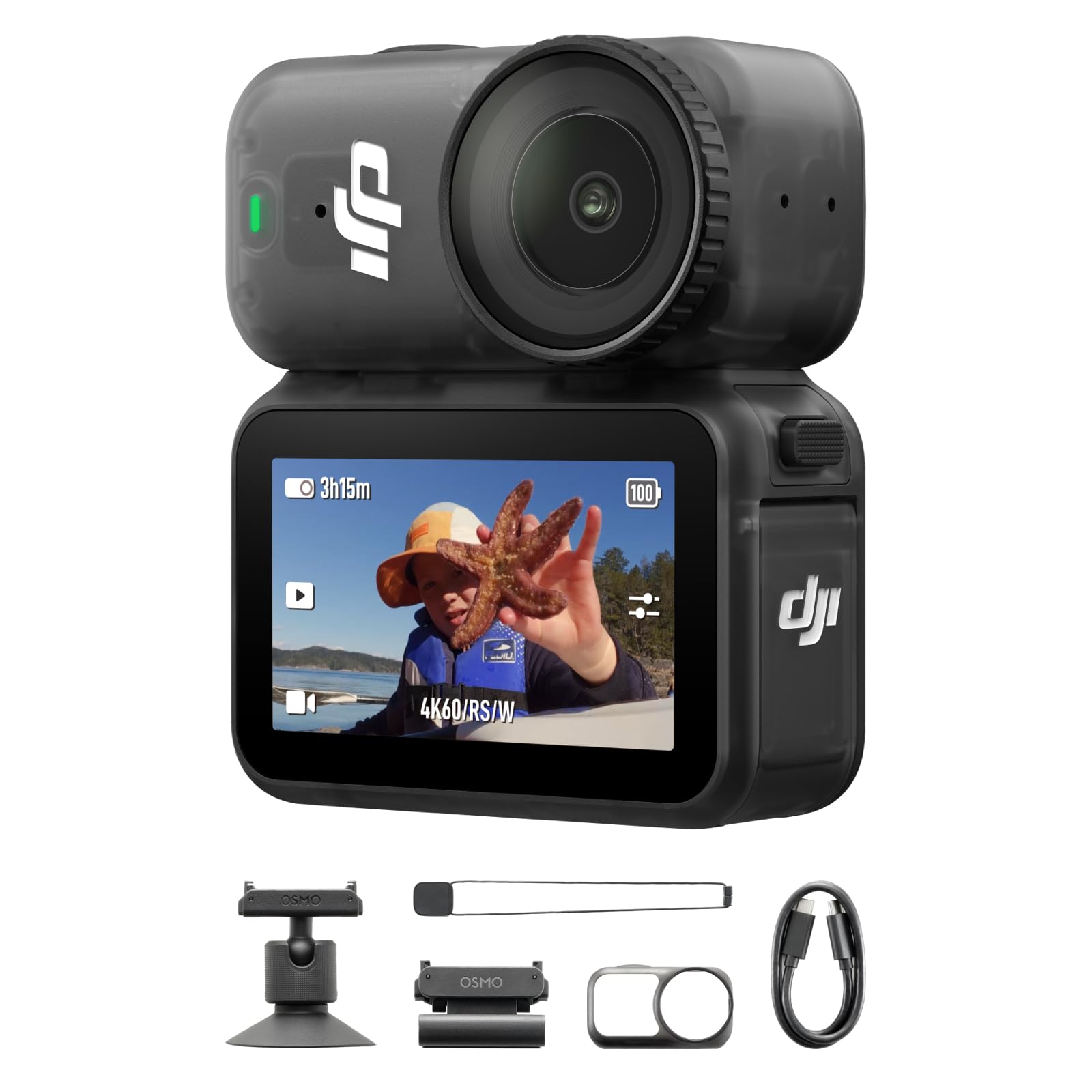
A thumb-sized magnetic camera that turns a cap or a shirt into a hands-free POV rig.
The compact size is the whole idea here. The Osmo Nano is built around a 1/1.3″ sensor that pulls in more light than a phone for crisp, vivid shots, and records 4K at 60fps with a 143° ultra-wide view. That field of view is what makes it work as a pet POV or helmet cam — you capture more of the scene without aiming carefully. It clips magnetically to a hat, lanyard, or ball-joint adapter, so your hands stay free while you film. The Combo ships with 128GB of built-in storage, so you can record immediately and expand later with a microSD card.
Audio and ruggedness suit outdoor vlogging well. The camera supports a direct connection to two microphones for cleaner sound, and it is waterproof up to 10m on its own, with IPX4 splash resistance when mounted in the Vision Dock. Battery is rated at up to 200 minutes, and fast charging keeps it ready between takes. The dock doubles as a mount and a charging/transfer station, which is what gives the Nano its everyday carry appeal.
Two things owners flag honestly. First, heat: the compact body runs warm during high-resolution recording, and built-in overheat protection will stop recording to protect the hardware — enabling Endurance Mode helps on longer sessions. Second, the small touchscreen is hard to read in direct sunlight, so many shooters skip the screen and learn the button and beep prompts instead. The magnetic mounts hold securely, and for a body this small the reliability conversation is genuine rather than dramatic — some units simply behave better than others.
The take: if you want hands-free, mount-anywhere POV footage from a camera the size of a thumb, this is built for it.
The trade-off: heat management and a dim screen mean long high-res sessions need planning, and it is not meant to replace a full-size camera for sit-down work.
Pick it for: motorcycle vlogs, pet POV walks, and clip-on first-person shots where hands-free matters most.
skip it if: you want a bright, readable screen and uninterrupted hour-long 4K recording in one take.
5. Canon PowerShot V10 Compact Vlogging Camera

Canon’s palm-sized point-and-shoot that stands itself up and gets you filming in seconds.
The PowerShot V10 is for the creator who wants zero setup friction. It packs a 15.2-megapixel 1-inch back-illuminated CMOS sensor — that “back-illuminated” design routes wiring behind the light-gathering layer so more light reaches the pixels, which helps in dim rooms. The star feature is a stand that folds out of both the front and back of the body, letting the camera stand unaided for hands-free shooting at a range of angles. There’s even a retractable front-facing screen so you can see yourself while it’s propped up.
The lens is a fixed 19mm wide-angle (35mm equivalent), which is wide enough to fit a room or a landscape but not so wide that faces stretch at the edges. Video tops out at 8-bit 4K up to 30 fps, or Full HD up to 60 fps, with 14 movie color filters for quick mood changes. There are three image stabilization modes — IS Off, IS On, and IS Enhanced — available on version 1.2.0 or later. Audio comes from a pair of stereo microphones with a third center mic to knock down background noise, plus there’s a micro-HDMI output and an external mic port if you want to step up.
Simplicity is the reason it competes here, and it is the easiest camera in this group to hand someone who has never filmed before. The recurring gripe is run time — the battery is rated at 2 hours and several owners wish it lasted longer, so a spare is smart. There is also no lens cover and no mic wind screens in the box, so the front glass wants care. For pure ease of use, it beats the Osmo Nano on screen readability and beats the Muse on controls.
What buyers love: the one-piece, powers-on-and-shoots simplicity, the self-standing design, and the compact body that fits in a bag with room to spare.
The honest catch: 2-hour run time and a bare front lens mean you’ll want a spare battery and a case.
The beginner pick: you want to start filming today with the least possible fiddling, travel lightly, and shoot solo.
Think twice if: you need long uninterrupted sessions or built-in lens protection from the start.
6. DJI Osmo Pocket 3 Vlogging Camera Bundle
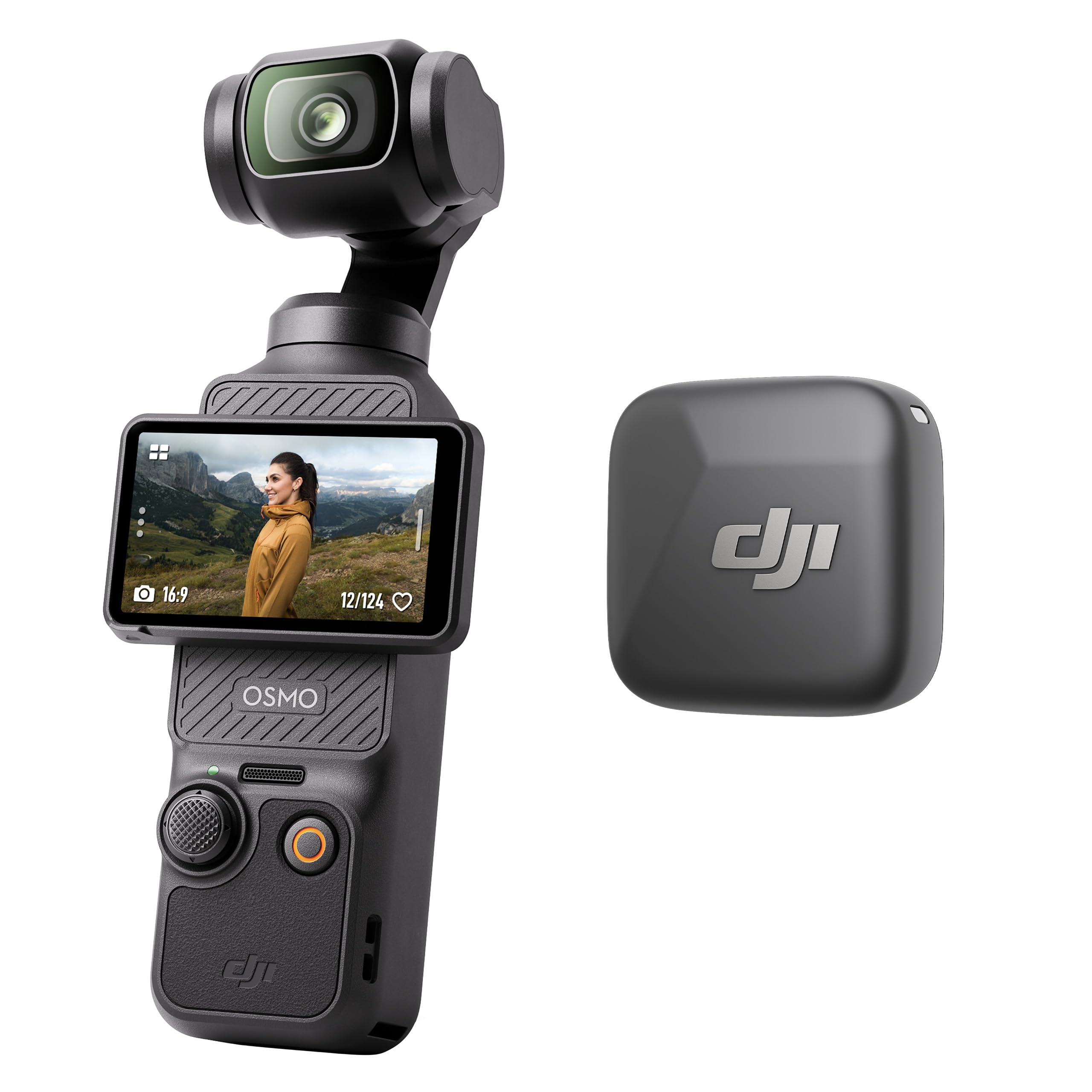
The pocket gimbal camera that made solo vloggers stop fighting their gear.
If you film yourself alone and want the camera to handle the hard parts, this is the one the crowd returns to. The Osmo Pocket 3 carries a 1-inch CMOS sensor and records in 4K resolution at up to 120fps, so smooth motion and low-light detail both come easily. A 2-inch touch screen rotates for horizontal or vertical shooting, matching whatever platform you’re posting to. The 3-axis mechanical gimbal keeps the shot level while you dance, chase a pet, or walk a trail, and ActiveTrack 6.0 keeps you center-frame automatically.
Microphone support is a big part of the package. The camera connects directly to two DJI Mic 2 or Mic Mini transmitters, which simplifies your audio rig considerably — no receiver, no extra cables. The bundle ships with the camera, a Mic Mini Transmitter, wrist strap, handle with a 1/4″ thread, protective cover, and cables. The 1-inch sensor also blurs the background nicely at close range, which is exactly what you want for a talking-head look.
Owners describe footage that looks cinematic from the start, and setup that’s fast enough to actually use regularly. Autofocus locks quickly, stabilization holds, and the onboard stereo audio is good enough for many vlogs without external gear. The fair caveats: the lens is delicate and the included case leaves the front and bottom somewhat exposed, plus tripod legs and the front protector are sold separately. It is not a full-frame replacement — but for a pocket camera it gets remarkably close.
Standout strengths
- 1-inch CMOS recording 4K at up to 120fps
- 3-axis mechanical gimbal for genuinely steady footage
- Rotating 2-inch touch screen for horizontal and vertical
- Direct connection to two DJI Mic 2/Mic Mini transmitters
Fair caveats
- Lens is delicate and the case doesn’t fully protect the front
- Tripod legs and front protector are sold separately
- Costs more than the single-purpose pocket cams
Reach for this if: you want a one-device vlogging setup with pro-grade stabilization and one-step audio.
Look elsewhere if: you need full-frame depth of field or interchangeable lenses for different focal lengths.
7. Insta360 GO Ultra Creator Bundle
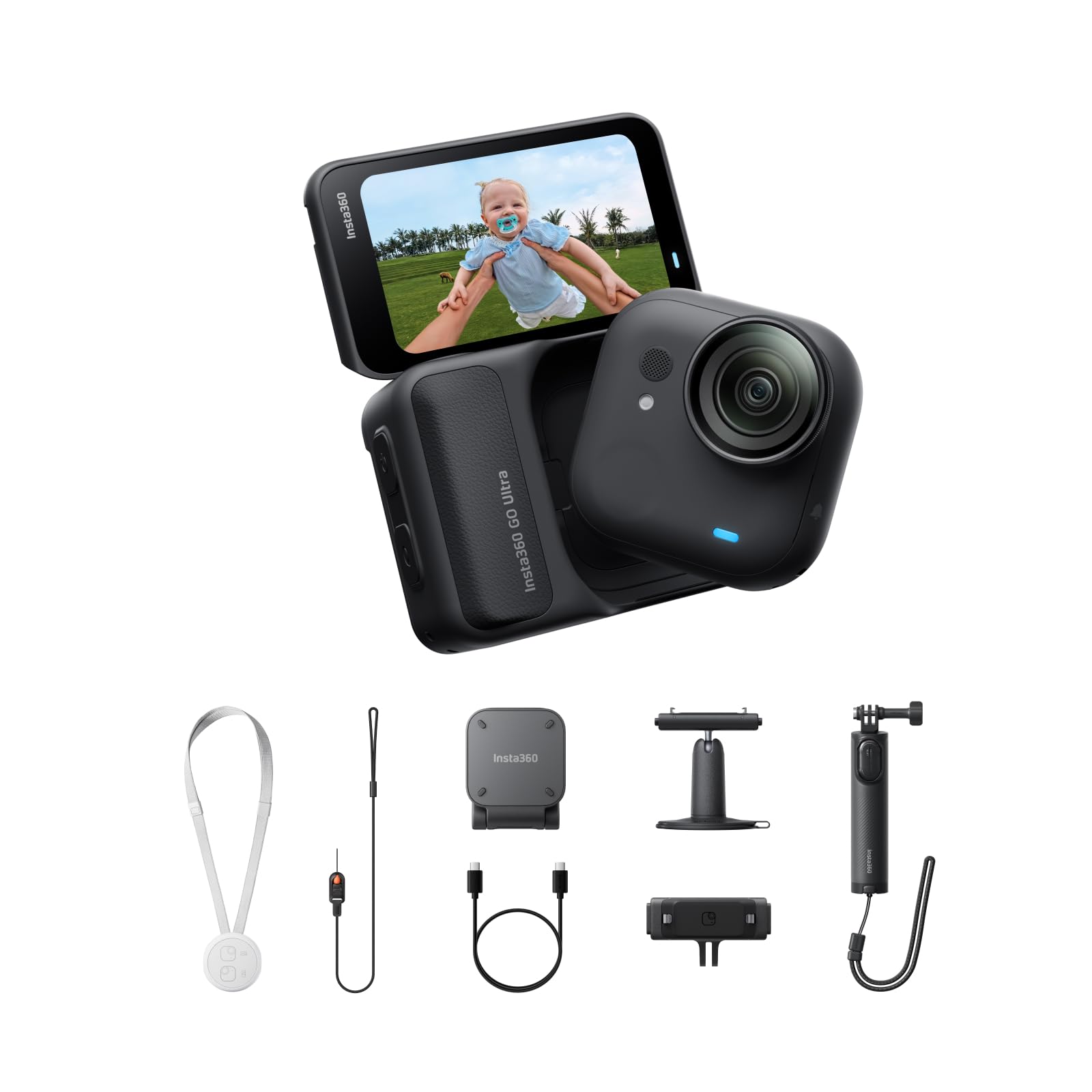
The watch-sized clip-on that films 4K while both your hands stay busy.
At 53g and about the size of a watch, the GO Ultra is built to disappear onto a cap, a pendant, or a clip and just record. It captures 4K at 60fps with 4K Active HDR for floodlit or bright outdoor scenes, and the 1/1.28″ sensor plus a 5nm AI chip and PureVideo Mode are tuned for dim conditions. Stabilization comes in three levels of FlowState with 360 Horizon Lock, which keeps the horizon flat even when the camera rolls. It’s IPX8 waterproof to 33ft (10m) on its own, and the Dive Case extends that to 197ft (60m).
The Creator Bundle is what makes it practical. You get the standalone camera, an Action Pod, a Magnet Pendant, a quick-release safety cord, a magnetic easy clip, a mini 2-in-1 tripod 2.0, a quick-release mount, and a pivot stand. Run time is listed at 200 minutes — 70 minutes with the standalone camera and 3 hours in the Action Pod — and it charges from 0 to 80% in 12 minutes. The Pod also adds a screen and control surface, plus a magnetic dock that owners find easy to grip.
There’s a travel twist you won’t find on the others: an AI voice assistant handles real-time translation, voice and photo questions, and voiceprint recognition, so it can work as a travel companion as well as a camera. AI auto-editing finds your highlights and cuts them into a shareable clip. On the honest side, battery life draws mixed feedback and the biggest recurring gripe is slow drain when the camera sits idle — leaving it charged and unused for a week, a few owners find it flat. The shooting itself is fast and reliable; it’s the standby drain that wants watching.
The wins
- 53g wearable that clips to a cap or pendant hands-free
- 4K60fps with 4K Active HDR and FlowState Stabilization
- IPX8 waterproof to 33ft, extending to 197ft with the Dive Case
- 0–80% charge in 12 minutes, 3 hours in the Action Pod
The trade-offs
- Battery draws mixed feedback and drains while idle
- Standalone run time is 70 minutes, so the Pod matters
- Charges a premium over the DJI Osmo Nano for the extra capability
Pick it for: cycling, running, diving, and hands-busy POV shooting, plus travel helpers who want translation on the go.
pass on it if: you need a camera that holds charge for weeks between shoots without maintenance.
8. Sony ZV-E10 APS-C Mirrorless Camera with 16-50mm Lens
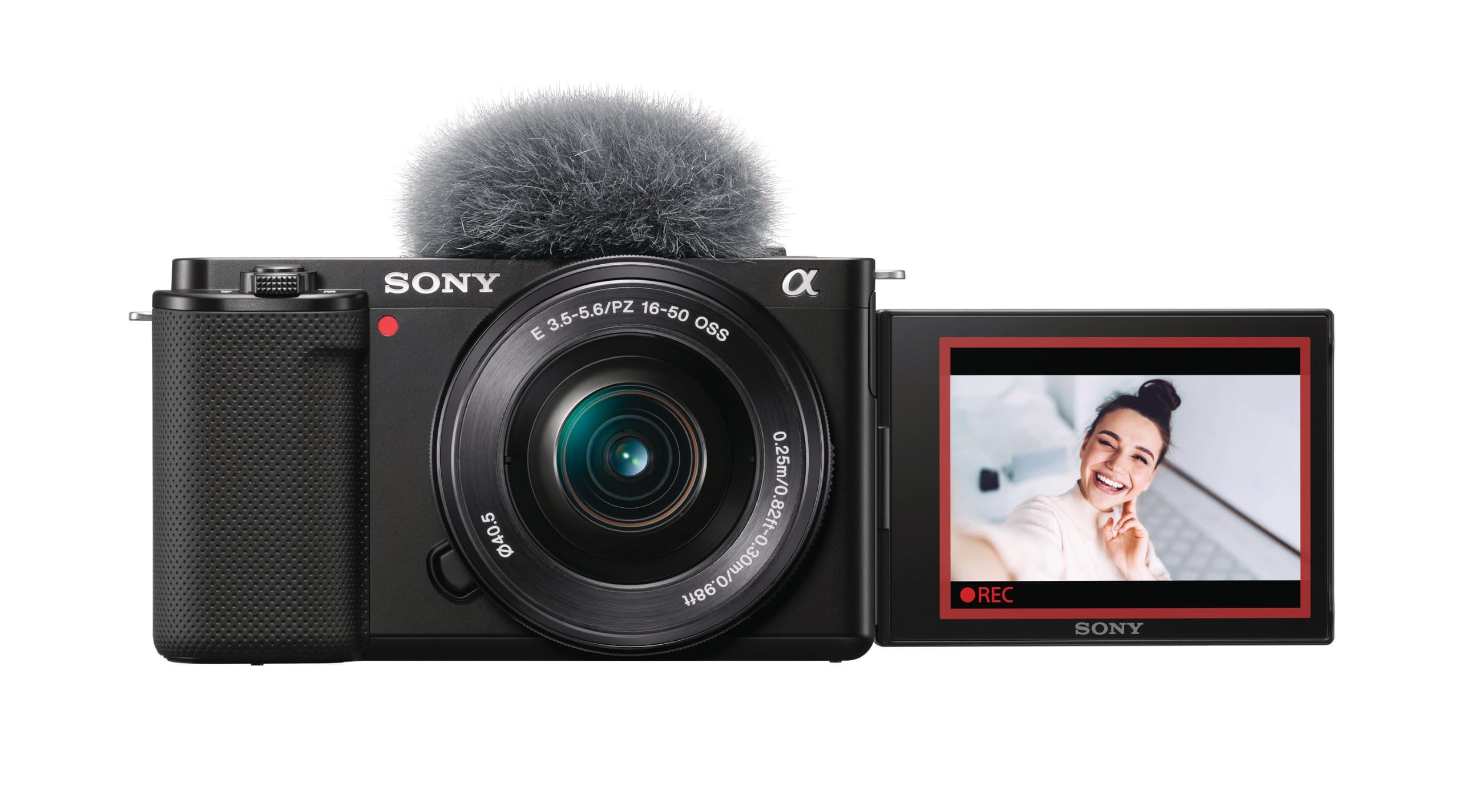
The swappable-lens body you buy once and keep upgrading around.
The ZV-E10 is for the creator who has outgrown a fixed camera and wants to grow. It packs a 24.2MP APS-C Exmor CMOS sensor and Sony’s fast BIONZ X processor, and its 4K movie mode is oversampled from 6K with full pixel readout and no pixel binning. That means every pixel of the frame is doing real work rather than being discarded, so detail is sharp. It also carries 425 autofocus points with contrast, phase, and face/eye detection, so focus can lock quickly when you’re moving around the frame.
Two vlogging-specific features set the tone. The Product Showcase Setting shifts focus smoothly from your face to an object you hold up — handy for unboxings and demos. The Background Defocus button toggles the background blur on and off instantly, so you can pop into a soft, out-of-focus look with one tap. Live streaming works over a single USB cable with no extra hardware or software to install. Because the mount is Sony E, you can swap the included 16-50mm lens for other glass as your skills grow.
The generous part is the price-to-capability ratio — owners describe it as a great deal that lets a phone shooter step into a real camera. Photos and video both come out with natural colors and sharp detail, and the swivel screen makes framing yourself simple. The real caveat is autofocus, which draws mixed feedback: plenty of owners find it fast and reliable, and a few have hit units where it stopped working. Worth knowing that’s the exception rather than the rule, but it is the one thing to sanity-check on arrival.
Where it shines: an APS-C sensor, 425 focus points, and Product Showcase plus Background Defocus modes make this a serious YouTube tool.
The one watch-point: autofocus mostly performs, but a few units have failed — the feature worth verifying early.
Best for: creators who want a real interchangeable-lens system they can grow with affordably.
Look elsewhere if: you want everything pocketable and self-contained with no lenses to manage.
9. Canon PowerShot V1

A compact with a fan that streams and shoots stills without breaking a sweat.
The PowerShot V1 is aimed at people who stream and film more than they pocket-carry, and its cooling fan is the giveaway. That fan keeps high-resolution recording going longer, which matters if you livestream or run long takes. At its heart is a 1.4-Type sensor that shoots 22.3MP stills and 18.7MP video, built around a 16-50mm F2.8-4.5 wide-angle zoom lens (35mm equivalent) — so you get real zoom range rather than a fixed lens. Canon Log 3 records with wide dynamic range and 10-bit color depth starting at ISO 800, giving editors room to grade footage properly.
It handles two jobs well. For streaming, it offers solid I/O and a fast, stable autofocus that stays locked on a subject. For photos, owners upgrading from earlier point-and-shoots report less grain at ISO 6400 and excellent macro performance. It brings 100 autofocus points with hybrid focus. The larger body actually helps here — there’s more to grip, and more room for the controls and cooling hardware that make longer sessions possible.
Where it draws criticism is a little different from the pure vlogging cams. Owners note it can look chunky compared to a small G-series body, and that there’s no optical image stabilization — electronic stabilization alone won’t fully smooth out walking bounce. The zoom also tops out at 50mm, which is a known ceiling, and the body ships without a charger. For a desktop talker or studio shooter, those limits barely register; for a run-and-gun walker, they do. The size that some find bulky is exactly what makes it stable to hold.
The case: a fan-cooled 1.4-Type sensor with 10-bit Canon Log 3 and real zoom makes it a strong streaming and stills hybrid.
Be aware: no in-body optical stabilization means handheld walking shots stay bumpy, and no charger is in the box.
Reach for this if: you stream, run long takes, or want a compact that shoots serious photos as well as video.
Look elsewhere if: your main output is fast handheld walking footage that needs real stabilization.
10. Sony ZV-1 II Premium Compact Digital Camera

A compact with a genuinely ultra-wide zoom for fitting yourself and your surroundings in frame.
The ZV-1 II is the pick when width matters — its 18-50mm zoom starts ultra-wide, so you can hold it at arm’s length and still fit your whole setup in frame. That wide starting point also helps in tight interior spaces without stepping back. Inside is a 1.0-type sensor paired with an F1.8-4.0 aperture lens; the wide F1.8 setting at the short end means a shallow depth of field, so backgrounds soften into a flattering blur. Autofocus relies on real-time tracking with Eye-AF, keeping a face locked in as you move.
Audio is a specific strength: a directional 3-capsule microphone with a bundled wind screen accessory focuses on what’s in front of the camera. The “directional” part means it favors sound from the direction the camera faces, which reduces ambient noise behind you. There are 315 autofocus points, and the body captures 24-bit audio. For a compact vlog camera, the on-board sound here is better than most in this group straight off the shelf.
Where the ZV-1 II gets more complicated is consistency. Owners love the look of the footage after editing and the wide framing, but they report mixed experiences on ease of use — a few find the camera turning on unexpectedly and the manual focus setting fiddly to dial in. Battery life is the recurring weak spot across this series. It is a capable, compact tool, but it rewards someone willing to spend time learning its menus rather than expecting pure point-and-shoot behavior.
The strength: an 18mm ultra-wide start plus an F1.8 wide aperture gives you roomfit framing and soft backgrounds in one compact body.
The honest note: mixed feedback on ease of use and a manual-focus setting that takes learning mean it’s better for a patient shooter.
Pick it for: desk-based and travel talking-heads where fitting a wide scene and clean directional audio matter most.
it’s not for you if: you want a fully automatic, set-and-go experience with no menu learning.
11. Canon EOS R Vlogging and Content Creator Camera (Body Only)

A full-frame body for creators who want depth of field no pocket camera can touch.
Step up here when image quality and lens flexibility outweigh the convenience of a self-contained pocket camera. The EOS R carries a full-frame 30.3MP CMOS sensor and Canon’s DIGIC 8 processor, and its Dual Pixel autofocus delivers sharp focus in as little as 0.05 seconds across 5,655 manually selectable AF points. For video, that speed is what keeps you locked in whether you’re seated or shifting position. The magnesium alloy chassis keeps it light enough to carry while protecting the electronics from heat — useful when recording long takes.
Two features stand out for a content creator. It has a 3.69-million-dot electronic viewfinder and a vari-angle touchscreen, so you can flip the screen to face you and monitor precise composition. There’s also a silent electronic shutter mode for shooting where noise would be a problem. Continuous shooting reaches 12fps for stills, and the RF mount works with RF lenses while staying compatible with EF and EF-S lenses through optional mount adapters, opening up a vast used-lens market.
The honest trade-off is that this is a full-frame body sold body-only — no lens is included, so it’s the start of a system rather than a ready kit. You also need to accept that its most advanced features carry a learning curve; the customization that experienced shooters love can feel like a lot at first. A few customers note a rare out-of-box fault, but the overwhelming picture is a reliable workhorse. It’s the top choice here for creators ready to build a real lens system.
The upside: a full-frame30.3MP sensor and Dual Pixel autofocus locking in as little as 0.05 seconds across 5,655 selectable points is a serious step up in image control.
The reality check: it’s a body-only purchase with no lens in the box, so budget for glass and expect a learning curve on the deeper settings.
Worth it for: creators building a proper full-frame lens system who want shallow depth of field and fast eye-detect focus.
Not the fit if: you want one box that films the day it arrives — this body needs a lens before it does anything.
Know the Specs
Sensor Size and Type
The sensor is the chip that catches light, and its physical size is the biggest predictor of low-light performance. A 1-inch sensor (like the PowerShot V10 or Osmo Pocket 3) gathers noticeably more light than a phone chip, which is why dim scenes stay cleaner. Step up to APS-C (the Sony ZV-E10) or full-frame (the Canon EOS R) and you get both better low light and stronger background blur. The cost is bulk — the bigger the sensor, the less it slips into a pocket.
Stabilization: Mechanical vs Electronic
Mechanical stabilization physically moves the camera or sensor to cancel hand shake — that’s what a 3-axis gimbal does on the Xtra Muse, Osmo Pocket 3, and the GO Ultra’s FlowState system. Electronic stabilization instead crops and shifts the image digitally, which can smooth motion but at the cost of some detail and a narrower view. For walking-and-talking vlogs, mechanical wins; for static desk shots, electronic is often enough.
Autofocus Tracking
Face and eye tracking keeps the camera locked on you as you move. Systems built on phase detection (which measures distance quickly) lock faster than contrast-only systems, which hunt back and forth in low light. The Sony ZV-E10 offers 425 focus points, the Canon EOS R 5,655 selectable points, and the PowerShot V1 carries 100. If a camera has no continuous autofocus at all — like the Blackmagic Pocket 4K — you pull focus by hand.
Battery Run Time and Charging
Run time tells you how long you can film before power runs out. The Osmo Nano is rated up to 200 minutes, the GO Ultra 200 minutes (70 standalone, 3 hours in the Action Pod), and the PowerShot V10 about 2 hours. Cameras without in-body power — the Blackmagic and the LUMIX G7 bundle — rely on removable batteries, and short run time is the most common gripe on both, so spares matter.
Common Questions
What is the difference between a gimbal camera and a regular vlogging camera?
Do I need autofocus for solo vlogging?
Is a 1-inch sensor good enough for vlogging in low light?
How long can a handheld vlogging camera record before the battery dies?
Can I use an external microphone with these cameras?
Is the Insta360 GO Ultra waterproof without a case?
Should I choose a fixed-lens or interchangeable-lens vlogging camera?
Will my vlogging camera overheat during long recordings?
Do vlogging cameras record vertical video for social media?
Can I livestream directly from a vlogging camera?
The Bottom Line
For most people who want the best handheld camera for vlogging, the Blackmagic Design Pocket Cinema Camera 4K takes the top spot because its 4/3″ sensor, native 4096 x 2160 recording, and 13 stops of dynamic range deliver image quality that holds up against gear costing far more — provided you accept manual focus and add your own stabilization. If you’d rather have the camera handle the hard parts, grab the DJI Osmo Pocket 3, whose 1-inch sensor and 3-axis gimbal make solo filming nearly easy. And for hands-free POV footage where both your hands are busy, the Insta360 GO Ultra is the one to reach for.
How we choose
We do not accept paid placement. Every pick is matched to a real buyer and a real use-case; we do not hands-on test units.
Sources
Specifications: manufacturer listings and product documentation. Review insights: verified customer reviews, as of October 2026. Pricing: not shown on this page (it changes often); check the current price via the retailer link.
As an Amazon Associate, Aappliancez earns from qualifying purchases. This does not affect which products we feature.