Disclosure: Some links in this post are affiliate links. As an Amazon Associate I earn from qualifying purchases, at no extra cost to you. Learn more
Specs are compiled from manufacturer listings and verified buyer reviews and can change over time — please confirm the key details on the product page before buying.
You squeeze, you look at the number, and you have no idea whether to believe it. That is the real problem with most hand dynamometers — the cheap ones drift, flex, and flatter you. The picks below are the ones where the reading actually holds up, sorted by what each does best.
This guide is built by comparing the manufacturers’ published specifications and the patterns across verified customer reviews, so you get each pick’s real strengths and trade-offs instead of marketing spin.
The first decision you make is accuracy versus tracking: a strain-gauge unit gives you repeatable numbers, while a hydraulic one is easier to break. Here is how each hand dynamometer on this list handles that trade-off in practice.
Top Picks

How To Choose The Best Hand Dynamometer
A hand dynamometer is a squeeze gauge — you grip it as hard as you can and it tells you how many pounds of force you produced. The number only means something if the same squeeze gives the same reading twice.
Sensor type decides whether your numbers mean anything
A strain gauge is a strip inside the device that bends slightly when you squeeze; the electronics convert that bend into a pound reading. A hydraulic unit uses fluid pressure instead, and an oil leak or a slow seal ruins the calibration without any visible warning.
A digital load-cell build goes a step further and removes the moving parts entirely. That matters if you plan to compare a reading from January against one from June.
Measuring range and division
Range is the maximum force the device can register — a 198 lb ceiling is plenty for most people, while a 400 lb or 440 lb ceiling is built for very strong athletes. Division is the smallest step the display shows, so a 0.2 lb division lets you see a small gain that a coarser display would round away.
Handle width and hand size
An adjustable handle lets you set the same grip span for different people, which is what makes a family or clinic device useful. A fixed handle gives a large hand a different mechanical advantage than a small one. If two people are comparing scores, the handle width has to match first.
What the stored data buys you
Multi-user memory lets you save a profile per person and recall previous readings. Without it, you are photographing the screen after every test. For solo training a single remembered maximum is enough; for a household or a therapy setting, profile slots do the real work.
Side-by-Side Comparison
| Model | Best For | Max Range | Sensor Type | Body Material | Amazon |
|---|---|---|---|---|---|
| JTHEW Grip Strength Tester Trainer★ Best Overall | Testing plus training in one box | 400 lbs | Strain gauge | Plastic, stainless steel | Amazon |
| GRIPX Digital Hand DynamometerBest Value | Shareable fun and everyday testing | 198 lbs / 90 kg | Strain gauge | Metal, plastic | Amazon |
| FitBeast Grip Strength Trainer Kit | Three tools for one training plan | 160 lbs resistance | Digital tester | ABS, iron, polypropylene, TPE | Amazon |
| CAMRY Digital Hand Dynamometer | Clean clinic-style data entry | 198 lbs / 90 kg | Strain gauge | Metal, plastic, rubber, silicone | Amazon |
| Hiyoga Digital Grip Strength Trainer | Silent desk practice | 440 lbs | Digital readout | Silicone | Amazon |
| GD DYNO-200 | Heavy daily testing | 440 lbs / 200 kg | Digital | Aluminum, S45C carbon steel | Amazon |
| Baseline BIMS 5-Position | High-volume professional testing | 300 lbs | Digital load cell | Not stated in listing data | Amazon |
Detailed Reviews
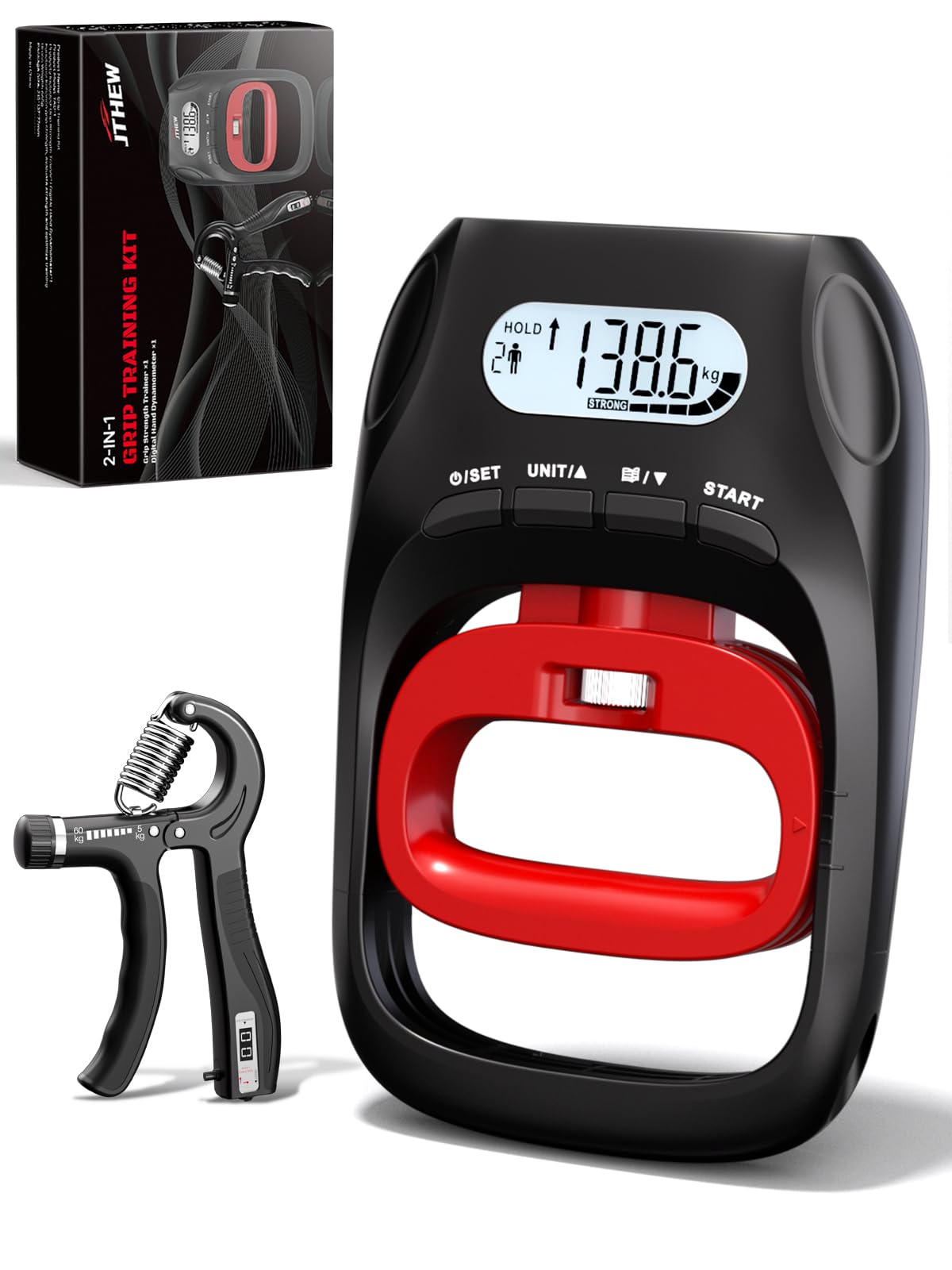
1. JTHEW Grip Strength Tester Trainer, 400lbs/180kg
Our pick — 4.5+★ from 700+ verified ratings; the strongest balance of quality and price.
One gadget that tests the squeeze and then trains it back up.
The reason this one wins is simple: it does both jobs. Most devices on this list only measure you — this set pairs a strain-gauge tester that reads up to 400 lb with a separate gripper whose resistance you can dial anywhere from 11 to 132 lb. You test, you get a number, and you immediately have the tool to move that number.
The accuracy side is where it separates from the budget crowd. Lasting readings come down to the sensor, and the ±2% figure here is the difference between tracking real progress and tracking noise. What wins people over is that the same tester carries 19 user profiles, so each person’s code, age, gender and grip value sit stored and ready for the next check-in.
Comfort during long sessions was clearly thought about — ergonomic handles on both units, with adjustable knobs to set the span. Setup runs about ten seconds. The honest catch is durability: it is a plastic-and-stainless-steel build, not a steel frame, so it belongs on a shelf rather than loose in a gym bag. Check the spec sheet before you compare — this carries 400 lb of range where the FitBeast kit tops out at 160 lb of resistance.
What earns its place
- Measures to 400 lb and trains from 11 to 132 lb of resistance, so testing and rehab live in one box
- Strain-gauge sensor rated at ±2%, the accuracy you need for week-over-week comparison
- 19 separate profiles remembered, each tagged with age, gender and grip value
- Both handles adjust, so a large hand and a small one get the same span
What to weigh up
- Plastic and stainless steel construction rather than a metal frame
- The printed instructions are thin enough that owners often look up a video instead
Made for: the household that wants a test number and a training plan without buying twice.
Think twice if: you want a chunk of steel you can drop in a gym bag — the second-lightest build here suits a shelf better.
2. GRIPX Digital Hand Dynamometer, 198Lbs / 90Kgs
A 100 g pocket tester that reads to a 0.2 lb step.
Two numbers tell you almost everything here. The first is 0.2 lbs — the finest division on this entire list, which is the smallest change the screen can register. In plain terms, you see a two-tenths improvement instead of it being rounded away. The second is 100 g, the weight of the thing, so it disappears into a work bag.
The ceiling is 198 lbs / 90 kg, and that is the real dividing line against the JTHEW pick above. If your training sits near or past 200 lbs of grip force, you need the higher range; for almost everyone else, 198 lbs is more than enough headroom. A maximum value is displayed and recalled, and each reading is tagged weak, normal or strong against your saved profile.
Where it shines is the social side — walk it around a shop floor and the whole crew wants a turn. The adjustable handle spans big hands and small ones, and the display gives back pounds or kilograms instantly. The honest trade-off is the build: buyers report mixed results on longevity, so treat it as a bench tool rather than something to toss between bags. There is a 10-year warranty behind it, which is unusual at this level.
The number that matters: a 0.2 lb division is finer than most devices here manage, so small gains show up rather than rounding away.
Second read: the 198 lb ceiling is the honest limit — the JTHEW carries 400 lb, and that gap is the reason to step up if you train heavy.
Reach for this if: you want an accurate everyday tester that lives in a bag and starts a friendly argument at work.
Step up instead if: your best grip readings run near the 198 lb ceiling.
3. FitBeast Grip Strength Trainer Kit, 3-in-1
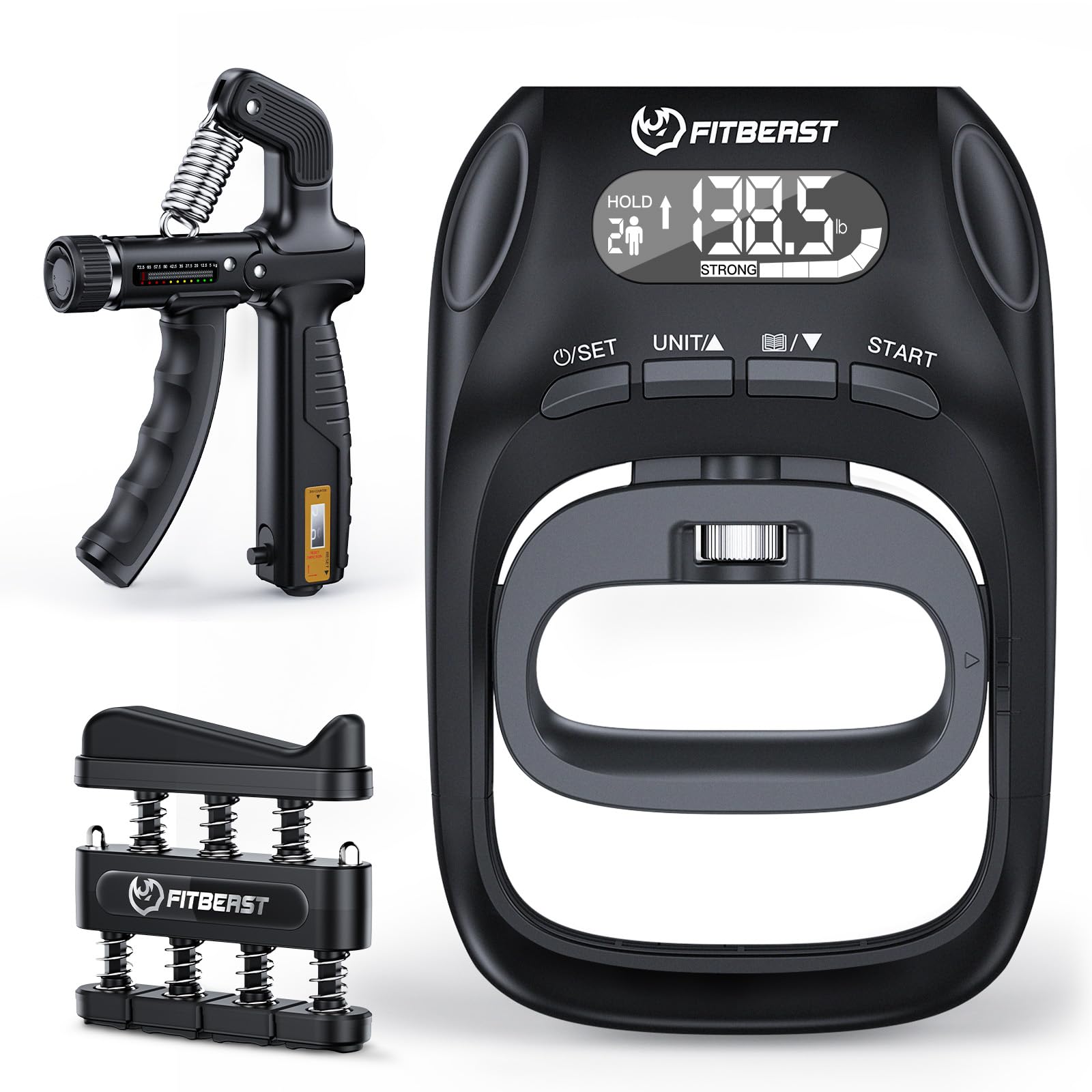
Three separate tools aimed at one plan: grip, fingers, tracking.
Where the other kits hand you a tester and stop, this one hands you a programme. A digital tester records the reading, a gripper dials resistance from 10 to 160 lbs, and a finger exerciser covers the digits the other two miss. For rebuilding a hand after a break, that split is the useful part — fingers and palm rarely come back at the same rate.
The kit stores 19 user profiles with a built-in counter on the trainer, so a household, a therapist, or two training partners can run their own numbers side by side. Setup is quick and the display is legible enough to read mid-squeeze.
Here is the honest bit, and it matters: the spring in the gripper is the weak link. A few owners mention it giving out after light use, so this is a kit to use with some care rather than to sling into a rucksack. Buyers also find the finger device on the easy side — it needs more resistance for a seasoned grip. Compared with the JTHEW above, this kit’s resistance tops out at 160 lb against 400 lb of measuring range, which tells you exactly who each one is for.
What the kit gives you: measuring, gripping and finger work in one box, with 19 profiles and a rep counter so progress is a number rather than a feeling.
The one weak joint: the gripper spring, which a handful of owners have had fail early — the reason to store it flat rather than bury it in a gym bag.
Pick this one if: you’re rebuilding a hand and want three angles of attack in a single purchase.
Look elsewhere if: a heavy, iron-solid gripper matters more to you than having the trio.
4. CAMRY Digital Hand Dynamometer 198Lbs / 90Kgs
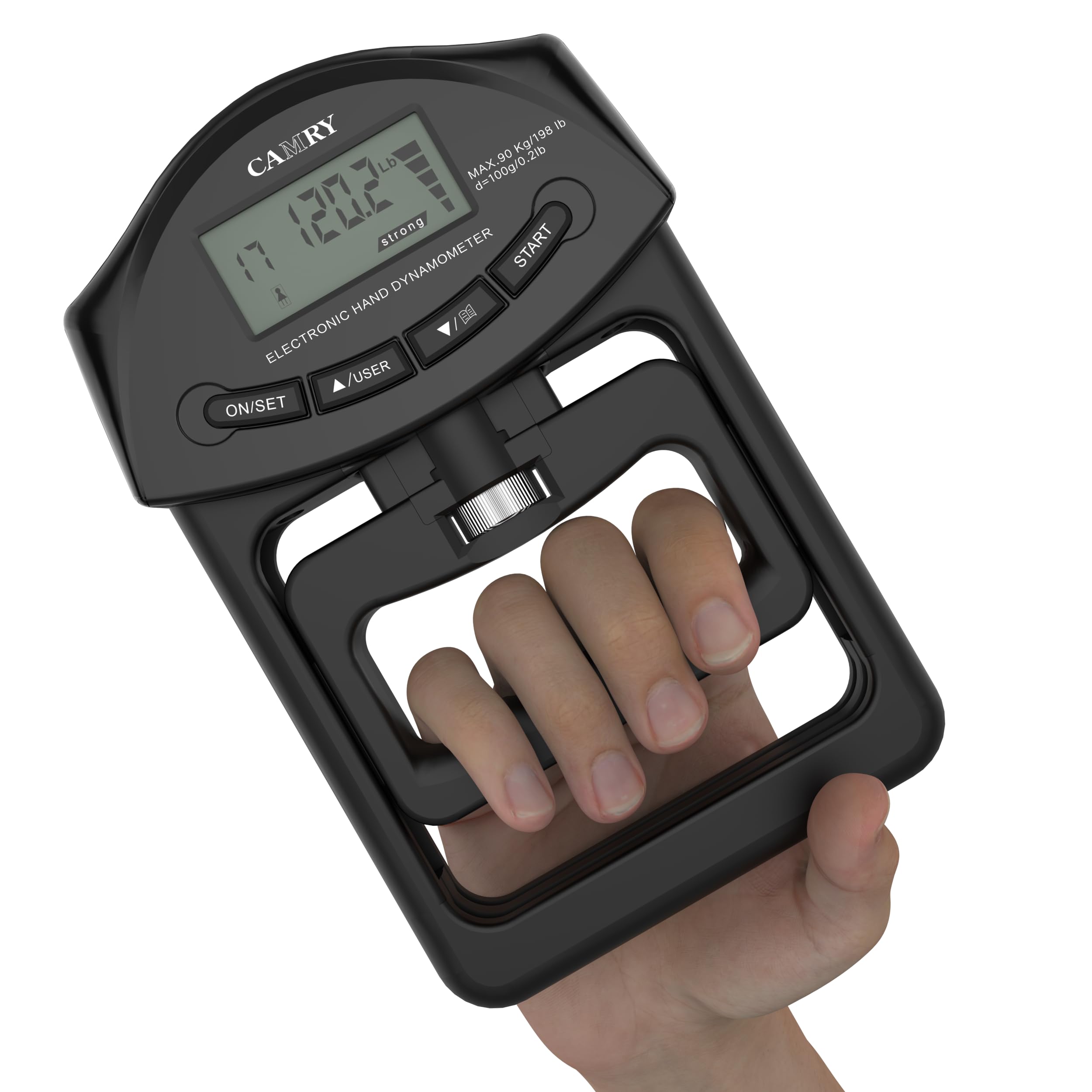
Built for the person who writes results down and compares them.
The feature that matters here is the rating label. Every squeeze is judged weak, normal, or strong against the age and gender saved in that person’s profile — so a raw pound number turns into some context. For anyone running a test on a parent, a patient, or a kid, that is far more useful than a bare figure.
The rest of the package is built for repeat visits: 19 distinct users, saved results per user, and a side-by-side view of each person’s runs that shows the incremental change from the last record. Division is 0.2 lbs / 0.1 kgs, so small movement registers. The mechanism is metal, plastic, rubber and silicone rather than a single rigid plate.
At 0.42 kg it stays light enough to live in a drawer between sessions. A science-fair parent found it accurate enough for a school project, which fits: it is a solid home tester dressed like a clinic tool. The 198 lb ceiling is the same cap the GRIPX carries, so neither will serve a very strong lifter chasing a personal record.
Best suited to: tracking several people’s grip over months, where a weak/normal/strong tag is more useful than a raw figure.
Not for: a heavy lifter who needs headroom past 198 lbs.
5. Hiyoga Digital Grip Strength Trainer, USB-C
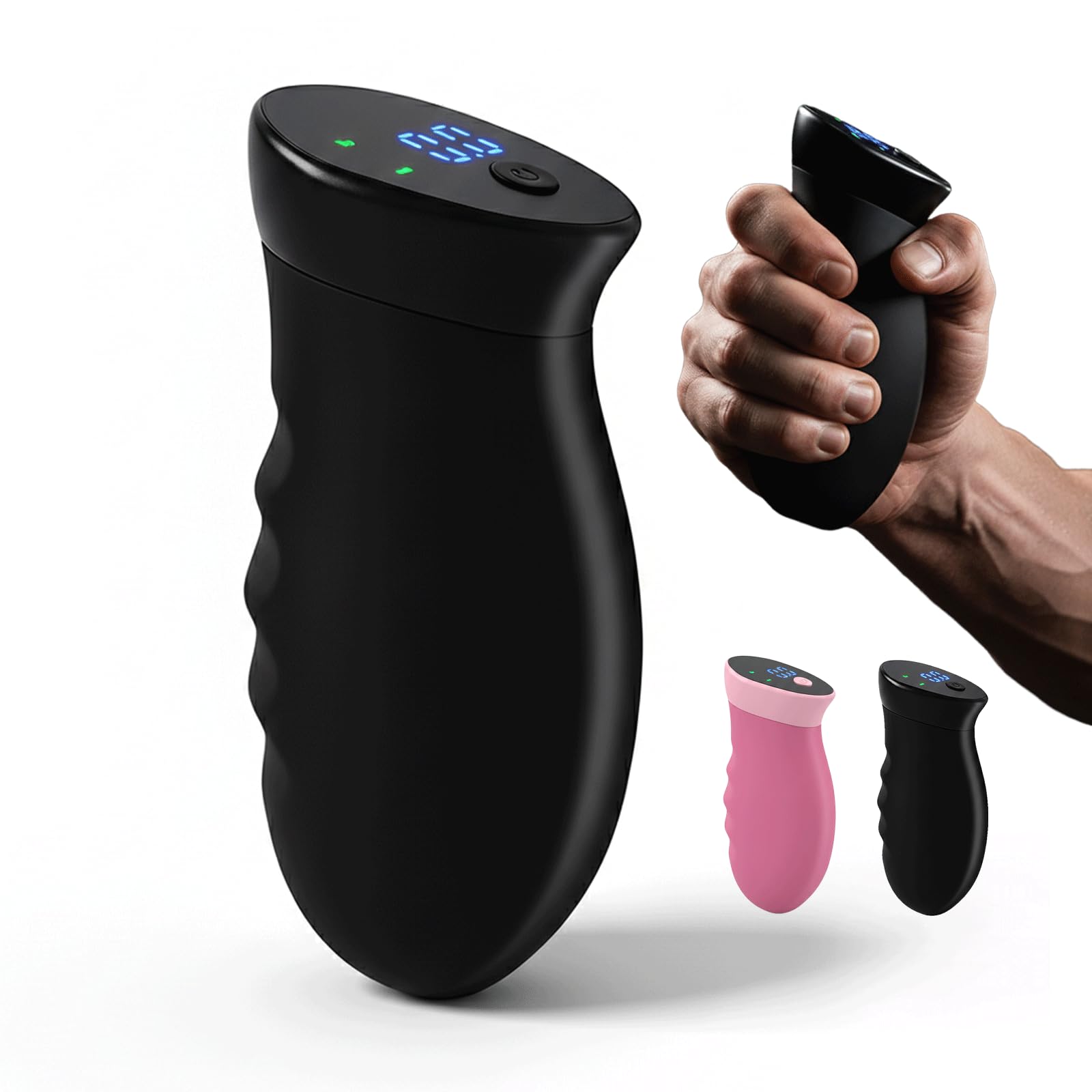
A 108 g squeezer that stays quiet and runs off USB-C.
Two modes, and they solve opposite problems. Test mode stays completely silent, so it works on a desk during a call. Smart vibration mode pushes back harder the harder you squeeze, giving you physical feedback rather than a number to read. The silicone grips are anti-slip and palm-fitting, and the whole unit weighs 108 g.
Charging by USB-C is genuinely convenient — no hunting for AAA cells, and it recalls easily in a drawer. It shows pounds in real time up to a claimed 440 lb, and it targets fingers and forearms alongside the palm.
Now the honest part, because this one splits opinion sharply. It is great at strengthening and much weaker at measuring: several owners found the readings far below what a calibrated gripper showed, and the vibration is gentle rather than dramatic. If your goal is a trustworthy record, spend a little more on a strain-gauge tester. If your goal is to work the hand at your desk and watch a rough trend, this does the job quietly. Note that a 3.5+ rating across a modest base means this one has more sceptics than anything else on the list.
Where it genuinely delivers
- Silent test mode suits an open-plan office desk
- USB-C charging, so no disposable batteries to keep buying
- Vibration feedback scales with how hard you squeeze
- 108 g of silicone — small enough to sit in a drawer
Where it lets you down
- Measuring accuracy is the recurring complaint — the readings can come in well under a calibrated device
- The vibration is mild rather than dramatic
- No stored history or app, so progress lives in your head
Works for: quiet daily hand work at a desk, where the number is a rough guide and the squeeze is the point.
Not for: anyone comparing readings against a clinic device or a certified gripper.
6. GD DYNO-200 Grip Strength Tester

A 440 lb steel jaw that stops flexing under a real squeeze.
The build is the whole argument. The body is S45C carbon steel, and the handle carries actual knurling — the diamond-pattern grip cut into metal — instead of a plastic coating. That combination stops the frame bowing when you squeeze hard, and a frame that does not bow gives you the same reading twice. A pair of AAA alkalines runs it, though they are not in the box, so add them to the order.
It reads to a 440 lb / 200 kg maximum, and this is where the head-to-head gets concrete: the JTHEW above carries 400 lb, and anything capped at 198 lb is out of the running for a serious lifter. Owners who upgraded from a plastic unit describe the reading jumping noticeably once the steel frame stops flexing. The sensor is fixed in place and does not shift.
One ordering note worth knowing: some units have shipped as the GD-150 rather than the GD-200, so check the model on arrival and send it back if it does not match. That aside, the knurled steel build makes plastic models feel like toys.
Why the steel wins: a knobbed, non-flexing frame is what removes calibration drift — the slow slide that makes month-old readings useless.
The ordering caveat: verify the model number on the box; a batch has turned up as the lower-capacity GD-150.
Go for it if: you’re a lifter or arm-wrestler who wants the frame to stay rigid and the readings to repeat.
Different pick if: you only need a household number a few times a year — the extra steel is wasted on that.
7. Baseline BIMS Digital 5-Position Hand Dynamometer

The listed ±1% accuracy figure is the tightest on this page.
This one is engineered for volume. A digital load cell measures the force with a stated ±1% accuracy, and there is no hydraulic oil and no moving parts inside to wear or leak. That removes the two classic failure paths on a clinic dynamometer: a slow oil seep and a drifting calibration. A colour LCD shows the results in pounds or kilograms.
The 5-position handle is the clinical feature. You set the span, so hands of very different sizes test on the same geometry, and it helps standardize comparisons between people. Capacity runs to 300 lb, and mean, standard deviation and COV are calculated on the device itself. Reset is digital, so a heavy testing session needs no wiping or pumping between patients.
The catches are real and you should size them. The handles are smooth rather than knurled, so chalk helps when you push hard. And one owner found the unit drifted at rest after a couple of months, which is the sort of fault to watch for in the first weeks. At 3.34 pounds it is a clinic bench instrument, not something you carry.
The right call for: a physio or trainer running many hands through a session and needing mean and standard deviation on the spot.
The wrong call for: a single home user, who can get a repeatable reading from a far simpler device.
Know the Specs
Strain Gauge vs Hydraulic vs Load Cell
A strain gauge is a strip that bends microscopically when you squeeze, and the electronics turn that bend into a pound figure. A hydraulic unit uses fluid pressure instead — cheap, but a slow leak ruins the reading without a visible sign. A digital load cell removes moving parts altogether, which is why a device rated at ±1% holds its calibration far longer than one that flexes.
Maximum Range and Division
Range is the ceiling the device can register — 198 lbs suits most people, while 400 lbs or 440 lbs is built for very strong lifters. Division is the smallest step the display can show, so a 0.2 lb division surfaces small gains that a coarser screen would round away. The best pairing is a ceiling above your strongest squeeze plus the finest division you can get.
Handle Width and 5-Position Adjustment
Grip span changes the mechanical advantage of the squeeze, so two people testing at different spans aren’t really comparing the same thing. An adjustable or 5-position handle lets you set the same width for everyone. That matters most in a clinic or a household where results get compared across people.
Build Material and Drift
A carbon-steel or aluminium body resists the frame flex that pushes readings off over time. A plastic frame flexes under a strong grip and the number creeps. Knurled metal handles add a secure grip; smooth handles need chalk when you push. If long-term records matter, prioritize a carbon-steel or aluminium frame over extra features.
Common Questions
Will a hand dynamometer work for both big and small hands?
How long does a hand dynamometer last?
Is 198 lbs enough range, or do I need a 440 lb model?
What does the ±2% or ±1% accuracy figure actually mean?
Do I need batteries for a digital hand dynamometer?
Can I test my grip strength at home without a clinic device?
Is a hand dynamometer a good gift?
Do these devices store results for multiple people?
Which is better for measuring — a plastic body or a carbon-steel one?
The Bottom Line
The winner for most people is the JTHEW Grip Strength Tester Trainer, because it measures to 400 lb and trains back from 11 to 132 lb in one set — test, then fix, without a second purchase. If you want a shareable tester that lives in a work bag, grab the GRIPX; its 0.2 lb division is the finest on the page. And for a clinic-grade read on a hand after injury, the GD DYNO-200 is the steel-frame upgrade that keeps your numbers honest. Whichever you choose, a consistent setup matters more than the model — same handle width, same hand, same time of day.
How we choose
We do not accept paid placement. Every pick is matched to a real buyer and a real use-case; we do not hands-on test units.
Sources
Specifications: manufacturer listings and product documentation. Review insights: verified customer reviews, as of October 2026. Pricing: not shown on this page (it changes often); check the current price via the retailer link.
As an Amazon Associate, Aappliancez earns from qualifying purchases. This does not affect which products we feature.