Disclosure: Some links in this post are affiliate links. As an Amazon Associate I earn from qualifying purchases, at no extra cost to you. Learn more
Specs are compiled from manufacturer listings and verified buyer reviews and can change over time — please confirm the key details on the product page before buying.
Your hamstrings do the work of both a brake and a spring — they slow your leg down and then drive you forward — and almost no home setup trains them through a full range. That is the whole problem with most home leg stations: they let you curl the weight, but the resistance goes slack exactly where the hamstring is strongest. The picks below are the ones that keep tension all the way through the curl, build a frame that will not walk across the floor, and hold up to plates you actually own.
This guide is built by comparing the manufacturers’ published specifications and the patterns across verified customer reviews, so you get each pick’s real strengths and trade-offs instead of marketing spin.
What separates a machine you keep from one you resell is the resistance path, the adjustability range, and whether the frame stays planted under load. Everything below covers those three things first, so you can find the right hamstring machine for your space.
Top Picks
How To Choose The Best Hamstring Machine
A hamstring machine is a small category with a big split down the middle: some units are built to curl your hamstrings in a lying or prone position, and some are leg-press-style stations that train the whole lower body at once. Which one you want depends less on the brand than on how much room you have and how heavy you plan to load the arm.
Resistance path: why the curl side matters more than the extension side
The hamstring shortens as your knee bends, and it is strongest when your knee is nearly straight. A machine that only delivers tension in the middle of the movement will feel heavy at the bottom and weightless at the top, which is exactly backwards for hamstring work. Look for a machine that lets you control the resistance curve, whether that is through a cable running over a pulley or through a plate arm whose leverage changes as it swings.
Load rating versus plate capacity — they are not the same number
The load rating on a frame is the total weight the structure is designed to carry, including your body weight and the plates. The plate capacity is how much you can actually stack on the loading post. A station rated for 1300 lbs might still only accept 330 lbs of plates on the arm, so read both numbers before you commit.
Measure before you buy — lying curls need depth and clearance
Lying or prone curl positions eat floor depth, and a station that rocks when you get your hips into it is worse than no station at all. Measure the footprint, then measure the clear space around it, including the room you need to walk in and out of the seated position. Wider floor legs and four-point bases resist tipping much better than narrow three-leg frames.
Side-by-Side Comparison
| Model | Best For | Weight Rating | Machine Weight | Footprint (D x W) | Amazon |
|---|---|---|---|---|---|
| GMWD LE02 Leg Extension and Curl Machine★ Best Overall | Small home gyms | 500 pounds | 95 pounds | 34″D x 36″W | Amazon |
| LIONSCOOL V4.0 Leg Extension and Curl MachineTop Performer | Heavy plate loaders | 800 pounds | 125 pounds | 57″D x 43″W | Amazon |
| GMWD LE03 Leg Extension and Curl MachineCompact Pick | Fixing strength imbalance | 700 pounds | 115 pounds | 48″D x 32.5″W | Amazon |
| XMark XM-7615 Rotary Leg Extension and Curl Machine | Serious lifters | — | 136 pounds | 37″D x 32″W | Amazon |
| Titan Fitness Glute and Ham Developer | Posterior chain work | 350 pounds | 190 pounds | — | Amazon |
| FEIERDUN 4-in-1 Adjustable Leg Extension Curl Machine | Tight corners | 700 pounds | — | 38.5″D x 34″W | Amazon |
| Mikolo LE00 Leg Extension and Curl Machine | Apartment gyms | 440 pounds | 55 pounds | 48.3″D x 21.7″W | Amazon |
| PASYOU PM30Pro Leg Press Machine | Full leg-day coverage | 1300 pounds | 73 pounds | 68″D x 19″W | Amazon |
| HANDBODE Leg Extension and Curl Machine | Max load ceiling | 1000 pounds | 91 pounds | 40.16″D x 34.84″W | Amazon |
Detailed Reviews
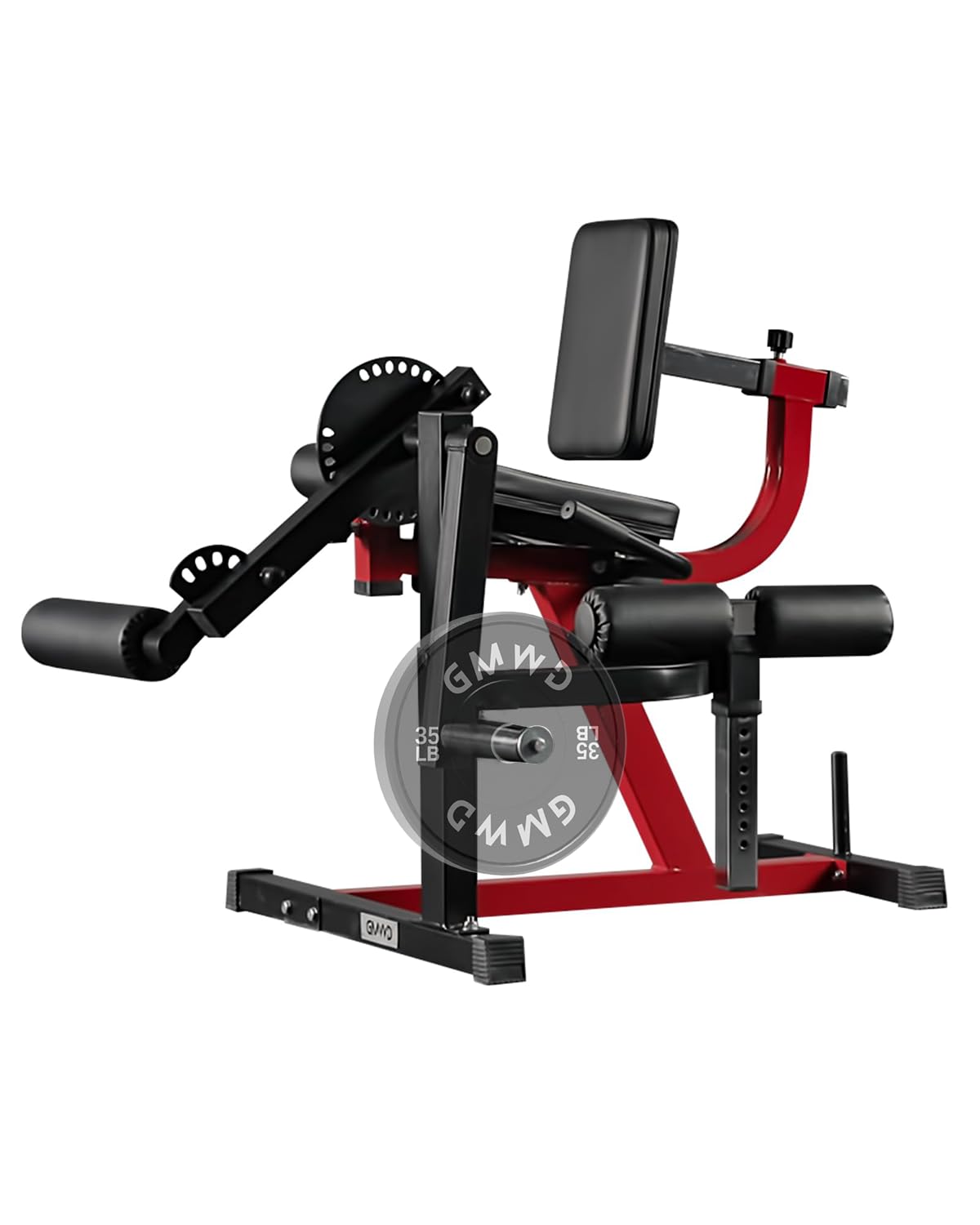
1. GMWD LE02 Leg Extension and Curl Machine
Our pick — 4.5+★ from 350+ verified ratings; the strongest balance of quality and price.
The strength machine that fits a spare corner and still takes a real leg day.
If your training space is a corner of a garage, the GMWD LE02 does what a bigger station does without eating the floor. It runs 34″D x 36″W at a 37-inch height, so it tucks against a wall and still lets you set up a full curl. The frame weighs 95 pounds, which is enough to keep it planted while a single person can still shove it aside to park a car. That is the tradeoff you are being handed versus the LIONSCOOL V4.0, which runs 57″D x 43″W — this one loses depth but gains back your garage.
What wins the majority over here is the adjustability. You get 28+5 leg positions, 8 backrest positions, 4 seat positions, and 8 leg hold-down positions, so the same machine fits a short lifter and a tall one without you rebuilding anything. The removable pins let you swap between leg extension and leg curl modes, and they double as a safety limiter — they stop the weight arm from overswinging when you come out of a rep fast, which is the moment most home injuries happen. The padding is the other thing that keeps coming up: thicker seat edges, plus sweat-resistant fabric on the seat, backrest, and leg pads.
Two honest things to know. Assembly runs somewhere between 30 minutes and two hours depending on how handy you are, and winding plates on and off mid-curl is genuinely awkward because the weight arm is short — you will want bumper-style plates or a spotter for heavy sets. Owners also report the machine fits a 6-foot frame but not much taller, so measure your back height before you buy. Set the swap pin before your working set rather than between reps, and it disappears as a problem.
Where it delivers
- Compact 34″D x 36″W footprint that fits tight home gyms without giving up curl range
- 28+5 leg positions, 8 backrest, 4 seat, and 8 hold-down settings — one machine covers short and tall lifters
- Removable pins double as an overswing limiter, keeping the weight arm from slamming back under inertia
- Thicker seat edges and sweat-resistant fabric across seat, backrest, and leg pads
What to plan for
- Switching between curl and extension is one mode at a time, and loading plates mid-curl is awkward
- Fits a 6-foot frame well; taller lifters should check clearance first
- Assembly can run past an hour, and overtightening the nylon lock nuts bends the tubing
Reach for this if: you want a compact plate-loaded station that covers both quad and hamstring work in a corner of the garage.
Look elsewhere if: you are over six feet and need a longer back pad, or you plan to load beyond 300 lbs of tension.
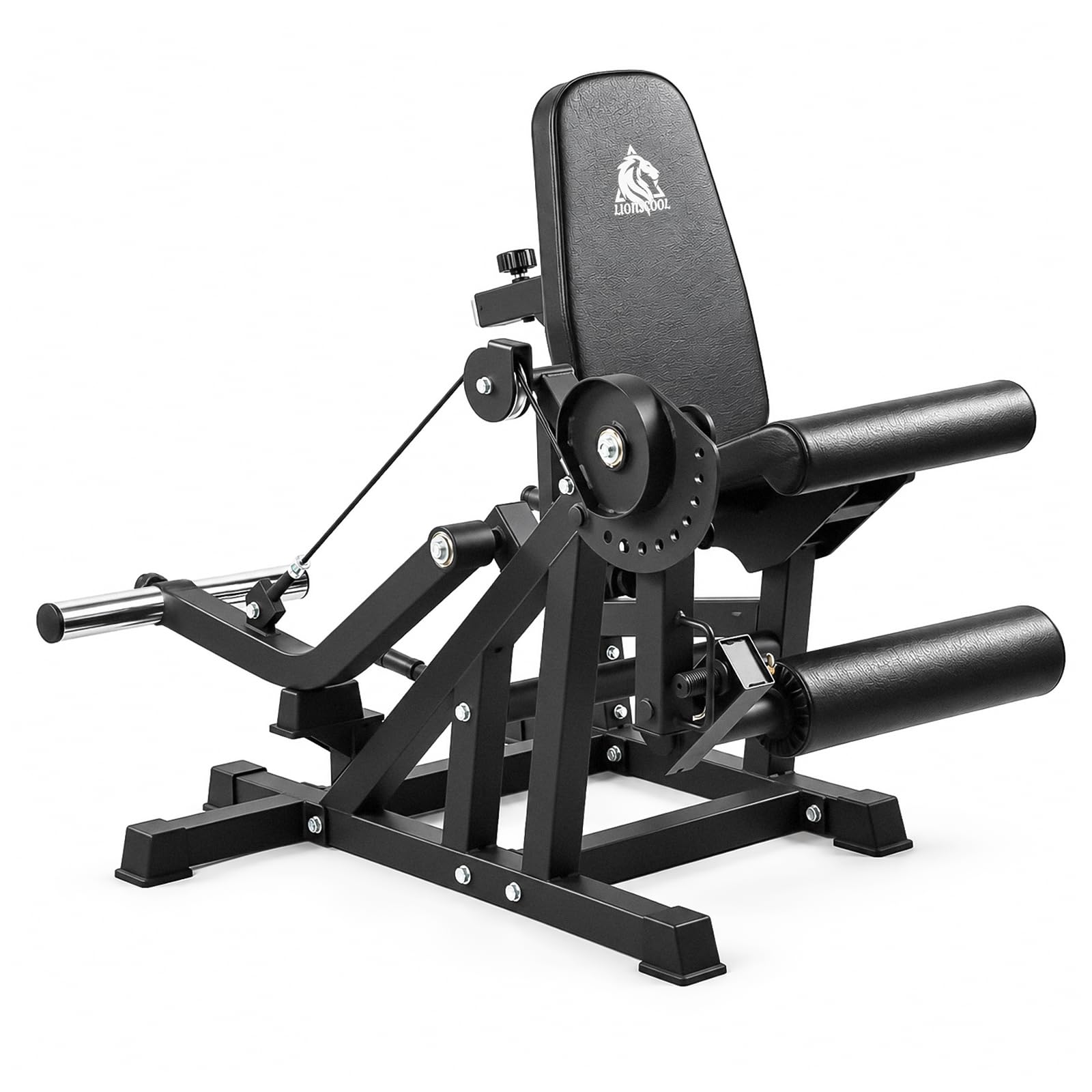
2. LIONSCOOL Leg Extension and Curl Machine V4.0
A cable-driven curl station that holds its resistance where lever machines go slack.
Here is the detail that decides this machine for a serious lifter: it runs on a cable and pulley instead of a swinging lever arm, with a reinforced 6mm-thick cable and an aluminum pulley. That cable holds steady resistance through the entire curl, so the weight does not go light at the top. Most lever machines — the GMWD LE02 among them — deliver their tension through a plate arm whose leverage shifts as it swings, which is why the top of the curl feels free. This one carries a patent on that pulley design, protects the ride with a 10-gauge steel support frame with extended feet, and holds a 800 lb user and load rating with up to 400 lbs of plate load on the arm.
The seat setup is where the comfort shows up. Instead of a knee holder you have to climb around, LIONSCOOL removed it entirely so getting in and out is unobstructed. The backrest adjusts through 6 seat depth positions to fit users from 5’2″ to 6’2″, and the foot roller adjusts through 9 angles so it conforms to the shin rather than pinching. The three-segment seat — seat, mid-section, and backrest — is the piece that makes lying curls tolerable, with 2.2-inch thick EPE foam padding on a textured PU surface. The 20-inch foot roller spreads pressure evenly across both shins.
Two things to go in knowing. It arrives in two packages and they ship separately, so do not panic when the second box lags. Assembly takes most people 60 to 90 minutes. There is also some frame flex under very heavy load, which a couple of owners fixed by pre-stressing the bolts — start every bolt before you tighten any of them, on a level surface, and that flex largely goes away. The plastic seat adjustment knobs are the other long-term item to keep an eye on.
Where the money goes: the cable pulley system is the reason to pick this over a cheaper lever machine — consistent resistance through the whole curl arc, not just the middle.
The honest read: a 2-year framework warranty and 1-year parts warranty back it up, but you are paying for the resistance design, not for more plates on the arm.
Best match: a lifter who has already owned a cheap leg machine, felt the resistance drop at the top, and wants it fixed.
The catch: it takes 57 inches of depth laid down and 65 inches when the curl arm is deployed, so measure your space before ordering two heavy boxes.
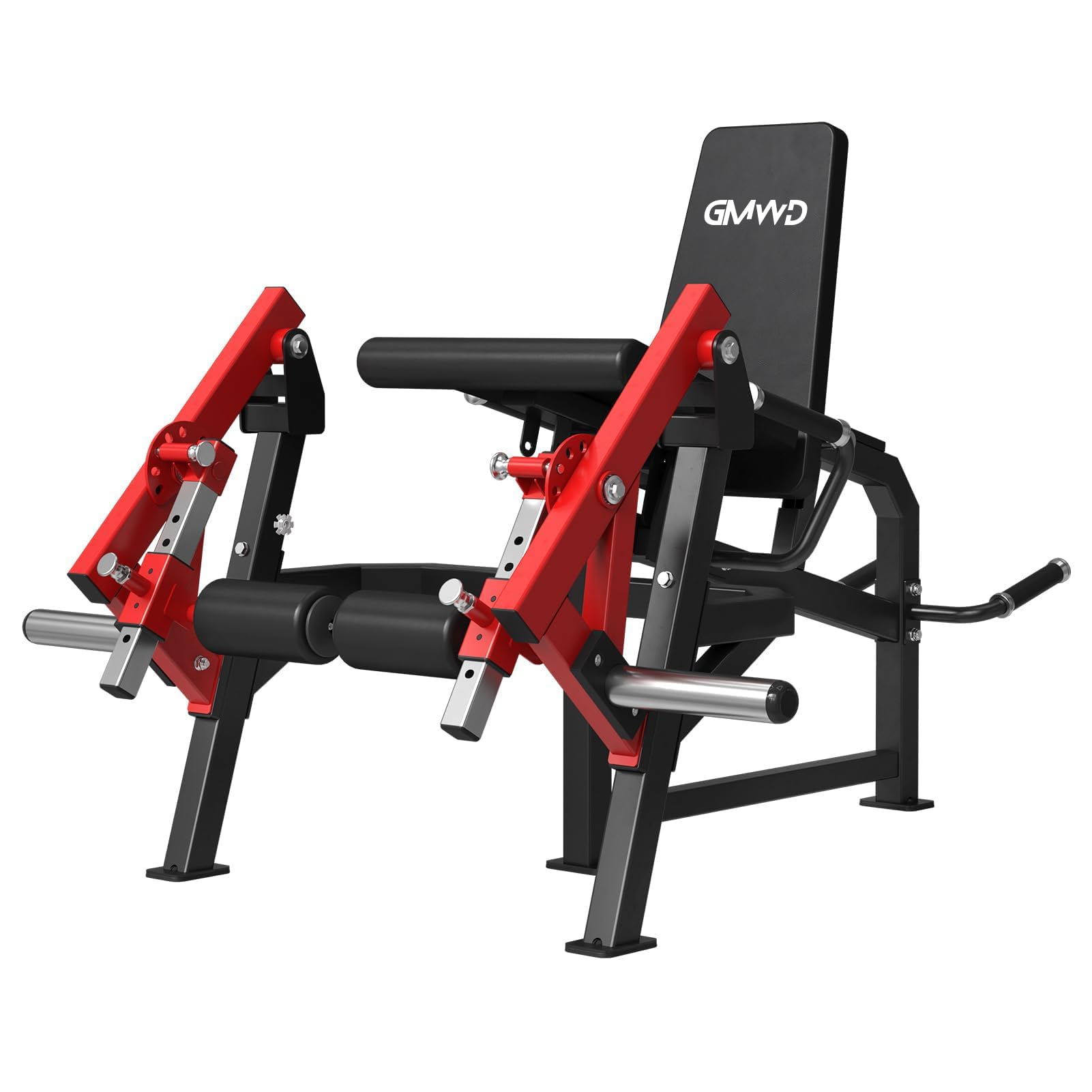
3. GMWD LE03 Leg Extension and Curl Machine
Independent arms on each side let you hunt down the weaker leg one rep at a time.
Most home leg machines move both legs as one unit, which quietly lets your stronger leg carry the weaker one for years. The LE03 splits the movement: each side loads and moves on its own, so you can train one leg at a time and see the imbalance instead of hiding it. Lock both arms together and it becomes a standard bilateral extension and curl station. It pairs that with a 4-in-1 range — leg extension, lying leg curl, standing leg curl, and glute work — all inside a 48″D x 32.5″W footprint, which is narrower than the LIONSCOOL V4.0’s 43-inch width and much easier to slot into a garage bay.
The build matches the price point rather than apologizing for it. The frame is 14-gauge alloy steel in a 50×50 mm profile, the machine weighs 115 pounds, and it holds a 700 lb rating with a 350 lb plate-loaded pin system. Its 115-pound frame and 700 lb rating hold it steady under heavy sets. Adjustments run through pop-pins: 6 positions on the ankle roller, 3 on the seat, and 2 on the back cushion, all set without tools. The handle stays fixed for stability on heavy sets.
A couple of recurring notes worth knowing. A few owners have reported that the two leg arms do not sit perfectly symmetrical when loaded — roughly an inch of leverage difference if you look for it — and that the seat has a little slack that can let the machine rock. Neither has stopped anyone from training, and customer service has been responsive when things arrived wrong. Assembly runs about an hour solo and the flow improves considerably if you watch the video guide first rather than working from the printed sheet.
Worth buying if: you are training around a strength gap between legs, or you want a 4-in-1 machine in a narrow footprint under 33 inches wide.
Know before ordering: the arms do not always sit perfectly even with each other, and the seat can rock slightly when you drive hard out of a rep.
4. XMark XM-7615 Rotary Leg Extension and Curl Machine

A rotary press arm that adjusts to fit your leg length — not the other way around.
The XM-7615 solves the problem most machines ignore: leg length. It runs a 12-position vertically adjustable thigh pad and a 20-position adjustable press arm, so the pivot can be centered on your knee rather than forcing you to reach for it. A fully adjustable backrest pad handles the rest. It weighs 136 pounds on an 11-gauge steel 2×3-inch mainframe with a rear weight plate post that pushes the frame’s weight behind the pivot and keeps it planted during heavy extensions. That is the biggest gap between this and the cheaper home machines — a 4-point base plus rear loading is a different level of stability than a narrow frame with everything stacked in front.
Both plate sizes work here. A 14-inch chrome Olympic adapter sleeve handles standard Olympic plates, and the plate posts accept 1-inch plates as well, so you can use whatever you already own. The padding is worth the mention outright — most owners describe it as commercial-grade, and the backrest can be adjusted to support a wide range of hip and torso lengths. Assembly runs about an hour from the included instructions and requires no specialty tools.
The honest downside here sits entirely in the details, not the frame. The plastic sleeve inserts on the plate posts wear faster than the rest of the machine, the knee pad post is a little undersized and can wobble, and the hold-down knob sits in front of the seat where it blocks hip thrusts entirely. There is also a grease fitting on the pivot that needs periodic lubrication or the curl action starts to feel gritty. Keep a grease gun nearby — buyers report the pivot holding up like day one after four years of twice-weekly use at 50 to 125 lbs.
The fit-and-finish verdict: the frame and the padding are the parts people write home about; the plastic inserts and the knee pad post are the parts they grumble about.
Maintenance expectations: it wants grease in the fitting, it wants the hold-down removed to do hip thrusts, and it wants a handyman if you would rather watch someone else spend the hour building it.
Pick it if: you are a serious lifter who wants a rotary-pivot machine with a range of adjustment that fits a tall frame and long femur.
Do not pick it if: hip thrusts are a core part of your routine — the hold-down knob sits directly in the way.
5. Titan Fitness Glute and Ham Developer
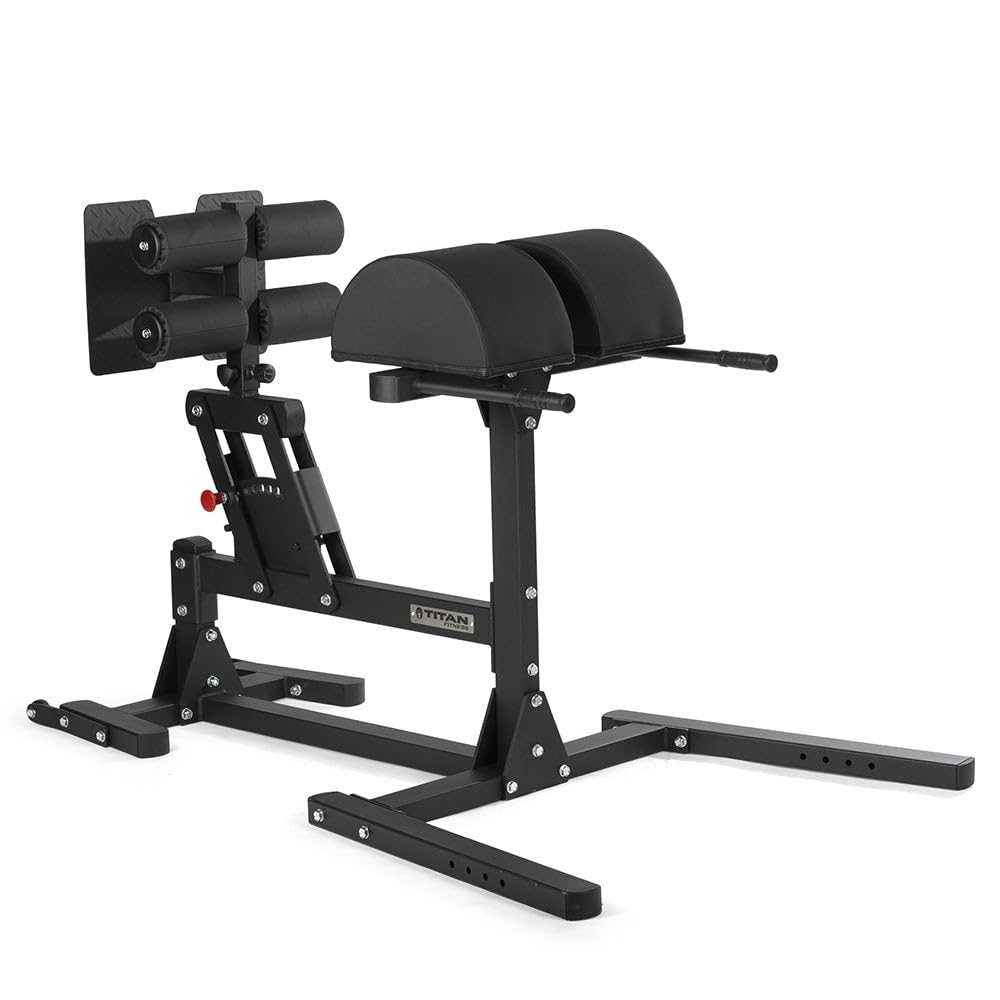
A 190-pound powder-coated steel hip-hinge bench built for glute and hamstring work.
This is a different animal than everything else on the list. A glute and ham developer is a hip-hinge bench: you lock your ankles under the padded rollers and drive your hips up and down against your own body weight, which hits the hamstrings as hip extensors — the way they actually work when you run. It also flips into an ab trainer for high-range sit-ups. Ten adjustment settings via pop-pins resize the bench for different athletes in seconds, and the HeftyGrip vinyl padding plus padded ankle rollers are what let you spend an hour on it without bruising your hip bones. The 350 lb weight capacity and wide base keep it planted.
This is the main vertical: it is heavy. The machine ships at 190 pounds and typically arrives in two boxes of roughly 120 lbs each, so plan for the delivery and plan for the assembly. Once it is built, owners mention years of solid service without issue from the 190-pound powder-coated steel frame. Wheels are included so you can roll it out of the way when it is not in use. Assembly is straightforward with basic instructions, though it does want a real set of tools and a helper.
Two real caveats. If you are shorter than most, the bench geometry can be harder to lock into properly — enough so that this is the machine most likely to feel wrong for a smaller athlete. And under very heavy loads the foot end can lift off the floor during back extensions unless you weight the base down; owners have handled this by parking a sandbag or plates on the rear of the frame, and it takes the load without complaint after that. Neither issue is a defect — they are setup problems with known fixes.
Who this is for: a home gym owner who wants hip extension and hamstring work that no leg curl machine can replicate.
Who should skip it: someone hoping for a compact grab-and-go station — this is a serious piece of equipment with a serious footprint.
Right choice for: anyone who wants strength that carries over to running, sprinting, and back extension work.
Wrong choice for: shorter athletes, or anyone who cannot anchor the base with extra weight — the foot end lifts without it.
6. FEIERDUN 4-in-1 Adjustable Leg Extension Curl Machine
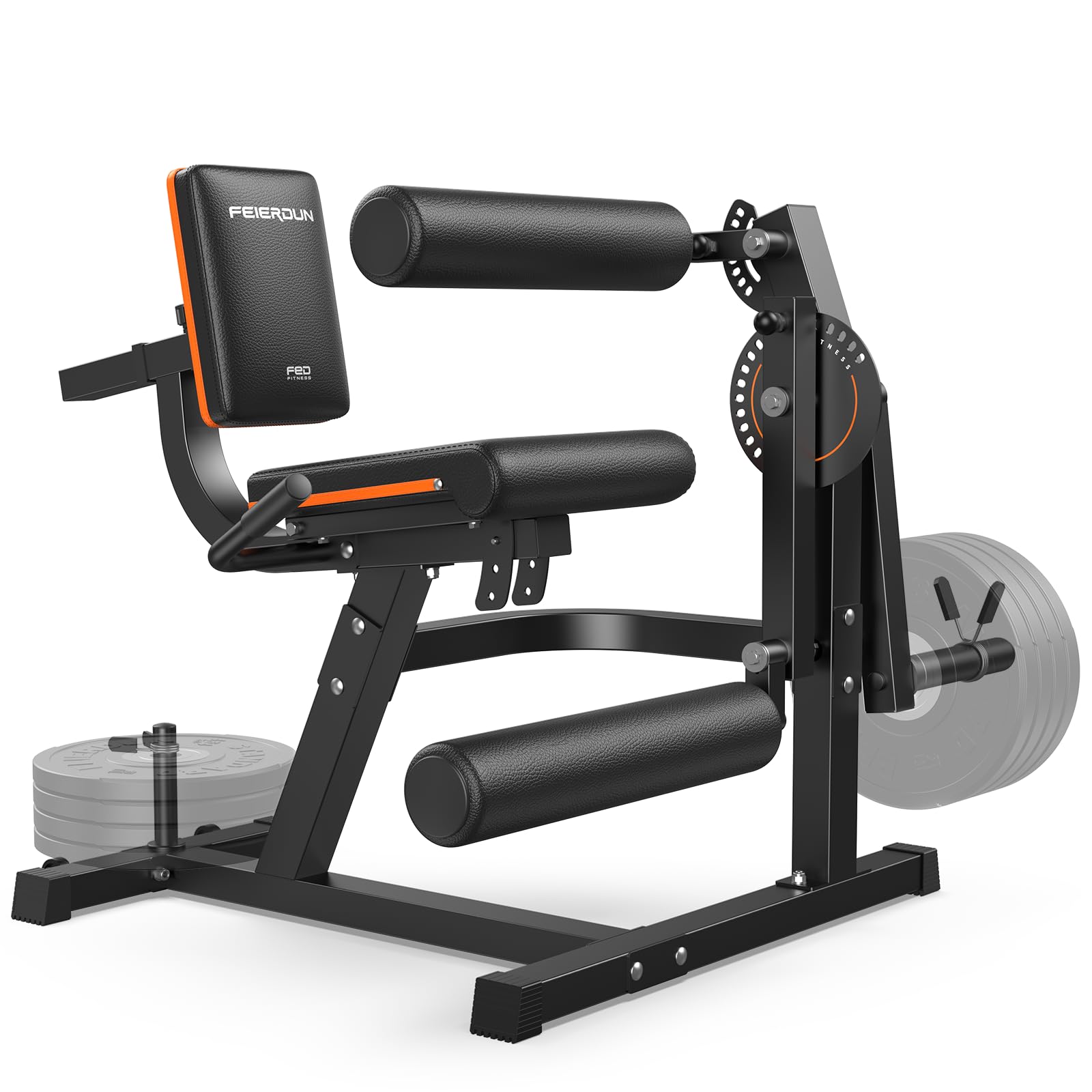
Four exercises, linear bearings, and a footprint under three feet wide.
The FEIERDUN’s standout number is not on the frame — it is on the four-exercise range inside a footprint that measures 33 x 34 x 38.5 inches. It runs commercial-grade steel rated to 700 lbs, with an Olympic adapter that accepts both 1-inch and 2-inch plates. Between leg extension, leg curl, hip thrust, and calf raise, that is a full lower-body session from one station. The linear bearing system is what makes exercise changes smooth rather than jerky — a bearing slides on a shaft instead of pivoting on a bushing, so the motion stays on a straight path and does not bind.
Assembly runs under 40 minutes per the manufacturer, and owners confirm a solo build in about two hours is realistic if you are working from the video. A 43-year-old owner at 5’4″ reported the machine handles hamstring and quad work well and delivers solid quality for the price point. The plate storage bar doubles as a stability anchor — it moves the rear load backward, so the frame stays put when you load heavy on the extension side.
The known weak spot here is the fit range at the very short end and the range of motion in general. Owners at the earlier model version had trouble with a badly placed leg curl pad and misaligned extension holes that limited the stretch, so verify you are ordering the newer “1S” version with the dial-pin thigh pad before you buy. A separate note: the loaded weight sits on one side only, so hip thrust work feels asymmetric — this machine handles quads and hamstrings cleanly, but skip it if hip thrusts are your main goal. Handle those two things and this is the most machine per dollar on the list.
Strongest fit for: someone wanting four exercises, plate compatibility with 1-inch and 2-inch plates, and a sub-three-foot footprint.
Falls short for: hip thrust enthusiasts — the single-sided plate loading feels lopsided, and the manufacturer recommends the newer 1S version specifically.
7. Mikolo LE00 Leg Extension and Curl Machine
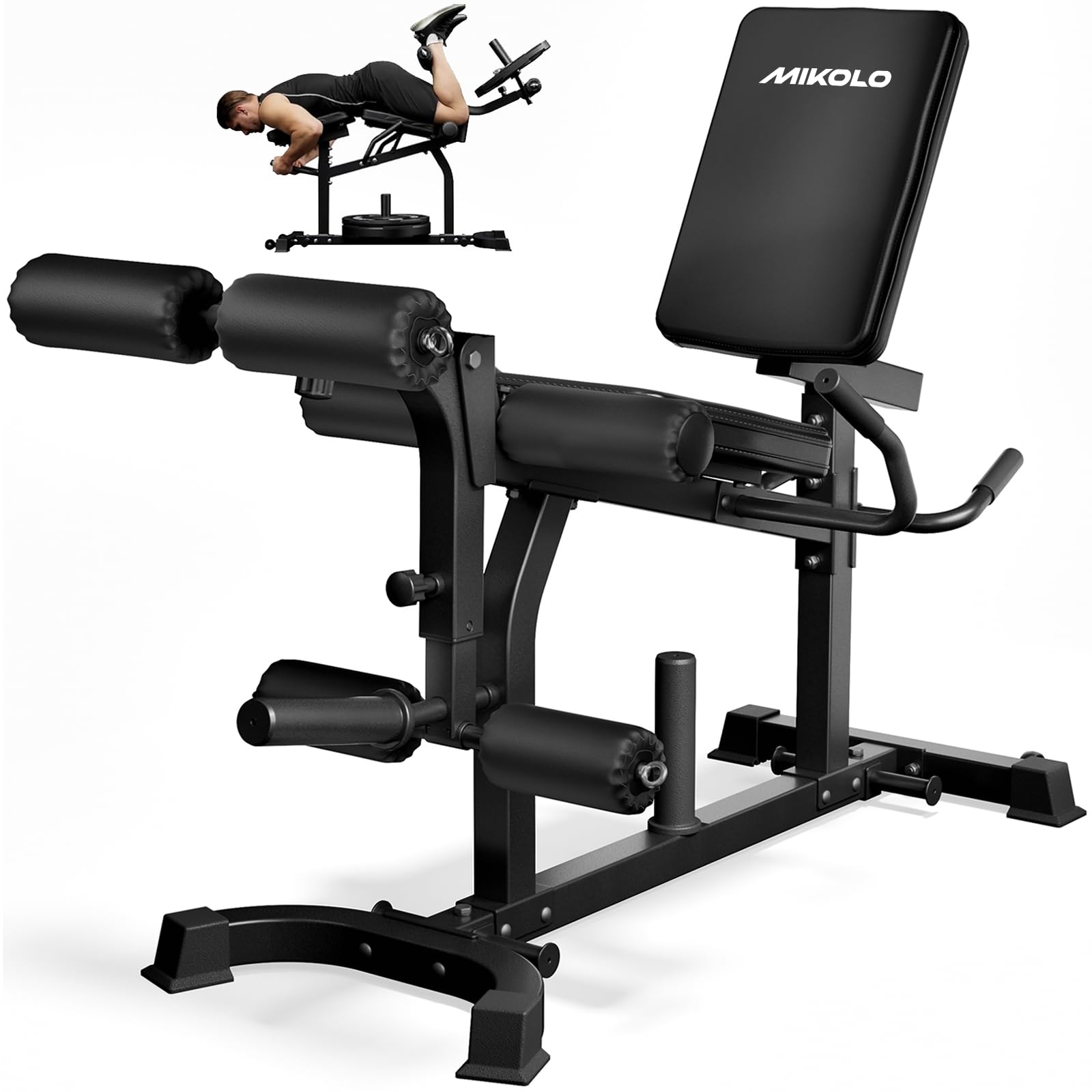
A 55-pound, sub-22-inch-wide station that rolls out of the closet and back in.
Here is the number that matters for apartment living: this machine is 55 pounds and 21.7 inches wide. That is dramatically lighter than the GMWD LE03 at 115 pounds and the XMark at 136 pounds, and narrower than every other machine on this list. It ships with wheels so you can roll it under a bed or against a wall between sessions. The whole thing covers 7.28 square feet when deployed. If you share floor space with furniture, this is the one to look at first.
It has some depth on the resistance side too. Mikolo built a triple loading system — a plate post, band pegs, and a cable clip — so you can load resistance through plates, resistance bands, or a cable connection if you have a cable station nearby. That gives the machine more ceiling than its 440 lb rating would suggest. The 15-degree V-tilt pad is the other design detail worth knowing: it cradles the torso at a slight angle rather than pressing it flat, which opens the chest so you can keep breathing through a hard set of curls instead of folding forward. The 5-position leg extension and 4-position leg curl settings cover most body heights. PU rollers on the leg pads smooth out the joint feel.
The honest limit here is the range of motion. A chunk of owners say the curl feels strong through the middle and tops out early, and the same complaints show up on the extension side. If you are tall or long-femured, the fixed geometry can leave some stretch on the table. It is not a flaw that stops anyone training — the machine still works — but if maximum stretch at the bottom of a lying curl is what you need, look at the LIONSCOOL with its adjustable backrest depth instead.
Where it shines: triple loading capability, a 7.28 sq ft working footprint, and 55 pounds of machine you can roll away.
The constraint: the range of motion tops out early for long-femured lifters, and the machine tops out at a 440 lb rating overall.
Built for: apartment dwellers or shared spaces where the machine needs to disappear between sessions.
Not built for: a long-legged lifter chasing maximum stretch in a lying curl.
8. PASYOU PM30Pro Adjustable Weight Bench Leg Press Machine
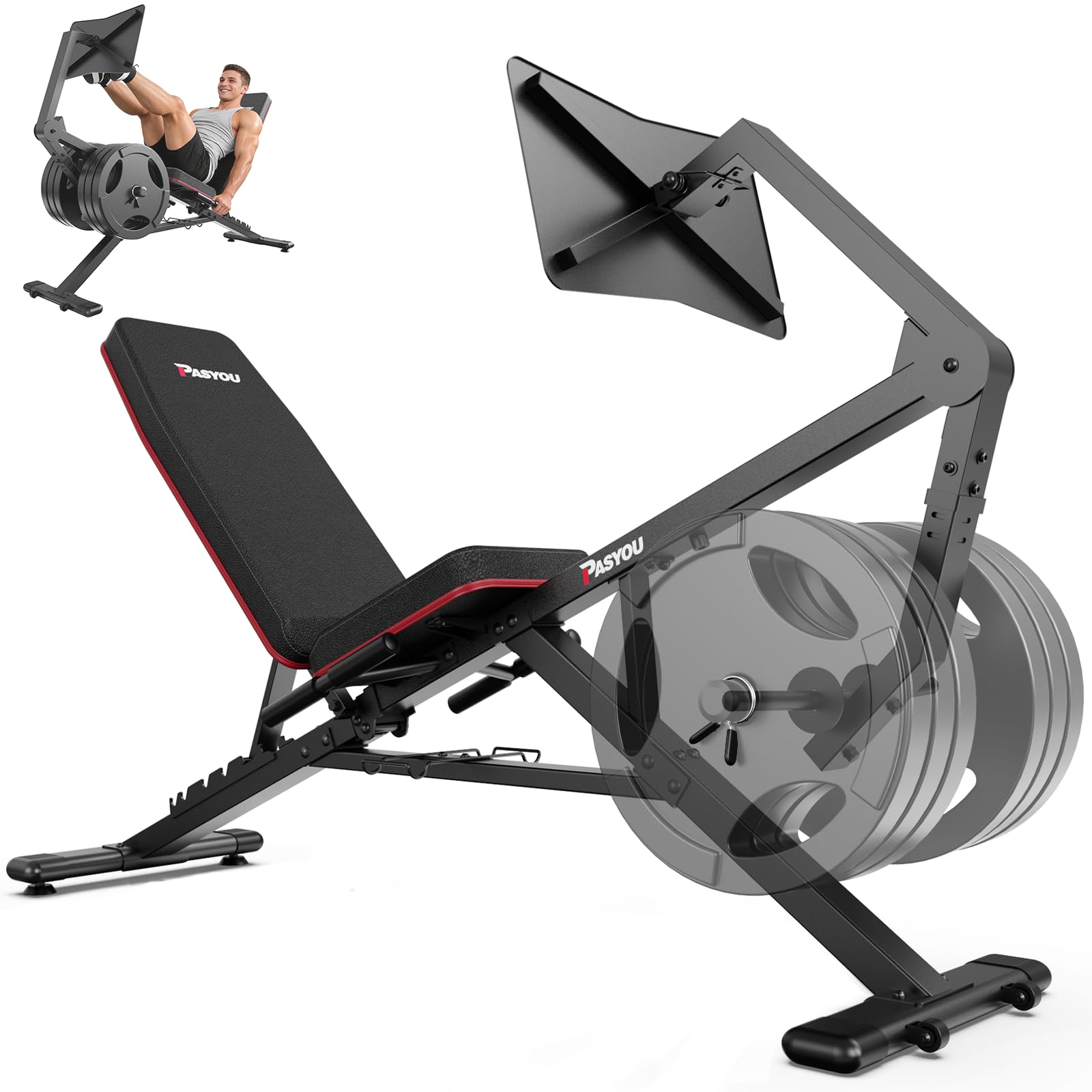
A full leg press, a weight bench, and a lower-body machine in the space of one station.
This is the only machine on the list that has a leg press plate rather than a curl lever, which means it hits the hamstrings from the front through the whole movement — quadriceps, glutes, hamstrings, adductors, and calves. The frame is a reinforced triangular structure rated to hold up to 1300 lbs, and it fits users from 64 to 79 inches tall, which is the widest height range on the list by a wide margin. The unit weighs 73 pounds, runs 68 inches deep and 19 inches wide, and rolls on wheels to move between sessions. The reinforced triangular frame is the design element that gives the machine its stability — three sides braced against each other resist wobble better than an open frame of the same weight.
The work it does for you is variety. The station doubles as an adjustable weight bench with 8 backrest angle settings, high-density foam cushions on the seat and back, and an oversized footplate with non-slip handles. It carries a front rack that accepts 1-inch and 2-inch weight plates and a lower dumbbell rack. Tuck it into a corner and it covers leg press, leg extension, and standard bench work without adding a second machine. Assembly is manageable — one owner knocked it out in 30 minutes using common sense and the video.
Two things to size honestly. The plate capacity on the arm is 330 lbs even though the frame rating is much higher — several owners wish for longer weight bars to stack more plates. And the seat is not slide-adjustable; only the backrest moves, so a 5’9″ user reports the fit works but you want to eyeball your leg length before ordering. Setup is also easier with the manufacturer’s assembly video than the printed manual.
Where it earns its place: a 1300 lb rated frame and a 64-to-79-inch user fit that covers a much wider range than any curl-specific machine on the list.
The honest limit: the front rack tops out at 330 lbs of plates even though the frame carries much more, and the seat does not slide forward or back.
Suits: a home gym owner who wants a leg press plate plus a bench in one station and a height range that includes tall lifters.
Think twice if: you plan to load heavy on the leg press plate — the 330 lb plate limit will be your ceiling.
9. HANDBODE Leg Extension and Curl Machine

The load ceiling here is the number that stands out — 1000 lbs on the frame.
On paper, this is the highest-rated load capacity on the list. The HANDBODE carries a 1000 lb maximum weight recommendation against the GMWD LE02’s 500 lb, and it supports 800 pounds of tension against the GMWD LE02’s 300 lbs. That 500 lb gap over the GMWD LE02 matters if you load heavy or plan to keep this machine for a decade. The frame is alloy steel with a 1-year manufacturer warranty, it weighs 91 pounds, and it fits 1-inch and 2-inch plates. It runs on wheels for mobility and is described by the manufacturer as ultra-quiet.
Owners who like it point to the quality and sturdiness of the build above everything else. Assembly works — the parts come in labeled bags and the instructions are clear — and the machine fits a 6’2″ user with full range of motion. A few pick up the trick early that it holds 4×45 lb bumper plates without struggling, which is a useful reference point for planning your weight purchases. Customers note the alloy steel frame stays sturdy through regular home gym use.
One honest note worth flagging directly: a single owner reported the seat broke on a third use with a 190-pound person warming up on extensions with 80 pounds loaded. That is one incident out of a small set of reviews, and it does not describe the machine’s routine performance, but it does mean you should not exceed the tension it is designed to handle and should not skip the tension-limiter bolt check during assembly. Assembly is a bit of a project — most reviewers point out about an hour to ninety minutes, and the included instructions are picture-only with metric bolts that take 14mm and 17mm sockets. Buy the sockets before the machine arrives.
Best for: a lifter who cares about a big load ceiling and does not mind a build session with an impact driver.
Worth noting: the assembly is picture-only, so plan a full afternoon and a set of metric sockets.
Know the Specs
Weight rating versus plate capacity
A machine’s “maximum weight recommendation” is the total load the frame is designed to carry — body weight plus plates together. It is a different number from the “tension supported” figure, which tells you how much resistance the moving arm is designed to handle. A station labeled for 1300 lbs of user weight might still be limited to far less plate on the arm. Read both, and never load the plate arm beyond its stated limit. Load the plate arm past its stated limit and the frame is the part that fails.
Footprint and clearance — the number that hides in the specs
The D and W dimensions on the listing tell you what the machine covers on the floor. What they do not tell you is the working clearance: how much space you need in front of the station to enter and exit, or how deep the curl arm swings when it is deployed. A machine measured at 57 inches deep can need noticeably more than that when the arm is in use. Measure the footprint plus a walk-in buffer — twice.
Adjustability range — more than a comfort feature
Leg length varies more than most people realize, and the difference between a good rep and a bad one often depends on whether the pivot lands on your knee. Variables to look at: backrest positions (which set the torso angle under load), seat positions (which set your hip position), leg hold-down positions (which keep your thighs from lifting), and adjustable press arms (which set the pivot point). The wider the total range, the more the machine fits your frame and the more consistent your reps stay.
Loading style — plates, bands, cables, or your body weight
How the resistance gets to the movement determines almost everything about the feel. Plate-loaded arms offer the most familiar setup but will only deliver resistance through the swing arc of the arm — that is the reason the pulley-style LIONSCOOL V4.0 keeps more tension at the top of a curl than a lever machine. Band pegs and cable clips give you resistance ratio options but add setup steps. Hip-hinge machine designs like the GHD load through your own body weight, which is a very different stimulus and worth choosing deliberately rather than by accident.
Common Questions
What is the difference between a hamstring machine and a leg extension machine?
Will any of these hamstring machines work with my existing 1-inch weight plates?
How much floor space does a hamstring machine actually need?
Do these machines work for very tall or very short lifters?
How long does assembly usually take on a home hamstring machine?
Do I need Olympic plates or standard plates for a hamstring machine?
Is a glute and ham developer the same as a hamstring curl machine?
Why does the resistance feel light at the top of my curl?
Can I use a hamstring machine for rehab work or knee recovery?
Do I need to lubricate the plate arm or pulley on a home hamstring machine?
Which hamstring machine takes the least space in a small home gym?
The Bottom Line
For most home gym owners, the hamstring machine worth building around is the GMWD LE02. It delivers the two things that keep a leg machine in daily rotation — a compact footprint that fits a garage corner and enough adjustability to fit the lifter, not the other way around. The 28+5 leg positions and 8 backrest settings do the hard work of matching your body, and the swing-limiting pins make heavy extensions feel safe without a spotter. If you are loading real plates and want the resistance to stay heavy at the top of the curl, grab the LIONSCOOL V4.0. And for posterior chain work that no curl station can replace, the Titan Fitness GHD is the one to reach for.
How we choose
We do not accept paid placement. Every pick is matched to a real buyer and a real use-case; we do not hands-on test units.
Sources
Specifications: manufacturer listings and product documentation. Review insights: verified customer reviews, as of October 2026. Pricing: not shown on this page (it changes often); check the current price via the retailer link.
As an Amazon Associate, Aappliancez earns from qualifying purchases. This does not affect which products we feature.