Disclosure: Some links in this post are affiliate links. As an Amazon Associate I earn from qualifying purchases, at no extra cost to you. Learn more
Specs are compiled from manufacturer listings and verified buyer reviews and can change over time — please confirm the key details on the product page before buying.
Buying the wrong blade is why so many people give up on a hacksaw and reach for a grinder. Teeth per inch (TPI) decides almost everything here — how fast the blade bites, how clean the edge comes out, and whether it survives a cut through thick steel or snaps halfway. This page breaks down eleven bi-metal blades and frames by the metal each one actually suits, so you can match the blade to the job instead of guessing at the hardware store.
This guide is built by comparing the manufacturers’ published specifications and the patterns across verified customer reviews, so you get each pick’s real strengths and trade-offs instead of marketing spin.
You will see which tooth count handles stainless, which frame keeps a blade tight enough to cut straight, and where a five-pack of mini blades beats a full-size saw. The short answer: 24 TPI is the all-rounder for steel, and 32 TPI is the pick for clean, thin-wall work.
Top Picks

How To Choose The Best Hacksaw Blade for Metal
The blade you pick has to survive one thing above all: the material you cut most often. A blade tuned for thin aluminum will skate and gum on a hardened bolt, and a blade built for stainless will feel slow and grabby on soft copper pipe. Start with your most common material, then let tooth count and blade construction narrow the field.
Match tooth count to the metal
Tooth count is written as TPI, or teeth per inch — how many cutting points sit in one inch of blade. A low count like 18 TPI has bigger, deeper teeth that clear chips fast, which suits thick stock and softer metals. A high count like 32 TPI puts more, smaller teeth against the metal, so each tooth takes a lighter bite and the cut comes out cleaner on thin-walled tube, conduit, and aluminum extrusion. The 24 TPI middle ground is the one most buyers can leave mounted for general steel work, because it balances speed with a finish that rarely needs a file afterwards.
Bi-metal versus plain carbon steel
Bi-metal means the blade is built from two steels — a hard high-speed steel tooth line welded to a flexible spring-steel back. That back lets the blade flex under a pinch instead of snapping, which is exactly the failure that ends a cheap carbon blade early. If your saw gets twisted in a tight spot or you cut in an awkward position, the bi-metal construction is what keeps the blade in one piece. Every full-size blade on this list is bi-metal for that reason.
Length, pins, and frame fit
Full-size hacksaw blades run 10-inch or 12-inch, and that length has to match your frame or the blade will not tension properly. A loose blade wanders in the cut and chews teeth off. Mini blades use a different system entirely — small 6-inch blades with pins that lock into a 6-inch adjustable frame, so they are not interchangeable with a full-size saw. Measure your frame before ordering, and check whether your saw takes standard pin-end blades or a different attachment.
Side-by-Side Comparison
| Model | Best For | Tooth Count | Blade Length | Pack Size | Amazon |
|---|---|---|---|---|---|
| LENOX 12-Inch 24 TPI 2-Pack★ Best Overall | General steel cutting | 24 TPI | 12 in | 2 | Amazon |
| HAUTMEC 12″ 24 TPI 2-PackBest Value | Aluminum and mixed metal | 24 TPI | 12 in | 2 | Amazon |
| LENOX 10-Inch 18 TPI 2-PackFastest Cutter | Fast cuts on thick stock | 18 TPI | 10 in | 2 | Amazon |
| LENOX 12-Inch 32 TPI 2-Pack | Clean cuts on thin metal | 32 TPI | 12 in | 2 | Amazon |
| GRAFF 8% Cobalt 24 TPI | Stainless steel | 24 TPI | 12 in | 3 | Amazon |
| Starrett 12″ 24 TPI 2-Pack | Mixed metal and PVC | 24 TPI | 12 in | 2 | Amazon |
| GreatNeck 5Pc Mini Blades | Tight spaces and small frames | — | 6 in | 5 | Amazon |
| HAUTMEC 12-Inch Hacksaw HT0398 | Full saw with high-tension frame | 24 TPI | 12 in | 1 | Amazon |
| Bahco Sandflex 12-Inch 5-Pack | Aggressive steel cutting | 24 TPI | 12 in | 5 | Amazon |
| HAUTMEC 32 TPI 10-Pack | Fine, smooth cuts in bulk | 32 TPI | 12 in | 10 | Amazon |
| HAUTMEC Mixed TPI 12-Pack | A blade for every metal | 18, 24 & 32 TPI | 12 in | 12 | Amazon |
Detailed Reviews
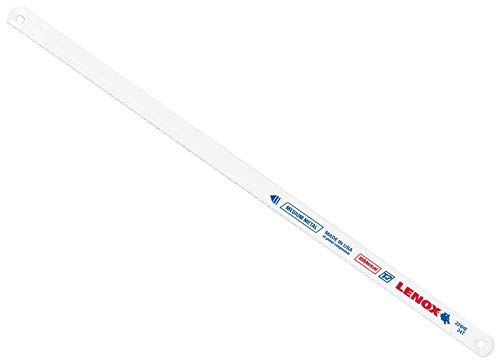
1. LENOX Tools Hacksaw Blade 12-Inch 24 TPI 2-Pack
Our pick — 4.5+★ from 950+ verified ratings; the strongest balance of quality and price.
The one blade most buyers can leave mounted for steel, aluminum, and everything between.
Twenty-four TPI is the number that earns this blade its place at the top. That tooth count is fine enough to leave a clean edge on steel and coarse enough to clear chips instead of clogging, so one blade covers the bulk of home and shop metal cutting without a swap. The blade is bi-metal — a hard tooth line welded to a flexible back — which lets it bend and flex under a pinch instead of breaking. In a 12-inch length it fits the common full-size frame, and the 2-pack means you have a spare ready when the first one dulls.
What wins people over is the value. Buyers describe these cutting a steel fence post like it was butter, and one long-running theme is that the blades simply do not need changing as often as cheaper ones. As buyers report: “Cut 1/8 inch steel easily and stay sharp well.” People also mention fitting an old Mac tools hacksaw perfectly, which says a lot about how standard that 12-inch profile really is.
The catch is on softer, gummier metals. Aluminum is the one material that shows up as a problem — thin, sticky metal can grab a fine-tooth blade and stop it cold, so save this one for steel and ferrous work. The 2-count pack is also modest for anyone cutting daily; if you burn through blades fast, the multi-packs lower on this list stretch further between orders. At 4.5+ stars across 900+ ratings it is the crowd favorite of the whole group, and it earns that spot on plain cutting performance.
Where this blade shines
- 24 TPI handles general steel and mixed metal work with one mount
- Bi-metal body bends and flexes under a pinch instead of shattering
- 12-inch length fits standard full-size hacksaw frames
What to expect before you buy
- Fine teeth can stick and stall on soft aluminum
- Two blades is a short supply for heavy shop use
Go for it if: you want one dependable blade for steel, bolts, and general metal cutting.
Look elsewhere if: aluminum or soft non-ferrous metal is most of your work.
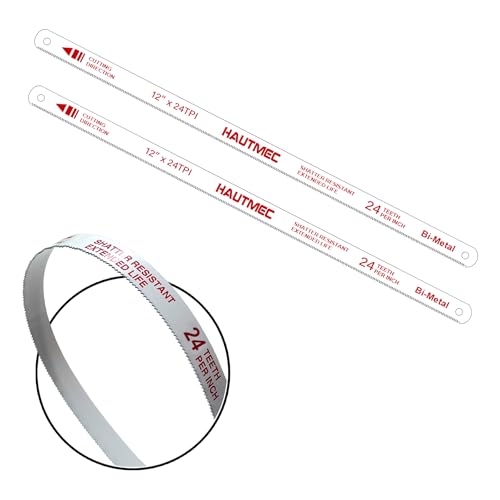
2. HAUTMEC 12″ Hacksaw Blades 24 TPI 2 Pack
Wavy-set 24 TPI teeth that bite aluminum as readily as steel, at the entry-level tier.
The detail that sets this blade apart is the wavy set — the teeth are set in a gentle wave so the cut stays wider than the blade body. That wider groove fights binding, which is why this one keeps moving through soft metals where finer, flatter blades tend to grab. The teeth are high-speed steel welded to a flexible spring-steel back, so the blade bends under stress rather than snapping. Size is 12″ long × 1/2″ wide × 0.025″ thick, which is the near-universal standard that fits most full-size frames.
Cutting performance is what buyers praise most here, and aluminium is the recurring star — the blade gets through aluminum tubing fast and without drama. As owners mention: “It cut right away and didn’t get dull; it’s flexible enough that when it was pinched it did not snap.” That flex is the whole point of the bi-metal build, and it shows up in real use. The spring-steel back is also coated to resist rust, so it survives a damp workshop or outdoor job.
Durability is the honest question mark. Some customers note they have only run one blade so far and cannot speak to long-term life, which is fair for an entry-level blade. Treat the 2-pack as a starter supply — it is a low-cost way to test the brand on your own material before committing to a bigger box. For occasional DIY cutting, two blades will carry you through a lot of jobs.
Why it earns its spot: the wavy-set 24 TPI teeth clear soft metal without binding, and the spring-steel back survives a pinch instead of cracking.
The trade-off to weigh: it is a budget blade, so count on replacing it sooner than a premium brand if you cut every day.
Reach for this if: aluminum, copper, and light steel jobs fill your bench and you want a cheap, reliable start.
Spend up if: you need a blade you can lean on through months of daily cutting.
3. LENOX Tools Hacksaw Blade 10-inch 18 TPI 2-Pack
Big, hungry teeth and a shorter 10-inch body for slicing through thick bolts and stock.
Eighteen TPI is the coarsest count in this lineup, and coarse teeth mean fast chip clearing. Set that beside the 32 TPI Lenox and the gap is real: 32 teeth per inch against 18 is a 78% difference in tooth density, and the 12-inch blade runs 12 in against this one’s 10 in. Fewer, deeper teeth take a bigger bite per stroke, so thick bar stock and stubborn bolts move under this blade quicker than fine-pitch alternatives. The shorter 10-inch length trades a little stroke length for control and fits frames built for 10-inch blades specifically.
What owners talk about most is how cleanly it takes on hard fasteners. As reviewers point out: “Made quick work of a 1/4 inch grade 8 bolt.” That is a hardened bolt most hand tools struggle with, and the same thread-preserving cut shows up elsewhere — one buyer shortened a lag bolt and the nut still spun off freely because the threads came through intact. Bi-metal construction keeps the blade flexing rather than cracking, and the shatter-resistant design backs that up.
There is one wrinkle worth knowing. A buyer received blades actually marked 24 TPI inside 18 TPI packaging — a mix-up at the factory, not the blade’s fault, but it means checking the stamp on the blade against the label is smart when your order lands. The 10-inch length also will not fit a 12-inch-only frame without adapting, so confirm your saw’s size first. Those who match it to the right frame get a durable, controllable cutter that lasts through patient, precise work.
The core appeal: 18 TPI teeth power through thick and hardened metal faster than fine-pitch blades, with bi-metal flex to back it up.
Check before buying: confirm your frame takes 10-inch blades, and verify the tooth count stamp on arrival.
Pick this when: you cut bolts, thick bar, and heavy stock and want speed over a glassy finish.
Pass if: your frame is a 12-inch-only model.
4. LENOX Tools Hacksaw Blade 12-inch 32 TPI 2-Pack

Thirty-two fine teeth for thin-wall tube, aluminum extrusion, and cuts that need almost no cleanup.
This is the high-tooth-count Lenox — 32 TPI against the 18 TPI model’s coarser 18, a 78% denser tooth line, and the 12-inch length gives it 20% more blade than the 10-inch version. Packed teeth take a lighter bite, so the blade slices without tearing, and that is exactly what thin-wall work needs. If you cut aluminum extrusion, conduit, or threaded rod and want a square, burr-light edge, this count is the tool for the job. Bi-metal construction lets it flex in tight spots without breaking.
Quality is the thing owners come back to again and again — it is by far the most-discussed strength on this blade. The edge holds up. One buyer pushed it through a 2020 aluminum extrusion run and got square cuts with almost no deburring, and noted that cutting oil keeps chips from gumming the teeth. As shoppers say: “Cut acrylic cane that’s over an inch thick” — a clean pass through a thick plastic that would grab a coarse blade. That range says the 32 TPI pattern is more versatile than its fine pitch suggests.
The one caution is length. A few buyers ordered the 12-inch when they needed 10-inch and had to cut and drill the blade to make it fit. Measure the frame before you order; a blade that is too long simply does not tension. In a 12-inch frame, the 32 TPI teeth leave a near-burr-free edge on thin tube and extrusion.
What buyers keep coming back for
- 32 TPI leaves a smooth, near-burr-free edge on thin metal and plastic
- Bi-metal body stays rigid in a tensioned frame for square cuts
- 12-inch length fits standard full-size saws
The one thing to get right
- Too long for 10-inch frames — measure before you order
- Fine teeth prefer cutting oil to stop soft-metal gumming
Best suited to: thin-wall tube, extrusion, and finish-sensitive cuts where a clean edge matters.
Not for: thick bar stock where you want maximum speed per stroke.
5. GRAFF 8% Cobalt Premium Hacksaw Blades 12 Inch 24 TPI

Cobalt-laced teeth built to keep biting where ordinary blades dull on stainless.
The number that matters on this blade is the 8% cobalt in the tooth line — cobalt stays hard at temperatures that soften plain steel teeth, so the cutting edge resists abrasion on tough alloys. The teeth are a fine 24 TPI for a measure of speed and finish, and the blade is 300 mm long at 0.62 mm thick. Graff builds it for stainless and general steel, and the flexible bi-metal body bends without losing its working edge. A 3-pack covers you for a few serious jobs.
Stainless is where this blade earns its keep. The head-to-head proof is a hand cut through a 1/4″ A304 stainless bolt in an awkward spot with no power tool access — the cut started easily, finished in about ten minutes, and the teeth showed no visible dulling. That is stainless, the grade that eats cheap blades for breakfast. Buyers also report it cuts cleaner and faster than other hacksaw blades, to the point that the manual saw now beats dragging out an angle grinder for small jobs.
The honest limit is fragility. The very hardness that keeps it cutting stainless means the teeth are brittle — cut at an angle and a tooth can snap off rather than bend. Keep your strokes straight and let the blade do the work. That is the price of a blade this sharp on hard metal, and for anyone cutting stainless regularly it is a fair trade.
Where it wins: 8% cobalt teeth hold an edge on stainless and hardened steel far longer than ordinary bi-metal.
The price of sharpness: brittle teeth snap if you twist the blade or cut off-line, so keep strokes straight.
Choose this if: stainless bolts, pipe, or hard alloys are a regular part of your work.
Stay with a standard blade if: you cut mostly soft steel and want teeth that bend rather than break.
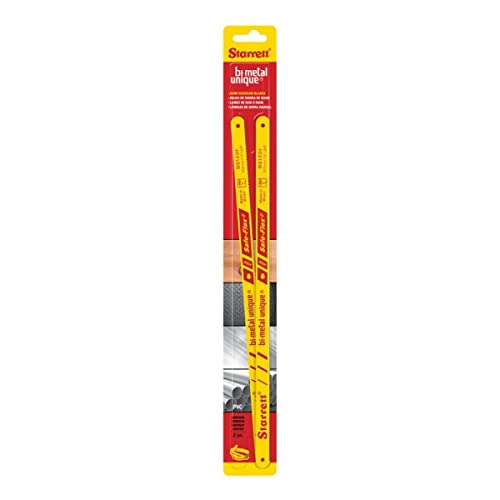
6. Starrett Hacksaw Blade 12″ 2-Pack
The toolmaker’s blade — a solid-state diffusion process that hardens the teeth against breakage.
Starrett’s angle is tooth strength. The blade goes through a patented solid-state diffusion process that bonds a high-speed steel tooth line to the body, and the maker states a reduction in tooth breakage and fracture compared with traditional bi-metal blades. It is built for interrupted cuts in cramped places, and for cuts where the blade is subject to bending or twisting — the situations that finish off lesser blades. The blade runs 24 TPI across a 12″ length and 1/2″ width, with a 0.024″ thickness.
Owners talk about it cutting through tool steel like it was butter, and staying sharp as new after multiple uses. It also earns its keep on stainless and PVC — the same blade that handles electrical conduit will take on a length of 2.75″ stainless pipe without trouble, which is why it ends up on so many trade and contractor benches. Lubricating oil and mounting the teeth for back-stroke cutting are the tips that come up most for keeping it cutting clean.
The trade-offs are cosmetic and minor. The yellow paint scuffs off fairly fast and leaves red flakes around the work — annoying, not damaging to the cut. One buyer did find the blade a touch less aggressive than a stock Klein, so if raw speed is the goal the coarser 18 TPI Lenox bites harder. For dependable, long-lasting cutting that holds up under twisting and bending, this is the safe pick.
Why trades trust it: the diffusion-hardened teeth resist breakage even in cramped, twisting cuts, and buyers report it staying sharp across many jobs.
Minor quibbles: the paint flakes off in use, and it cuts a touch slower than a coarser blade.
Made for: tradesmen and serious DIYers who cut in awkward spots and refuse to break teeth.
Another route: speed hounds cutting thick bar should look at the 18 TPI option instead.
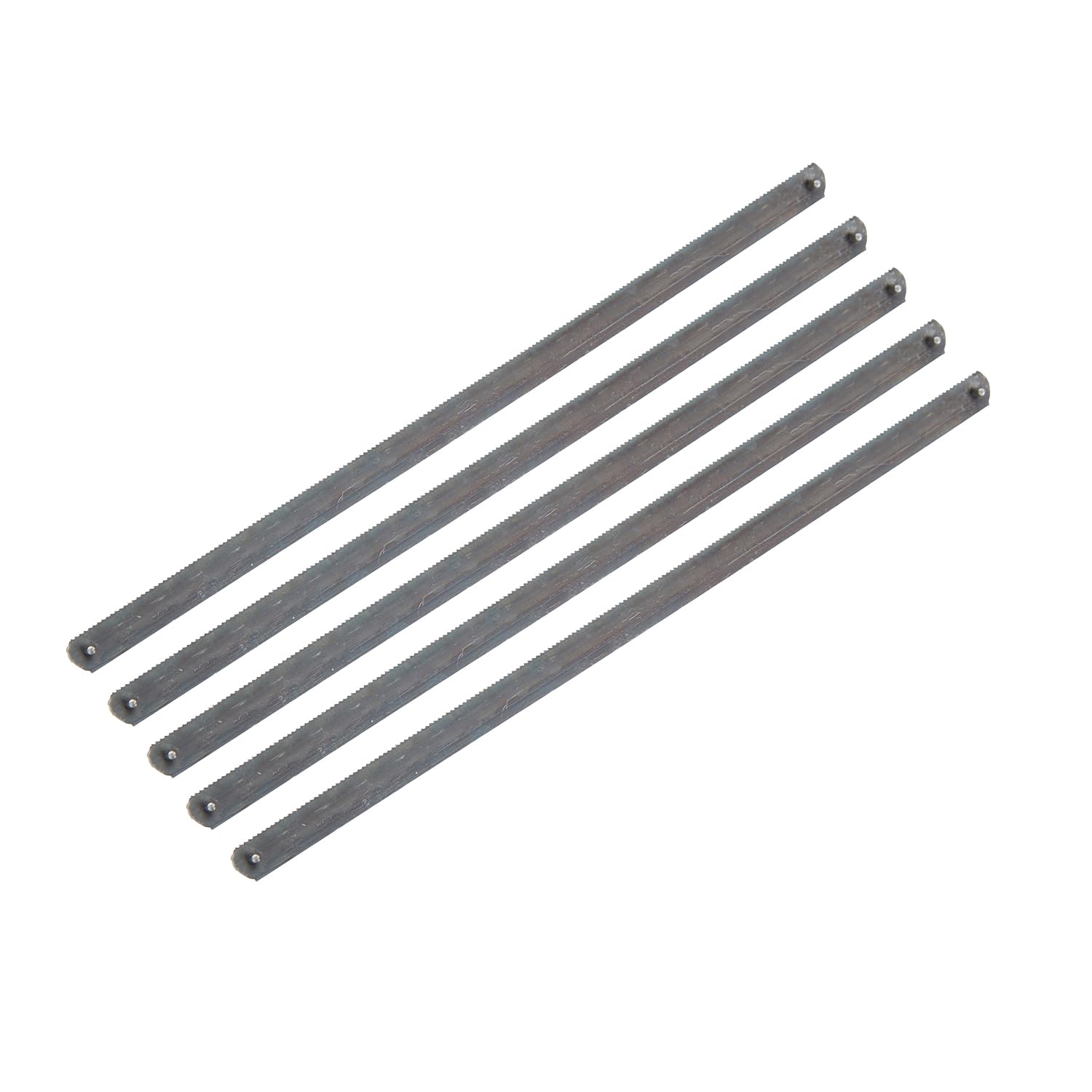
7. GreatNeck 5Pc Mini Hacksaw Blades
Six-inch blades for the tight corners a full-size frame simply cannot reach.
These are not full-size replacement blades. They are 6-inch mini blades with pins designed to clip into a standard 6-inch adjustable frame, and that size is the entire point — a short, controllable blade for close-quarters cuts and delicate work. The cutting edge is heat-treated to stay sharper longer, and the body is alloy steel for strength. The set gives you 5 blades, made in the USA, so you have spares on hand. If you have a small adjustable frame sitting in a drawer, these bring it back to life.
Owners describe resurrecting an old 6-inch saw that had a bad blade, unsure the size was even made anymore, and being delighted that these fit perfectly. The edge is reported as very sharp, sawing smoothly and noticeably better than a tired old blade. Buyers do flag one compatibility catch: not every mini saw takes this pin attachment. Check that your little frame is the standard adjustable type with pins before ordering — the blades are right, but the mount has to match.
What you are getting is renovation rather than reinvention — a way to keep an old mini saw working for delicate cuts, with a heat-treated edge that lasts. These 6-inch pin-end blades only fit a 6-inch adjustable mini frame, not a full-size saw. For close-quarters cuts a full-size frame cannot reach, the 6-inch blade gives you control.
Where the mini set delivers
- 6-inch blades reach tight spots a full-size saw cannot
- Heat-treated alloy steel edge stays sharp through small jobs
- 5-pack keeps spares ready for an old mini frame
Before you order
- Only fits standard pin-style 6-inch adjustable frames
- Not a full-size blade — no use in a standard hacksaw
The right call for: small frame work and delicate cuts where a full saw will not fit.
skip it if: you only own a full-size 12-inch hacksaw.
8. HAUTMEC 12-Inch Hacksaw HT0398
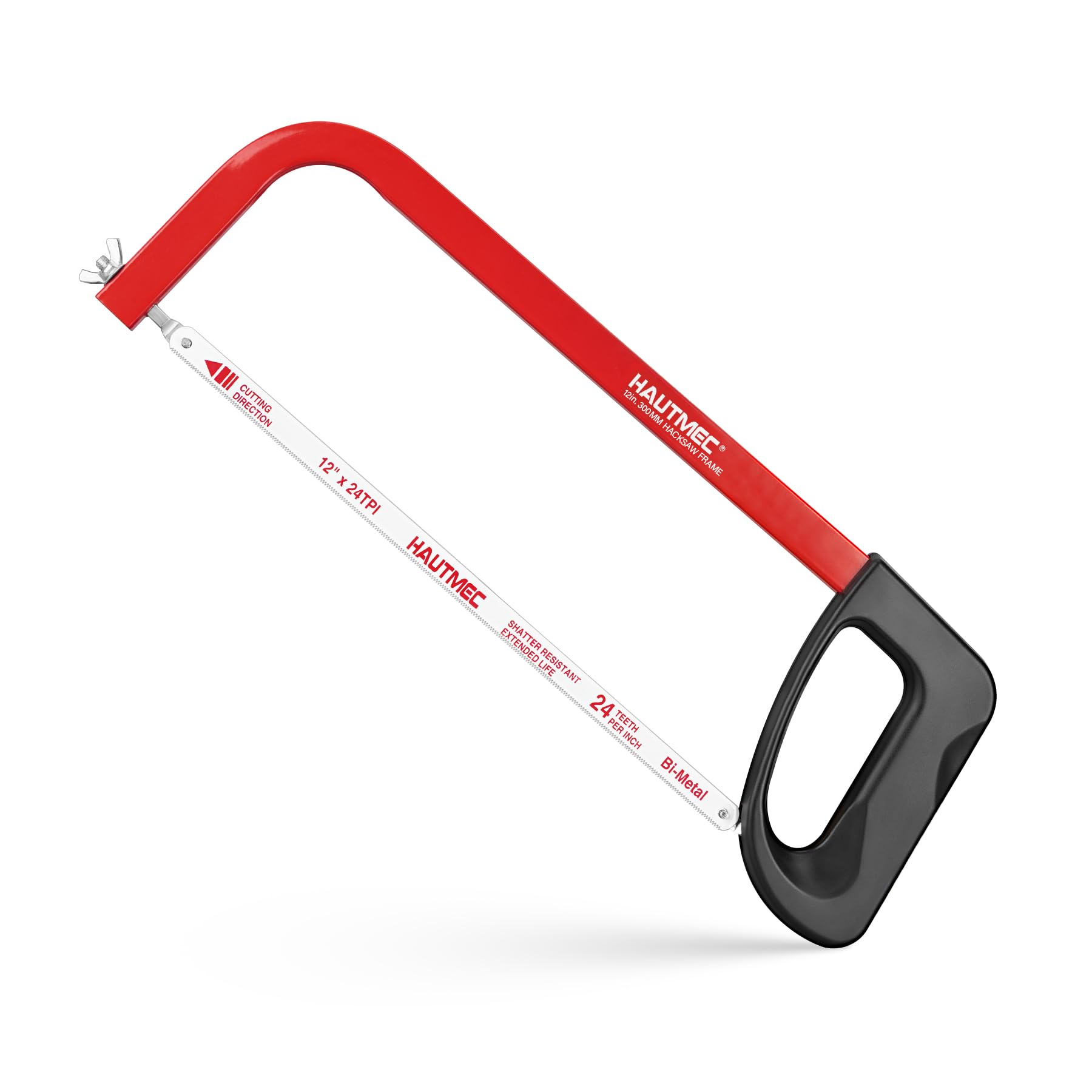
The whole saw, not just the blade — a steel frame that keeps tension high for straighter cuts.
Everyone else on this list sells blades. This one sells you the frame too. The steel frame is engineered to hold high blade tension, which keeps the blade rigid so cuts stay straight instead of wandering, and reduces the bending that chews through teeth. A top-mounted knob adjusts tension without tools, so blade swaps are quick. It ships with a 12″ (300 mm) 24 TPI bi-metal HSS blade and a 4″ cutting depth that clears steel pipe, copper tubing, plastic pipe, and wood.
Functionality is what owners praise most, and build quality follows right behind — the frame does not fall apart under load, the grip is comfortable for long sessions, and the blade stays tight. It cuts mild steel at a steady pace without feeling flimsy. The one recurring gripe is the blade brackets: they are short, and the blade can pop off unless you really crank the tension. Get it tight and it behaves; leave it loose and you will be refitting the blade mid-cut.
That bracket tension point is the honest trade-off for the convenience of a full kit. If you would rather not fight a loose blade, learning to over-tighten the top knob solves it. For anyone starting from nothing — no frame, no blade — this is the simplest way to get a complete, straight-cutting saw in one order.
The core appeal: a high-tension steel frame plus a 24 TPI bi-metal blade in one box, with tool-free tension adjustment.
The honest catch: short blade brackets mean the blade pops off unless you tighten it firmly.
Start here if: you need a complete saw — frame and blade together — ready for mixed metal and pipe.
Buy blades alone if: you already own a frame you trust.
9. SnapOn 3906-300-24-5P Hacksaw Blade 5-Pack
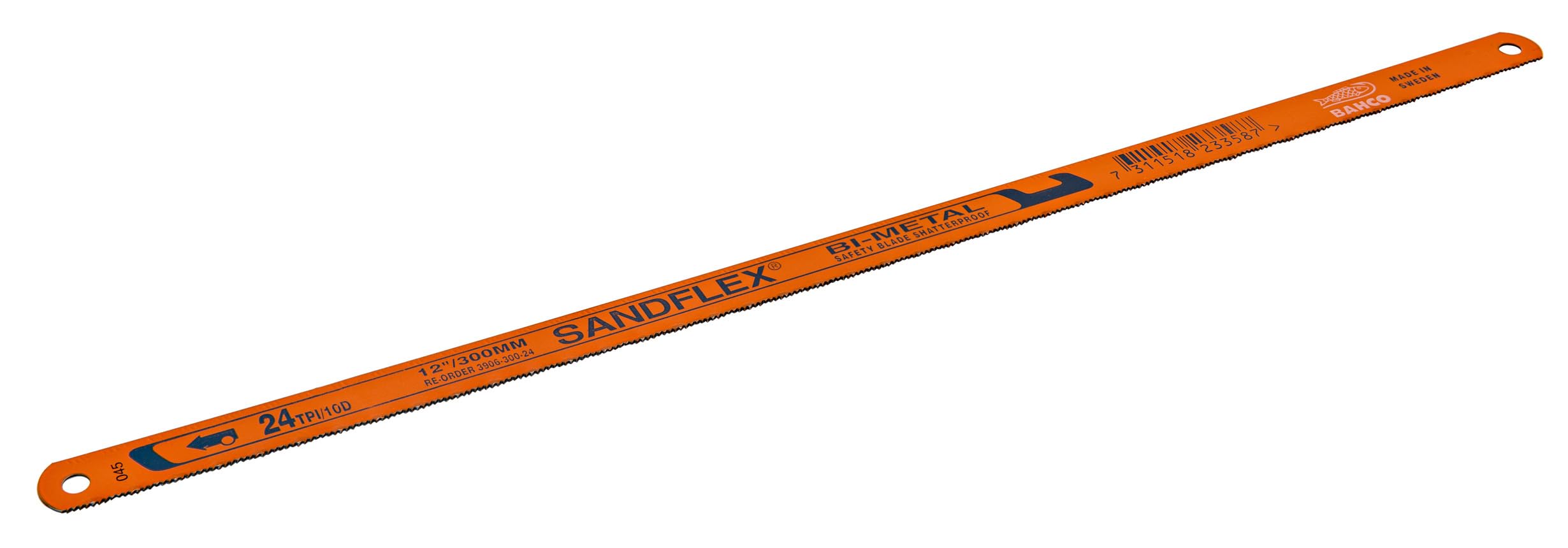
Swedish steel with teeth that out-bite their official tooth count, five blades to a box.
Sandflex has a reputation for cutting harder than its 24 TPI number suggests. The blade back is flexible spring steel with a tooth line of high-alloy super high-speed steel, precision-ground for clean metal sawing, and it is made in Sweden. Five blades per pack means a long working supply. The wide kerf — the groove the blade carves — is the reason it bites so aggressively: it clears chips fast and refuses to bind mid-cut. The trade is that thin kerf makes starts a bit bumpier, so the first strokes want a light, steady hand.
Owners rate it as more aggressive per TPI than the common U.S. brands, and report it holding that smooth aggression longer than anything else they have run. It takes a break-in pass on scrap steel before it settles into its stride. Then it simply eats metal — one 82-year-old buyer cut through a 1″ diameter steel lathe post in just a few minutes and called it the best blade ever used. That is the kind of cut that sells a blade on its own.
Because the kerf is wide, this blade is not the friendliest starter for a beginner on unclamped work — it wants your workpiece held firmly so the teeth can dig in cleanly. Get that right and the aggressive grind rewards you with speed the pack-of-two blades cannot match. For fast stock removal on thick steel, the wide-kerf Sandflex teeth clear chips quicker than a 2-pack blade.
Where it shines: a wide-kerf, high-alloy tooth line cuts aggressively and resists mid-cut binding, with five blades to a pack.
The trade-off: rough starts on unclamped work, and a break-in pass is needed before it hits top form.
Reach for it when: you cut steel stock fast and want a blade that holds its aggression.
Keep looking if: you need gentle, easy starts on loosely held pieces.
10. HAUTMEC Hacksaw Blades 12 inch 10-Pack 32 TPI
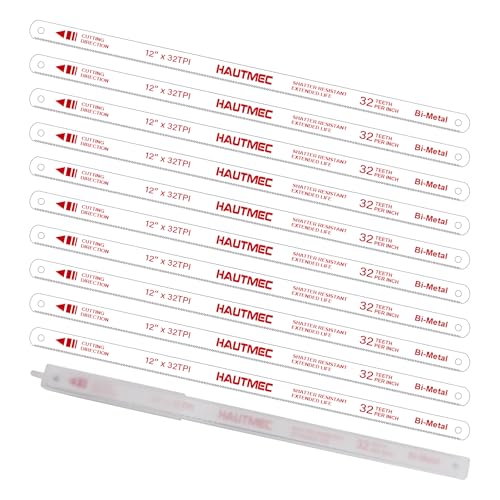
Ten fine-pitch blades in a storage case — a whole season of smooth cuts in one order.
Fine work, bought in bulk. These are 32 TPI blades, the tooth count that cuts thin metal and tubing smoothly with little vibration, held in a plastic case so they stay protected between jobs. The teeth are hardened high-speed steel electron-beam welded to a flexible spring-steel back, so they flex under tension instead of snapping. They fit the universal 12″ × 1/2″ × 0.025″ frame size, and the white anti-rust coating stands up to damp shops and outdoor work. Ten at a time means you stop running out mid-project.
Quality is the strength owners name most often, and it plays out in clean cutting — this blade handles 6mm aluminum and steel with ease. Where it really proves itself is in a powered body saw, split into thirds: a third lasted nearly a full day against three to five ordinary blades burned daily, at a fraction of what professional body-saw blades run. That is a lot of cutting from one blade. The value of the 10-pack lands when you are replacing blades often.
Two things temper the praise. On the hardest steels — high-carbon grades and TP316 or TP321 stainless — the blades do not hold up as long as softer metal allows. And in a hand frame the wide profile wanders a little, making perfectly straight cuts harder. Neither dents the value offered by ten blades in a case; they just tell you where the blade stops being the star.
What the 10-pack gives you
- 32 TPI teeth deliver smooth, low-vibration cuts on thin metal
- Spring-steel back flexes rather than snaps under tension
- Storage case keeps ten blades protected and organized
Where it falls short
- Wears faster on hard carbon steel and TP316/TP321 stainless
- Wide profile can wander, so dead-straight cuts take care
For the frequent cutter: anyone doing regular fine work on aluminum, tubing, and soft steel who hates running out of blades.
Think twice if: your stock is mostly hard stainless, where durability drops off.
11. HAUTMEC Hacksaw Blades Set 12-Pack HT0441
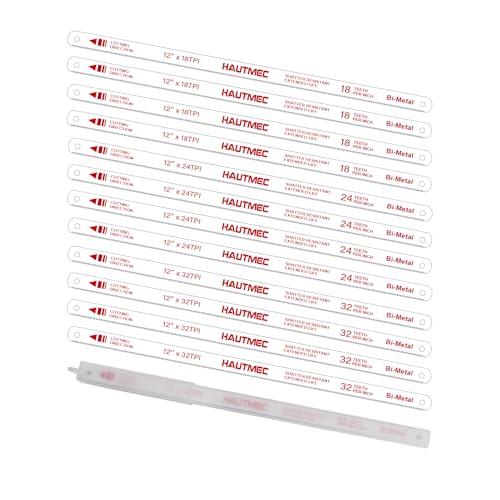
Three tooth counts in one case — a blade for fast rough cuts and a blade for a fine finish.
This is the flexible option for anyone who cuts more than one kind of metal. You get 12 blades — 4 each of 18 TPI, 24 TPI, and 32 TPI — in a storage case, so you can pick fast cutting for thick stock (18 TPI), balanced performance for general steel (24 TPI), or smoother, cleaner cuts for thin metal and tube (32 TPI). The teeth are hardened high-speed steel welded to a flexible spring-steel back, sized at the universal 12″ × 1/2″ × 0.025″ frame fit with a white anti-rust coating.
The spread is where it wins. Most buyers pick one tooth count and live with it; this set lets you swap the blade to the material instead of forcing one blade to do every job. That is real value for a mixed shop, a garage covering steel, aluminum, PVC, and conduit, or anyone learning which count suits which metal. Having all three in one case also means you compare them directly and find your own favorite for your work.
The one thing to know is the coating — the paint on the blade is on the thick side, and it takes a few strokes before it wears off and the teeth bite freely. That is a break-in nuisance, not a lasting flaw. It is a newer set with a small track record so far, but the makeup is strong: three tooth counts, a dozen blades, and a case that keeps them sorted.
Why it is worth a look: 4 blades each in 18, 24, and 32 TPI let you match the count to the metal instead of compromising.
The small snag: thick paint on the teeth needs a few strokes to wear in before clean cutting.
Ideal for: a mixed-material workshop that wants every tooth count in one organized box.
Not needed if: you only ever cut one type of metal and want to keep it simple.
Know the Specs
TPI (Teeth Per Inch)
TPI tells you how many cutting teeth sit in one inch of blade, and it is the single biggest lever on how a blade behaves. A low count like 18 TPI has fewer, larger teeth that clear chips fast, so it suits thick stock and speed. A high count like 32 TPI packs in finer teeth that take lighter bites, giving cleaner cuts on thin metal, tube, and extrusion. The 24 TPI middle ground balances speed with a finish that rarely needs filing — the reason it turns up on so many general-purpose blades. Match the count to the material and one 24 TPI blade covers most general steel work.
Bi-Metal Construction and Cobalt
Bi-metal means a hard high-speed steel tooth line welded to a flexible spring-steel back. The hard teeth do the cutting; the springy back absorbs bending and twisting so the blade flexes instead of shattering. That matters most when your saw gets pinched or you cut in a cramped spot. Cobalt, when it is added to the tooth line, keeps the edge hard at the high temperatures a tough cut generates, which is why cobalt blades hold up longer on stainless and hardened steel. The trade is brittleness — a very hard tooth can snap if you cut off-line, so a cobalt blade rewards a straight, steady stroke.
Common Questions
What TPI should I use for cutting steel?
Will a 12-inch blade fit my hacksaw frame?
Is a bi-metal blade better than a carbon steel blade?
Can I cut stainless steel with a hacksaw?
Why do my hacksaw blades keep snapping?
What is the difference between 18, 24, and 32 TPI blades?
Should I use cutting oil when sawing metal?
How do I fit a new blade in my hacksaw frame?
Can I use a hacksaw on plastic, PVC, or wood?
How long does a hacksaw blade last?
The Bottom Line
For most metal cutting, the winner is the LENOX 12-Inch 24 TPI 2-Pack — a 24 TPI bi-metal blade that handles steel and mixed work with one mount, at 4.5+ stars across 900+ ratings. If aluminum and soft metal fill your bench, the budget-friendly HAUTMEC 24 TPI 2-Pack with its wavy-set teeth cuts those faster. And when stainless is on the job, reach for the GRAFF 8% Cobalt blades, whose hard tooth line keeps biting where ordinary blades give up. Match the tooth count to your metal and keep the blade tight in the frame, and the saw cuts straight.
How we choose
We do not accept paid placement. Every pick is matched to a real buyer and a real use-case; we do not hands-on test units.
Sources
Specifications: manufacturer listings and product documentation. Review insights: verified customer reviews, as of October 2026. Pricing: not shown on this page (it changes often); check the current price via the retailer link.
As an Amazon Associate, Aappliancez earns from qualifying purchases. This does not affect which products we feature.