Disclosure: Some links in this post are affiliate links. As an Amazon Associate I earn from qualifying purchases, at no extra cost to you. Learn more
Specs are compiled from manufacturer listings and verified buyer reviews and can change over time — please confirm the key details on the product page before buying.
Laying a gym floor over carpet sounds easy until the first burpee sends your mat skidding into the sofa. The fix is not a thicker mat but an interlocking tile or roll-up mat dense enough, with a grippy underside, to sit still on soft pile. Below are seven options that hold their ground on carpet.
This guide is built by comparing the manufacturers’ published specifications and the patterns across verified customer reviews, so you get each pick’s real strengths and trade-offs instead of marketing spin.
You will see how thickness, tile size, and surface texture change the way each option behaves on carpet, and which ones suit heavy racks versus barefoot stretching. The short version: pick for the weight you drop, not for how plush it feels underfoot.
Top Picks


How To Choose The Best Gym Flooring to Put Over Carpet
Carpet sinks under load, holds dust, and lets a mat creep sideways mid-set. It sinks under load, it holds dust, and it lets a mat creep sideways mid-set. Everything below hinges on three things: how thick the tile or mat is, how dense the material is, and whether the underside has enough texture to bite into pile instead of skating across it.
Thickness is a cushioning decision, not a comfort decision
A 1-inch foam tile cushions a fall and spares your knees during floor work. That same softness is a liability under a loaded barbell, because foam compresses and leaves a dent. A 1/2-inch tile or a thin roll-up mat keeps you closer to a hard surface, which is what you want if the room holds a bench or a rack.
Size the floor for the heaviest thing that will sit on it, not the lightest. If it is a yoga mat and a pair of dumbbells, thicker foam is the friendlier choice. If it is a squat rack, the answer is a firmer, thinner surface that resists compression.
Tile versus roll: how much floor you need to cover
Interlocking tiles let you buy coverage in multiples — a 12-tile pack covers 48 sq ft, while an 18-tile set reaches 72 sq ft. You can pull one tile out when a piece wears or cut a tile to fit around a doorway. A single roll-up mat gives you one continuous surface with no seams for a foot to catch on, but you cannot shrink it if it does not quite fit the room.
Why the underside matters more on carpet than on concrete
On a hard floor, gravity and friction do most of the work. On carpet, the pile acts like a layer of tiny rollers, so the material’s grip and weight become the deciding factors. A heavier tile stays put more reliably than a light one, and a textured base grabs pile better than a smooth one.
Rug liners, double-sided tape, and a few well-placed strips of grip tape are the normal fixes when a floor still wants to drift. None of the picks here are marketed as carpet anchors, so plan for a little settling-in time.
Side-by-Side Comparison
| Model | Best For | Coverage | Thickness | Material | Amazon |
|---|---|---|---|---|---|
| ProsourceFit Weaved Puzzle Mat, 1 in★ Best Overall | Deep cushioning over soft carpet | 72 sq ft (18 tiles) | 1 in | EVA foam | Amazon |
| Our Modern Space 12 PackBudget Champion | Light stretching and floor work | 48 sq ft (12 tiles) | 1/2 in | EVA foam | Amazon |
| CAP Interlocking EVA Mat | Garage and basement setups | 48 sq ft (12 tiles) | 3/4 in | EVA foam | Amazon |
| ProsourceFit Puzzle Mat ½-inch | Covering carpet in a spare room | 48 sq ft (12 tiles) | 1/2 in | EVA foam | Amazon |
| Gogokiwi Extra Large Yoga Mat | One continuous stretch space | 72 x 48 in | 0.25 in | Recfoam | Amazon |
| GymCope Extra Large Exercise Mat | Shoe-friendly cardio and HIIT | 72.04 x 48.03 in | 0.31 in | PVC | Amazon |
| GymCope Large Exercise Mat | Bigger rooms and couples | 72 x 48 in | 0.27 in | PVC | Amazon |
Detailed Reviews
1. ProsourceFit Weaved Exercise Puzzle Mat 18 Tiles
Our pick — 4.5+★ from 6,000+ verified ratings; the strongest balance of quality and price.
A full inch of foam that swallows hard landings and covers a whole corner in one box.
This pick earns the top spot with 1 inch of tile thickness — twice the cushioning of most budget-friendly foam floors here, since the Our Modern Space pack sits at 1/2 inch. So a knee, elbow, or dropped dumbbell meets roughly double the depth. Each tile runs 24 by 24 inches, and 18 of them piece together into 72 sq ft of coverage. That is the largest floor in this lineup, and enough to turn a carpeted corner into a real workout zone with no gap in the middle.
What wins people over is how much punishment it takes without showing it. The high-density EVA foam — a firm, springy rubber-like material that resists flattening — holds its shape under a stationary bike, a rower, a heavy bag, and a weight bench. It stays pieced tightly and does not tear or deform. In a woodworking studio it has soaked up full standing days, and as buyers put it: “I don’t get fatigued when standing on these for 8 hours a day and they don’t fall apart.” The non-skid textured surface adds traction so bare feet and socks do not slide. And when you need to move them, the tiles pull apart as easily as they snap together.
The honest catch is what 1 inch means under load. Soft foam compresses, and the maker’s own note warns that surface compression can occur under heavy equipment. Treat it as a floor for bodyweight work, floor work, bags, and mid-weight gear rather than a platform for a fully loaded rack. If you plan to bolt down a power cage, the firmer CAP tile below is the better fit; if your room is a floor-work and cardio space, this is the floor to buy.
Why it takes the top spot
- 1-inch high-density EVA foam cushions far more than the 1/2-inch packs here.
- 72 sq ft from 18 tiles — the widest coverage in this lineup.
- Tiles stay locked and do not tear under a bike, rower, or heavy bag.
- Textured top surface cuts slipping, and the tiles disassemble fast for storage.
- Water-resistant and noise-reducing, so a carpeted room stops sounding hollow.
Where it gives ground
- Foam can compress and dent under very heavy equipment.
- Hand wash only — spot cleaning is the practical route.
- The smooth underside can slide if a tile gets kicked hard; a strip of double-sided tape helps.
Reach for this if: your room needs maximum cushioning across a big area and your gear tops out around a bench, bag, or dumbbells.
Look elsewhere if: a loaded power rack is the centerpiece — the compression note will bother you.
2. 12 Pack 48 SQFT Floor Exercise Mat
Twelve tiles, 48 sq ft, and enough cushion to kneel on without dragging out a yoga mat.
For the entry-level price tier, this is a lot of floor. Twelve interlocking tiles at 24 by 24 inches apiece cover 48 sq ft, so a spare-bedroom corner gets a padded surface without a big outlay. The foam is made without PVC, lead, silicone, BPA, phthalates, or latex — a real plus if the room is a play area as often as a workout area. Cushioning is described as shock-absorbing, which shows up in practice as comfortable kneeling and floor work.
The thing everyone raves about is build quality relative to what you spend. It holds furniture, weights, and workout gear without complaint, and it does not skate around during a set — though it can slide on hardwood, where a rug liner fixes the problem. Flip a tile over and you are kneeling directly on it instead of digging out extra padding. Assembly is quick, and once the edges are in place the whole floor looks deliberate rather than improvised.
One spec worth flagging before you buy: the listing calls this extra thick, but the item thickness is recorded at 0.4 inches. That is thinner than the 1/2 inch in the product name, and it is why the thickness rating comes back mixed. For stretching, light weights, and bodyweight work it is plenty. For heavy lifting or high jumps, expect the floor to send more shock into your joints. If deep cushioning is the whole point, the 1-inch ProsourceFit above is the safer call.
The practical read: treat this as an affordable padded base for a carpeted spare room, not a platform for a loaded barbell.
Ideal for: renters and first-timers who need 48 sq ft of padded floor on a small budget and mostly stretch, squat light, or do floor work.
Think twice if: your routine is built on heavy lifts or jump training — a firmer, thicker tile serves you better.
3. CAP Interlocking EVA Foam Puzzle Exercise Mat

The middleweight: three-quarters of an inch of dense foam with finished edges that make it look built in.
CAP sits in the mid-range tier and picks a smart middle ground.
Cushioning and thickness are what reviewers praise most, and both land where they should: firm enough to stand on during a session, yielding enough to soften a joint when you drop to the floor. The diamond-textured surface adds traction and wipes clean with a damp cloth, so sweat does not turn it slick. Finishing strips cover the outer joins, which is the detail that makes this floor look intentional against a carpet edge rather than unfinished.
Two practical notes before you commit. Tiles are directional, so every piece has to go down the same side up or the joins will not seat — get that wrong and the fit suffers. And at 3/4 inch, the cushioning runs out under heavy jumping and very heavy weights, with plate edges occasionally prising apart during vigorous sessions. For garage work, basement circuits, and grappling drills it has held up well; for a full powerlifting setup, go firmer.
Installation reality: grab a utility knife and a straight edge. Trimming tiles to a room’s exact length is straightforward, and foam does expand and contract, so cut to fit when the room is warm.
Pick this for: garage or basement gyms where you want a firmer floor than a budget pack delivers and a tidy finished border.
Pass if: you need the deepest possible cushioning — the 1-inch ProsourceFit beats it on that one measure.
4. ProsourceFit Exercise Puzzle Mat ½-inch, 48 SQ FT – 12 Tiles

The half-inch workhorse built specifically to cover carpet without wrecking it.
This is the most-reviewed pick here — 4.5+ stars across 61,000+ owners — and the maker markets it directly as a carpet protector. Twelve tiles at 24 by 24 by 1/2 inch cover 48 sq ft, end borders included for a clean perimeter. The EVA foam is dense enough to hold a weight bench steady and springy enough that a barefoot circuit feels fine on the feet.
Quality and function are what carry it. Tiles snap together fast and stay locked, they cut cleanly to fit awkward corners, and the finished look holds up through kids, a dog, and regular mopping. Noise is the quiet bonus — a carpeted room with this down stops echoing the way a bare floor does. There is also a limited lifetime warranty against manufacturer defects, which is unusual at this price tier and speaks to how the foam is expected to hold up.
The trade-off is that 1/2 inch is a floor for moderate use. Grip and durability both come back mixed in owner feedback: sudden movements can pop tiles apart, and the fix is a strip of grip tape across a join. Heavy weights leave dents. That is not a defect — it is what thin foam does — but it tells you this is the pick for yoga, moderate lifting, stretching, and a floor that protects the carpet beneath it. Want a floor that shrugs off burpees? Go thicker.
What the floor gets right
- 48 sq ft from 12 tiles, with end borders for a finished edge.
- Limited lifetime warranty against manufacturer defects.
- Water-resistant and easy to wipe, vacuum, or mop.
- Cuts cleanly to fit doorways and odd corners.
Where it asks for care
- Half-inch foam dents under heavy weights and pops apart during sudden moves.
- Does not interlock with other brands’ puzzle tiles, so no mixing and matching.
- Best results on flat, hard surfaces — on carpet, expect a little settling.
Worth choosing when: the carpet is the thing you want protected and your sessions are stretching, yoga, or moderate dumbbell work.
Not the one for: a burpee-heavy or powerlifting routine.
5. Gogokiwi Extra Large Yoga Mat 6’x4′

One big sheet instead of a jigsaw — 72 by 48 inches with no seams to catch a foot.
Not everyone wants a jigsaw puzzle on the floor. It is a single 72 by 48 inch mat — the maker pitches it as 112% more exercise space than a traditional yoga mat — with no interlocking seams to catch a foot. Material is Recfoam, a closed-cell foam that keeps sweat from soaking in, so a quick wipe with a damp towel is the whole cleaning routine. It rolls up with velcro straps when the room needs to become a room again.
What buyers keep coming back to is the quality of the surface and the cushioning it delivers on a hard floor. The dual-sided design gives you two colors and two textures, and the anti-slip property is the reason to flip it. A 1/4-inch thickness adds a little padding without turning a squat shaky — the balance point between comfort and stability. There is no chemical smell on arrival, which matters when the mat lives in a bedroom or living room.
The catch on carpet is exactly where this category gets tricky. A thin mat that grips beautifully on LVT can shift on deep pile, and the grip rating here is mixed — some sessions stay put, others migrate. It is not claw-resistant either; keep pets off it. And there is one rolling-out quirk: the mat can arrive with residue that needs a wipe-down before first use. On carpet, plan on a rug grip underneath.
Who it clicks with: dancers, mat-based mobility work, and stretching sessions where a continuous surface matters more than shatterproof cushioning.
Choose this if: you want one wide, smooth mat for stretching and low-impact work over a carpeted floor.
Skip if: you need a surface that stays pinned during explosive jumping — add a rug grip or pick an interlocking tile.
6. GymCope Extra Large Exercise Mat 6’x4′ (8mm)
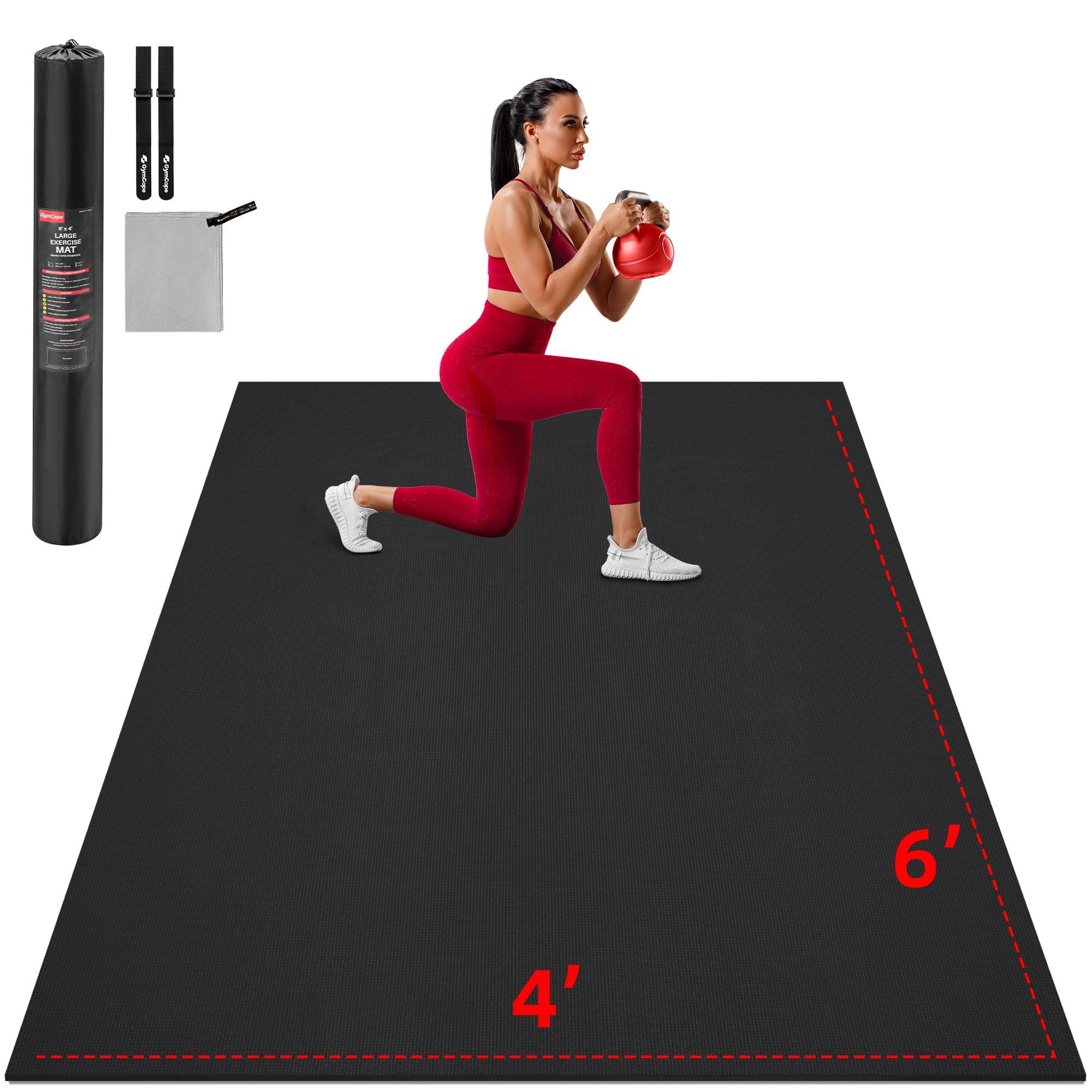
Built for training shoes — a PVC surface that takes jump rope and kettlebell work without shredding.
Most mats in this roundup baby your bare feet. This one expects shoes. The pickup is a tough PVC top layer on a triple-layer system: the top resists wear from high-intensity moves, the shock-absorbing core takes the sting out of landings, and the anti-slip bottom keeps the whole thing planted. At 8mm thick in a 72.04 by 48.03 inch footprint, it covers a serious chunk of floor in one piece.
What earns its keep is grip during movement. It does not slide underfoot, and owner feedback on quality and cushioning backs that up — it does not buckle, and it stays flat once unrolled. The double-sided anti-slip texture is specified for hardwood, tile, concrete, and low-pile carpet, which is the closest thing here to a mat designed with carpet in mind. Add the carry straps, storage bag, and microfiber towel and you have a mat you can fold up and move between rooms.
Now the honest bit. Durability is the mixed signal here — some owners keep it holding well, others see flaking over time. The maker’s own note says this is not built for extreme impact or commercial-gym abuse, and folding it leaves creases. So this is the mat for home cardio, boxing drills, and jump rope in shoes, not for dropping heavy barbells or living with an open fold in your car trunk.
The cardio verdict: at 8mm it cushions landings without gobbling your stability, which is why it suits HIIT and dance formats better than slow, heavy lifting.
Best matched to: shoe-on cardio, jump rope, and MMA-style drills over low-pile carpet.
Less suited to: anyone who needs a floor to survive years of hard-soled footwear or heavy barbell drops.
7. GymCope Large Exercise Mat for Home Workouts, 7mm

Pick your footprint from six sizes, then roll it up with the bag and straps when guests arrive.
Flexibility is the whole pitch. You choose from 6’x4′, 7’x5′, 8’x6′, 9’x6′, or 10’x6′ in this lineup, so the mat can be sized to the room rather than the room to the mat. It is a 7mm PVC floor — dense enough to resist abrasion and scratches from shoes, flexible enough to roll. Double-sided anti-slip surfaces are specified to stay put on tile, carpet, concrete, and hardwood, and a carrying bag plus three hook-and-loop straps make packing it away simple.
Quality and durability are the two things owners trust most here, and the sturdier feel underfoot is the reason. It does not run too soft under a bench, so you keep your balance while lifting. The surface wipes clean in a few passes, and it takes tennis shoes without complaint. For a room where the floor doubles as a play mat for kids or a spot for the dog, that toughness earns its keep.
The one thing to know before you unroll it: stability on carpet splits both ways. Some sessions it stays put; on berber pile it can travel, which is the nature of a smooth PVC underside on loop carpet. The initial smell fades within about a day, and some owners wish the carrying bag were sturdier for daily hauling. Neither is a reason to walk away — just a reason to add a grip layer if your carpet is thick.
Standout strengths
- Six sizes, so you can buy to fit the room.
- 7mm PVC resists abrasion from shoes and high-intensity drills.
- Bag, three straps, and a microfiber towel come with it.
- Waterproof surface keeps sweat out of the foam.
Honest limits
- Can slide on looped or berber carpet without a grip layer.
- A slight initial odor that fades over the first day.
- The carry bag has earned complaints about seams giving way.
The floor to grab if: you want a large, shoe-friendly surface you can size precisely and roll away between sessions.
Consider an alternative if: your carpet is thick and looped — a tile floor or a rug grip will sit steadier.
Know the Specs
Thickness (measured in inches or millimeters)
Thickness is how deep the cushioning goes, and it is the first spec to match to your workout. A 1-inch tile like the ProsourceFit set gives you a soft landing for knees and elbows, but it compresses under heavy gear. A 1/2-inch tile or a thin roll-up mat like the Gogokiwi keeps you closer to a firm surface, which suits balance work and loaded lifts.
Rather than chasing the thickest number, ask what the heaviest object on your floor weighs. Yoga, stretching, and bodyweight work reward thickness. Racks and barbells punish it.
Coverage (square feet or tile count)
Coverage tells you how much floor you actually get. Twelve 24 by 24 inch tiles make 48 sq ft; eighteen make 72 sq ft. Measure the space you want to cover before buying, because a floor that stops two inches short is a floor that looks unfinished and lets cold air creep under the edge.
Think about the shape of the room, too. Interlocking tiles can be trimmed and rearranged around doorways and furniture legs. A single large mat can only be as big as the one you buy.
Material (EVA foam versus PVC)
EVA foam is the springy, rubber-like material behind the interlocking puzzle tiles. It is softer, lighter, and easy to cut with a utility knife, but it dents under concentrated weight. PVC is the tougher, denser material behind the roll-up mats. It resists abrasion from shoes and wipes clean easily, but it is less forgiving underfoot for prolonged kneeling.
On carpet, both benefit from a textured underside and enough mass to grip the pile.
Grip and surface texture
Grip is the spec that determines whether the floor stays put and whether you stay balanced. A textured top — diamond pattern, woven look, or anti-slip finish — keeps sweaty feet from sliding during a squat or a lunge. The underside matters just as much: a smooth base on thick carpet will travel, while a heavier tile or rubberized back digs in.
If the room has deep pile, plan on a rug liner or grip tape regardless of what you buy.
Common Questions
Will interlocking foam tiles work directly over thick carpet?
Does gym flooring over carpet damage the carpet underneath?
How thick should gym flooring be over carpet for weightlifting?
Can I cut puzzle tiles to fit around a doorway or an awkward corner?
Do I need a rug grip under gym flooring on carpet?
Is EVA foam or PVC better for a carpeted home gym?
Will a large exercise mat stay flat over carpet?
How do I clean gym flooring that sits on carpet?
Is gym flooring over carpet safe for a play area with kids and pets?
The Bottom Line
For most carpeted rooms, the strongest pick is the ProsourceFit Weaved Puzzle Mat — a full inch of cushioning and 72 sq ft of coverage is hard to argue with, and it holds its shape under a bike, rower, or heavy bag. If your garage holds a rack and you need a firmer floor, the CAP 3/4-Inch Mat gives you that without the deep squish. And if shoes, jump rope, and a floor you can roll away matter most, reach for the GymCope Large Exercise Mat.
One last nudge: the ProsourceFit half-inch set has the deepest review history in this roundup. If you want the most settled track record in this roundup, it is the safe bet — just match it to moderate work, not maxed-out lifting.
How we choose
We do not accept paid placement. Every pick is matched to a real buyer and a real use-case; we do not hands-on test units.
Sources
Specifications: manufacturer listings and product documentation. Review insights: verified customer reviews, as of October 2026. Pricing: not shown on this page (it changes often); check the current price via the retailer link.
As an Amazon Associate, Aappliancez earns from qualifying purchases. This does not affect which products we feature.