Disclosure: Some links in this post are affiliate links. As an Amazon Associate I earn from qualifying purchases, at no extra cost to you. Learn more
Specs are compiled from manufacturer listings and verified buyer reviews and can change over time — please confirm the key details on the product page before buying.
The hardest part of fueling a run isn’t the running — it’s getting carbs down your throat at mile 14 without your stomach staging a revolt. Chews beat gels here for most people, because you control the pace: one bite, chew it fully, swallow, repeat. So what actually matters? How many carbs you get per serving, whether the texture stays soft in cold air and heat, and whether the flavor still tastes good on your third pack of the day. This guide covers the five chews worth packing, who each one suits, and the honest catch on every single one.
This guide is built by comparing the manufacturers’ published specifications and the patterns across verified customer reviews, so you get each pick’s real strengths and trade-offs instead of marketing spin.
The picks below run from caffeine-free beginner chews to a yerba mate blend built for marathon mile 24, and every one of them is easy to carry in a shorts pocket or a hydration belt. Whether you are chasing a first 10K or a personal best, this breakdown of the best gummies for running shows which of the five packs earns its place in your belt.
Top Picks

How To Choose The Best Gummies for Running
Running fuel is not candy, even when it tastes like it. The difference is what happens after you swallow: the right chew delivers fast carbs your body can pull into the bloodstream while you are still moving, without sitting heavy or triggering a cramp at mile 8. Pick wrong and you either bonk early or spend the back half of your run managing your gut instead of your pace.
Carbohydrates Per Serving Is The Number That Matters
Your body burns through stored glycogen on a run, and once it runs low you hit the wall — the sudden heaviness in your legs where your pace just dies. Chews solve this by topping up your blood sugar mid-run. A serving in the low-20-gram carb range is the working standard for endurance fuel, with 23g and 24g per serving showing up in the packs here. Higher-carb chews mean fewer bites you need to force down at pace, which matters when your mouth is dry and your breathing is heavy.
Texture, Dissolvability, And Cold-Weather Chew
Every chew brand claims to be soft. What separates them is behavior in real conditions. In freezing air on a winter long run, some chews go firm and take real jaw work to break down. In summer heat, some go sticky in the package and glue themselves to your fingers. Reviews here point both ways: softer, less sticky textures get eaten in full, while gummy textures that stick get abandoned mid-pack. If you run in cold weather, look for chews that hold softness below freezing.
Caffeine Or Caffeine-Free On Race Day
Caffeine is a dial, not a default. Caffeine-free chews suit anyone running a late-afternoon session who does not want a stimulant in the bloodstream during sleep hours, and they suit anyone sensitive to jitters. Caffeine from a natural source like yerba mate gives you a lift with a slower, smoother feel than a coffee-style spike. The right answer depends on when you train and how you respond — if you have never used caffeine mid-run, test it on a training run first, not on race day.
Packaging And Portability
You are eating these with one hand while the other hand holds a bottle. Chews that come in single-serve pouches or packs with easy-open flaps are easier to dose at pace. Larger boxes with more pieces per pack mean more chances to split a pack across a run, but each pack is bulkier in a shorts pocket. If you carry a hydration belt or vest, count how many packs fit in your front pocket before you commit to a big box.
Side-by-Side Comparison
| Model | Best For | Carbs Per Serving | Pack Count | Caffeine | Amazon |
|---|---|---|---|---|---|
| Honey Stinger Organic Cherry Blossom Energy Chew★ Best Overall | Beginner runners and first race day | 23g per serving | 12 packs | Caffeine-free | Amazon |
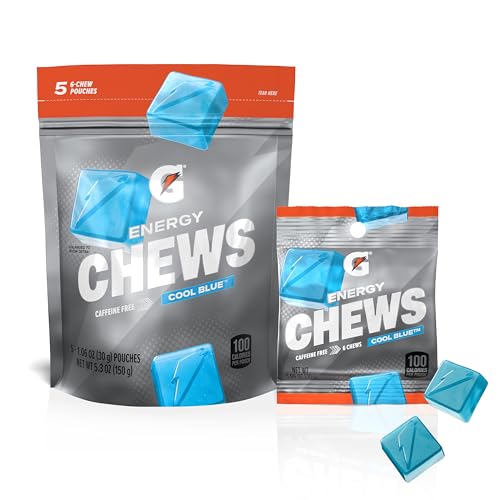
| Gatorade Energy Chews, Cool BlueBudget Champion | Long runs and caffeine-free electrolyte top-up | 100 calorie pouch | 5 pouches | Caffeine-free, B12 | Amazon |
| Hydration Electrolyte Gummies by Nature’s Nutrition | Daily hydration and electrolyte balance | Electrolytes, potassium, real salt | 120 gummies | None | Amazon |
| PROBAR Bolt Organic Energy Chews, Raspberry | Marathon training and long-distance fueling | 24g per 30g serving | 12 packs | 20mg from yerba mate | Amazon |
| Skratch Labs Energy Chews, Variety Pack | Mid-run fueling for ultra and long-distance athletes | 19g per serving | 10 packs | Caffeine-free | Amazon |
Detailed Reviews
1. Honey Stinger Organic Cherry Blossom Energy Chew
Our pick — 4.5+★ from 1,000+ verified ratings; the strongest balance of quality and price.
The beginner-safe chew that gets you through a first 10K without a stomach flip.
If you are new to fueling on the run, this is the pack to learn on. Each serving carries 23g of carbs — fast energy your body can pull in without heavy digestion — and the whole box is USDA Organic, gluten-free, and caffeine-free, so there is nothing to manage before or after a run. Buyers describe them as not too sweet, which sounds minor until you have tried forcing down an oversweet chew at mile 6 with dry mouth. The texture lands in the soft-chew zone: soft enough to chew fully, firm enough not to dissolve into paste in your pocket.
What makes this the pick for most runners is the whole experience around the chew, not just the carb number. Half-carbs-per-serving lower than the PROBAR Bolt (23g vs 24g per serving) is a rounding difference you will never feel on a training run, but the 12-pack format is the real advantage — you get one pack per session with no splitting and no re-closing. Owners use it for 40-60 minute runs, which is exactly the range where a runner first notices the bonk and first learns how their body handles mid-run fuel. It is also the pack people reach for when they move from 5Ks to longer distances, because the dose is forgiving and the flavor does not turn you off by the second pack.
The honest catch: several owners flag that these are dangerously easy to eat as a snack off the run. They are that palatable. If you are watching sugar intake or prone to grazing, keep the box in your running bag and not the pantry. The other limitation is that a low-caffeine pack is not going to give you a late-race kick; if you want a mental edge on a long marathon, look further down this list.
What runners actually like
- 23g carbs per serving gives a real pre-run and mid-run top-up
- Caffeine-free and USDA Organic — nothing to schedule around a run
- Soft chew texture stays easy to eat without a dry mouth
- 12 individually wrapped packs means one pack per session
What to keep in mind
- Highly palatable and easy to graze on when you mean to save them for a run
- Caffeine-free formula gives no late-race stimulant boost
- 23g per serving is slightly lower than the PROBAR Bolt at 24g
Reach for this if: you want a first running chew — beginner distances, sensitive stomach, race-day with no caffeine.
Look elsewhere if: you need a late-race mental kick or a higher-carb-per-serving formula for marathon-distance fueling.
2. Gatorade Energy Chews, Cool Blue
Pocket-sized pouches built for grabbing mid-run without breaking stride.
The Gatorade name is the biggest thing these have going for them, and that is not marketing — it is the reason they are easier to find in a hurry and easier to trust if you have used Gatorade products before. Each pouch is a single-serve 100 calorie portion, caffeine-free, with B12 included.
Runners who like these tend to like them for one specific reason: speed. The pouch open-and-eat motion is fast, and the cool blue flavor goes down easy in the summer heat when your body rejects sweet flavors. Effectiveness is what comes up most in the feedback, with runners calling these perfect for long runs and specifically noting the boost working quickly.
Where it gets honest: the taste is genuinely polarizing. Some owners love the Cool Blue bite, and some compare the chew to eating soap. Texture gets the same split — the chew holds together and can feel rubbery if you try to break it into small pieces in your mouth. The other flag is more practical: the pouch format has changed, and buyers who preferred the old packaging say the new open-pouch is less convenient to half-eat and save. If you want a pack you can open, take a few chews, and tuck away for later, bear that in mind.
The format is the sell: five single-serve pouches, 100 calories each, caffeine-free with B12 — clean, simple, fast to eat at pace.
The catch to weigh: the Cool Blue flavor and the chew texture divide buyers right down the middle, and the packaging change has split fans of the old format.
The smart grab if: you want a name-brand caffeine-free pouch you can open and eat in seconds without carrying a whole box.
Skip these if: texture is a deal for you — if you have disliked rubbery chews before, the Cool Blue bite may not land.
3. Hydration Electrolyte Gummies by Nature’s Nutrition

Not a race-day pack — a daily electrolyte bottle for runners who sweat heavy and hate drink mixes.
This one is a different animal from the chews above, and that distinction is the whole point. These are 120 gummies in a single bottle with a lemon flavor, formulated around electrolytes — potassium and real salt — rather than fast carbs. That makes them a daily hydration supplier for runners who sweat heavy on long summer sessions and do not want to mix a drink powder every time. They are vegan, non-GMO, and weigh 8 ounces for the whole bottle, which lives on a kitchen counter, not in a shorts pocket. If you want a chew to eat at mile 8, look at the Honey Stinger or Skratch Labs instead — this is the one you take before and after.
The gummy format is what wins people over here. Taste is the strongest thing about this bottle: owners describe it as candy-like in the morning, and the lemon is bright enough that it does not feel like a supplement. The electrolyte angle works for what runners usually need day-to-day — replacing what you sweat out — and the daily dose, rather than a per-run dose, suits anyone who trains most days and wants a low-effort way to keep minerals topped up without a scoop and a shaker bottle. The 120-count bottle also spreads out nicely — a daily user is going to be on the same bottle for a while.
Where it gets honest: the effect is cumulative, not instant. Buyers describe noticing the difference after a couple of days rather than within minutes, so this is not a mid-run fuel swap. A few note a slightly bitter edge to the lemon, and one reviewer noted feeling jittery after starting them — worth knowing if you are sensitive to gummy supplements. But the pattern is that the positives — taste and daily hydration — outweigh the small gripes for most people, and this is one of the few supplement-style gummies on the list that genuinely fits a runner’s routine off the track as much as on it.
The daily-driver angle: 120 lemon gummies with potassium and real salt build a hydration habit without a powder scoop or a shaker bottle.
The honest limit: no fast carbs and no mid-run boost — this is a before-and-after product, not a mile-8 chew, and one buyer mentioned feeling jittery.
Ideal for: runners who sweat heavily on daily training and want a simple, tasty electrolyte top-up that lives in the kitchen.
Not the one for: race-day mid-run carb top-ups — the pack has no fast carbs, so it will not replace a chew at mile 8.
4. PROBAR Bolt Organic Energy Chews, Raspberry
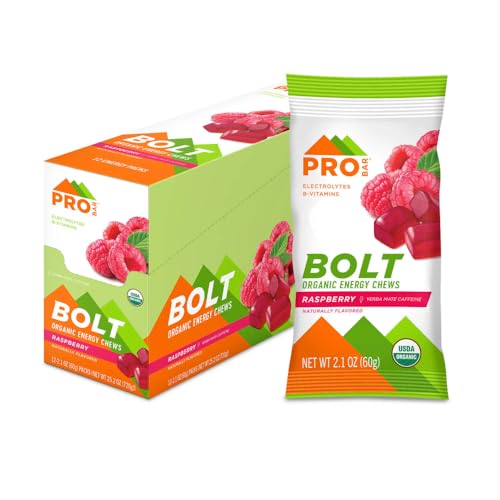
Marathon fuel — 24g of carbs per serving with a yerba mate lift at mile 24.
If you are training for a marathon or a long-distance race, this is the pack to understand. Each serving carries 24g of carbs — the highest per-serving carb count on this list, edging the Honey Stinger at 23g — plus 20mg of caffeine from yerba mate, which is a much smaller and smoother hit than a coffee or an energy drink. The real-world reason that matters: marathon runners eating one chew every two miles reach for something that gives sustained carbs without a jittery spike, and the yerba mate lands differently than a coffee-style caffeine, which is exactly why long-distance buyers describe it as a mental boost rather than a rush. The 12-pack format means one pack of 12 chews covers a big chunk of a long run, and the pack slides into a hydration belt with an easy-open flap that one buyer cut down to trim bulk.
Where this beats a standard gummy is in cold air. A long run in winter is where a soft chew either works or turns into jaw work, and this one holds softness even at 30°F, which is the kind of detail that separates a real race-day pack from a desk drawer snack. The raspberry flavor is a favorite in the feedback — bright and distinctive enough to still taste good after the fourth or fifth chew. Veteran runners have also noted these work as a pre-starting snack on days when they would rather not eat a whole chew mid-activity, which is a clever way to use a yerba mate pack as a soft, low-commitment pre-run lift.
The honest catch: a natural caffeine source does not come with an exact number printed on the pack, and buyers who want to know precisely how much caffeine they are taking want that transparency. The other point is weight: for ultralight backpacking, these come in slightly heavy per calorie, which matters if you are counting grams for a multi-day trip. For road and trail runners who are not counting every gram, that is not a real cost, but for someone running through a hike or backpacking trip, the weight-to-calorie math gets noticeable.
What earns it a spot in the belt
- 24g carbs per 30g serving — the highest per-serving carb count here, ahead of Honey Stinger at 23g
- 20mg yerba mate caffeine gives a smooth lift without the coffee-style jitter
- Stays soft at 30°F, so winter long runs do not turn into jaw work
- 12 per pack with an easy-open flap you can trim to fit a hydration belt
The trade-offs worth knowing
- The yerba mate caffeine does not come with an exact per-pack number printed on the label
- For backpacking and ultralight trips, these weigh slightly heavy relative to the calories they deliver
- A yerba mate pick is not the right call if you want to avoid caffeine entirely
Best suited to: marathon and long-distance runners who want a higher-carb chew with a gentle yerba mate lift built in.
Look past it if: you need zero caffeine on board, or you are counting grams on a backpacking trip where weight per calorie matters.
5. Skratch Labs Energy Chews, Variety Pack
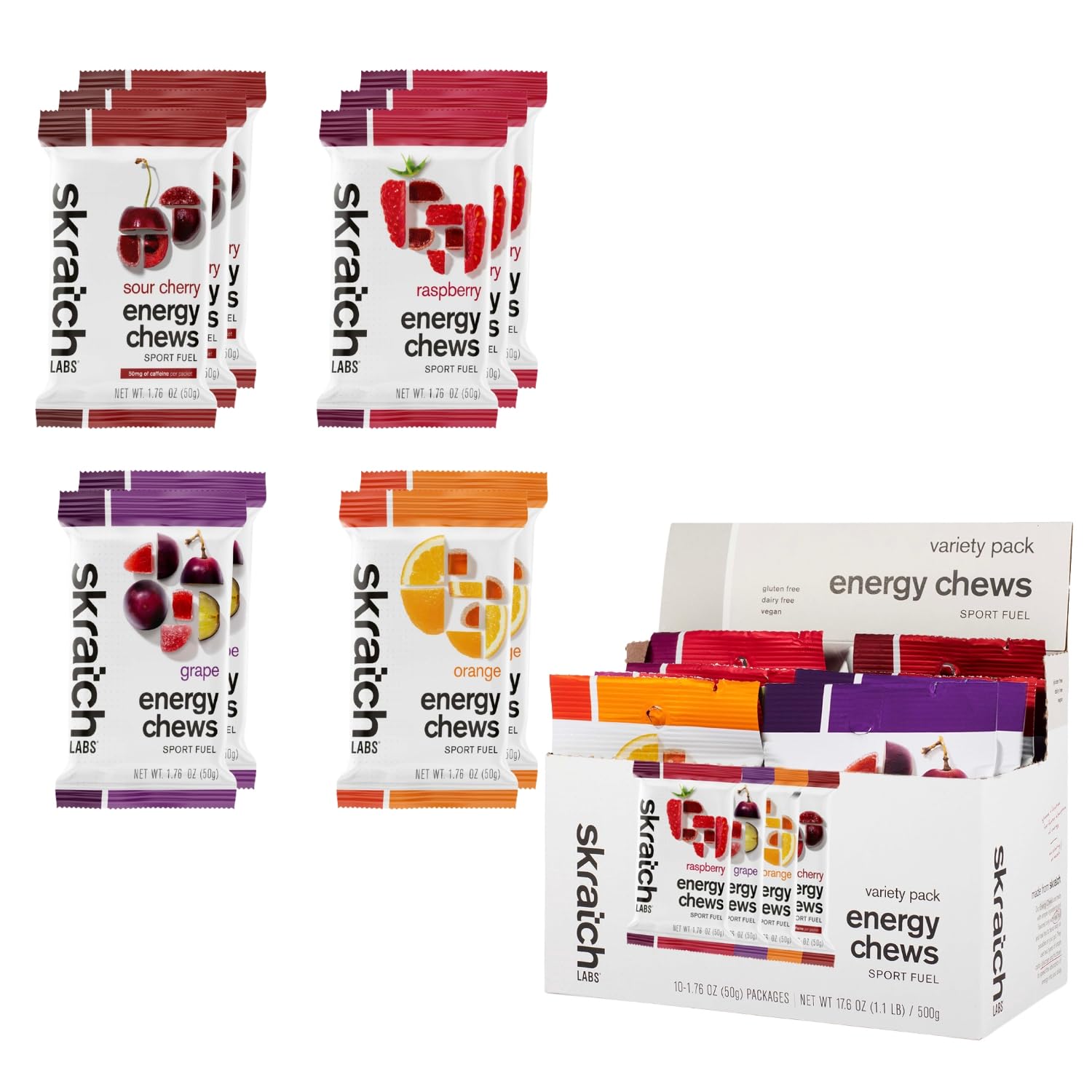
The gel-averse runner’s cheat code — real fruit flavor and no stickiness, even in Texas heat.
If you have ever ripped open a gel and immediately regretted it, this is the pack to try. Skratch Labs built these specifically as a gel alternative for runners, cyclists, and endurance athletes who prefer to chew their fuel instead of squeeze it. Each serving delivers 19g of carbs from a glucose and fructose blend — the two-sugar combo sports nutritionists pair for fast uptake — with a soft chewable texture and real fruit flavor and no artificial sweeteners, colors, or preservatives. The key phrase there is “no artificial anything,” which matters if you have ever had a chew that disagreed with you mid-ride; the formula here is deliberately built around what is gentler on the stomach during hard effort. This is the pick for anyone doing ultra-distance or multi-hour efforts where a gel every 45 minutes is simply not what your gut wants.
What separates Skratch from the other packs on this list is how it handles heat and stickiness. Riders have taken these through a 140-mile ride in the Texas summer and reported that they did not turn sticky or gloppy, which is the failure mode that ruins a chew on a hot day. The sour cherry flavor is the standout across customer feedback, and the soft, digestible texture goes down easily with chewing water without needing a lot of chewing. There are 2 servings per package, which means each pack covers a good swath of a long effort, and the chewability stays consistent pack to pack — where a lot of chews vary, this one is reliable.
Where it falls short: stickiness is real, in some use cases. Feedback flags a sticky texture that some runners and cyclists find unappealing when the chews sit in a hot pocket. A few buyers also reported gas and stomach upset with these, with a possible link to the plant sugars or artificial sweeteners — if you know you are sensitive to either, test on a training run before you rely on them on race day. And some buyers judge these overpriced relative to what they carry, so if budget is the priority, the Gatorade chews further up are the more frugal caffeine-free option.
The standout spec: 19g of glucose and fructose carbs with no artificial sweeteners, colors, or preservatives, in a soft chewable format made for gel-averse athletes.
One honest flag: the sticky texture gets called out a fair bit, and a handful of sensitive-stomach buyers have had gas or discomfort — worth a training-run test before race day.
Pick this one if: you want a real-fruit chew with no artificial anything, built for ultramarathons, century rides, and hours of steady fueling.
Choose differently if: you are highly sensitive to plant sugars, or you want the most frugal caffeine-free option — the Gatorade pouches are leaner on the wallet.
Know the Specs
Carbs Per Serving
The number of grams of carbohydrate you get in one serving of chews, printed on the nutrition panel. This is what your body turns into blood sugar fast enough to fuel working muscles mid-run. A low-20s figure is the working range for endurance fuel — 23g and 24g per serving show up in the packs on this list — and a higher number per serving means fewer bites you have to force down at pace. Carbs are not the same as calories; a 100-calorie pouch format tells you the total energy, not the carb split, so check both if you are counting macros for a long race.
Electrolytes And Real Salt
Electrolytes are the minerals — potassium, sodium, and others — that you sweat out on a long run and that your muscles need to keep firing properly. A hydration gummy built around potassium and real salt is aimed at daily and post-run replenishment, not at fast carb delivery. That is why the Hydration Electrolyte Gummies are a “take at home” product rather than a mile-8 chew: they supply minerals without the quick carbs you need mid-effort. If you are cramping on long summer runs, both fast carbs from a chew and electrolytes from a daily gummy have a role — just not the same role. Plain water alone does not replace what you sweat out on a multi-hour effort.
Caffeine From Yerba Mate
Yerba mate is a plant-based caffeine source, and it lands differently than a coffee or energy-drink caffeine hit — smoother and slower, which is why runners describe the PROBAR Bolt chews as a mental boost rather than a spike. A pack with caffeine is a race-day tool, not a daily default: use it on long efforts where you want a lift in the later miles, and keep it away from evening training runs if caffeine affects your sleep. Caffeine-free chews are the safer pick for anyone training after work or sensitive to stimulants. Both styles fuel you — the caffeine is the difference in how and when you want it working.
Chew Texture And Stickiness
Texture is the spec brands rarely print but buyers notice most. A soft, chewable gummy that breaks down easily suits runners mid-effort — especially in cold air, where firm chews become real jaw work. A sticky texture is the other failure mode: it sticks to your fingers and your teeth when the pack has been in a hot pocket or jersey for an hour. Packaging matters too — single-serve pouches and packs with easy-open flaps are easier to dose one-handed at pace. If you have never used a chew before, buy a single pack and test the texture on a training run before you commit to a 12-count box.
Common Questions
How many chews should I eat per hour on a long run?
Are running chews better than gels?
Will running chews upset my stomach?
Can I use hydration gummies as running fuel?
Do running chews need to be taken with water?
What is the difference between chews with caffeine and caffeine-free chews?
How do I keep chews from getting sticky in hot weather?
Can I use running chews if I am gluten-free or vegan?
How many packs should I carry for a marathon?
Do chews work for hiking and cycling too or just running?
The Bottom Line
For most runners, the gummies for running pick is the Honey Stinger Organic Cherry Blossom Energy Chew because its 23g of carbs per serving, USDA Organic, gluten-free, caffeine-free formula works for a first 10K as well as a marathon — you do not outgrow it. If you want a yerba mate lift and the highest per-serving carb count here, reach for the PROBAR Bolt Organic Energy Chews at 24g per serving with 20mg of caffeine from yerba mate. And for long-distance fueling where the texture matters as much as the carbs, the Skratch Labs Energy Chews Variety Pack was built as a gel alternative for exactly that — try one pack on a training run before you commit to a box for race day.
How we choose
We do not accept paid placement. Every pick is matched to a real buyer and a real use-case; we do not hands-on test units.
Sources
Specifications: manufacturer listings and product documentation. Review insights: verified customer reviews, as of October 2026. Pricing: not shown on this page (it changes often); check the current price via the retailer link.
As an Amazon Associate, Aappliancez earns from qualifying purchases. This does not affect which products we feature.