Disclosure: Some links in this post are affiliate links. As an Amazon Associate I earn from qualifying purchases, at no extra cost to you. Learn more
Specs are compiled from manufacturer listings and verified buyer reviews and can change over time — please confirm the key details on the product page before buying.
You lie down to rest, and you want the mat under you to actually connect you to the earth’s charge — not just feel nice. The short answer: the Grounding Mat for Bed with Leather is the king-size mattress topper most people should start with, while a small foot pad like the GAYA Grounding Mat for Feet is the smarter pick if you mostly want it under a desk.
This guide is built by comparing the manufacturers’ published specifications and the patterns across verified customer reviews, so you get each pick’s real strengths and trade-offs instead of marketing spin.
Grounding results vary from person to person. So finding a pad that actually conducts takes a closer look at what the reviews reveal about the best grounding pads.
Top Picks


How To Choose The Best Grounding Pads
Most grounding pads fail buyers on fit, not on fancy surfaces. A bed-sized mat has to stay put all night. A desk pad has to be small enough to slide under your feet without crowding your chair. Get the size and the cord right and the rest follows.
Match the size to where you will use it
A full mattress topper covers more of your body for overnight skin contact. A foot pad measures roughly 24 by 16 inches and tucks neatly under a desk or at the end of a bed. Sleeping on it? Measure your mattress first. Just resting your feet while you work? A compact foot mat fits better.
Check the cord length and outlet setup
The cord is what actually carries the ground connection, so length matters. A 15-foot cord reaches from a bed or desk to most wall outlets; the Reaks sheet ships with a 19.7-foot cord for larger rooms. You also need a grounded outlet (a socket wired to the earth). The included testers reveal whether the socket you plug into is actually grounded.
Know what the resistor and conductive layer do
The built-in resistor is a safety part that limits current from an electrical surge. Some pads use a 50K Ohm resistor, others 100K Ohm. The conductive layer — often carbon or silver fiber — is what spreads the earth’s charge across the surface. Look for a pad that names its materials, because a mat with no metallic or carbon conductivity won’t ground at all.
Side-by-Side Comparison
| Model | Best For | Rated As | Footprint | Grounding Cord | Amazon |
|---|---|---|---|---|---|
| Grounding Mat for Bed with Leather (King)★ Best Overall | Full-body sleep | King-27”×78” | PU leather, anti-slip | 15-foot | Amazon |
| Hooga Grounding Mat KitComplete Starter Kit | Starter kit with testers | 2.03 pounds | Desk or floor mat | Included | Amazon |
| FENBAS Enjoy The Grounding Effect | Budget entry point | Black | Silver fiber mat | Not listed | Amazon |
| Reaks Grounding Sheets Queen | Fitted sheet | 80″L x 60″W | 95% cotton + 5% silver | 19.7-foot | Amazon |
| GAYA Grounding Mat for Feet | Under-desk feet | 24″L x 16″W | 3-layer conductive carbon | 15-foot, 100K Ohm | Amazon |
| GroundLuxe Earthing Foot Mat | Durable travel pad | 1.54 pounds | Vegan faux leather | 15-foot | Amazon |
Detailed Reviews
1. Grounding Mat for Bed with Leather
Our pick — 4.0+★ from 4,500+ verified ratings; the strongest balance of quality and price.
The king-size leather mat that turns your whole bed into an earthing surface.
This mat earns the top spot by covering more skin for more hours: its King-27”×78” footprint runs nearly the full length of a mattress. So your body stays in contact all night without you lying in one spot. The top is PU leather (polyurethane leather, a smooth synthetic hide) over a durable polyester base. An anti-slip backing is meant to keep it from sliding as you shift. The kit also includes a 15-foot grounding cord and a sleep mask.
Buyers report a soft, smooth surface that feels comfortable against bare skin. They also describe the grounding effect as something subtle that builds over days, rather than a jolt you notice instantly. One reviewer noted muscle twitching settling after about 10 minutes of skin contact. Another noted the mat staying put at the foot of the bed — exactly what you want from an overnight pad.
Two limits matter. The provided tester (a small pen that lights up on contact) only proves metal contact, not a true ground connection; a multimeter (a meter that measures electrical continuity) is the real check. The anti-slip grip is also the most-mentioned soft spot — a handful of users find the mat slides or gets kicked down during the night. If you move a lot in bed, tuck it under the fitted sheet or place it at the foot.
What earns its keep
- King-27”×78” coverage means skin contact across a full body, not just feet.
- PU leather top and anti-slip base feel comfortable and stay put for most users.
- 15-foot cord gives you room to route it to a grounded outlet.
Where it can disappoint
- The included tester only proves metal contact, not true grounding — a multimeter is the real check.
- Some sleepers find the mat slips and gets kicked during the night.
Best for: sleepers who want full-body contact and a comfortable leather surface instead of a small foot pad.
Look elsewhere if: you need a verified grounding indicator built in — this one relies on an external meter to confirm.
2. Hooga Grounding Mat Kit
The mat bundle that hands you the testers most pads leave from the start.
Proof before trust is what sets the Hooga kit apart. You get an outlet tester (a plug-in tool that confirms your socket is grounded), a continuity tester (a tool that checks the path from cord to mat), a plug adapter that lets two grounding cords share one grounded outlet, and a tangle-free cord alongside the mat itself. The whole package lists at 2.03 pounds and 17.09 x 5.67 x 2.72 inches — light enough to move from bedroom to desk, compact enough to store.
Quality and functionality are the two things owners praise most. The pad works on a bed or on the floor. One buyer used it under the lower legs for five nights without sleep disruption and rated knee tightness down from about a 5 to a 3. Another reported sudden back pain easing within about 10 minutes of contact. Those are individual experiences, but they match the starter-kit pitch: a structured way to test and use the mat.
The frustration is instructions. Some find the guide clear; others say setup is complicated and the wires hard to tell apart. The surface is also described as rubbery under bare feet, and one user found it sweaty enough to stop using. Effects are genuinely variable — a few people notice nothing. Treat it as a slow, subtle tool and plan a month-long trial.
Why the kit stands out: the included outlet tester and continuity tester let you verify the outlet is grounded before you trust the pad.
The trade-off to expect: setup instructions divide opinion, and the rubbery surface won’t suit everyone barefoot.
Reach for this if: you want a ready-to-test bundle rather than buying a mat and meters separately.
Think twice if: you want a soft, cool fabric feel against your skin rather than a rubbery pad.
3. FENBAS Enjoy The Grounding Effect Indoors

A low-cost silver-fiber mat for anyone curious enough to try grounding first.
A single line of listing copy is the whole story here: the mat carries silver fibers, and a small test pen (a pen that checks for silver content) comes in the box. That pen does not measure a true ground connection — a distinction worth knowing before you buy. The mat is black and sold as one unit, with no cord length or resistor spec published. If you want a no-frills entry point to see whether grounding fits your routine, this is the most budget-friendly way in.
Buyers split both ways. One user who sleeps head to toe on the mat says there is no change yet but allows that it may be too soon. A second used it for just over a week for sciatic pain and reported a significant reduction, calling it a standout. That split is typical of grounding: some feel a difference quickly, others need weeks or feel nothing. With so little review history, go in expecting to test it yourself.
The missing detail is the real limitation. No cord spec, no resistor rating, and no published dimensions mean you can’t confirm what safety element sits between you and the outlet. Compare that to the GAYA mat, which publishes a 100K Ohm resistor, and you can see what the extra spend buys. This one suits the curious buyer on a tight budget, not the person who wants documented conductivity.
What you get: a black silver-fiber mat and a test pen in a single-count package — the leanest setup here.
Pick it if: you want the lowest-cost way to try sleeping on a grounding mat before committing more.
Be aware: the pen tests for silver fibers only, and the listing publishes no cord length or resistor rating.
4. Reaks Grounding Sheets Queen Size

A fitted sheet you sleep on directly, with silver woven into the cotton itself.
No extra layer to kick off in the night — that is the appeal of this Queen fitted sheet, 80″L x 60″W with a 15-inch deep pocket. Woven from 95% cotton and 5% pure silver fiber, the conductivity lives in the fabric, so it goes on like a normal sheet and you sleep on it directly. The bundle includes a 19.7-foot grounding cord, an outlet checker (a plug-in tool that confirms the socket is grounded), and a conductivity testing pen.
Sleep quality is the thing owners talk about most, with softness second. Owners mention the cotton reads as softer than expected, and that the sheet fits the mattress well without bunching. One user who already used a desk foot pad said the sheet improved sleep, though more time was needed to judge. Compare it to the leather bed mat above: the Reaks gives you ground contact without a separate pad to reposition.
Care is where you need to pay attention. The silver fibers need gentle handling: machine wash, then low-temperature tumble dry or hang dry, and a wash every two or three weeks is the recommended rhythm. Value is the soft spot in the feedback — some find it fairly priced, others don’t see the return. One warning worth repeating: a conductivity pen can light up on metal contact even when the sheet isn’t plugged in, so treat the pen as one clue, not proof.
Why it suits side sleepers
- 95% cotton + 5% pure silver fiber keeps conductivity in the fabric itself.
- 15-inch deep pocket fits a Queen mattress without bunching.
- 19.7-foot cord plus outlet checker and testing pen in the box.
What to keep in mind
- Silver fibers need low-temperature drying and careful washing to last.
- Value divides opinion, and the testing pen isn’t a true grounding proof.
Suits you if: you want grounding built into your bedding rather than a mat on top of it.
skip it if: you’d rather not manage special wash-and-dry care for conductive fabric.
5. GAYA Grounding Mat for Feet
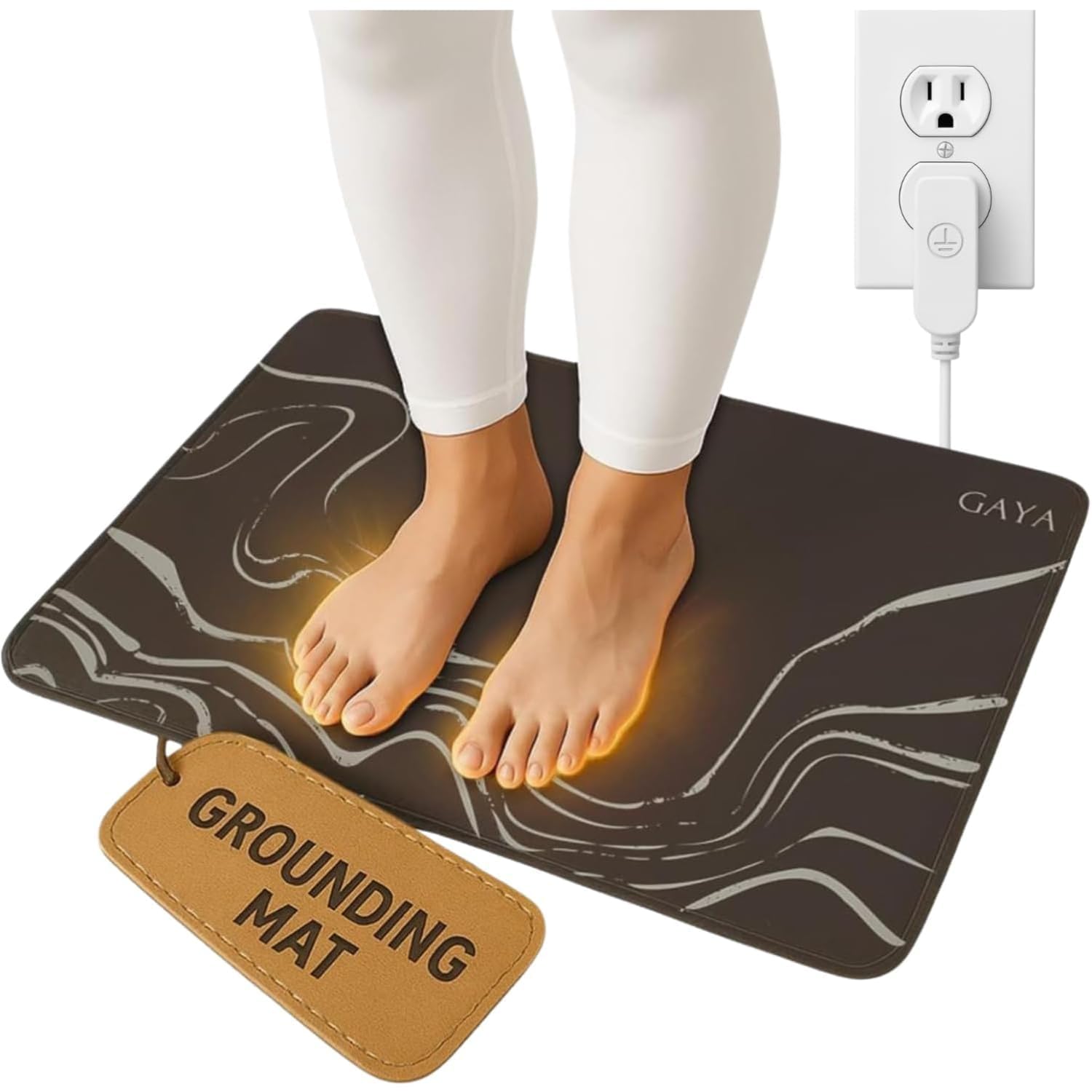
The foot pad with the deepest review history and a published safety resistor.
At 24″L x 16″W x 0.1″Th, this mat slides under a desk, sits at the end of a bed, or rests in front of a couch. Inside are three layers: a skin-friendly PU (polyurethane) top, a conductive carbon middle, and a non-slip base. A 100K Ohm resistor (a safety part that limits surge current) is wired into the 15-foot cord. That’s more published detail than the FENBAS mat offers, which names no resistor at all — and it’s comfortable enough to leave down all day.
Buyers respond to the overall quality and the sleep angle, the two things they bring up most. Reviewers describe the mat as stylish, well made, and easy to clean, with a smooth surface that feels pleasant underfoot. One daily user — at sleep, desk, and TV — reported gentle relief from chronic full-body fatigue by week one and none by week three. Another reported energy returning and foot discomfort easing after a single 30-minute session. Grounding here is framed as a slow, cumulative effect, so plan daily use of 30-plus minutes rather than expecting a switch to flip.
The honest catch is that results are far from guaranteed. Some users report no change at all after weeks of daily use, and a few note the absence of any indicator light to confirm the mat is grounded. A calibration stretch of tingling or cramps is mentioned too, which passes for some and doesn’t for others. If a visual confirmation of grounding is what keeps you motivated, this doesn’t provide one — the effect is something you judge by feel over time.
Where it leads the pack: the 100K Ohm resistor and published three-layer construction give you a clear picture of what’s inside, and the 24″L x 16″W size fits under a desk or at the foot of a bed.
The one honest gap: there’s no built-in indicator to confirm the mat is grounded, so the effect is something you judge by feel over time.
Best fit for: desk workers and side sleepers who want a small, well-documented foot pad with a published safety resistor.
Not the one for: anyone who needs confirmation lights or instant, measurable feedback to stay motivated.
6. GroundingWell Grounding Mat for Feet

A light carbon-fiber pad built to travel between desk, couch, and foot of the bed.
Portability is the whole point: at 23.6 x 15.7 x 0.2 inches and 8 ounces, this mat folds down and moves with you — desk in the morning, couch in the evening, foot of the bed at night. The surface is a skin-friendly PU cushion over conductive carbon fiber, and the 15-foot cord carries a 50K Ohm resistor (a safety part that limits surge current) for surge protection. It’s water-resistant, and setup takes about a minute: snap the wire in, plug into a grounded outlet, done.
Relaxation and ease of use are the two areas buyers flag most. The mat is described as comfortable, breathable, and well made, and the routine tends to stick. One user had it in the daily rotation after a week, used at the desk and before bed, and reported a calmer feeling and better sleep. Another, skeptical at first, found desk-job leg swelling and tightness easing within days and sleep quality improving over three months.
Effectiveness is the honest question, and it is genuinely mixed. Some people feel nothing at all, and a few describe the mat as just lying there with no discernible effect. That’s a fit issue, not a defect — grounding doesn’t register the same way for everyone. One more warning worth taking seriously: buyers with pacemakers or other implanted medical devices should check with a qualified professional before using any grounding product.
Built for the go-bag
- 8 ounces and 0.2 inches thick — rolls or folds into a bag easily.
- 50K Ohm resistor and 15-foot cord in a one-minute setup.
- Breathable PU cushion that stays comfortable at a desk.
Before you commit
- Effectiveness varies — some users feel nothing at all.
- Not for anyone with a pacemaker or implanted medical device without professional advice.
Choose this for: a portable pad you can move between work and home without a second purchase.
Look past it if: you need a guaranteed, felt response — this one asks for a patient trial.
7. GroundLuxe Earthing Foot Mat

The leather-look mat built twice as thick, with sewn edges that resist fraying.
The GroundLuxe lasts longer than a thin pad because it’s built thicker. The surface is vegan faux leather with an anti-slip rubber backing, and the listing says it’s twice as thick as most other grounding mats. Thick sewn edges are meant to resist fraying, peeling upward, and de-laminating (layers separating) with temperature swings — the failure mode that shortens the life of thinner pads. It rolls into a sturdy tube for travel, ships with a 15-foot cord and an outlet tester, and weighs 1.54 pounds.
Buyers describe the mat as effective and simple to use, with improved sleep and reduced discomfort getting the most attention. One user placed it under the legs in bed and reported sciatica hip and leg aching easing about ten days in, plus faster post-exertion recovery. Another reported better and longer sleep, a tingling sensation across the feet and legs, and feeling calmer and more relaxed after a few days. The outlet tester earns its place too — it revealed a faulty outlet in one user’s home.
The recurring question is measurement: grounding effects are hard to quantify, and a few users see no results, especially those without stress or pain to address in the first place. There’s no meter in the box beyond the outlet tester, so you judge by feel. Compare it to the GroundingWell pad: both travel, but the GroundLuxe trades that pad’s 8 ounces for 1.54 pounds and a thicker, sewn-edge build.
Where the thickness pays off: twice the thickness of most mats plus sewn edges that resist fraying, peeling, and de-lamination — a build meant to outlast thin pads.
Worth it for: heavy daily use and travel, where a thick, non-fraying mat matters more than a low price.
Hold off if: you need measurable proof of effect — the box includes an outlet tester, not a body-voltage meter.
Know the Specs
Resistor Rating
The resistor is a small safety part inside the cord that limits current from an electrical surge. The GAYA pad publishes a 100K Ohm resistor; the GroundingWell pad uses a 50K Ohm resistor. The higher the Ohm rating, the more current it restricts. Both protect you during daily use, and both are worth checking before you sleep on a pad.
Conductive Layer
The conductive layer is what actually spreads the earth’s charge across the surface — carbon in the GAYA and GroundingWell pads, silver fiber in the Reaks sheet and FENBAS mat. A pad that names its material, whether carbon fiber or pure silver, gives you a reason to trust its conductivity. A mat with no named conductive layer is a surface you can’t verify.
Common Questions
How do I know my grounding pad is actually working?
Can I use a grounding pad if my outlet isn’t grounded?
Is a grounding pad safe to sleep on all night?
How long before I feel a difference from grounding?
Can I wear socks on a grounding mat?
How often should I wash a grounding sheet?
What’s the difference between a foot mat and a bed mat?
Do grounding pads come with everything I need to start?
Can a grounding pad help with leg swelling or soreness?
Why do some people feel nothing from a grounding pad?
The Bottom Line
For most people after a grounding pad that covers the whole bed, the Grounding Mat for Bed with Leather is the pick — its king-size PU leather surface keeps skin in contact through the night, and the anti-slip base holds it in place for most sleepers. If you want a small foot pad with a published 100K Ohm resistor and the most substantial review history of the group, the GAYA Grounding Mat for Feet leads there. And for a fitted sheet with silver woven into the cotton, the Reaks Grounding Sheets Queen is the one to reach for. Whichever you choose, test your outlet first — that one check does more for your results than any label on the box.
How we choose
We do not accept paid placement. Every pick is matched to a real buyer and a real use-case; we do not hands-on test units.
Sources
Specifications: manufacturer listings and product documentation. Review insights: verified customer reviews. Pricing: not shown on this page (it changes often); check the current price via the retailer link.
As an Amazon Associate, Aappliancez earns from qualifying purchases. This does not affect which products we feature.