Disclosure: Some links in this post are affiliate links. As an Amazon Associate I earn from qualifying purchases, at no extra cost to you. Learn more
Specs are compiled from manufacturer listings and verified buyer reviews and can change over time — please confirm the key details on the product page before buying.
You want the groundhog gone without hurting it, and the trap that does that best for most yards is the Duke Traps Heavy Duty Large Cage Trap — a 30″ x 12″ x 12″ steel cage that a groundhog walks into and cannot back out of. The rest of this list is about matching the right cage to your actual animal, because a trap that is too small lets a big groundhog nose the door open, and one that is too flimsy lets it chew its way out.
This guide is built by comparing the manufacturers’ published specifications and the patterns across verified customer reviews, so you get each pick’s real strengths and trade-offs instead of marketing spin.
Groundhogs are strong diggers with a low center of gravity, so the cage has to be long enough to hold a full body and heavy enough that a panicked animal cannot roll it. Below you will find seven live-catch cages sorted by what they actually do well, from budget-friendly folding units to a double-door premium cage built for repeat trapping. groundhog trap shopping gets a lot easier once you know the three numbers that matter.
Top Picks


How To Choose The Best Groundhog Trap
A groundhog is heavier and stronger than a squirrel or a rabbit, and it digs. That changes what you need from a cage: the door has to drop fast enough to beat a retreat, and the frame has to resist a nose pushed under the bottom edge.
Cage length and door style
Groundhogs generally need a cage in the 30-inch range or longer so the whole body clears the door before the trigger fires. A single-door cage like the Duke Traps 30″ x 12″ x 12″ works well because the animal has to walk the full length to reach bait at the far end. A double-door cage like the Timaze 40″ gives the animal a clear path from either side, which can encourage a cautious groundhog to commit.
A gravity door drops on its own weight, and a spring-loaded door snaps shut. Both are used on live-catch cages, and neither is automatically better — a heavier gravity door resists a determined push, while a spring door closes faster on a skittish animal.
Material and coating
Galvanized steel is dipped in zinc so it resists rust, and a powder coat adds a second layer. Look for smooth edges on the inside plate, because a sharp edge can catch an animal’s paw or tail on the way in. A pound rating on the box tells you nothing about the gauge of the wire, so judge sturdiness by how thick the frame feels in photos and by what owners say about it holding up.
Side-by-Side Comparison
| Model | Best For | Cage Size (L x W x H) | Doors | Material | Amazon |
|---|---|---|---|---|---|
| Duke Traps Heavy Duty Large Cage Trap★ Best Overall | Best overall for strong diggers | 30″ x 12″ x 12″ | Single | Plastic | Amazon |
| ANT MARCH 32” Live Animal Cage Trap with GlovesBest for Storage | Best for folding storage | 32″ x 11.8″ x 12.7″ | Single | Alloy Steel | Amazon |
| 32″ Foldable Humane Animal Trap | Best for TNR and cat work | 30″ x 11″ x 12.5″ | Single | Iron | Amazon |
| Timaze 32″ Folding Live Animal Trap | Best for baiting at both ends | 32″ x 11″ x 12.5″ | Single | Iron | Amazon |
| Rockever Live Animal Trap Cage with Cover | Best for calm transport | 32″ x 10″ x 12″ | Single | Fabric + Polyester, Metal | Amazon |
| Humane Way Sentinel 32 Inch Live Animal Trap | Best for no-assembly setup | 32″ x 10.5″ x 12.5″ | Single | Metal | Amazon |
| Timaze 40″ Large Double-Door Live Animal Trap | Best for repeat trapping | 39.96″ x 10″ x 11.81″ | Double | Iron | Amazon |
Detailed Reviews
1. Duke Traps Heavy Duty Large Cage Trap
Our pick — 4.5+★ from 550+ verified ratings; the strongest balance of quality and price.
A 30-inch steel tank with a gravity door that a groundhog cannot reason its way out of.
What makes this cage the one to start with is the 30″L x 12″W x 12″H body — long enough that a groundhog has to commit its whole body to reach the bait at the far end, and tall enough that it cannot turn around easily once the door drops. The door runs on gravity rather than a spring, so there is no trigger latch to bend or forget to set.
The build is the reason it keeps coming up in yard-after-yard conversations. Owners describe the frame as tank-like, and the green coating both hides the cage against grass and slows corrosion on the wire. Thicker bars are there for the animal’s benefit too, since thin wire is what cuts and bruises a panicked groundhog. For a buy-once cage, this is the one most buyers land on: 4.5+ stars across 500+ reviews, the strongest score-and-volume combination here.
The honest catch is size and portability. A large steel cage plus a frightened animal is a two-hand job, and the single handle makes a solo carry feel like a balancing act. Owners who planned ahead tied a rope to both ends and carried it like a sling — a cheap fix worth doing before you trap. The other trade-off is baiting depth: you need something that outsmells a garden, and dog food, wet cat food, or a bruised apple at the far wall all earn mentions.
Get the door tension right and this cage does the rest. Buyers report first-night catches of raccoons, opossums, armadillos, and hefty groundhogs, including “7 armadillos and 4 raccoons unbaited” — the trigger fires without fancy bait. No other 30-inch cage on this list has a comparable first-night catch record.
What earns it the top spot
- 30″ x 12″ x 12″ cage fits a full-grown groundhog with room to spare
- Gravity door with a sturdy trip lever — no spring to weaken
- Green coating hides the cage and fights corrosion
- Thicker bars protect the animal from injury on release
Where it asks more of you
- Single handle makes a one-person carry awkward with a live animal inside
- Paint can wear where an animal chews — plan on a touch-up now and then
- Large footprint needs flat ground to sit level
Buy this if: you have one stubborn groundhog and want a cage that outlasts the job — the 4.5+ star score with 500+ buyers backs the build.
Look elsewhere if: you need something you can fold flat and slip behind a shed — this one stays assembled and takes up real space.
2. ANT MARCH 32” Live Animal Cage Trap with Gloves
Thirty-two inches of rust-resistant wire that collapses flat when the season is over.
The number that sells this cage is the fold. It measures 32″L x 11.8″W x 12.7″H in use and collapses flat for storage, which is the difference between a trap you keep in the garage and one you trip over all summer. The trigger rod sits on the outside of the cage, so an animal cannot chew or push on it from inside — a small design choice that matters when you are dealing with a groundhog’s teeth.
Where the Duke above is built like a tank, this one is built like a tool you carry. It weighs in lighter and comes with a pair of gloves, which owners consistently rate as better than expected — thick enough to handle a live animal without a second thought. It works the large-rodent list hard: cats, raccoons, rabbits, squirrels, opossums, voles, and groundhogs are all named as targets.
Here is the honest read: this is not the sturdiest cage on the list, and the review pages say so. The wire mesh flexes and a determined animal can test it. The fix owners keep coming back to is zip-tying the corners and the trigger plate for extra rigidity before the first set. Bait at the back, set the door, and check it twice a day — a cage this size can catch a groundhog, but it will not shrug off a raccoon the way a heavier cage does.
For the money, it is the practical pick if you trap a few times a year and want the cage out of the way the rest of the time. Multiple owners caught a groundhog within a day of setup, and one reports “caught an opossum within a day of arrival using dog food” — plain bait is enough. Just budget five minutes and a few zip ties for reinforcement before you set it.
Where it fits: the folding frame and included gloves make this the cage you can store on a shelf and pull out when the groundhog shows up — no assembly, no wall space lost.
What to plan for: the build is on the lighter side, so reinforce the corners with zip ties and place a board underneath if the animal digs — the bottom wire alone will not stop claws.
Best for: renters and small yards where a permanent cage has nowhere to live.
Pass on it if: you expect a heavy raccoon or a groundhog that fights the wire — pay more for the Duke and skip the reinforcement work.
3. 32″ Foldable Humane Animal Trap

The cage that volunteers grab when the colony needs trapping, not the showpiece of the shed.
This one earns its place on the list by being the most reliable catcher in the fold. The spring-loaded front door and sensitive trigger are designed to drop fast and lock, and that combination is why it shows up in trap-neuter-return work. The body measures 30″L x 11″W x 12.5″H — the manufacturer lists it as suitable for stray cats up to 16.5 pounds, raccoons, squirrels, rabbits, moles, groundhogs, and armadillos.
What owners keep coming back to is how quickly it converts. It arrives flat, folds open into a working cage, and folds back down for the trunk of a car. The galvanized steel is treated to resist rust, and the handle has guards so your hand stays clear of the door when you lift it. Bait it, set it, and check it — that is the whole routine.
The one flaw worth naming before you buy is the internal plate. There are sharp edges on the trap plate, and one reviewer noted an injury to a cat that got a paw in the wrong spot. It is not the usual outcome, but if you are trapping cats for a TNR program, a quick pass with a file or a strip of tape over the plate edge is cheap insurance. Bait placement also matters: an open food container taped to the back gets moved around without triggering, so anchor your bait low and heavy.
For groundhog duty, point it at the burrow entrance and use something strong-smelling at the far end. The spring door closes fast enough for a retreating animal, and the cage holds up through the season. It is the pick when the job is catching and relocating rather than one big trophy.
Why trappers like it
- Spring-loaded door and sensitive trigger drop fast and lock
- Folds flat between jobs — fits in a car trunk
- Galvanized steel resists rust through wet seasons
- Hand guards keep your fingers clear of the door
Small things to know
- Sharp edges on the internal plate — file or tape them before first use
- Lightweight build shifts on soft ground unless weighted
- Bait can be moved without tripping the plate if not anchored
Worth buying when: you trap seasonally, work with a TNR group, or want a cage that stores out of sight.
Think twice if: you need a cage that survives a raccoon fighting a spring door every week — this is a volunteer tool, not a tank.
4. Timaze 32″ Folding Live Animal Trap

Built with the groundhog listed as its target species, and a long body for a safe release.
The manufacturer lists groundhog as the target species on this cage, and it is sized for the job: 32″L x 11″W x 12.5″H, with a body long enough that a groundhog has to walk in fully. It weighs 8.8 pounds, which is light enough to carry one-handed with the handle guard in place. The galvanized steel is treated against rust, and the frame folds flat for storage.
What separates it from the foldable cage above is the length and the release story. A long cage lets you tip the door open with minimal contact — the animal walks out on its own — and owners who relocated skunks and cats single that out. It handles the usual suspects: stray cats up to 16.5 pounds, raccoons, squirrels, skunks, moles, groundhogs, armadillos, and rabbits. Bait with sardines or wet cat food at the far end and you have a working set.
The caution is the hinges. Several owners note they stick when you fold the cage, and it needs a firm hand to open and close cleanly. That is not a dealbreaker, but it is the first thing to check when the box arrives. There is also a rear door on this model, and it opens outward — less secure than an up-and-down design for feeding a trapped animal, and worth reinforcing before you rely on it.
For one groundhog or a handful of cats, this cage is a strong middle pick. The price sits between the budget folding traps and the heavier premium cages, and the build is a step up from the cheap wire mesh. If your groundhog is stubborn and refuses to enter a shorter cage, the extra length here is the reason to choose it.
The groundhog argument: a 32-inch body gives a burrow-shy animal room to commit, and a long cage makes release a hands-off tilt rather than a reach-in.
The hinge question: folding hinges can stick, and the outward-opening rear door is less secure — check both before you set the trap.
Pick it for: groundhogs, raccoons, and cats where a long, light cage helps you release without a wrestling match.
skip it if: you want a cage you never have to think about again — the folding mechanism and rear door need a little attention each time.
5. Rockever Live Animal Trap Cage with Cover
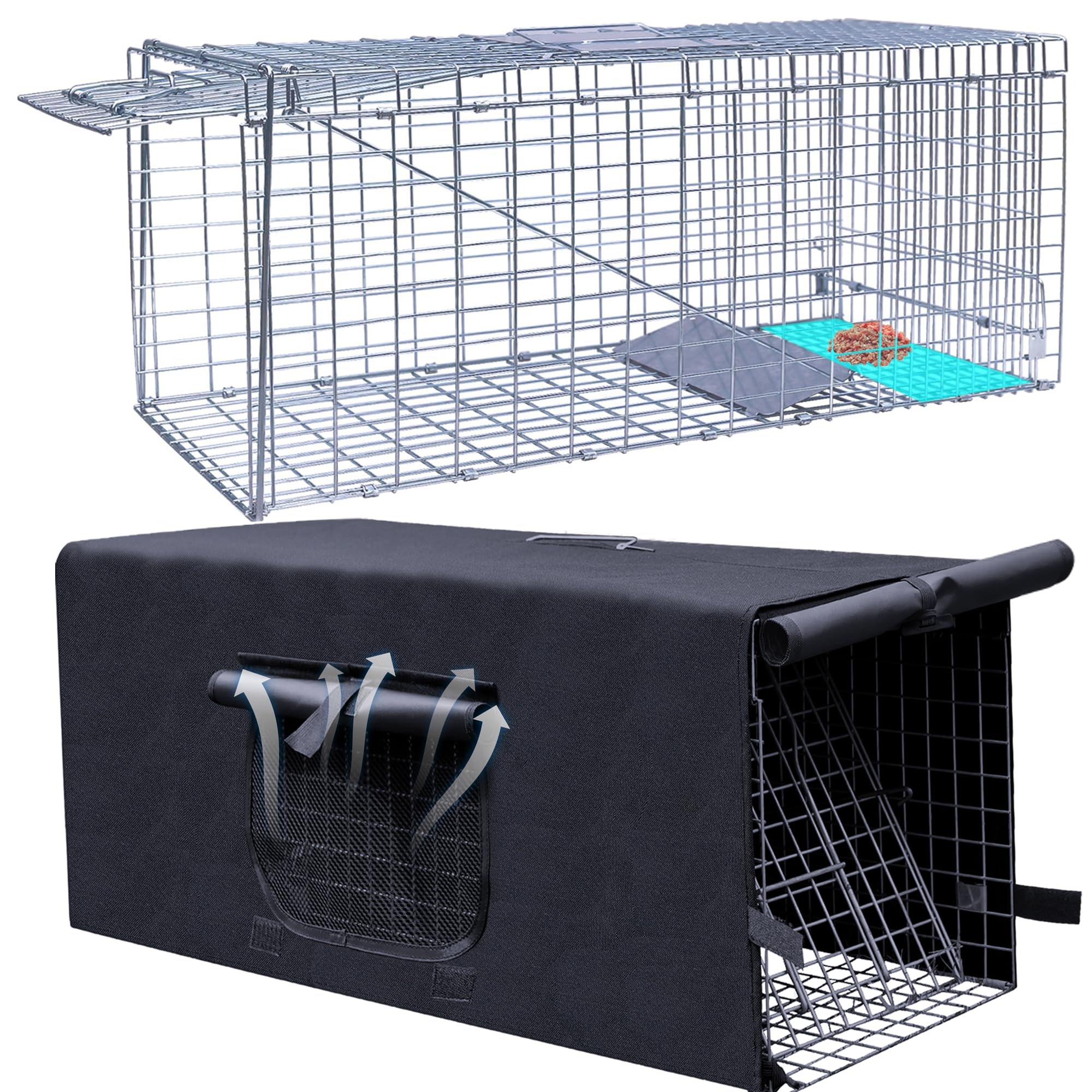
The cage that comes with a jacket — a cover that darkens the inside and settles a trapped animal.
Most cages on this list are steel and nothing else. This one includes a fitted cover, and that changes how the animal behaves after the door drops. The cover is 600D Oxford fabric with a PVC composite coating, which makes it UV-resistant and weather-ready, and it blocks out noise and light so a captured groundhog or cat sits still instead of throwing itself at the wire.
The cage itself is 32″L x 10″W x 12″H, built from galvanized wire mesh on a reinforced frame with a rust-resistant finish. Four corner clasps hold the cover down in wind, and the top zipper lets you reach the cage without pulling the cover off. The manufacturer lists raccoons, squirrels, groundhogs, skunks, and feral cats as targets, and the smooth edges on the interior are there to prevent injuries.
What you should know is that the durability is the weak point. Raccoons in particular are hard on fabric, and the cover can tear if an animal claws at it. The frame is lighter-gauge than the premium cages here. The fix is to treat the cover as a transport aid rather than a permanent shell — put it on after the catch, not before — and store it out of direct sun when not in use.
Where this cage wins is the hour between the catch and the release. A covered animal is calm, which means you can move it without it thrashing, and the cover makes the whole setup look like a box in the yard instead of a trap. For a groundhog you plan to relocate across town, that is the difference between a peaceful ride and a frantic one.
What the cover buys you
- Included fitted cover blocks light and sound to settle a trapped animal
- 600D Oxford fabric with PVC coating resists UV and rain
- Four corner clasps hold against wind; top zipper for access
- Smooth interior edges reduce injury risk
Honest limits
- Cover can tear under a determined raccoon’s claws
- Frame is lighter than premium cages — inspect welds on arrival
- Fits the specific cage; the cover is not swappable to another size
Reach for this if: you want a trapped groundhog calm and quiet until you can drive it out to a release site.
Not for you if: you need a cage that shrugs off a raccoon every night for years — the fabric and frame want gentler handling.
6. Humane Way Sentinel 32 Inch Live Animal Trap
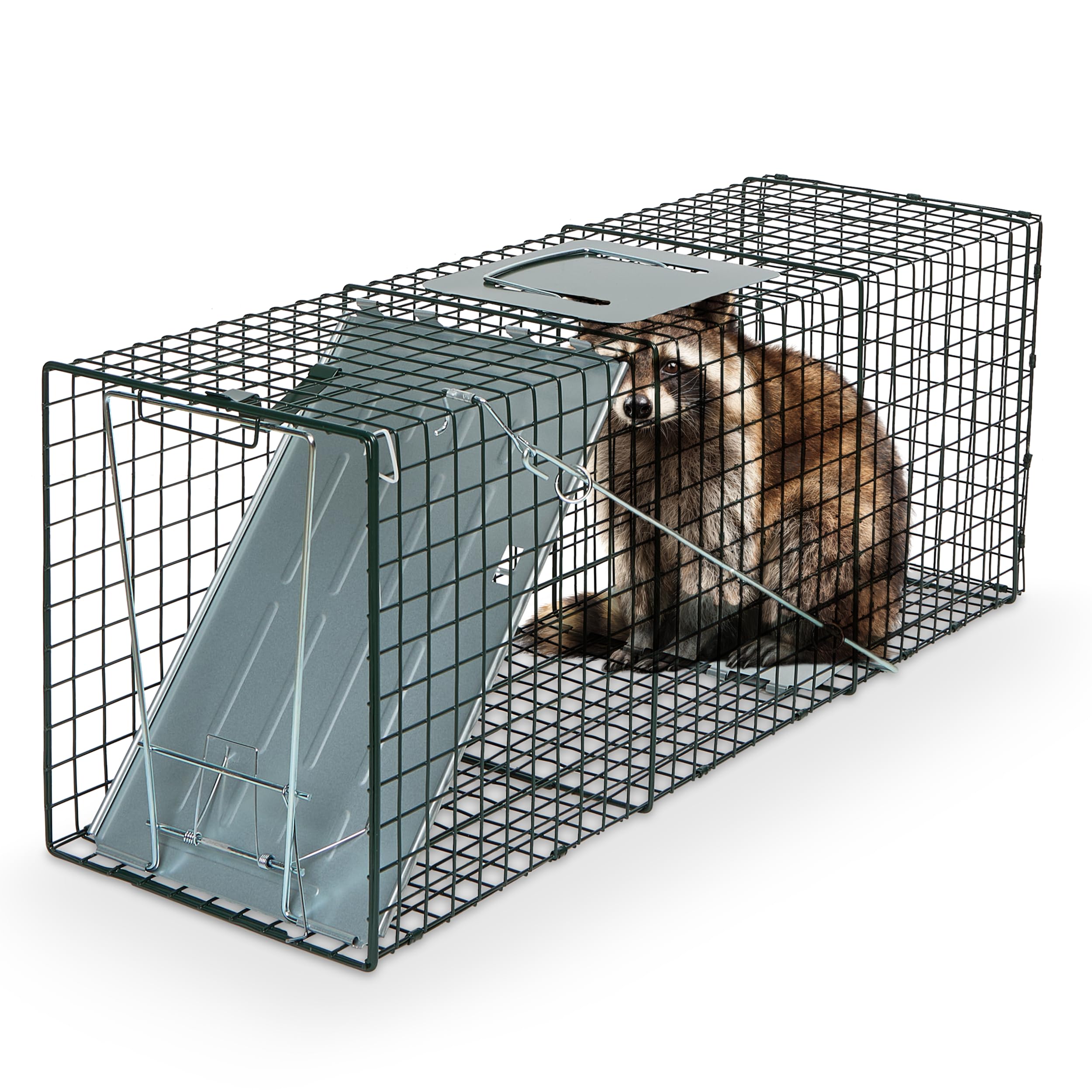
from the start and ready to set — no folding, no clips, no instructions to lose.
This cage arrives fully built. There is no assembly, no folding, and no video to watch before you can set it: the Sentinel 32 is ready to bait and place the minute you pull it from the box. It measures 32″L x 10.5″W x 12.5″H and weighs 7 pounds, the lightest full-size cage on this list, and it is built from heavy-duty galvanized steel with an extra-strength rust-resistant powder coat.
The size and weight are why people keep it. A groundhog, raccoon, opossum, or feral cat all fit inside, and the light frame makes it easy to carry from the garage to the burrow. The single-step set is a real convenience if you are placing the trap at dawn and want to get back inside before the animal notices.
Reviews keep returning to one word — effectiveness — because this cage catches quickly. One owner reports three raccoons in under three days. But the door is the part to watch. With no back opening, baiting is the main struggle: you have to reach in from the front, and that is awkward with a long cage. The door mechanism also needs a firm trigger — if it does not drop cleanly on a test set, adjust it before you leave it overnight.
For a first-time trapper, the no-assembly design saves an hour of frustration. For a repeat trapper, the lack of a back door is the one thing that will wear on you. This is the cage to grab when the groundhog is already in the garden and you need something working today, not a project.
Why it’s easy to live with: the cage is fully built, light at 7 pounds, and sets in one motion — a strong pick for a first catch.
The real gripe: no back opening means reaching through the whole cage to place bait, and the door wants a firm trigger to drop reliably.
Suits: anyone who wants a working trap today with zero assembly and the lightest carry here.
Think hard if: you bait and set traps often — the closed back turns a two-minute job into a fiddly one.
7. Timaze 40″ Large Double-Door Live Animal Trap

Forty inches of cage with two doors and a trigger you can tune to a cautious groundhog.
This is the biggest cage on the list at 39.96″L x 10″W x 11.81″H, and the two-door design is its whole reason for existing. A double door creates a clear path straight through the cage, which encourages a wary groundhog to walk in rather than stopping at the entrance. The manufacturer rates it for stray cats up to 17.6 pounds, plus raccoons, squirrels, skunks, moles, groundhogs, armadillos, and rabbits.
The trigger is adjustable, so you can dial the pedal to the weight of your animal. That is the feature that separates it from the single-door cages: a heavy groundhog that steps lightly gets caught because you tuned the trip for it, and a light squirrel does not set it off by accident. The galvanized steel is treated against rust, and the doors lock automatically when they drop.
Two honest cautions. First, the cage is heavy — this is a two-hand lift and not a fold-and-carry tool. Second, the doors drop with real force, and more than one owner has modified the bottom strip with thicker foam to soften the blow. Easy assembly and the two-door design are what buyers like best; the weight and the powerful door are what they mention as the trade-off. If you are handy with a few minutes and a piece of foam, you get a lot of cage for the job.
For the trapper who has already tried a smaller cage and watched the groundhog walk away, the extra length and the tunable trigger are the answer. Two doors mean the animal commits from whichever side it approaches the burrow from, and a 40-inch body gives you room to release without reaching in. This is the repeat-trapper’s cage.
Why the two-door design works
- 39.96-inch body gives a full-grown groundhog room to commit
- Two doors create a clear path from either side
- Adjustable trigger can be tuned to the animal’s weight
- Automatic locking doors hold the catch securely
The trade-offs to accept
- Heaviest cage here — plan on a two-hand carry
- Doors drop hard; the bottom strip may need a foam upgrade
- Larger footprint needs level ground to sit right
Choose this when: a smaller cage has already failed you and the groundhog is wise to the routine.
Look elsewhere if: you need something you can lift easily — this cage earns its size and asks you to respect the weight.
Know the Specs
Cage dimensions and door count
The dimensions are listed as length x width x height in inches, and the length is the one that matters most for a groundhog. A cage in the 30-inch range is the practical minimum for a full-grown animal; below that, the groundhog may not fully enter before the door drops. A double-door cage gives the animal a clear path through the trap from either side, which can encourage a cautious animal to commit. Width and height need to clear the animal’s body comfortably without giving it room to turn around and push at the door.
Gravity vs spring-loaded doors
A gravity door falls under its own weight once the trigger releases, which means there is no spring to weaken or replace. A spring-loaded door is pulled shut by a spring, so it closes faster and holds firmer on a light trigger. Both are used on live-catch cages, and neither is inherently more humane — the key is that the door closes cleanly and locks, so the animal is not caught half-in. An adjustable trigger lets you set the trip weight to your target animal.
Galvanized steel and coatings
Galvanized steel is coated in zinc to resist rust, and a powder coat or painted finish adds a second layer of protection. This matters because a cage sits outside in wet ground and stays there. A painted finish like the green coating on the Duke also helps hide the cage against grass. Check the coating around welds and the door hinge, since that is where rust usually starts.
Weight and portability
Cage weight is the spec buyers notice after the catch. A lighter cage is easier to carry from the shed to the burrow, but a lighter cage also shifts on soft ground and can be tipped by a strong animal. The heavier cages hold their place better. Whichever you choose, plan the carry before you trap — a live groundhog plus a steel cage is a two-hand job unless you rig a sling, and a folded cage is the easiest to store between seasons.
Common Questions
What size cage do I need for a groundhog?
Is a single-door or double-door live trap better for groundhogs?
Will a live trap hurt the groundhog?
What is the best bait for a groundhog trap?
Do I need gloves to handle a live trap?
How often should I check a set groundhog trap?
Will a groundhog trap rust if it sits outside?
Can a groundhog tip over a live trap?
How do I release a groundhog from a live trap?
Do folding traps hold up as well as fixed cages?
The Bottom Line
For most yards, the winner is the Duke Traps Heavy Duty Large Cage Trap because its 30″ x 12″ x 12″ steel body and gravity door handle a full-grown groundhog without the reinforcement work the lighter cages need. If you want a cage that folds flat and stows away, grab the ANT MARCH 32” Live Animal Cage Trap and a handful of zip ties. For repeat trapping where the animal is already wise to a shorter cage, the Timaze 40″ Large Double-Door Live Animal Trap gives you the extra length and an adjustable trigger to match the animal’s weight.
How we choose
We do not accept paid placement. Every pick is matched to a real buyer and a real use-case; we do not hands-on test units.
Sources
Specifications: manufacturer listings and product documentation. Review insights: verified customer reviews, as of October 2026. Pricing: not shown on this page (it changes often); check the current price via the retailer link.
As an Amazon Associate, Aappliancez earns from qualifying purchases. This does not affect which products we feature.