Disclosure: Some links in this post are affiliate links. As an Amazon Associate I earn from qualifying purchases, at no extra cost to you. Learn more
Specs are compiled from manufacturer listings and verified buyer reviews and can change over time — please confirm the key details on the product page before buying.
If a groundhog has turned your garden into a buffet, you already know the real problem: most baits and repellents work for a week and then stop. What you need is a product matched to how the animal is actually getting in — a burrow bait for tunnels under the lawn, or a repellent for plants you still want to eat. That split is the whole buying decision, and this guide walks you through it pick by pick.
This guide is built by comparing the manufacturers’ published specifications and the patterns across verified customer reviews, so you get each pick’s real strengths and trade-offs instead of marketing spin.
Below you’ll find how to read a bait label before you buy anything, a side-by-side table of the five products worth considering, full reviews of each, and a plain-English spec section covering active ingredients and application methods. Whether you’re baiting a main runway or spraying cucumbers, this breakdown of the best groundhog bait covers what matters.
Top Picks


How To Choose The Best Groundhog Bait
Groundhogs — woodchucks, if you grew up calling them that — are burrowers, not grazers. They dig a main tunnel with side chambers, pop up wherever they like, and eat a shocking volume of leafy greens on the way. That single fact decides everything about which product will work in your yard, because a bait dropped in the wrong place is just wasted money.
Decide first: poison bait or repellent
Poison baits are placed underground at tunnel entrances or along the main runway, and they kill the animal inside its own burrow. Repellents are sprayed or scattered on the plants you want to keep, and they aim to make your garden unpleasant enough that the animal feeds somewhere else. Both approaches get used on the same property — one for the animal living under your shed, one for the one wandering in from the field next door.
The trade-off is straightforward. Baits target the resident groundhog but require you to find and clear its tunnel, and you must keep pets and poultry away from treated holes. Repellents leave the animal alive but never fully solve a burrow problem, and most need reapplying on a schedule. Pick based on whether your enemy sleeps on your property or visits it.
Read the active ingredient, not the front label
Zinc phosphide is the active ingredient in the Motomco gopher killer, and it works differently from the slow-acting anticoagulant baits you may have seen: it is described by the maker as a swift, non-anticoagulant formula. Zinc-based granules show up in the Revenge Moletox bait too. Botanical-oil repellents, by contrast, rely on scent and taste rather than a poison, which is why they turn up in the ready-to-spray bottles.
Match the form to your terrain and your patience
Granules get dropped by the spoonful into a tunnel opening; liquids get sprayed across leaves; a shaker jar of granular repellent gets broadcast over a lawn. Hard, dry soil makes tunnel work slow — one buyer described clearing the passage with a running hose and waiting for it to dry before applying. If you would rather not dig at all, a spray or granular repellent on the surface is the lower-effort route.
Check the rain-resistance claim and the refill math
A repellent that washes off after the first irrigation is a weekly chore forever. Rain-resistant formulas are worth prioritizing if you water often or live somewhere wet. Just as important is how far one container goes — a 32-fluid-ounce spray bottle and a 40-ounce bottle look similar on the shelf but the reapplication interval is what really sets the cost of owning either one.
Safety is a buying criterion, not a footnote
Anything with zinc phosphide needs gloves, covered holes, and a sweep for stray pellets so pets and poultry cannot reach them. Botanical repellents marketed as natural still carry a scent that divides households. Whichever you choose, plan where the animals and kids actually move before you open the container.
Side-by-Side Comparison
Scan this table the way you’d scan a shelf. Active ingredient tells you how it kills or repels. Form tells you how much work the application is. Weight tells you how long one container lasts.
| Model | Best For | Active Ingredient | Item Form | Item Weight | Amazon |
|---|---|---|---|---|---|
| Motomco 32553 1# Gopher Killer★ Best Overall | Killing resident groundhogs underground | Zinc Phosphide | Spray | 1.1 pounds | Amazon |
| REVENGE Moletox Mole & Gopher Killer GranulesBest Value | Budget tunnel baiting at one teaspoon per burrow | zinc | Granules | 1.2 pounds | Amazon |
| I Must Garden Groundhog/Woodchuck Repellent | Spraying vegetables, shrubs, and bark | Botanical oils | Aerosol | — | Amazon |
| Rabbit & Groundhog Repellent: Rabbit Out 40oz | Year-round spraying with a mint scent | Natural ingredients | Ready-to-use spray | — | Amazon |
| I Must Garden Deer/Rabbit/Groundhog Repellent 2.5lb | Broadcasting over a large lawn area | Botanical oils | Granule | 2.7 pounds | Amazon |
Detailed Reviews
1. Motomco 32553 1# Gopher Killer
The zinc phosphide bait pros use when a groundhog has moved in for good.
This is the pick for the homeowner who has found the main runway and wants the animal gone rather than discouraged. It is labeled for manual outdoor and underground use, and it is the bait agricultural pros reach for on pocket gophers. In plain terms: you bait the tunnel, not the lawn.
The active ingredient is Zinc Phosphide, described by the maker as a swift, non-anticoagulant — meaning it does not need the animal to feed repeatedly over days the way blood-thinning baits do. The label walks you through baiting at tunnel entrances or main runways, and the whole container weighs 1.1 pounds. That puts it 9% lighter than the Revenge Moletox granules at 1.2 pounds, which matters little on the shelf and a fair bit in your hand if you are crouched over a burrow.
What wins people over is how quickly a well-placed dose shows up in the dirt. Buyers report gopher mounds dropping from 6-8 to 2 by day three. The recurring workflow tip is worth copying: locate the tunnel with a stake, open a hole with a sprinkler line, drop the pellets through a funnel, then close it up again. Gloves on, holes covered, stray pellets picked up so pets and poultry stay out of it.
Where it earns its keep
- Zinc Phosphide works as a swift, non-anticoagulant active rather than a bait the animal must eat repeatedly
- 1.1 pounds of product — the lightest container in this lineup
- Explicitly permitted for manual outdoor and underground use
- Label gives tunnel-entrance and main-runway placement instructions
What you’ll actually deal with
- You have to expose and clear the tunnel before you can bait it, which may mean flushing dirt with a hose and waiting for it to dry
- Treated holes must be covered so dogs cannot dig them up
- The same resident animals can return in a couple of weeks, and rotating baits is a common workaround
Reach for this if: you have located an active burrow and want the problem ended at the source.
Look elsewhere if: the tunnels sit close enough to the house that a trap is your only safe option — the granule bait is not the tool for that call.
2. REVENGE Moletox Mole & Gopher Killer Poison Bait Granules, 1 lb.
One teaspoon does one burrow — the cheapest per-tunnel math on this list.
If you want to treat several tunnels without measuring or mixing anything, the Revenge Moletox granules are the straightforward answer. The active ingredient is zinc, the form is granules, and the manufacturer states plainly that one teaspoon treats an active burrow or tunnel. The container weighs 1.2 pounds, so it edges past the Motomco bait’s 1.1 pounds and outlasts it on paper.
It is intended for residential use in manual, below-the-ground applications in lawns — this is not a product you scatter on the surface and hope for the best. The maker also notes a side use worth knowing: place several baits at the sides of and around flower bulbs at fall planting to help protect them. That is a chunk of the value you are getting: two seasonal jobs from one container.
Honestly, this one is a fit decision rather than a slam dunk. Owners describe the effectiveness as genuinely uneven — the recurring theme is that it works, then it does not. One buyer’s blunt summary: “Used 2 containers; some tunnels vacated but new ones appeared.” Others love the low-key proof — dry bodies turning up on the lawn, and, as one put it, “a couple of surprises while mowing my lawn.” Direction-following matters more than usual here: if the bait is not placed deep enough, animals push it back up to the surface rather than eating it. Expect to reapply as new mounds appear.
The deal-sizing note: several owners mention containers arriving noticeably under-full, so keep your expectations calibrated on how much product is actually in the pail.
Most sensible for: the gardener with multiple small tunnels who wants a low-cost, ready-to-use granule and doesn’t mind reapplying.
Think twice if: you want one treatment and a closed case — this formula reads as a recurring-maintenance tool, not a one-shot fix.
3. I Must Garden Groundhog/Woodchuck Repellent: 32oz

For the gardener who wants the woodchuck to leave the cucumbers and never wants to dig a hole.
This is the animal-alive approach. Botanical oils do the work instead of poison, and the manufacturer states the product contains no harmful chemicals or poisons and is safe for pets, people, and the environment. The form is an aerosol, and the bottle holds 32 fluid ounces — enough to spray a garden bed repeatedly rather than a single treatment.
The physical job is simple: you spray the plants you want protected, and the maker says you do not need to re-apply after every rainfall or irrigation cycle because the formula is rain resistant. That claim is the entire value of choosing this over a cheaper wash-off spray, since outdoor watering is the thing that eats repellents alive. Ready to use, no mixing, no measuring — you walk out, spray, and go back inside.
Here is the honest picture. Effectiveness on groundhogs is genuinely split, and owners who get results tend to do one thing: spray on a schedule. As one put it, “I did have to spray about every 4 days, but it was worth it.” Others report the animal returning within a day of application and giving up on the bottle entirely. The scent is the other sticking point — botanical does not mean scentless, and some houses find the smell lingers. This is a product for the persistent, not the one-and-done.
Suits: the vegetable gardener with a repeat visitor and the patience for a spray routine.
Doesn’t suit: anyone hoping for instant results on a burrow — this treats foliage, not the animal living under the shed.
4. Rabbit & Groundhog Repellent: Rabbit Out 40oz Ready-to-Use

The mint-scented spray you actually don’t hate using — if the bottle cooperates.
This is the pick for someone who wants a repellent that works in every season and does not smell like a chemical spill. The form is a ready-to-use spray and the bottle holds 40 fluid ounces — the largest liquid volume in the group. The maker states it uses two natural stickers so the formula is rain resistant and won’t wash off, and it is described as effective in spring, summer, winter, and fall.
The scent is Fresh, and that is the point: the brand’s whole pitch is that it smells great to humans while groundhogs, woodchucks, gophers, and rabbits are naturally repelled by it. Owners back the scent up. “Smells good, works well,” sums up the consensus. Its natural ingredients are described by the maker as safe around children and pets, and the brand cites over 100,000 repeat customers across 22 years.
The catch here is hardware, not formula. The recurring gripe is the sprayer — customers note it failing, leaking, or arriving defective, and at least one describes a bottle top that pops off and won’t tighten. The other honest note is effort: it repels, but frequently. Groundhogs often return in smaller visits, and the math some reviewers point out is roughly a quarter to half a bottle per application. It keeps the animal away part-time, not permanently. That is a meaningful difference from the Motomco bait above, which ends the resident animal’s burrow entirely.
Why people keep rebuying
- 40 fluid ounces — the biggest liquid bottle on this list
- Fresh mint-scented formula the manufacturer describes as safe around children and pets
- Two natural stickers keep it on the plant through rain
- Usable year-round, not just spring
Where it loses ground
- The sprayer is the weak point — complaints center on bottles that leak or stop working
- Repelling groundhogs requires frequent respraying, and the animal often returns
- Heavy applications drain the bottle fast
Pick it when: smell matters to you and you’re treating plants, not attacking a burrow.
Pass if: you want a single treatment and no sprayer to replace — the tunnel baits above are your route.
5. I Must Garden Deer/Rabbit/Groundhog Repellent: 2.5lb
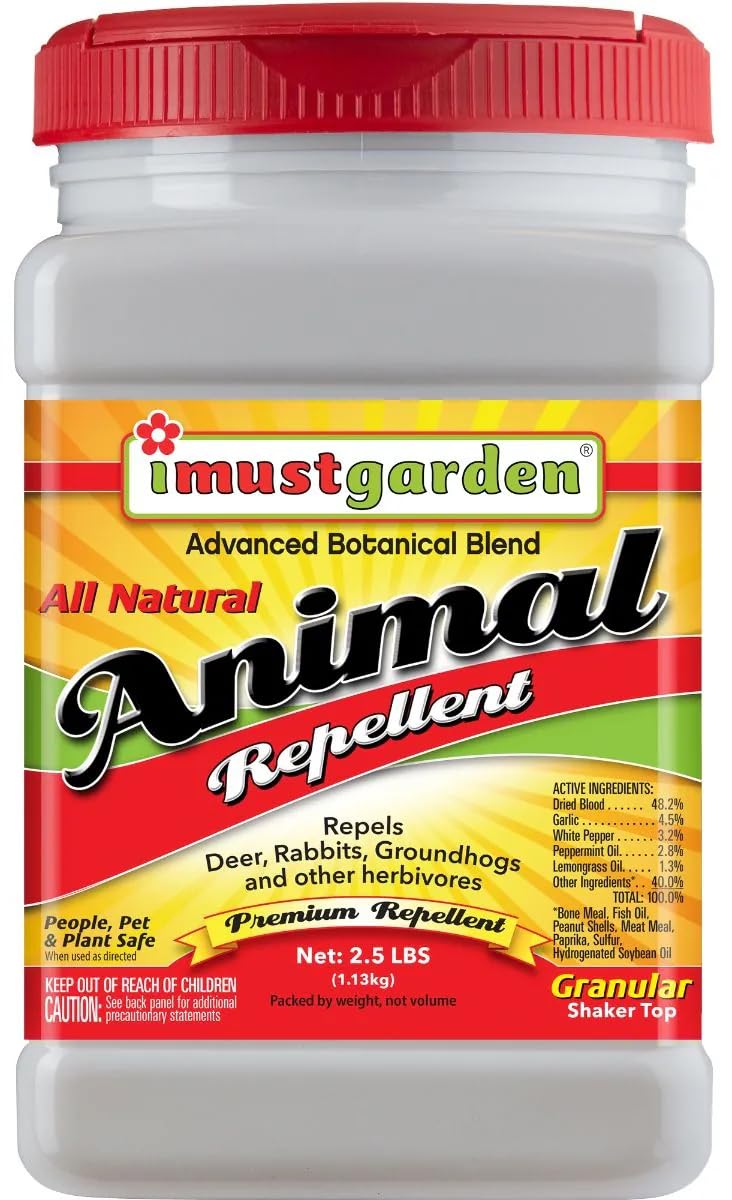
The broadcast-and-forget option for yards where a spray bottle would run dry in an afternoon.
When the treated area is measured in lawn, not in planters, this is the form that makes sense. It is a granular product — 2.5 pounds of it, weighing 2.7 pounds total — and the maker states one 2.5-pound container covers about 1,500 square feet of lawn or garden. The form is granule, and the container is a shaker jar, which the manufacturer describes as slotted for easy applications.
The other structural difference from the spray bottles is weather tolerance. This is formulated for rain, snow, and freezing temperatures, and the brand says it even works when applied on top of snow. The formula is dual-action — the maker states it repels by fear and smell — and the manufacturer claims it packs more active ingredients than any other repellent on the market. Treat that last line as a manufacturer claim, not a measured fact.
Application is the thing this product gets right. Owners describe the shaker jar as genuinely easy, and one notes they didn’t have to reapply after rainfall. On groundhogs specifically, though, results are split — plenty report it works, others report the animals walking right through it. As one owner put it, “I followed instructions and the groundhogs laughed in my general direction.” The scent divides the house too: mint to some noses, unpleasant to others.
Best use case: large lawn perimeters, fast-growing seedlings, and bedding plants where a shaker is faster than a sprayer.
Keep in mind: as the repellent loses potency after rain, the label’s own advice is to reapply every few days while plants are getting established.
Made for: the property with a lot of ground to protect and no interest in mixing or spraying.
skip it if: your issue is a single determined burrow — broadcast granules treat surfaces, and a tunnel bait is the tool for that job.
Know the Specs
Three specs do most of the work when you’re comparing groundhog baits and repellents: the active ingredient, the item form, and the safety regime. Here’s how to read each in plain terms.
Active Ingredient
This is what does the killing or repelling. Zinc Phosphide, the active in the Motomco gopher killer, is described by its manufacturer as a swift, non-anticoagulant formula — meaning it does not rely on the animal eating repeatedly over a period of days the way blood-thinning baits do. Zinc, the active ingredient in the Revenge Moletox granules, is a different chemistry but the same category: a poison meant to be placed underground. Botanical oils, in the I Must Garden sprays and the Rabbit Out bottle, are the third category — no poison, instead a scent and taste the animal avoids. Reading this label first tells you whether you are killing or deterring.
Item Form
Form decides how much work the product is. Granules and powders are dropped into a burrow or broadcast by shaker jar, which means an exposed tunnel and a bit of digging on your part. Sprays and aerosols go on the plant surface and are faster to apply but wash off more easily and need more frequent reapplication. The form also changes your coverage math: a granule jar covers area, a spray bottle covers foliage. Match the form to the job, not the price tag — a spray bottle is wrong for a burrow and a granule jar is wrong for the leaves you are trying to protect this week.
Item Weight and Coverage
Weight tells you how long a container lasts. The Motomco and Revenge baits sit at 1.1 pounds and 1.2 pounds respectively — small, targeted doses meant to treat individual tunnels. The I Must Garden granular repellent weighs 2.7 pounds and covers about 1,500 square feet, which is why it makes sense for perimeter work rather than one burrow. Liquid repellents are measured in fluid ounces instead: the I Must Garden spray is 32 fluid ounces and the Rabbit Out bottle is 40 fluid ounces, so the Rabbit Out container lasts longer on paper between refills.
Safety and Weather Resistance
Two final specs decide how painful the product is to live with. First, safety: anything with a poison active — zinc or zinc phosphide — needs gloves, covered holes, and a sweep for stray pellets so pets and poultry can’t reach them. Botanical repellents are documented by their makers as safe for pets and people, though a scent that divides a household is still a real cost. Second, rain resistance: the I Must Garden spray and the Rabbit Out bottle both advertise stickers or rain-resistant formulas, while granular products generally need reapplication every few days and after heavy rain, since the maker of the 2.5lb granular product notes it loses potency after rain.
Common Questions
Will a groundhog bait sold for gophers also work on woodchucks?
How much bait do I use per tunnel?
How long before I see a difference after baiting?
Will a bait kill the whole groundhog family or just one?
Can I use a poison bait if I have dogs or chickens on the property?
Do I have to dig up the tunnel before baiting?
How often do I need to reapply a spray repellent?
Will a repellent wash off in the rain?
Are natural repellents actually effective on groundhogs?
Should I choose granules or a spray bottle?
The Bottom Line
For most people dealing with a resident groundhog — mounds in the lawn, a burrow under the shed, and a garden that gets stripped overnight — the top pick here is the Motomco 32553 1# Gopher Killer, because zinc phosphide works as a swift, non-anticoagulant active rather than a slow bait, and it’s the only pick in this group designed and permitted for underground tunnel baiting. Buyers report mounds dropping from 6-8 to 2 by day three. If you want a low-cost granule you can load a teaspoon at a time into multiple burrows, the Revenge Moletox granules are the value pick — just expect to reapply as new mounds appear. And for the gardener with a wandering visitor and a sprayer in hand, the I Must Garden 32oz repellent is the one to reach for — spray every few days and it holds the line on your vegetables.
One honest nudge: if you’re treating several tunnels this season and don’t want to be back at the store in a month, buy the largest granule container you’ll actually use, since the baits above are all meant for repeated applications as new burrows show up.
How we choose
We do not accept paid placement. Every pick is matched to a real buyer and a real use-case; we do not hands-on test units.
Sources
Specifications: manufacturer listings and product documentation. Review insights: verified customer reviews, as of October 2026. Pricing: not shown on this page (it changes often); check the current price via the retailer link.
As an Amazon Associate, Aappliancez earns from qualifying purchases. This does not affect which products we feature.