Disclosure: Some links in this post are affiliate links. As an Amazon Associate I earn from qualifying purchases, at no extra cost to you. Learn more
Specs are compiled from manufacturer listings and verified buyer reviews and can change over time — please confirm the key details on the product page before buying.
A squeaking hinge wakes the baby, grinds at 6 a.m., and sends you back to the same can that failed last time. This guide sorts the sprays and greases that quiet a door hinge and keep it quiet, so you stop re-doing the job every week.
This guide is built by comparing the manufacturers’ published specifications and the patterns across verified customer reviews, so you get each pick’s real strengths and trade-offs instead of marketing spin.
Spray oils quiet a hinge for a day while thick lithium grease can hold it silent for months, and the five picks below split cleanly along that line. That difference decides which grease for door hinges fits your door.
Top Picks
How To Choose The Best Grease for Door Hinges
A door hinge is an awkward target. It sits vertical, so anything runny slides straight down the leaf instead of staying on the pin. That single fact is why a spray oil quiets a hinge for a day and a proper grease can hold it silent for months. Match the product to that vertical pin and most squeaks disappear on the first try.
Thickness is everything on a vertical pin
Grease is rated by NLGI grade, a scale for how stiff it is. NLGI-2 is the middle of that scale — a soft paste that clings to metal and stays where you put it rather than dripping onto your floor. That cling is what keeps a door quiet after the door has been swung a few thousand times. A thin penetrating oil creeps into the gap instantly but creeps right back out; a thicker film stays.
Know what you are aiming at
Doors here fall into three groups: residential interior hinges, exterior doors that see weather, and sliding or garage assemblies with rollers and tracks. Interior hinges want a clean grease that will not stain trim or carpet. Exterior hinges want something with rust protection built in. Sliding setups and garage doors want a track-friendly lube that will not gum up the rollers with grit.
The material question
Not every lubricant is safe on every surface. Greases built for metal are the norm for hinges. But if you are also treating rubber seals, vinyl, or plastic trim in the same pass, check the label — some formulas are safe on those surfaces while others, like dry PTFE sprays, can attack clear polycarbonate and polystyrene. Keep the two jobs separate and you will not melt anything.
Oil versus grease, honestly
For a hinge you want quiet today, a spray reaches the pin in one squeeze. For a hinge you want quiet for a season, an NLGI-2 paste wins. Many homes end up needing both.
Side-by-Side Comparison
| Model | Best For | Format | Volume | Rubber & Plastic Safe | Amazon |
|---|---|---|---|---|---|
| WD-40 Specialist Silicone Lubricant★ Best Overall | Quieting seals and tracks without attracting dust | Spray | 11 fl oz | Yes | Amazon |
| WD-40 Specialist Dry LubeTop Performer | Sliding doors, tracks, and industrial equipment | Dry PTFE Spray | 10 fl oz | No — attacks clear polycarbonate | Amazon |
| PlanetSafe SqueaksGone Hinge & Garage Door Oil | Rusty vintage hinges and quiet-first work | Penetrating Oil | 1 oz | Not stated | Amazon |
| JENOLITE White Lithium Grease Aerosol | Heavy metal-on-metal load bearing parts | Aerosol Grease | 400 ml | Not stated | Amazon |
| CRC SL3660 Super White Multi-Purpose Lithium Grease | Long-silence applications and visible fix jobs | Grease (Tube/Can) | 10 wt oz | Not stated | Amazon |
Detailed Reviews
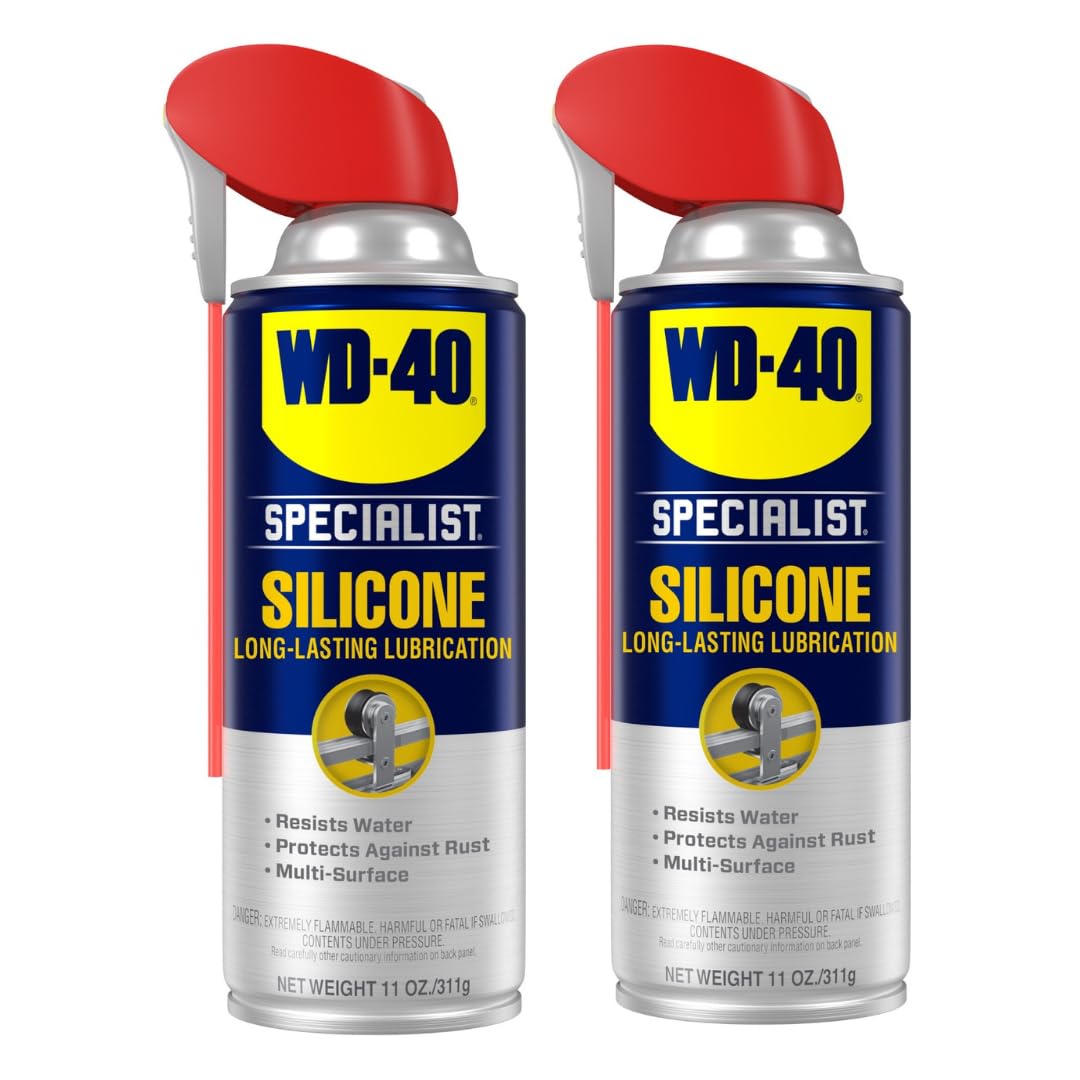
1. WD-40 Specialist Silicone Lubricant Twin-Pack
Our pick — 4.5+★ from 850+ verified ratings; the strongest balance of quality and price.
The everyday anti-squeak can that won’t drip on your carpet or gum up your plastics
For most homes, this is the sensible first can to keep on the shelf. It is built for the spots that squeak fastest — the top hinge of a heavy interior door, a sliding closet track, a rubber weather seal that has gone stiff. Where the traditional WD-40 is a water-displacer, this Specialist version is a silicone spray, which means it lubricates and waterproofs but never leaves the greasy film that collects dust on a hinge pin.
The Twin-Pack format is one of the strongest practical arguments for the pick. Each can holds 11 fluid ounces of liquid and weighs 12.8 ounces total, versus the 1-ounce PlanetSafe bottle further down — a 12.8x weight difference that means you are getting serious capacity instead of a sample size. The Smart Straw is the second clever bit: flip it up for a pinpoint stream into a hinge pin, flip it down for a wide fan over a sliding track, no swapping tips.
The composition is where this product separates itself from a generic aerosol. It is safe on rubber, vinyl, and plastic — a real constraint when a hinge sits next to a vinyl frame or a rubber bumper, because aggressive solvents will chew through both. The trade-off is that silicone is not a heavy-load product. On a hinge carrying a solid-core exterior door, expect the quiet to fade faster than it would under a lithium paste, and plan to reapply more often.
Where It Earns Its Place
- Silicone base is safe on rubber, vinyl, and plastic trim next to the hinge
- 11 fl oz per can across a two-can pack covers a lot of doors before you rebuy
- Smart Straw flips between a pinpoint stream and a wide spray without tools
- Quick-drying, no messy residue to wipe off the doorframe
What To Expect Over Time
- Silicone film is lighter than lithium grease, so heavy doors need reapplication sooner
- Not a replacement for a true metal-on-metal paste on a load-bearing garage hinge
Grab this one if: you want a single can for the whole house — hinges, sliding tracks, rubber seals — without worrying about surface damage.
Think twice if: you need a paste-grade product for a garage or exterior hinge carrying real weight; a lithium tube will outlast a silicone spray there.
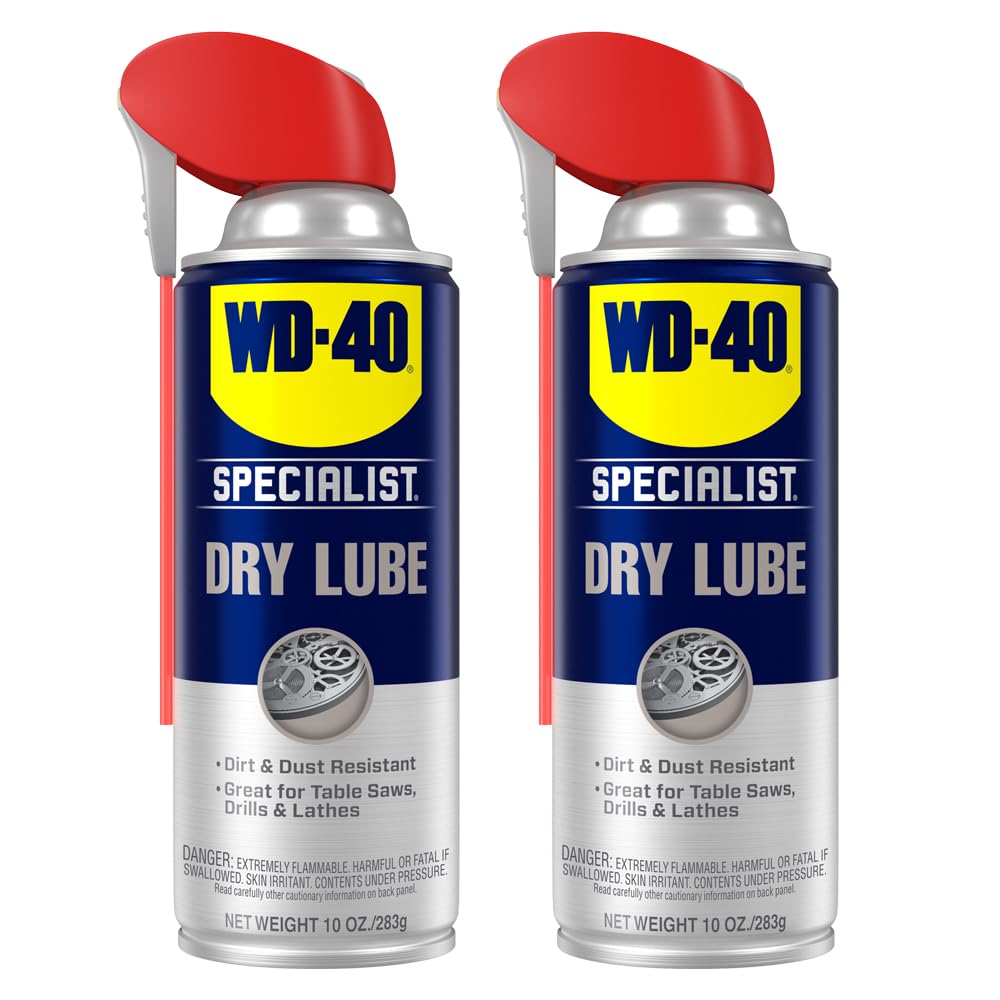
2. WD-40 Specialist Dry Lube Twin Pack
The dust-free specialist for sliding doors and tracks that keep grinding no matter what
If your problem is a sliding door that takes two hands and a hip-check to move, this is the product built for it. The dry PTFE formula — PTFE being the slippery compound behind non-stick pans, here delivered as a spray — leaves a thin film instead of a wet layer. That matters on tracks and rollers where a wet grease would trap sawdust and grit and eventually grind the whole mechanism to a stop.
The temperature range is the spec that tells you how seriously this was engineered. It holds up from -50° F to 500° F, and the 10 fluid-ounce can carries a flash point of 500° F. That range is why it lives on table saws, drills, and lathes in workshops as readily as it does on a patio door track. Compare the liquid volume to the silicone twin-pack above — 10 fluid ounces versus 11 — roughly comparable per can, so the choice is formula, not quantity.
Buyers describe exactly the transformation you would hope for. The typical report is a heavy 16-foot sliding glass patio door that used to be impossible for a small child to open, now gliding freely in its tracks after a quick spray and a moment to dry. The other recurring note is a preference for this format on tracks specifically because it does not attract dust the way a wet oil does. The catch is compatibility: this formula is safe on wood, paper, fabrics, leather, metal, and most plastics, but explicitly not for clear polycarbonate or polystyrene, so read the label before spraying a plastic window frame.
Why tracks love it: a dry film that keeps rollers gliding and refuses to collect grit is worth more than a wet lubricant on any sliding mechanism.
The honest limit: it is not the right product for a load-bearing metal hinge that lives outside; the film is thin, and a paste will hold up longer where rain and friction meet.
Reach for this if: you have sliding doors, window channels, or workshop equipment that grinds and you want a fix that stays clean.
Look elsewhere if: you need a long-lasting protective paste for an exterior hinge exposed to weather — lithium grease is the better tool there.
3. PlanetSafe Lubricants SqueaksGone Hinge & Garage Door Oil

The tiny precision bottle for old, rusted hinges that need waking up before they can be quiet
Some hinges do not have a lubrication problem — they have a rust problem. A hinge that has sat outside for a decade does not want a coating on top of the rust, it wants something that penetrates underneath it and breaks it up. That is exactly the job this product is built for. It is a penetrating oil first, a lubricant second, and the small 1-ounce bottle reflects the concentrated use case rather than a household-everything can.
Aged, stuck hinges are where this pick shines. What makes it land with older doors is the combination of penetrating action and quiet; the rust gets loosened and the squeak gets silenced in one pass rather than two products over two weekends. Typical buyers report it working almost instantly on hinges that other sprays had failed to quiet, and being effectively odorless — a genuine plus when the door swings past a bedroom or a nursery. It is also made in the USA with a formula described as non-toxic and free of the harsher chemicals found in some alternatives.
The honest caveat is the cap. The recurring complaint is that the cap is genuinely stubborn to remove, and you should expect to use a little force or a fingernail to pry it. Small thing to know before you buy. The other note is the bottle size — at 1 oz it will not cover an entire house of doors, but it does not need to. This is the product you keep for one rusted hinge that nothing else has touched, not the product for a whole-house sweep.
The scene it is built for: a 1960s front door whose hinges have rusted shut over decades, and nothing on the shelf can touch them.
Small honest catch: the cap fights back, so keep a small screwdriver nearby for the first open.
Pick this for: vintage or rusted hinges, or a home where you want the quietest possible formula with no lingering smell.
Choose a bigger tin instead if: you need to treat a whole floor of interior hinges in one session; 1 oz will not stretch that far.
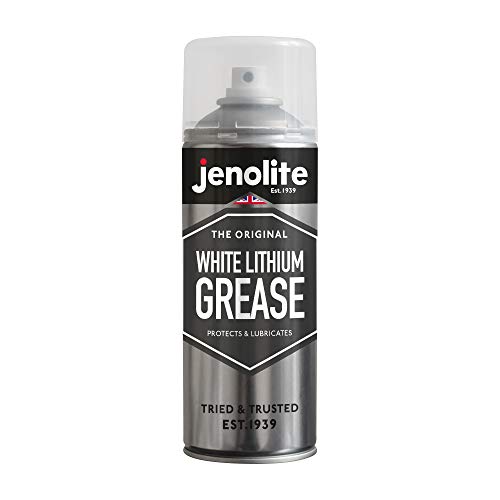
4. JENOLITE White Lithium Grease Aerosol
The thick white paste in a spray can, for hinge pins carrying real load
Interior swing doors are one problem. Car doors, gate hinges, garage latches, and load-bearing pivots are another — they need a lubricant with body, and that is the exact lane this product occupies. It is a white lithium grease delivered as an aerosol, so you get the thickness of a paste with the reach of a spray.
The behavior you get is what paste buyers want: it sprays on, dries into a thick, non-drip coating, and stays on the metal rather than working its way down the door leaf. That non-drip quality is the whole reason a vertical hinge pin finally stops squeaking for a season instead of a weekend. It is recommended for metal-on-metal and load-bearing jobs, and it is equally at home on pulley grooves, gear teeth, winches and latches — anywhere metal is grinding against metal under force.
Treated-metal reports line up with the spec sheet. Across a wide mix of languages in the reviews, the consistent note is that the thick paste gives new life to metal parts that had seized — a sliding sunroof that had stopped moving, a car latch that had gone raspy, a garage hinge that had gone silent. The lithium base brings rust and corrosion protection along with the lubrication, which is the reason exterior fix jobs hold up better with this formula than with a thin silicone spray. What it is not built for is rubber seals or plastic trim — the recommended surface is metal, so keep it away from those.
What the aerosol gets right: the reach of a spray with the body of a paste — you get lithium grease exactly where you want it without a spatula.
Where to keep this instead: on metal hinge pins, car doors, and gate hardware — not on rubber weather strip or plastic trim, which the formula is not designed to touch.
Suits you if: your squeak lives on a car door, a gate hinge, a garage latch, or any swing pivot that carries real load and needs a thick, staying coat.
Not your can if: the target is a rubber seal or a plastic window frame — this one is metal only.
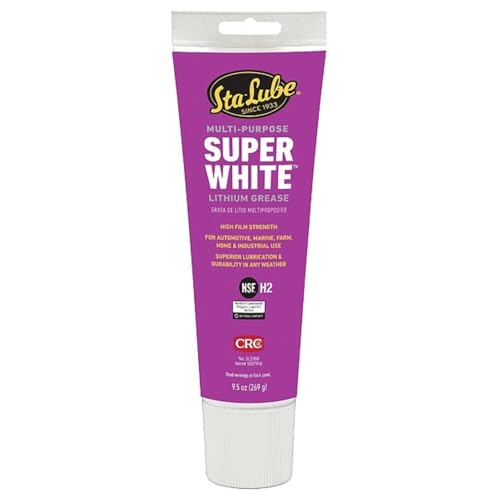
5. CRC SL3660 Super White Multi-Purpose Lithium Grease
The tube of NLGI-2 paste that makes a hinge go silent for months, not days
If a single product name is what a homeowner wants when they say “grease a door hinge,” it is this one. It is a white lithium base in NLGI-2 grade — the middle of the thickness scale, which means it holds its shape on a vertical pin rather than running down the door. Delivered as a tube or a can, it gives you enough paste to apply directly to a pulled hinge pin and coat it properly instead of spraying at it hopefully and watching the run-off drip onto your floor.
The specs behind the endurance are simple. A 10-ounce net weight puts this in the workhorse category — one buyer in the reviews notes they will be set for a very long time on a tube this size, which tracks for the typical household that touches a hinge occasionally rather than professionally. The declared drop point of 380°F means the paste does not soften under ordinary door friction, which is the technical reason a door treated with this can go quiet for months at a stretch rather than needing a reapplication every couple of weeks. Reviews of the paste on worn hinges confirm the outcome: multiple doors across the house going silent on a single treatment, with a fresh pinch of paste after pulling rusty hinge pins, wiping them clean, and pressing them back in.
The honest limits are worth knowing up front. Reviews point out that a tube of this size is more than most single-door jobs need, so budget storage space if you are only treating one hinge. A recurring note is that grease this thick can act as a magnet for dust on an outdoor hinge over time, so a wipe-down before you re-apply is smart. And the formula is not VOC compliant in California and the OTC states, which matters if your project is regulated there — check your local rules before ordering.
Why Long-Term Buyers Stay
- NLGI-2 paste clings to a vertical pin instead of dripping off
- Drop point of 380°F keeps the paste firm under normal hinge heat
- 10 oz tube is a serious quantity for a household — one tube lasts a long time
- Bright white so you can see exactly where it landed
Worth Knowing Before You Buy
- Thick paste attracts dust on an exposed outdoor hinge — wipe and re-apply occasionally
- Not VOC compliant for California and OTC states, so check local rules
- Tube format is more product than a single-hinge job needs
Buy it when: you want to treat a hinge once and forget about it for a full season — this paste is the format that makes that possible.
Pass if: you only have one small hinge to quiet and no storage, or you need a VOC-compliant formula for a California or OTC state project.
Know the Specs
Format — Spray vs Paste vs Penetrating Oil
Format is the fastest predictor of how long the quiet lasts. A spray dries quickly and covers a wide area, which is why sliding tracks and roller assemblies love it. A paste holds its shape on a vertical pin and coats the metal more heavily, which is what keeps a swing hinge silent for months. A penetrating oil is thinner still — it creeps into a rust seam rather than sitting on top of it, so it wins on old, seized hinges where nothing else can get under the corrosion. Match the format to the failure you actually have and you skip half the wasted product.
Volume and Container — What You Are Really Buying
Volume tells you how many applications you have before rebuying. An 11-fluid-ounce spray can covers many small jobs across a house; a 10-ounce tube of paste is a multi-year supply for one home; a 1-ounce penetrating oil is a spot treatment. Container matters too — a can with a built-in straw is far easier to aim straight into a hinge pin than a rotating nozzle, and a tube lets you apply a dab exactly where you need it rather than a fan of spray across the trim.
Common Questions
Will white lithium grease work on a plastic or nylon door hinge?
How do I stop a hinge from squeaking after I have already sprayed it once?
Is WD-40 dry lube safe for a sliding glass door track?
Do I need to remove the door hinge pin to grease it properly?
Why does grease attract dust on an outdoor hinge?
Is a silicone spray or a lithium grease better for door hinges?
How long does lithium grease last on a door hinge?
Can I use WD-40 on car door hinges?
Is a dry PTFE spray safe on painted metal?
Which grease for door hinges actually silences a garage door?
The Bottom Line
For most homes treating interior hinges, rubber seals, and sliding tracks, the winner is the WD-40 Specialist Silicone Lubricant because its 11-fluid-ounce twin pack and rubber-and-plastic-safe silicone formula cover the widest range of door hardware without risking surface damage. If sliding doors or workshop tracks are your real problem, the WD-40 Specialist Dry Lube is the smarter tool. And for the hinge that has gone silent and stayed silent for months, the CRC SL3660 Super White Lithium Grease is the one to reach for — a paste in NLGI-2 grade that treats a hinge once and pays you back with seasons of quiet.
How we choose
We do not accept paid placement. Every pick is matched to a real buyer and a real use-case; we do not hands-on test units.
Sources
Specifications: manufacturer listings and product documentation. Review insights: verified customer reviews, as of October 2026. Pricing: not shown on this page (it changes often); check the current price via the retailer link.
As an Amazon Associate, Aappliancez earns from qualifying purchases. This does not affect which products we feature.