Disclosure: Some links in this post are affiliate links. As an Amazon Associate I earn from qualifying purchases, at no extra cost to you. Learn more
Specs are compiled from manufacturer listings and verified buyer reviews and can change over time — please confirm the key details on the product page before buying.
If your seed keeps sliding down a slope or washing into the street after the first hard rain, the fix is usually not more seed — it is a mat that pins the soil and the seed in place while roots take hold. This guide covers five grass seed mats and seed-and-mulch products that do exactly that job, from jute blankets you stake to a slope to bagged mixes with a built-in tackifier that glues seed to the ground. You will see which ones hold through storms, which ones disappear into the soil as the grass fills in, and which ones need a little extra handling.
This guide is built by comparing the manufacturers’ published specifications and the patterns across verified customer reviews, so you get each pick’s real strengths and trade-offs instead of marketing spin.
Every pick below is chosen for how well it keeps seed and topsoil where you put them, and the crowd favorite holds 4.3 stars across 34,000+ ratings. Here is what separates the blankets that survive a storm from the ones that drift away in the first downpour in this list of best grass seed mats.
Top Picks


How To Choose The Best Grass Seed Mats
A grass seed mat does two jobs at once: it shields loose seed from rain and wind, and it keeps the topsoil underneath from sliding away before roots form. The right one depends on your slope’s steepness, its shade, and whether you would rather stake a blanket or spread a bagged mix that grips on its own.
Match the material to your slope and sun
Jute is a natural woven fiber that holds moisture between rains and slowly breaks down as grass pushes through it — it is the pick for steep, sunbaked hillsides where plastic mesh feels wrong. Straw blankets are heavier and warmer, holding moisture over a wide strip, which suits long channel banks and big open runs. Bagged mixes with a tackifier (a sticky ingredient that glues seed to the soil surface) skip the staking entirely, which is what you want for bare spots and shady lawn corners.
Check coverage before you buy, not after
A blanket roll lists its square-foot coverage, and a seed bag lists how many square feet it seeds for a new lawn versus overseeding. Write your slope’s rough area down first. It is easy to buy one roll, discover it covers a third of the hill, and end up paying for a second order plus a second round of stakes.
Plan the anchor, not just the mat
On anything steeper than a gentle grade, a blanket is only as good as what holds it down. Landscape pins spaced along the edges and the middle keep a jute or straw blanket from lifting in wind or heavy sheet flow, and pushing the edges into a shallow trench hides the seams. If you skip the staking on a slope, even a sturdy mat can peel back in the first storm.
Side-by-Side Comparison
| Model | Best For | Material | Coverage | Item Weight | Amazon |
|---|---|---|---|---|---|
| Scotts Turf Builder Sun & Shade Mix★ Best Overall | Overseeding a mixed sun and shade lawn | Seed + fertilizer + soil improver blend | 745 sq. ft. new lawn / 2,240 sq. ft. overseeding | 5.6 pounds | Amazon |
| AK Trading Jute Erosion Control BlanketBest for Slopes | Steep hillsides that need a long-lasting anchor | Jute | 60 sq. ft. | 2.74 kg | Amazon |
| Pennington Smart Patch Dense Shade | Fixing bare spots in heavy shade | Tall fescue + rye seed, fertilizer, mulch with tackifier | Up to 200 sq. ft. (per bag listing) | 10 pounds | Amazon |
| Farm Plastic Supply Erosion Control Blanket | Long channel and ditch runs on a budget per foot | Agricultural wheat straw, stitch-bonded | 2′ x 112.5′ | 39 pounds | Amazon |
| Jonathan Green Black Beauty Heavy Traffic | Lawns hammered by kids, pets, and foot traffic | Tall fescue + perennial rye cool-season mix | 1,750 sq. ft. new lawn / 2,800 sq. ft. overseeding | 7 pounds | Amazon |
Detailed Reviews
1. Scotts Turf Builder Grass Seed Sun & Shade Mix, 5.6 lbs.
Our pick — over 4★ from 34,000+ verified ratings; the strongest balance of quality and price.
The seed-only route for lawns with both bright and shaded stretches
This is the pick for the person who wants to throw down seed and be done — no stakes, no blanket, no wrestling with a roll on a windy day. Where the other picks here add a physical mat or a tackifier to hold things down, this bag is a straight blend: grass seed plus a fertilizer and soil improver that Scotts says helps establish deep roots. One 5.6-pound bag covers 745 sq. ft. as a brand-new lawn, or 2,240 sq. ft. if you are overseeding an existing one, which is enough to patch or thicken a normal suburban yard in one go.
The timing rule matters more than anything else with this bag. Scotts specifies applying it in spring or fall, when daily average soil temperatures sit between 55°F and 70°F — or when air temperatures are between 60°F and 80°F. Plant outside that window and you are fighting the weather. It handles full sun and moderate shade with medium drought resistance and medium-to-high durability, so a yard that swings between morning sun and afternoon shade fits it.
What wins people over is the appearance — thick, green fill that makes patchy lawns look whole again, and the seed-and-fertilizer combo saves the separate step of feeding. Honest note: germination is the mixed part of the story, and it is the most-discussed thing about this bag overall. Some lawns come up fast while others stall, and it usually traces back to watering. The people who water lightly twice a day for the first week are the ones posting fast sprouting photos; as owners put it, “I bought a bag last year and it was great. I had grass starting to grow within a week.”
Here is the real-world catch that explains most of the frustration: this is bare seed with nothing pinning it, so on slope or in a downpour it can move before it ever roots. Loosen the top layer of soil, water before and after spreading, and keep the surface damp — not soaked — for the first week. That is the whole prep routine, and skipping it is the difference between a thick lawn and a bare one.
Where it earns its keep
- Covers 2,240 sq. ft. when overseeding, so one bag stretches across a full lawn
- Seed, fertilizer, and soil improver in one application — no separate feeding step
- Handles full sun and moderate shade, ideal for yards that get both
What to plan around
- Germination is the mixed part of owner experience — results swing with how consistently you water
- No tackifier or mat in the bag, so it needs calm ground and steady moisture to hold on a slope
Grab this if: you are overseeding or filling bare patches on fairly level ground and will actually keep the surface damp for a week.
Think twice if: your spot is a steep grade where seed needs a blanket or tackifier to stay put before it roots.
2. AK Trading CO. Jute Erosion Control
The woven jute that plants bare hillsides and holds them through gully-washers
If you have a steep bank that sheds soil every time it rains, this jute blanket is the tool built for that problem. Unlike the Scotts seed above, which you scatter and hope stays put, this is a 48-inch-wide roll of woven natural fiber that you pin over loose soil and seed — giving both a physical roof against rainfall impact. One roll runs 5 yards, or 15 feet long, covering roughly 60 square feet. It is biodegradable, so it slowly breaks down and lets the grass come through rather than staying in the ground forever like plastic mesh.
The heavy duty details show up in the field: the weave is described as thick, and the mesh handles being cut with tin snips without tangling, which means you can shape it around curves, tree bases, and bed edges. Because it retains moisture between rains, it keeps newly spread seed damp instead of drying out — the main reason buyers report germination success on ground where direct sowing had failed before.
The proof is in the staying power, and owners mention that it held through severe weather — as one put it, “It’s been 3 months & the soil & mulch has not moved!” That staying power is exactly what a slope needs while roots form.
Two honest notes before you buy. First, the smell: the jute arrives with a noticeable gaseous or kerosene-like odor that fades outdoors within a short time — one buyer with an allergy found it strong enough to return. Second, cutting this heavy material takes effort; it can fray slightly at the edges once snipped, and at least one roll came up short of the advertised length. Work with sharp snips and generous overlap and those issues stay minor.
Between this and loose seed: on flat ground, Scotts alone gets the job done. On a grade, this blanket and seed working together beat seed alone for holding soil while roots form.
Buy it when: you are seeding a steep, erosion-prone bank or an area you cannot irrigate every day and need the soil to stay in place through rain.
Reconsider if: you want an odorless product you can unroll without special cutting tools — this one can smell for a while and is heavy to trim.
3. Pennington Smart Patch Dense Shade Grass Seed

A tackifier-glued seed mix made to fix the shady spot nothing else would grow in
For homeowners who have a dead patch under a tree or along the shady side of a house, this bag does the job of a blanket without the staking — the seed comes pre-mixed with mulch and fertilizer, and a tackifier (a sticky ingredient) that glues it to the soil surface so rain does not wash it away. The blend is tall fescue and American rye, chosen for dense shade. The mulch inside actually lightens in color as it dries, giving you a visual cue for when it is time to water again.
It also has a built-in fertilizer, so it feeds as it seeds, removing one separate step from the job. The tackifier works like a spray-on blanket, holding the seed in place on slopes, hills, and in rain — the practical answer to bare ground that a plain seed bag cannot grip. For a chronic problem area owners describe as having no direct sunlight, this is the mix that has a track record of coming up where other seeds gave out.
What owners praise most is the ease of use: spread it and water, follow the simple prep, and it does the work. The seed is slow out of the gate — growth takes weeks, not days — but it comes in with real thickness once it settles. A word of comparison: in the shade-seed head-to-head, Pennington is the one owners reach for over Scotts for these dark corners, because Scotts leans toward full sun and only moderate shade.
Two things to weigh. The germination rate is genuinely mixed — results swing with watering, exactly as with any bare-seed product. And the coverage claim needs scrutiny — the bag lists a generous square footage, but the mulch-and-seed blend spreads thinner than plain seed, so one reviewer noted that the real coverage fell well short. Treat the bag math as optimistic and buy enough for your patch.
The honest trade-off: it can be slow-going to establish, and it holds less usable seed per bag than straight seed because of the filler — but for a spot with almost no sun, that trade is worth making.
Best for: filling bare, shady, or sloped spots where you want the seed pre-anchored and fed without staking anything down.
Look elsewhere if: you are seeding a large sunny area and want maximum seed-to-dollar — the mulch filler spreads thin over wide ground.
4. Farm Plastic Supply Erosion Control Blanket

A long, heavy straw roll for covering channel banks and open runs fast
This straw blanket is the opposite of the jute roll above: instead of a short 60-square-foot jute strip, this is a single 2-foot-wide by 112.5-foot-long roll that unspools into a long continuous strip — enough to lay down one long run along a bank, culvert, ditch, or channel without stopping to piece rolls together. At 39 pounds, it is substantially heavier to move (the jute roll is about 6 pounds), so plan to carry it with two hands and likely a helper for the full length.
The straw is agricultural wheat, mechanically stitch-bonded so it holds together as a mat instead of blowing apart like loose straw. Functionally, it does what you want over new grass seed: it shields seed and soil from rain impact, dog traffic, and wind, and retains moisture so what is planted underneath germinates more evenly. Where the jute was designed around steep erosion with a tight weave, this heavier straw roll is the coverage-volume pick — the roll’s sheer length gives you more square footage per order than the others for long, open channel runs.
Owners who use it over fresh seed report it does its job: grass grows quicker and more evenly, and the mat stays in place during heavy rain, protecting seeds from being eaten or knocked loose. The straw blanket also holds moisture in the dirt, which helps germination on bare ground.
Quality is the mixed part of the story. Some report the roll was sturdy and had plenty of straw; others received sections where the straw had thinned out, with a portion missing on the roll. One experienced farmer called it sparse. So buy enough to overlap generously, and inspect each roll when it arrives — spotty straw defeats the purpose on the thinned sections.
The verdict in one line: for long channel and ditch runs where per-foot coverage is what matters, its 112.5-foot length is hard to match — but quality control on the straw fill varies roll to roll.
Buy it when: you are blanketing a long, flat-ish channel, ditch, or wide seeded area in one pass and want the most linear feet per roll.
Steer clear if: you need to cut fitted patches around individual plants — the straw falls out of small cuts, and it is a five-foot roll you would rather unspool than snip.
5. Jonathan Green Black Beauty Heavy Traffic Grass Seed – 7 lb
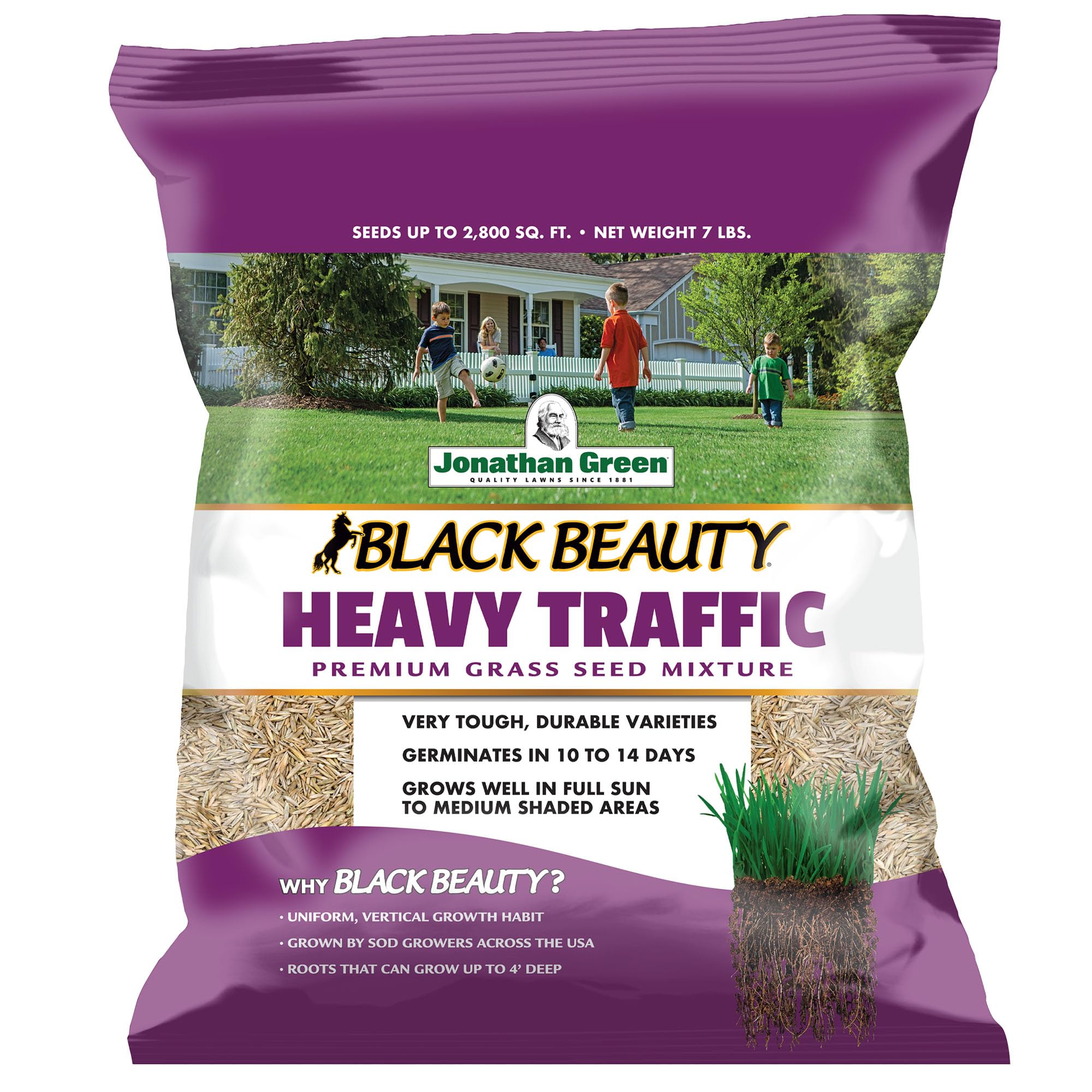
The seed that survives the dog, the kids, and the backyard soccer match
If your lawn takes a beating every day, this is the seed built around that. It is a cool-season mix of tall fescues and perennial rye, chosen for wear tolerance — Jonathan Green says the roots reach 4 feet deep, deep enough to hold turf together under constant foot traffic from athletes, children, and pets. Unlike the tackifier mix above, which is aimed at shade repair, this one is built for full sun to partial shade where activity is heaviest. A 7-pound bag seeds up to 1,750 sq. ft. for a new lawn, or up to 2,800 sq. ft. for overseeding — solid coverage for a busy yard. Germination time is listed at 10 to 14 days.
The texture detail matters here: this mix is chosen so soccer balls, footballs, and baseballs bounce true on a uniform surface, which tells you the lawn stays smooth rather than growing in clumps. For a yard that doubles as a playfield, that smoothness is the difference between a good field and a patchy one. It also produces a notably dark green color, and owners who overseed weedy or bare ground report it fills back in on those tough patches.
The standout in owner experience is how quickly and evenly it establishes. As buyers put it, “Grew very quickly, I was pleased with how quickly grass sprouted up and how evenly it grew.” On badly compacted or damaged slopes that a puppy has dug up, it re-establishes fast enough to reclaim the ground, and owners who mix it with topsoil before seeding report strong results even on hard ground.
The honest trade-offs: cost runs higher than the seed blends above, and it drinks water — germination can stretch toward three weeks in cooler conditions, so you cannot neglect it. One owner reported a mix of patchy growth and un-sprouted seeds after planting in sandy southern soil with no watering or tilling, which underlines the point: this seed rewards proper soil prep and a steady watering routine, and penalizes a lazy drop-and-go.
Why it wins on wear
- Roots reach 4 feet deep, anchoring the lawn against heavy foot traffic
- Uniform texture keeps balls bouncing true and the lawn looking even
- Covers up to 2,800 sq. ft. when overseeding
What it asks of you
- Higher cost than the other seed blends here
- Needs steady watering to germinate — growth can stretch toward three weeks and undoes itself without moisture
Best for: backyards, sports fields, and curb strips where pets, kids, and constant foot traffic grind a lawn down.
Not the one if: you want cheap, hands-off seeding — this mix costs more and leans hard on consistent watering to come in.
Know the Specs
Coverage: new lawn versus overseeding
Coverage is listed two ways because overseeding (spreading seed over an existing thin lawn) uses far less per square foot than seeding bare ground from scratch. So the same bag can stretch across a much larger area when you are just thickening what is already there, and a much smaller area when you are starting a lawn from nothing. Always check which number applies to your job — buying for the smaller figure on flat ground wastes seed, and buying for the larger one on a slope leaves gaps.
Tackifier and mulch mix
A tackifier is a sticky binding ingredient sprinkled through the seed blend so the seed clings to the soil surface instead of washing away — it does the same job as staking a physical mat on a slope or hill. The mulch within those blends doubles as a moisture blanket, holding water against the seed while it germinates, and it also lightens in color as it dries, which signals that it is time to water again. For shady, sloped, or rain-beaten patches, this pre-adhered-seed approach is the low-effort alternative to rolling out a blanket.
Common Questions
What is the difference between a grass seed mat and just spreading seed?
Will jute erosion control blanket really break down on its own?
How much seed does it take to cover a bare spot?
What temperature is best for planting grass seed?
How do I keep a straw erosion blanket from blowing away?
Does grass seed grow in full shade?
How long before grass seed actually sprouts?
Can I put a grass seed mat over existing weeds or grass?
Does the mulch in a seed mat mix need to be removed later?
How do I handle the smell from a natural jute blanket?
The Bottom Line
The best overall pick is the Scotts Turf Builder Sun & Shade Mix — it overseeds 2,240 sq. ft. with a seed, fertilizer, and soil-improver blend in one pass, making it the safest bet for the widest range of lawns. If your problem is a steep, eroding bank rather than a flat yard, the AK Trading jute blanket is the one — it is biodegradable, cuts to shape, and holds soil and seed through heavy rain. For a shady bare patch under a tree, the Pennington Smart Patch Dense Shade with its built-in tackifier is the pick that skips the staking. And if your lawn is a daily playfield, the Jonathan Green Black Beauty Heavy Traffic seed is the durable choice built to survive foot traffic. Whichever direction you go, the seed that germinates is the one you kept watered for the first week — that habit beats every product claim on this page.
How we choose
We do not accept paid placement. Every pick is matched to a real buyer and a real use-case; we do not hands-on test units.
Sources
Specifications: manufacturer listings and product documentation. Review insights: verified customer reviews, as of October 2026. Pricing: not shown on this page (it changes often); check the current price via the retailer link.
As an Amazon Associate, Aappliancez earns from qualifying purchases. This does not affect which products we feature.