Disclosure: Some links in this post are affiliate links. As an Amazon Associate I earn from qualifying purchases, at no extra cost to you. Learn more
Specs are compiled from manufacturer listings and verified buyer reviews and can change over time — please confirm the key details on the product page before buying.
You want the gravel path, the driveway seam, and the fence line to stop sprouting green — and you want it to stay that way. The short answer: a concentrate gives you the most control and the least wasted liquid, while a ready-to-use bottle wins when you only have a few spots to hit. Below are five sprays that actually kill to the root, sorted by what they are genuinely good at, so you can grab the right jug on the first trip.
This guide is built by comparing the manufacturers’ published specifications and the patterns across verified customer reviews, so you get each pick’s real strengths and trade-offs instead of marketing spin.
How fast you see brown grass depends on the formula you pick. A fast-browning spray and a slow root-killer behave nothing alike in the first week. Choosing well depends on matching the formula to your surface, your timeline, and whether you are protecting grass or erasing it.
This breakdown of the best grass killer spray covers mixing ratios, rainproof timing, and which bottles stay effective in cool weather.
Top Picks

How To Choose The Best Grass Killer Spray
Most people buy the wrong bottle for one simple reason: they buy for the spray, not for the surface. A lawn-safe selective spray and a total-vegetation killer look like siblings on the shelf and behave nothing alike. Decide whether you are killing everything green or only the weeds inside a lawn, then pick the jug.
Decide whether you are protecting grass or erasing it
A non-selective killer wipes out anything green it touches, so it belongs on gravel, driveway cracks, fence lines, and the base of mature trees — never on a lawn you want to keep. A lawn-safe selective spray is the opposite: it is built to knock down listed broadleaf weeds and crabgrass while the surrounding turf stays put. If you spray a non-selective product across a lawn, you are not spot-treating, you are renovating.
Concentrate or ready-to-use
A concentrate is a small bottle you dilute in a tank sprayer. You control the strength, which matters for tough perennial roots, and one quart can make several gallons of spray mix. A ready-to-use bottle is already mixed — screw on the wand, pull the trigger, done. Ready-to-use is the right call for a few dozen weeds, a patio edge, or a neighbor who will never own a sprayer. Concentrate is the right call for a long driveway, a fence run, or a gravel yard.
Match the spray window to the weather
Heat and sun help most of these formulas work faster, so a warm sunny morning is the best slot. Rainproof timing matters too: some bottles shrug off rain within minutes, others need a dry stretch. And check the low-temperature limit before you commit to a fall application — a formula rated for cool conditions keeps working when another one stalls.
Read the coverage number, not the bottle size
Bottle size tells you how much liquid you carry, not how many square feet it treats. Coverage tells you how much ground a bottle treats when mixed as directed. A compact concentrate can cover more square footage than a large ready-to-use jug because you are adding water at the job site. Compare the treated area figure and the mixing instructions side by side before you assume the bigger jug is the better deal.
Side-by-Side Comparison
| Model | Best For | Form | Liquid Volume | Stated Coverage | Amazon |
|---|---|---|---|---|---|
| Control Solutions Eraser & Grass Killer Concentrate★ Best Overall | Driveways, fence lines, and heavy brush | Concentrate | 32 fluid ounces | — | Amazon |
| Roundup Weed and Grass Killer III Trigger SprayBest for Visibility | Seeing exactly where you sprayed | Ready-to-use | 30 fluid ounces | 3000 sq. ft. | Amazon |
| Spectracide Weed and Grass Killer Concentrate | Fast results across a large paved area | Concentrate | 32 fluid ounces | 1,350 sq ft | Amazon |
| Bonide Captain Jack’s Deadweed Brew | Organic gardens and around food crops | Ready-to-use | 128 fluid ounces | — | Amazon |
| Ortho WeedClear Lawn Weed Killer Refill | Spot-treating weeds inside a lawn | Ready-to-use refill | 1.33 gallons | 5000 square feet | Amazon |
Detailed Reviews
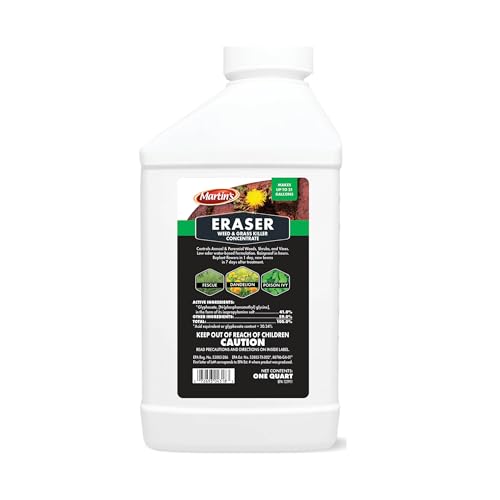
1. Control Solutions 82004318 Eraser & Grass Killer Concentrate
Our pick — 4.5+★ from 700+ verified ratings; the strongest balance of quality and price.
One quart that mixes into gallons — and wipes out brush your string trimmer only wounds.
If you need a gravel driveway, a fence line, or a patch of poison ivy gone for good, this is the bottle to buy. The active ingredient is glyphosate at 41%, a systemic herbicide — meaning it travels down through the plant into the root instead of just scorching the leaves. That is why the top of the plant dies and does not come back from the same crown. It also leaves no residual soil activity, so the ground is not locked out for replanting afterward.
Patience is the price of the root kill. Expect nothing for two days, yellowing around four to seven days, and full death somewhere between seven and fourteen days. That is a totally normal timeline for a systemic product, and it is where most one-star reviews of this type of spray come from — buyers comparing it to a fast leaf-burner. Mix it in a tank sprayer, add a surfactant (a soap-like helper that makes the liquid cling to waxy leaves), and spray on a warm sunny morning. Rainproof in hours means you do not have to sprint indoors if the sky turns.
What wins people over is the effectiveness, and it is not subtle — as buyers put it, “Kills everything you spray with it just like it advertises.” Wild brush, vines, grass, and clover all go down. One note: check the mixing strength before you pour, because one owner found the printed instructions less clear than they would like and settled on a working ratio by trial. Measure carefully at the tank and you are fine.
What earns its keep
- 41% glyphosate travels to the root, so treated brush does not regrow from the same crown
- No residual soil activity — the ground is free for replanting once the weeds are gone
- 32 fluid ounces of concentrate stretches to several gallons of spray mix in a tank sprayer
- Rainproof in hours, so a passing shower will not undo the job
What to plan around
- Slow by design — seven to fourteen days to full death, not an afternoon
- Non-selective, so any green plant it touches is a casualty
- The printed mixing instructions leave a little to be worked out
The one to carry home: Buy this if you want permanent removal on hard surfaces and woody growth, and you can give it two weeks.
Leave it on the shelf: Not for you if you want visible browning before dinner — grab a fast-acting bottle instead.
2. Roundup 5003410 Weed and Grass Killer III Trigger Spray
The foam is the whole trick — you see every weed you hit, and nothing gets double-dosed.
You get the shortest rain window in this lineup: just ten minutes of dry time before rain stops mattering. The Spectracide bottle below asks for fifteen minutes, and the Control Solutions concentrate runs to hours. For a driveway crack on a muggy afternoon, that ten-minute window is real confidence.
The foaming technology is what separates it from every other trigger spray here. It lands as a visible white foam instead of an invisible mist, so you can see exactly which leaves are coated and which are still dry. Around shrubs and slab edges, where overspray is the enemy, that visibility saves plants. Results show up in about six hours, and the bottle claims it kills to the root. The 30-ounce trigger bottle is a self-contained unit — no tank, no measuring, no mixing cup.
Two honest notes. The coverage figure of 3,000 sq. ft. is a big claim for a 30-ounce bottle, so plan on spot work rather than a full-lot treatment. And the trigger mechanism is the most-discussed topic on this listing, drawing a split reaction — the spray works, but it is the part buyers have the most to say about, so store the bottle upright and rinse the nozzle after use.
Precision over volume: The foam marker turns this into a spot-treatment tool, and the 10-minute rainproof window means weather rarely ruins an application.
The trade-off: 30 fluid ounces goes fast if you treat broadly, and the trigger is the piece to treat gently.
Reach for this: Anyone spraying along fences, rocks, or flower-bed margins who needs to see the hit.
Pass if: You have a long gravel run — a concentrate will carry you further.
3. Spectracide Weed and Grass Killer Concentrate 32 Oz
Three hours to visible browning, and 1,350 square feet out of a single quart.
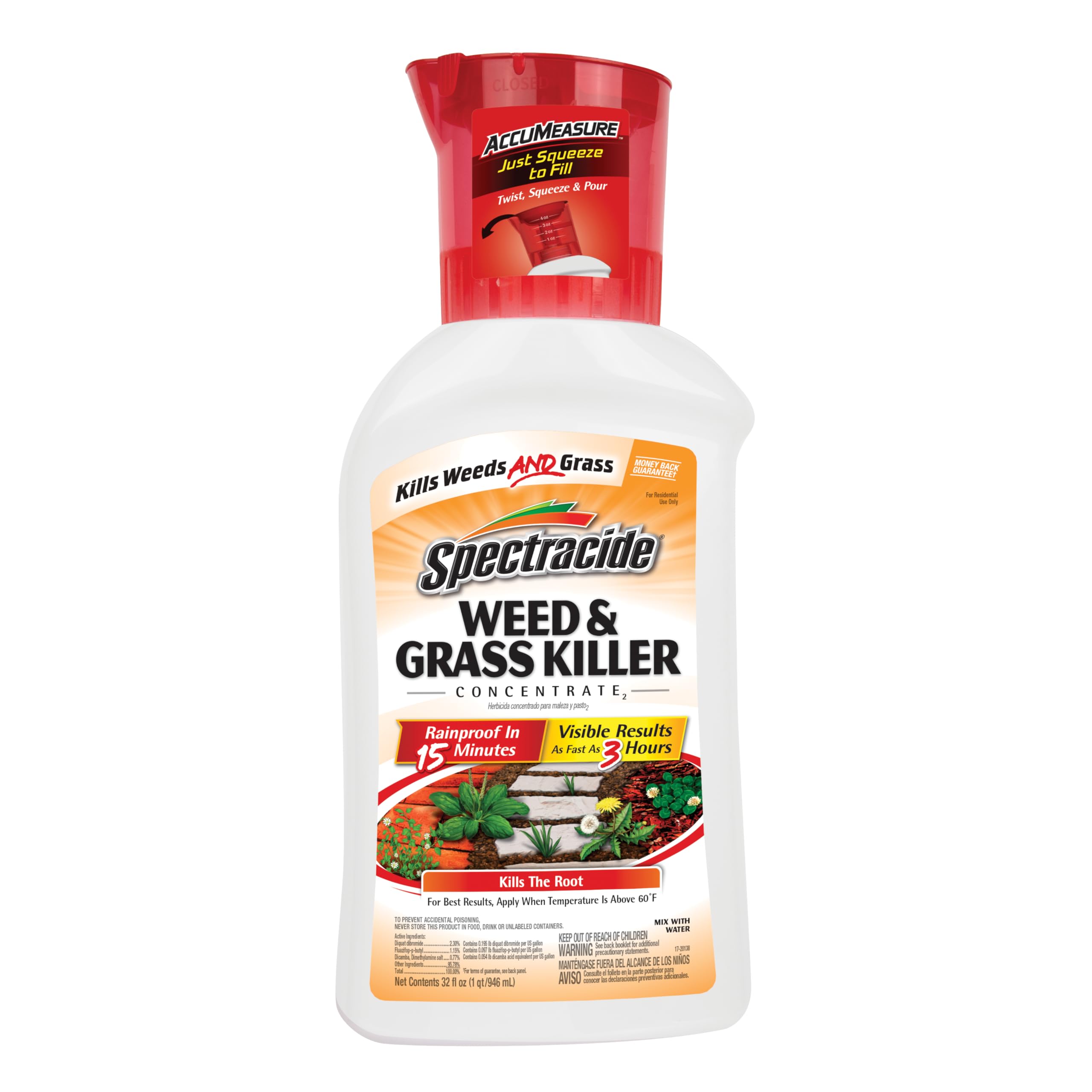
If speed is what you are after, start here. Visible results land in as little as three hours, which beats the six-hour claim on the Roundup trigger bottle and runs laps around the seven-to-fourteen-day timeline of a slow systemic. It kills down to the root, so the browning is not cosmetic. Rainfast in 15 minutes means a light shower a quarter-hour after you finish will not wash the job away.
The Accumeasure cap is the feature you will either love or shrug at. It lets you twist, squeeze, and pour a measured dose without hunting for a cup, which keeps the mix consistent and your hands cleaner. The reaction is genuinely split — some buyers find it clever, others would rather just measure. Since it is a concentrate, you still need a tank sprayer, and buyers report it works with whatever sprayer you already own.
Where this earns its place is coverage for the money. At 1,350 sq ft from a 32-fluid-ounce bottle, it treats a driveway, a walkway, and a fence run before you need another jug. One caveat worth knowing up front: a few units arrive with a leak, so check the seal on delivery and store it upright. And one buyer’s honest note — “Kills them dead, could really do without the auto dispenser feature” — tells you the cap is a preference, not a requirement.
The case for the bottle
- Visible browning in as fast as 3 hours — the quickest claim in this lineup
- 1,350 sq ft of treated ground from a 32-fluid-ounce concentrate
- Rainfast in 15 minutes, so a quick shower will not undo it
- Works with the tank sprayer you already own
Where it asks for care
- Check the seal — leakage is a known possibility on arrival
- The Accumeasure cap divides opinion; some would rather measure by hand
- Still requires mixing and a sprayer, unlike a ready-to-use bottle
Built for: Large paved areas where you want to see the kill the same afternoon.
Think twice if: You want zero setup — this one needs a tank and a mix.
4. Bonide Captain Jack’s Deadweed Brew 128 oz

Approved for Organic GardeningWorks Down to 40°F
The gallon that works in 40-degree weather and still lets you eat from the beds beside it.
Bonide sells this as a non-selective spray approved for organic gardening, ready to use straight from the jug with no mixing. At 128 fluid ounces it is the largest bottle here, four times the 32 fluid ounces in the Control Solutions concentrate and four times the 2-pound shipping weight of that same quart. You are paying for a gallon of pre-mixed spray plus a hand pump nozzle already attached.
The standout spec is the temperature floor. It keeps working down to 40 degrees Fahrenheit, which matters for fall and early-spring cleanup when other formulas slow to a crawl. A review from zone 7b described it beating plain vinegar outright while the crops nearby stayed alive. It dries waterproof after application, so a hose-down later in the day does not cancel the kill. Owners mention weeds dying within an hour of spraying, with the full gallon used across gravel paths between raised beds.
Two things temper the enthusiasm. First, the hand pump nozzle is fine for spot work but awkward over a big area — pouring it into a larger wand sprayer is the smoother route, and one owner’s second bottle had its sprayer give out midway. Second, the nozzle setting matters: a wide spray wastes product, so keep it narrow. Keep the bottle upright once opened, too, because the top can weep.
Cold-weather advantage: The 40°F working floor and the organic-gardening approval are the two facts that set this gallon apart from everything else here.
Honest limitation: Non-selective — it cannot tell a weed from a prized seedling, so aim with care and keep the nozzle on narrow.
Suits you if: You garden organically and want a ready-to-spray gallon that still works in cool weather.
Skip when: Large acreage is the job — the pump nozzle is built for smaller targets.
5. Ortho WeedClear Lawn Weed Killer Refill

The refill for lawn owners who want the dandelions gone but the turf very much alive.
This is the only spray in the lineup built to protect grass rather than erase it. It targets listed weeds — crabgrass, dandelion, clover, chickweed, and creeping charlie — down to the root while the surrounding turf stays green. That selectivity is the whole reason it exists, and it is why you should not use it on a gravel path where you want everything gone dead.
The coverage figure is the biggest here. At 1.33 gallons it treats 5,000 square feet, and in fluid terms that is 166.4 fluid ounces against the 128 fluid ounces of the Bonide gallon. It arrives as a refill, so you screw it into the Comfort Wand from your original Ortho container instead of buying a whole new sprayer each season. It is also the only bottle here that spells out a temperature window: spray when it is between 45°F and 90°F, on young, actively growing weeds, in spring or fall.
Now the honest part. This one is a slower, more variable performer than the rest — some lawns see full die-off in a few weeks, others see stubborn survivors after a single pass, and one frustrated buyer reported the whole yard still unchanged 34 days later. That variance is real, and it is the trade-off for a spray gentle enough not to torch your grass. A second application is often the answer, and patience over a few weeks is the realistic expectation.
Why lawn owners pick it
- Selective — kills listed broadleaf weeds and crabgrass while the lawn stays put
- 5,000 square feet of coverage, the largest treated area in this lineup
- Refill format reuses your existing Comfort Wand instead of a new sprayer
- Clear temperature guidance: spray between 45°F and 90°F
What to expect
- Results vary from lawn to lawn, and a second pass is often needed
- Only for listed lawn weeds — not a hard-surface killer
- Slower to show full die-off than a fast-acting concentrate
Pick it when: Your weeds are inside a lawn you care about, and you can give it weeks rather than hours.
Look elsewhere if: The job is a driveway or gravel — you want a non-selective product for that.
Know the Specs
Concentrate vs Ready-to-Use
A concentrate is a small bottle of active ingredient you dilute in water inside a tank sprayer. You decide the strength — useful for tough perennial roots — and one bottle stretches across multiple tanks. A ready-to-use bottle is already mixed, so you just point and spray. Concentrates reward the buyer who owns a sprayer; ready-to-use rewards the buyer who wants zero setup.
Rainproof and Rainfast Timing
This is the number of minutes (or hours) a spray needs to stay dry before rain stops mattering. Short windows — ten to fifteen minutes — let you spray on a day with a chance of showers. Longer ones mean you should watch the forecast and pick a dry morning. Either way, applying on a sunny day helps the formula get into the leaf.
Systemic vs Contact Kill
A systemic herbicide travels through the plant into the root, so the plant does not return from the same crown — that is why it takes days. A contact product burns the leaves fast but may leave the root alive. If you see browning in hours, you likely have a fast contact effect; if you see full die-off in a week or two, the root went too.
Stated Coverage in Square Feet
Coverage tells you how much ground a bottle treats when mixed as directed, which is more useful than bottle size. A quart of concentrate can out-cover a larger ready-to-use jug because you add the water yourself. Compare the square-foot figure to the area you actually need to treat before assuming the bigger jug is the better value.
Common Questions
Will a grass killer spray also kill my lawn if I overspray?
How long before I see dead grass after spraying?
Does rain wash off the spray before it works?
What temperature is too cold to spray grass killer?
Is a concentrate cheaper than a ready-to-use bottle?
Can I use these sprays around vegetables and food crops?
Do I need a tank sprayer to use a concentrate?
Why did my spray do nothing at all after a full week?
Is it safe to replant flowers after killing grass with these sprays?
Can these sprays hurt pets or kids in the yard?
The Bottom Line
For most jobs, the grass killer spray that delivers the best balance is the Control Solutions Eraser & Grass Killer Concentrate. It carries 41% glyphosate, kills to the root, leaves no residual soil activity for replanting, and turns one quart into several gallons of mix — the most permanent result per dollar for driveways, fences, and brush. If visibility on the job site is what you are missing, the Roundup Trigger Spray lets you see every leaf you hit. And if the weeds are growing inside a lawn you want to keep, the Ortho WeedClear Refill is the one to reach for — just give it weeks, not hours. Match the bottle to your surface — gravel, lawn, or garden bed — and you will only make one trip.
How we choose
We do not accept paid placement. Every pick is matched to a real buyer and a real use-case; we do not hands-on test units.
Sources
Specifications: manufacturer listings and product documentation. Review insights: verified customer reviews, as of October 2026. Pricing: not shown on this page (it changes often); check the current price via the retailer link.
As an Amazon Associate, Aappliancez earns from qualifying purchases. This does not affect which products we feature.