Disclosure: Some links in this post are affiliate links. As an Amazon Associate I earn from qualifying purchases, at no extra cost to you. Learn more
Specs are compiled from manufacturer listings and verified buyer reviews and can change over time — please confirm the key details on the product page before buying.
You want your dog safe in the yard without a monthly bill attached to the collar. That is the whole promise of a no-subscription GPS fence — you buy the hardware once and it keeps working. The catch is that “no subscription” systems split into two very different jobs: some build an invisible fence around your property, and some hand you a tracker that follows your dog across a field. Pick the wrong type and you will be disappointed, no matter how good the collar is. This guide separates the two, explains the specs that actually matter, and matches each collar to a yard size, a dog, and a daily routine.
This guide is built by comparing the manufacturers’ published specifications and the patterns across verified customer reviews, so you get each pick’s real strengths and trade-offs instead of marketing spin.
Some collars here contain a dog inside your yard; others find a dog that already bolted. Decide which job you need first, then compare the eight no-subscription collars below.
Top Picks

How To Choose A GPS Dog Collar Without Subscription
The first decision is not brand or budget — it is job. A containment fence keeps a dog inside a boundary you draw. A tracker tells you where a dog already is. Some products do one; a few do both. A collar that only tracks will never stop your dog from bolting toward a deer, and a collar that only contains will not help you find a dog that already jumped the line. Decide which problem you are solving before you look at a single spec.
Containment versus tracking — pick your problem
Containment collars work by pairing the collar to a boundary: either a radius you set from a center point, or a shape you draw on a map. When your dog nears that line, the collar warns with a tone or vibration, then corrects if the dog keeps going. Once the fence is built, the collar enforces the boundary on its own with no phone in hand. Trackers, by contrast, follow a moving dot. They show you direction and distance so you can walk or drive to your dog. If your dog has a reliable yard and stays home, you want containment. If your dog ranges over open land and sometimes disappears, you want tracking.
The radius and boundary spec that actually limits you
Look hard at the boundary range, because it decides what kind of property the collar suits. Radius-based systems let you set a circle from a center point, and that circle’s maximum distance is the real limit. Shape-drawing systems let you outline an irregular yard, add no-go zones, and match the actual shape of your land. A large property with an odd footprint needs a drawable boundary. A simple square yard is fine with a radius. Also check the minimum: some systems are only designed for properties of a certain size, and a tiny yard can fall below the minimum and produce false warnings.
Correction levels, warning zones, and your dog’s temperament
The best systems layer the warning: a tone or vibration first, then a static correction only if the dog keeps moving outward. The number of adjustable correction levels matters less than whether the collar lets you start gentle. A stubborn dog may need more; a soft dog may never need static at all. A warning zone — the buffer that triggers before the actual boundary — gives your dog time to turn around. Wider warning zones are safer but can produce more false triggers if GPS drifts.
Battery life and what a charge cycle costs you
Battery is the spec buyers underestimate. A collar rated for a full day means you charge it nightly; a collar rated for several days means less nightly routine. Neither is wrong, but be honest about whether you will remember to plug it in. A dead collar on a boundary-trained dog means no warning tone and no correction at the line.
Waterproofing and collar fit
An IP rating tells you how well the collar survives water. IP67 means it handles being dunked; IPX7 and IPX9K mean it handles water at higher pressure or full submersion. If your dog swims, wades creeks, or rolls in wet grass daily, this matters. Fit matters just as much — measure your dog’s neck and check the collar’s stated range. A collar that slides on a thick-coated dog can miss the warning zone entirely, no matter how good the GPS is.
Side-by-Side Comparison
| Model | Best For | Type | Boundary / Range | Waterproof Rating | Amazon |
|---|---|---|---|---|---|
| FOCUSER GPS Wireless Dog Fence★ Best Overall | Big yards, multi-dog homes | Containment fence | Radius 10 m to 990 m | IP67 | Amazon |
| DJNFGQ GPS Wireless Dog FenceBest for Odd-Shaped Yards | Drawable fences on odd-shaped land | Containment fence | Radius 49 ft to 6561 ft | IPX7 | Amazon |
| JDXSZ Wireless GPS Fence CollarBest App Control | App users, up to 3 dogs | Containment fence | Radius 65 ft to 3280 ft | IPX7 | Amazon |
| Dogtra GPS Fence GF10UC | Larger properties, up to 30 fences | Containment fence | Circular or custom shapes | IPX9K | Amazon |
| Aorkuler GPS Dog Tracker 2 | Hiking and remote, no signal | Live tracker | Up to 3.5 miles | Waterproof | Amazon |
| PetSafe Guardian GPS Fence | App-guided setup on 3/4 acre+ | Containment fence | 3/4 acre and up | Waterproof | Amazon |
| Dogtra Pathfinder 2 Mini | Tracking plus training, 4 miles | Live tracker + e-collar | Up to 4 miles | Waterproof | Amazon |
| SpotOn Omni GPS Fence | Wooded acreage, precision boundaries | Containment fence | 1/2 acre to 100k+ acres | IP67 | Amazon |
Detailed Reviews
1. FOCUSER GPS Wireless Dog Fence System
Our pick — 4.5+★ from 80+ verified ratings; the strongest balance of quality and price.
The collar that turns a ten-meter circle into a half-mile yard, with no fees attached.
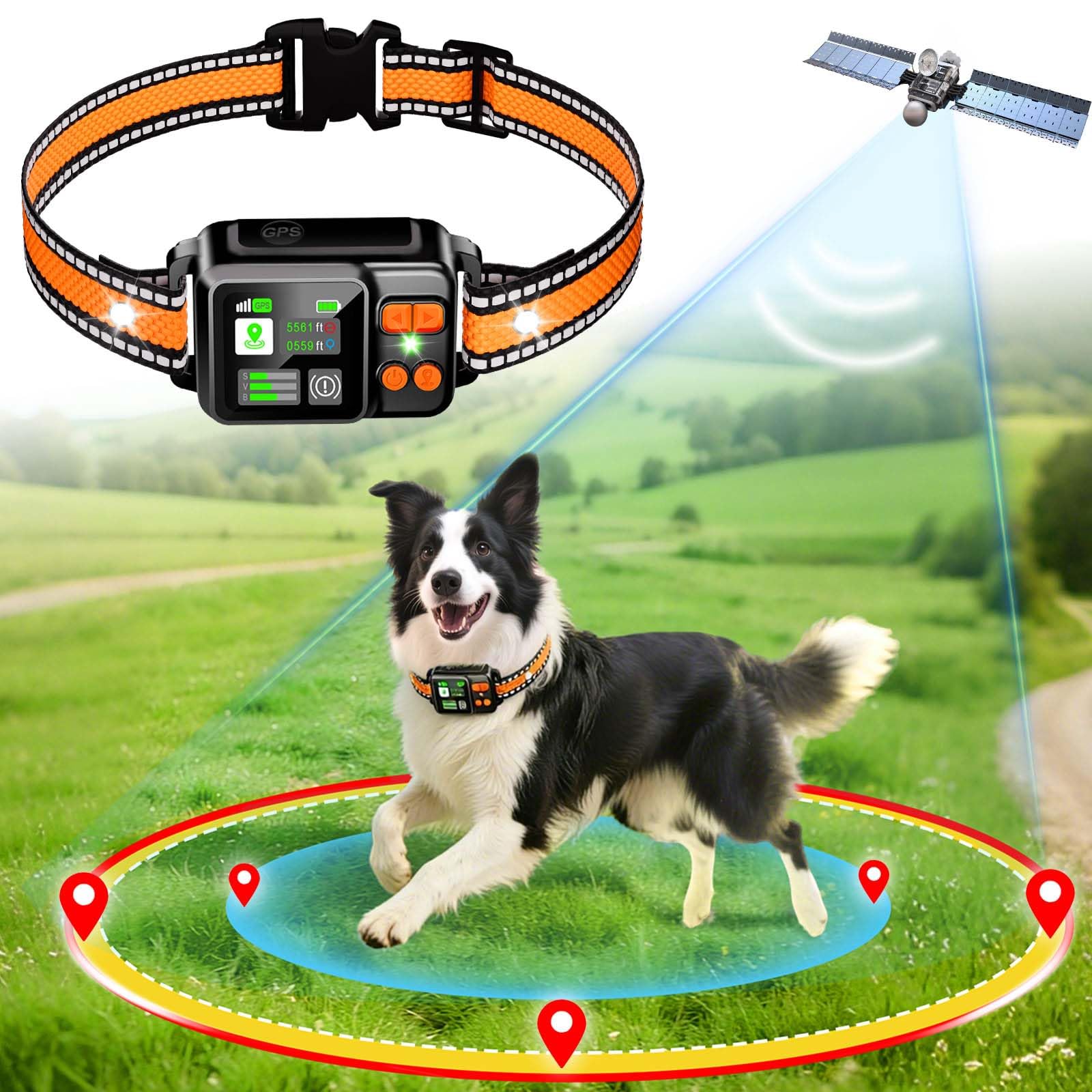
You can fence a small lawn or a wide-open field with one collar, because the boundary radius adjusts from 10 meters to 990 meters. That range runs from a patch of grass to serious open ground, and you fine-tune it with 99 adjustable levels to match your actual yard. A dog on a small lot gets a small circle; a dog on a farm field gets a big one. Underneath it all: no monthly fee, no SIM card, and no subscription — the whole reason you are shopping in this category. You buy the collar once and the boundary is yours to keep.
You get a well-built receiver that is quick to set up, and that is what wins people over here. Well over two dozen buyers single out the quality of the hardware in the review pages, and buyers report it running in about 45 minutes. One system handles up to 10 dogs, which is unusual at this level — ten dogs versus the three-dog limit on the JDXSZ model further down, a gap that matters if you run a pack. Necks from 7 to 26.5 inches fit, so one receiver spans extra-large down to small breeds.
Your dog can wade through wet grass, take the sprinkler full in the face, and play in the rain without the electronics giving up, thanks to an IP67 rating (a waterproofing grade that survives brief dunking). Training is where owners mention the biggest relief. One family that lost a previous dog to a truck had a stubborn husky respecting the boundary in three days after only two correction events, and the owner tested the correction on themselves first — buyers describe the sensation as comparable to carpet static. Another owner of three 140-pound livestock guardian dogs reported the collars stayed in perfect condition through a month of rough play. The signal also pushed through thick historic home walls where an earlier system had failed, holding around 400 feet from the house.
Where the value piles up
- Radius spans 10 m to 990 m with 99 adjustable levels — one system works for a small lot or a large field
- Up to 10 dogs on a single system, well beyond most budget-tier fences
- No monthly fee, no SIM, no subscription — the boundary is yours permanently
- IP67 collar survives sprinklers, rain, and wet grass without complaint
What to plan around
- Setup runs closer to 45 minutes than five — budget an afternoon, not a coffee break
- It is a containment fence, not a live tracker; you cannot see your dog’s dot on a map
- Owners with very large properties should measure their yard against the 990-meter ceiling first
Reach for this if: you have a real yard, more than one dog, and you want a boundary that keeps working without a monthly bill.
Look elsewhere if: you need to watch your dog’s location on a phone screen — this one contains a dog, it does not track one.
2. DJNFGQ GPS Wireless Dog Fence System
Two fence modes for yards that were never going to fit a tidy circle.
Most radius fences force your yard into a circle. This one gives you a second option: a free-form polygonal fence where you set multiple vertices (corner points) and trace the real shape of your land, corner by corner, so the boundary hugs your actual property instead of cutting through it. Want the fast route? Circular mode is still there — pick a center point and a radius anywhere between 49 ft and 6561 ft, and the fence generates within 3 seconds. That dual-mode flexibility is why it belongs on this list.
Daily use is where the battery story reads well. A full charge takes about 3 hours and the collar runs 24 hours on that charge — one owner stretched that into roughly a week at 4 to 6 hours a day. An IPX7 rating (a waterproofing grade for short immersion) means it shrugs off rain and standing water. Build quality earns the loudest praise in the feedback, with ease of use and value right behind it — this collar feels better made than its price tier suggests. A dog on eight unfenced acres learned the boundary in a single day using only beep and vibration.
Now the honest part, because this collar’s feedback splits. GPS timing is the recurring gripe: corrections can lag your dog’s actual position, and one owner measured the delay as the dog passing roughly 30 feet beyond the boundary before the correction landed. Satellite signals also wobble under trees, under a deck, and in storms, which can trigger a warning while the dog is well inside the line. A few owners solved the small-property version of this by setting the GPS points 5 to 10 feet outside their true property lines so the buffer absorbs the drift. As the review pages sum it up: “Collar works, but most of the time it seems to be a delay in dog collar recognizing when in/out boundary.”
Fit check: a strong pick if your yard is an awkward shape and your dog responds to beep and vibration alone — many owners never touch the static setting.
Where it strains: dogs that bolt fast will outrun the update speed, and heavily wooded or deck-covered lots will produce more false warnings than open ground. It is built for outdoor use only.
Worth it when: your property lines are irregular and you want to trace them precisely without buried wire.
Think twice when: your dog is a sprinter or your yard sits under heavy tree canopy — GPS lag is this collar’s known weak spot.
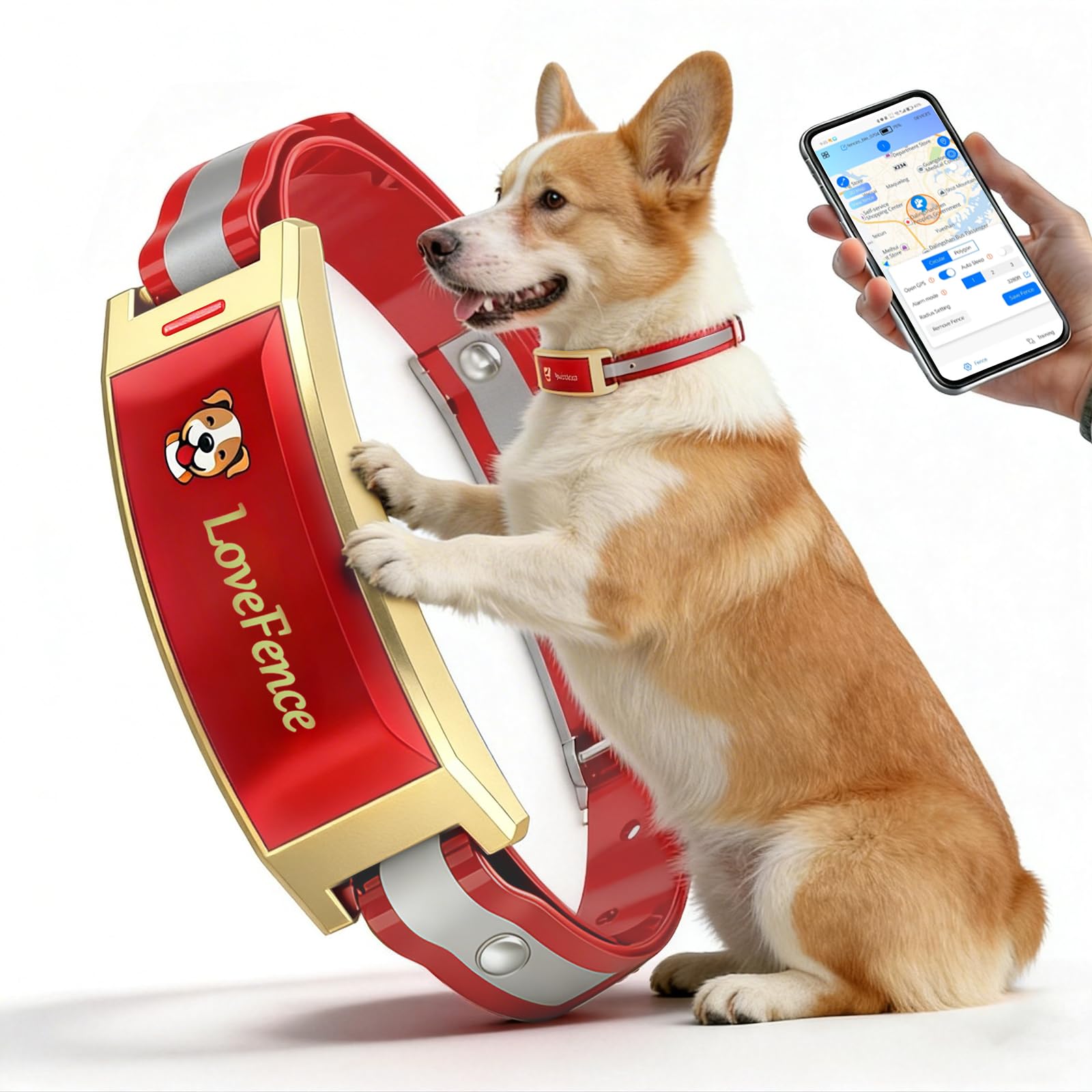
3. JDXSZ Wireless Electric GPS Dog Collar Fence
Draw your fence on a real map, then let the collar do the guarding.
This is the pick for the owner who wants to see the fence. The app is built on real Google Maps, so you draw circular, rectangular, or polygonal zones — up to a hexagon — right on a satellite view of your own property. You can create up to 3 custom invisible fences and manage up to 3 dogs on one account, and the boundary radius runs from 65 to 3280 feet in precise 1-foot increments. That fine-tuning matters when your yard boundary has to stop half a foot short of a neighbor’s fence.
Three training modes give you real range in how you teach the line: sound, vibration, and static, with vibration and static each adjustable across 1 to 5 intensity levels. A progressive warning ramps the vibration up as your dog closes on the boundary, which gives a soft dog plenty of warning before anything stronger happens. Battery runs up to 48 hours of continuous use per charge, with an auto-sleep/wake mode that kicks in after 2 minutes of stillness to save power. It fits dogs over 3 months old on an adjustable silicone collar ranging 8 to 22 inches, and the IPX7 rating covers rain, mud, and swimming. The free app stays free for life — no monthly charge, ever.
Know this before you buy: the reviews on this listing are muddled, and several describe a plain nylon or neon collar rather than the GPS unit itself, so buyer sentiment here is thinner than the numbers suggest. The clear GPS-specific feedback points at the app — the boundary works, but adjusting a fence means deleting and redrawing it rather than dragging a marker, and the beeping can lag your dog’s actual crossing by 10 to 20 feet. Owners also note the collar unit cannot be switched off while mounted, so you remove it to power down.
Pick this if: you like working from a phone map and want the finest boundary control with a free-forever app.
Pass if: you want set-and-forget simplicity — the app-first workflow and redraw-to-adjust design will feel fiddly.
4. Dogtra GPS Fence GF10UC

Thirty fences, no wires, and a waterproof rating that laughs at a lake.
Support for up to 30 unique fences is the standout spec here, and it reframes what a no-subscription collar can do. You can build layered protection around your property — a warning zone, a primary fence, and two backup fences — and then add more custom shapes for trails, barns, or fields, all from the free app. The app is only needed during setup. Once the fence exists, the collar works alone, with no phone and no WiFi connection required. That independence is the reason to choose it over a fence that needs your phone nearby to run.
The IPX9K rating is the highest water protection on this list — it means the collar handles high-pressure water, so a dog that swims and shakes off in the rain is not a concern. It fits dogs 15 lbs and up on necks from 10 to 30 inches with a 3/4-inch strap, and up to 3 dogs can share one fence profile. The come-home sequence is the thoughtful touch: correction disables when your dog is heading back toward home, and a continuous beeping tone guides them in. Customers note the setup is genuinely quick — the app handles the map work in minutes, and the collar then runs on its own.
Battery is the honest trade-off you should hear. Owners describe the charge lasting somewhere around a day, which means a nightly charging routine, and a few mention the traditional buckle being stiff and awkward on an excited dog. The minimum warning zone is 15 feet, so a tiny yard is not this collar’s home. It is designed for properties 3/4 acre and larger, and the collar comes off when the dog is indoors. A couple of owners also note the weighted GPS box can shift on a slender-necked dog, so fit it snug before you trust the boundary.
The case for it: the 30-fence limit and app-free operation make this the most flexible containment system here for a large or multi-building property.
What it asks of you: a nightly charge and a snug, secure fit — a collar that slides will miss its warning zone.
Best matched to: owners on acreage who want many separate zones and a collar that works with the phone left in the house.
Not for: small lots under 3/4 acre, or anyone who wants to skip a daily charging habit.
5. Aorkuler GPS Dog Tracker
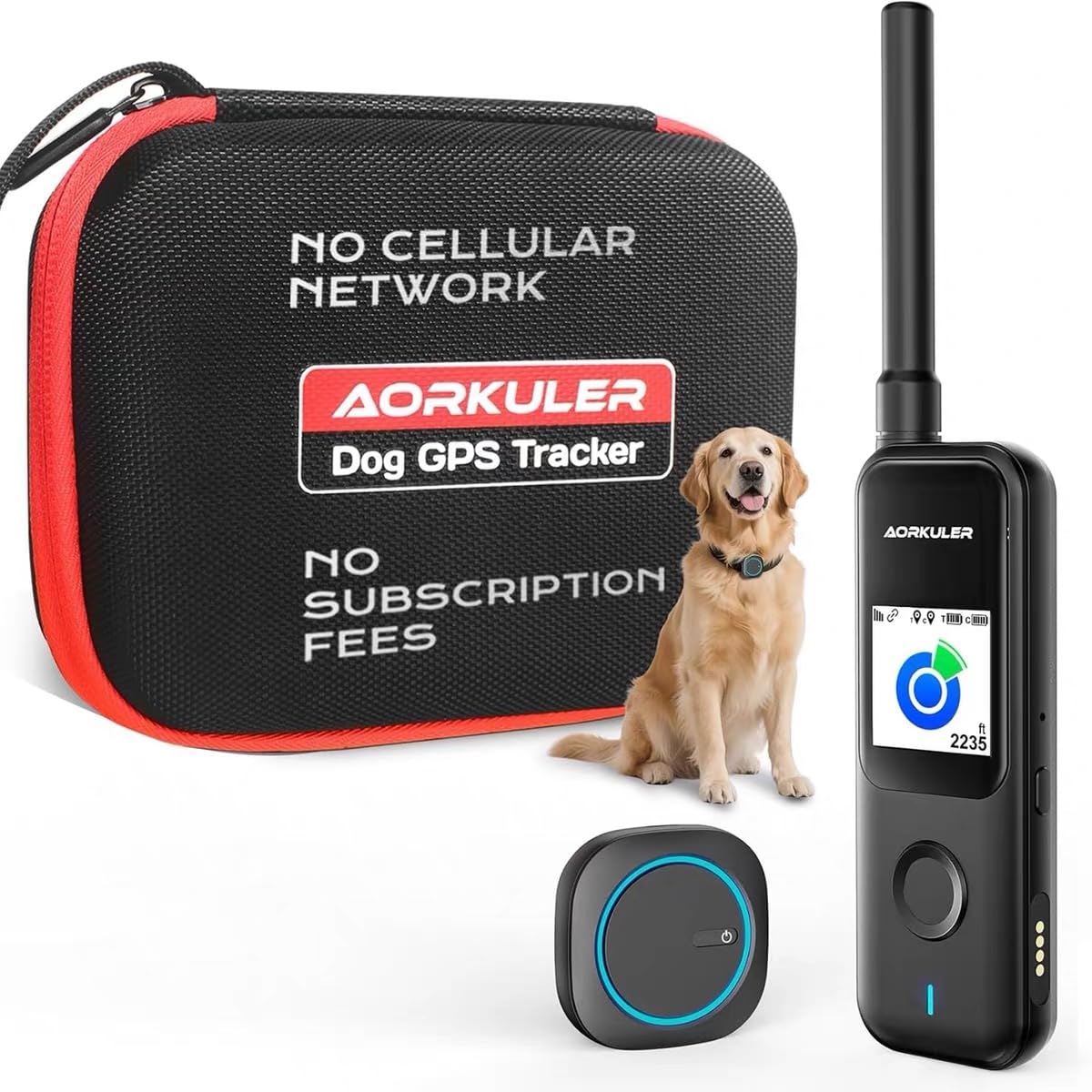
No phone, no towers, no app — just a green arrow pointing at your dog.
This is not a fence. Read that twice, because buying it expecting containment is the most common way people end up unhappy. The Aorkuler is a live tracker with a handheld controller: you point, the green arrow shows direction, and the screen shows distance, updating every 3 seconds out to 3.5 miles in open spaces. It works entirely by GPS, with no WiFi, no cellular, and no monthly fee — so a dead zone in the mountains is irrelevant. With a clear view of the sky, the controller keeps a fix on your dog out to 3.5 miles.
Your dog can wear this all day on a harness because the tracker weighs just 1.08 oz. It recharges in 2 to 3 hours for up to 24 hours of nonstop tracking, or 10+ days of battery on 1 to 2 hour daily walks. Reliability and functionality are what owners rave about most — 25 owners specifically flag reliability as their reason for trusting it. It has pulled dogs out of thick woods where a cell-based collar lost signal entirely, and one rescue dog that hopped fences was tracked to 800 feet in semi-wooded terrain. Setup is simple enough that people describe it as turn-on-and-go.
Here is the caveat worth your attention, and it is about range. The 3.5-mile figure is an open-sky best case. Under obstructions, reviewers point out practical range falling off sharply, so this tracker is at its best on open farmland, trails, and big fields rather than dense suburbia. Updates can also lag by a couple of minutes, which tells you direction rather than an exact instant position, and there is no automatic alert when your dog wanders off — you have to check the screen. For open-country hikers and rural owners working fields and trails, the 3.5-mile open-sky range is what gets a dog back.
Why owners trust it
- Works with zero cell signal and zero app — ideal for remote land and dead zones
- Green-arrow direction plus distance is instantly readable, no learning curve
- 1.08 oz tracker is light enough to wear all day on a harness
- 2 to 3 hour recharge, up to 24 hours of tracking per charge
Read before you buy
- It tracks but does not contain — it will not stop your dog from leaving
- Real-world range under trees and buildings falls well short of the open-sky figure
- No leave-the-area alert; you must watch the screen to catch a wandering dog
The right tool for: hikers, rural owners, and anyone whose dog roams where cell service does not reach.
Wrong tool for: keeping a dog inside a yard — pair this with a containment collar if you need both jobs done.
6. PetSafe Guardian GPS Dog Fence, 3/4 Acre+
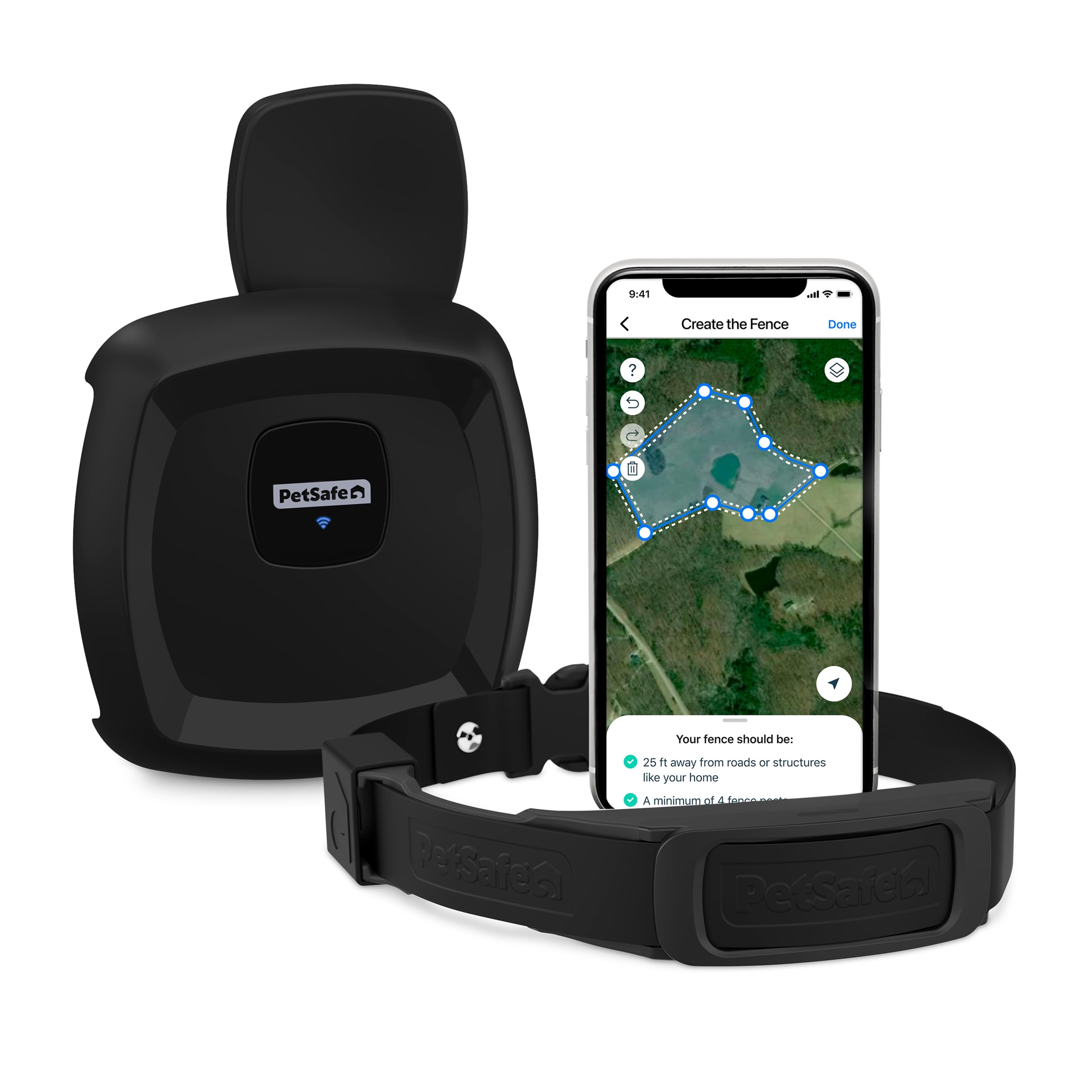
The most patient battery here, tuned for dogs that would rather stay out all day.
Up to 5 days of battery life on a single charge is the reason this collar earns a spot, and it is a meaningful jump from the nightly-charge routine that most fences in this category demand. The Guardian pairs GPS satellite data with real-time motion detection and AI to smooth out the boundary, and you set the whole fence up from the couch through the My PetSafe app. That app also monitors battery level, adjusts collar settings, and pushes notifications, so you are not guessing whether the collar is live.
Correction is gentle if you want it to be. You choose between tone and vibration, or step up through 10 levels of static, so a soft dog can live on tone alone. The collar fits dogs over 25 pounds with neck sizes from 13 to 28 inches, and the updated design is slimmer and lighter than the wired-fence collars it replaces. One owner who upgraded from a buried-wire PetSafe system had the new fence running in 15 to 20 minutes, with the firmware update taking the longest.
Where the feedback turns, it turns on the app and the collar strap. The app is the recurring irritation — clunky boundary drawing, a battery bar with no percentage, and occasional sync trouble — and a couple of owners note the collar material loosening over time. It is also an app-mandatory system, which is worth knowing if you live where WiFi is patchy. Size this one for your dog’s temperament: it is built for dogs that will respect a boundary once trained, not for a hard-charging escape artist.
Choose it for: the multi-day battery and couch-side setup on a yard of 3/4 acre or more.
Look past it if: you want a polished app experience or you have a dog that tests fences hard.
7. Dogtra Pathfinder 2 Mini GPS Dog Tracker

Four miles of live tracking with a training collar built into the same system.
If you hunt, run hounds, or work a dog over open country, range is everything — and this system tracks up to 21 dogs within a 4-mile range in real time. It pairs a GPS collar with a Dogtra Pathfinder2 connector, and you can issue e-collar corrections either from the connector or from the free app on your smartphone or smartwatch. The smartwatch support (Apple Watch Series 5 and Galaxy Watch4 Series and above) puts the compass, map, and collar commands on your wrist, which matters when your hands are full.
The receiver is 22% smaller than the original Pathfinder2, sized for dogs 25 lbs and up, so it fits a smaller dog without being a brick on the neck. Maps are free through Mapbox, with general, satellite, and terrain views, and offline maps let you download an area before you lose signal — a real advantage on a mountainside. Accuracy is what earns this collar its reputation; 50 owners specifically flag accuracy as its strength. Correction modes run from nick and constant to an audible tone, plus a new LED locate light and pager vibration, and a lost-collar locator protects the hardware.
The strap-side downside is minor but real: the long antenna flops around, and a few owners find it needs taming when the dog stays close. There is also a well-known quirk where the remote beeps when it is out of range even with the collars powered off, which some owners find annoying enough to mute. The satellite map is described as dated compared to the terrain view. None of that touches the tracking itself, which is why this is the pick for serious field use.
The real draw: 4-mile real-time tracking, 21-dog capacity, and free maps that work offline — a complete system for dogs that work at distance.
Know before you go: the remote’s out-of-range beeping and the floppy antenna are the two quirks owners mention most, neither of which affects tracking.
Built for: hunters, hound owners, and anyone tracking a working dog across open ground who wants training built in.
Overkill for: a suburban yard — this is a field system, not a simple containment fence.
8. SpotOn Omni GPS Dog Fence Collar

The collar that holds a line through heavy woods, backed by a hundred satellite locks.
Connecting to 128 satellites is the spec that separates this one, and it is what lets you draw precise boundaries even in heavy woods where other GPS fences wander. The dual-feed GPS antenna and True Location technology are the machinery behind that, and the result is the most accurate boundary placement in this lineup. Fences run from 1/2 acre to 100k+ acres in any shape, you can add off-limits areas and correction-free zones, and it is the only system here that supports overlapping fences — two fences that share GPS coordinates. Quality is the aspect owners praise most, well over 100 of them singling it out.
Off-Grid mode is the feature that sells this collar to rural owners. You can build a fence with no cell service and no internet, take the whole system with you when you move, and store the boundary on the collar so it works when your phone does not. Battery runs 40+ hours if you skip the optional tracking subscription entirely, and drops to a shorter runtime if you activate tracking — meaning the no-fee path actually gives you more battery. It is IP67 rated, so rain, snow, and swimming are covered, with two alert tones and 30 levels of optional static correction and vibration to tune to your dog.
The honest tension here is cost versus subscription. This is a premium system that also offers an optional subscription for live tracking, so decide up front if you want the fence alone or the fence plus tracking. Feedback splits on value for money and on battery, with some owners reporting it does not stretch a full day on very large dogs. The buckle is another known point — a couple of shoppers say it failing to stay shut, so give it a firm double-check each time you fit the collar.
The one for hard terrain: wooded acreage, overlapping zones, and off-grid setups where accuracy decides whether your dog stays in.
The trade-off: a premium price with an optional tracking subscription layered on top — decide which tier you need before you commit.
Know the Specs
Containment vs. Tracking Systems
A containment fence creates a boundary and warns, then corrects, when a dog crosses it. A tracker follows a moving dot and shows you direction and distance. These are not interchangeable: a fence will not help you find a dog that already left, and a tracker will not stop a dog from leaving. Some products — like the Dogtra Pathfinder 2 Mini — combine training and tracking, but they still do not create an automatic corrective boundary on their own. Know which problem you are solving before you compare specs.
Boundary Radius and Fence Shape
Radius-based systems let you set a circle from a center point; the maximum distance is the real limit on your property size. Shape-drawing systems let you trace an irregular fence and add no-go zones. The minimum boundary also matters — several systems are designed around a minimum property size, and a small yard can fall below it and trigger false corrections.
Waterproof Ratings (IP67, IPX7, IPX9K)
An IP rating tells you how well a collar survives water. IP67 means it survives being dunked; IPX7 means it handles temporary submersion; IPX9K means it handles high-pressure water. If your dog swims or works in wet fields, this is the spec that decides whether the electronics live to see another season.
Correction Levels and Warning Zones
Adjustable correction levels let you start gentle — tone or vibration first — and escalate only if your dog ignores the warning. A warning zone is the buffer that fires before the actual boundary, giving your dog time to turn around. A wider warning zone is safer but can trigger more often when GPS drifts under trees or in storms.
Common Questions
Will a GPS dog collar without a subscription really have no monthly fees?
Do I need cell service for a no-subscription GPS fence to work?
Can a GPS fence collar track my dog’s location, or only contain them?
How accurate is GPS under trees and in bad weather?
How long does the collar battery last on a no-subscription fence?
Will the static correction hurt my dog?
What neck size and dog weight does a GPS fence collar fit?
Can I run more than one dog on the same no-subscription fence?
Do these collars need to be removed indoors?
The Bottom Line
For most owners, the gps dog collar without subscription winner is the FOCUSER GPS Wireless Dog Fence, because it pairs a huge adjustable radius with support for up to 10 dogs and no monthly fee at all. If you need to trace an irregular yard or watch a dog on a map, the JDXSZ gives you app-drawn boundaries and a free-forever app. And if your dog ranges far from home where cell service disappears, the Aorkuler is the one to reach for. Match the tool to the job — containment for the yard, tracking for the wild — and you get a collar that does the one thing you bought it for.
How we choose
We do not accept paid placement. Every pick is matched to a real buyer and a real use-case; we do not hands-on test units.
Sources
Specifications: manufacturer listings and product documentation. Review insights: verified customer reviews, as of October 2026. Pricing: not shown on this page (it changes often); check the current price via the retailer link.
As an Amazon Associate, Aappliancez earns from qualifying purchases. This does not affect which products we feature.