Disclosure: Some links in this post are affiliate links. As an Amazon Associate I earn from qualifying purchases, at no extra cost to you. Learn more
Specs are compiled from manufacturer listings and verified buyer reviews and can change over time — please confirm the key details on the product page before buying.
If you want the short answer: buy the Radioddity GM-30. It earns 4.5+ stars across 1,300+ ratings, ships with the eight GMRS repeater channels ready to use, and costs less than most radios here. Everything below explains why that pick holds up, and which of the other ten radios fits a narrower job better — a wet kayak trip, a two-car road trip, a work crew, or an off-grid hunt where you want GPS on the screen.
This guide is built by comparing the manufacturers’ published specifications and the patterns across verified customer reviews, so you get each pick’s real strengths and trade-offs instead of marketing spin.
What actually separates these radios is not the wattage on the box — it is whether the radio can reach a repeater and whether you can program it without a headache. This breakdown of the gmrs handheld radios covers both, plus the battery and weather details that decide a long day outdoors.
Top Picks


How To Choose The Best GMRS Handheld Radios
Start with the job, not the spec sheet. A radio that reaches a hilltop repeater will talk across a county; a radio that cannot will struggle at two miles even with a big watt number printed on the front. Here are the four things that actually change your experience.
Repeater capability beats headline range
A repeater is a shared antenna on a high point that listens on one frequency and instantly retransmits on another, so your little handheld only has to reach the tower, not the other person. On GMRS, channels 23 through 30 are the repeater pairs. A radio that ships pre-programmed with those eight channels (like the Radioddity GM-30 or the BTECH GMRS-V2) lets you join a local repeater the day you unbox it. A bubble-pack pair that only does simplex (radio straight to radio) tops out fast in hills or suburbs.
Watch which channels actually get full power
On GMRS, the shared channels 8 through 14 are capped at low power by the rules, while the main calling channels and the repeater inputs can run at the radio’s full output. That is why the same radio can sound mighty on channel 15 and weak on channel 8. Look for whether the maker states power per channel, and treat a bare “5W” or “8W” badge as the best-case number.
Match the water rating to where you actually go
IP54 means splash and dust resistant, which handles rain and a wet dock. IP67 means the radio can sit in about three feet of water for half an hour, which is what you want for kayaking, jet skis, or a canoe that tips. Pay for IP67 only if you genuinely get wet; otherwise the money is better spent on a spare battery.
Programming and charging decide how much you love it
CHIRP is free third-party software that lets you load dozens of repeater channels from a laptop in minutes. Radios that support it (the GM-30, the UV-5G Plus, the GMRS-V2, and the Retevis RB17P) save you from keypad tedium. USB-C charging means one cable in the truck for your phone and your radio; a proprietary charging cradle means packing a second brick.
Side-by-Side Comparison
| Model | Best For | Channels | Battery | Water Rating | Amazon |
|---|---|---|---|---|---|
| Radioddity GM-30★ Best Overall | Most buyers | 250 | 2 days avg | — | Amazon |
| BAOFENG UV-5G Plus (1 Pack)Repeater Chaser | Repeater chasers | 999 | 2500mAh | — | Amazon |
| BAOFENG UV-9G (1 Pack)Waterproof Pick | Wet outdoor use | 128 | — | IP67 | Amazon |
| Radioddity GM-30 Plus | GPS and wide scanning | 1000 | 2500mAh | — | Amazon |
| BTECH GMRS-V2 | Custom channel layouts | 200 | 1800mAh | IP54 | Amazon |
| BAOFENG MP31 (2 Pack) | Simple group handouts | 38 | 1500mAh | IP54 | Amazon |
| BAOFENG UV-5G Plus (2 Pack) | Two-radio starter kit | 999 | 2500mAh | — | Amazon |
| BAOFENG UV-9G (2 Pack) | Waterproof pairs | 128 | 1800mAh | IP67 | Amazon |
| Midland GXT1000VP4 | Casual family use | 50 | 10 hours | JIS4 | Amazon |
| Retevis RB17P | Long talk time | 30 | 2200mAh | — | Amazon |
| BTECH GMRS-PRO | Bluetooth and GPS texting | 180 | 2600mAh | IP67 | Amazon |
Detailed Reviews
1. Radioddity GM-30 GMRS Handheld Radio 1 Pack
Our pick — 4.5+★ from 1,000+ verified ratings; the strongest balance of quality and price.
The do-everything starter radio that already knows how to find a repeater.
This is the radio to buy if you want one handheld that does the whole job without study. It arrives with 30 working channels: 22 for talking to other GMRS radios straight across, and 8 for hitting GMRS repeaters, those shared hilltop towers that carry your voice for miles. That small detail is the reason it beats a bubble-pack pair for anyone who leaves the neighborhood. You get 250 channels in total, so there is plenty of room to add your local repeaters later.
The range claim is 5 miles, and it is worth being clear about what that means: it is a best-case, clear-line-of-sight number. In real mixed terrain, buyers report the radio stays clean at shorter distances — the review pages describe loud, clear audio at a half-mile with roughly 70 feet of elevation change in a dense area. Against the BAOFENG MP31 two-pack, this radio’s 5-mile rating versus the MP31’s 3-mile rating is the honest headline difference, and it is a fair way to read the two. What wins people over most is the audio — clear receive and transmit is what the GM-30 is known for. It also runs about 2 days of average use per charge, and the USB-C port lets you top up the battery on its own or charge the whole radio, so a truck USB socket does the job.
The catch is channel flexibility. The 8 repeater channels carry a hard-set offset, so each one works with only one repeater frequency — you can change the tone codes but not the frequency itself. If you roam between several towns, that means juggling radios or a cable. It is also not waterproof, so treat it as a fair-weather trail tool rather than a kayak companion.
Where it earns its keep
- 30 channels ready from the start, 8 of them aimed at repeaters
- USB-C charging that works from a truck, power bank, or wall brick
- Dual-band scanning on UHF and VHF, plus NOAA weather and FM radio
- Removable antenna so you can swap in a longer whip later
Where it asks patience
- Repeater channels are locked to one frequency each
- No waterproof rating on the spec sheet
- Power setting occasionally needs a manual reset after programming
Buy this one: first-time GMRS owners and off-road groups who want repeater access without a steep learning curve.
Think twice: if you paddle or ride in heavy rain, since there is no water rating here.
2. BAOFENG UV-5G Plus GMRS Handheld Radio 1 Pack
Nine hundred and ninety-nine channels for anyone who maps repeaters city by city.
If your idea of a good radio is one you can load with every repeater between home and the cabin once, before you leave, this is that radio. The 999-channel capacity is the headline, and the payoff is real: you can pre-set many repeaters with different split tones so a trip through several towns needs no reprogramming at the roadside. It is compatible with CHIRP, the free laptop software that does the bulk of that work for you in a few minutes. The battery upgrade is the other big story — 2500mAh versus the 1500mAh in the BAOFENG MP31 pair. That is a genuinely larger tank for a radio that lives in a glovebox.
The 1.9-inch color display is easier to read than the older UV-5G panel, and there is a frequency copy feature that clones settings from one radio straight to another, which makes setting up a second handheld quick. Range lands at up to 7 miles in the right conditions, and repeated reports describe hitting a repeater across a city and beyond. One thing to know before you buy: the display is a known weak point in bright sun, and the dual-watch feature stays on rather than toggling off.
There is a small design quirk worth hearing about. The battery pack can work loose and slip out on a rough trail, and replacement packs reportedly fit the same way. A strip of tape or a snug pouch fixes it, but it is the honest flaw in an otherwise strong package. Also note the battery is not cross-compatible with the older 5R series, so do not plan on sharing spares.
Best at: pre-loading a whole road trip’s worth of repeaters before you leave the driveway.
One honest note: the battery latch is the recurring sore spot — seat it firmly and check it before a hike.
Reach for this if: you travel between towns and want the repeater list already waiting when you arrive.
Look elsewhere if: you want a radio that survives a dunk — there is no water rating on the sheet.
3. BAOFENG UV-9G GMRS Handheld Radio 1 Pack
The one that shrugs off a tipped canoe and keeps talking.
Here is the number that matters for a wet day: IP67. That rating means the UV-9G is designed to sit in about three feet of water for 30 minutes without damage, and handle dust while it does it. Kayakers, jet-ski riders, and duck-hunters get a radio they do not have to baby. It ships with 30 pre-programmed GMRS channels and 11 NOAA weather channels with an alert function, so severe-weather warnings reach you where there is no cell signal. It carries FCC ID 2AJGM-P52UV and is listed as certified to Part 95E, the rule set that governs GMRS.
The channel layout is a bit special, and it works in your favor outdoors. Beyond the usual repeater channels 23–30, this radio frees up channels 31–54 as extra repeater slots, giving you four groups of repeater frequencies to load with different tone codes and cut out interference from other users. It packs 128 channels, runs 5 watts on the main and repeater channels and 0.5 watts on the shared low-power channels, and is CHIRP-programmable with the included cable. Owners mention reaching a repeater more than ten miles out with the long antenna. What the label does not shout is the learning curve: this is more radio than a first-timer needs to master in an evening.
The fair trade-off is charging. The stock battery is not USB-C, so you will need the cradle or an optional USB-C pack. The belt clip also lets the radio dangle awkwardly. Both are minor, but they are the kind of thing you notice on day three of a trip.
What you get for the mud
- IP67: three feet of water for 30 minutes, dust sealed
- Extra repeater channels 31–54 for cutting crosstalk
- NOAA weather channels with alert, sitting ready 24/7
- CHIRP-programmable with the programming cable in the box
The gripes that show up
- Stock battery is not USB-C
- Belt clip leaves the radio swinging on your hip
- Menu depth can overwhelm a first-time GMRS user
Worth it for: people whose radio gets rained on, splashed, or dropped in the shallows.
Skip the upgrade if: your radio never leaves the truck cab — the water rating is wasted money there.
4. Radioddity GM-30 Plus GMRS Handheld Radio

A radio that also tells your group where you are standing.
The reason to pick this over the standard GM-30 above is the built-in GPS. It shows longitude, latitude, and a straight-line distance to each contact, so a trail group can see who is where and how far out they are without a phone or cell signal. That is a genuine safety tool on a backcountry ride, and you will not find it in most radios here. Around it sits a wide listening package: it receives GMRS, FM, UHF, VHF, NOAA weather, Air, 1.25M, and 1M bands. Plane spotters and scanner hobbyists get a lot of extra listening on top of GMRS talking.
Channel capacity is 1,000 across 10 zones, with 30 default GMRS channels and 970 you can customize. Organizing channels into zones makes a lot of sense once you have a hundred repeaters loaded — this is the radio to buy if you want your home channels in one zone, your road-trip channels in another, and your ranch channels separate. The 2500mAh battery and USB-C port keep it running off a truck socket or a power bank, and there is a one-click frequency copy that clones settings between two of these radios on the trail.
The text claims up to a 15-mile transmission range, and it is fair to call that a marketing best case. Honest line-of-sight radio-to-radio range for GMRS handhelds is far shorter in practice, and the review pages reflect that. The other honest note is the stock antenna — swapping to a higher-gain whip is reported to open up repeater access.
Standout spec: GPS with distance-to-contact is the feature that changes how a group rides together.
Be realistic: treat the 15-mile line as an ideal-condition ceiling, not a normal trail figure.
Fits best: trail leaders and hunting groups who want location awareness baked into the radio itself.
Don’t overpay for: GPS if you already ride with a phone and a map — the standard GM-30 does the talking just as well.
5. BTECH GMRS-V2 GMRS Two-Way Radio

Two hundred channels you can name and arrange your own way.
Not everyone needs a thousand channels; some people want the two hundred they actually use, labeled with real names. The GMRS-V2 is that radio. Every one of its 200 channels is fully customizable — you set the name, the layout, and the function for GMRS, NOAA, and scanner use, so the screen reads “Cabin Repeater” instead of a frequency number. It supports both CHIRP programming from a laptop and quick keypad entry in the field. For anyone who has fumbled a menu in the dark, that flexibility is the whole point.
The build and daily-use details are where this one earns its spot. It works simplex and on repeaters, has true USB-C charging and a desktop charger in the box, and offers dual watch with dual PTT so you can monitor two channels and key up either one. It is rated IP54 for weather resistance — dust and splashes, not submersion. Scanning reaches VHF and UHF, and NOAA weather monitoring is there when the sky turns ugly. Range reaches repeaters in the tens of miles depending on antenna height and line of sight; a local repeater is no trouble at all.
Two things to weigh. The battery indicator is not linear — it can show full right up until it drops sharply, so if you want certainty, learn the voltage readout (hold the 0 key) or just carry a spare. And IP54 means a downpour is fine but a dunk is not. If you kayak, the UV-9G above is a better match.
Why it clicks
- All 200 channels nameable and rearrangeable
- USB-C plus an included desktop cradle for charging at home
- Dual PTT for switching between two channels fast
- CHIRP-ready for bulk repeater loading from a laptop
What to plan around
- Battery gauge drops suddenly near the end
- IP54 only — splashes, not submersible
- Display character limits mean the manual is worth reading
Pick it when: you want a tidy, named channel list and a cradle that keeps it charged by the door.
Pick the UV-9G instead if: water is part of your trip.
6. BAOFENG MP31 GMRS Handheld Radios 2 Pack

Two radios, no fuss, ready to hand out to the whole crew.
If the plan is to give everyone in the group a radio and not worry about the one that gets dropped, the MP31 is the answer. This is a two-pack, and the honest headline is that the radios are simple: 38 channels total across 22 GMRS, 8 repeater, and 8 more repeater channels, plus 260 privacy codes. There is no programming cable needed and no software to learn. Big buttons, a voice announcement of the channel, and USB-C charging through a single 2-in-1 cable — hand one to a non-technical friend and they will be talking in two minutes. The pair runs on two included 1500mAh batteries, and the talk range is rated at 3 miles.
What people actually lean on this pair for is convenience. A family road trip where cell signal dies, a worksite, a warehouse where the staff need simple comms — the MP31 handles it. The IP54 sealing means rain splashes and dust are fine. NOAA weather scanning covers 10 channels. It is not the radio for someone who wants to chase repeaters across a state. It is the radio for getting a group on the same channel and keeping them there.
The honest trade-off: range is the weak spot. The rated 3 miles is well behind the Radioddity GM-30’s 5-mile rating, and heavy structures will cut that further. Also, a GMRS license is required if staff use these at work, so plan for that if it is a business purchase.
The value win: two ready-to-go radios for the cost of one mid-range handheld, with no programming in sight.
The reality check: range tops out early in buildings and tight terrain — fine for a farm, tighter for a city block.
Go here for: families, work crews, and anyone handing out radios to people who do not want to read a manual.
Look up the page if: you need long-haul range or repeater-programming freedom.
7. BAOFENG UV-5G Plus GMRS Handheld Radio 2 Pack
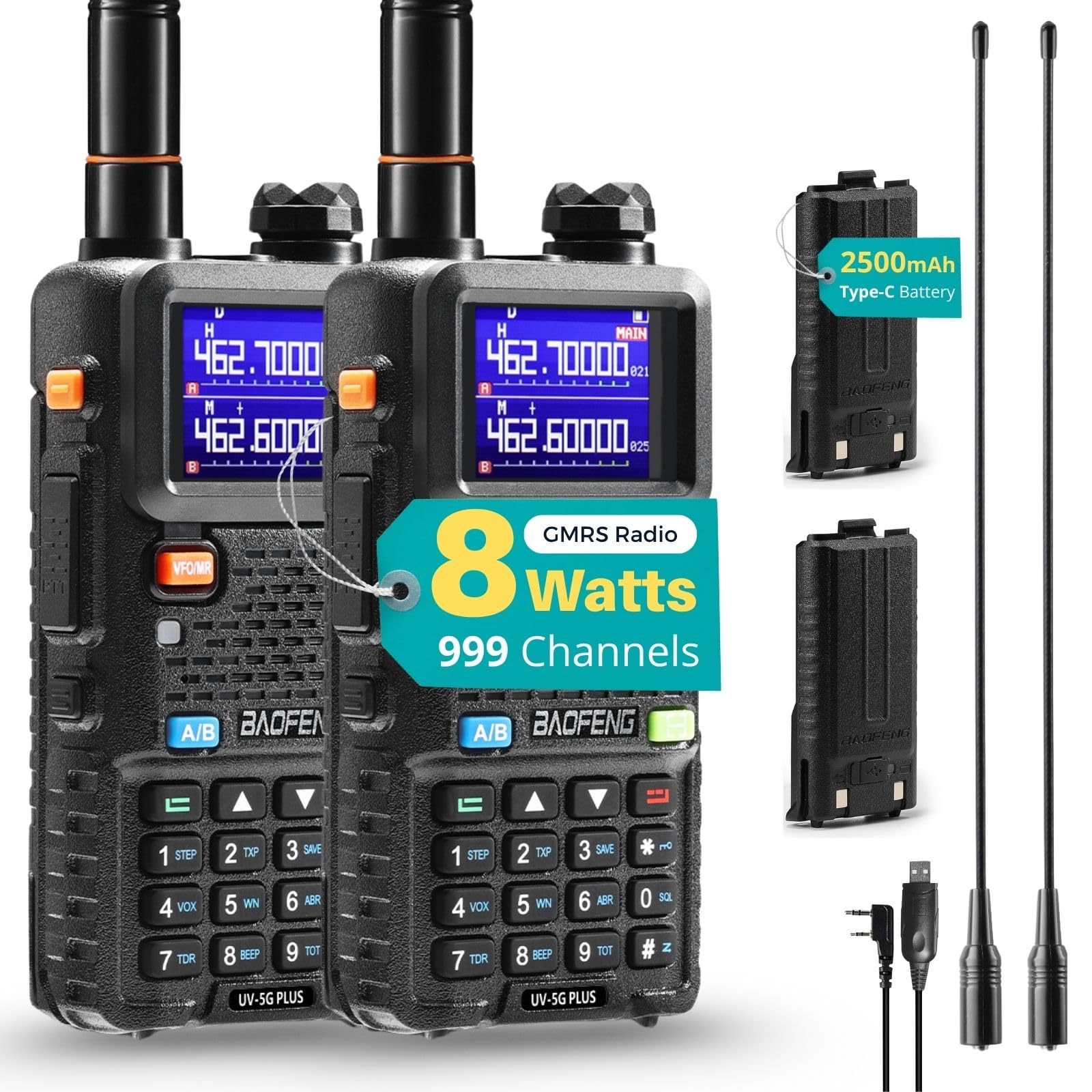
Same capable radio as the single pack, now with a partner and a programming cable.
This is the UV-5G Plus above, doubled. You get two radios, two 2500mAh USB-C batteries, two belt clips, a programming cable, and — the meaningful addition — both an 8-inch and a 15.5-inch high-gain antenna for each radio. That antenna choice matters: the longer whip is what owners swap in when they want more reach, and having it in the box means no extra shopping trip. The 999-channel capacity, the frequency copy feature, and the 1.9-inch color display are all here too. The battery life rating is 12 hours.
For a household, a pair of vehicles, or a two-person trail team, this is the smarter buy than two single packs because of the spares and the cable. The programming side is handled by the included cable and CHIRP, so you can load repeaters for both radios in one sitting after a trip planning session. Reports describe the pair reaching a repeater across a city and well beyond, and one describes transmitting through the suburbs with a clear signal.
What to prepare for: the display is hard to read in direct sun, and the dual-watch function stays on. The battery seating is the recurring complaint — one buyer lost a pack because it did not sit tight. Tape or a snug holster is the fix. And as with every radio on this list, GMRS operation requires an FCC license.
What you gain over the single: a second radio, a long whip antenna for both, and the programming cable all in one box.
The recurring grip: battery packs can work loose in a pocket or on a rough trail — seat them firmly.
Best for: couples or two-vehicle households who want matching radios with the antennas and cable sorted.
Not the one for: wet, submersion-prone trips — no IP rating here.
8. BAOFENG UV-9G GMRS Handheld Radio 2 Pack

The same IP67 radio as the single pack, paired up with a cable for both.
The two-pack version of the UV-9G exists for the crew that needs water protection on both sides of the conversation. You get two IP67-rated radios that take three feet of water for 30 minutes, two 1800mAh batteries, a programming cable, and a 15.5-inch RA-MD2 high-gain antenna in the box. The channel layout is the same one that made the single pack the waterproof pick: 30 GMRS channels, 11 NOAA channels with weather scanning, and the extended repeater channels 31–54 to load with separate tone codes and cut interference.
What the water rating buys you in practice is freedom from worry. Rain, spray from a jet ski, a radio that slips off the dock and into the shallows — all handled. NOAA weather scanning is the other big outdoor asset; the radio can sit on a weather channel and alert when conditions turn. Customers note reaching repeaters more than ten miles out with the long antenna, and the speaker stays audible over engine noise and wind. The included cable means you can program both radios from a laptop on a rainy afternoon before the trip.
The honest caveats mirror the single pack. The stock battery is not USB-C, so you need the cradle or an optional pack, and the belt clip lets the radio hang awkwardly. The learning curve is real if you have never touched GMRS before. Budget a session with the manual and the cable before you head out.
What the pair delivers
- Two IP67 radios that survive submersion
- Long and short antenna options for range versus pocket carry
- NOAA weather scanning on both units
- Programming cable included for both radios
The gripes to know
- Batteries are not USB-C stock
- Bulky belt clip lets the radio swing
- Steeper learning curve than a bubble-pack radio
Right call for: two people who both need waterproof radios on the water or in the weather.
Better off with the MP31 if: the water is a splash and you want a simpler, lower-cost setup.
9. Midland GXT1000VP4 GMRS Two-Way Radios 2 Pack

The familiar name in family radios, backed by headset comfort and 142 privacy codes.
If the priority is comfort and simplicity for a casual group — camping families, a ski trip, a car show, backing a trailer — the GXT1000VP4 is the recognizable choice. It brings 50 channels and 142 privacy codes so the group can pick a quiet line and cut out cross-talk. The ear-hook headsets that come in the box are a genuine daily-use win: they keep the microphone close to your mouth and free your hands, which matters when you are holding a ski pole or guiding a trailer into a spot. VOX (voice-activated transmit) means you can talk without pressing a button once you learn its timing. The listed battery life is 10 hours with the rechargeable packs, and it can swap to AA cells if the packs die.
What the brand gets right is the human side of the radio. The menus are simple enough to set up in about ten minutes, keypad lock stops accidental channel changes, and the included desktop charger keeps the packs topped up. NOAA weather alert is built in, so storm warnings reach you when the sky changes fast. On a good line of sight — like a beach to a hotel, or hill to hill with clear ground between — the range gets impressive. On a ski hill with trees and a lift in the way, it still held up at shorter distances in testing reports.
The honest limits are real for this one: it does not hit repeaters, and it does not run at full 5-watt power on every channel. It is a simpler radio than the BTECH or the UV-9G for a dedicated user. The battery indicator also tends to jump from full to empty with little warning. For a casual family radio, that is a fair trade for the convenience.
What it shines at: straightforward family use with headsets and a dock — set it up, hand it out, get on with the day.
Where it stops: no repeater access and no full-power output, which matters for a serious user.
Ideal for: families and casual groups who want a familiar radio with headsets and a charger in the box.
Not the one for: repeater chasers or anyone who needs the full legal GMRS output on the main channels.
10. Retevis RB17P GMRS Handheld Radio

Built for the long haul: a 2200mAh battery rated for 24 hours of talk time.
This is the radio for the person who does not want to think about charging. The 2200mAh battery is rated for up to 24 hours of talk time and 7 days of standby, enough for a weekend camping trip on one charge. Retevis also fits a desktop charger in the box, so it is topped up and waiting when you grab it. The 30 memory channels include 8 dedicated base-station channels, letting the RB17P talk with a GMRS base station for wider coverage — handy for a cabin or a hunting camp that runs a base unit.
What people like about this one, judging by the reviews, is range with a repeater in the mix. Reviewers point out 38-mile contacts over a repeater and a clear line-of-sight hit to a repeater 56 miles out on the short stock antenna. Indoors on a 10-acre property with dense foliage, it covered the whole spread without trouble. The audio is loud and clear, there is a dedicated NOAA weather button on the side and an SOS button on top, and CHIRP programming lets you load repeaters from a laptop.
The honest friction is programming and the stock antenna. from the start, this radio will not connect to a repeater set up for a different tone or offset until you program it — the manual can be vague, and the correct software is sometimes not the one listed. A 15-inch folding antenna reportedly opened up clean repeater contact. Also, the programming cable is not included with every version, so check before you buy.
What wins here
- 2200mAh battery rated for a full day of talk time
- 8 dedicated base-station channels for wider coverage
- Dedicated NOAA button and SOS top button
- Kenwood 2-pin plug for broad earpiece and mic support
The honest frictions
- Will not hit a repeater from the start until you program it
- Programming software situation is confusing
- Programming cable not always included
Go for it if: you want a radio that stays alive for a full day of talking and pairs with a base station.
Better fit elsewhere if: you want a radio that just works without a programming session.
11. BTECH GMRS-PRO GMRS Radio

The only radio here that can text your position to another radio.
This is the top of the stack for features. It pairs with the BTECH GMRS app on your phone for setup, channel management, and contact syncing, so the radio becomes configurable from a screen you already know. It supports Bluetooth for a hands-free headset or your vehicle’s audio system, has built-in GPS for location sharing and nearby-user tools, and sends text messages to other GMRS-PRO radios. There is a digital compass that shows coordinates, heading, speed, and altitude, and it is rated IP67 dust-tight and water resistant for rain and mud. For someone who wants an off-grid tool with a map and messaging on it, nothing else here matches it.
The 2600mAh battery is the largest here on paper, and USB-C charging means a standard cable in the field. NOAA weather scanning keeps storm warnings coming. 180 channels give you room to organize, and the radio talks with standard GMRS and FRS radios so the rest of the family on plain blister-pack units can still hear you. In the tested uses, buyers describe clear comms through obstructed Appalachian terrain and beyond.
The hard truth is the price and the learning curve. It costs the most here by a wide margin, and some find the interface not intuitive — the app helps, but the first setup may take a session. Also, texting and GPS location sharing only work with another GMRS-PRO unit, not a general GMRS radio. The belt clip install requires tiny screws and a small screwdriver, and it is fiddly enough to frustrate some owners.
Standout: the only radio on the list with Bluetooth, GPS, and radio-to-radio texting in one body.
The honest catch: the features only pay off if your group also owns a GMRS-PRO — otherwise you are a standard GMRS radio with extras.
Choose this for: off-grid groups, overlanders, and serious users who want app control, map awareness, and waterproofing in one hand.
The budget pair is smarter if: you just want two people to talk on the trail and nothing more.
Know the Specs
Channels and repeater pairs
Channel count tells you how many memories the radio holds, not how far it talks. Thirty channels is enough for a casual family; a few hundred is what you want once you start loading repeaters for different towns. The eight repeater pairs — channels 23 through 30 on GMRS — are the important ones for range, because they let you use a shared hilltop tower. A radio that ships with those eight pre-programmed is ready to use a repeater the day it arrives; a radio with them locked to one frequency each needs a cable to change towns.
Battery capacity in mAh
mAh stands for milliamp-hours — think of it as the size of the fuel tank. A 1500mAh pack is the modest tank on the budget two-pack; 2200mAh to 2600mAh packs are the bigger ones that last longer on a trip. Runtime also depends on how much you transmit, so a radio rated for 24 hours of talk time on a 2200mAh pack will often go several days of light listening. USB-C charging is the practical detail to check: fewer cables to pack, and a power bank can top you up.
IP ratings explained
The first digit in an IP rating is dust and the second is water. IP54 (splash and dust) handles rain and a wet dock. IP67 means dust-tight and able to survive temporary immersion of roughly three feet for 30 minutes. JIS4, which one pick here lists, is a splash standard — fine for a light shower, not for a dunk. Match this rating to your actual trips; paying for IP67 on a radio that lives in a truck cab is money you will never use.
Wattage and what it really means
Watts measure transmit power. Higher watts can mean better reach, but on GMRS, the shared channels 8 through 14 are capped at low power, so a 5W radio runs at 0.5W there. That is why a radio can feel strong on some channels and weak on others. Antenna quality and height matter as much as wattage — an improve or high-gain antenna often beats a bigger watt number on flat ground. Treat headline range claims as ideal-condition ceilings.
Common Questions
Do I need an FCC license to use a GMRS handheld radio?
Will a GMRS radio work with my old FRS walkie-talkies?
Can I hit a repeater from the start, or do I have to program it?
What is CHIRP, and do I need a cable to use it?
How much range should I actually expect in hills or dense trees?
Is the IP67 rating on the UV-9G and GMRS-PRO enough for kayaking?
What is the difference between the UV-5G Plus single and the two-pack?
Do GPS and texting on the GMRS-PRO work with any other GMRS radio?
How long do the rechargeable packs last, and can I use AA batteries instead?
What should I look for if I want to use this on a work site?
The Bottom Line
The gmrs handheld radios pick that suits the most people is the Radioddity GM-30. It ships with repeater channels ready, charges over USB-C, and does the everyday job without a manual. If you want to load a whole road trip of repeaters from a laptop before you leave, go for the BAOFENG UV-5G Plus with its 999-channel capacity and 2500mAh battery. For wet trips, the BAOFENG UV-9G is the one to clip on, with its IP67 rating that shrugs off a dunk. And if your group wants the smart-radio experience with GPS and texting, the BTECH GMRS-PRO is the only one on this list built for it — buy two so the features actually work.
Before you buy, decide if you need repeater access, match the water rating to your trips, and confirm the programming cable is in the box if you plan to load more than a few channels. Get those three right and the wattage number on the box matters far less.
How we choose
We do not accept paid placement. Every pick is matched to a real buyer and a real use-case; we do not hands-on test units.
Sources
Specifications: manufacturer listings and product documentation. Review insights: verified customer reviews, as of October 2026. Pricing: not shown on this page (it changes often); check the current price via the retailer link.
As an Amazon Associate, Aappliancez earns from qualifying purchases. This does not affect which products we feature.