Disclosure: Some links in this post are affiliate links. As an Amazon Associate I earn from qualifying purchases, at no extra cost to you. Learn more
Specs are compiled from manufacturer listings and verified buyer reviews and can change over time — please confirm the key details on the product page before buying.
PVC glue is not glue in the craft-store sense — it works by briefly melting the surface of the pipe so two pieces fuse into one solid joint. Pick the wrong formula and you get a joint that weeps under pressure or pops apart at the worst moment. That is why the picks below split cleanly by job: solvent cement for pressure pipe and plumbing, and specialty vinyl cement for inflatables, pool liners, and flex repairs.
This guide is built by comparing the manufacturers’ published specifications and the patterns across verified customer reviews, so you get each pick’s real strengths and trade-offs instead of marketing spin.
Solvent cement is the only adhesive that chemically welds PVC pipe, so the practical question is which body thickness and cure window fits your pipe diameter and working temperature. Every pick here earns its place on glue for pvc.
Top Picks

How To Choose The Best Glue for PVC
Two products on a hardware shelf can both say “PVC glue” and behave nothing alike. One is a solvent cement that fuses pipe permanently — the other is a flexible vinyl adhesive meant to stay slightly soft so inflatables, liners, and patches can flex without cracking. Matching the formula to the surface is the single decision that separates a joint that holds for years from one that fails in a season.
Body thickness and what it actually fills
Body is how thick the cement is when you brush it on. A heavy-bodied formula (a thicker, syrupy texture) fills small gaps in loose-fitting joints and stays put on vertical runs instead of running down the pipe. A thinner cement penetrates tighter interference fits faster but drips more on overhead work. Neither is better — they suit different pipe diameters and fit tolerances.
Set time versus cure time
Set time is how long you have to push the pipe and fitting together and twist a quarter turn before the cement grabs. Cure time is how long the joint needs before you pressurize it or run water through it. Set times are measured in seconds for most solvent cements; full cure stretches to hours. Weld-On 10121 711 reaches full cure in 24 hours. Titebond 4 Oz. PVC Trim Joint Adhesive reaches full cure in 8 hours — a three-times-faster full cure, which matters when you need the assembly load-bearing the same day.
VOC content and indoor work
Volatile organic compounds (VOCs) are the solvent vapors that evaporate as the cement cures — the strong smell. Low-VOC formulas reduce those emissions, which matters most when you are working in a basement, crawlspace, or closed room. If you are plumbing in a tight indoor space, check the label before you open the can.
Side-by-Side Comparison
| Model | Best For | Container Weight | Full Cure Time | Compatible Material | Amazon |
|---|---|---|---|---|---|
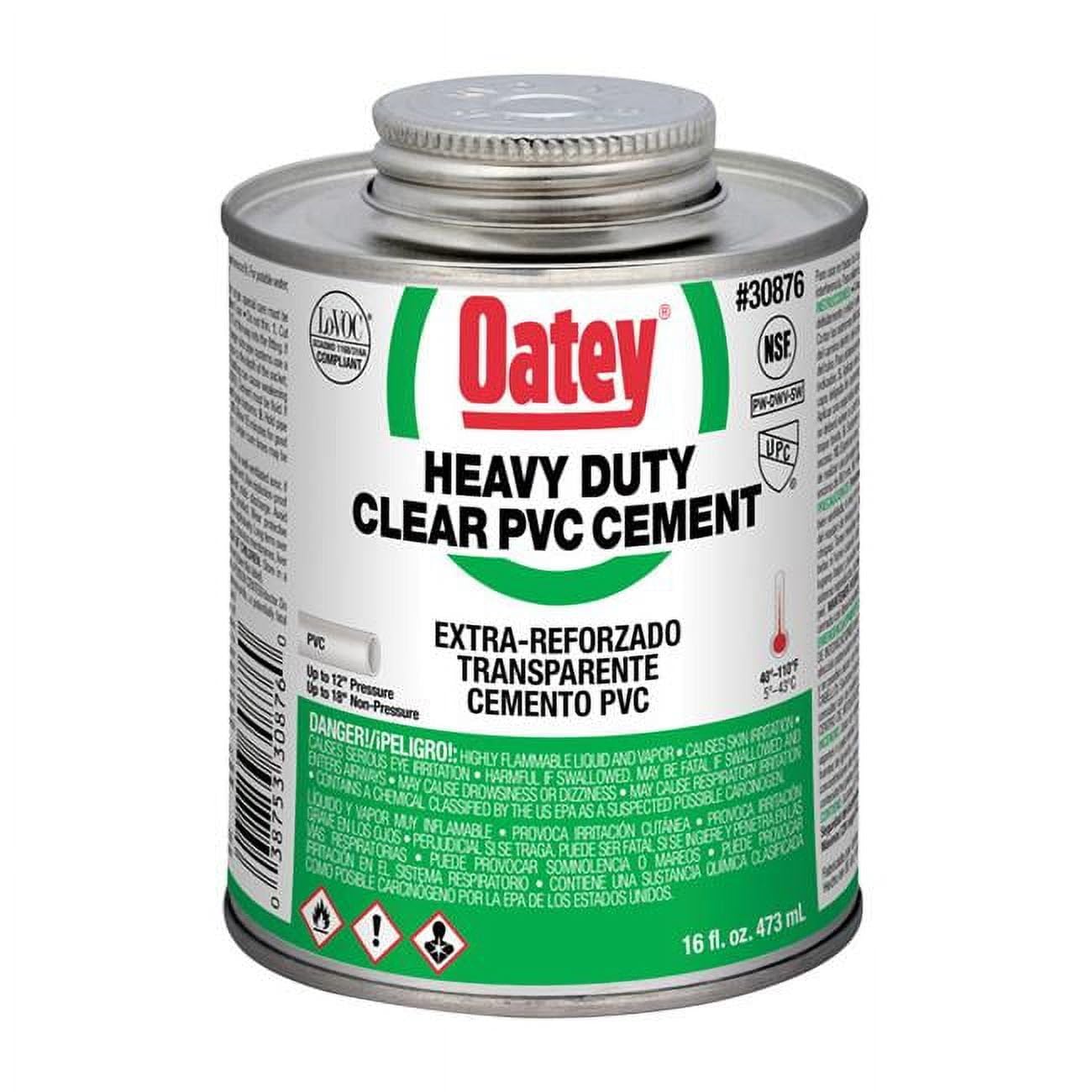
| Oatey 16 Oz. Heavy Bodied Heavy-Duty Clear PVC Cement★ Best Overall | General PVC plumbing and pipe joints | 16 ounces | — | Polyvinyl Chloride | Amazon |
| Vinyl Cement, Vinyl Glue for Inflatables, Waterproof AdhesiveBest for Inflatables | Inflatable repairs, pool liners, hot tubs, air mattresses | 4.4 oz | 24 hours | Vinyl | Amazon |
| Titebond 4 Oz. PVC Trim Joint Adhesive | PVC trim, miter joints, fascia installation | 2.4 ounces | 8 hours | Plastic | Amazon |
| Weld-On 10121 711 Industrial Grade PVC Solvent Cement | Heavy-duty and high-pressure pipe work | — | 24 hours | Plastic | Amazon |
| Oatey 31105, 32 oz, Gray PVC Cement | Large-diameter and loose-fitting pipe joints | 32 ounces | — | Polyvinyl Chloride | Amazon |
Detailed Reviews
1. Oatey 16 Oz. PVC Cement
Our pick — 4.5+★ from 450+ verified ratings; the strongest balance of quality and price.
The 16-ounce can that handles almost any PVC plumbing job in one go, clear so you see exactly where the cement lands.
Most people buying a PVC cement are fixing a leak, joining a repair coupling, or patching something that livesoutside. This is the one that quietly handles all three. The 16-ounce weight is the standout here — it is the heaviest container on this list, more than four times the stated weight of the 4-ounce pours, so you are not running dry mid-job on a big run of pipe.
What wins people over is how fast it grabs. The cement bonds quickly and sets up almost as soon as the pipe bottoms out in the fitting, so you are not standing there holding two pieces of pipe together waiting for it to take. One buyer used it to reattach patches on a bounce house and reported the bond held. That is the simplest possible verdict, but it is the right one for this kind of product — you only know a cement worked when you come back later and the joint is still there.
The clear color is more useful than it sounds. A heavy-bodied cement leaves a visible bead at the joint, and clear means you can see the squeeze-out and wipe it before it cures into a hard ridge. On visible work — a repair under a sink where a plumber might glance at it — that clean look matters.
The reasons it works
- 16-ounce can gives the largest working quantity of any pick here, so one container covers multiple repair jobs.
- Heavy-bodied formula fills small gaps in loose-fitting joints and does not run downhill on vertical runs.
- Bonds quickly — several buyers report how fast it grabs, which shortens the time you spend holding the joint.
- Clear finish lets you spot squeeze-out and clean it before it hardens into a rough ring.
The trade-offs worth knowing
- Banned in California and Alaska — a solvent-content restriction, so check your state before ordering.
- Heavy-bodied cement cures slower than thin cements in cold weather, so give it more cure time outdoors in winter.
- The can size is generous, but once opened, solvent cement gradually thickens with repeated air exposure.
The right pick if: you want one can that covers everyday PVC plumbing repairs and holds a reservoir of cement for repeat jobs.
Worth checking first: the state restriction — California and Alaska shoppers need a different formula.
2. Vinyl Cement 4.4 oz.
The patch-and-pool specialist — a flexible vinyl cement built for underwater repairs and inflatables that flex, not rigid pipe welding.
Rigid solvent cement cracks when the surface underneath it moves. Pool liners, air mattresses, boating covers, tarps — all of that flexes, and vinyl cement is formulated to stay slightly flexible after it cures, so it moves with the material instead of cracking off. This one reaches full cure in 24 hours and comes with a brush already built into the cap.
What owners rave about most is the adhesiveness — it grips and holds firmly on inflatable pool tears and holds up under daily use. One review describes patching a pinhole leak in a three-season-old 18-foot round Coleman pool while it was still filled with water. The buyer applied two layers by finger, pressed for a minute, then set the patch and sealed the edges. It cured at 75–80°F in indirect sunlight, confirming it sets at ambient temperature.
The built-in brush applicator is the sleeper feature. Decals applied to a pool, rings stuck to a paddleboard, tarp holes sealed — owners note the brush makes placement precise and a small amount covers a lot of surface. Just be careful on soft foam or squishy toys: One buyer reports it ate into a NeeDoh-style squishy toy and widened the hole, so keep it off soft foam.
Where it earns its spot: this is the most-multipurpose formula on the list for non-rigid repairs — inflatables, liners, tarps, and pool surfaces that solvent cements cannot touch. The 24-hour full cure means you patch tonight and fill tomorrow.
Reach for this if: your repair involves a pool liner, air mattress, tarp, or any flexible vinyl surface that needs a waterproof, slightly flexible bond.
Look elsewhere if: you are welding rigid pressure pipe — that needs a true solvent cement, not a vinyl adhesive, because it will not fuse the plastic.
3. Titebond 4 Oz. PVC Trim Joint Adhesive

The trim-shop specialist: 100% waterproof, eight-hour full cure, and the only pick here cut specifically for miter and scarf joints.
If your job is fascia boards, column wraps, or miter joints on PVC trim, this is the adhesive engineered for it rather than for pipe. What that buys you is full cure in 8 hours — the fastest on this list, and three times faster than the 24-hour Weld-On below. When you need a joint that is solid before you walk away for the day, that gap matters.
The bond is thick and gap-filling, which is how people end up using it for model kits and craft builds too. The thickener keeps it from running out of a vertical joint, so miters stay put while they set. One buyer who installed Royal PVC fascia on their home reported it worked great on the joints.
The catch is the working window. Owners describe the open time as quick, and you have to be ready to clamp or tape the joint the moment it comes together. Shake the tube before use — the thickener separates, and if the thinner portion rises to the top, it behaves like a much thinner glue. One quibble worth knowing: at 2.4 ounces it is the lightest tube here, the smallest to hold in a toolbelt but also the first to empty on a long run.
What makes it different: this is not a solvent cement for pressure pipe — it is a trim and construction adhesive, and it cures in 8 hours instead of 24.
The honest trade-off: drying time sits in the mixed column, and the recurring gripe is that an opened tube thickens or dries out over time — use it up and keep the cap tight.
Best for: PVC trim, fascia, column wraps, miter and scarf joints where strength and speed matter more than container size.
Not the right tool for: pressurizing pipe the same day — the 8-hour cure is fast for trim, but pressure work still wants a solvent cement rated for it.
4. Weld-On 711 PVC Solvent Cement

Industrial-rated solvent cement for Schedule 80 and up to 12-inch pipe — the one that earns its keep on high-pressure and commercial work.
The Weld-On name shows up on commercial job sites for a reason, and the 711 formula carries a heavy body with a medium setting — which means a visible, gap-filling bead that still gives you enough positioning time to align the pipe before it locks. It handles all classes and schedules with an interference fit, so it is not limited to standard thin-wall pipe.
The low-VOC formula is genuinely meaningful indoors. Because it emits fewer solvent vapors than a standard cement, it is a cleaner option for basement and crawlspace plumbing where ventilation is limited. Full cure runs 24 hours — three times longer than the 8-hour Titebond above, so plan your pressure test for the next day, not the same afternoon.
Owners describe the application as effective and the bond as strong and leak-proof after it chemical-welds the joint. The heavy-duty dauber cap is what people mention most often as the part that makes the job easier. The one real complaint surfaces with viscosity: a couple of buyers describe the cement as thin and runny, which is easier to spread but drips more on overhead joints. It is a formula that rewards careful, even application over trying to slather it on.
Why it stays in the tool bag: it is the only pick here paired with a heavy-duty applicator dauber, and it holds up under repeated use on pressure and thermal-cycling work.
Reach for this when: you are doing high-pressure, commercial, or Schedule 80 plumbing and want a formula that holds under thermal cycling.
Second thought if: you are drawn to a light, easy-spreading cement — this runs on the thinner side, so overhead work needs a steady hand.
5. Oatey 31105, 32 oz, Gray, PVC Cement
A 32-ounce powerhouse for big-diameter runs — thick enough to fill gaps in loose-fitting joints that thinner cements would leave weeping.
When you are gluing large-diameter pipe or dealing with a joint that is a little loose, a thin cement runs right out and leaves gaps behind. This Oatey cement is designed exactly for that problem: a thick formula that fills gaps in large-diameter pipe and loose-fitting joints. It covers all schedules and classes of PVC pipe and fitting up to 12-inch diameter with interference fit — and up to 18-inch for non-pressure work.
It is one of the few picks here rated for potable water, plus pressure pipe, conduit, and DWV (drain, waste, and vent). The recommended application temperature is 40°F to 110°F (4°C to 43°C), which is a wider working window than you might expect, and the low-VOC formula meets California South Coast Air Quality Management District and BAAQMD requirements — relevant if you live somewhere with solvent regulations. The 32-ounce container holds the most cement of any product here.
Owners lean on it for reliability. One buyer switched to it after thinner glues let irrigation pipes pop off couplers, and reports this one never failed. Another praised the packaging as the best they had seen on a liquid product. The recurring gripe is practical: the applicator that comes with it is not very durable, and several users advise picking up a spare brush before you start a big job.
Where it delivers: this is the only pick that states a specific recommended application temperature range and the only one that carries a potable-water rating, so it is built for both plumbing and large-diameter pipe work.
The honest caveat: the included applicator wears out quickly, and while the big 32-ounce can goes far, a partially used can will thicken over time.
Choose it when: your job involves large-diameter pipe, loose-fitting joints, potable water, or you simply want to stop re-buying cement every few months.
skip it if: you only ever patch small pipes — the 32-ounce container is more cement than a lone repair will ever use.
Know the Specs
Container weight and quantity
The weight on the label tells you how much cement you are actually buying, which matters once and then keeps mattering every time you reach for it. Container weights here run from 2.4 ounces up to 32 ounces. A small tube suits trim work where you use a little at a time; a large can suits major pipe runs where you need a continuous bead without stopping to refill.
Full cure time
Full cure is how long the joint needs before it can handle real pressure or water. It is written on the container and ranges from 8 hours to 24 hours across the picks above. If you need the same-day turnaround on a load-bearing trim joint, a shorter cure is the deciding spec; for pressure pipe, follow the labeled cure time before you test.
Body and viscosity
Heavy-bodied cements are thick and gap-filling — they stay where you put them and fill loose joints. Lower-viscosity cements spread thin and fast, which makes them easy to apply but more likely to drip. Neither is better; pick based on your fit tolerance and whether you are working overhead.
Compatible material
Solvent cement is formulated for polyvinyl chloride — it chemically fuses those surfaces. Vinyl and trim adhesives are made for a broader range including vinyl, ABS, EVA, and rubber. Using a cement on a material it was not formulated for is the most common reason a repair fails.
VOC content and regulatory compliance
Low-VOC formulations cut the solvent vapors released during curing, which keeps the working environment cleaner. Some areas — California and parts of Alaska among them — restrict high-VOC cements outright, so check the label and your local rules before ordering if you live there.
Common Questions
Can I use PVC cement on ABS pipe?
How long do I have to push the pipe and fitting together before the cement sets?
How long before I can pressurize the joint?
What does heavy-bodied mean and do I need it?
What temperature can I apply PVC cement in?
Why is some PVC cement banned in California and Alaska?
Can I use PVC cement to patch an inflatable pool or air mattress?
Does PVC trim adhesive work for anything besides trim?
Does a bigger can of PVC cement make more sense than a small tube?
Is vinyl cement and PVC cement the same thing?
The Bottom Line
For most people fixing PVC around the house, the winner is the Oatey 16 Oz. Heavy Bodied Heavy-Duty Clear PVC Cement — it bonds fast, the heavy body fills gaps, and the clear finish makes cleanup on visible joints easy. If your repair involves an inflatable, pool liner, or anything flexible, grab the Vinyl Cement for Inflatables for its waterproof, flexible bond. And for large-diameter, loose-fitting pipe where reliability matters most, the Oatey 31105 32 oz Gray PVC Cement is the one to reach for.
How we choose
We do not accept paid placement. Every pick is matched to a real buyer and a real use-case; we do not hands-on test units.
Sources
Specifications: manufacturer listings and product documentation. Review insights: verified customer reviews, as of October 2026. Pricing: not shown on this page (it changes often); check the current price via the retailer link.
As an Amazon Associate, Aappliancez earns from qualifying purchases. This does not affect which products we feature.