Disclosure: Some links in this post are affiliate links. As an Amazon Associate I earn from qualifying purchases, at no extra cost to you. Learn more
Specs are compiled from manufacturer listings and verified buyer reviews and can change over time — please confirm the key details on the product page before buying.
If you have ever watched a rhinestone slide off a pendant ten minutes after you glued it, you already know the real problem. Most jewelry glues either set so fast you cannot reposition a stone, or they dry cloudy and dull the crystal you were trying to show off. The picks below solve that in different ways, so the right one depends entirely on the material you are bonding and how much working time you need.
This guide is built by comparing the manufacturers’ published specifications and the patterns across verified customer reviews, so you get each pick’s real strengths and trade-offs instead of marketing spin.
Setting a pearl into a sterling post and bedazzling a phone case need different glues. The right one depends on three things: how fast it cures, how clear it dries, and how precisely you can place a dot. This glue for jewelry stones guide is organised around those three.
Top Picks


How To Choose The Best Glue for Jewelry Stones
For gemstones, the strongest glue on the shelf is not the goal. Match three things to your project instead: how long the glue gives you to slide a stone into place, what it looks like once it hardens, and how narrow a bead you can squeeze out. Get those three right and a repair lasts years. Get them wrong and you get a cloudy ring around a loose rhinestone.
Working time before the glue grabs
Some adhesives thicken in as little as 15 minutes, while others give you far longer before they set. If you are placing one stone into one setting, a fast grab is helpful — the stone stops wanting to slide. If you are setting a row of small stones into a channel, you want more time so you are not fighting the glue halfway through.
Clarity after curing
A clear-drying glue matters most when the joint is visible, like a stone sitting on an open metal setting or a crystal repaired on a glass surface. Cloudy residue under a rhinestone kills the sparkle it was meant to protect. Look for an adhesive that hardens transparent rather than one that only goes on clear.
Applicator precision for small stones
This is where most beginner attempts fail. A wide nozzle dumps far more glue than a small stone needs, and the overflow is what dulls a gemstone and creates visible mess. A needle tip, a fine metal applicator or an interchangeable precision cap lets you place a single dot exactly where the stone meets the metal. On a bonded stone, that control is worth more than any strength rating.
Side-by-Side Comparison
| Model | Best For | Full Cure Time | Container | Form | Amazon |
|---|---|---|---|---|---|
| Bearly Art Precision Craft Glue Original 4 fl oz★ Best Overall | Fine detail work and tip control | 24 hours | Bottle | Oz | Amazon |
| Jewelry Glue for Jewelry Making RepairTop Performer | Simple home repairs on rings and bracelets | 24 hours | Tube | Gel | Amazon |
| BEACON Gem-Tac Permanent Adhesives 8oz | Rhinestones and bedazzling | — | Bottle | Gel | Amazon |
| Epoxy 330 Glue, Pack of 2 | Pearls and metal-to-metal settings | 2 hours | Tube | Liquid | Amazon |
| Jewelry Displays & Boxes G-S Hypo Cement (3 Pack) | Beading, knots and knot sealing | — | Tube | Stick | Amazon |
Detailed Reviews
1. Bearly Art Precision Craft Glue Original 4 fl oz
Our pick — over 4.5★ from 11,500+ verified ratings; the strongest balance of quality and price.
The tip kit that lets you place one clean dot of glue on a single small stone.
This is the pick for anyone who has ruined a nice gemstone by smearing glue across it. The Bearly Art bottle ships with a kit of interchangeable precision tips that twist and snap into place, so you swap the nozzle to suit the job instead of squeezing through whatever opening the bottle happens to have. For setting a stone into an earring or dotting adhesive beside a rhinestone, that control is the whole point.
What wins people over is the sheer consistency of the formula. It is wrinkle and clump resistant, meaning it stays smooth on the surface instead of drying in stringy lumps, and it cures to a clear matte finish rather than a cloudy haze. Reviewers describe using a very small amount with a bubble-free application, which is exactly the discipline a small stone setting rewards. The 4 fluid ounce bottle carries a 1 year shelf life, so it will not go bad before you finish it.
Here is the honest trade-off. Full cure runs 24 hours, so this is not the glue for a repair you need finished in an hour. It is also the largest bottle in this lineup by a wide margin, and the number of pieces in the listing is 100 against the Epoxy 330’s pack of 2 — a very different scale of purchase. A little genuinely goes a long way here. Buyers report: “I love this glue. It is a little pricey, but worth the money. A little goes a long way. There isn’t any odor.”
Where it earns its keep
- Interchangeable precision tips twist and snap into place for exact dot placement
- Cures clear and matte with no warping or wrinkling on delicate surfaces
- Freeze and thaw stable across 5 tested cycles, so it survives shipping in any season
- Made in the USA with a 1 year shelf life on the 4 fl oz bottle
What to plan around
- A full 24 hour cure means no same-evening finishing
- The bottle is far larger than a single small repair needs
- Go light — the formula asks for conservative application to avoid warping
Reach for this if: you want one bottle that handles gem decorating, card making and fine craft work with swappable precision tips.
Look elsewhere if: you need a stone secured and wearable tonight, because the cure is a full day.
2. Jewelry Glue 2oz
A needle-top tube built for the loose stone you only just noticed.
For the everyday repair — a wobbly bracelet stone, a clasp that let go, a gemstone that worked loose from its setting — this is the practical choice. It is a 2 fluid ounce gel in a tube with a precision open needle top, and the cap itself carries a pin so the needle does not clog between sessions. That sounds small until you have thrown away half a tube because the nozzle sealed shut.
The formula is a semi-fluid transparent gel that dries crisp and rock hard, and the listing describes it as waterproof and highly elastic, able to stretch without breaking. It is listed as compatible with jewelry, glass, leather, ceramic, wood, plastic, metal, rubber, fabric, stone, PVC and acrylic — unusually wide coverage for a jewelry adhesive. It also ships with a brush, disposable gloves and a fleece cloth, which covers the whole bonding process in one box.
The catch is time. Cure runs to 24 hours, and buyers consistently mention allowing enough drying time before wearing the piece. It is also a soft-bodied gel rather than a rigid epoxy, so if you want a stone locked into a metal setting with zero flex, the Epoxy 330 below is the stiffer option. The ratio here is one tube to a single piece, against the Bearly Art’s listing count of 100 — a very different scale of purchase.
What the repair bench likes: a small, mess-free drop through the needle tip, a strong bond once cured, and a finish that is barely noticeable on the repaired piece.
What it is not: a rigid structural bond for heavy metal-to-metal settings.
Best suited to: household jewelry repairs on rings, earrings and bracelets where a neat, near-invisible mend matters more than speed.
Not the one for: a stone you need wearable within the hour.
3. BEACON Gem-Tac Permanent Adhesives 8oz
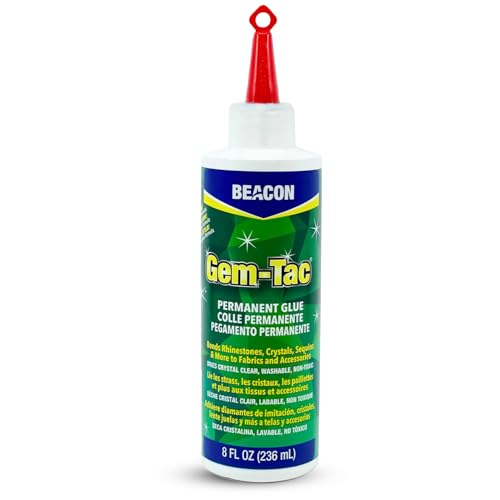
The high-viscosity eight-ounce workhorse rhinestone setters keep refilling.
If your project is rhinestones — phone cases, tumblers, shoes, fabric, or a bedazzled garment — Gem-Tac is the name that comes up again and again. The reason is physical: this is a high viscosity gel, meaning it is thick and holds its shape where you place it. A stone dropped onto a bead of thick gel does not skate across the surface the way it does on a thin liquid adhesive. It stays exactly where you set it.
Two specs matter most here. It is machine washable once cured, which is what makes it usable on clothing and accessories that actually get worn and cleaned. And it is listed as non-toxic with a dries-clear finish, so it will not fog or dull the stones it holds. The bottle is a full 8 fluid ounces against the Epoxy 330’s 0.5 fluid ounces — sixteen times the volume, which is why it suits volume work rather than a one-off repair.
The trade-off is straightforward. It is also the one pick with no listed full cure time in its specifications, so plan around that rather than against it. For a single loose stone on a ring, the Epoxy 330 below is the better-targeted tool.
The bedazzler’s default: thick enough that stones stop sliding, dries clear so rhinestones keep their sparkle, and the finish survives a wash cycle once cured.
Worth knowing: it is a craft-scale adhesive, not a precision jeweler’s epoxy.
Pick this when: you are setting many stones across fabric, tumblers or accessories and need a bottle that lasts.
Pass on it when: your job is one stone on one ring and you need needle-tip accuracy.
4. Epoxy 330 Glue, 1/2 Fluid Ounces, Pack of 2 | GLU-203.30

Two hours to a hard, invisible bond — a full day faster than most of this lineup.
Epoxy 330 is the speed pick, and the numbers make the case plainly. It thickens in 15 minutes and hardens in 2 hours, against the 24 hour full cure listed for both the Bearly Art bottle and the Jewelry Glue tube. That is a twelve-fold difference in cure time, and it is why this is the pick when a stone must be wearable the same day. The 2 hour cure is the fastest in this lineup.
It is a water-clear liquid epoxy that provides an invisible bond, which is exactly what a visible setting needs — no ring of residue around a pearl, no cloudy shadow under a crystal. The listing covers gems, glass, china, ceramics, stone and metals, with compatible materials listed as glass, metal and stone. A medium to high viscosity means it holds position on a metal post without running off before it grabs.
Now the honest part. The thicker, stiffer cure is the whole point for metal-to-metal setting, but customers do report mixed results on adhesion and ease of use — some get a fantastic hold, others find it inconvenient to handle in small amounts. One practical note from a buyer who prepped properly: sand or roughen the post, wipe it with alcohol, apply a thin epoxy layer on a pin, and set the pearl before it thickens.
Where it stands apart: a 2 hour hard cure and a genuinely invisible bond, which no gel in this lineup matches.
Where it asks more of you: a two-part epoxy needs clean surfaces and deliberate mixing, so results track how carefully you prep.
Best for: pearls on sterling posts, crystal repairs and any setting where you want a rock-hard, invisible bond finished the same day.
Think twice if: you want a no-mix, one-squeeze gel for a quick fix.
5. Jewelry Displays & Boxes G-S Hypo Cement (3 Pack)
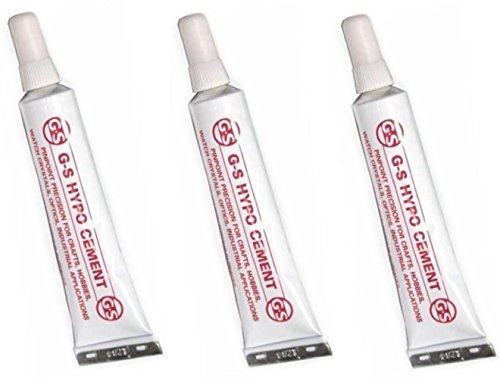
The beader’s needle-tip cement, sold three tubes at a time.
G-S Hypo Cement has been the beading bench standard for years. The “hypo” in the name refers to its fine needle applicator (a thin metal tube that lets you place glue exactly where you want it). That needle is what makes it valuable: it places a tiny, controlled amount of cement inside a bead or at a knot. The listing describes exactly that use — neatly attaching beads and pearls and setting small amounts of glue inside beads. It is made in the United States, and the material is cyanoacrylate (a fast-bonding glue also known as super glue).
Three tubes ship in the pack, each weighing 30 g. The adhesive is listed as compatible with ceramic and plastic, and it dries clear. What separates it from the fastest-setting cyanoacrylates is working time: buyers specifically note this cement does not dry too quickly, so a bead stays adjustable while you position it. One buyer put it plainly — the precision tip comes with a top that keeps the tip open between projects.
The thing to know before you buy is the cap. The closing gripe here is the cap threading, which a few buyers find fiddly to seat correctly, occasionally needing a magnifying glass to line up. The cement also sets in around 10 minutes and hardens clear in about an hour, so this is a mid-speed pick rather than an instant grab. Owners mention using it for bridal alterations to secure loose beads and threads, which tells you how well it holds under real wear.
What beaders count on
- Fine hypo needle applicator places cement inside beads and at knots
- Slower set than typical cyanoacrylate, so beads stay adjustable while positioning
- Three tubes in the pack, each 30 g, so it lasts through a season of projects
- Dries clear and holds knots well, made in the United States
Small things to note
- The cap thread can be finicky to reseat, especially for close-up work
- It is a beading and knot cement, not a heavy structural adhesive for metal settings
The one for: bead stringers, bracelet makers and anyone sealing knots or securing loose beads and threads.
skip it if: you need to bond a pearl onto a metal post — that job belongs to the Epoxy 330.
Know the Specs
Full Cure Time
This is how long the adhesive needs before it reaches its final hardness, not how long before it stops looking wet. A 2 hour epoxy and a 24 hour gel can both feel set to the touch long before they are actually finished. If you wear the piece too early, a stone can shift inside a bond that has not fully hardened — which is how a repair that “seemed fine” comes loose a week later.
Viscosity
Viscosity describes how thick the glue is and therefore how much it runs. A high viscosity gel stays where you drop it, which stops small stones sliding across a surface while you work. A lower viscosity liquid flows into tight gaps and thinner joints but needs more control. Matching viscosity to your job matters more than the strength label on the bottle.
Applicator Type
The nozzle decides how much glue reaches your stone. A precision tip, a needle top or an interchangeable cap lets you place a single dot; a standard opening does not. For anything smaller than a fingernail, the applicator is the feature that separates a clean set from a flooded one.
Dries Clear vs Goes On Clear
A glue can look transparent in the bottle and dry cloudy, which is the failure mode that dulls rhinestones and fogs crystal. Look for an adhesive described as dries clear, and check whether it is formulated not to fog or dull the material it bonds. On a visible setting, clarity is as important as hold.
Common Questions
What is the best glue for setting a stone into a metal ring setting?
How long should I wait before wearing a piece I just glued?
Will jewelry glue work on pearls?
Does jewelry glue dry clear or does it turn cloudy?
Can I reposition a stone after I place it?
Is epoxy or gel glue better for rhinestones on fabric?
How much glue should I use on a single small stone?
Does jewelry glue work on metal-to-metal components?
How should I store jewelry glue so it stays usable?
Is waterproof jewelry glue better for pieces you wear daily?
The Bottom Line
For most people setting or repairing gemstones, the glue for jewelry stones winner is the Bearly Art Precision Craft Glue with Tip Kit. Its interchangeable precision tips let you place a single clean dot on a small stone, and it cures clear and matte without warping. If speed is your priority, grab the Epoxy 330 — it hardens in 2 hours with a water-clear, invisible bond. And for fabric and rhinestone work that needs to survive a wash, the machine washable BEACON Gem-Tac is the one to reach for.
How we choose
We do not accept paid placement. Every pick is matched to a real buyer and a real use-case; we do not hands-on test units.
Sources
Specifications: manufacturer listings and product documentation. Review insights: verified customer reviews, as of October 2026. Pricing: not shown on this page (it changes often); check the current price via the retailer link.
As an Amazon Associate, Aappliancez earns from qualifying purchases. This does not affect which products we feature.