Disclosure: Some links in this post are affiliate links. As an Amazon Associate I earn from qualifying purchases, at no extra cost to you. Learn more
Specs are compiled from manufacturer listings and verified buyer reviews and can change over time — please confirm the key details on the product page before buying.
Most hard plastic repairs fail for one plain reason: you bought a glue that never had a chance on that surface. Ordinary cyanoacrylate — the thin stuff sold as super glue — grabs smooth, non-porous plastics poorly, so a cracked bumper tab or a snapped mirror housing pops apart a day later. The right adhesive depends on which plastic you are repairing. Polypropylene and polyethylene (the waxy-feeling plastics used in car trim and storage cases) need a primer or a two-part formula, while rigid ABS and polycarbonate panels respond well to a light-cured or urethane adhesive. Below you get five genuinely capable options, each matched to a different repair job.
This guide is built by comparing the manufacturers’ published specifications and the patterns across verified customer reviews, so you get each pick’s real strengths and trade-offs instead of marketing spin.
Some glues here cure in seconds under a light you shine yourself, others need a full day before you can load the joint, and one works as a moldable filler for missing chunks. This breakdown of the glue for hard plastic repair covers cure times, surface compatibility, and strength so you pick right the first time.
Top Picks

How To Choose The Best Glue for Hard Plastic Repair
Your glue fails because you treated every plastic as the same material. It is not. A glue that welds a cracked ABS laptop shell can slide straight off a fuel tank or a kayak hull, because those are polypropylene and polyethylene — two plastics with very low surface energy (a chemist’s way of saying nothing wants to stick to them). Match the adhesive to the plastic first, then weigh cure time against how fast you need the part back in service.
Identify Your Plastic Before You Buy Anything
Look for a stamped recycling code somewhere on the part. A “5” means polypropylene, a “2” means polyethylene, and a “7” or “ABS” mark points to rigid styrene plastics that most adhesives handle well. Waxy, semi-flexible plastic that flexes without creasing is usually polypropylene or polyethylene, and it needs a primer or a dedicated two-part system. Rigid plastic that cracks with a sharp snap is easier and bonds with almost anything on this list.
Set Time Versus Full Cure Time
These are two different numbers and sellers rarely separate them clearly. Set time is how long you must hold the part still — that can be as short as ten seconds under a UV light or fifteen minutes for a urethane. Full cure time is when the joint reaches rated strength, and one pick here needs a full 24 hours while another wants 30 hours. A repair you will load heavily needs the full cure window, so plan the job around it.
Strength Figures and What They Mean for You
Tensile strength, measured in PSI (pounds per square inch), describes how much pull a cured joint resists before it separates. Most consumer super glues sit far lower than the two-part formulas aimed at automotive plastics. A higher number is better for a bracket under load and largely irrelevant for a decorative trim piece that never gets stressed. Match the PSI rating to the load the joint will actually carry.
Side-by-Side Comparison
| Model | Best For | Cure Type | Full Cure | Form | Amazon |
|---|---|---|---|---|---|
| J-B Weld Light-Activated Superglue, Clear, 5g, 2-Pack★ Best Overall | Precision fixes you can position first | UV light activated | 24 hours | Liquid, 2 tubes | Amazon |
| Loctite Super Glue Plastics Bonding System 2-Gram (2 Pack)Hard-to-Bond Specialist | Hard-to-bond plastics like PP and PE | Two-part with activator | 1 minute | Liquid, 2 count | Amazon |
| Epoxy Putty, Endhokn 10.5oz White Putty Stick | Filling cracks, holes, and gaps | Two-part kneadable putty | 24 hours | Paste, 300 g | Amazon |
| Loctite Vinyl, Plastic, and Fabric Adhesive, Pack of 2 Clear | Flexible vinyl and fabric-to-plastic bonds | Single-part paste | 24 hours | Paste, 2 tubes | Amazon |
| J-B Weld Plastic Bonder Black 25ml Syringe – 2 Pack (50139-2) | Rigid automotive and structural plastic | Two-part urethane syringe | 30 hours | Liquid, 25 ml syringe | Amazon |
Detailed Reviews
1. J-B Weld Light-Activated Superglue, Clear, 5g, 2-Pack
Our pick — over 4.5★ from 600+ verified ratings; the strongest balance of quality and price.
Freeze the repair mid-air, hit it with light, and it locks in seconds
Reach for this when a cracked ABS panel or clear acrylic housing keeps slipping out of alignment before ordinary super glue can grab. You set the pieces exactly where you want them, hold them there, then shine the included UV light — light in the ultraviolet range that triggers the chemistry — and the joint hardens in 10 seconds. No clamping, no tape, no waiting with your fingers cramping.
That control comes from the light-gated formula, which only cures where the UV beam reaches. It bonds across a long list of surfaces including plastic, acrylic, glass, metal, ceramic, fabric, and vinyl, and it dries clear so a repaired seam on a clear plastic housing stays visually quiet. Tensile strength is rated at 2800 PSI, which tells you the cured joint resists serious pulling force. If you lose or skip the light, it still sets in 1 minute and fully cures in 24 hours on its own.
What buyers describe most is the value of positioning before curing — the freedom to nudge a part a millimeter before committing. As owners put it: “This glue is awesome. Strong and dries with in 10 secs with UV light.” Two 5g tubes come in the pack, and a small bead covers a lot of ground. Expect a hard, glass-like cured film that takes a steady hand on delicate work.
Where It Pulls Ahead
- 10-second cure under the included UV light means no clamping or holding
- 2800 PSI tensile strength holds up on loaded joints
- Position, check the fit, then cure — the light gives you unlimited working time
- Dries clear across plastic, acrylic, glass, and ceramic
- Two 5g tubes, so you have a spare when one runs dry
What To Watch For
- The cap can bond itself to the tube and waste whatever is left inside
- It grips skin instantly once light hits, so keep fingers clear of the beam
- Tubes have been known to arrive broken in transit
Grab this one if: you are fixing a visible seam where alignment matters and you want it locked before you walk away.
Consider the urethane pick instead if: you are filling a gap rather than joining two clean edges, since this cures thin and leaves a hard ridge.
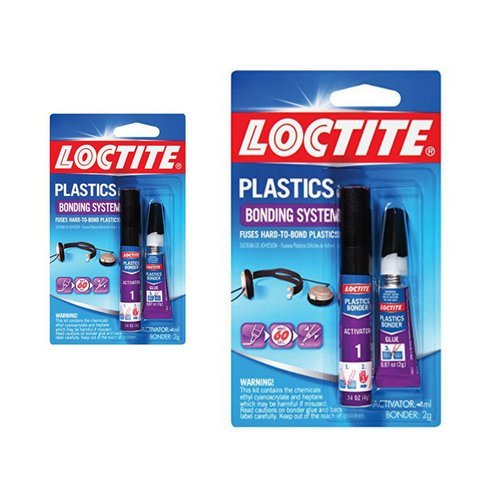
2. Loctite Super Glue Plastics Bonding System 2-Gram (2 Pack)
Two steps, one minute, and it grabs the waxy plastics nothing else will
Polypropylene and polyethylene are the reason half of all plastic repairs fail, and this kit is built specifically for them. You swipe the activator — a priming liquid that changes the surface so adhesive can bite — onto the hard-to-bond plastic, then apply the cyanoacrylate glue. The pair cures in 1 minute and sets without clamping. The full kit is two of these bottles, each with activator and glue.
This is a two-part cyanoacrylate system (a superglue that comes with a separate activator) rather than a single liquid, and that distinction is why it belongs here. The cured bond resists water, most chemicals, and freezing temperatures, so a cold garage or a damp shed will not undo it. Skin contact is the real hazard — the glue bites onto fingertips fast, and the instructions warn you plainly about it. Wood and acrylic bonded to polypropylene is the balance: think a hard case, a storage bin lid, or a mounting plate.
The honest trade-off is consistency. This is the technology for tough plastics, not a universal fix, and it is the wrong tool for a fiberglass RV water tank or a flexible bumper cover. If your part is rigid ABS or a clean break on a solid panel, one of the other picks will be simpler and surer. Pair it with the J-B Weld syringe above and you have both the difficult-plastic answer and the structural answer covered.
Where it earns its place: The activator step is the whole point. Without it, a standard super glue on a waxy plastic part slides off; with it, you get a real mechanical grip and a bond that shrugs off cold and moisture.
Be realistic about scope: This solves the polypropylene and polyethylene problem. It does not make itself universal, and treating it as a one-glue-fixes-everything product is how you end up disappointed.
Best fit: A rigid part made of polypropylene or polyethylene that has defeated every ordinary glue you tried.
Wrong tool for: Any joint that flexes or bends, and any surface where the plastic type is soft and pliable rather than firm.
3. Endhokn Epoxy Putty 10.5oz White Putty Stick

When a chunk is missing, mold the replacement by hand and let it set like stone
Some breaks cannot be glued because there is nothing left to glue together — a corner knocked off a plastic housing, a hole punched through a panel, a cracked pipe fitting. That is the job this putty handles. You knead the two parts together, press the soft clay into the gap, and shape it with your fingers. It stays workable for 30 minutes, then hardens within 24 hours into a surface you can drill, sand, and paint. The box holds 300 g — 150 g of Part A and 150 g of Part B — plus two pairs of gloves, a scraper, and an instruction manual.
Once cured it does not shrink and stays put, which is why it works as a long-term patch rather than a temporary smear. It has a working temperature range from -50 °C to 130 °C, so it survives both a freezer and a hot engine bay. It also cures underwater, which is rare and useful for a leaking tank or pipe that you cannot fully drain first. The white color takes paint well if you need the repair to disappear.
Where this beats a liquid glue is volume. A pack with 2 pieces versus 1 — the 2-pack of adhesive tubes against this single tub of putty — is the wrong way to think about it, because the putty covers a crack or hole that a drop of glue simply cannot bridge. Sanding after cure is the standard way to flatten it.
Why it earns a slot: Nothing else here fills a gap. The 24-hour cure and the 30-minute molding window give you real shaping time, and the -50 °C to 130 °C range makes it durable in harsh spots.
The honest catch: It does not give a pretty finish straight out of the tube. Getting a smooth surface usually means a sanding pass afterward, and 24 hours is a long wait if you need the part back today.
Reach for this if: you are filling a hole, sealing a leak, or rebuilding a missing section rather than joining two matching edges.
Not the pick for: a hairline crack in a thin, flexible plastic panel, where a low-viscosity liquid glue wicks into the split far better than a thick paste can.
4. Loctite Vinyl, Plastic, and Fabric Adhesive, Pack of 2 Clear

The repair that has to bend without cracking or showing a glue line
Not every plastic repair is a rigid break. Vinyl seats, padded covers, plastic trim backed with fabric, and flexible housings all fail in ways that a hard, brittle glue makes worse. This adhesive is clear, dries flexible, and is made to hold plastic, vinyl, glass, paper, and wood without going rock-hard. Prep the surface properly and it is the difference between a fix that lasts a season and one that peels off in a week.
Preparation is not a suggestion here, it is the whole method. A lawn mower seat pad reattached with it held firm through an entire mowing season, and the reason it worked was correct surface cleaning first. What earns the most mentions is simple effectiveness — it does the job it claims. The drying behavior is the second thing people notice: it tacks up in a way that lets you hold a piece in place and move on, rather than waiting around with clamps.
It is versatile beyond the obvious. A custom action figure project used it to bond epoxy and cloth into a flexible mask, and it glued a swimsuit repair without a visible line — clear enough for fabric-on-fabric work where a yellow glue mark would show. Durability does get mixed notes, so treat heavy, constantly flexing joints with care. Compared to the Loctite Plastics Bonding System above, this one is the flexible-bond partner, not the rigid-plastic solution.
The strength: A clear, flexible cure that works on vinyl, plastic, fabric, and combinations of all three — the only pick built for a bond that needs to move.
The limitation: Durability on hard-loaded rigid joints is not its strong suit. Use it where movement matters and rigid strength does not.
Pick this for: Vinyl seating, padded covers, flexible trim, and fabric-to-plastic repairs where a hard, brittle glue would crack off.
Look elsewhere for: A structural bracket, a bumper tab, or anything that needs to carry real load — those want the urethane or light-cured picks.
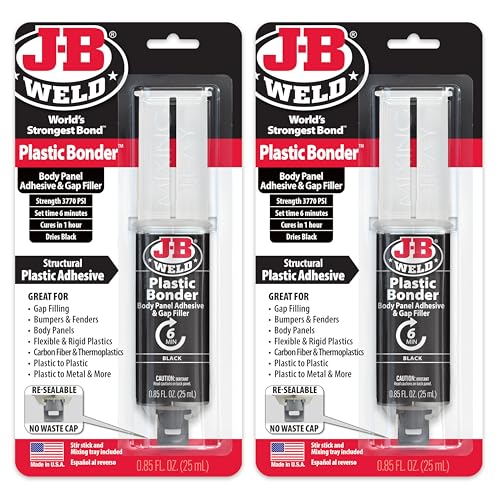
5. J-B Weld Plastic Bonder Black 25ml Syringe – 2 Pack
For a cracked bumper or a broken bracket, this is the bond that outlasts the part
When the repair has to survive road vibration, temperature swings, and actual load, this two-part urethane syringe is the heavyweight on the list. Strength is rated at 3770 PSI (pounds per square inch — a measure of how much pull the bond can take) — the highest figure here. Mix the two parts through the syringe in a 1:1 ratio, stir on the included mixing tray with the supplied stick, and you get a thick, gap-filling paste that sets in 15 minutes and fully cures in 30 hours.
The syringe design is the practical advantage that keeps you coming back. A re-sealable cap prevents the adhesive from drying out or leaking between uses, so a big project does not become a one-and-done tube. It handles thermoset and carbon fiber composites, thermoplastics, coated metals, PVC, concrete, ceramic and tile, fiberglass, and aluminum — which is why it turns up in automotive work constantly.
Automotive plastic repair is where it shines. Body panels, mirror housings, bumper covers, and interior trim are the usual suspects, and with a bit of tape on the surrounding paint the syringe dispenses cleanly without overshoot. It works as a gap filler on a cracked panel, and once set it takes paint and sanding like the original plastic. The black color blends into dark trim and bumper material well enough to go unnoticed at a glance.
The case for it: Highest tensile strength of the picks at 3770 PSI, a re-sealable 1:1 syringe, and heat, cold, and moisture resistance rated for automotive duty. It sets in 15 minutes and cures in 30 hours.
The catch: Two-part mixing means a bit more setup and a stronger chemical smell at work — ventilate. And 30 hours to full strength is the longest wait here, so a job you need back on the road now is not its strength.
The match for: A structural plastic repair — bumper, bracket, mirror base, body panel — where the fixed part has to bear weight and live outdoors.
Reconsider when: You want a one-drop, thirty-second job. This wants measured parts, mixed, and set, which is more hands-on than any other pick here.
Know the Specs
Cure Time and Set Time Explained
Set time is how long the part must sit still before it will hold; full cure time is when it hits rated strength. A UV glue here cures in 10 seconds under the light, the Loctite activator system sets in 1 minute, the urethane syringe sets in 15 minutes, and two of the picks need a full 24 hours. Always plan the repair around full cure, not set time.
Tensile Strength in PSI
Tensile strength measures how much pulling force a cured joint resists before it fails, in pounds per square inch. The J-B Weld syringe rates 3770 PSI and the light-activated glue 2800 PSI — both built for loaded plastic parts. A decorative trim piece that never gets stressed does not need the higher figure.
Liquid, Paste, and Putty Forms
Liquid glues wick into tight seams and give the thinnest bond line, which suits a hairline crack with matching edges. Paste formulas like the vinyl and plastic adhesive sit thicker and stay flexible. Putty is the only form that fills a hole or reconstructs a missing chunk, and it can be drilled and sanded after it hardens.
Surface Compatibility and Primers
Polypropylene and polyethylene are the two plastics that defeat standard cyanoacrylate glues. They need an activator, a primer that changes the surface, or a two-part system designed for low-energy plastics. Rigid ABS, polycarbonate, acrylic, and PVC bond without that extra step, so identifying your plastic first saves you the wrong purchase.
Common Questions
Will any of these glues work on a cracked car bumper?
How do I know if my plastic is polypropylene or polyethylene?
Do I have to use the UV light with the J-B Weld light-activated glue?
Is epoxy putty as strong as a liquid plastic glue?
How long should I wait before putting load on a plastic repair?
Can I use these glues underwater or on a wet surface?
Will the repair show on clear or light-colored plastic?
What is the difference between the two Loctite products here?
Can I sand or paint a cured plastic repair?
Does surface preparation really matter for these adhesives?
The Bottom Line
For most people fixing hard plastic, the glue for hard plastic repair winner is the J-B Weld Light-Activated Superglue because it lets you position the broken edges precisely, then locks them in 10 seconds under the included UV light (ultraviolet light — the same kind that cures some dental fillings) with a 2800 PSI cure. If you are working with waxy polypropylene or polyethylene, grab the Loctite Super Glue Plastics Bonding System with Activator, whose activator is the only thing that gives those tough plastics a real grip. And for a cracked bumper, bracket, or any part that has to carry load outdoors, the J-B Weld Plastic Bonder Black syringe is the one to reach for — at 3770 PSI it is the strongest bond here, and a quick 1:1 mix means you spend minutes, not hours, on the repair.
How we choose
We do not accept paid placement. Every pick is matched to a real buyer and a real use-case; we do not hands-on test units.
Sources
Specifications: manufacturer listings and product documentation. Review insights: verified customer reviews, as of October 2026. Pricing: not shown on this page (it changes often); check the current price via the retailer link.
As an Amazon Associate, Aappliancez earns from qualifying purchases. This does not affect which products we feature.