Disclosure: Some links in this post are affiliate links. As an Amazon Associate I earn from qualifying purchases, at no extra cost to you. Learn more
Specs are compiled from manufacturer listings and verified buyer reviews and can change over time — please confirm the key details on the product page before buying.
Gluing glass is the repair that punishes sloppy products. A weak glue lets a vase seam split under a little water pressure, and a cloudy one leaves a milky scar across a clean pane. The five picks below cover the three jobs people actually face: invisible small breaks, decorative work where the glass has to stay looking like glass, and structural mends where the joint has to carry load.
This guide is built by comparing the manufacturers’ published specifications and the patterns across verified customer reviews, so you get each pick’s real strengths and trade-offs instead of marketing spin.
Two things trip most people up. The first is transparent glass, because most strong adhesives dry cloudy. The second is opaque-to-opaque joints, where ultraviolet light simply cannot reach the glue. Work out which of those two describes your break and you can stop reading after one pick. The one that handles the widest spread of glass repairs is the light-cured tube in the top spot, which is why it headlines this list of the best glue for glass.
Top Picks

How To Choose Glue for Glass
The fastest way to end up with a failed repair is to buy a strong adhesive that cannot reach the glass surface it needs to grip. Almost everything else is secondary.
Can your light or air actually reach the joint?
A light-cured glue (one that sets only when ultraviolet light hits it) needs a clear line of sight into the break. A glowing torch aimed from outside will not set a layer that sits inside two opaque edges, so the glue stays wet where you cannot see. If the glass is clear, or one of the two pieces is, that changes everything. If both pieces are solid and dark, a two-part epoxy is the realistic answer.
How much load will the joint carry?
A decorative pendant on a window hanging and a shelf bracket glass panel are two entirely different quantities of stress. The tubes in this category advertise a tensile strength, which is the pulling force the cured bond can take before it separates. A higher number is a cushion against clumsy handling, not a licence to hang weight on glass that was never meant to take any.
Will the seam stay invisible?
Cured clarity only lasts if the cured material keeps its colour. Amber-tinted epoxy will show a warm line, and a clear gel can yellow on sunlit glass over time. For a repair on a drinking glass or a window pane, read the colour description carefully. For a bonded joint behind a mosaic, nobody will ever look at it.
Side-by-Side Comparison
| Model | Best For | Cure / Set Time | Capacity | Form | Amazon |
|---|---|---|---|---|---|
| J-B Weld Light-Activated Superglue★ Best Overall | Invisible glass and crystal breaks | 10 seconds with light | 5 g, 2-Pack | Liquid | Amazon |
| Akisey 100g UV Resin Kit with LightBest Bonding Kit | Small glass-to-glass ornament repairs | 5–10 seconds under 395nm | 100 g | Liquid resin | Amazon |
| Brampton Extra Strength Epoxy | Opaque joints that light cannot reach | 20-min work life, 24-hour full cure | 4 oz, 1:1 mix | Epoxy | Amazon |
| Limino UV Resin 200g | Coating and casting glass craft pieces | 2 minutes | 200 g | Liquid resin | Amazon |
| GDDP 200ml Mosaic Tile Glue | Glass mosaics and garden craft work | 2-hour surface dry, 24-hour full cure | 200 ml | Gel | Amazon |
Detailed Reviews
1. J-B Weld Light-Activated Superglue, Clear, 5g, 2-Pack
Our pick — 4.5+★ from 650+ verified ratings; the strongest balance of quality and price.
You get to line the break up perfectly, then set it on command with a torch.
That control is the whole reason this tube wins. The glue sits still until light touches it, so you can slide a chipped edge back into place without the panic that ordinary instant glue creates. Shine the included torch on the seam and the joint is solid ten seconds later — no clamps, no holding your arm still for five minutes. Buyers report it “cures in seconds under included UV light.”
Strength is the number that backs this up: 2800 PSI, the pulling force the cured bond can take. That is well above what a decorative glass repair will ever see, and it holds on the clear, smooth surfaces where weaker glue slides away — crystal, porcelain, and glass among the long list of materials confirmed as compatible. What people keep coming back to is the bond itself; the cured seam reads as hard and as clear as the glass around it, which is the real test for a visible repair. It holds a 4.5+ rating across hundreds of reviews, and repeat buyers keep coming back to it.
The honest catch is the cap: glue in the threads welds it shut. Once a little glue gets into the threads, it welds the cap shut and a partly used tube is finished. The torch head also detaches, which some owners treat as a bonus pocket black light. As for the drying debate, read the instructions: the bond holds in seconds, but full cure takes 24 hours, so don’t stress the joint on day one. And like any cyanoacrylate — the chemical family behind instant glue — the cured joint is hard but brittle, so it belongs on a static break, not on a flexing piece under load.
What justifies the top spot
- Cures in 10 seconds under the included light, so clamping and holding are gone entirely
- 2800 PSI tensile strength gives a real margin on small glass and crystal breaks
- Dries clear and hard, so the repair disappears on transparent pieces
- Stays repositionable until you switch the light on, cutting misaligned seams
- Two 5 g tubes in the pack, and a little goes a long way
Where it needs care
- A gluey cap bonds itself shut, so wipe threads clean every single time
- Takes 24 hours to fully cure even though the bond holds in seconds
- Brittle after curing, so high-stress or flexing joints are a poor fit
- The torch on/off switch starts very stiff and needs breaking in
Made for this: chipped crystal, split vase rims, jewellery repairs and any break where the seam will be on show and the piece sits still.
Look past it if: the joint you are fixing flexes under load or both broken faces are opaque, since the light has to land on the glue.
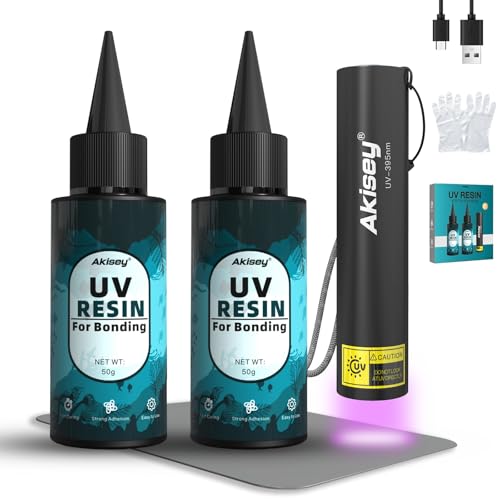
2. Akisey 100g UV Resin Kit
A whole bonding station in one box, torch and mat included.
Where the J-B Weld gives you a syringe-style precision tube, this kit gives you a hundred grams of liquid resin and a dedicated torch to set it. That maths is not close: 100 g against the 5 g in a J-B Weld tube, and the low-viscosity formula flows into gaps that a thick gel cannot enter. Under the 395nm flashlight — that number describes the ultraviolet wavelength the resin responds to — the resin sets in 5 to 10 seconds, as the listing states and as buyers confirm: “Under the irradiation of 395nm UV flashlight, the UV resin can fast cured in just 5-10s.”
The included 395nm flashlight is what makes the kit self-contained. It puts out 1300mw at 395nm, runs on a built-in 400mAh battery and measures 3.2 by 0.8 inches, so it slips into a drawer with the bottle. The silicone mat is 7.8 by 7.8 inches and comes with a pair of gloves and a storage bag, which means you can start a repair on the kitchen table without hunting for protection first. Working time is the invisible benefit: the resin stays liquid while you line up pieces, which makes assembling a multi-part glass ornament far less frantic than one-shot instant glue.
What you cannot do is bond two opaque pieces. Ultraviolet light has to land on the resin to cure it, so a hidden interior layer stays wet no matter how long you hold the torch over the outside — break the piece apart and the inside is still liquid, which is exactly the wrong result for a load-bearing joint. The resin also runs, so vertical faces need support while they set. For small transparent ornamental repairs, though, few things are this quick, and the fact that it is available in a kit with the torch, mat and gloves at a modest outlay makes it the easiest way to try light-cured glass work.
Assembly-friendly working time: parts stay puttable for as long as you like, then a 5–10 second blast locks them — ideal for a multi-piece glass ornament that would be impossible to clamp.
The colour caveat: cured resin reads clear on clear glass but turns foggy against coloured pieces, so keep it for transparent glass-on-glass work.
Reach for it when: you want a light, a mat and gloves in the same box and you are bonding glass to glass where light gets to the joint.
Steer clear of this one if: both pieces are solid and dark — resin this thin also runs on vertical faces, so it wants a flat or supported setup.
3. Brampton Extra Strength Epoxy

The pick for the repairs no light can reach and no water should break.
Every light-cured option above has one blind spot: a joint where the adhesive is buried between two solid pieces. This two-part epoxy has no such limit because it does not need light, air or any external trigger to cure — mixing the two parts starts a chemical reaction that hardens on its own. That makes it the only realistic answer for bonding glass to metal, tile to concrete, or a glass pane into a frame where the seam is sealed away.
The 20-minute work life is what makes it usable on a real project. You get a 20-minute work life, which is enough time to mix, apply and seat a piece before it starts to firm up, and the no-drip formula is designed to stay put on vertical surfaces rather than sliding down the wall. A 5-hour set time follows, with full cure around 24 hours, and it can be sanded and painted after roughly 20 hours — useful if the repair sits on something you intend to finish. “Easy to use. Worked well on brass sculpture. Very little dripping. Thick and sticky. I would buy again. Does take 24 hours or more to cure.”
The compromise is colour. The manufacturer lists amber as the cured shade, and a clear-glass repair will show a warm line if you use this — so treat clear glass panes as the wrong job for it and opaque or hidden joints as the right one. Mixing is 1:1, which is straightforward but needs doing properly; the two bottles beat a dual dispenser that clogs once the hardener creeps into the epoxy side. Where strength matters most, it delivers: one user glued a wooden frame together and found the joints outlasted the timber itself when they tried to take it apart. The flip side of that grip is its need for patience — leave it clamped for the full cure instead of testing it early.
Where it wins
- Cures without light, so it handles joints that UV glue can never reach
- 20-minute work life gives room to seat a piece properly
- No-drip formula holds on vertical surfaces instead of sliding
- Fully waterproof and rated for indoor and outdoor use
- Sandable and paintable after 20 hours, so repairs can be finished
What to expect
- Dries amber, not clear — a clear glass seam will show the tint
- Needs the full cure window before you lean on the joint
- Requires a careful 1:1 mix of two parts rather than a single squeeze
Pick this when: your break is opaque-to-opaque, exposed to weather, or a structural glass-to-metal joint that needs to hold long term.
Not the one for: a drinking glass or window pane where the seam must stay invisible — the cured amber tint will show.
4. Limino UV Resin 200g

Two hundred grams of glass-clear resin that pours itself flat.
If your glass work is really coating and casting rather than gluing two broken edges, this bottle is the volume buy. It holds 200 g against the 5 g in a J-B Weld tube, and the self-levelling and self-degassing formula spreads itself to a smooth, glassy surface — useful for sealing the top of a glass pendant or building up a clear dome over a small piece. Curing takes around two minutes under light, or it will set in sunlight if you leave the piece out.
The curing is where you have to pay attention. A little warmth before curing also helps thin the resin so it flows and cures evenly, and you should let the piece cool fully before handling it or you leave fingerprints in the surface.
The draw is the glass-clear gloss; the tacky surface on thick pours is the thing to manage. Mixed thoroughly and cured under strong enough light, this dries to a high gloss that masks brush marks and makes small detailing pop. The one habit to avoid is curing a flat object unevenly, which can warp it — flip and rotate the piece between passes. And if you are mixing in colour, go gently; the bubbles come from stirring too hard, and a slow fold keeps the finish clean.
The volume play: a 200 g bottle goes a long way when you are coating small glass pieces rather than bonding structural joints, which is where its value sits rather than raw holding power.
The tackiness caveat: expect a slightly gummy surface on thick pours and finish it off in the sun, since weak light will leave it wet.
Great for: jewellery makers and crafters coating, casting or sealing glass pieces repeatedly, where bottle volume matters more than tack-free speed.
Better options exist if: you need a two-piece structural bond — sizing up on volume is not the same as gluing a load-bearing break — or you only own a weak nail lamp.
5. GDDP 200ml Clear Mosaic Tile Glue
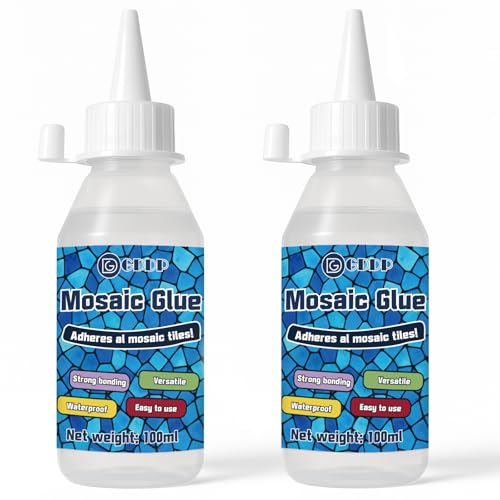
A grippy gel built for setting glass tiles and beads where they stay put.
This is the pick for the person laying small glass pieces onto a backing rather than mending a break. It comes as a non-drip gel, so it sits where you put it instead of running down a vertical frame, and the surface dries in about two hours with a full cure around 24. The clear finish is the point: it holds glass, beads and ceramic without hiding the colour of what you have stuck down, which is what you want on a mosaic or a framed craft panel.
Its waterproof, weatherproof formula is what separates it for outdoor exposure. If the mosaic goes on a garden wall or a patio, water and the elements are the enemy of most adhesives, and this one is formulated for exactly that. It also takes holding without sliding — the slow dry lets you nudge a tile into position, which matters when you are laying a pattern and the second row depends on the first being square.
The honest limit is glass to glass, where the gel needs the piece held flat until it dries. On its own the gel does not grip two smooth faces well unless the piece is held flat until it dries, so a joint under load or a curved glass-on-glass seam is the wrong job. There is also a colour question on clear glass — a clear-drying glue can pick up a yellow tint when it sets against transparent material, and a white mosaic adhesive is the more forgiving choice if you are working with sea glass. The gel is tacky enough that it is not a children’s craft glue. “Working well on the project. Dries clear, easy to use.”
Go for it if: you are laying glass tiles, beads or shells onto a backing and need a non-drip gel plus waterproof protection for garden or patio work.
Choose a different adhesive if: your job is a structural glass-to-glass joint, since this gel needs the piece held flat until it sets and is a weak hold on two smooth faces.
Know the Specs
Tensile Strength (PSI)
Tensile strength is the pulling force a cured bond resists before it separates, measured in PSI — pounds per square inch. A high figure like 2800 PSI means the joint is far stronger than any decorative glass repair will ever need, so your margin against a mishap is comfortable. It says nothing about how the joint behaves under twisting or flexing, which is a separate weakness of very hard, brittle adhesives.
Cure Time vs Work Life
Work life is how long you have to position a piece before the adhesive starts to set; cure time is how long until it is fully hard. A light-cured glue can have seconds of cure but unlimited work life, because it does nothing until the light is on. An epoxy trades that for a fixed 20-minute window you must work within, then a full cure measured in hours.
UV Wavelength and Light Power
Ultraviolet-curing adhesives respond to a specific wavelength of invisible light, often 395nm in the lamps sold with these kits. The wavelength has to match the resin’s sensitivity and the lamp has to deliver enough power to drive the reaction through the thickness of the glue. A weak lamp leaves a tacky surface even after the full sum of time, which is why users upgrade to stronger nail lamps or sunlight.
Clear vs Amber Finish
The cured colour decides whether a repair stays invisible. A clear glue on clear glass disappears because light passes straight through it. An amber-cured epoxy shows a warm line, so it is right for hidden or opaque joints and wrong for a visible glass seam. Keep the two jobs mentally separate and you will not waste a tube on the wrong repair.
Common Questions
Can I use UV glue to fix a cracked drinking glass?
What glue holds glass to metal?
Why does my UV resin stay tacky after curing?
Does the Brampton epoxy dry clear on glass?
How long should I hold a glass repair before it sets?
Is the GDDP mosaic glue safe for a glass mosaic outdoors?
Can I use standard superglue on glass?
Will a light-cured glass bond pop off in water or cold weather?
Do I need a high-wattage UV lamp for the Limino 200g resin?
The Bottom Line
Start with your break and work backwards. If the seam is on show and both surfaces are transparent enough for light to reach the glue, the J-B Weld Light-Activated Superglue is the one worth keeping in the drawer — the 10-second cure and 2800 PSI strength make a hard, clear bond that stays invisible, and the honesty about the cap fuss is a fair trade for that result.
For a kit that covers light, mat and gloves in one box, the Akisey 100g UV Resin Kit is the friendlier starting point. When the joint is opaque or has to survive weather, the Brampton Extra Strength Epoxy is the one that cures without any light at all. And a glass mosaic on a patio wall wants the GDDP Mosaic Tile Glue for its non-drip gel hold.
How we choose
We do not accept paid placement. Every pick is matched to a real buyer and a real use-case; we do not hands-on test units.
Sources
Specifications: manufacturer listings and product documentation. Review insights: verified customer reviews, as of October 2026. Pricing: not shown on this page (it changes often); check the current price via the retailer link.
As an Amazon Associate, Aappliancez earns from qualifying purchases. This does not affect which products we feature.