Disclosure: Some links in this post are affiliate links. As an Amazon Associate I earn from qualifying purchases, at no extra cost to you. Learn more
Specs are compiled from manufacturer listings and verified buyer reviews and can change over time — please confirm the key details on the product page before buying.
The short answer: most people shopping for TV glasses are choosing between two different jobs — 3D movie glasses that make a compatible projector or TV pop, and blue-light or magnifying glasses that make the screen easier to look at for long stretches. If you own a DLP-LINK 3D projector, go straight to the AWOL VISION pair. If your problem is glare, eye fatigue, or just reading the small text on a big screen from across the room, the blue-light and magnifying picks further down are the ones that actually change your evening.
This guide is built by comparing the manufacturers’ published specifications and the patterns across verified customer reviews, so you get each pick’s real strengths and trade-offs instead of marketing spin.
Fit and compatibility matter more than any spec sheet here, so this breakdown covers the rechargeable active-shutter options, the light-filtering frames, and the magnifying designs, and it explains what each really does for your eyes. That is why the picks below are the strongest glasses for watching TV you can put on today.
Top Picks


How To Choose The Best Glasses for Watching TV
Before you buy anything, answer one question honestly: what is the screen doing that you dislike? If you own a 3D-capable projector and want the depth effect, you need active-shutter glasses that sync to that exact projector. If the problem is tired eyes or a headache after a long night of watching, you need a lens that filters blue light. If you simply cannot read the small text on your TV from the sofa, you need magnification built for distance viewing. Those are three separate products, and buying the wrong type is the single most common mistake in this category.
Sync technology decides 3D glasses
Active-shutter 3D glasses work by darkening each lens in time with the screen, so your left eye and right eye see different frames. DLP-LINK models read that timing signal straight off the projected image, so they need no separate emitter box. IR, RF, and Bluetooth models pair with a transmitter instead. Match the sync type to your TV or projector first — everything else is secondary.
Why weight and lens adjustment matter more than you think
A pair that feels fine for ten minutes can dig into your nose an hour into a film. Look at the weight in grams, whether the frame is built to sit over your prescription glasses, and whether the lenses focus or adjust individually. Those three details decide whether the glasses end up on your face or in a drawer.
Side-by-Side Comparison
| Model | Best For | Type | Weight | Fits Over Glasses | Amazon |
|---|---|---|---|---|---|
| AWOL VISION DLP Link 3D Glasses★ Best Overall | 3D projector owners | Rechargeable active shutter | 28 g | Yes | Amazon |
| Samsung SSG-3050GB 3D Active GlassesBest Value | 2011+ Samsung 3D TVs | Battery active shutter | 1.2 oz (33 g) | Yes | Amazon |
| GUNNAR VertexMost Popular | Screen fatigue relief | Blue-light lens frame | — | — | Amazon |
| PRIMALS Blue Light Blocking Glasses | Nighttime TV viewing | Red-lens blue blocker | — | — | Amazon |
| Versace VE3186 Eyeglass Frames | Prescription TV lenses | Optical frame | Lightweight acetate | — | Amazon |
| Eschenbach Tv-Glasses | Projected TV up to 10 ft | 2x magnifying glasses | 52 g | — | Amazon |
| Gucci Women’s Optical Gray Glasses | Designer TV frames | Optical frame | — | — | Amazon |
| Bigeyes H3 Head-Mounted Display | Private movie watching | Dual-LCD HMD | Lightweight | — | Amazon |
| Ra Optics Daylight Lenses | Daytime screen use | Blue-light lens frame | — | — | Amazon |
| 2.1X Eschenbach Max TV Glasses | Distance TV viewing | 2.1x Galilean glasses | 1.7 ounces | — | Amazon |
| XREAL 1S AR Glasses | Giant private screen | OLED AR glasses | 0.08 kg | — | Amazon |
Detailed Reviews
1. AWOL VISION DLP Link 3D Glasses 2 Packs
Our pick — 4.5★ from 300+ verified ratings; the strongest balance of quality and price.
Two pairs of rechargeable active-shutter glasses that pull their 3D sync straight from a DLP-LINK projector’s image.
If you have an AWOL VISION LTV-2500, LTV-3000 Pro, LTV-3500 Pro, or any other DLP-LINK 3D projector gathering dust because nobody owns glasses, this two-pack is the shortcut back to a 3D night. The pair skips the transmitter box entirely — the lenses read the timing signal off the projected image itself, so setup is charging them and pressing the button on top until the blue light comes on. It is the same two-second ritual whether you are running a Vanish TV or a ViewSonic projector.
The number that stands out on a long movie night is the built-in rechargeable battery, rated for up to 50 hours of continuous play — roughly 15 films before you hunt for a cable. At 28 grams they are light enough that a full double feature does not turn into a headache, and the 178° viewing angle holds the 3D effect across a wide seating spread, so the far end of the couch is not stuck with a warped image. Owners describe them as brighter and cleaner than the bulky DLP glasses they used before, and the large frame is built to sit over myopic prescription glasses rather than replace them.
Here is the catch worth knowing before you order. The hinge is the recurring weak point — the glasses are not built for being tossed into a drawer or handed around a house full of kids, so treat them with a little care and they hold up fine. A few users also note there is no automatic mode detection and the open-sided frames let some ambient light in, which shows up as a flicker of distraction if your room is bright. The wider reality is that most owners are happy: the quality and how well these actually function are what people talk about, and long-term buyers report pairs surviving several years of use. It is also worth knowing that DLP-LINK sync, while convenient, is a per-press affair rather than the instant auto-pairing some other systems offer — a minor trade for not needing a transmitter.
Why It Earns The Top Slot
- Rechargeable battery rated for up to 50 hours of continuous play
- 178° viewing angle holds the 3D effect across wide seating
- 28 g frame fits over prescription glasses
- Works with AWOL VISION LTV-2500, LTV-3000 Pro, LTV-3500 Pro, Vanish TV, and other DLP-LINK projectors
Where It Asks For Care
- Hinge is the reported weak point over time
- No automatic mode detection — 3D mode is a manual button press
- Open-sided frames let in a little ambient light
Made for: anyone with a DLP-LINK 3D projector and a two-seat cinema at home.
Think twice if: your 3D projector relies on IR or Bluetooth sync rather than DLP-LINK.
2. Samsung SSG-3050GB 3D Active Glasses – Black
The smartest way to fill a room with 3D glasses for a 2011-or-later Samsung 3D TV.
Samsung’s SSG-3050GB solves a problem the AWOL VISION pair does not: it pairs over Bluetooth, so there is no image-sync ritual and no transmitter to think about. You press the power button until the indicator blinks red and green, the TV confirms the connection, and you are in. Setup takes seconds, which matters a lot when you are handing glasses to a house full of guests instead of settling in for a solo movie.
At 1.2 oz (33 g) they are lighter than the AWOL VISION pair, and the open front is designed to sit over prescription glasses. The 3D picture itself is bright with virtually no crosstalk — owners compare the detail favourably to the Real 3D they have seen in a cinema, and kids around five years old wear them without trouble. Pairing is where these earn their keep: buy four and the whole family is covered, with each pair connecting in seconds.
The honest trade-offs are worth knowing up front. The on/off switch is hard to read, so it is easy to leave a pair on and drain the battery — a small habit to build, but one that catches new owners. The open frame means no side panels, so light leaks in from the edges of your vision. And these are built for Samsung TVs of the right generation; they will not pair with a 2010 model or another brand. A fragile hinge holds up under normal care but will not survive being tossed in a bag. For the price of a single premium pair, this is the one that gets a whole room watching 3D.
What makes the buy easy: Bluetooth pairing in seconds, 1.2 oz (33 g) build, and a fit that covers adults and children alike. Buy four, and nobody fights over the good pair. The battery handles a long evening of viewing, and the auto power-off when the 3D signal stops saves you the forgetful-drain problem.
The honest catch: no side panels means ambient light leaks in from the edges of your vision, and the hinge is the part that fails first if the glasses live loosely in a drawer.
Reach for this if you own a 2011-or-later Samsung 3D TV and want enough pairs to fill the sofa.
Look elsewhere if your 3D TV is a 2010 model or a different brand — the pairing will not connect.
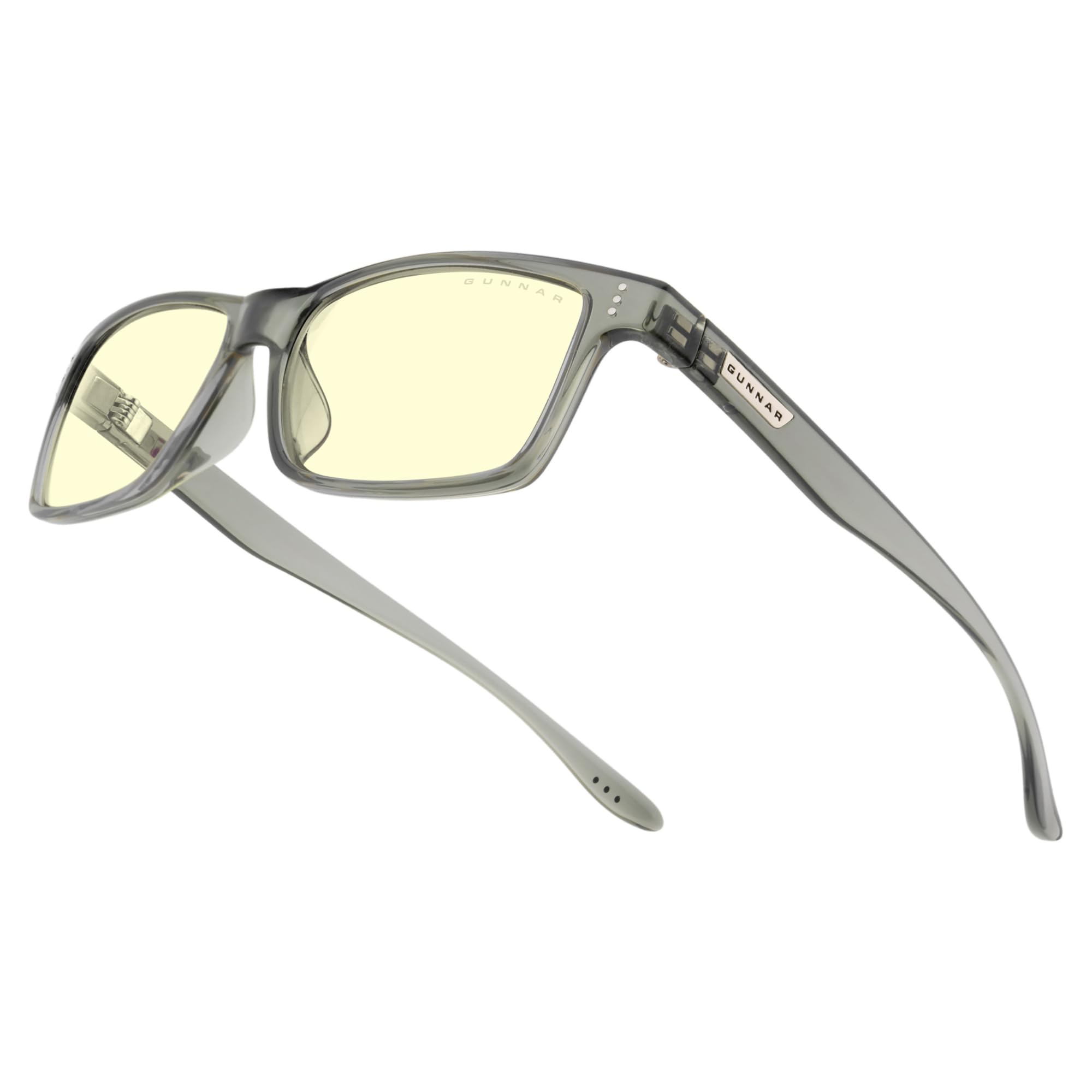
3. GUNNAR – Premium Gaming and Computer Glasses – Vertex
The pick for anyone whose eyes ache after a night of movies, gaming, or a long workday in front of a screen.
GUNNAR’s Vertex is a blue-light lens frame rather than a 3D accessory, and the tint system is what separates it from the field. The clear tint blocks 35% of blue light at 450nm — the wavelength most associated with screen glare — for office work, photo editing, and graphic design. The amber tint, the most popular option, blocks 65% at 450nm for all-purpose computer work, reading, and data entry. An amber max tint blocks 98% at 450nm for extreme photosensitivity and sleep control, and a sun tint blocks 90% at 450nm for outdoor digital viewing. Pick the tint that matches your evening, and the filter strength scales with it.
Owners mention the tint eases the eye strain and headaches that follow long screen sessions, and the frame holds up over time. The lens tint also does something useful for a TV watcher — it cuts the harsh edge off a bright panel in a dim room, so you can watch later without the screen feeling like it is poking back at you. The frame is built for everyday wear rather than a special occasion, which suits the person who wants one pair to cover work and evening viewing.
The trade-off is a split reaction to clarity — some people find the lenses vivid, others pick up glare depending on the room lighting and the angle of the screen. Durability is the other soft spot, so store them in a case rather than a pocket. Neither complaint takes away from the core job: for the office worker who games at night and watches movies after, this is the most flexible pair in the list.
Why it wins the desk-and-couch crowd: four tint grades (35%, 65%, 90%, and 98% blue-light reduction at 450nm) mean you can pick a filter strength that matches how much screen time you log and how sensitive your eyes are to a bright panel at night.
One thing to know: the amber max tint is designed for extreme photosensitivity and sleep control, so its deep colour is a deliberate choice rather than a subtle filter.
Ideal for: anyone who splits their time between a work screen, a gaming session, and an evening movie — one frame covers all three.
Skip if: you need a 3D sync system for a projector, since the Vertex is a filter lens with no active sync at all.
4. PRIMALS Blue Light Blocking Glasses Red Lens

The deep-red filter for the person who watches TV right up until bedtime.
PRIMALS goes further than the amber crowd. The red lens blocks 99.9% of blue light, and the frame is built for the exact moment most people feel a screen at night — the last hour before bed. The fit is comfortable, the frame reads as a real pair of glasses rather than a piece of kit, and the case it arrives in is genuinely good. The glasses are aimed at computer, gaming, TV, and phone use, and they cover all four.
The strongest feedback comes from people who wear them through long screen sessions: eye protection comes up most often, with nose comfort close behind. One user reports “I’ve been falling asleep faster since wearing these in the evening” — the result this pair is built for if you watch late. Comfort is personal, but most people who try these find them comfortable.
The honest note here is durability. These glasses hold up fine with normal care, but a couple of owners have found the build less sturdy than they wanted and questioned whether it justifies the price tag — the frame is not armour, and it will not survive being sat on or knocked around in a bag. Treat them as a dedicated pair for the sofa and the bedside table, and the value story is much stronger. For the price bracket, the 99.9% block is the highest in this list, and if your goal is winding down before sleep, that is the number that matters most.
What Owners Love
- Blocks 99.9% of blue light — the deepest filter in this guide
- Comfortable enough for long computer, TV, and phone sessions
- Case is good quality, so the glasses travel safely
- Designed around evening and pre-sleep screen use
The Fine Print
- A minority find the build less sturdy than expected for the price
- The red tint changes the colour of everything you watch, so it is not a pair to wear around other people
- Best kept as a dedicated evening pair rather than an everyday frame
Buy these when your biggest screen problem is the last hour before bed and you want the strongest blue-light filter in the lineup.
Not the right pair if you need a clear-tint lens that looks like normal glasses out in public.
5. Versace VE3186 Eyeglass Frames GB1-54 – Black

A designer frame you take to the optician so your TV prescription finally looks like a deliberate choice.
Some people do not want a 3D pair or a red tint. They want a frame they would wear out to dinner, and that they can have fitted with lenses tuned for the exact distance they watch TV from. The Versace VE3186 is built for that — premium acetate, a classic shape, and pyramid studs on the temples that give the frame its character without going loud. The style reads elegant in everyday life, which is more than can be said for most of the functional pairs in this guide.
What people consistently like is how these feel on the face. The frame is lightweight, does not dig in anywhere, and does not pinch — the three things that decide whether a pair actually gets worn through a three-hour film. The shape is deliberately not too big and not too small, which owners describe as just right on the face. The frame is authentic Versace, and the box, case, and logo cloth all arrive with it, so the presentation matches the brand on the temple.
The one thing to plan around is lens installation. These arrive as frames, so you need to take them into an optician to have your prescription cut and fitted — you cannot pick them up and start watching. A few buyers have received a box that arrived crushed in shipping, so check the package when it turns up. Design is subjective, and a small number of buyers have found the shape larger than the photos suggest, so it pays to check the size chart against your own face before you commit. For the buyer who has wanted to swap out of a utilitarian pair, though, these are the ones that finally feel like an upgrade.
The reason people keep coming back: a lightweight acetate frame that stays comfortable through a full film, with the sort of shape that stays in style after the current trend moves on.
Do not forget: the price buys the frame only — the prescription lenses and the fitting trip to the optician are extra.
Right choice for the viewer who wants a TV-distance prescription in a frame that looks intentional.
A mismatch if you wanted glasses that work from the start and need no optician visit at all.
6. Eschenbach Tv-Glasses

A 2x magnifier built to double a TV image from up to 10 feet away.
These are not blue-light glasses and not 3D glasses. They are a magnifying system aimed at one very specific job — making a screen readable for someone who cannot get the detail back by sitting closer. Eschenbach builds them around a 2x magnification and a 9° field of view, which the maker describes as “dual-size TV from up to 10 feet away.” The lenses sit in a plastic and acrylic housing, they weigh 52 g, and the large focusing range is what makes the image sharp rather than a blurry wash.
The owners who get on with them describe a real change in the room. A larger, clearer picture means a person can sit back on the sofa with the rest of the family instead of pulling a chair to within a few feet of the screen, and one user says the adjusters are stiff for tender hands but stay exactly where you set them once dialled in. Reading small on-screen text — streaming menus, subtitles, channel guides — becomes possible again, which is what pushes many buyers to try a pair in the first place.
The catch is that magnification at a distance is a narrow tool, and it demands a specific setup. The field of view is small, so you are looking straight ahead through a window rather than at the whole room, and standing or walking while wearing is not advised. Users also note the plastic build feels lightweight for the price, and the adjusters take some patience. Where it fits, it fits well; where it does not, the dual-size claim and the focus range are the things to check against your own viewing distance before you commit.
The core value: a 2x magnifier with a 9° field of view that turns a distant screen into a near one, from up to 10 feet away. For someone whose sight has shifted and who has been watching TV from too close, that is a real change to how the lounge works.
The fit note: this is a specialist pair, so the person who needs to glance around the room mid-programme will find the narrow field of view restrictive.
Best for: someone who has moved a chair close to the screen because distance viewing has slipped, and wants to sit back again.
The wrong tool for: anyone who wants peripheral vision intact while watching, or who needs to walk around with the glasses on.
7. Gucci Women’s Optical Gray Glasses, Black/Transparent

A designer optical frame for viewers who want their TV prescription to look sharp rather than functional.
Like the Versace pair above, these Gucci frames arrive empty — you take them to your optician, have the prescription lenses cut, and then wear them for the distance you watch from. The GG0634O model is built from the same premium acetate Gucci uses across its optical line, and the black-and-transparent colourway reads as a deliberate style choice rather than a default black frame. If the point of buying a designer pair is that you keep them on after the film, this is where the frame earns its keep.
The response from owners is overwhelmingly about how the frame looks. People describe the frames as beautiful, and the common note is that they wear them every day — which is the highest compliment a TV-distance prescription frame can get. The look works for a wide range of face shapes, and the frames take standard prescription lenses without trouble. The Gucci badge and the packaging round out the purchase for anyone who wants the brand experience to match the price.
The one thing to verify before you buy is the shape. The listing describes a rectangular frame, and some buyers find the frame is more of a cat-eye in person, which is lovely if that is what you wanted and a mismatch if you specifically wanted a rectangle. The listing is also tagged for the men’s department alongside the women’s, so check the fit on your face rather than relying on the department label. It is a strong frame for someone who treats glasses as an accessory, as long as the shape matches expectations on arrival.
What the frame delivers: an optical frame in black and transparent acetate that wears as jewellery for the face, and that stays on all day because it looks the part.
What to verify first: the shape — several buyers describe the frame arriving closer to a cat-eye than the rectangular listing suggests.
Suits you if you want a designer frame you will wear from morning to the last programme of the night.
Not for you if you wanted a rectangle — check the shape carefully before ordering.
8. Bigeyes H3 Head-Mounted Display, 300-Inch HD Virtual Screen

A private 300-inch screen with a built-in battery for watching TV in bed without waking anyone.
This is the pick for the person who watches TV in bed, on a plane, or at a campsite where a screen is out of the question. The Bigeyes H3 straps a pair of built-in LCD panels to your face and shows a 300-inch virtual image powered by HDMI from a set-top box, TV stick, games console, or PC. Because everything is enclosed, nothing on the screen leaks out into the room — which is exactly the point if your viewing happens after everyone else has gone to sleep.
The setup details are what make or break it. Diopters adjust from 0 to 500 degrees, so myopic viewers can use it without their prescription glasses, and the pupil distance adjusts between 60 and 70 millimetres, which the maker says suits nearly all people. A soft sponge eye mask and adjustable head strap tame the tightness for long wear, and the built-in rechargeable battery delivers up to 3 hours of continuous playback without drawing power from your source. The display resolution is 1280 x 720 per panel at 60Hz, which is honest 720p, and movies and TV look the part at that resolution.
Be clear on what this is for. It is a personal cinema and nothing else — the maker says plainly it is not ideal for text, office work, or CAD. A few buyers have found the focus fiddly and better suited to one-eyed setup, and there is a recurring note about dust trapped inside the lens plastic on returned units. The headphones bundled in the box are weak, so plan on a decent pair of your own. Treated as a private movie screen for the bedroom or a long journey, the H3 delivers a giant image without a giant television.
Where It Delivers
- 300-inch virtual screen from a single HDMI cable
- Diopters adjust from 0 to 500 degrees so myopic viewers skip their glasses
- Pupil distance adjusts between 60 and 70 millimetres
- Built-in rechargeable battery rated for up to 3 hours of playback
- Fully enclosed, so no light leaks to the rest of the room
Where It Struggles
- 720p panel resolution, not 1080p
- Focus takes fiddling, and there are reports of dust trapped inside the lens plastic
- Bundled headphones are poor — bring your own
- Not built for text, office work, or precision tasks
Choose this when you want a private giant screen in bed, on a flight, or at a campsite and do not mind a 720p display.
Pass on it if you want to read small text or do any precision work on the screen.
9. Ra Optics Daylight Lenses

A daytime filter meant for screens you watch in a bright room rather than a darkened bedroom.
Most blue-light glasses are sold for the evening, when a screen in a dark room feels harsh. Ra Optics goes the opposite way — Daylight Lenses are built specifically to filter the harshest blue wavelengths during the day, which is when most people spend the longest continuous stretch in front of a screen. The frame is unisex and the lens colour is a deliberate result of the filter rather than a style choice, so if you wear a blue-light pair while doing a day of work in front of a screen and then watch a programme in the evening, these are meant to stay on your face the whole time.
The technical pitch is the draw: the lenses carry a filter tuned to the wavelengths Ra Optics calls the most harmful, and the frame targets anyone logging long screen hours for work, gaming, or streaming. The frame is built for the everyday wearer, and the target user is someone whose eyes are doing long, steady periods of screen time rather than the occasional film. For that buyer, the Daylight Lenses are the closest thing to a single pair that covers a whole day of screens.
The honest note here is that the Daylight Lenses are a specialised filter rather than a general-purpose pair. The colour of the lens is the filter at work, so you should not expect a clear tint, and the frame is best treated as a personal pair for long screen sessions rather than something you share. If your goal is a filter tuned to the daylight hours — the ones where most of your screen time actually lands — this is the pick that matches the job.
The job it takes on: filtering the harshest blue wavelengths during the day, when most people log the bulk of their screen hours, rather than only at night.
The trade-off: the tint is visible, and the frame is meant as a personal pair for long screen sessions — not a pair to share around the room at movie time.
Ideal for: someone whose main screen time happens during the day and who wants a single pair to carry into the evening.
Not the match if you specifically want an evening-only pair, where a deeper red-tinted filter makes more sense.
10. 2.1X Eschenbach Max TV Glasses Distance Viewing

The step up from the standard Eschenbach pair — a 2.1x magnifier with a wider field of view for distance viewing.
These rise above the standard Eschenbach pair on one key number: a 20° field of view instead of the narrower 9°. That is the difference between a peephole and a window. The Galilean lens design delivers a bright, wide image at 2.1x magnification, and the individual objective lenses each focus on their own — the maker rates the adjustment at up to +/- 3D of spherical correction, with a focal range from 10 feet to infinity. In practice that means you can dial the image to your eyes rather than adjusting your seat to the glasses.
The build details are as thoughtful as the optics. Each pair is engineered for wearers with binocular pupil distances between 60 and 68 millimetres, and the frosted objective lens housing cuts the reflections that would otherwise flare across the image. The moulded bridge has no sharp edges, so the frame stays comfortable even through a long film, and at 1.7 ounces the whole thing is light enough to forget. Owners describe a meaningful change in how much detail they can pull out of a TV across the room, with faces and large print coming back into focus beyond 10 feet.
Two things to understand before you buy. This design is built for people with moderate refractive error rather than severe vision loss — the maker says plainly it may not work for individuals with AMD or other severe vision conditions, so check the match first if that applies. The plastic build is the other soft spot, and a small number of owners have found the hinge is the part that fails first over time. Where it fits, the wider field of view is the reason people pick this over the standard pair.
The upgrade case: the 20° field of view against the standard pair’s 9° makes it a wider, more natural image, and the individual focus settings mean both eyes can be dialled in separately.
Check compatibility first: the maker does not recommend these for severe vision loss including AMD, so confirm that match before ordering.
The right pair for anyone with moderate refractive error who wants a wider field of view than the standard magnifying TV glasses offer.
The wrong fit if you have severe vision loss — the maker is clear these are not designed for that.
11. XREAL 1S AR Glasses
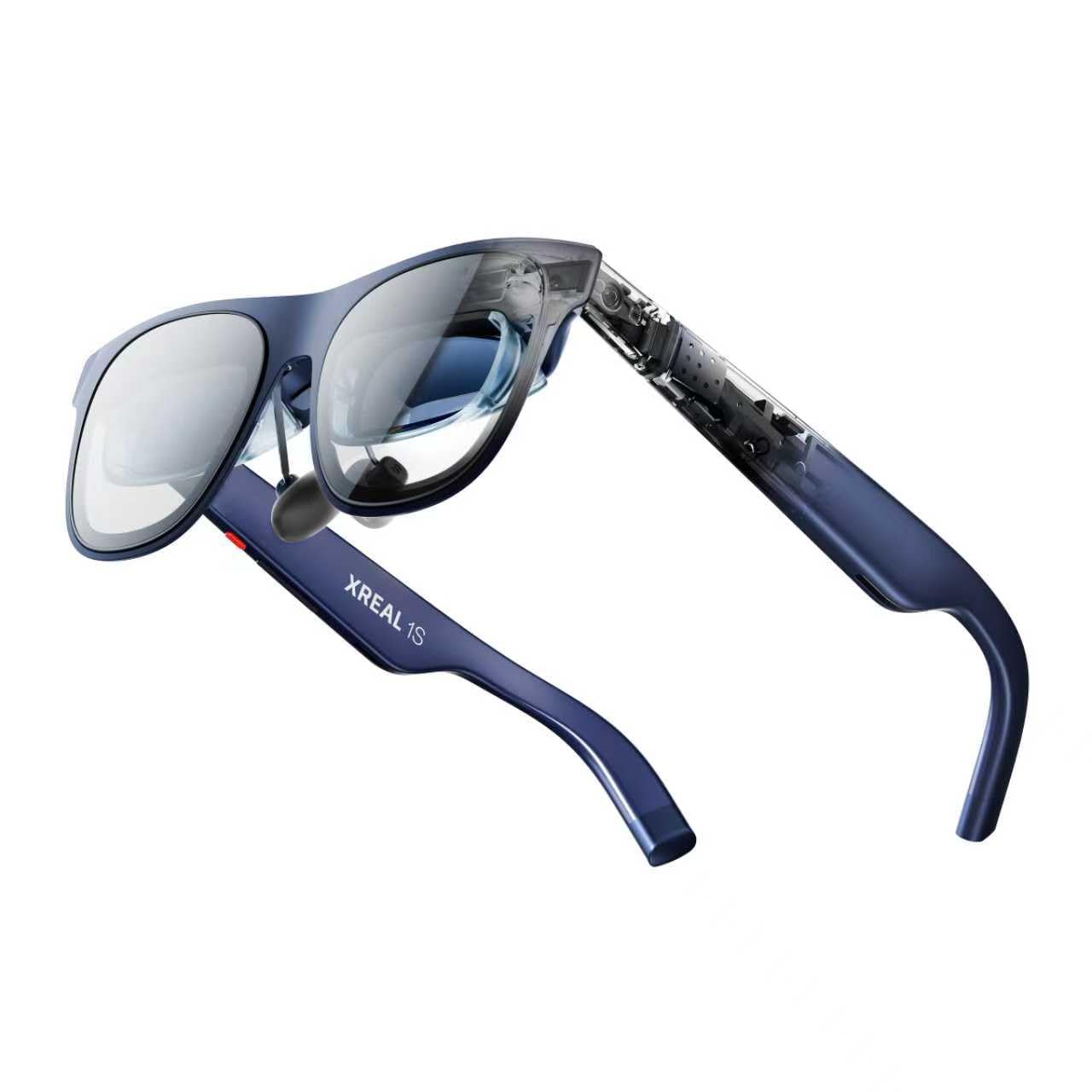
The premium pick for anyone who wants a giant private cinema that plugs into a phone or handheld with one cable.
This is what happens when the TV glasses idea grows up. The XREAL 1S projects a virtual screen up to 500 inches, runs an OLED display at 1920 x 1200, refreshes at 120Hz, and carries a 52° field of view — all on a dual-lens system that rests on your face and connects to any USB-C DisplayPort device with no app and no setup. A self-developed X1 chip handles the spatial processing locally, with 3ms motion-to-photon latency, and the frame is individually colour-tuned and distortion-tuned so the image does not wobble as your head moves.
The hardware reads like a top-tier product. IPD adjusts between 59.5 and 70.5 millimetres, the frame is TÜV Rheinland certified for eye comfort, and the audio is co-developed with Bose for an open-ear system that keeps the room around you audible. Native 3DoF keeps the screen anchored while you glance around, and a REAL 3D mode converts standard content to spatial depth on a button press. Owners compare the image favourably to rival AR glasses, with clean, sharp text even for people who wear reading glasses, and the metal frame signals the premium build.
Know the limits before you commit. There is no diopter adjustment, so anyone with a strong prescription needs custom lenses rather than a dial, and a few users have run into early bugs — a tutorial that froze, the occasional “video not supported” error, and HDCP limits that cap some content at 1080p. The nose pad is not as comfortable as some rivals from the start, and the extra TPU cover adds a little weight. For the buyer who wants the biggest screen and the crispest text and will accept the setup quirks, the 1S is the flagship pick in this guide. For everyone else, the simpler plug-in designs above will do the job for far less.
Where It Leads The Group
- Up to 500-inch virtual screen from a single USB-C cable
- 1920 x 1200 OLED display at 120Hz with a 52° field of view
- Native 3DoF anchor mode, plus a REAL 3D mode for any content
- TÜV Rheinland certified for eye comfort, with 100% UV protection
- Bose-tuned open-ear audio
Where It Leaves Room
- No diopter adjustment — strong prescriptions need custom lenses
- Early software bugs: tutorial freezes and occasional “video not supported” errors
- HDCP caps some content at 1080p
- Nose pad comfort needs a third-party replacement for some owners
Worth it for anyone who wants the biggest, sharpest private screen and a premium metal build.
skip it if you need built-in focus adjustment or want a bug-free experience from day one.
Know the Specs
Blue-light blocking percentage
When a pair of glasses claims to block blue light, the number tells you how much of that wavelength the lens stops. A clear tint that blocks 35% at 450nm (450nm is a specific wavelength in the blue part of the spectrum) is a light filter meant for office work and photo editing, where you want the colour on the screen to stay close to true. A 65% filter is the all-purpose workhorse for computer, reading, and data entry. A 98% filter is reserved for extreme cases and turns the whole world amber, and a 99.9% red lens is the deepest filter available. Higher numbers filter more of the blue wavelength, but they also change the colour of everything you look at, so the right answer is the one that matches your viewing situation rather than the biggest number on the box.
Magnification and field of view
Magnifying TV glasses work by making a distant screen appear closer. The magnification number — 2x, 2.1x — is the size of the image boost, and it is only useful in combination with the viewing distance the maker specifies. The field of view is a second number in degrees, and it tells you how wide the window through the lenses is. A 9° field of view is a narrow beam, best for watching straight ahead from a set distance, and a 20° field of view is a much wider window that lets the edges of the image sit closer to the corner of your eye. The viewing distance that suits the pair is fixed by the maker, so match the distance to your own seating before buying rather than expecting to move around with the glasses on.
Common Questions
Will 3D active-shutter glasses work with my projector or TV?
How long does a rechargeable 3D glasses battery last?
Can I wear these glasses over my prescription glasses?
Are magnifying TV glasses the same as reading glasses?
Do blue-light glasses actually change how a TV looks at night?
How much magnification do I need for TV viewing?
Is a head-mounted display better than a TV for watching in bed?
What is the difference between 3DoF and 0DoF on AR glasses?
Are these glasses safe to wear for long sessions?
Will a designer frame take prescription lenses for TV viewing?
The Bottom Line
For the majority of shoppers, the glasses for watching tv winner is the AWOL VISION DLP Link 3D Glasses because it delivers a 50-hour rechargeable battery, a 178° viewing angle, and a 28-gram frame that fits over prescription glasses at a fair price for two pairs. If you own a 2011-or-later Samsung 3D TV and want enough pairs to fill the sofa, the Samsung SSG-3050GB is the value pick with Bluetooth pairing and a bright, virtually crosstalk-free picture. And for a private giant screen in bed or on the road, the XREAL 1S is the one to reach for with its 120Hz OLED display and up to 500-inch virtual image.
One honest nudge before you choose: the top pick earned its spot on the strength of how well owners say these function and how light they feel, and the 3D glasses category rewards you most when you match the sync type to your screen. If your issue is tired eyes rather than a 3D effect, start with the GUNNAR Vertex and pick a tint that matches your screen time. If you cannot read the small text on the TV from the couch, skip the filters entirely and go straight to the 2.1X Eschenbach Max TV Glasses.
How we choose
We do not accept paid placement. Every pick is matched to a real buyer and a real use-case; we do not hands-on test units.
Sources
Specifications: manufacturer listings and product documentation. Review insights: verified customer reviews, as of October 2026. Pricing: not shown on this page (it changes often); check the current price via the retailer link.
As an Amazon Associate, Aappliancez earns from qualifying purchases. This does not affect which products we feature.