Disclosure: Some links in this post are affiliate links. As an Amazon Associate I earn from qualifying purchases, at no extra cost to you. Learn more
Specs are compiled from manufacturer listings and verified buyer reviews and can change over time — please confirm the key details on the product page before buying.
If your eyes ache, water, or feel gritty by mid-afternoon, the fix is usually simpler than you think. You want a pair of glasses that actually cuts the harsh part of screen light without turning your monitor yellow — and that fits your face well enough to forget you have them on. Below are five pairs that do that job, sorted by what each one is genuinely best at: all-day office work, hardcore gaming, reading small text, or winding down before bed.
This guide is built by comparing the manufacturers’ published specifications and the patterns across verified customer reviews, so you get each pick’s real strengths and trade-offs instead of marketing spin.
Frames matter as much as lenses here, so we weighed comfort, tint strength, and magnification. That means these picks cover everything from nearly clear everyday lenses to deep amber sleep glasses — the best glasses for eye strain you can actually wear through a full workday.
Top Picks
How To Choose The Best Glasses for Eye Strain
Most people buy a pair of screen glasses by colour and then wonder why their eyes still hurt. The lens is doing one job — filtering a slice of the light spectrum — and the frame is doing a second job, which is staying on your face without pressing on your temples. Get either one wrong and the pair ends up in a drawer.
Start With The Wavelength, Not The Colour
Blue light sits roughly in the 380–500 nm band (a nanometer is a billionth of a metre, used to measure light waves). The higher-energy end near 400–455 nm is the part most often singled out for screen comfort, and that is the range the Prospek pair filters. A deep orange lens can block the whole 380–500 nm span, which is why it also changes how everything looks. Decide first how much colour shift you can live with.
Then Decide if you need Magnification
Diopters (the number printed on reading glasses, like +1.50) measure how much the lens magnifies. If your eyes are fine at distance and only strain at the screen, a no-magnification pair is right. If you are leaning in to read small text, pick a power close to what you already use in readers. Several pairs here come in both versions, so check the dropdown before you commit.
Frame Width And Hinges Decide Comfort
Spring hinges (the arms flex outward when you put the glasses on) and a wide frame are what let a pair survive a ten-hour day. A frame sized for an average head will press on larger temples, and that pressure is its own headache. Look at the listed arm length and frame width when they are published, and treat “too tight” as a fit note rather than a defect.
Side-by-Side Comparison
| Model | Best For | Lens Tint | Magnification | Frame | Amazon |
|---|---|---|---|---|---|
| Prospek Computer Readers★ Best Overall | Full workdays at a monitor | Nearly clear, 8 coatings | None or +0.50 to +3.00 | Ultra-light ergonomic | Amazon |
| Goiteia Amber Easier SleepBest For Sleep | Evening wind-down and sleep | Orange, blocks 380–500 nm | — | Spring hinge, matte finish | Amazon |
| Blue Cut Anti-Fatigue | Day-long computer and phone work | Blue Cut filter | 0.00 or +1.00 to +1.50 | Plastic full rim | Amazon |
| livho High Tech Gaming | Gaming and night driving | Clear plus red night lenses | Non-prescription | Nylon, flexible | Amazon |
| GUNNAR Vertex | Heavy screen users wanting readers | Slight yellow, blocks 65% | Reader powers | Precision engineered polymer | Amazon |
Detailed Reviews
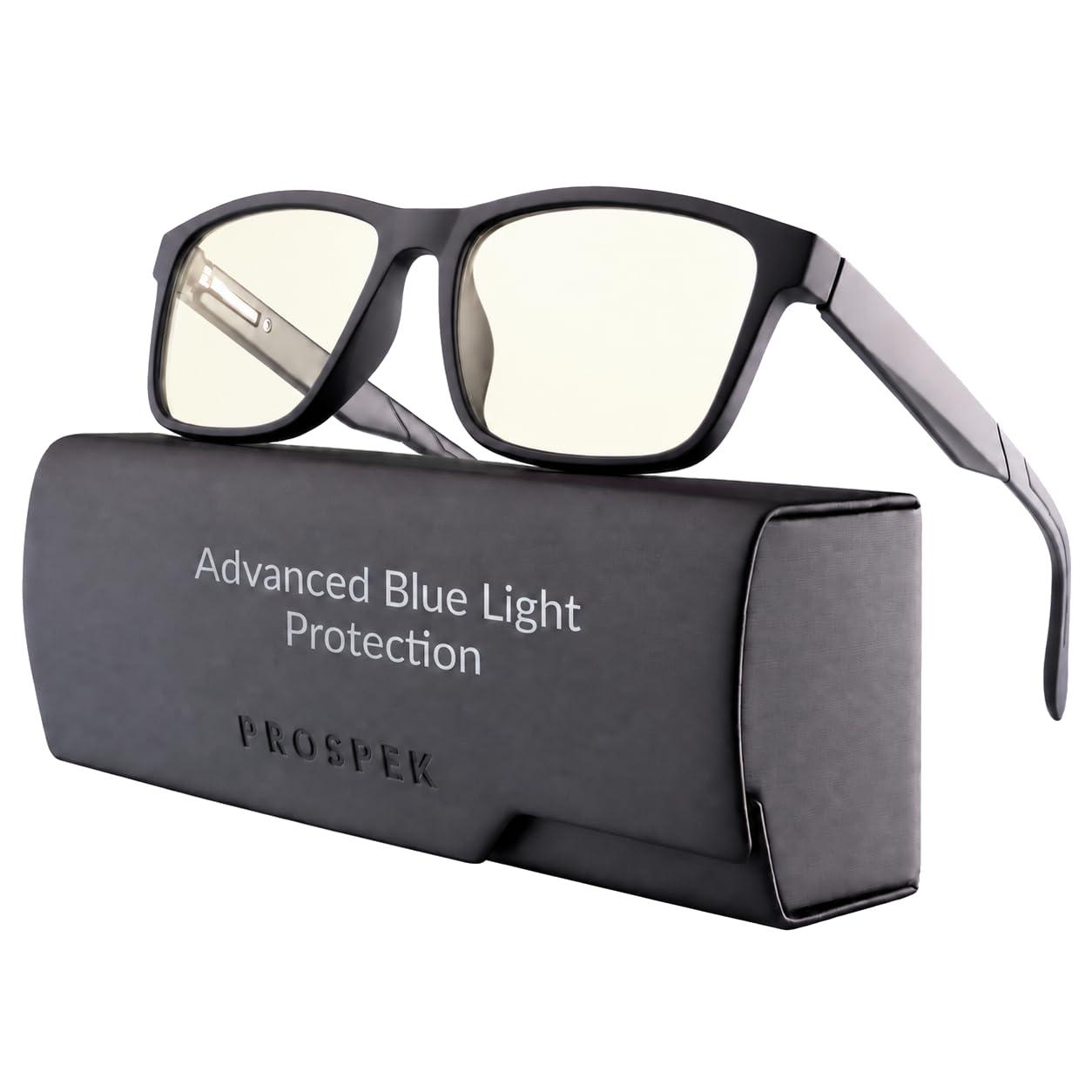
1. Prospek Blue Light Blocking Glasses
Our pick — 4.5+★ from 800+ verified ratings; the strongest balance of quality and price.
The pair you forget you are wearing — nearly clear lenses that still pull the sting out of a monitor.
This is the one to buy if you want a single pair that handles spreadsheets, video calls and evening scrolling without repainting your world yellow. The lens filters the 400–455 nm slice of blue light — the higher-energy band that screens throw at your eyes — and does it with a nearly clear finish. Eight coatings on high optical-grade glass handle anti-glare and smudge resistance, so fingerprints wipe off instead of smearing.
You pick the power at checkout: no magnification for pure screen use, or a reader version running from +0.50 to +3.00 diopters for close-up work. Four frame finishes cover the usual looks. The comfort angle is where it earns its place, though — the ultra-light ergonomic frame is built for all-day wear, and the spring-hinged arms flex rather than clamp. It holds 4.5+ stars across 800+ ratings, with reviewers who have 20/15 vision reporting the lens still eased their screen strain.
What wins people over is how little it distorts. A design professional can work on colour-sensitive art without the tint throwing off the palette, and a gamer sees the same monitor colours with less burn by hour six. A 7½ cap size wearer found the large frame roomy with no corner glare. Honest catch: the tint does shift colour slightly for the most exacting colour work, and if you have a very large head, the frame is cut toward average sizing.
What earns it the top slot
- Nearly clear lens keeps monitor colours close to true while still filtering 400–455 nm
- Eight coatings including anti-glare and smudge resistance
- Same frame sold with no magnification or in +0.50 to +3.00 reader powers
- Ultra-light ergonomic build with spring hinges for all-day wear
Where it asks for patience
- Even a slight tint shows up in precise colour-matching work
- Frame leans average in width, so a very broad head may feel temple pressure
- Not the budget route — you are paying for optical quality
As buyers put it: “I bought 7 different blue light glasses and this pair is my favorite.
Reach for this if: you stare at a monitor all day and want one pair that covers work, reading and evening screens without a visible yellow cast.
Think twice if: you need the absolute maximum block for late nights — that is a job for an amber lens, not this one.
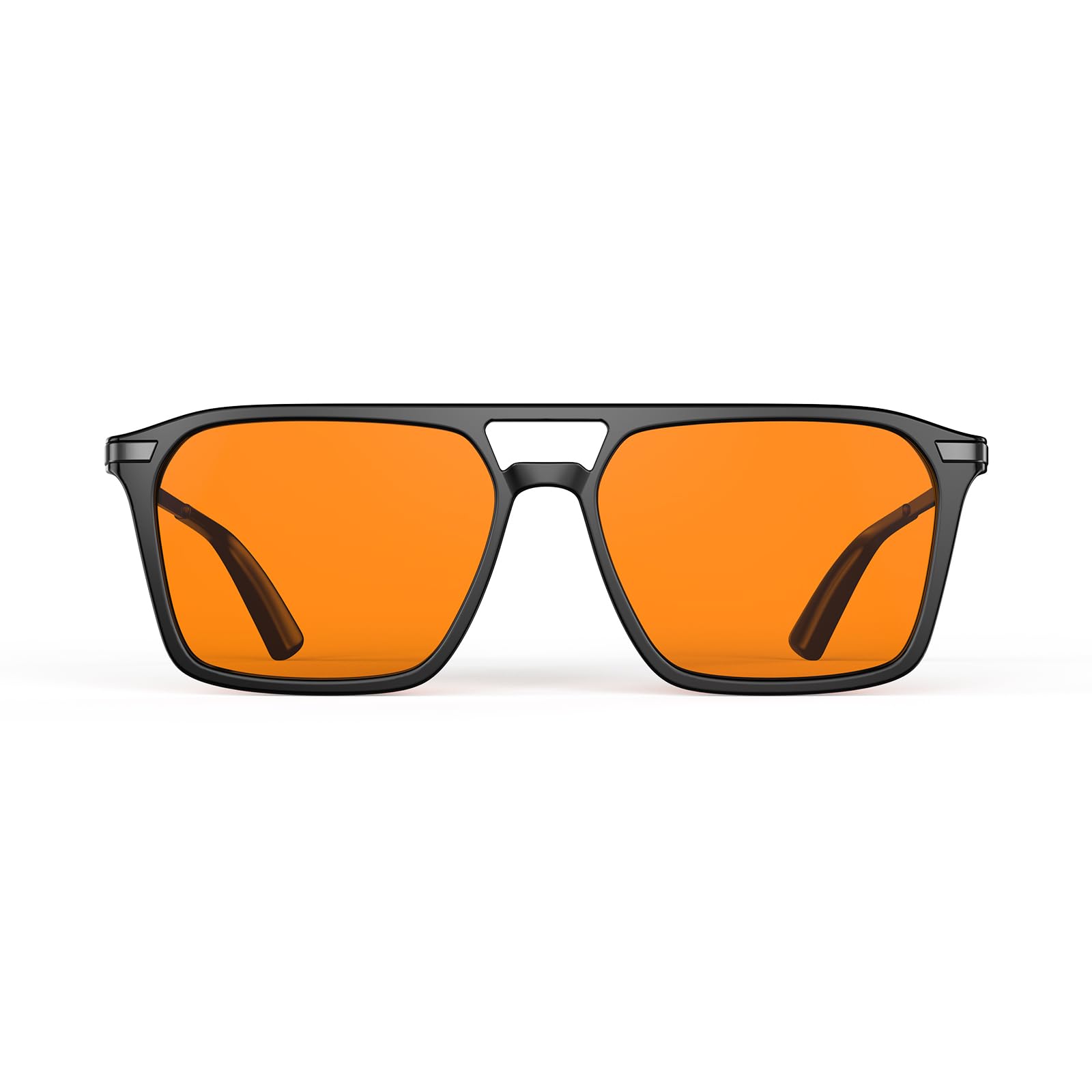
2. Goiteia Orange Blue Light Blocking Glasses
The orange lens that turns your TV into a night light and your phone into something you put down.
This pair blocks 100% of blue light in the 380–500 nm wavelength range (nm means nanometres, the unit used to measure light colour). That is a very different job from the nearly clear pairs above. The full block is the whole point for evening use. Blue light suppresses melatonin, the hormone that cues your body toward sleep. So if you game or doomscroll after dark, the depth of the tint is the feature, not a flaw.
The tint is strong enough to make blue LEDs unreadable and to render RGB colours as red and green only. That is fine for texting, typing and reading. It is a problem if you are colour-grading video or editing photos, where the shift is simply too much. The frame itself has a matte finish and spring hinges, and it is thin enough to wear comfortably under over-ear headphones.
What people praise most is exactly the blocking — over a hundred reviews single it out — followed by how much better it looks than the typical orange pair. A family of several head sizes reports the spring hinge fits everyone, and long 10-hour days across four screens stay comfortable. The mixed part is fit: some larger heads find them snug. Treat that as a sizing question, not a fault.
One correction worth knowing before you buy: these are tinted lenses, not photochromic ones, so they will not darken in sunlight.
The tint does the lifting: full 380–500 nm blocking in a matte frame that stays wearable over headphones — the deepest evening filter on this list.
Buy it for: the last two hours before bed, when you want your screens to stop acting like daylight.
Leave it if: your screen time is colour-critical — this lens repaints everything in amber.
3. Blue Cut Anti-Fatigue Computer and Gaming Glasses

A 13.8 cm full-rim frame that holds steady on long shifts — and the fit is why.
Fit is the number that decides whether screen glasses get worn or shelved, and this one is built around it. The frame measures 13.8 centimetres across with a 17 millimetre bridge and 14 centimetre arms — measurements that translate to a medium, steady hold rather than a clamp. The lenses are made in an FDA-registered facility, and each pair ships with a semi-soft case, a microfiber cloth and a two-year limited warranty.
You choose no magnification for pure screen protection, or +1.00 to +1.50 if you want close-up help at the desk. The Blue Cut lens filters the harsh part of the screen spectrum while keeping the view natural, and the plastic full-rim frame is listed as lightweight with medium stretch. What people praise most is the fit — well over a hundred reviews call it out — and the blocking comes second. A snug wearer drawing on an iPad all day reports the strain easing even though the frame is a little tight.
The honest caveat is build consistency. The lenses sit loosely enough to rattle when you put the pair on, and one owner who replaced an earlier pair found the newer hinges noticeably weaker. For most buyers that never comes up, but if you are hard on your glasses, know it going in.
Why the fit matters most: a 13.8 cm frame with a 17 mm bridge stays put through long shifts — the difference between glasses you wear and glasses you lose.
Compare it directly with the Prospek above: this one is the cheaper route to daily screen relief, but the Prospek’s eight-coating lens and spring-hinged ergonomic frame are the step up if your budget stretches.
Best matched to: heavy computer and phone users who want a generous fit and a warranty behind the frame.
The one snag: lens seating and hinge stiffness are not as tight as pricier pairs, so handle them gently.
4. livho Blue Light Blocking Gaming Glasses
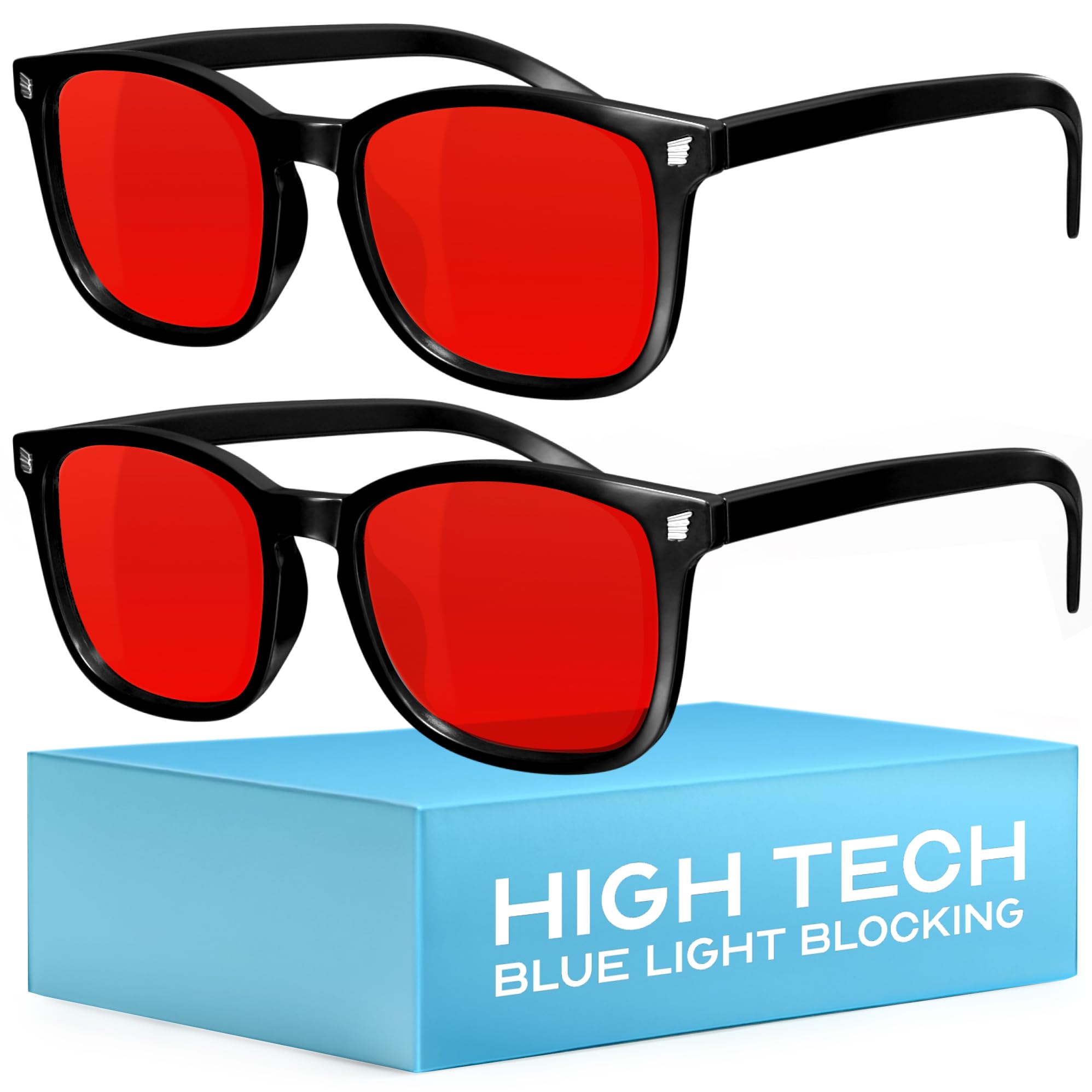
Two pairs, one clear and one red-tinted for night — the desk-and-car combo in a single box.
You get two pairs here, and the split is the smart part: one for daytime glare at the desk, one red-lensed pair for night driving and low light. The frame is ultra-lightweight flexible nylon, which is why it survives being shoved in a bag and still feels comfortable around the ears after a long session. Both are non-prescription, so this is a pair for people whose distance vision is already fine.
What deserves a plain-English caveat is the “blocks blue light” expectation. Clear lenses cannot block every blue wavelength — that would require a dark amber tint that distorts colour. These block the specific harmful wavelengths while keeping colours accurate, and the box includes a test card so you can check the filtering yourself. Anyone expecting a clear lens to zero out blue light entirely is buying the wrong product, not a bad one.
The quality picture is the strongest in this list by a wide margin. Over 4,600 reviews single out build quality and 3,500 point to effectiveness — volume that only builds when a pair genuinely holds up. Daytime glare at a desk for eight hours, gaming, TV, low-light outdoor use: owners stretch these across all of it. The included cases are basic, and that is the only complaint that surfaces with any consistency.
What the two-pack buys you
- Two pairs — clear for daytime screens, red lenses for night glare
- Flexible nylon frame that stays comfortable around the ears
- Test card included so you can verify the filtering yourself
- Holds colour accuracy where a deep amber lens would not
Set your expectations here
- Clear lenses filter specific wavelengths, not all blue light
- Both pairs are non-prescription
- The cases are plain and not built for heavy travel
Pairs well with: a gamer or commuter who wants one box covering monitor glare and headlights.
Skip past if: you need reading magnification or a lens that blocks the entire blue spectrum.
5. GUNNAR Vertex Blue Light Reading Glasses

The optical-quality play — a third of the way up the spectrum blocked, with focus sharpened to match.
This one is for the heavy screen user who already wears readers and refuses to downgrade the lens. It blocks 65% of blue light in a slight yellow tint, and the patented lens geometry sharpens text edges and reduces the focus effort that drives late-day strain. The lens coating adds an external hard coat to resist scratches, and the frame is precision engineered polymer.
Buyers report the optical quality sits well above cheap readers. One IT professional juggling online university, work and gaming says the 1.5x power works at a 24 inch monitor distance — close enough for the screen, far enough to keep posture sane. A software developer with 30+ years at a keyboard wears them over prescription readers at the computer, and doubles them as safety glasses for car work. That is real verification from daily use rather than from a spec sheet.
The genuine risk is scratch resistance in practice. Despite the hard coat, owners repeatedly report that these lenses scratch easily and need a cloth pouch, not a shirt sleeve. There is also an occasional report of a distracting blue after-image on some units, which is worth knowing if you are sensitive to that kind of visual artifact.
Where the money goes: patented optics and a hard-coated lens that sharpens text — the closest thing here to a proper vision-store pair.
The right buyer: a reader-wearing professional who lives at a monitor and wants lens quality first.
Go elsewhere if: you are rough with your glasses — this lens rewards careful storage.
Know the Specs
Nanometers and Blocking Percentage
A nanometer measures the length of a light wave, and blue light sits roughly between 380 and 500 nm. A lens that blocks “100% of 380–500 nm” goes all the way to amber; a lens that filters 400–455 nm targets the higher-energy band and stays nearly clear. A “65% blue light” figure sits between those two approaches. The wider the block, the greater the colour shift you will notice on screen.
Diopters and Reading Power
A diopter is the unit on a reading lens, and the number tells you how strongly it magnifies. A 0.00 lens has no magnification at all — pure screen filtering. A +1.00 to +1.50 lens helps with close-up text. A +3.00 is a strong reader for very close work. Match the number to what you already wear, and if two powers bracket your guess, the lower one is usually the safer start.
Frame Width, Bridge and Arm Length
Frame width is the total span across the front, bridge width is the gap over your nose, and arm length is how far the temples reach back. Together they decide whether a pair presses on your temples or sits easy. A 13.8 cm frame with a 17 mm bridge is a medium fit. Spring hinges add flex so the same frame covers more head sizes, which is why they show up on the pairs built for long wear.
Common Questions
Do blue light glasses actually reduce eye strain from screens?
Will a clear blue light lens block all of the blue light?
Can I wear blue light reading glasses if I already have perfect vision?
How do I pick the right diopter strength for reading glasses?
Are amber or orange lenses better for sleep than clear ones?
Can I wear these glasses over my regular prescription glasses?
How long do blue light glasses last before the coating wears off?
Will the tint on amber glasses make my photos and videos look wrong?
Are these glasses safe to wear for a full workday?
The Bottom Line
For most people, the glasses for eye strain winner is the Prospek Computer Readers. One pair covers work, reading and evening screens, because the lens is nearly clear, carries eight coatings and comes in a power range up to +3.00 (the magnification strength). If your real problem is winding down at night, grab the Goiteia Amber Easier Sleep pair — full 380–500 nm blocking is the reason it exists. And for a gamer or commuter who wants two pairs in one box, reach for the livho High Tech set. Thousands of owners name its build quality, and it ships with a test card so you can check the filtering yourself.
How we choose
We do not accept paid placement. Every pick is matched to a real buyer and a real use-case; we do not hands-on test units.
Sources
Specifications: manufacturer listings and product documentation. Review insights: verified customer reviews, as of October 2026. Pricing: not shown on this page (it changes often); check the current price via the retailer link.
As an Amazon Associate, Aappliancez earns from qualifying purchases. This does not affect which products we feature.