Disclosure: Some links in this post are affiliate links. As an Amazon Associate I earn from qualifying purchases, at no extra cost to you. Learn more
Specs are compiled from manufacturer listings and verified buyer reviews and can change over time — please confirm the key details on the product page before buying.
If your windshield looks permanently smeared after every wipe, the fix is not a stronger cleaner — it is a mild abrasive that physically levels the glass. That is why an abrasive, not a stronger cleaner, is what actually levels the glass. Below you get the picks worth your time, what each one actually does to a scratch, and the honest limits nobody puts on the label.
This guide is built by comparing the manufacturers’ published specifications and the patterns across verified customer reviews, so you get each pick’s real strengths and trade-offs instead of marketing spin.
Glass is harder than paint, so scratch removal depends on the abrasive and the pad, not on how hard you rub. This breakdown covers what genuinely works as a glass scratch remover.
Top Picks
How To Choose The Best Glass Scratch Remover
Start with your fingernail. Drag it gently across the scratch — if the nail catches in the groove, the damage is deep and most hand polishing will only soften it, not erase it. If your nail glides over the top, you are in the sweet range where a cerium oxide polish (a fine glass-cutting powder mixed with water) can genuinely clear it.
Match the abrasive to the damage
A polishing compound is not one product — it is a grade of abrasive. A heavier cut compound removes sanding marks and scuffs but leaves its own fine haze that you then refine out. A fine cerium oxide slurry is the finishing step that brings the glass back to clear. Serious buyers check the grit number and the grit material first, because those two facts decide what the product can physically do.
Pad choice matters as much as the powder
A firm felt pad on a rotary or dual-action polisher does the cutting; a soft foam pad mostly spreads. If you plan to work by hand, expect far longer. If you are using a drill or polisher, check the pad’s maximum rotational speed — over-rev a felt wheel and it sheds fibers across your windshield instead of polishing it.
Decide if you want polish or protection
Some kits restore clarity and then seal the surface with a ceramic coating to slow the return of UV yellowing. Others are pure abrasive with no protection step. Both are valid — they just do different jobs. A coating kit will not cut a deep scratch, and a pure powder will not protect the lens afterward.
Side-by-Side Comparison
| Model | Best For | Format | Grit / Abrasive | Weight or Size | Amazon |
|---|---|---|---|---|---|
| CERAKOTE Ceramic Headlight Restoration Kit★ Best Overall | Foggy, yellowed headlights | 10-wipe kit | Step-based sanding plus ceramic | 4.8 ounces | Amazon |
| menzerna Heavy Cut Compound 1000Deep-Cut Specialist | Deep scratches and sanding marks | 8 fl oz compound | 1000 grit, aluminum oxide | 8 ounces | Amazon |
| 3D Glass Polish | Wiper marks and water spots | 16 oz liquid polish | Cerium oxide based | 16 ounces | Amazon |
| Gold Label Detailing Glass Polishing Pads | Windshields with a slurry you own | 5-pack felt discs | Cerium oxide, 180 grit | 6 inches | Amazon |
| Gordon Glass Cerium Oxide Kit | Fine scuffs on flat glass | 8 oz powder plus 3″ wheel | Cerium oxide, 24 grit | 8 ounces | Amazon |
Detailed Reviews
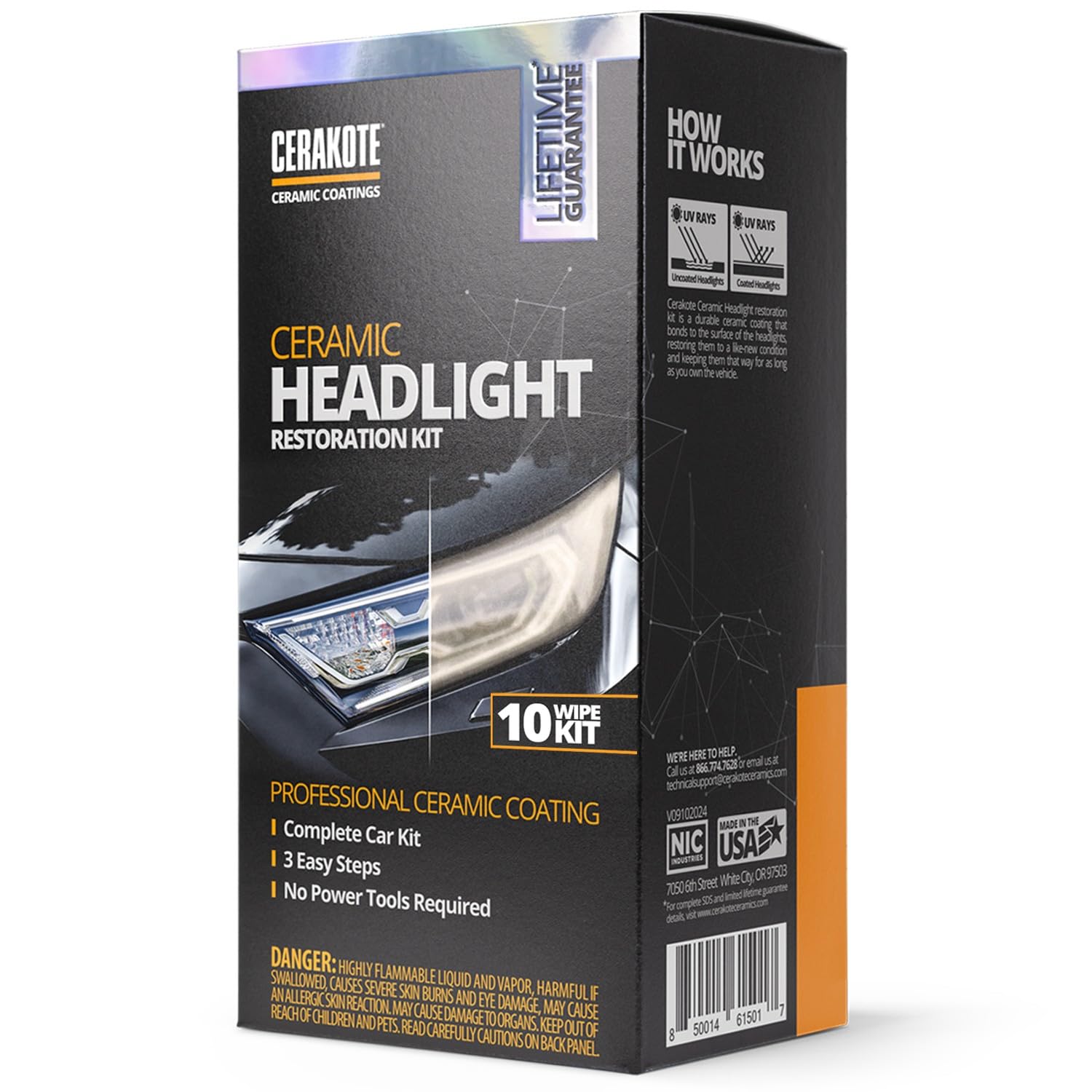
1. CERAKOTE® Ceramic Headlight Restoration Kit, 10 Wipe Kit
Our pick — 4.5+★ from 75,500+ verified ratings; the strongest balance of quality and price.
Ten wipes, three steps, and no power tools — the least intimidating way to clear yellowed glass.
Most glass scratch removers are abrasives in a bottle. This one is a staged cleanup: eight Step 1 oxidation-removing wipes, one Step 2 sanding kit, and two Step 3 ceramic coating wipes, packed in a 4.8-ounce kit. You work through the steps in order, and the ceramic layer chemically bonds to the lens so the UV protection keeps yellowing from creeping back.
Reviewers keep coming back to how well it clears yellowed lenses. A 16-year-old Highlander went from orange-yellow to near-new clarity, and the owner reckoned it was barely distinguishable from a replaced lens after about 35 minutes of easy work. That is the honest pitch: a baked-on haze comes back to useful clarity without buying new housings. The kit also earns the crowd — 4.5+ stars across 75,000+ ratings.
The recurring gripe is the mixed side of things — some lenses stay foggy after treatment, and the clarity does not always hold the way the coating promises. Read the sanding guidance properly and keep the lens wet through the grit phase; that is where the outcome is decided. As buyers put it: “Restored 16-year-old Highlander headlight from orange-yellow to near-new clarity, barely distinguishable from a replaced lens.”
What Holds Up
- Clear, step-by-step wipes so you never guess the next move
- Ceramic coating bonds to the lens for ongoing UV protection
- No power tools — safer for a first-timer around paint
- Roughly 30-35 minutes of work per pair of headlights
Where It Strains
- Made for lens haze, not deep gouges in windshield glass
- Some lenses stay foggy if the sanding stage is rushed
- Tape off painted panels — the wipes are not trim-friendly
Reach for this if: your headlights are cloudy, yellow, or dim at night and you want a no-tool fix.
Look elsewhere if: the damage is a scratch you can feel with a fingernail — this kit is a haze restorer, not a gouge cutter.
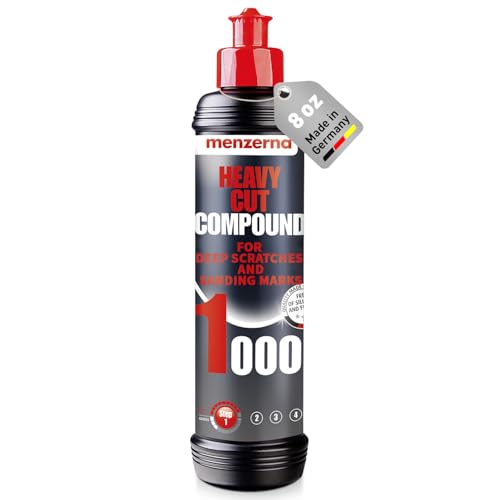
2. menzerna Heavy Cut Compound 1000
A 1000-grit aluminum oxide compound that bites hard — then makes you clean up after it.
Where the Cerakote kit clears a haze, this 8-ounce bottle is for actual correction: deep scratches, sanding marks, swirls, and holograms. The abrasive is aluminum oxide at 1000 grit (a medium, fairly aggressive grade), and it works with an orbital or rotary machine on a heavy-cut foam pad. By hand it still works — you just trade speed for control.
Here is the contrast that matters. Compare grit numbers across this list and the gap is wide — this compound sits at 1000 grit while the Gold Label glass pads run 180. Lower grit means a finer, gentler cut, so the menzerna takes off material faster and the pads refine. It is also heavier in the bottle at 8 ounces versus 4.8 ounces for the Cerakote kit, which makes sense: this is a working product, not a wipe-and-go kit.
That cutting power is what people rave about — it removes what two prior products and wet sanding could not. One detail keeps coming up honestly: it leaves a lot of dust and cakes on the pad. Keep a microfiber cloth and a water spray handy, and work the criss-cross method until the milky film turns translucent. As buyers report: “All I used was a cheap 3 inch foam buffing pad attached to a drill after some 1500 grit wet sanding.”
The trade-off, plainly: the 1000-grit abrasive cuts fast and well, but the dust it throws is the price of that aggression. On a cast-iron sink or a scuffed bumper it is worth the mess; for a light glass haze you would be over-tooling.
Best fit for: anyone chasing a deep scratch or sanding mark who has a polisher and a mask.
Think twice if: you want a wipe-on fix with no cleanup — this is a machine-grade job.
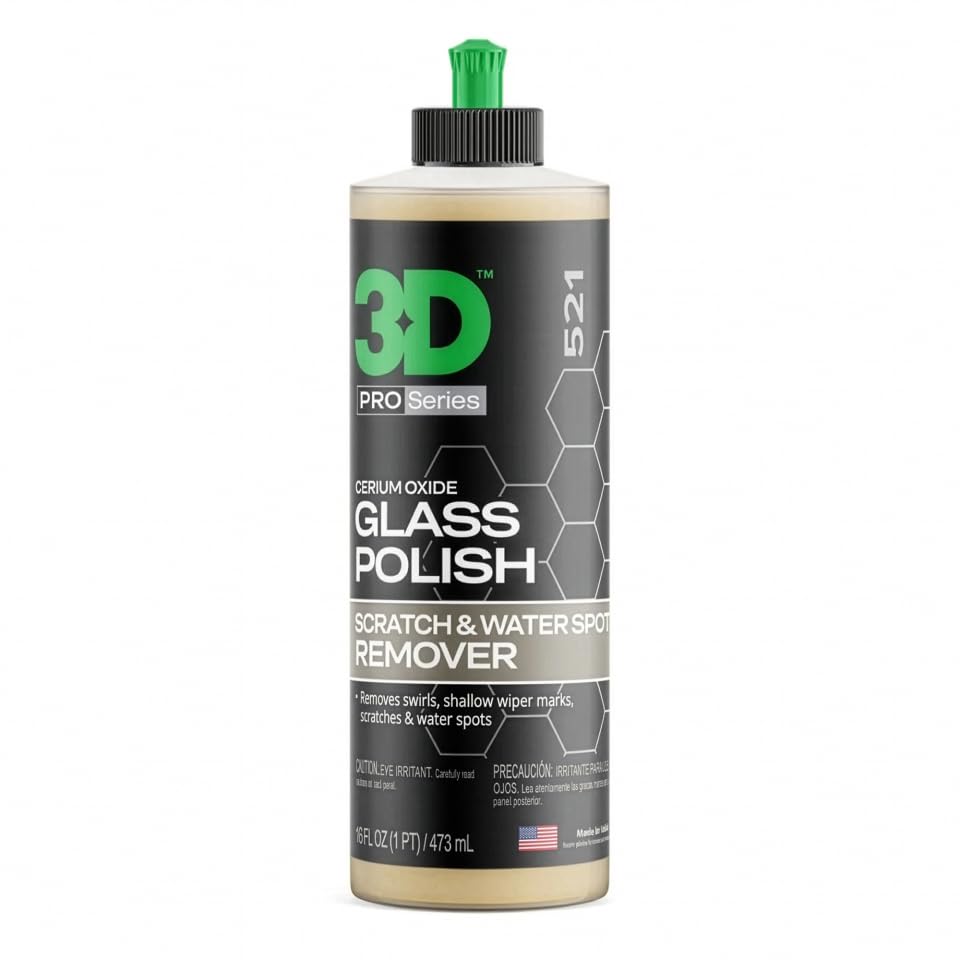
3. 3D Glass Polish – Cerium-Oxide Based Window Polish, 16oz
The one built for the smear left by wipers — a cerium oxide liquid you can run on a felt pad.
Wiper marks, etched water spots, and the fine swirl trace a windshield picks up over years — that is this 16-ounce bottle’s target. It is a cerium oxide based liquid polish, meant for a rotary polisher or a dual-action machine with a felt pad. The formula is sold on long open time (it stays workable rather than drying on you) so you get extended working window and less product waste.
What it realistically does is the important bit. It clears fine scratches — the ones your fingernail glides over — and reduces the deeper wiper gouges without fully erasing them. One buyer took it to a windshield whose wipers had been left on too long and got rid of the vast majority of the scarring. It also doubles as the prep step before a ceramic or hydrophobic coating, since a clean, smooth surface lets the coating bond better.
Its honest limits are time and depth. A few buyers found it slow and one felt a straight cerium oxide powder cut faster per session. Another noted the cap can pop off with force when you first open it, so press it down carefully. The reward is a windshield that beads water and needs less cleaning between washes.
Where it shines: fine-to-moderate glass flaws and pre-coating prep — the 16-ounce size gives plenty of working volume for multiple panels.
Set your expectations: deep scratches felt by fingernail get reduced, not removed; plan for patience and a machine rather than a rag.
Reach for this if: your windshield shows wiper trails and fine water etching you want polished clean.
Look elsewhere if: the scratch is deep enough to catch your nail — no liquid polish fully cures that.
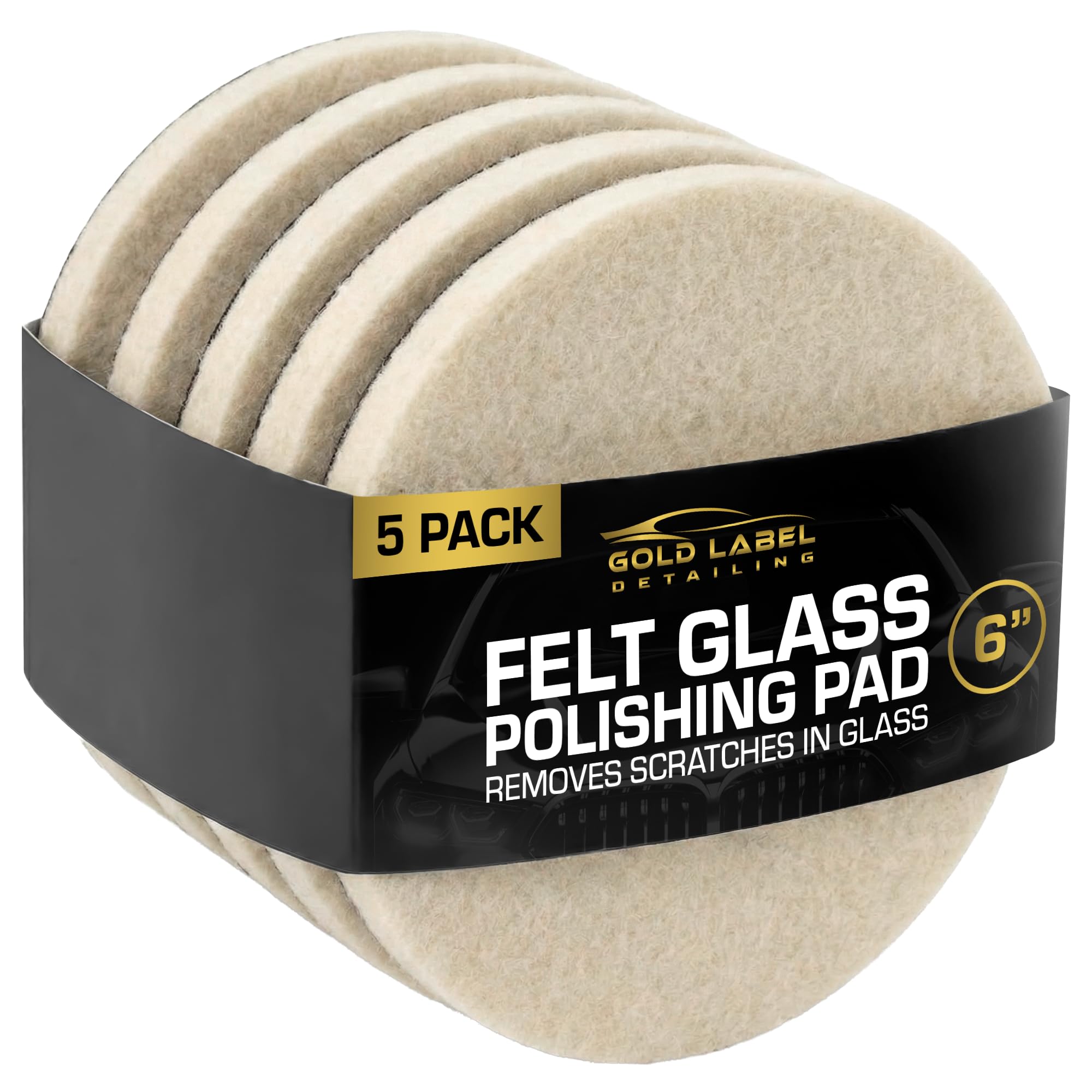
4. Gold Label Detailing Glass Polishing Pad Discs, 5 Pack
Five felt discs, no compounds — the pad set for anyone who already owns the powder.
If you already have a cerium oxide slurry, the missing piece is often a proper pad. This five-pack gives you 6-inch felt discs with a hook-and-loop backing (the velcro-style face that sticks to a backing plate) so they fit most machine plates. The pads are rated to a maximum rotational speed of 1300 rpm — stay under that and they hold together; over-rev them and they start shedding.
Buyers use these discs on truck windshields, a 50-year-old hunting jeep, and a dual-action polisher on deep wiper scratches. The fiber-shedding is the honest caveat, and it is not a light one. Soak the pad first and keep it moist while you work; a fully saturated pad performs noticeably better and sheds less. Tape off the surrounding area before you start if you are polishing a vertical windshield.
Two things set this apart from the bottle-based options above. It ships as pads only — no powder, no compound — so the total job depends on what you feed it. And it is the multipack: five discs mean you are not stuck mid-job if one wears thin.
Strength In The Set
- Six-inch felt face covers a decent area per pass
- Hook-and-loop backing fits common backing plates
- Five discs so a worn pad does not stall the job
- Caps at 1300 rpm for controlled machine polishing
The Honest Friction
- Cannot polish anything without a slurry you supply
- Sheds fibers if it runs dry — keep it soaked
- Fragile on a vertical windshield; tape and contain the area
Good match if: you have the powder and a machine, and need the working surface.
Skip the pairing if: you have no compound on hand — buy a kit that includes it instead.
5. Cerium Oxide Glass Polishing Kit
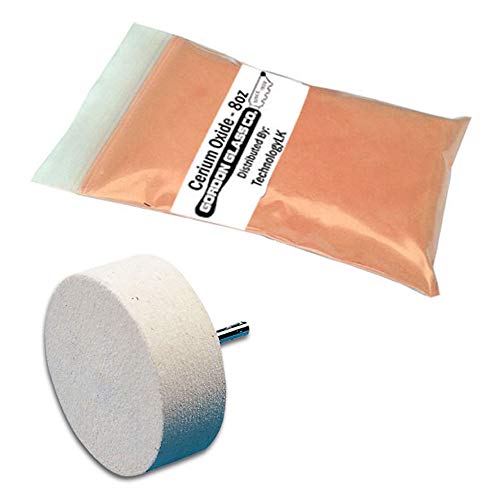
Powder plus wheel in one bag — effective, messy, and not for the impatient.
This is the closest thing on the list to a bare-bones professional setup: an 8-ounce bag of Gordon Glass cerium oxide powder and a 3-inch felt polishing wheel that runs on any electric drill or grinder. No zinc in the formula, and the slurry can dry out and be revived with a splash of water, so the powder stretches. For fine scuffs on flat glass, tabletops, mirrors, and headlights, it is the raw material that everything else is built around.
It clears fine scratches and stubborn water spots on older glass where liquid products stall. It is also slow, heavy work. Some owners mention spending four hours across two days on one window, and vertical panes are far harder than flat ones because your arms carry the tool. Deeper scratches, the fingernail-catch kind, are out of reach — polishing levels the surface, it does not fill a groove.
The honest stumbling block is the missing instructions. Start with a watery slurry and test a small spot before committing. On the pad, treat it as the weak link — a rough pad on a delicate surface can make a mark worse, so use fresh felt and light pressure.
Value read: the powder-plus-wheel bundle covers the essentials at a budget-friendly tier and stretches further than a single-use wipe kit because the slurry is re-usable.
Know before you start: you supply the technique and the drill — this kit is a starting point, not a guided process.
Best for: a hands-on owner with a drill and the patience to work a small area at a time.
Not for you if: you want step-by-step hand-holding or a flawless finish on the first pass.
Know the Specs
Grit number and abrasive material
Grit number describes how coarse the abrasive is — a lower number tends to mean a finer, gentler cut and a higher one removes material faster. The abrasive material matters just as much: cerium oxide is the classic glass polisher because it cuts glass specifically, while aluminum oxide compounds like the menzerna 1000-grit product are aggressive cutters for deeper damage. Match the grit and abrasive material to the depth of the scratch, not to the brand.
Pad diameter and speed rating
You cover more glass per pass with a wider felt pad, so its diameter sets your coverage. Its speed rating (measured in rpm — revolutions per minute, how fast the tool spins) sets how hard you can push the machine before the pad breaks down. Stay at or under the rated maximum and keep the pad wet, and it lasts. Run it dry and fast, and you get shed fibers across the glass instead of a polish.
Common Questions
Can a glass scratch remover fix a scratch I can feel with my fingernail?
Is cerium oxide safe to use on a car windshield?
Do I need a machine or can I polish glass by hand?
How much time does a deep windshield scratch take to polish out?
What is the difference between a glass polish and a ceramic coating kit?
Will polishing leave a haze or waviness behind?
How long should I keep the pad wet while polishing?
Can I reuse leftover cerium oxide slurry?
Which grit should I pick for a wiper-blade scratch?
The Bottom Line
For most buyers the winner is the CERAKOTE Ceramic Headlight Restoration Kit for one simple reason: it handles the haze most people actually have, needs no power tools, and leaves a protective coating behind. If you are chasing wiper trails and water etching on a windshield, the 3D Glass Polish is your polish. And for a raw powder-and-wheel setup that stretches across multiple jobs, the Gordon Glass Cerium Oxide Kit is the hands-on pick. Three picks cover the three jobs: haze, wiper trails, and raw powder work.
How we choose
We do not accept paid placement. Every pick is matched to a real buyer and a real use-case; we do not hands-on test units.
Sources
Specifications: manufacturer listings and product documentation. Review insights: verified customer reviews, as of October 2026. Pricing: not shown on this page (it changes often); check the current price via the retailer link.
As an Amazon Associate, Aappliancez earns from qualifying purchases. This does not affect which products we feature.