Disclosure: Some links in this post are affiliate links. As an Amazon Associate I earn from qualifying purchases, at no extra cost to you. Learn more
Specs are compiled from manufacturer listings and verified buyer reviews and can change over time — please confirm the key details on the product page before buying.
You cannot test a radiation detector before you trust it, so you need one that clicks the moment radiation is present, tells you whether the reading is just background or genuinely improve, and keeps working when the power does not. That depends on two things: the sensor inside, and how fast it responds. A traditional Geiger tube (a sealed gas-filled tube that ticks once per detected particle) is simple and honest, while a scintillator (a crystal that flashes light when radiation hits it) reacts far faster and can even hint at which isotope you are standing near. This guide walks through seven detectors that cover background checks, antique uranium glass, food and material screening, and full emergency preparedness, so you can match the tool to the job instead of guessing.
This guide is built by comparing the manufacturers’ published specifications and the patterns across verified customer reviews, so you get each pick’s real strengths and trade-offs instead of marketing spin.
Most people shopping for a detector only need one that reads background levels clearly, responds quickly to a source, and lasts through a long power outage or camping trip. That is exactly the ground covered below, so you can pick the right one without overbuying or underbuying. The shortlist here explains which of these seven detectors earns a place in your kit for checking antiques, building materials, or emergency supplies with confidence. Choosing the right geiger counter is easier once you know where the sensor sits and what it can and cannot see.
Top Picks

How To Choose The Best Geiger Counter
There is no single best detector, only the one that matches your use case. A homeowner who wants to monitor a basement is served by a different device than someone who needs to identify an unknown isotope in the field. Before you spend, decide if you need simple background confirmation, cumulative dose tracking, or full spectral analysis.
Sensor type: Geiger tube versus scintillator
A Geiger-Muller tube (a sealed gas tube that produces a click for each particle) is the classic detector, simple and dependable for detecting beta, gamma, and X-ray. A scintillator (a crystal that flashes light proportional to the radiation energy) is a newer approach that reacts faster and can distinguish between isotopes. If you only need to know whether radiation is present, a tube is sufficient. If you want to identify what is emitting it, the scintillator wins.
Dose rate versus total dose
Dose rate, measured in microsieverts per hour (μSv/h), tells you how much radiation is hitting you right now. Total dose, measured in millisieverts (mSv), tells you how much you have accumulated over time. A detector that shows only dose rate is fine for a quick check; a detector that tracks both is better for long-term monitoring around a home or workplace.
Alerts, alarms, and alarm thresholds
An alarm that fires when dose rate crosses a threshold is the difference between a passive readout and an active warning. Look for adjustable thresholds and multiple alert modes, including sound, light, and vibration, so a warning reaches you whether you are in a noisy workshop or a quiet room. Fixed thresholds are less useful because background levels vary by location.
Battery and power options
Runtime varies widely. A rechargeable lithium cell keeps a device light and USB-chargeable, while standard AA or 9V batteries let you swap cells on the road without a cable. For an emergency kit or a long field trip, prioritize a device that runs on common cells and lasts for months or years, or one that includes a rechargeable pack with clear low-battery warnings.
Side-by-Side Comparison
| Model | Best For | Sensor / Detection | Dose Range | Weight | Amazon |
|---|---|---|---|---|---|
| Smart Geiger Counter Radiacode-103★ Best Overall | Field survey and isotope ID | Scintillator (GAGG:Ce) | Gamma, X-ray, hard beta | 2.36 ounces | Amazon |
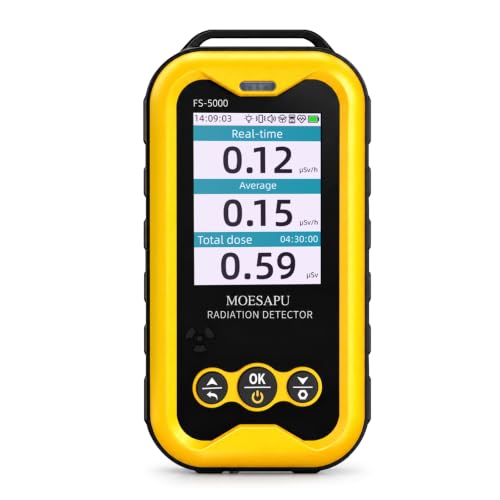
| MOESAPU FS5000Best Value | Value home checks | J321 GM tube | 0.01μSv/h–50mSv/h; 0μSv–1000Sv total | 5.6 ounces | Amazon |
| GQ GMC-320 Plus | Data logging on a budget | GM tube (photoelectric) | Beta, gamma, X-ray | 6 ounces | Amazon |
| SAF Aranet Radiation Detector | Home and vehicle monitoring | GM tube (γ, β, X-ray) | 0–1000 mSv / 0–100 rem total | 7.8 ounces | Amazon |
| Better Geiger S-2 | High-range emergency prep | Solid-state scintillator | 100x higher range than standard | 9.6 ounces | Amazon |
| GQ 600 PRO | Alpha detection and data sharing | LND 7317 Pancake tube | Alpha, beta, gamma, X-ray | 1.6 pounds | Amazon |
| GCA-07W External Wand Probe | Regulatory-grade monitoring | LND712 with external wand | 0.001–1,000 mR/hr; 0.01μSv/h–10 mSv/hr | 1.46 pounds | Amazon |
Detailed Reviews
1. Radiacode-103 Geiger Counter
Our pick — 4.5+★ from 350+ verified ratings; the strongest balance of quality and price.
The scintillator detector that maps isotope readings onto a color-coded GPS map.
If you want to know not just that radiation is present but what is emitting it, this is the pick that earns the top slot. Its scintillator samples up to 20 times faster than a standard Geiger tube, so a quick pass over a hot spot still registers. At 2.36 ounces it slips into a shirt pocket, and it detects gamma, X-ray, and hard beta radiation.
The numbers behind that speed come from a scintillator crystal paired with a photomultiplier tube. Spectral resolution (FWHM) is 8.4% (+/- 0.4%), which is how precisely the device can separate one isotope’s energy signature from another. In practice that means the app can flag Cs-137, Ra-226, Th-232, and U-238, plus the decay products of the radioactive gas Radon-222, like Lead-214 and Bismuth-214. At home, buyers report “~3.5 CPS background at home; uranium glass ~10 CPS; brick house ~6-7 CPS” — real counts that tell you whether a reading is background hum or something worth investigating.
The free mobile and desktop apps run on iOS, Android, macOS, and Windows, and they add dose-rate graphs, spectrograms, event logs, a food analyzer, and GPS-logged radiation mapping you can save and share. Up to seven alarm modes cover two sound levels, an LED indicator, vibration, and three app-based alerts. The trade-off that comes up most: it does not detect alpha particles at all, so if your focus is alpha-emitting surface contamination, look to the GQ 600 PRO below instead. The lost-item chime also runs quiet enough that you may want the optional case to keep it from wandering off.
What makes it the pick
- Scintillator sensor identifies isotopes the app names on screen, not just a raw count.
- Weighs 2.36 ounces yet detects gamma, X-ray, and hard beta.
- GPS mapping logs every reading onto online or offline maps you can save and share.
- Apps cover iOS, Android, macOS, and Windows with free continuous updates.
Where it draws a line
- No alpha detection, so surface contamination checks need a different tool.
- The small built-in screen limits standalone spectrometry — the app does the heavy lifting.
Reach for this if: you want to identify what you are standing near, not just confirm a count, and pocket-size portability matters.
Think twice if: alpha particles are your target — this sensor does not see them.
2. MOESAPU FS5000 Geiger Counter
A budget handheld with a 2.4-inch TFT screen and up to 30 days of standby per charge.
For checking uranium glass in an antique collection or scanning renovation materials, this detector keeps the spend low without feeling like a toy. Its 2.4-inch TFT screen (a bright color LCD readable in sunlight) shows dose rate and total dose together, so you see both at a glance. The J321 sensor (a gas-filled Geiger tube) responds to beta, gamma, and X-ray inside a 48KeV-1.5MeV energy range with a 0.5-second response — quick enough that a moving hand still registers a hit. It makes the classic Geiger click too, turning invisible particles into something you can hear.
Where it separates itself from the crowd is runtime. A rechargeable 1800mAh battery delivers up to 720 hours of standby, which the brand describes as up to 30 days on a full charge when the shortest backlight setting is used to conserve power. Recharging happens over USB Type-C, and a low-battery alert fires with enough warning to top it up before it dies.
Compare it to the GQ GMC-320 Plus below and the case is straightforward: same basic idea, and the MOESAPU is the lighter and smaller of the two at 5.12 x 2.56 x 1.18 inches versus the GQ’s larger footprint. Owners mention “It works, got the same reading as my other counter on my uranium glass set, it clicks for particles but it can be turned off in settings.” The honest catch is the manual — it is thin on detail, and one owner found the beta detection slower than expected. For straightforward home use it still holds up, with customizable alarms at dose rate above 2.5μSv/h or total dose above 1mSv that fire via sound, light, and vibration.
Where the screen shines: a 6-level adjustable brightness TFT-LCD stays readable in direct sun and dim rooms alike, and the live dose-rate graph shows your exposure trend at a glance rather than a single frozen number.
The honest caution: the included manual leaves gaps and a couple of buyers found beta sensitivity modest, so plan to lean on the device’s own on-screen modes over the paperwork.
Best fit: hobbyists and homeowners who want clear dose readings and a battery that survives long stretches between charges.
Not the one for: anyone who needs deep document support or fast beta detection as a priority.
3. GQ GMC-320 Plus Geiger Counter
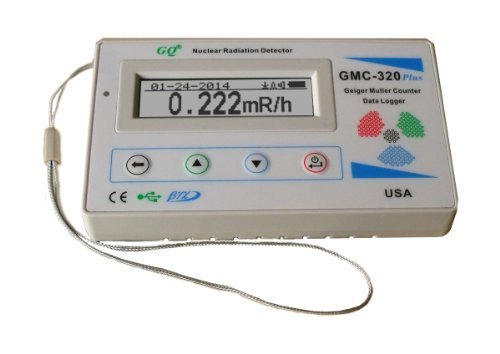
The data-logging workhorse that records readings automatically and plays them back on your PC.
If you want a running record of radiation levels rather than a one-off reading, this is the detector built for the job. It automatically records readings and lets you play them back later from a PC, and it uses an open communication protocol for wide-range radiation network support — a feature that makes it useful to tinkerers and makers. It runs on a rechargeable battery and ships with a mini USB cable.
The device hits 6 ounces, which is noticeably heavier than the 2.36-ounce Radiacode-103 above, but the trade-off brings a bigger control philosophy: many display modes and an audible alarm. Customers note “After 1yr 9mo: still works, dropped several times, battery lasts ~1 day” — a rare real-world durability note that suggests the plastic enclosure holds up under rough handling. It detects potassium in fertilizer, radioactive vases, welding rods, and Vaseline glass, and you should give it about a minute at low levels for a stable reading.
Two honest notes before you buy. The rechargeable battery is built in and cannot be removed or replaced, so when the cell eventually weakens, the unit does too. And a few reviewers point out accuracy runs low compared to laboratory-grade instruments, while others find it quite accurate — the reading is fine for spotting whether a level is improve, not for official measurement. It ships with a 30-day money-back guarantee and a one-year factory warranty.
Who it suits: anyone who wants long-term data logging and a unit that survives being dropped.
Look elsewhere if: you need replaceable batteries or reference-grade accuracy.
4. SAF Aranet Radiation Detector
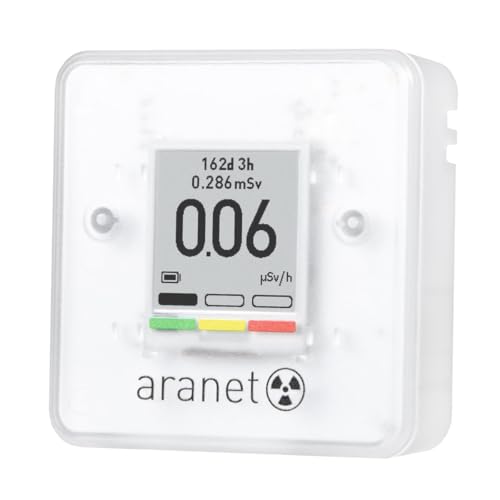
A wall-mountable E-Ink monitor that runs up to 4 years on a set of batteries.
This is the detector for someone who wants permanent awareness of radiation at home, not a handheld tool for field work. The headline number is battery life: up to 4 years on a set of batteries, which is what makes continuous monitoring realistic without constant maintenance. It tracks both the ambient equivalent dose rate of ionizing radiation and the total dose (0–1000 mSv, 0–100 rem, up to 2 years), so you get a complete dosimeter picture rather than a snapshot.
The E-Ink display (a low-power screen like an e-reader that holds its image without refreshing) shows clear readings that stay visible from many angles, and there is no backlight drain to worry about. Bluetooth connects it to a free app that adds graphics, transforming the unit into a portable particle counter with alerts. Shoppers say mounting it on a wall and letting it log and store data on an iPhone with alerts, and owners describe it as accurate with an easy Bluetooth hookup and a wide-viewing display.
There is one real limitation to weigh. The minimum sampling rate is one minute, which is a slowdown if you wanted to sweep a room quickly for a moving source — a buyer wishing for a 10-second or faster interval is thinking about exactly this. The unit also ships with its beeping enabled by default, and turning it off requires a physical jumper (a small internal switch), not a software toggle. Neither is a dealbreaker for a wall-mounted monitor, but both matter if you plan to carry it around. It detects gamma, beta, and X-ray.
Built for the long haul
- Up to 4 years of battery life makes set-and-watch monitoring practical.
- E-Ink display stays readable from many angles without drawing power.
- Bluetooth app adds graphs, storage, and alerts on your phone.
- Tracks both dose rate and 2 years of cumulative dose.
The practical trade-off
- One-minute minimum sampling is slow for a walking room survey.
- Beeping default needs a physical jumper change to mute, not a menu option.
Pick this if: you want a set-and-forget radiation monitor for your home or vehicle that rarely needs attention.
skip it if: you need fast, second-by-second sampling while moving through a space.
5. Better Geiger S-2 Geiger Counter

The high-range detector that keeps reading when levels climb past what a standard Geiger counter can handle.
Here is the scenario this was built for: an emergency where levels spike far beyond what an ordinary Geiger counter can survive. Its solid-state sensor reads 100x higher radiation levels than a standard Geiger counter and is 3x more sensitive to X-ray and gamma than a typical tube. It also automatically corrects the measured dose rate based on incoming X-ray and gamma energy, which improves accuracy across a range of sources rather than just one calibrated energy. Power comes from two AA batteries with typical >50 hour operating time — easy to keep fresh in a go-bag.
Compared to the Radiacode-103 above, this is the more rugged, more resilient choice — and it is heavier at 9.6 ounces versus 2.36 ounces, but the size and weight bring a shock-resistant design with a rubber shock protector included. The display is easy to understand, controls are simple, and you get user-controlled dose-rate and total-dose alarms. It is designed and manufactured in the USA, with an optional waterproof case and optional Uranium ore test source available on other item variations.
What comes through from owners is how straightforward it is to operate — the buttons respond well, the audible click is a helpful confirmation, and the unit is described as solidly built and good to have around for unlikely disasters. One thing to note: the version most owners bought is the detector only, so it does not include the case or the test source unless you specifically choose those variations. It does not offer graphing or remote logging either — this is a field instrument, not a data platform.
Why it holds its place: the high-range sensor and automatic energy correction make it the pick for preparedness, and the two-AA power keeps it simple to keep ready.
The line it draws: no graphing, no remote logging, and the standard listing ships without the case or test source — those are separate variations.
Choose this if: you want a rugged, high-range detector for emergency preparedness that runs on easy-to-find AA batteries.
Not for you if: you want logging, graphing, or app-connected data sharing.
6. GQ 600 PRO Geiger Counter

The LND 7317 pancake-tube pick that reads alpha, beta, gamma, and X-ray in one unit.
If alpha detection is on your list — surface contamination checks, for example — this is the detector that covers it alongside beta, gamma, and X-ray. It uses the LND 7317 Pancake Geiger Tube (a wide, flat-sensing tube built to catch alpha particles that a standard tube misses), delivering accurate real-time response indoors and outdoors. It automatically records a reading every second to internal memory and lets you view data as a graph, text, or in large-font mode.
The data story does not stop at the device. Built-in WiFi logs readings in real time to the GQ Geiger Counter World Map with unlimited online history storage, so you can view and download radiation data from anywhere in the world. You can also export to Excel, CSV, or HTML over USB. It recharges via USB Type-C and can run on any standard USB power source for continuous monitoring without interruption — the pick for a permanent station that never stops recording. Buyers describe it as extremely satisfying and as a tool that “really works high-quality heavy duty.”
The one snag worth planning around: WiFi connection to a phone hotspot did not work for one owner with a specific Samsung phone model, though the same device connected fine to other Samsung hotspots. If WiFi logging matters to you, keep a compatible hotspot on hand. At 1.6 pounds it is also the heaviest detector on this list, so this is a fixed or bagged instrument rather than a pocket carry.
Best for: anyone who needs alpha detection plus cloud data logging that runs continuously.
Weigh before buying: the WiFi hotspot compatibility with some newer phones and the 1.6-pound carry weight.
7. GCA-07W Geiger Counter

The wand-probe professional that reaches into tight spots where handhelds cannot.
This is the pick for someone who needs to measure regulatory-grade radiation on surfaces, in corners, or across a wide area — the external wand probe is the reason. The probe carries an American-made LND712 GM tube that detects alpha particles above 3 MeV, beta above 50 KeV, and X-ray and gamma above 7 KeV. That combination means it sees background radiation, NORM (naturally occurring radioactive materials), and even low-energy emissions that simpler detectors miss. Counting resolution runs from 1 CPM up to 10,000 CPS, and it displays readings in both Imperial (0.001 mR/hr resolution, 1,000 mR/hr range) and Metric (0.01 uSv/hr resolution, 10 mSv/hr range).
The unit is factory-calibrated using a NIST-traceable reference source (a measurement tied to a national standard) and is ANSI N323A certification ready. That certification capability is what separates it from the field devices above — no other detector here carries it. Power options are flexible: a standard 9V battery for portable work or the included external power supply for stationary operation. Buyers found it accurate and well-built, testing it with radium clock faces, Fiesta ware, and ore samples, and noting it outperformed other units on hand.
There is a power quirk to know before you commit. It will not run on NiMH 9V batteries (rechargeable cells that rest around 8 volts under no load) but works fine with a Powerex 9V, which reads 10V or higher unloaded — so buy the right cells. And one owner described the enclosure as a lighter plastic build that feels more like a hobby device than a sealed instrument, with no seal around the display. The construction is simple and solid, but if you expect a heavy-duty chassis, temper that expectation.
What earns the price: the external wand probe, the broad detection range down to low-energy emissions, and factory calibration to a NIST-traceable source with ANSI N323A certification ready.
What owners flag: the enclosure reads as lighter-weight plastic to some buyers, and the 9V power is picky about which rechargeable cells it accepts.
Reach for this if: you need a wand probe for inspection work and want certification-ready calibration.
Look elsewhere if: a sealed, premium-feeling enclosure matters more to you than measurement capability.
Know the Specs
Scintillator vs. Geiger tube
A Geiger tube is a sealed gas chamber that clicks once for every particle it detects — reliable and simple. A scintillator is a crystal that flashes light when radiation strikes it, which lets the device measure the energy of each particle rather than just counting it. That energy data is what makes isotope identification possible, and it is why scintillator units like the Radiacode-103 respond faster and can tell Cs-137 apart from Ra-226 rather than just flagging “radiation present.”
Dose rate vs. total dose
Dose rate, shown in microsieverts per hour, tells you the intensity of radiation right now — useful for deciding whether to stay in a space. Total dose, shown in millisieverts, accumulates over time and tells you how much you have been exposed to across a day, a week, or two years. A detector that shows both gives you a fuller picture: dose rate for immediate decisions, total dose for long-term awareness.
Alarm thresholds and alert modes
An alarm threshold is the level at which the device warns you — the MOESAPU FS5000, for example, fires when dose rate passes 2.5μSv/h or total dose passes 1mSv, and those thresholds are adjustable. Alert modes matter as much as the threshold: sound works in a quiet room, vibration and light reach you in a loud or dark setting. Adjustable thresholds beat fixed ones because normal background radiation varies by location.
Battery type and runtime
Runtime shapes how you use a detector. Up to 4 years on a set of batteries, as with the SAF Aranet, suits a wall-mounted monitor that rarely gets touched. Two AA batteries with >50 hours suits a device you grab in an emergency. A rechargeable pack with 30-day standby suits a handheld you can top up over USB Type-C. Match the power source to how you actually plan to use the device.
Common Questions
What is the difference between a Geiger counter and a dosimeter?
Can a Geiger counter detect radiation from uranium glass or Fiesta ware?
Why does my Geiger counter show a reading even when there is no radiation source nearby?
Do I need alpha detection or is beta and gamma enough?
How long do the batteries last in a radiation detector?
Can I identify which radioactive isotope I am detecting?
Will a Geiger counter work without a phone or computer?
What does ANSI N323A certification ready mean for a radiation detector?
Can a rechargeable 9V battery run a professional Geiger counter?
The Bottom Line
For most readers, the geiger counter winner is the Smart Geiger Counter Radiacode-103 because it does something no other pick on this list can: it identifies which isotope you are standing near, not just whether radiation is present. If you want a rugged emergency kit tool that runs on AA batteries and handles extreme levels, grab the Better Geiger S-2. And for alpha detection with cloud logging on a fixed station, the GQ 600 PRO is the one to reach for.
How we choose
We do not accept paid placement. Every pick is matched to a real buyer and a real use-case; we do not hands-on test units.
Sources
Specifications: manufacturer listings and product documentation. Review insights: verified customer reviews, as of October 2026. Pricing: not shown on this page (it changes often); check the current price via the retailer link.
As an Amazon Associate, Aappliancez earns from qualifying purchases. This does not affect which products we feature.