Disclosure: Some links in this post are affiliate links. As an Amazon Associate I earn from qualifying purchases, at no extra cost to you. Learn more
Specs are compiled from manufacturer listings and verified buyer reviews and can change over time — please confirm the key details on the product page before buying.
If your engine ticks, hesitates, or drags on a hill, the fix is often a clean fuel system rather than a repair bill. A good gasoline additive clears carbon and gum out of your injectors, valves and combustion chambers, so the fuel burns the way it was meant to. Below are seven picks, sorted by what they do best, so you can match the bottle to the symptom instead of guessing at the parts counter.
This guide is built by comparing the manufacturers’ published specifications and the patterns across verified customer reviews, so you get each pick’s real strengths and trade-offs instead of marketing spin.
Some bottles shine at injector cleaning, others at boosting octane, and a couple target the catalytic converter and its check-engine codes. The trick is matching the bottle to your engine’s specific symptom — rough idle, knock, or a converter code. That is the core of choosing the gasoline additive.
Top Picks

How To Choose The Best Gasoline Additive
Start with the symptom, not the bottle. Rough idle, a cold-start miss, a failing emissions test and a converter code are four different complaints, and the additive that fixes one often does little for the others. Read the label for what the product actually cleans or boosts, then check the dose.
Match the additive to the complaint
Injector cleaners tackle clogged nozzles that cause hesitation and rough running. Octane boosters raise the fuel’s knock resistance, which helps a high-compression or turbo engine that pings on regular pump gas. Converter cleaners target the emissions codes a clogged or fouled converter throws. Choosing by complaint keeps you from pouring an octane booster into an engine that actually needed carbon cleaned out of its injectors.
Read the dose ratio before you buy
Every additive treats a set amount of fuel. Quicksilver Quickleen runs at 1 ounce per 5 gallons, while BG 44K treats up to 20 gallons per can. A concentrated bottle that treats a large tank is easy to over- or under-dose if you do not know your tank size. Know your gallons first, then buy the bottle whose ratio fits.
Know what a cleaner cannot fix
Additives dissolve deposits — they do not repair broken hardware. A cracked, melted or physically damaged catalytic converter will not come back with a bottle, no matter what the label promises. If a code persists after a proper treatment and a few hundred miles of driving, the part itself may be the problem.
Side-by-Side Comparison
| Model | Best For | Format | Treats | Primary Job | Amazon |
|---|---|---|---|---|---|
| Quicksilver Quickleen★ Best Overall | All-round carbon cleanup | 12 fl oz bottle | 1 oz per 5 gal | Removes carbon deposits | Amazon |
| STP Super Concentrated Injector CleanerBest Value | Unclogging dirty injectors | 12 oz bottle | — | Unclogs injectors | Amazon |
| Mercury Quickleen 8M0047931 | Marine and small-engine carbs | 12 oz bottle | 1 oz per 5 gal | Carbon removal | Amazon |
| Liqui Moly Jectron 2-Pack | Smoother idling and response | 2-pack bottles | — | Injection cleaning | Amazon |
| MotorPower Care Converter Cleaner 2-Pack | Converter and emissions codes | 2 × 8.45 fl oz | — | Converter cleaning | Amazon |
| BG 44K 2-Pack | Deep professional-grade cleaning | 2 × 11 oz cans | Up to 20 gal per can | Full fuel-system cleanup | Amazon |
| STP Octane Booster 12-Pack | Knock relief and octane boost | 12 × 5.25 fl oz | Up to 15 gal per bottle | Raises octane | Amazon |
Detailed Reviews
1. Quicksilver Quickleen Engine and Fuel System Cleaner
Our pick — 4.5+★ from 950+ verified ratings; the strongest balance of quality and price.
The bottle that cleans carbon out of the whole fuel path, from injector to piston crown.
What makes Quickleen the pick here is its reach. It targets carbon deposits on carburetors, injectors, intake valves, spark plugs, piston crowns and cylinder heads — the full list of places carbon gums up and turns a smooth engine rough. It is rated for use with all grades of gasoline and ethanol blends, so you are not guessing about compatibility at the pump.
The dose is where it earns its everyday keep. One ounce treats 5 gallons of gasoline, and the bottle is 12 fluid ounces, so a single bottle covers a lot of fill-ups when you add it at every tank. It also works to prevent engine knocking and piston seize-up, which is the long-game protection that a lot of drivers buy an additive for in the first place.
Cleaning effectiveness is the trait that stands out most about this bottle, and the emissions-test turnaround in the review pages sums it up — buyers report the code clear after treatment and driving: “followed directions, failed emissions test, applied this to empty gas tank, cleaned entire systems and valves. Passed emissions after traveling 50 miles. Would buy again.” The one thing to plan for is that it carries no fuel stabilizer, so if you store equipment for months, you need a separate stabilizer in the mix. Rated 4.5+ stars across 900+ ratings.
Why it earns top spot
- Cleans carbon from carburetors, injectors, intake valves, spark plugs, piston crowns and cylinder heads
- Works with all grades of gasoline and ethanol blends
- Easy dose at 1 ounce per 5 gallons
- Also helps prevent knocking and piston seize-up
Where it asks for a partner
- No fuel stabilizer built in — add a separate one for storage
- A few bottles arrive with leakage in transit, so check the seal on arrival
Reach for it if: you want one bottle that addresses carbon across the whole fuel path on a car, truck or outboard.
Pair it up if: your rig sits between seasons, since it will not stabilize fuel on its own.
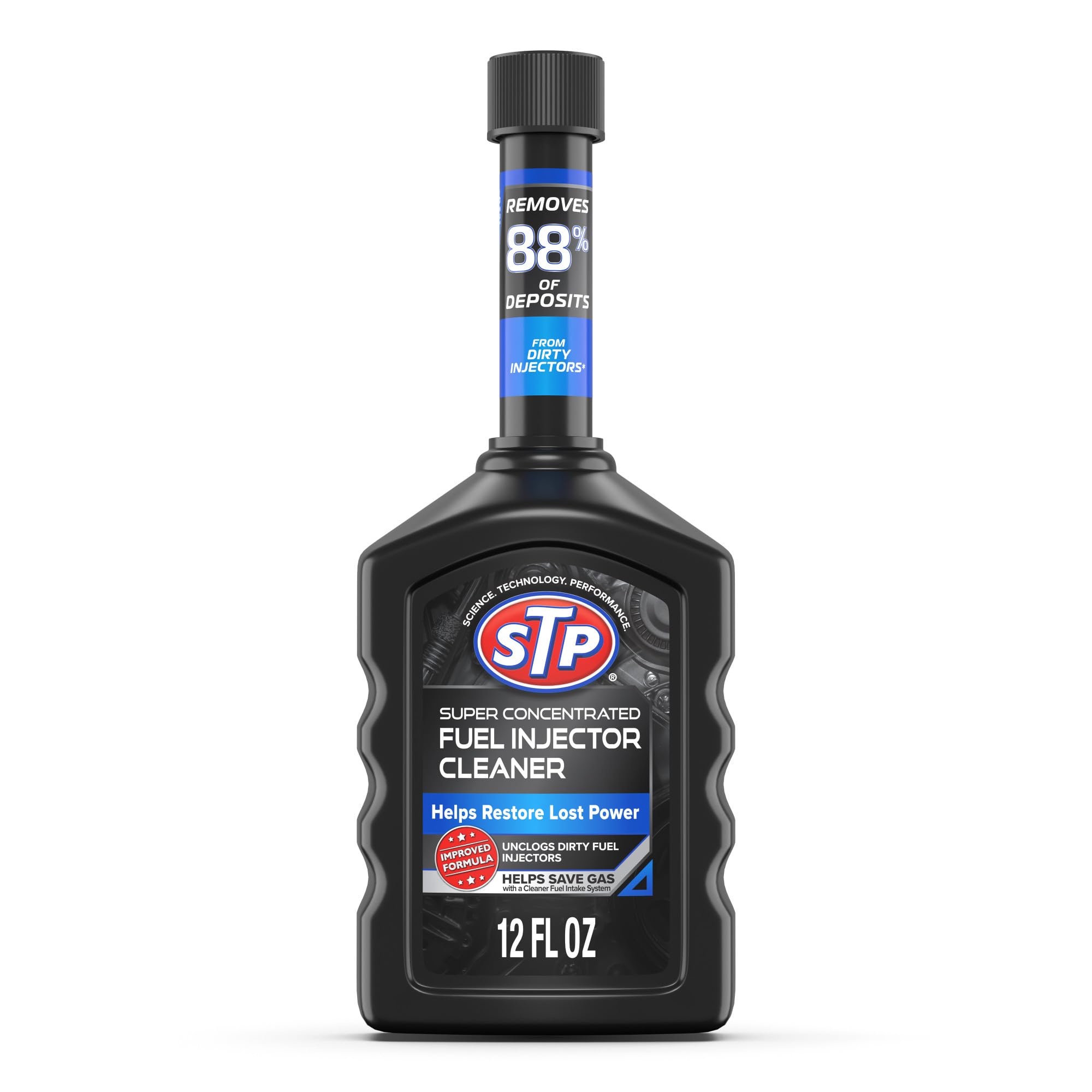
2. STP Super Concentrated Fuel Injector Cleaner, 12 Oz
A concentrated injector cleaner built for the driver chasing a check-engine miss, not a full teardown.
If your complaint is a rough idle or a cold-start stumble, start here. This STP bottle is formulated to unclog dirty fuel injectors and restore lost power, and it is safe for all gasoline engines. It uses jet fuel as the carrier, which is the medium that carries the active cleaning ingredients into the injectors.
Owners describe a fast turnaround on real symptoms. One driver with a three-year-old Chevrolet Colorado had a slight cold miss and reports: “After using 1/4 of a tank the miss has stopped and my Chevy runs like new again.” Another owner with a 2007 Yukon had a bad idle that a mechanic chalked up to bad gas or buildup — after a couple of days the rough idle was gone and it smoothed out at stoplights. Mileage gains show up too, with a short-trip driver climbing from 33 to 39 MPG after a dealer engine cleaning and this bottle.
The honest read: this is a targeted injector fix, not a full-system carbon treatment like the Quickleen above, and it does not touch octane. For an old, high-mileage engine with gum everywhere, you may want a broader cleaner. But for the specific “it misses when cold” complaint, it is the least expensive way to see if a dirty injector is the cause. Rated 4.5+ stars across 600+ ratings.
What it handles best: dirty injectors and the hesitation, rough idle and power loss that come with them.
The trade-off: it is not an octane booster and not a full carbon sweep, so pair it with a broader cleaner if your engine has never been treated.
Your move if: a cold miss or shaky idle has you suspecting clogged injectors.
Not for: pinging under load, which is an octane problem, not a deposit one.
3. Mercury 8M0047931 Quickleen Engine & Fuel System Cleaner
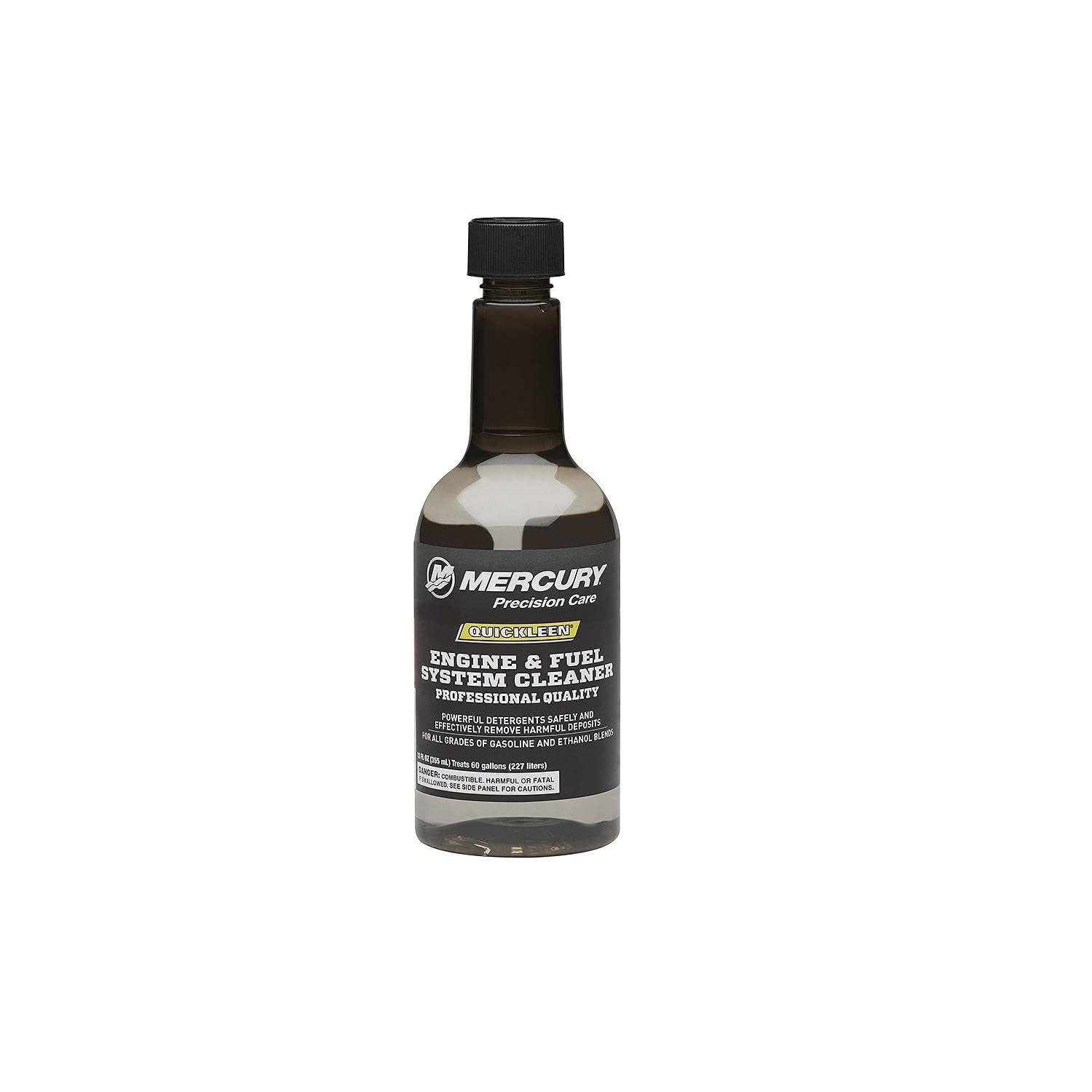
Outboard owners get a cleaner tuned for carbs and fuel systems that sit through long off-seasons.
Marine engines live a harder fuel life than cars — they sit, they see ethanol, and their carb jets clog. This Mercury bottle is built for that, removing carbon deposits from carburetors, injectors, intake valves, spark plugs, piston crowns and cylinder heads, and preventing knocking and piston seize-up. It is a vehicle-specific fit listed for watercraft.
The formula is gentle on parts and simple to dose: use it occasionally through the season at 1 ounce per 5 gallons. It does not contain fuel stabilizers, and Mercury points you to its Quickare product for preventing fuel breakdown and oxidation during storage — worth knowing if your boat sits between trips. Owners who run it after a carburetor jet clogs report the outboard running better than ever, and the review pages carry the pattern for motorcycle carbs too: “it cleaned up the carb no it runs smoother and better good quality product so good I have bought 5 since my first one I bought.”
Compare it to the car-focused Quickleen above — same core carbon-cleaning mission, but this one is the marine-labeled version backed by Mercury’s OEM spec and a 1 Year warranty. If you keep an outboard, an inboard or a small engine that lives outdoors, the fit line and warranty make this the sensible match. If you only run a road car, the car bottle is the better target. Rated 4.5+ stars across 800+ ratings.
Built for the water: specified for watercraft and dosed at 1 ounce per 5 gallons for occasional season-long use.
The catch: no stabilizer inside, so stored fuel still needs a separate treatment.
Suit an outboard owner: a Mercury-spec cleaner for carbs and fuel systems that sit through winter.
Skip for a daily driver: the car-focused picks above fit road engines better.
4. Liqui Moly Jectron Gasoline Fuel Injection Cleaner 2-Pack

A two-bottle German injection cleaner aimed squarely at smoother idle and sharper throttle.
What this bottle promises reads like a wish list for a tired engine: lower fuel consumption, cleaner combustion, smoother idling and better throttle response. It comes as a 2-pack, so you can treat, drive, and treat again — the second bottle is what convinces a lot of owners who want a repeat dose rather than a one-shot.
Owners see the difference in how the engine feels underfoot. A truck owner who ran two bottles on separate occasions reports mileage going up and the truck running smoother with a little more power. Another describes a Can-Am Spyder that was missing and acting like it was running out of gas — a bottle in, a couple of miles driven, and it ran good again. Starting issues clear up too, which is the everyday win: turn the key and it fires instead of cranking.
Worth sizing the honest limits. On a four-cylinder turbo engine, one owner found it lifts the lifters only a little — “not as much as I would like.” That is a reminder this is a maintenance cleaner, not a rebuild. The two-bottle format is the reason it sits above the single-bottle cleaners: for the same rough-idle complaint, you get a second treatment to confirm or deepen the result. Rated 4.5+ stars across 700+ ratings.
The wins owners feel
- Smoother idling and better throttle response are the headline benefits
- Two bottles let you treat, then treat again
- Clears starting issues and sluggish running
- Lower fuel consumption is the design aim
Set your expectations here
- On a four-cylinder turbo, the lift it gives is modest
- It is a maintenance cleaner, not a cure for worn internals
Choose this if: a sluggish, hard-starting engine needs two rounds of injection cleaning.
Look elsewhere if: you are chasing a catalytic converter code — this will not touch it.
5. MotorPower Care Catalytic Converter Cleaner 2-Pack

The bottle for a P0420 or P0430 code you would rather clean than pay to replace a converter.
This is a different animal from the injector cleaners. It targets the catalytic converter, O2 sensor and EGR path, designed to clear the emissions codes that light the check engine lamp. It works with gasoline and hybrid vehicles. The two 8.45 fl oz cans give you a second shot if the first does not fully clear the code.
The method matters here, and owners swear by a specific routine: run the tank down to a quarter, add a can, drive 20 to 30 miles, then refill. Reports of success follow it. One Honda CR-V owner had a converter code after a PCV valve replacement, and it cleared about a third through the first bottle. A Ridgeline owner at 140k miles found the first can did nothing but the second cleared it. Others see the light go out, come back, then clear again over a few weeks of driving — patience is part of the process.
Read the warning closely before you buy: this cleans, and it will not repair a cracked, broken or melted converter. If your converter is physically damaged, no bottle fixes it, and the honest expectation is that this helps a fouled-but-intact converter, not a dead one. Rated 4.0+ stars across 1,000+ ratings.
What it is for: fouled but intact converters throwing P0420 or P0430 codes, on gas or hybrid vehicles.
The hard limit: a cracked or melted converter needs replacing, and no additive changes that.
Try it first if: a converter code has you facing a big repair quote and the converter is otherwise sound.
Do not expect it to fix: physical converter damage or a dead O2 sensor.
6. BG 44K Fuel System Cleaner 2-Pack, 11 Oz Cans

The shop-grade can that cleans injectors, valves and combustion chambers in one dose.
The number that defines BG 44K is 20 — one 11 oz can treats up to 20 gallons of gasoline, which covers a full tank on most cars and trucks. It cleans fuel injectors, valves and combustion chambers, which is the whole top end of the fuel path, not just the nozzles. It has been a professional shop staple for over 40 years and is formulated for gasoline engines only.
Owners compare it to the cheaper off-the-shelf bottles and come away convinced. A skeptical owner with a 2019 Tundra at 50k miles had a rough idle from generic gas — after half a tank and this can run near-empty, the idle smoothed, throttle response sharpened and mileage climbed about 1 mpg. A long-haul truck driver with over two million miles behind the wheel calls it expensive but well worth it after a local mechanic recommended it. Another owner says it cleared a check engine light that had been on for quite some time and cleaned sludge out of the parts.
The catch is the cost per dose — it sits at the top of the price range here, and you get two cans. But when you factor in the 20-gallon treatment, a can goes a long way. Against the single-bottle injector cleaners above, this is the deeper clean for a vehicle that has gone years without treatment. Rated 4.5+ stars across 900+ ratings.
Why pros reach for it: one 11 oz can treats up to 20 gallons and cleans injectors, valves and combustion chambers together.
What to weigh: it is one of the pricier bottles per can, so it suits a vehicle doing a serious catch-up clean rather than routine topping.
The deep-clean choice if: your truck has run years of generic fuel and idle quality has slipped.
Overkill for: a lightly used car already on a steady additive routine.
7. STP Octane Booster, 5.25 Fl Oz, Pack of 12

Twelve little bottles that lift pump gas toward premium — without paying premium prices.
When an engine pings under load on regular gas, the problem is octane, not deposits. This STP booster uses MMT plus synthetic technology to raise octane levels and reduce the knocking and pinging that combustion chamber deposits cause. It also cleans the fuel intake system for smoother acceleration, and it works with cap-less gas systems as well as standard ones.
Each 5.25 fl oz bottle treats up to 15 gallons of gasoline, and you get a 12-pack — enough for a full season of treatment if you add one before each fill. Owners notice it within the first 20 miles. A driver in an AWD Sienna running 87 octane reports seeing 1-2 mpg increases using this each tank. A turbo Mazda 3 owner calls it the most effective booster for the money, saying it prevents timing pull and restores boost when the 93 octane available is subpar.
The honest sizing on this one: it is an octane tool, so it does not replace a carbon-cleaning injector treatment — think of it as the fuel-quality fix for a high-compression or turbo engine, not the deep clean a tired motor needs. Twelve small bottles also mean careful storage so they do not leak in a hot trunk. Rated 4.5+ stars across 700+ ratings.
Where the booster shines
- Raise octane to cut knocking and pinging on regular gas
- One bottle treats up to 15 gallons
- Works with cap-less gas systems
- Owners see 1-2 mpg gains and stronger throttle response
Keep it in its lane
- It is an octane fix, not a full carbon cleaner
- Twelve small bottles need careful storage
Pick it up if: a turbo or high-compression engine pings on regular and you want premium behavior without premium pumps.
Better with a cleaner if: your issue is idle quality rather than knock.
Know the Specs
Dose Ratio
Dose ratio is how much fuel one measure of additive treats. Quicksilver Quickleen runs 1 ounce per 5 gallons, STP Octane Booster covers up to 15 gallons per bottle, and BG 44K treats up to 20 gallons per can. Match the ratio to your tank — a bottle that treats a large tank can be under-dosed in a big SUV if you do not watch the gallons.
Injector vs. Octane Cleaner
An injector cleaner dissolves carbon and gum from the fuel nozzles and intake path, which fixes rough idle and hesitation. An octane booster raises the fuel’s knock resistance, which quells pinging under load. Likewise a converter cleaner targets the emissions codes a fouled converter throws. Buy by the symptom you actually have — an octane booster will not fix a clogged injector, and an injector cleaner will not stop knock.
Common Questions
Is a gasoline additive safe to use in every fill-up?
Will an octane booster fix rough idling and hesitation?
Can a converter cleaner repair a cracked or melted catalytic converter?
How long does it take to notice a difference after adding a cleaner?
Do these additives work with ethanol-blend fuel?
Is a full-tank treatment like BG 44K worth it over a cheaper bottle?
Will these additives help me pass an emissions test?
Can I mix an injector cleaner and an octane booster in the same tank?
Do any of these bottles include a fuel stabilizer for storage?
The Bottom Line
For most drivers, the best gasoline additive here is the Quicksilver Quickleen because it cleans carbon from injectors, valves, spark plugs and piston crowns across the whole path, and its 1 ounce per 5 gallons dose makes routine use easy. If your complaint is a cold-start miss, the budget-friendly STP Super Concentrated Injector Cleaner is the sharpest tool. And when a converter code has you facing a big repair, the MotorPower Care Catalytic Converter Cleaner is worth a try before you replace the part — it cleans but cannot repair a damaged converter. Add one before your next fill and watch idle quality and throttle response over the following tank.
How we choose
We do not accept paid placement. Every pick is matched to a real buyer and a real use-case; we do not hands-on test units.
Sources
Specifications: manufacturer listings and product documentation. Review insights: verified customer reviews, as of October 2026. Pricing: not shown on this page (it changes often); check the current price via the retailer link.
As an Amazon Associate, Aappliancez earns from qualifying purchases. This does not affect which products we feature.