Disclosure: Some links in this post are affiliate links. As an Amazon Associate I earn from qualifying purchases, at no extra cost to you. Learn more
Specs are compiled from manufacturer listings and verified buyer reviews and can change over time — please confirm the key details on the product page before buying.
One powerhead that trims the fence line, edges the driveway, shaves the hedge and clears brush saves you from buying four separate machines. But a gas string trimmer with attachments only pays off if the engine starts on the second pull, the attachments click on in seconds, and the whole thing doesn’t wear your arms out by the third pass. Below are the seven most relevant attachment-capable gas trimmers, sorted by what actually matters in daily use, so you can pick the right one in a couple of minutes.
This guide is built by comparing the manufacturers’ published specifications and the patterns across verified customer reviews, so you get each pick’s real strengths and trade-offs instead of marketing spin.
Most buyers get tripped up by two things: how much the tool weighs at full stretch, and whether the engine is a 2-cycle that needs oil mixed into the fuel or a 4-cycle that takes straight gas. Below, you’ll find the honest trade-off on each pick, plus a plain-English explainer on what all those cc and rpm numbers really mean. Every pick below is judged on engine, weight and attachment system, so you can match one to your yard.
Top Picks
How To Choose The Best Gas String Trimmer With Attachments
Buying an attachment-capable trimmer is really a decision about the engine, not the attachments. The powerhead is the part you keep for years; the heads are extras you can add later. Answer these four questions about your own yard and the choice gets much simpler.
Does your yard really need attachments?
If you have a fence line to trim, a driveway edge to cut and a hedge that needs a pass every few weeks, one powerhead with a detachable shaft saves you storing three machines. If you only ever trim grass, a plain straight-shaft trimmer will do the job with less weight in your hands. A multi-tool only pays off if you’ll actually swap heads for edging and hedging, not just trim grass.
2-cycle or 4-cycle: the fuel habit you are signing up for
A 2-cycle engine burns a mix of gas and oil, so you measure oil into the can before every fill. A 4-cycle engine runs on plain gas with no mixing, which is why models like the Troy-Bilt TB304S make “never mix gas & oil” their headline. The trade-off is maintenance: the 2-cycle side tends to be simpler to repair and lighter for the power.
Cutting width changes how many passes you take
Swath is the width of grass the head clears in one pass. A 17-inch swath is the common homeowner figure on these picks, and it cuts a lawn in tidy laps. A wider 20-inch swath covers more ground per walk but needs enough engine behind it to keep the revs up in thick growth. Pick a 17-inch swath for ordinary lawn grass and a 20-inch swath only if the engine can hold revs in thick growth.
Side-by-Side Comparison
| Model | Best For | Engine | Cutting Width | Weight | Amazon |
|---|---|---|---|---|---|
| ECHO PAS-225VP★ Best Overall | One engine, three tools | 21.2 cc gas PAS | 17 inches | 16.2 pounds | Amazon |
| Wild Badger Power WB26MTSEBest Value Kit | Four blades on a budget | 26cc 2-cycle | 17 inches | 23.9 pounds | Amazon |
| Husqvarna 122LK | Easy starts, lighter frame | 22cc 2-cycle | 17 inches | 10.6 pounds | Amazon |
| PRORUN PPCK2 | Four-in-one value kit | 25.4cc 2-cycle | 15 inches | 24 pounds | Amazon |
| Troy-Bilt TB304S | No-mix fueling | 30cc 4-cycle | 17 inches | 15 pounds | Amazon |
| Husqvarna 330LK | Wide 20-inch swath | Gas, Rapid Replace head | 20 inches | 12.9 pounds | Amazon |
| Echo SRM-2620T | Heavy-growth torque | 25.4cc high-torque | — | 5.9 kg | Amazon |
Detailed Reviews
1. ECHO 17 in. 21.2 cc Gas PAS Trimmer and Edger Kit-PAS-225VP
Our pick — 4.5+★ from 300+ verified ratings; the strongest balance of quality and price.
One powerhead, a trimmer and an edger in the box — and owners keep coming back to how well it simply works.
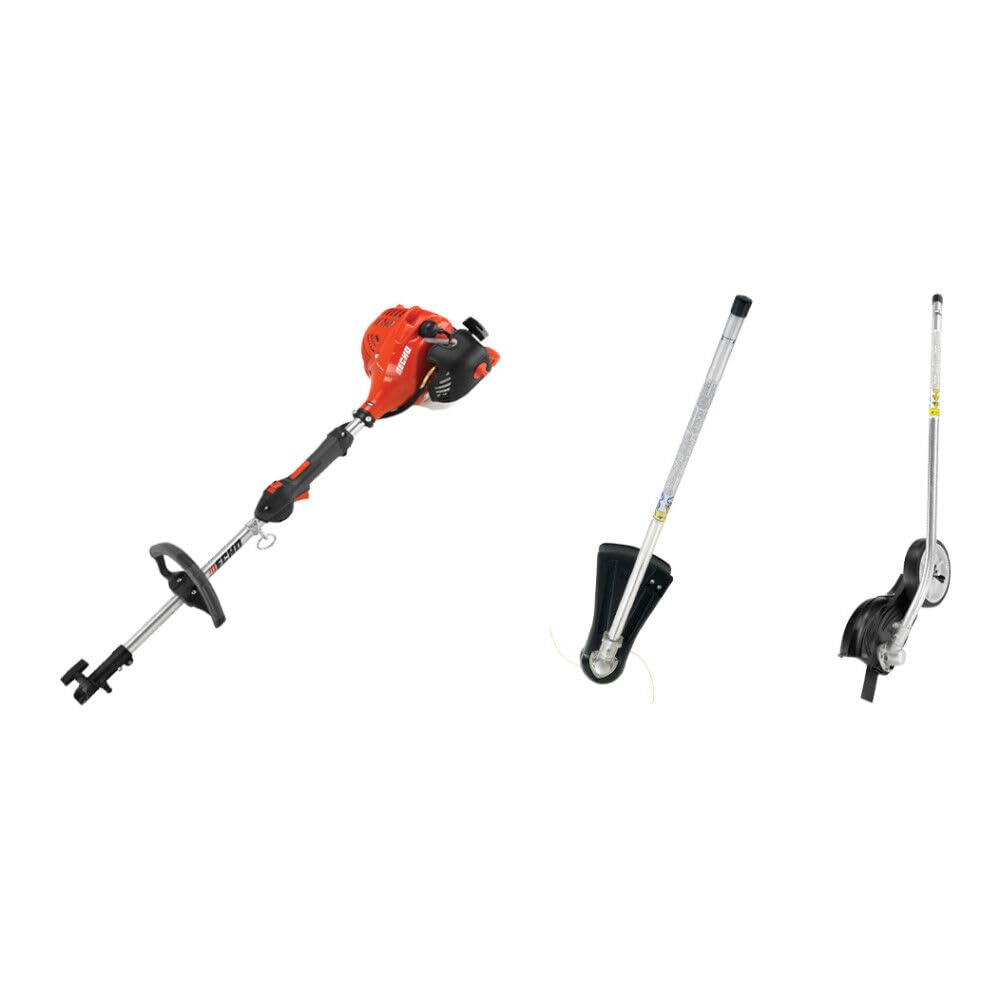
This is the pick for the homeowner with a real yard — a few thousand square feet of fence line, walkway edges and beds — who wants one engine to do the trimming and the edging. The ECHO PAS-225VP runs a 21.2 cc gas engine on a detachable straight shaft, with a 17-inch cutting width. That swath is the width of grass the head clears per pass, so a normal suburban lawn goes quickly. The kit ships with the string trimmer head and the edger attachment together, which is the whole appeal: you buy the powerhead once and swap heads as the job changes.
This engine earns its spot on outright function. The trimmer head and edger head both click onto the shaft, and the edger cuts through thick, built-up grass at the curb rather than skimming it. An experienced two-stroke owner who has run Stihl and Echo gear called the combo good value next to buying the powerhead on its own. That owner noted it is ample for homeowner weed-eating, edging and hedging — though underpowered for heavy brushcutting or a pole saw. That is a fair ceiling: this is a homeowner tool, not a land-clearing rig. Assembly is straightforward and the engine fires on the first pull when fueled right, as one buyer put it: “Easy set up. Start on first pull.”
The honest catch is ergonomics and weight. At 16.2 pounds it is a substantial machine to carry along a long edge, and the edging stance — stepping near sideways as you walk the blade — takes a pass or two to get used to. A few owners also note the edger throws dirt back onto their feet despite the rubber flaps. This trimmer also stands a couple of inches shorter in overall length than the Wild Badger at 54″L versus 69″L, so it stows a little more easily in a shed. On a small flat yard the 16.2-pound carry is fine; on a long sloped driveway you’ll feel it by the third pass.
What owners keep praising
- Function and performance are the two things the review pages agree on — the trimmer and edger both do their job without drama
- Trimmer and edger ship together, so one purchase covers two tasks
- Fires reliably and assembles with clear instructions
- Handles thick built-up grass at the edger that stops weaker electrics
Where it asks more of you
- 16.2 pounds is real weight at the end of a long edge
- The edging stance is awkward and flings debris near your feet
- The hedge trimmer attachment is sold separately and owners balk at the cost
Reach for this if: you want a proven two-tool setup from one engine and your trimming is homeowner-scale rather than brush-clearing.
Look elsewhere if: the ergonomics of edging or the 16.2-pound carry will wear you down on a big property.
2. Wild Badger Power 26cc Gas Weed Wacker
Four cutting heads in one box — trimmer, wheeled edger, hedge trimmer and brush blade — on a 26cc engine.
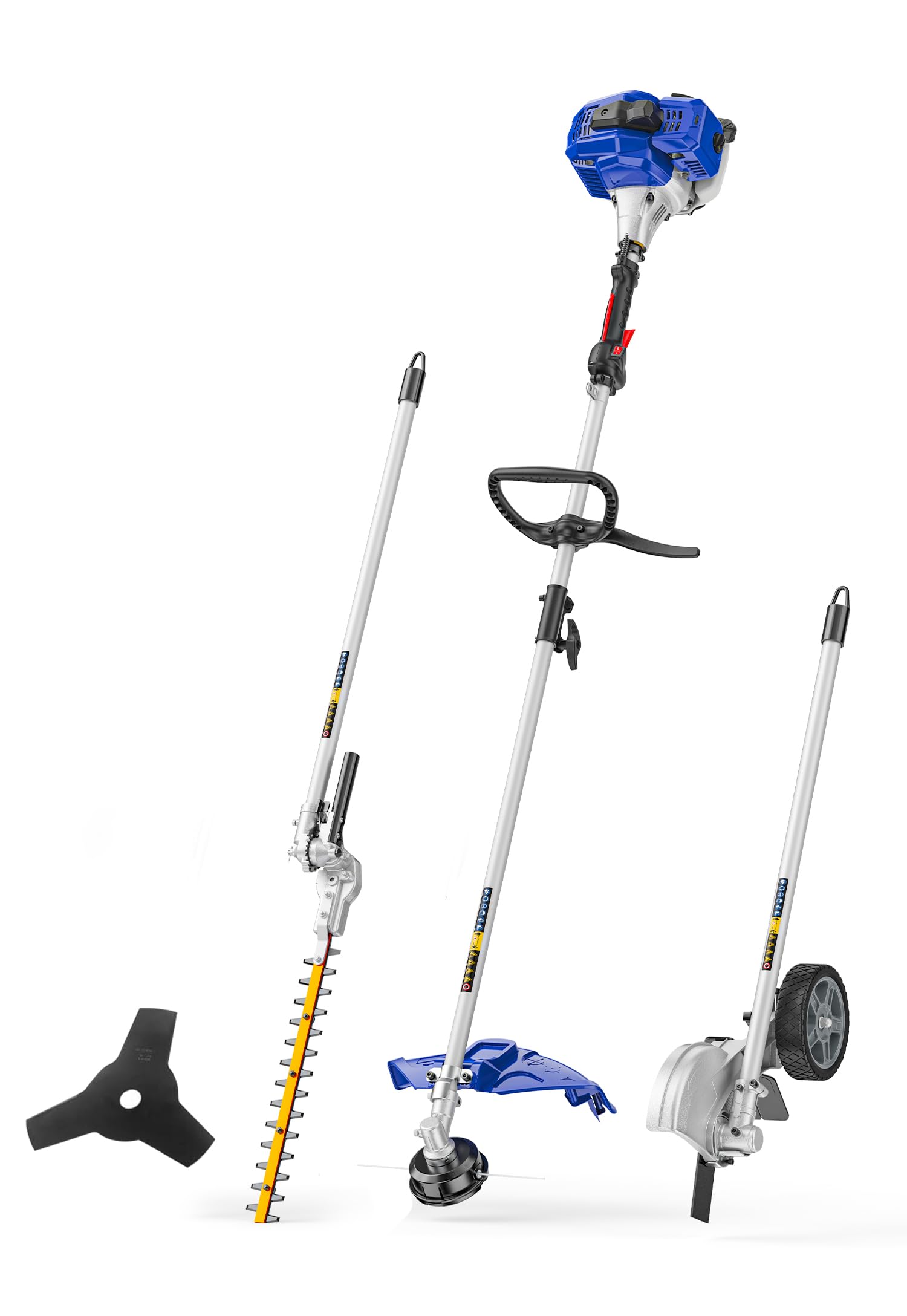
For a big, messy property that needs everything done, this is the kit that hands you the whole toolbox up front. The Wild Badger WB26MTSE centers on a 26cc 2-cycle full-crank engine — a two-stroke that needs oil mixed into the gas can — and drives a 17-inch string trimmer head. In the same box: a 9-inch wheeled-edger blade for crisp borders, a 16-inch hedge trimmer and a 10-inch brush-cutter blade for heavier growth. The quick-change collar lets you pull one head and clip on the next in seconds, so you are not stopping to hunt for a wrench between tasks.
That quick swap is the reason to consider it. Started on the second pull, the trimmer head has strong cutting power, and the hedge trimmer’s angle adjusts on two levers so you can work it along a pole rather than overhead — noticeably kinder on your back. Assembly has a trick worth knowing: attach the pole to the powerhead first, then the attachment, and snug the allen screw fully without cranking it. Most of the routine trimming is done at partial throttle; save full throttle for heavy weeds. The engine drinks 87 octane, and owners often plan for ethanol-free 50:1 mix to keep it running clean.
Now the reality check, and it is a big one: at 23.9 pounds this machine is heavy — compare that to the Husqvarna 122LK at 10.6 pounds and you feel the difference in your shoulders. The reliability story is more mixed than the feature list suggests. Some units run great for a season; others stop after a couple of minutes. The recurring friction point is the fuel system — the filter and pickup can get stuck when you flip the tank to rewind line. Badger’s support has a solid reputation for sending replacement tanks, lines and carburetors, but this is a tool that rewards a bit of mechanical patience. Buy the Echo PAS-225VP if you want two heads that just work; buy this if four heads at a lower price outweigh fuel-line fiddling.
The four-head math: one powerhead covering trimming, edging, hedging and brush work is genuinely convenient, and the 3-year homeowner warranty is real coverage backing it.
What you trade: weight and reliability variance — a 23.9-pound frame plus a fuel system that occasionally needs attention. It suits the hands-on owner, not the plug-and-play one.
Suits the tinkerer: a big property, four tasks, and a homeowner comfortable with a little fuel-line maintenance.
Sidestep it if: easy starts and light weight top your wish list more than attachment count.
3. Husqvarna 122LK Grass Trimmer

At 10.6 pounds this is the trimmer you can carry all afternoon — straight shaft, SmartStart, attachments that click on.
If arm fatigue is the reason you are shopping, start here. The Husqvarna 122LK weighs 10.6 pounds running a 22cc 2-cycle engine, which makes it the lightest full attachment-capable trimmer in this group by a wide margin — compare it to the Wild Badger at 23.9 pounds and the difference is not subtle. The straight shaft reaches under shrubs and around fence posts, and the 17-inch cutting width matches the rest of the class. It is built for occasional homeowner use, not daily professional work, and the 2-year consumer warranty reflects that.
The starting story is the standout. The 122LK uses Husqvarna’s SmartStart system, which uses a decompression valve to reduce the effort of the pull cord — an engineering touch that pays off when you’re restarting a hot engine mid-job. The trimmer fires on the first or second pull when the fuel mix is right, and restarts warm without fuss. It is also multi-tool compatible, so you can add Husqvarna’s click-on attachments later, and the T25 heavy-duty head handles standard line. The straight shaft makes this efficient at reaching beneath obstacles, and at 70.1″L it lays out long enough for comfortable reach. Fuel mileage lands around 45-60 minutes of running per tank, which is a full trimming session for most yards.
Here is the part that needs saying plainly: quality and reliability are the most-discussed topics on this trimmer, and the verdict is split. Some units run like a champion; others bog down in heavy weeds and want short, patient swipes to let the motor rev. A few buyers report hard starts that get worse when hot, and some find the fuel tank runs small for a big job. It is loud enough to require ear protection, and it vibrates like any 2-cycle.
Comfort leader: 10.6 pounds and a straight shaft make long sessions easier on the arms, and SmartStart reduces the pull effort.
The split you should weigh: mixed reliability reports mean this favors occasional use over hard commercial work, and the small fuel tank means more refills.
Best for: the occasional user who values a light frame and an engine that restarts warm without drama.
Think twice if: your yard has heavy, overgrown weeds that want sustained full-throttle cutting.
4. PRORUN PPCK2 Combo Unit
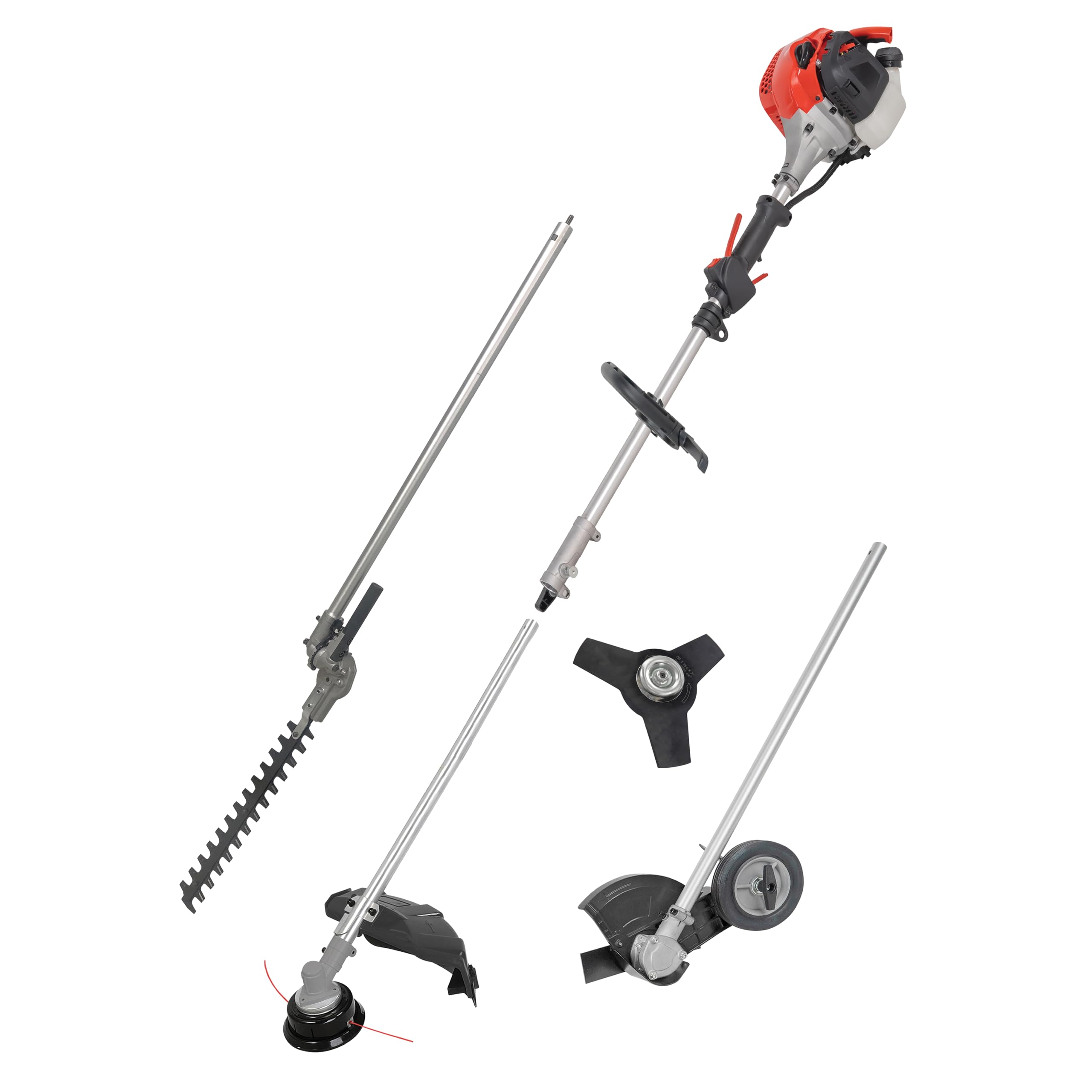
A 25.4cc powerhead that ships with edger, trimmer, brush cutter and hedge trimmer heads — and swaps them in seconds.
The PRORUN PPCK2 is the four-job answer for a weekend project yard. Its 25.4cc 2-cycle engine spins up to 7000 rpm — a measure of how fast the head rotates, so the line whips through grass rather than pushing it over. The kit includes an edger, a string trimmer, a brush cutter and a hedge trimmer, and the quick-connect collar lets you change heads without tools. A 15-inch cutting width keeps the head compact for getting into tight spots, and an adjustable pole plus ergonomic handles let you match the shaft to your height for reaching edges and tall shrubs.
What it does best is handle a variety of weekend jobs from one engine. The bush trimmer has been put to work on Japanese yew with good results, and the edger cleans up a driveway edge cleanly. The pieces interchange easily, and the whole unit is built with heavy-duty construction meant to take regular use, backed by a limited 3-year residential warranty (1-year commercial). Coming off a dedicated brand like Echo, the trade-off is weight and a little grunt: it feels heavier than a comparable single-purpose trimmer and can run low on power for its size, which is why some owners plan to tune the carburetor.
Two honest limits stand out. First, it is heavy — around 24 pounds — and a shoulder harness makes a real difference if you’ll be at full extension. Second, a small minority of units have starting trouble from the outset, and heavy attachments like the hedge trimmer can be a stretch for the engine; one owner had a starting problem after using the hedge head. The satisfaction is mixed for that reason, and this is a value-priced combo rather than a premium one. If the four tools you would otherwise buy separately are the attraction, this kit still undercuts that path. Read the instruction sheet on how the parts change before the first job, and you avoid most of the frustration.
What lands well
- Four attachments — edger, trimmer, brush cutter, hedge trimmer — in one package
- Quick tool-free swaps between heads
- 7000 rpm head speed handles overgrown edges
- Limited 3-year residential warranty
What to weigh
- Around 24 pounds at full stretch; a harness helps
- Power can feel low for its size on the heaviest tasks
- A few units have out-of-box starting trouble
Good fit for: the homeowner who wants four tasks covered by one purchase and doesn’t mind a heavier frame.
Weigh before buying: the hedge trimmer asks a lot of this engine, so heavy shrub work may be its weak spot.
5. Troy-Bilt TB304S Gas String Trimmer

A 4-cycle engine that takes straight gas — no oil, no mixing, no measuring at the can.
The Troy-Bilt TB304S is the pick for anyone who has ever ruined a 2-cycle engine by eyeballing the oil mix. It runs a 4-cycle engine, described in the listing as a 30cc unit (the headline says 17cc, so check what’s stamped on the engine you receive) that takes plain gasoline straight from the pump. That means cleaner running and less noise than a two-stroke, plus no mixing of gas and oil at every fill. Its 17-inch cutting width matches the class, and the straight shaft reaches under shrubs and around fence posts. SpringAssist technology eases the pull cord so starting takes less yank, and the whole machine weighs 15 pounds.
Owners who run it find it starts right up with plenty of power to take down weeds, and the machine is widely described as well built and dependable. It’s a common choice for people who want one trimmer they can trust season after season without the small-engine ritual of a two-stroke. The 4-cycle advantage is the whole point: no more mixing, no more guessing, just gas in the tank and a pull of the cord. If you edge and trim around a house with a modest yard, that simplicity alone makes it worth a close look.
The honest friction point shows in the reviews: quality and reliability are the most-discussed aspects, and opinion is split — some units run beautifully, others report trouble staying running. That’s not unique to Troy-Bilt, but it’s the thing to weigh. The other quibble is the guard: it’s a 1/4-round shape that digs in on the straight side rather than covering a full 180 degrees, which leaves a bit more throw-back. Neither is a dealbreaker for the average homeowner; both are worth knowing. Shortlist this if you want straight gas with no oil mixing and can live with split reliability reports.
Why the 4-cycle wins: no fuel mixing at every fill, quieter running, and SpringAssist cuts the pull effort — a genuine daily-use difference.
What to expect: mixed reliability reports and a partial guard that lets more clippings fly. Test the engine early and keep the receipt close.
Made for: the homeowner who wants straight gas in the tank and a lighter 15-pound frame.
Skip if: you expect pro-grade durability in the heaviest weeds — this sits at homeowner tier.
6. Husqvarna 330LK Gas String Trimmer

A 20-inch swath for big lawns, with a head you reload by twisting rather than threading.
For large properties and long fence lines, the Husqvarna 330LK puts a 20-inch cutting width on the end of a straight shaft — the widest swath in this group, and one that cuts a big lawn in fewer laps. You can dial it back to 18 inches when you want maximum power in thicker vegetation, so the same trimmer covers open grass and tougher growth. It weighs 12.9 pounds, which sits in the comfortable middle of the class and keeps it manageable for long sessions. The detachable shaft accepts Husqvarna’s wide range of click-on attachments sold separately, so it grows with your to-do list.
The starting and handling package is where the 330LK earns its keep. A spring-assisted start system reduces the pull effort, and the air purge clears air from the carburetor and fuel lines for a quicker cold start, with an automatic stop switch. LowVib anti-vibration technology cuts the shake that numbs your hands after a while — a real difference on a big trim. The Rapid Replace head spins counter-clockwise and reloads by aligning, loading and twisting the string instead of winding it by hand. Buyers who moved up from battery trimmers notice the extra power on odd-angle growth along a bank.
Durability is the concern that shows up most in the reviews. A few units have failed after roughly a month of use, and one commercial user found a repair bill after a quick breakdown — that’s a real risk for daily landscaping work. There are also gripes about the trimmer head’s bump feed being inconsistent on stock, and owners who replace the head find the machine works well after. One fair caveat: some find the attachment collar on the shaft loosens and needs re-tightening, which makes the head tip sideways mid-cut. Treated as a homeowner tool and broken in gently, it does the job; pushed hard commercially, it’s a gamble.
Strengths worth noting
- 20-inch swath, adjustable to 18 inches for thick growth
- LowVib anti-vibration keeps the hands comfortable longer
- Rapid Replace head reloads by align, load, twist
- Air purge and spring-assist start ease cold starts
The honest concerns
- Durability reports are the weak spot — a few units fail early
- Stock bump-feed head is inconsistent; many swap it out
- The attachment collar can loosen and turn the head sideways
Right for: big lawns and long fence lines where a 20-inch swath and a comfortable grip save real time.
Not for: commercial crews who need a trimmer to survive daily abuse — this one is happiest at home.
7. Echo SRM-2620T Line Trimmer

Genuine Echo pro-level torque — the “T” means a lower gear ratio that plows through woody stalks.
When the growth on your property has gone past grass and into real brush, this is the trimmer built for it. The Echo SRM-2620T runs a 25.4cc engine (5.9 kg on the scale) with a “T” designation that means a lower gear ratio — more turning force at the head, so the line keeps cutting through thick stems instead of stalling on them. It spins at 6000 rpm and comes with a Speed Feed quick-feed cutting head for reloading line without tearing the head apart. It’s the heavier-duty sibling of the PAS-225VP up top: where that one is homeowner-scale, this one is pro tier.
Owners who upgraded to it from a weaker-unit brand describe the difference in how it clears growth. Three-foot weeds with woody stalks fall without a struggle, and the torque keeps the head moving when a lighter trimmer would bog. The engine starts immediately and stays durable — the reviews agree the build quality and the power are the two things this machine does well. It replaces older pro-model trimmers that ran for years, and for someone stepping up from a consumer unit, that longevity track record is the draw.
What you give up for the torque is weight and a couple of quirks. At 5.9 kg it is a hefty tool to swing along a long fence line, so plan to use the loop handle and take breaks. It’s not attachment-capable in the multi-tool sense of the others in this guide — this is a dedicated trimmer, not a powerhead that takes an edger or hedge head. It’s also the priciest of the group. But if heavy brush is your regular reality and you want one machine that simply outmuscles the weeds, this is the one that does it. The trade is clear: you pay for pro torque, not for a kit of extras.
The torque payoff: a 25.4cc high-torque engine and 6000 rpm head spin clear woody, 3-foot growth that stops lighter trimmers — the reviews agree on build quality and power.
The trade: it’s a dedicated trimmer with no attachment system, and 5.9 kg gets tiring on a big property. This is the pro-grade choice, not the do-everything kit.
Choose it for: heavy brush and woody growth where torque beats versatility every time.
Pass if: you need one powerhead to switch to an edger or hedge trimmer — this one is a single-purpose tool.
Know the Specs
Engine displacement (cc) and 2-cycle vs 4-cycle
Displacement in cubic centimeters tells you the cylinder size and roughly how much pulling power the engine can make in heavy growth. A bigger cc number generally means more grunt in thick weeds, but it also means more weight and more fuel. The bigger decision is 2-cycle versus 4-cycle: a 2-cycle engine needs oil mixed into the gas, so you carry a measuring cup and a mix can; a 4-cycle engine takes straight gas from the pump. For a homeowner who fills up occasionally, the no-mix 4-cycle removes a common mistake. For a pro who wants light, simple, powerful, the 2-cycle is the workhorse.
Cutting width, rpm, and attachment systems
Cutting width is the swath of grass the head clears per pass — 17 inches and 20 inches are the common homeowner figures here, and a wider swath means fewer laps on a big lawn. Head speed (rpm) describes how fast the line spins; a higher spin whips through growth faster, while lower gear ratios trade spin speed for turning force on tough stems. Attachment systems fall into two camps: a quick-connect collar that changes heads in seconds with no tools, and a click-on shaft like Husqvarna’s that accepts sold-separately heads. Choose a quick-connect collar if you swap heads weekly, or a click-on shaft if you add one attachment a season.
Common Questions
Do I have to mix oil into the gas on all of these trimmers?
Can I add attachments later to a trimmer I already own?
How heavy is too heavy for a gas trimmer with attachments?
Will a wider cutting width really save me time?
Why does my trimmer bog down in tall weeds?
Is a 4-cycle trimmer better than a 2-cycle for a homeowner?
How long does a tank of fuel last on these trimmers?
What should I check first if a multi-tool trimmer won’t start?
Do all attachment-capable trimmers use the same attachments?
The Bottom Line
The best gas string trimmer with attachments for most homeowners is the Echo PAS-225VP: a 21.2 cc engine, a trimmer and an edger in one kit, and a function-over-everything reputation that keeps owners coming back. If you’d rather have four heads up front for a big property, the Wild Badger WB26MTSE hands you the whole toolbox in one box. And if your yard is heavy brush rather than grass, the Echo SRM-2620T is the torque you actually need. Buy the cc and cycle type your yard actually demands: 21–26cc 2-cycle for routine trimming, 30cc 4-cycle for no-mix fueling, high-torque for brush.
How we choose
We do not accept paid placement. Every pick is matched to a real buyer and a real use-case; we do not hands-on test units.
Sources
Specifications: manufacturer listings and product documentation. Review insights: verified customer reviews, as of October 2026. Pricing: not shown on this page (it changes often); check the current price via the retailer link.
As an Amazon Associate, Aappliancez earns from qualifying purchases. This does not affect which products we feature.